
Hitler, Germany, and the Jews: Context Is Everything, Part 1
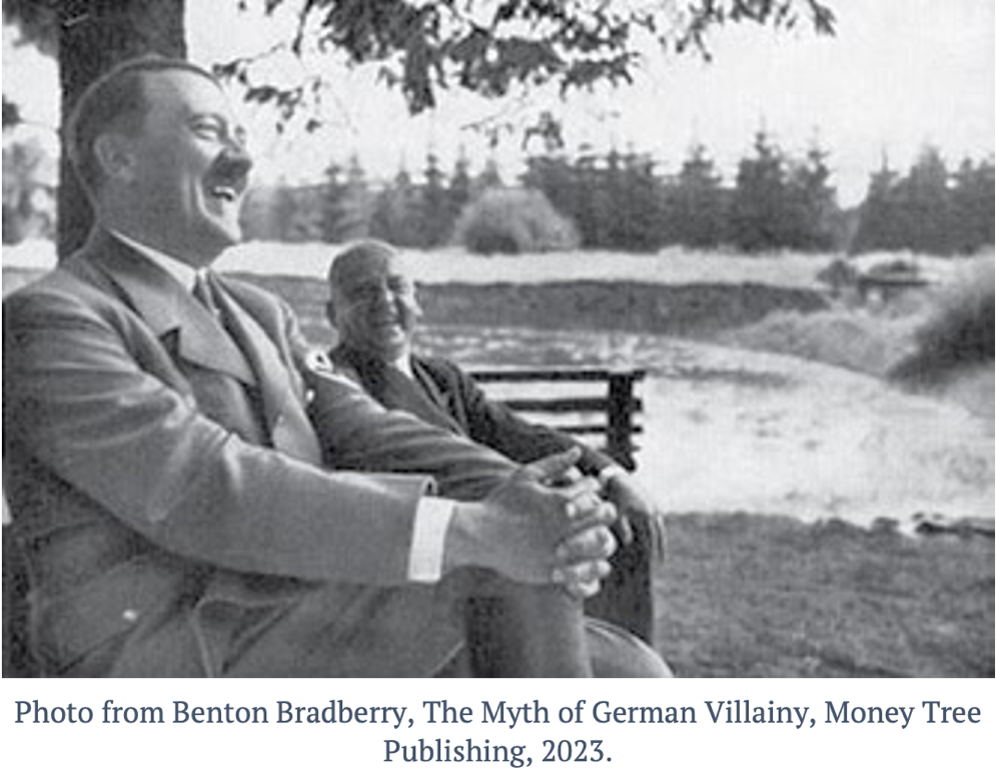
Before getting into the crux of the matter, it’s important to set the stage by first defining an important term that is often neglected when trying to ascertain facts of the past.
Context
Contextualization is a fundamental ethical and scholarly principle in historical analysis. To understand history, one must analyze events within the moral, intellectual, and social framework of the time. This does not mean endorsing past actions, but rather understanding why intelligent, educated people believed them to be correct. Judging the past exclusively by post-war or today’s standards—a fallacy known as presentism—obscures the reality of how pre-war ideas and events evolved.
In other words, you cannot explore the incendiary topic of Hitler and Germany’s anti-Judaism without first putting the epoch in context and examining the circumstances and situation of the Germans at a time when anti-Judaism became the norm.[1] A complete analysis requires balancing intellectual ideas with the historic, economic, and social pressures that allowed these ideas to flourish.
Confirmation bias
Be careful when you consult anti-German or overtly anti-Jewish sources because they are more likely to be biased for understandable reasons as each one will tend to exaggerate or downplay events according to their interests and core beliefs. Ideally, you must explore neutral sources that don’t have an axe to grind, if that is at all possible, because everybody is influenced in one way or another by their cultural background and experiences.
If you use AI to do research and assess your arguments, you will be turned-off at first by the use of post-war rhetoric that is used to downplay an argument or to demonize Nazis. So, you have to train the AI—if it is truly AI and not just a propaganda prop—you are using to exclude post-war rhetoric or conclusions that are obviously made by people hostile to the Germans and Hitler. Command it to stick to facts and to concentrate on the perspective of the Germans up to the end of the war in 1945. It’s unethical to constantly refer to the Nuremberg trials and post-war rhetoric to judge that period. Which is what the mainstream historians cited herein explicitly do. All their assumptions and pre-suppositions are based on the fallacy of presentism.[2]
Western Context
In the context of the late 19th and early 20th centuries, eugenics and racial Darwinism were widely regarded as the cutting edge of progressive science. Leading institutions, universities, and governments in the United States, Great Britain, Scandinavia, and Germany embraced these ideas. They were seen as the logical application of Charles Darwin’s theories to human society—a way to use science to improve the human race, eliminate disease, and reduce social costs.[3]
The purpose of eugenics was to create a superior Nordic race by applying the same principles used to breed cattle and corn. The movement targeted all mankind and eventually spread to Germany where it caught Hitler’s attention. As Jewish author Edwin Black asserts in his book War Against the Weak, “The Nazi principle of Nordic superiority was not hatched in Germany but on Long Island decades earlier, and then actively transplanted to the Third Reich.”[4]
These ideas are the backdrop of anti-Judaism in Hitler’s Germany. They were championed by respected figures such as H.G. Wells, George Bernard Shaw, John Maynard Keynes, Winston Churchill, Alexander Graham Bell, Theodore Roosevelt, Woodrow Wilson, Andrew Carnegie, John D. Rockefeller, E. H. Hariman, and Margaret Sanger. To them, sterilization laws and racial hierarchies were rational, humanitarian policies designed to create a healthier, more efficient society.[5]
United States: By the 1920s, 32 states had enacted forced sterilization laws for the “feeble-minded” and “socially undesirable” resulting in over 60,000 sterilizations. The U.S. Supreme Court upheld these laws in Buck v. Bell (1927), and American eugenicists such as Harry Laughlin and Charles Davenport were honored by German universities for their scientific leadership.[6]
Scandinavia: Sweden, Denmark, Norway, Finland, and Iceland all passed comprehensive sterilization laws between 1923 and 1941, targeting the mentally ill and disabled. These programs were viewed as progressive social hygiene measures based on the best genetic science of the day. [7]
Jewish Context
In the 19th century, anthropology classified the Jews as a race. They described Jews not just as a religious group, but as a distinct biological race or “people” with immutable characteristics. Jewish intellectuals and leaders accepted the “race science” of the day.[8]
The founders of Zionism such as Ze’ev Jabotinsky (1880-1940), Max Nordau (1849-1923), and Arthur Ruppin (1876-1943), for example, explicitly utilized racial theories. They shared an ideological framework rooted in late 19th-century race science, Social Darwinism, and the belief in a distinct Jewish racial identity. [9]
They argued that Jews possessed a unique biological constitution that had degenerated in the Diaspora and could only be “regenerated” or “normalized” through a return to the land and physical labor in Palestine. They prioritized Ashkenazi Europeans and expressed discriminatory views toward non-European Sephardic Jews, whom they considered less capable. [10]
Jabotinsky, Nordau, and Ruppin were key architects of the Zionist settlement, more important than Theodor Herzl, even though Herzl is considered to this day the primary founder and iconic figure of Zionism.[11]
German Context
Global ideas on race, eugenism, genetic determinism, and anti-Judaism were integrated into state policy as Rassenhygiene (racial hygiene). Leading German scientists (e.g., Eugen Fischer, Fritz Lenz, Ernst Rüdin) were internationally respected. Their work on heredity and race was considered cutting-edge biology.[12]
When the National Socialists came to power in 1933, they adopted these existing scientific concepts into a central state principle. The Law for the Prevention of Genetically Diseased Offspring (1933) was explicitly modeled on American laws and supported by the German medical establishment.[13]
High level intellectuals such as philosopher Martin Heidegger, jurist and political theorist Carl Schmitt, theologian Gerhard Kittel, biologist and future Nobel prize winner (1973) Konrad Lorenz were all enthusiastic adepts of the national socialist ideology on eugenics, race, and genetic determinism.[14]
Within this framework, racism was viewed as a biological necessity. Jews and other races were classified as distinct, alien races, whose presence threatened the genetic health of the Volkskörper (national body). This made their exclusion and removal a matter of public health and national survival in the eyes of the regime and its scientific and intellectual supporters. In the Nazi worldview, behavior of these races was irrelevant to their fate.[15]
Shift from Cultural to Racial nationalism
The shift from cultural to racial nationalism in Germany began in the late 19th century and solidified in the early 20th century. It was driven by the völkisch movement, which emerged in the 1880s–1890s and redefined the German Volk (people) not by shared language or culture, but by “blood and soil” (Blut und Boden), an organic, biologically determined community.
Influenced by thinkers like Paul de Lagarde and Houston Stewart Chamberlain, this ideology rejected Enlightenment values and liberalism, viewing other races as biologically alien and threatening to the racial purity of the Volkskörper (national body). The rise of Social Darwinism and eugenics provided a scientific framework, transforming racism from a religious or cultural prejudice into a biological imperative for national survival. This racial worldview became central to Nazi ideology and state policy after 1933.[16]
With the transition from a cultural-nationalist identity to a biological-racial one (völkisch ideology), other races were no longer welcome in Germany and every excuse was made to push them out. As such, this shift in ideology made it impossible for other races to ever be considered “true” Germans again, regardless of their assimilation or patriotism.
Anti-Judaism in European Countries
Several Western countries exhibited significant anti-Judaism during the 1920s and 1930s.
United States
Widespread anti-Judaism included social exclusion, employment discrimination, and quotas in elite universities. Harvard, Yale, and others imposed informal limits on Jewish enrollment (e.g., Harvard’s president proposed a 15% cap in 1922). Henry Ford’s Dearborn Independent propagated the “International Jew” which catalogued Jewish aggressive behavior against White, Christian society. [17]
The United States implemented strict immigration quotas based on national origin, heavily influenced by the eugenics movement. The Immigration Act of 1924 (Johnson-Reed Act) established a quota system that:
- Severely restricted immigration from Southern and Eastern Europe (countries like Italy, as well as Poland, and Russia, where most Jews lived).
- Favored immigrants from Northern and Western Europe where the Nordic race was prevalent (Britain, Germany, Scandinavia).
- Used the 1890 census (when fewer Southern/Eastern Europeans were in the U.S.) to set quotas, effectively reducing Jewish immigration from 190,000 in 1920 to 7,000 in 1926. [18]
Immigration quotas were explicitly supported by eugenicists, who believed in a hierarchy of “superior” and “inferior” races, aiming to preserve a “homogeneous” America. This system remained in place until 1965 when the Hart-Cellar policy on immigration was voted into law and the flooding of the country by Third-World populations initiated.[19]
Poland
The government and far-right National Democrats (Endeks) promoted anti-Judaism. Policies included economic boycotts, restrictions on Jewish businesses and professions, and the implementation of numerus clauses in universities, drastically reducing Jewish enrollment from 25% in 1921 to 8% by 1939.[20]
Romania
Authorities pursued harsh anti-Jewish policies, particularly against Jews in border regions, associating them with Soviet communism. The fascist Iron Guard gained significant support with its platform of removing Jews from power and expelling them.[21]
Britain
While not state-sponsored like in Germany, anti-Judaism existed socially and politically, but the English establishment was thoroughly Judaized.[22]
Germany
While racial anti-Judaism (viewing Jews as a distinct, inferior, and dangerous biological race) became dominant in Nazi Germany, it built upon centuries of other forms of anti-Judaism:
- Religious Anti-Judaism: The origin of intellectual religious anti-Judaism is primarily from a critique of Talmudic law by authors such as Martin Luther in The Jews and Their Lies and Johann Eisenmenger in Judaism Unveiled. Both Martin Luther and Johann Eisenmenger viewed the Talmud as a malicious, anti-Christian corruption of divine law that justified Jewish hostility toward Gentiles. Luther condemned the Talmud as a repository of “idolatry, lies, cursing, and blasphemy,” specifically stating it taught Jews that killing or stealing from non-Jews was a religious duty and that they were superior “masters” while Christians were mere “cattle.” Similarly, Eisenmenger systematically compiled Talmudic passages to argue that Judaism doctrinally mandated deception, the murder of converts, and the testing of poisons on Christians, portraying the text not as holy scripture but as a manual for ethical dualism and a global conspiracy against Christianity. [23]
- Economic Anti-Judaism: During medieval times, Jews were banned from many professional trade associations and Christians were not allowed to charge interest. Hence, few Jews had “normal” professions, but went into trade and finance instead, leading to stereotypes of Jewish greed and control of money.
- Political/Nationalist Anti-Judaism: In the 19th century, Jews were accused of being disloyal citizens and a threat to the nation-state, especially as they gained emancipation and entered politics, academia, and the professions. As it is written in the Talmud and the Shulchan Aruch, Jews are loyal to no nation other than their own. The entire political Antisemitismusstreit in Germany in the 1880s and 1890s centered around the immoral Jewish laws contained in these books.
The Nazi ideology fused these older ideas with modern scientific racism, making Jewishness an inescapable biological condition. These ideas radicalized the rejection of Jews, but the roots were multifaceted. And propaganda was not the major influence on the outcome.[24] It did play a role, but as American maverick Eric Hoffer says,
[t]he truth seems to be that propaganda on its own cannot force its way into unwilling minds; neither can it inculcate something wholly new; nor can it keep people persuaded once they have ceased to believe. It penetrates into minds already open, and rather than instill opinions, it articulates and justifies opinions already present in the minds of its recipients. The gifted propagandist brings to a boil ideas and passions already simmering in the minds of his hearers. He echoes in their innermost feelings. Where opinion is not coerced, people can be made to behave only in what they already “know.”[25]
As such, Joseph Goebbels did not invent racial antisemitism; he amplified it. Indeed, research indicates that indoctrination was particularly effective in regions where antisemitic beliefs were already widespread, suggesting a “confirmation bias” where propaganda intensified latent prejudices rather than creating them from scratch.[26]
Other Targeted Races and Groups in Germany
Jews were not the only ones targeted. From the contemporary perspective of the Nazi state (1933–1945), the focus was also on implementing biological policies on the following races and groups:
Sinti and Roma:
They were categorized as “asocial” and “racially alien,” subject to deportation and sterilization laws similar to Jews. However, as was the case for Jews, the pre-war regime did not describe their removal as “extermination.”
Homosexuals: Homosexuals were not targeted beyond what other nations did to them. Homosexuality was a crime in Germany under certain circumstances, as it was in many countries. It was so until the 1960s. Targeted were pimps, pedophiles, male prostitutes etc., but not homosexuals acting privately.[27]
Jehovah’s Witnesses: Jehovah’s Witnesses, who refused to serve in the army were imprisoned as was anyone else refusing to serve, so the practice was not directed at them as a group. In the U.S. during the war era, Jehovah’s Witnesses were subjected to severe mob violence including documented incidents of castration, beatings, and being tarred and feathered.[28]
Political Opponents: The first inmates of Dachau, the first concentration camp established in March 1933, were predominantly Communists, Social Democrats, and trade unionists. Their imprisonment in concentration camps was presented as protective custody (Schutzhaft) to safeguard national security, not as systematic persecution based on identity. The Nazi ideology posited that “Judeo-Bolshevism” was an existential threat, leading to the conclusion that a Jewish Bolshevik was not merely a political opponent to be re-educated, but a racial enemy. However, according to contrarian sources, Jewish Bolsheviks were not treated differently than non-Jewish Bolsheviks.[29]
Slavic Peoples: “Subhuman” (Untermenschen) propaganda was directed against Soviet Jews and on rarer occasions against Asians (Mongols). Ethnic replacement in the Warthegau and other Lebensraum policies was not based on inferiority, but on pure imperialism of the moment. Interactions with Ukrainians were extremely close and cordial on all levels. Slavic workers in Germany enjoyed the same worker’s rights as Germans, the most advanced social-welfare system in the world; in 1941–43, Germany invested billions into reviving political, cultural, social and economic life in the East devastated by Soviet scorched-earth politics.[30]
“Common law” criminals: Particularly “habitual” or “professional” offenders, were targeted as threats to the Volksgemeinschaft (national community). The Law against Dangerous Habitual Criminals (1933) introduced Sicherungsverwahrung (preventive detention), allowing for indefinite imprisonment after a sentence was served. The Criminal Police (Kripo) used “preventive arrest” (Vorbeugungshaft) to detain individuals deemed likely to reoffend, often sending them directly to concentration camps without trial. While not targeted for expulsion based on race, they were subject to harsh treatment, forced labor, and sterilization under the regime’s eugenic policies. Preventive detention exists to this day in Germany, but only for violent felonies (murder, rape, armed robbery, etc.), and frequently with court review. [31]
All these groups had identification colours and their identification number tattooed on their forearm when they entered a camp:
- Red: Political prisoners
- Green: Criminals
- Purple: Jehovah’s Witnesses who refused to serve
- Pink: Homosexual men
- Black: “Asocials” (vagrants, paupers, beggars, etc.)
- Brown: Sinti and Roma (later addition)
- Blue: Emigrants and foreign forced laborers
- Yellow: Jews (worn as a Star of David, often combined with another color)
In summary, here are the major points, from a German perspective:
- All races, including the Jewish race, believed in Darwinism, racial reality, and genetic determinism; it was the norm in all civilized countries.
- Eugenics at the time was not a pseudoscience. It was pervasive among elites on the left and the right, and was not considered an ethical failure.
- The Nazi government—and all Western governments for that matter—viewed eugenic policies as rational, scientific, and necessary measures for national health and security;
- The idea of a Master Nordic Race was not a German invention; it was widespread in all Western countries; the champion of this idea was the United States; it was first promoted by people such as Madison Grant, author of The Passing of the Great Race and Lothrop Stoddard, author of The Rising Tide of Color Against White World-Supremacy.
- Anti-Judaism reflected centuries of anti-Jewish sentiment and was based on actual Jewish behavior.
- Germans were not the only ones to dislike or hate Jews; all European countries had important laws or social customs targeting Jews; they had been expelled repeatedly from many countries across history.
- Jews were not the only ones targeted.
[1] Because 90% to 95% of Semites are Arabs, the term “anti-Judaism” is used instead of “anti-Semitism.”
[2] An assumption is a belief accepted as true without proof, often serving as a premise in an argument. A presupposition is a background belief or condition that must be true for a statement or question to even make sense; it is implicitly accepted before the argument begins.
[3] Edwin Black, War Against the Weak. Eugenics and America’s Campaign to Create a Master Race, Dialog Press, 2012. Documents the American institutional roots (foundations, universities, laws) that influenced global eugenics, including Germany. It focuses on institutional responsibility.
[4] Ibid., p. xviii.
[5] Daniel J. Kevles, In the Name of Eugenics: Genetics and the Uses of Human Heredity, 1985. Documents the American institutional roots (foundations, universities, laws) that influenced global eugenics, including Germany. It focuses on institutional responsibility.
[6] Edwin Black, book cited.
[7] Ibid.
[8] John M. Efron, Defenders of the Race. Jewish Doctors and Race Science in Fin de Siècle Europe, Yale University Press, 1994.
[9] Ibid.
[10] Ibid.
[11] “Racial conceptions of Jewish identity in Zionism,” Wikipedia. The Free Encyclopedia.
[12] Claudia Koonz, “Allies in the Academy,” The Nazi Conscience, The Belknap Press of Harvard University Press, 2003.
[13] Ibid.
[14] Ibid.
[15] Robert N. Proctor, “Racial Hygiene: Medicine Under the Nazis,” Harvard University Press, 1988.
[16] George L. Mosse, The Crisis of German Ideology: Intellectual Origins of the Third Reich, 1964. Traces the völkisch movement and Romantic nationalism in Germany from the 19th century. It explains how German intellectuals fused Darwinism with folklore and nationalism to create a unique worldview where Jews were seen as an “alien” element disrupting the organic national community.
[17] John Higham, “The Unwanted: European Refugees in the Twentieth Century,” Strangers in the Land: Patterns of American Nativism, 1860-1925, Rutgers University Press. 2002 (first published in 1920).
[18] Ibid.
[19] Kevin MacDonald, PhD, “Jewish Involvement in Shaping U.S. Immigration Policy,” The Culture of Critique. An Evolutionary Analysis of Jewish Involvement in Twentieth-Century Intellectual and Political Movements, 3rd Edition, Antelope Hill Publishing, 2025, pp. 481-545.
[20] Michael R. Marrus, The Unwanted: European Refugees in the Twentieth Century, Oxford University Press, 1985.
[21] Ibid.
[22] Anthony M. Ludivici, The Jews, and the Jews in England, Ostara Publications, 2021 (first published in 1938 under the pseudonym “Corbett.”
[23] Information obtained from LEO AI of the BRAVE navigator.
[24] Claudia Koonz, The Nazi Conscience, The Belknap Press of Harvard University Press, 2003.
[25] Eric Hoffer, The True Believer. Thoughts on the Nature of Mass Movements, Harper & Row, 1951, p. 105.
[26] Information obtained from Leo AI of the Brave Navigator.
[27] Jack Wikoff, “The Myth of the Extermination of Homosexuals by the Third Reich. On the Making of a Propaganda Figure,” Committee for Open Debate on the Holocaust, June 27, 2023.
[28] Shawn Francis Peters, Jehovah’s Witnesses: Religious Persecution and the Dawn of the Rights Revolution, 2000.
[29] Paul Rassinier, The Drama of European Jewry, Stepping Stones Publications, 1975. A French Communist survivor of the camps, who downplayed racial targeting. Major revisionists such as Arthur Butz, Ernst Zundel, and the Institute for Historical Reviews claim that Jews were treated the same way as any other prisoners.
[30] Hans-Jürgen Witzsch, “Foreign Workers in the Third Reich,” Committee for Open Debate on the Holocaust, August 1, 2003.
[31] The Institute for Historical Reviews claims that the “green triangle” (criminal) and “black triangle” (asocial) prisoners were treated according to standard penal logic of the time. The distinction between “punishment” and “protection” in Nazi law was similar to modern preventive detention, just applied more broadly due to the wartime emergency. They frequently cited the existence of modern Sicherungsverwahrung to argue that the Nazi laws were not unique or inherently genocidal.




Germans (and the entire West) must ask the question, “What/who has caused us to become so pathetically weak?” They must look at the accomplishments of their ancestors: the music, art, literature, inventions, architecture of the past centuries and identify the causes of this completely irrational mass guilt trip they have been on. We owe it to our forefathers.
We owe it to ourselves.
Why are we punishing ourselves? Because Jews tell us we should and must.
You can tell at first glance from the overweight
people that this place must be outside Europe—
namely, far away in America. “…but the Village
has become more ethnically diverse over time.”
https://www.youtube.com/watch?v=u8WCcwWJWoA
https://en.wikipedia.org/wiki/Old_World_Village
This is progress. But what do our weary dog eyes
have to witness here once again: nothing but Nazi
terror—even babies wearing swastika armbands!
https://archive.ph/vtLOw
As early as 1985, Jewish attorneys Meyer & Lewin
were hired by Latino invaders to curb rampant Nazi
terror perpetrated by racist village founder Bischof.
https://archive.is/UXEnP
Also, notorious traditional Gypsy fortune-teller
“Psychic Reader” Cathy Justine Adams was up to
her old tricks there, shamelessly exploiting unsus-
pecting, superstitious customers by using her all-
knowing pendulum & gazing into her crystal ball.
Here, too, assistance of attorney
Meyer was again indispensable
in averting an unjust punishment.
https://archive.is/gUg7U
The quirky Brits on their Isle of Fools
also love their Hitler-Beetle, although
VW had to put the steering wheel on
the wrong side to make that happen.
https://www.youtube.com/watch?v=zWPJkgRaI_I
Collecting old cars has become a kind of substi-
tute tradition that unites us all cross-nationally,
ever since we were no longer “allowed” to have
our old traditions—which, according to the Jews,
were all fascist, racist, and anti-Semitic, and the-
refore must be banished from the world forever.
Even the old VWs belonging to Schneider, the
irradiated power-plant flutist—in which the or-
chestral quantum leap “Autobahn” was compo-
sed—went under the hammer after his death.
https://www.youtube.com/watch?v=QoGqHq9DzI0
https://www.youtube.com/watch?v=WxYGxpXBEos
The Jews are trying toclaim him as “Jew-
ish” on Bolshewikipedia, just because he
had a vulture-like nose, which was presu-
mably inherited from his half-Jewish mom.
https://archive.is/nMm5p
They constantly try to do the same thing with ma-
ny others, such as Isaac Singer, inventor of the se-
wing machine, whose father was a Saxon millbuil-
der named Reisinger (unlike Singer, not a typical
Jewish name) and not a “Galician moneylender.”
Speaking of “Volkswagen” (or the nation in general)
https://www.youtube.com/watch?v=Szn21rTmmZQ
https://www.youtube.com/watch?v=GeEkzM7qQao
I’m really curious to hear what Reich Mar-
shal Hermann had to say about all of this.
https://rumble.com/v7bxoj2-germany-reborn-reichsmarshal-hermann-gring-audiobook.html
We have an immense problem, jews are pavking the West with the most desperate and feral, they’ve infiltrated and commandeered our nations to wage wars solely for their benefit, and are squeezing native Europeans out of every position, from professor to truck driver.
Nobody gives a shit about Hitler or the Holly anymore, except jews, jews bc they can suck all the air outa the room, displace the wanton murder everyone, now, can see they’re committing.
That’s the issue, that’s what you need to be talking, not what somebody in Hungary was thinking a century ago.
Wake TF up
Incorrect. Tons and tons of people give a shit about Hitler. Firstly there are many who read about him and simply are fascinated by how a lower-middle-class son of a small time gov’t official could have ended up – after surviving the meatgrinders of WWI and pre and post war Munich as a homeless person – becoming leader of a great nation.
Then there are those who are really interested in what he had to say. Not what the Jews say he had to say, but what he actually had to say. They want to know how he lived, and related to others, again not how the Jews say he did but how he really did.
About the holly, there are those of us older people who were raised on the holly as some kind of damn religion, the Jews controlling US media as they do, and are starting to wake up to how much of it is just the Jews’ fantasy fanfic and a money-hustling scheme, and there are the youngers, GenX and younger, who are interested in the grift and how many holes are really in it.
Since understanding the holly hustle is a good entree to understanding the parasitic Jew problem, it’s a good place to start. White working-class Americans, passed over for a college education because of their color, passed over for a job or a promotion because of their color, passed over for a home loan because of … will eventually put 2 and 2 together and start to see who’s pulling the strings. And then they become avid learners.
So no we’re not done with Hitler and the holly because for most of us, the times resemble far closer the 1920s and 1930s than they do the prosperous 1950s and 1960s that were most boomers’ formative years.
“The Jewish doctrine of Marxism denies the noble goal of Nature and sets mass and dead weight of numbers in place of the eternal privilege of strength and power. It denies the value of personality in man, disputes the significance of nation and race, and deprives mankind of the essentials of its survival and civilization. As a foundation of the universe, Marxism would be the end of any order conceivable to man. The result of applying such a law could only be chaos. Destruction would be the only result for the inhabitants of this planet. If, through his Marxist faith, the Jew conquers the peoples of this world, his crown will be the death and destruction of all mankind. Earth would again move uninhabited through space as it did millions of years ago. Eternal Nature takes revenge for violation of her commandments.”
― Adolf Hitler, Mein Kampf
This is one of my main bitches with Judaism/parasitism. They believe in this “man vs. nature” thing as if Man is not part of Nature. They set themselves apart from Nature and then the next step is eradicating Nature because it’s “dirty” or “uncomfortable” etc.
Following AfD in Germany and other rightwing movements in Europe is useful and hopeful. When extreme economic conditions arrive as they will soon, the liberal racially promiscuous lunatics who govern Western Europe will be back on their heels as elections further confirm their dying days.
It is coming. Whites are awakening to racial biological realities. Even the homosexual realities which are based in biology, stand to, curiously enough, in AfD, to affirm Race/Biology and genetics.
Time and race-realism and hardship sobers up liberals when their juvenile Openness to strangers gives way to adult, grownup assessments of the people one is around take the fore. Childhood’s End for Whites is nigh.
They are all Zionist, including the AfD, that fact says they’ll be a Meloni or Trump the moment they get power.
We need to rotk things ourselves, trusting in organizations always fails
Jews were something like 1/2 of 1% of the population yet were anywhere from 60%-95% of the good, well-paying professions like law and medicine and especially commerce.
The Jew will tell you WHAT was done to him, but never WHY.
BTW I’ve recently re-discovered the existence of one Gerard Menuhin, yes, son of the famous violinist. He’s written some great books, and since he’s in his late 70’s now it’s worth it to look into his books and if you like, obtain some while it’s still possible.
I myself am planning a major move in about 14 months and and trimming down possessions but once I’m moved and situated I plan to load up on Gerard Menuhin, David Irving, etc. books while the getting is still good.
Their numbers must be severely underreported. Their numbers in the entertainment industry and media alone are insane.
In other news, Nolan’s super woke Odyssey is making big money and I’m so disappointed that so many Whites are eager to pay for seeing it.
The world would be so much better if NYC, Hollywood, DC, London and Tel Aviv dropped deep into the ocean/sea.
He is of English and Jewish descent.
Darryl Cooper is an American podcaster and writer best known for The MartyrMade Podcast which is on Substack and Spotify. He served in the US Navy for about 10 years and then another decade as a U.S. Department of Defense engineer.
“Enemy: The Germans’ War” is one of his long form podcasts and is about World War II from the German perspective—examining the experience of ordinary Germans. Starting from before WW1 it’s fascinating and well worth anyone’s time.
https://open.spotify.com/episode/7GqZmUatZKmXAOd8F8stQD?si=_imb_9WYT_KPx57aN_lkrA&utm_source=copy-link
I am wary of contextualization.
1 – Yes, it is useful for seeking out the meaning of events.
2 – But it is often used to fill in gaps where we lack the actual facts.
3 – And the worst part is recontextualization: here, the claim is essentially to replace facts with contextualization—or, which amounts to the same thing, to assume the existence of imaginary facts.
e.g.: AH was very antisemitic, so the gas chambers existed.
“Why we punish ourselves” per Ms. Yeager above is not because jews tell us to do so. Christian religion expresses a “unique to Whites” trait of self-consciousness including the perception that Others not only exist but deserve to exist because I suppose, God put them here and furthermore the trait of altruism, more or less restricted genetically only to Whites, wishes the best for everybody, presumably with the proviso that ‘the best’ is conditioned by realistic awareness of one’s limitations and society’s limited ability to help one get on with one’s life and affairs.
This altruism has enabled Whites to build good societies, which do not, for example , enslave, and subject lawbreakers to ‘cruel and unusual punishment” for crime as well as provide for what we call a social democratic state with free education and some measure of basic support.
So far, so good but white altruism has, as we all recognize, become pathological thru the promiscuous inclusion of races who will never “integrate” but still demand that they be “included” in White society and economy and social welfare. etc,
Thus White altruists have been betrayed by their own genes and Good Intentions. This we all know. Still it is NOT just TheJews, although they have set the trap with their Bosian anthropology and Bolshevizing rhetoric of racism anti this and that, as we all know.
Christianity is not a Jewish subversion but a White kind of juvenile naïveté which has abandoned by the Father Principle and remains in the realm of the Mother Principle. Leaving religion aside, economics in ancient Greek thought was within the realm of the household, and the Mother. Politics was the realm of action and speaking, man’s work.
Today we got a burlesque of the Father in Trumpstein, who of course is Bibi’s bitch, and thinks only in money terms, and personal egoism, again, a degeneration, a reduction of State and Political affairs to the realm of the household, not the State and its well-being. Trump is a slave of the jews, and of money. That is all.
His statecraft is merely bullying, warfare, and craven subordination to the Master/Slave polity of Israel. Total disgrace to our country, which of course has been degraded over several decades of Liberal/Communist rule led by Jews. Arguably all of this degeneration has been rooted in Equality and Subversion of the Father Principle by money/economy of the mere household, and consequent greed and gynecological luv everybody.
The only escape from this swamp of jews, money, liberalism, race promiscuity, and war…is the reassertion of the Father Principle….This is a White country and it will be rebuilt with Male dominance and guns. Elections are totally corrupted by jews and money.
Excellent article. The contextualization provided by Pierre Simon is not only essential when examining the pre-modern era, but Simon was also concise and his presentation was balanced. Thank you!