
American Sabotage of Europe’s Empires
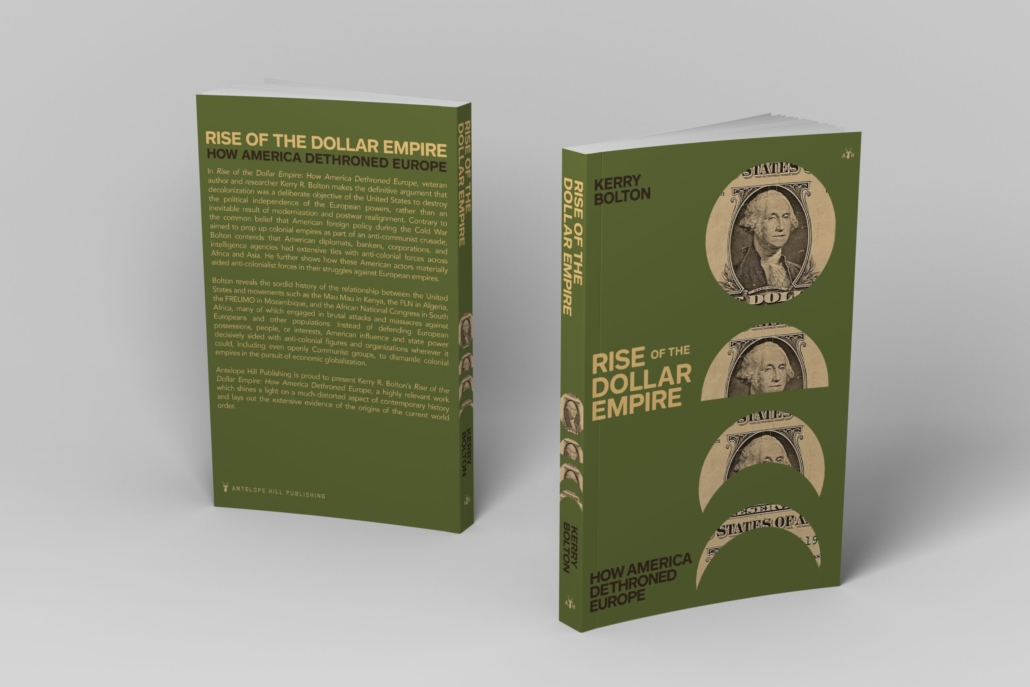
Rise of the Dollar Empire: How America Dethroned Europe
Kerry Bolton
Antelope Hill Publishers, 2026
Rise of the Dollar Empire is a history of decolonization written by an admirer of Western imperialism. The enemies of Europe have, of course, raised this chapter of history to the level of myth:
The “anti-imperialist struggle” is commonly portrayed as the victory of “liberation,” democracy, and equality against White imperialist oppression and “White supremacy.” The legend has become part of a global collective folklore that White evil and greed were defeated by African and Asian heroism.
In fact, decolonization was no act of self-liberation by the colonized, but “a convergence of geopolitical and economic interests which saw the White imperial blocs as impediments to other forms of expansion, largely directed from Washington and Wall Street.” The story will make uncomfortable reading for Americans.
The standard anti-White narrative attributes European imperialism to greed and economic exploitation. Obviously, the empire-builders did hope to find sources of wealth to offset the cost of their enterprise, but this fails spectacularly to account for an undertaking which required a heroism and sacrifice far transcending any possible material motives. There are quite simply too many easier and safer ways of getting rich. (Bolton does acknowledge, however, that once the imperial enterprise was underway “financial cabals lurked in the background ready to come along for the ride, with names such as Sassoon and Rothschild.”)
Colonial administrators had the usual human imperfections, but were often chosen from the aristocracy precisely to ensure their economic independence. In India, while British civil servants were paid adequately, they were forbidden from participating in private business in order to guarantee their disinterestedness and personal integrity. Bolton writes:
It is only in the wake of decolonization that purely financial interests have moved in to fill the vacuum. . . . In place of largely incorruptible, dedicated, and honor-bound White colonial administrators, local and international oligarchs assumed control, and where once the imperial trading blocs limited the extent of global exploitation, now the reign of Mammon proceeded unhindered.
As if anticipating later anticolonial mythmakers, the British administrator Alfred Milner wrote in 1913:
Imperialism as a political doctrine has often been represented as something tawdry and superficial. In reality, it has all the depth and comprehensiveness of a religious faith. Its significance is moral even more than material. It is a mistake to think of it as principally concerned with extension of territory. It is a question of preserving the unity of a great race, of enabling it, by maintaining that unity, to develop freely on its own lines, and to continue to fulfil its distinctive mission in the world.
Milner emphasized that the imperial project, unlike today’s globalism, did not aim at culturally assimilating the rest of the world:
Do not let me be thought to advocate the “Anglicisation” of the non-British races of the Empire, or to wish to force them into a British mould. The power of incorporating alien races, without trying to disintegrate them, or to rob them of their individuality, is characteristic of the British imperial system. It is not by what it takes away, but by what it gives, not by depriving them of their own character, language, and traditions, but by ensuring them the retention of all these, and at the same time opening new vistas of culture and advancement, that it seeks to win them to itself.
Although the main phase of decolonization occurred after the Second World War, its historical origins can be traced back at least to America’s own War of Independence from Great Britain, the original “anti-imperial struggle” against a European power. Like many writers, Bolton emphasizes the influence on subsequent American behavior of Puritanism, an effort to abstract Christianity from the historical tradition of the church. The resulting Puritan-centered Yankee version of American history requires ignoring or downplaying a great deal, notably the far more conservative culture of the American South. It is true, however, that the Yankee heirs of the Puritans emerged triumphant from the bloodbath of 1861–65, and their thinking was the predominant influence on American foreign policy over the subsequent generations. For the Puritans, America represented not a continuation of European civilization on a new continent, but a deliberate rejection of Europe, a creation of something entirely de novo, uncorrupted by the “Old World” and the dead hand of tradition.
Furthermore, as Bolton notes, Puritanism is ill-suited as a vessel of High Culture:
Puritanism is not conducive to High Art. Doctrinally it rejects leisure—the necessary milieu for the pursuit of High Culture—as un-Godly. For example, in the founding American Colonies, the influence of music was minimal, and was excluded as a profession. Puritan functionalism also worked against the development of a significant Puritan visual art. Work was a Godly duty and should not be wasted on frivolous and distracting pursuits.
This repudiation eventually led to a view of the arts as a kind of commercial enterprise.
Despite his philistinism and principled ignorance of tradition—or perhaps because of them—the Puritan is full of self-regard, a moral certainty that his perspective is unsurpassable, and that the commercial way of life to which it gives rise is the ideal condition for the whole of humanity. Spreading it to the rest of the world thus constitutes a moral imperative, whether the world wants it or not.
That this Puritan-derived way of thinking remains alive and well Bolton demonstrates with a telling quote from American “strategic analyst” Col. Ralph Peters:
It is fashionable among world intellectual elites to decry “American culture.” But traditional intellectual elites are of shrinking relevance, replaced by cognitive-practical elites—figures such as Bill Gates, Steven Spielberg, Madonna, or our most successful politicians—human beings who can recognize or create popular appetites [!], recreating themselves as necessary. Contemporary American culture is the most powerful in history, and the most destructive of competitor cultures. Our cultural empire has the addicted—men and women everywhere—clamoring for more. The films most despised by the intellectual elite—those that feature extreme violence and to-the-victors-the-spoils sex—are our most popular cultural weapon, bought or bootlegged nearly everywhere. American action films, often in dreadful copies, are available from the Upper Amazon to Mandalay. . . . The de facto role of the US armed forces will be to keep the world safe for our economy and open to our cultural assault. To those ends, we will do a fair amount of killing.
This is a nearly perfect statement of the ideology behind what Bolton calls “the Dollar Empire,” and I would not wish it upon my worst enemy. It deserves careful comparison with Alfred Milner’s defense of British Imperialism quoted above.
* * *
But we have gotten well ahead of ourselves. Following America’s achievement of independence from Great Britain, the next major chapter in her opposition to European imperialism came during Latin America’s independence movement of 1810–26. The new nation proceeded cautiously at this stage, not wanting to offend a Spain from which she wished to acquire Florida. But official U.S. neutrality did not prevent arms sales by American businesses to the revolutionaries. Diplomatic historian Samuel Flagg Bemis devoted a book to America’s encouragement of revolutionary envoys from South America, the opening of her ports to them, and “the export of all kinds of goods, including war materials.” The young nation
allowed its republican example to stream out to South America. And the beacon-light of successful republicanism held aloft in the New World helped to deter the new states from being guided by British diplomacy into the realms of European monarchical legitimacy, that shadowed vestibule leading back to the power politics of the Old World.
In 1823, Pres. James Monroe announced his famous doctrine of American opposition to any European “interference” in the Western hemisphere.
Two generations later, the US completed the expulsion of Spain from the New World. In April, 1898, a joint resolution of Congress recognized the independence of Cuba a month before the Cubans themselves declared it. “When Spain rejected the US’s ultimatum to abdicate its sovereignty over Cuba,” Bolton writes, “Congress imposed a naval blockade. Pres. William McKinley called for a volunteer invasion force, and Spain’s Caribbean squadron was destroyed while attempting to escape the blockade.” American newspapers whipped up war fever with lurid accounts of alleged Spanish atrocities (“How long shall Cuban women be the victims of Spanish outrages and lie sobbing and bruised in loathsome prisons?”). Such yellow journalism was a precursor of today’s use of “human rights” as a façade for extending the dollar empire.
The Spanish-American War established the playbook for America’s sabotage of European power overseas for the next century:
[The] scenario was oft-repeated during the decolonization period of the 1960s, when the US intervened to scuttle the European colonies in Asia and Africa, ostensibly without any intention of filling the power vacuum, undertaken solely due to the US’s pureness of heart. As is now known, Cuba, like the subsequent decolonized states, became a de facto vassal state of US export-capitalism.
The brief war of 1898 also began the process of dislodging Europeans from Asia by forcing Spain to relinquish the Philippine Islands and Guam. Not accidentally, it was also at this time that America formally annexed Hawaii.
Within a year of establishing this foothold in Asia, America began to oppose the European system of establishing tariff-protected “spheres of influence” in China. McKinley’s Secretary of State John Hay proposed instead that the European powers do away with economic advantages for their own citizens, suggesting the establishment of uniform tariffs collected by the Chinese themselves. This free trade proposal, aimed at American domination of the Chinese market, became known as the “Open Door” policy.
The following year, 1900, saw the Chinese revolt against foreign influence known as the Boxer Rebellion. A German diplomat was murdered, and an expeditionary force was gathered to suppress the revolt. America’s participation, according to Bolton, was inspired by
self-interest, not “white solidarity.” The motive was to limit European influence over China. The US contribution was around twenty-five hundred troops and Marines in a total relief force of about twenty thousand. This enabled the US to get a footing in China and pursue its own policy.
When the Russo-Japanese War broke out in 1904, the Russian Empire was ill-regarded in U.S. political and financial quarters, while Japan was seen as possessing economic possibilities. America contributed significantly to the Japanese victory; in the words of one historian:
Japan stunned the world not only by defeating Imperial Russia in 1904–05 but also by adeptly financing most of the nearly-billion-dollar war with foreign loans originated by US bankers [especially Jacob H. Schiff motivated by hatred of the Czar]. Its financial success was the capstone of a forty-year struggle to attain prime international credit standing. But the war left an important legacy to the United States as well, since Japan’s war loans also marked the coming of age of Wall Street in global finance.
The First World War marked a new stage in European decline, as Oswald Spengler saw: “This war was a defeat of the white races, and the Peace of 1918 was the first great triumph of the colored world.” The European powers made free use of colored troops during the fighting.
The subjects of Europe’s empires were quick to respond, as Jonathan Krause has written:
The rebellions in Indochina in 1916 and 1917 were not isolated incidents. Nearly every major French colony experienced some form of organised anticolonial resistance during, and as a direct result of, the First World War. Algeria, Morocco, Tunisia, Senegal, Niger, Mali, Chad, Burkina Faso, Madagascar, New Caledonia, and Indochina all experienced rebellion of some notable scope. Similar patterns of unrest also developed in the British, Russian, Italian and Ottoman empires during the First World War, suggesting a global moment for anticolonialism. For all their contextual diversity, the anticolonial rebellions that erupted from 1914 through to the 1920s could not help but be influenced by the realities presented by the First World War.
Pres. Woodrow Wilson’s Fourteen Points issued in January 1918 were “formulated by a cabal with close Wall Street associations.” They amounted to a declaration of war against Europe’s Imperial powers and included this assurance of American support for the colored world: “we feel ourselves to be intimate partners of all the governments and peoples associated together against the Imperialists.” Point six offered de facto support for the new Soviet government of Russia at a time when its hold on power remained anything but certain. Bolton remarks: “The ‘intervention’ in Russia by American troops supposedly to help the ‘White armies’ against the Bolsheviks is one of the great myths of history. The American Expeditionary Force in Siberia was overtly hostile toward Admiral Kolchak.”
An entire chapter of The Dollar Empire is devoted to refuting the notion, derived from American historian Carroll Quigley, that British imperialists collaborated with the internationalists around Wilson to establish “an Anglo-American conspiratorial network to rule the world.” This idea remains popular with elements of the American right including the John Birch Society and those associated with Willis Carto and Lyndon LaRouche. It casts modern globalism as a British neo-imperialist conspiracy. Bolton writes:
So far from there being a longstanding accord between Anglophile globalists in the United States and Britain to rule the world, an anti-imperialist, internationalist agenda centered on Washington and New York pursued an offensive against the empires of Britain and the Occident. The reasons include:
-
The US’s foundational animosity toward Britain and Europe, reflected in the Monroe Doctrine.
-
The US’s sense of messianic mission to be the harbinger of liberty to the world, against the traditional order dominated by Europe.
-
The rise of Wall Street as the leading center of international finance from 1905, whence,
-
the internationalization of finance and commerce [occurred] at an accelerated pace, the expansion of which was being hindered by imperial trading blocs.
There were indeed proposals for British-American foreign policy collaboration during the First World War, but they quickly came to nothing under pressure of differing national interests in the early 1920s.
During the interwar period, the future Axis powers pursued trade policies that put them at odds with the international finance system championed by America. Indeed, Bolton writes that “the common factor for this ‘Axis’ could be claimed as the fight against international finance and export-capitalism.” As Germany’s Economics Minister Hjalmar Schacht explains in his postwar memoirs:
In September 1934 I introduced a new foreign trade programme which made use of offset accounts, and book entry credit. My plan was to some extent a reversion to the primitive barter economy, only the technique was modern. The equivalent value of imported goods was credited to the foreign supplier in a German banking account, and vice versa foreign buyers of German goods could make payment by means of these accounts. No movement of money in marks or foreign currency took place. All was done through credits and debits in a bank account. Thus, no foreign exchange problem came into being. [As a result,] those interested in the exchange of goods came into conflict with those interested solely in money. There was soon a battle royal between the exporters who sold goods to Germany, and the creditors who wanted their interest.
A similar challenge to international financial interests was offered by Japan’s “Greater East Asian Co-Prosperity Sphere,” a self-contained economic bloc wherein “Japan was dependent on its colonies for supplies of food and raw materials [while] in return Japan exported manufactured products to them.” Bolton writes:
The war against the Axis was fought to secure the primacy of export-capitalism and international finance under US auspices. The rhetoric about “democracy,” like today’s about “human rights,” was a façade. The Axis states, Italy, Germany, and Japan, had placed their economies on an autarchic basis, and had implemented trade relations based on barter, bypassing the international financial system.
Pres. Roosevelt was open about these considerations, asking Churchill in August, 1941: “Will anyone suggest that Germany’s attempt to dominate trade in central Europe was not a major contributing factor to war?” Churchill understood the implied criticism of the British Empire’s economic arrangements, and was justifiably alarmed. As Bolten recounts:
At the Ottawa conference in 1932, the United Kingdom, Australia, Canada, India, New Zealand, and South Africa agreed to give preferential tariff treatment for each other’s goods. Imperial preferences instituted higher duties on non‐empire goods and lower duties on dominion goods. Testifying before Congress in 1940, [Pres. Roosevelt’s Secretary of State] Cordell Hull called imperial preferences “the greatest injury, in a commercial way, that has been inflicted on this country since I have been in public life.” Hull did not differentiate between Britain, Germany, or Japan in stating that autarchy threatens export capitalism and international finance, as they were all “the root cause of the instability of the period and the onset of war.”
Consistent with such views, the “Hull Note,” the American Secretary of State’s final diplomatic note to Japan eleven days before the Pearl Harbor attack (described by Bolton as an “ultimatum”), demanded that the Greater East Asian Coprosperity Sphere be replaced by a system of free trade. It required Japan to uphold, inter alia,
the principle of non-discrimination in international commercial relations; the principle of international economic cooperation and abolition of extreme nationalism as expressed in excessive trade restrictions; the principle of non-discriminatory access by all nations to raw material supplies; the principle of establishment of such institutions and arrangements of international finance [emphasis added] as may lend aid to the essential enterprises of all countries.
World War II succeeded in eliminating the Axis challenge to international finance and formalized the U.S. dollar as the international reserve currency. American aid such as the Lend-Lease Program created indebtedness which was later used to pressure recipients into abolishing imperial preferences. The Bretton Woods conference of July, 1944, also instrumentalized debt for political power: it established the International Monetary Fund, which was empowered from the beginning to dictate the economic and financial policies of any state that became indebted to international finance. Bolton writes:
Even the supposedly “victorious” European powers [of World War II] were indebted to the point of financial and economic ruin. They were in the thrall of Wall Street and Washington via war debts. Washington was not much interested in having these debts redeemed, more than happy to use them as leverage. This indebtedness of Europe to the US ultimately became the most significant factor in the scuttling of the continent’s empires.
This summary makes abundantly clear that the U.S. government had already worked consistently for over a century to sabotage European imperial rule even before the principal phase of decolonization began following World War II.
* * *
The largest and most important European colony was British India. British achievements in India included a vigorous program to develop India’s infrastructure, ending the practice of suttee (the immolation of widows on their husbands’ funeral pyres), the eradication of the murderous thuggee sect by 1841 and the registering of all births after 1870 to discouraged the killing of female infants.
Philip Mason, a notable official in the Indian Civil Service (1928–47) wrote of the colonial administrators:
They were men who by the middle of the nineteenth century had brought peace to the country instead of anarchy, had mapped the fields and made lists of every man’s rights and had made a beginning of the task of building roads, bridges and railways, of harnessing the rivers to irrigation. More important, they had associated Indians with them in their work and the greater part of the administration was carried out by Indians.
Pres. Roosevelt worked to detach the country from Britain even as he allied with the British Empire to fight Hitler. Beginning in 1941, India received Lend-Lease aid directly from the United States, bypassing the British and undermining their authority. By war’s end India was importing more from America than from Britain. In 1942, Roosevelt saw to it that India became a signatory to the United Nations declaration, implying its status as an independent nation. The President subsequently sent two “personal representatives” to India, both of whom were strong supporters of the country’s independence movement. He apparently expected great political benefits from a future alliance with a grateful India. Instead, the Cold War intervened, and Nehru, the country’s first Prime Minister, declared his nation “non-aligned.”
America sought to bring “free trade” to the Dutch East Indies for the benefit of American oil interests as early as the 1920s, but without success. Following the occupation of the Netherlands by Germany in 1940, the East Indies came to be dominated by Imperial Japan:
All Dutch citizens were interned. Many administrative positions were filled by Indonesians, thereby laying the foundations for postwar Indonesian demands for decolonization, while anti-imperialist sentiments against the European powers had been encouraged by the Japanese.
American wartime intelligence dispatches were favorable to the Indonesians. “The longer we stayed in the [Asian] Theater,” an OSS agent commented, “the more OSS became permeated with a suspicion and disapproval of Western Imperialism.” Most agents recommended US backing for the independence movement.
Following the Japanese surrender of 1945, the former Dutch East Indies declared independence under the name “Indonesia.” A campaign of terror was waged against Europeans and Eurasians (the mixed-race population which was predominantly European in culture). This was led by a character named Sutomo, previously cultivated by the Japanese as a “youth leader.” In November, 1945, he proclaimed:
The Indo-Nederlanders are bloodhounds. Torture them to death, eradicate those watchdogs of colonialism down to the root, before they escape to Irian (New Guinea) from where they—as unadulterated lion cubs of the imperialistic Netherlands—intend to build a springboard to recapture our beloved fatherland. For 300 years they have emaciated our country in order to fill the coffers of a white queen. But now Allah has announced the hour of revenge.
Adult male Indo-Nederlanders had largely been interned by the Japanese, so the victims of the ensuing campaign were mainly defenseless women and children.
“With the defeat of the Axis and the emergence of the USSR as an obstacle to the United States’ dream of a UN-based new international order,” writes Bolton, “the US presented decolonization as the only alternative to Sovietization.” When the Dutch sent in troops to protect Europeans and Eurasians and restore order in January 1946, the U.S. responded by refusing them access to U.S. shipping vessels for transporting troops or armaments.
While the Indonesian gangs were targeting Dutch and Indo women and children, U.S. Secretary of State James F. Byrnes put responsibility for the turmoil on the Dutch, demanding from them a “broad-minded and positive approach” in “discussions with leaders of all Indonesian factions.” An American loan of USD $100,000,000 for the Dutch East Indies arranged in late 1945 was now blocked to increase pressure on the Dutch government.
In July 1947 the Dutch launched an offensive against the Indonesian Republic. The following month, the UN Security Council ordered a ceasefire, with the U.S. voting in favor of the resolution. While the Dutch were condemned at the UN for briefly continuing mop-up operations within their remaining territorial control, Indonesian gangs pursued their terrorism behind the facade of the Republic’s order for its army to ceasefire. An American representative to a UN committee established to resolve the conflict declared that the Indonesians were “engaged in a struggle resembling our own revolution against British rule.”
The Dutch army launched a second offensive against the Indonesian Republic in December 1948, and it proved successful. America responded with an embargo against the Netherlands, ensuring that the military victory was scuttled by economic pressure. Withing a year, the Dutch government acceded to American pressure and relinquished its sovereignty over the archipelago. Bolton summarizes:
So far from the United States providing covert support to the Dutch imperialists, which is the impression often given by academics intent on maintaining such myths, the US sought to sabotage the Dutch in the midst of a savage insurgency. . . . The outcome was the scuttling of the colonial “allies” while maintaining a pretense of “friendship” necessary for the Atlantic Alliance.
Since 2011, the Dutch government has issued four separate apologies for the use of “excessive violence” by the Dutch military in attempting to defend Dutch citizens from the Indonesian bloodlust. Meanwhile, Sutomo, instigator of the terror campaign against the Dutch and Eurasians, has officially been proclaimed a “National Hero” of Indonesia.
American policy towards French Indochina mirrored its policy regarding the Dutch East Indies.
By 1885, France had taken control of the territory now occupied by Vietnam, Cambodia and Laos under the name Indochina. Rejecting assimilation, whether racial or cultural, the French sought to maintain the identity of the Indochinese. They called their policy “association.” According to one historian:
This doctrine allowed geography, ethnic characteristics, and the rate of social development to determine how the French ruled. The two racial groups would “associate” with each other, work side by side with the traditional village system and do what was best suited for each. The French took responsibility for the indigenous population while respecting their culture, customs, and existing laws. Although this system worked better with the Indochinese than had assimilation, association was based on mutual interests and fraternity, not equality.
In 1940, the Japanese invaded and occupied French Indochina. Japan’s defeat in 1945 allowed Communist leader Ho Chi Minh to take power in Hanoi. From 1946 to 1954 there was continual conflict between the returning French and Ho’s forces.
America’s Indochina policy in these years sought to “eliminate French influence while not alienating France as a Cold War ally nor allowing a regime that would be aligned with the USSR.” French resistance fighters in Vietnam who had saved American airmen during the war were fobbed off with decorations, while until about 1951 “American political and military support was thrown behind Ho Chi Minh.” The US was aware of Ho’s communist affiliations, as he had been expelled from Hong Kong during the 1930s as head of the Southeast Asia bureau of the Communist International. But any official who warned against supporting Ho was ruthlessly dropped if in American employ and blacklisted if he were not, on charges that he was “working against America.” Ho’s American supporters were later sent as “advisers” to the French in Indochina. A high U.S. government official in Washington told French Minister for Overseas Affairs Jean Letourneau: “I will not hide the fact from you that I and an important number of my colleagues desire to see a Ho Chi Minh victory in Indochina and we will do all in our power to achieve that end.”
In March 1954 a small French outpost at Dien Bien Phu in Northwest Vietnam came under siege by communist Viet Minh troops who outnumbered them three to one. The US rejected a French request for planes and crew to fly three thousand French troops from North Africa to Indochina to their relief. Among those captured by the Viet Minh, one thousand Legionnaires from states now in the Soviet bloc were returned to those states, where they were executed. Out of the 10,300 French soldiers taken prisoner, only 3,300 returned. War correspondent Bernard Fall wrote that for the first time in her history America “abandoned an ally to his fate while the ally was fighting a war that the United States had encouraged him to fight to a point far beyond his own political objectives and most certainly far beyond his own military means.”
France’s most important colony was Algeria:
During the hundred and thirty years of the “French presence” new cities were built, wheat-farms, vineyards, and cotton plantations sprang from a hitherto desolate land. Wide paved roads and three thousand miles of railways were constructed, linking all the major centers. European medicine, hygiene, including a sewage system that had not existed there since Roman times, and French colonial order saw the Muslim population grow from two million in 1830 to eight million in the 1950s, while the European population reached 1,200,000.
America subverted French authority there primarily through trade unionism, as Bolton explains:
The US labor movement was run by social democrats and disaffected communists whose obsessional hatred of the USSR saw many prominent figures from the left become ardent Cold Warriors on the side of the US. The American Federation of Labor (AFL) and Congress of Industrial Organizations (CIO) worked closely with the CIA and State Department to promote US foreign policy . . . and organize labor movements in the European colonies.
They did this primarily via the International Confederation of Free Trade Unions (ICFTU). The AFL’s main European agent was a certain Irving Brown, a protégé of former Communist Party boss Jay Lovestone. Brown urged the ICFTU to accept the affiliation of organizations even if they were “not building real unions,” but were exploiting grievances in the European colonies “to attain purely political ends,” stating that the most important consideration was the “struggle for political liberation.”
Following the Suez conflict in 1956, America exploited France’s balance of payments deficits to exert pressure on its Algeria policy. In January 1958, at the height of the fighting, France received $650,000,000 from the US, the International Monetary Fund, and the European Payments Union, under the proviso that military procurement be cut by 25 percent and 150,000 troops demobilized. One historian admits that under these conditions it “would be difficult [for France] to continue the war and impossible to win.”
The US even demanded that France send arms to Tunisia, a haven from which Algerian nationalists were launching terror attacks against the French. France gave in because of her need for an American loan. Prime Minister Mendès-France called the situation “humiliating” and said that French arms would not have been delivered to Tunisia had it not been for France’s economic subordination to the US.
Next, the US gave France an ultimatum that if they did not end the conflict with Algeria, America would provide economic and military aid to Morocco and Tunisia. CIA Director Allen Dulles flew representatives of Algeria’s National Liberation Front to Tunis for secret meetings with US officials. Eisenhower considered that even risking the French relationship with NATO was justified for the sake of backing the Algerians. The pied-noirs, or French Algerians, understood who was betraying them: in May 1958 they sacked the American Cultural Center in Algiers.
The same subversive role was played by the US in black Africa. The official American view of the struggle against white rule was expressed by Roswell D. McClelland, American Consul General in Rhodesia, in an address to a private dinner party arranged by the leftist Rhodesian Constitutional Association in October 1965:
Africa today is in the throes of revolutionary change; and there is as much legitimacy in revolution as there is in government. Indeed, an African leader has to be a revolutionary if he is to remain in power. To be otherwise is to defend the status quo; and the status quo was colonialism. It is the innate role of the revolutionary, and this applies a fortiori to the still White-dominated southern part of the continent, to change an existing and unsatisfactory order.
White South Africans and Rhodesians were puzzled as to why the U.S., supposedly in a life-or-death struggle against communism, was so hostile to them when they were fighting the proxy forces of the U.S.S.R. In fact, America saw itself as no less on the side of revolution in Africa than the Soviet Union or Communist China. Not to promote revolution in Africa against Whites, said McClelland,
would be an intolerable betrayal of the moral and political principles which are not only an integral part of the fabric of American life but have provided the main impulse for human progress in the 20th Century: democracy, self-determination, human rights and racial equality.
McClelland told his audience that it was the moral duty of the United States to thwart communism with American-style liberal internationalism; if such a revolution were not led by the U.S., the communists would seize the initiative instead.
There were plenty of ambitious Black Africans whose craving for power could not be satisfied through the traditional tribal structures which European colonialism had left intact. They were natural candidates for the new leadership stratum America sought to create. In 1953 the Africa-America Institute (AAI) was founded to fund and train a postcolonial Black leadership and bureaucracy for Africa in accord with America’s ambitions. The organization employed “leaders of the terrorist campaign against Rhodesia” to help select candidates for its scholarships. The AAI was funded mainly by the CIA until 1962, and the US government even entrusted it with some diplomatic activities, such hosting African leaders on tour in the US. Bolton comments:
The AAI, with its CIA and corporate sponsorship could reach where the State Department and other Federal agencies might find it difficult to explain to the US’s supposed “allies,” while supporting decolonization, which included periods where NATO “partners” were engaged in counter-terrorism conflicts. As with much else the US did during the Cold War, this could be justified as thwarting Soviet influence—albeit over the corpses (often mutilated) of White soldiers and civilians, farmers, and families, and of those Africans targeted as collaborators. From a pro-European perspective, the offensive of the US against Whites in the colonies in the name of anti-communism, and more specifically of thwarting Soviet influence, is nothing to celebrate.
Bolton’s work more than succeeds in refuting the Marxist-inspired narrative that European imperialism was a “capitalist” enterprise supported by the U.S. as the supreme embodiment of capitalism. In fact, American liberalism seeks to destroy the bases of cultural identity all over the world in order to create a global market in which no borders obstruct the free movement of either commodities or people. And its first target is always European cultural identity; it seeks, in Bolton’s words, “the subordination of Europeans in the interests of an ‘inclusive economy.’”
In his conclusion Bolton mentions some recent signs of a possible change in direction:
Trump’s dismantling of USAID, a nefarious and subversive agency of US infiltration across the world, is pregnant with meaning. Even more significantly, the National Endowment for Democracy, a key player in the globalization process, has also been defunded. The Office of Management and Budget has proposed that State Department funding be cut in half and that programs such as democracy promotion be eliminated. The Trump administration has halted 92 of 95 programs of the International Republican Institute, [which] has closed all 64 of its offices abroad and fired up to 85 percent of its staff. National Democratic Institute President Tamara Wittes testified that 93 of its 97 awards were terminated, three-fourths of its offices closed and about 1,000 people fired.
This could not have happened to a better bunch of people, but as Bolton notes, it remains to be seen whether it represents a radical change of outlook or a mere change of tactics.
Even after two hundred years of sabotaging European power abroad, the United States remains home to the largest European-descended population of any country in the world by far. The future remains open, and if there is to be any revival of European civilization, it will depend crucially on this great reserve of European blood.




Leave a Reply
Want to join the discussion?Feel free to contribute!