
Women with Borderline Personality Disorder Have Helped Shape Our Culture and Our History
There is a common idea that the world is ruled by extremely intelligent male psychopaths. Social status is predicted by intelligence combined with a pro-social personality. But very high status is different. This is a combination of extremely high intelligence and moderately anti-social personality. Low in impulse control, you can think outside the box. Low in Agreeableness, you don’t care if your new ideas offend people. High in mental instability, you are constantly ruminating and desperately want to make sense of a world which you perceive as frightening chaos. Add to this a cut-throat desire for power and the charisma, confidence, self-importance and need for praise that comes from Narcissism, and a pronounced eminence is a result.
A study entitled “Creativity and Psychopathology” actually found that the majority of “great men” were sub-clinally Narcissistic or Psychopathic. But this got me thinking, “What about the great women? What is their psychology? What about the wives and mistresses of great men; the power behind the throne?”
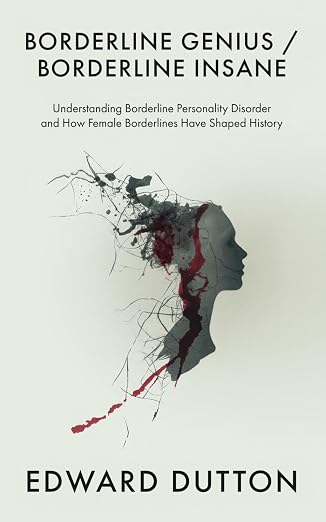
This became the subject of my new book, Borderline Genius/Borderline Insane: Understanding Borderline Personality Disorder and How Female Borderlines Have Shaped History. Now, obviously, there are fewer great women and their influence tends to be weaker than that of great men. This is because females have fewer outliers who have extremely high intelligence, and because females sexually select for status, meaning males have more of an innate drive to achieve it. Women are also more pro-social and they are evolved to adapt to polygamous mating systems where they create cliques of complete equality and trust in order to alloparent your children. The “Queen Bee” is shunned. So, we can expect great women to be psychological outliers to a greater extent than great men.
Drawing on Charles Murray’s Human Accomplishment, where he calculated influence scores for prominent people up until 1950, I focused on Anglophone females, such that I could read the primary sources. What I found was that the majority of great Anglophone females reached the criteria for what is called Borderline Personality Disorder (BPD), marked as we would expect, by low Agreeableness, low Conscientiousness and high Neuroticism; this is a Cluster B disorder, associated with depression, and it is related to the “Dark Triad” of Psychopathy, Narcissism and Machiavellianism.
The stereotypical example of borderline would be Sylvia Plath; dramatic emotional swings, overwhelming depression, oscillating between self-absorbed Narcissism and despair, symbolic suicide attempts, biting the stranger Ted Hughes in an impulsive expression of obsessive love and wedding him shortly after; intense and tempestuous relationships, experimenting with different selves.
The DSM symptoms of BPD are extreme mood swings, fear of abandonment, impulsive risk-taking (such as adultery), an unstable sense of self, chronic emptiness, intense idealising and de-idealising of partners (“splitting”), uncontrollable anger, self-harm (to feel a sense of control of the agony), and dissociation and psychosis under stress. The condition is “on the border” between neurosis and psychosis. Eighty per cent of those who are diagnosed have a comorbid personality disorder (often Narcissism) and 75% of those diagnosed with BPD are women. The BPD figures from Human Accomplishment explored in my book include Virginia Woolf, Charlotte Bronte, Emily Bronte and George Eliot, A number of the great women did not reach the criteria of at least 5 out of the 9 symptoms such as Jane Austen, Emily Dickinson and Willa Cather.
It was noticeable that the majority of these great women were not sub-clinical. They reached the cut-off point for the personality disorder and, in many cases, displayed almost all of the symptoms. This makes sense, in that women tend to be highly socially conformist, lacking in ambition, and are evolved to not stand out, at least socially. BPD is likely causal insomuch as these women were novelists and poets. Expressing their intense negative feelings could act as a kind of therapy and a means of making sense of a chaotic world. Immersing themselves in a world of their creation would be consistent with dissociation. An unstable sense of self means that you experiment with different personas, question who you are, and change your ambitions and ideas. At any one time, you will have an extreme and black and white identity, as a way of controlling a dangerous world. This permits you, as a writer, to convincingly describe different types of people, because you have “been them.”
However, it is important to note that there is a strong genetic component to personality disorders—around 50%. Due to the way in which we select for genetic similarity, in order to pass on more of our genes, the personality disordered tend to be attracted to each other, with suffering from depression being a central factor. In addition, the Narcissistic man will love being idealised by a borderline woman. She idealises her special person—the black and white thinking, again—as her rescuer and regulator of her intense emotions. She is attracted to high-status and much older men (as age is a proxy for status) and she is effectively adapted to a dangerous, unstable ecology in which only the high-status genes survive.
It would follow that a certain kind of “great woman” —an absolute monarch queen regnant—would be likely to have borderline traits. Studies I review have found that the fathers of borderlines tend to have Cluster B traits, certain genes express as violence in men but self-harm in women, and there is evidence that Narcissism is X-linked and, so, more likely to pass from father to daughter. Clearly, we would predict that historical kings, who had to fight against rebellions, would be Cluster B; likely Narcissists. I have found that all four British absolute queens regnant—Lady Jane Grey, Mary I, Elizabeth I and Mary Queen of Scots—met the criteria for BPD, with the latter being very extreme and marrying her rapist. In that only about 2% of women have BPD then, as with the writers, this was highly statistically significant.
My book also explored other kinds of highly influential women and, once more, found that Borderline Personality Disorder, or related Cluster B disorders, was central. This pattern is clear among the wives and mistresses of many “great men.” Anne Boleyn, who essentially caused England’s break with Rome, was seemingly Histrionic, a condition where one is dangerously flirtatious and needs to be the centre of attention. Princess Diana, wife of the future king, was evidently a borderline. Both of the most prominent mistresses of Adolf Hitler—Eva Braun and Unity Mitford—were almost archetypal borderlines, with suicide being strongly elevated among borderlines.
The influence of borderlines, the book argues, is also elevated by the increasing feminisation of society, in which females are increasingly influential and are increasingly taken seriously. In addition, the breakdown of harsh Darwinian conditions since the Industrial Revolution—before which we were selecting for being group-oriented and pro-social—will mean more borderlines, as does a culture obsessed with harm avoidance and emotion. This means that women with borderline traits are not compelled to suppress the related behaviour. In its absence you see eating disorders, gender dysphoria, bisexuality, and pathological lying (as with Virginia Roberts Giuffre), traits that are all robustly associated with BPD.
I argue that female campaigning groups (wherein you deal with you negative feelings by telling yourself you are morally superior, a Narcissistic method) tend to reflect borderline traits—anger (fury at Pro-Life activists), mood swings (such as moving from tantrum to pleading when being arrested), self-harm (gluing yourself to the road to “Just Stop Oil,” Suffragettes going on hunger strikes), identity disturbance (tattoos as a means of asserting a clear self, the way in which many Suffragettes flipped and joined the British Union of Fascists), dangerous impulsivity (ex-fundamentalist Renee Nicole Good driving her car at an ICE officer), and paranoid psychosis (feeling “literally unsafe” in the presence of opponents).
However, the book notes that, if anything, you would expect high levels of BPD among women on the “far right.” Not only are they frequently formerly of the “far left,” implying an unstable sense of self, but, in a Woke world, they are extreme non-conformists, in contrast to leftist super-conformist women. The risk-taking involved in BPD—combined with a strong desire for masculine, high-status men and a realisation that the wind is blowing rightwards—would make sense of this.
It is a common feminist idea that the influence of women in history has been down-played. On this point, I think they are right, though not for the right reasons. High-status men are Narcissists who attract borderline women who, thus, exert indirect influence over them. In modern times, however, the influence of these kinds of women—on the culture, via literature and even on politics—is considerable and is likely to continue growing.




Leave a Reply
Want to join the discussion?Feel free to contribute!