
Murray Rothbard’s Secret Ancestry: “The Rothschilds of Russia”, Polyakov-Raskin Dynasty
Creating Russian Railroads, Banks, Bolshevik Revolution and US Communist Party
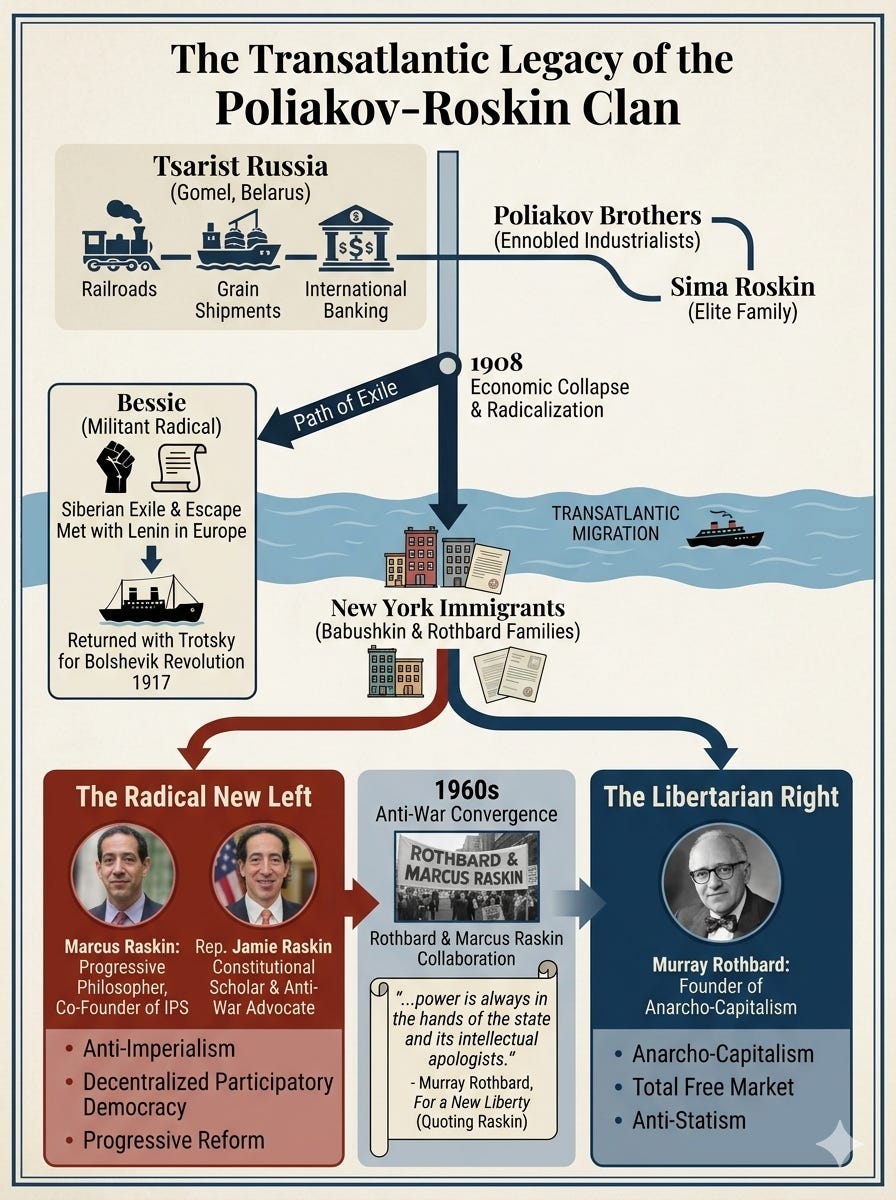
Note: This article is an early draft of chapter one of a forthcoming revisionist biography of Murray Rothbard. It is part of the ongoing Rationalist Grand System Book Series, which also features upcoming revisionist biographies of Ludwig von Mises, Milton Friedman, and Ayn Rand. Together, these biographical works demonstrate how these prominent libertarians were tied from birth to the Rothschilds and its revolutionary Jewish network that migrated from Eastern Europe to America, continuing its subversive efforts to transform the United States into an explicitly philosemitic nation dominated by the Jewish Dominant Minority. Drafts are well underway, but much work remains to be done. We welcome your assistance in sourcing information and developing the final books. Many thanks to the team that has done great work this far.
Introduction
Much like his mentor, the eminent economist Ludwig von Mises, Murray Rothbard never authored a formal memoir or comprehensive autobiography, despite his central role in shaping the modern libertarian movement. Rothbard left his ancestry largely unexamined in his published work, keeping his family origins in Eastern European Jewish communities largely out of view; he never once publicly identified even his grandparents.
Fortunately, a single partial exception survives: an autobiographical essay written during Rothbard’s high school years. Curiously, this early reflection was distorted by his unofficial biographer, Justin Raimondo. Literally on his deathbed in 2019, Raimondo finally sent the essay together with other biographical material to the Ludwig von Mises Institute, which houses Rothbard’s papers. The Institute acknowledged the receipt of these materials with an editorial note stating:
Recently the Mises Institute received a box of documents belonging to Murray Rothbard from our friend Justin Raimondo. We will make new material available online as we work through the collection.” (Murray N. Rothbard. Young Murray Rothbard: An Autobiography. (Mises Wire, 7 January 2019.)
While the Mises Institute published this particular essay online, extensive portions of the collection remain unscanned and inaccessible to independent researchers. This lack of transparency has effectively walled off vital primary sources from critical historical scrutiny, serving as a tactical component of the broader censorship project detailed in the Five Purges article.

The link to article.
Taboo Ancestry
The Mises Institute has never published an exhaustive, verified family tree of Rothbard, nor has it commissioned an independent genealogical investigation. Consequently, Rothbard’s essay takes on exceptional historical weight. It stands as his only deeper commentary on his family’s roots, a topic that has remained largely untouched by institute scholars, biographers, and the broader libertarian establishment.
This silence aligns with a broader pattern among leading twentieth-century libertarian figures. The prominent biographers of Ludwig von Mises, Ayn Rand, Milton Friedman and Rose Director Friedman, as well as their family friends and Fed chairmen, Arthur Burns and Alan Greenspan, have consistently directed attention away from detailed genealogical inquiry. David Friedman and many other prominent libertarians have followed the same course. Consequently, we are left without a documented family tree for any of these major figures, a notable absence in their existing biographical literature.
This is not surprising, as Ashkenazi Jews are often reluctant to discuss their ancestry—particularly when it links them to the slave trade or highly exploitative monopolist arenda system or other monopolist and terrorist activities directed against their host populations. Just as Germans are often reluctant to discuss their Nazi relatives, concentration camps, and connections to the SS, Jews are frequently unwilling to address their own links to Jewish bankers, slave traders, the arenda system, Bolsheviks, the Red Terror, Gulag concentration camps, the Cheka, and the KGB—especially when their transplanted network is actively seeking to reshape the government of their new country as well.
While everyone possesses a right to privacy, it remains suspicious that not one prominent Ashkenazi Jewish intellectual seems to have published his family tree, despite having a clear and obvious interest in the history and current politics of Eastern Europe. Thus, the discussion of one’s own or other Jews’ possible ancestral links to Jewish revolutionary activities serves as one possible litmus test for gatekeeping, alongside the topics of White genocide and the geopolitically motivated Jewish Grand Gonspiracy for hegemony. In any case, directly or indirectly advancing Jewish interests seems to be second nature, even to leading Jewish libertarians.

The link to the article. See also The Occidental Observer version.
In fact, it appears to be an unwritten rule that, unlike many Gentiles, all prominent modern Jewish intellectuals—such as David Friedman, Ron Unz, William Kristol, Robert Kagan, and Ben Shapiro—are exceptionally reluctant to publish or discuss their genealogical history in detail with family trees. One reason for this might be the American myth of the ‘self-made man,’ but another is the possibility that the ancestral families of most, or even all, of these prominent and highly intelligent and driven Jews—from libertarians to neoconservatives—are part of an interlocking Jewish elite family network that, under the Rothschilds, organized political activities in Eastern Europe and now in America. While they may hold different perspectives on how to manipulate America, they all work to turn it into a multicultural philosemitic country. We will now examine whether Murray Rothbard’s family belonged to this Rothschild-led Jewish network.
Aristocratic Lineage
Rothbard’s youthful essay breaks this pattern of secrecy at the outset. He describes his father, David Rothbard, as an industrious immigrant of modest middle-class origins, while characterizing his mother, Rachel “Rae” Babushkin, as the daughter of a family possessing immense wealth, social distinction, and aristocratic connections in pre-revolutionary Russia.
My mother’s background, though different, is just as colorful. Her family abounded in the traditions and characteristics of the old Russian aristocracy. My grandmother’s family, especially, had reached the highest pinnacle that the Jews in Czarist Russia could have achieved. One ancestor founded the railroads in Russia, one was a brilliant lawyer, another was a prominent international banker; in short, my mother’s family was raised in luxury and wealth,
My grandfather, even though lower in the Russian social ladder, was still respected and beloved as a, member of the upper middle class. Unfortunately, the kindness of his heart was his undoing, and he lost nearly everything due to his lack of business sense, and to the fact that he persistently gave away large sums of money, sometimes neglecting his family’s interest. Finally, my mother’s family was forced to immigrate to America.” (Murray N. Rothbard. Young Murray Rothbard: An Autobiography. Mises Wire, 7 January 2019. Emphasis added.)
This amazing disclosure raises an immediate question: to whom exactly was Rothbard referring when he wrote of ancestors who “had reached the highest pinnacle” and who were “founders of railroads, a brilliant lawyer, and an international banker”?
Justin Raimondo’s biography of Rothbard notably fails to address this: though he possessed Rothbard’s own autobiographical essay, he suppressed any mention of the family’s immense wealth and aristocratic connections, portraying Rothbard’s mother, instead, as a divorced-from-reality, dream-world escapist. Raimondo wrote:
Murray’s mother, Raya Babushkin, was born in a tiny Jewish village near the Russian-Polish border and came to America with her mother and sister in 1916. She ‘had been brought up without any necessity of facing the realities of life,’ writes her young son, ‘and consequently she shut herself up in a dream world of books and literature, much as Keats had escaped to a dream world of beauty.’6 (Justin Raimondo. An Enemy of the State. The Life of Murray Rothbard. Prometheus Books, 2000.)
For some reason, Raimondo also does not name the ‘tiny Jewish village,’ nor does he specify which ‘Russian-Polish border’ he means. Does he refer to the period of the Partitions of Poland, the First World War, or the Second World War? Why hide the name of the village and the region of Raya Babushkin’s birth?
Because also other biographers and the Mises Institute have refused to study Rothbard’s ancestry in detail—particularly through Eastern European Jewish archival records and imperial Russian financial history—answering the question of Rothbard’s true ancestry requires systematic, albeit speculative, historical deduction.

Image: Murray Rothbard and his parents, David Rothbard and Rachel Babushkin.
Mystery Grandmother
One possibility is that Rachel Babushkin embellished her family’s standing, presenting an exaggerated version of their position to her son. Yet, this is highly unlikely. First, even as early as high school, Rothbard demonstrated exceptional intellect alongside a keen interest in historical study and methodology. Consequently, he was not easily deceived. Second, David Rothbard was a logical, analytical industrial chemist, and he would have easily detected an outright fabrication within his own household. After all, Rachel was not recounting vague folklore about distant ancestors, but describing her immediate family and her own youth in Russia.
Who, then, were Rachel’s parents? Neither Rothbard’s adult writings, nor Raimondo’s biography, nor any official publication provides these names. The Mises Institute’s Jewish chief editor, David Gordon—widely considered the foremost scholar on Rothbard’s life work—has stated that he does not know them.
Jeff Deist, the former president of the Mises Institute, recently admitted to his ignorance of Rothbard’s maternal ancestry. Yet, he fails to explain why the Institute has not commissioned a professional genealogist to investigate the matter, particularly since basic information regarding Rothbard’s maternal family should be readily accessible. Instead of pursuing such research, Deist appears skeptical of Rothbard’s own claims concerning the vast wealth of his forebears.
His mother’s family’s roots trace to an undisclosed region of Russia—though possibly having roots in the Russian upper class or intelligentsia. (Jeff Deist. “Rothbard and the Paleo Right.” Property and Freedom Journal. September 27, 2026. Emphasis added.)
Even the family gravestone is unusually bare, lacking an exact date of birth and spelling Rachel’s first name as “Ray.” More curiously still, Rachel’s ancestral names are omitted entirely, despite her evident pride in her pedigree.

Fortunately, Rothbard’s early autobiographical essay offers critical clues. He seems to imply that Rachel’s parents had not personally reached the “highest pinnacle” of power and wealth, attributing that stature instead to the preceding generation. Furthermore, he makes a clear social distinction between the Babushkin family of his maternal grandfather, who were prosperous merchants, and his maternal grandmother’s family, which occupied a far higher rung in the imperial hierarchy. The direct link to the prominent bankers and railroad magnates runs squarely through his maternal grandmother.
For decades, prominent genealogical repositories like Geni maintained no records for Rothbard’s maternal grandparents. Recently, however, new documentation identifying this line has surfaced on the public genealogical database Find a Grave, opening a potential path toward verifying this lineage.


Image: Find a Grave, Murray Rothbard’s mother and maternal grandparents.
The Roskin-Polyakov Alliance
Find a Grave, geneological websites, search engines and AI models fail to return more information on Sima/Sema “Sylvia/Sonja” Roskin or her kin. However, the surname can be transcribed in many different ways, such as Raskin or Rashkin, depending on the regional dialects of the Russian Empire; these variants may hold the key to the mystery.
The Jewish Roskins/Raskins seem to have been merchants in Belarus’s second biggest city and railroad hub, Gomel. The majority of the population in the city were Jews, and it served as a de facto capital of Central Russian Jewry. Identifying Gomel as his mother’s birthplace aligns perfectly with what Rothbard claimed about her family. It also squares with Raimondo’s reference to the ‘Polish-Russian border’—provided he was referring to the historical boundaries established during the Partitions of Poland that created the famous but now politically incorrect Pale of Settlement.

To achieve ‘the pinnacle of success’ under a restrictive Tsarist regime, the Roskins would likely have had to form a powerful alliance—and perhaps even marital ties—with the legendary Polyakov brothers: Samuil, Yakov, and Lazar. Known throughout Europe as the ‘Rothschilds of Russia,’ the Jewish Polyakovs were originally monopolist alcohol merchants and tax farmers who hailed from the same Belorussian Mogilev Governorate as the Roskins. Again, everything would fit perfectly.
Sponsored by the powerful Tolstoy family, the Polyakov brothers earned their moniker as the “Railroad Kings” of the Russian Empire by pioneering a quarter of the imperial rail network, driven by the central idea of connecting Ukrainian resources directly to the global marketplace. Their vital transit lines, such as the Kursk–Kharkov–Azov Railway, were designed specifically to facilitate the export of both the plentiful grain from the Black Earth region and the vital coal and metals from the rich mines of the Donbas out to the world market.
The staggering profits from these railway monopolies allowed the Poliakov-Roskin Jewish network centered around its major commercial hub in Gomel to expand into banking. The Polyakovs’ Oryol Commercial Bank greatly benefited from Gomel’s export boom and allowed them to create a banking empire that included several financial institutions across Saint Petersburg and Moscow, most notably the Moscow International Commercial Bank.


The influence of the Polyakov brothers eventually reached the highest levels of the imperial court. Furthermore, the Polyakovs also leveraged their Jewish network to help the Tsarist regime solidify critical political, military, and trade relations with the Persian Empire and other Muslim nations. In recognition of these contributions, the Tsar broke with strict precedent and formally ennobled the Polyakov family, elevating them to the Russian nobility. All this—railroads, banks, immense wealth, aristocracy—would perfectly fit Rothbard’s description, including ‘the highest pinnacle that the Jews in Tsarist Russia could have achieved.’

Anna Karenina
When Belarus was transferred to Russia during the Partitions of Poland in the late 1700s, the highly exploitative, Jewish-run arenda monopoly economy was not abolished. Instead Catherine the Great placed the aristocratic Tolstoy family in charge of vast lands in Eastern Belarus and ordered the gradual removal of these Jewish monopolies and their power. Instead, the Tolstoys allied with the originally Polish Polyakov tax-farmers, allowing them to operate vodka distilleries on Tolstoy lands, thereby effectively leveraging noble holdings to profit from the lucrative state liquor tax-farming system. This relationship reached its zenith under Count Ivan Matveevich Tolstoy, a high-ranking minister in the Imperial government who acted as a critical patron. Through his influence, the Polyakovs secured not only monopoly licenses for alcohol but also the government contracts that established them as railway magnates, transitioning from local monopolist liquor merchants to the monopolist builders of the Russian Empire’s primary rail arteries.
This deep integration of nobility and Jewish monopolies left an indelible mark on Russian literature, most notably in Leo Tolstoy’s Anna Karenina. The author utilized the figure of “Bolgarinov”—a thinly veiled caricature of the Polyakovs—to capture the disruptive influence of Jewish monopolistic finance on traditional Russian society. In the novel, the Jew Bolgarinov enjoys humiliating Anna’s brother, the honest high Russian aristocrat Prince Stepan ‘Stiva’ Arkadyevich Oblonsky—’a descendant of Rurik’—who, finding himself in financial difficulties, applies for a ‘post of secretary of the committee of the amalgamated agency of the Southern Railways, and of certain banking companies,’ a clear reference to the railways and banks dominated by the Polyakov dynasty (Part 7, Chapter 17). Thus, Tolstoy dared to challenge the stereotype of the ‘persecuted Jew,’ demonstrating a profound understanding of the millennial-long conflict between Russians and Jews.
1000-Year War Between Jews and Russia

Anna Karenina is a foundational masterwork of world literature; usually, every page of such a famous book is meticulously mapped out by artists, set designers, and actors. Amazingly, however, it seems the character of Bolgarinov has never been visualized or portrayed in print, theater, or film over the last 150 years, either in the West or the East. Despite this visual absence, the book itself has seldom been censored. For instance, the more faithful 2015 edition contains the following explicit translation: “My business was with a Hebrew, so I had to knee-brow.”

Murray Rothbard’s Maternal Family: Proxies of the Tolstoy Dynasty?

Revolution
This golden age of Jewish influence proved temporary. First, the Polyakov railways developed a reputation for corrupt and shoddy construction, leading to lethal accidents—even Alexander III and members of the imperial family were victims of these derailments. Second, following the assassination of Alexander II, the Tsarist regime intensified its Russification policies. The Polyakovs faced increasing pressure from both the Tolstoys and the imperial court to abandon their Jewish faith and convert to Christianity—a path toward total social integration that many other elite Jewish dynasties had navigated.
The youngest brother, Samuil Polyakov (1837–1888), had distanced himself from the Jewish community and appeared to consider converting to Christianity; however, he died suddenly at the age of 51. This was apparently interpreted as “heavenly retribution,” and the two older brothers, Yakov and Lazar, steadfastly refused conversion and further assimilation. Consequently, imperial favor gradually evaporated. Simultaneously, the younger generations of the Polyakov-Roskin network grew disillusioned with autocracy. During the attempted Russian Revolution of 1905, members of the network—including various radicalized Polyakovs and Raskins—likely began to aggressively bankroll and support the anti-Tsarist opposition, a subversive effort heavily instigated and financially backstopped across the Atlantic by the Jewish Wall Street financier and Rothschild front, Jacob Schiff.
It is probably no coincidence that the Jewish commercial and transport hub of Gomel, dominated by the influential Polyakov network, alongside the vital Kursk–Kharkov–Azov Railway created by the Polyakovs, routinely served as the absolute center of the 1905 Russian Revolution. The interconnected Jewish-led transit and financial network concentrated thousands of radicalized railway employees and industrial laborers into an organized force. When the uprising ignited, this shared infrastructure allowed revolutionary organizations like the General Jewish Labour Bund to seamlessly coordinate labor movements and crippling general strikes, fund underground printing presses, and establish highly organized armed Jewish self-defense units that paralyzed Tsarist control, especially over the Gomel region.
After the failed revolution, the state’s backlash was swift. Stripped of imperial monopolies and support, the Polyakov financial empire began to fracture. When the global economic depression of 1908 struck, the interlocking enterprises finally collapsed, probably dragging Roskin businesses with them.
In any case, the family was rapidly radicalized. While some branches remained to fight the autocracy from the underground, other bankrupt fragments of the clan—including Sima Roskin and her husband, Hyman Babushkin—turned socialist and fled the empire. They joined the mass migration to New York—also known as ‘Jew York’—to rebuild their lives using their remaining financial capital.
Bessie
For those who remained, the fight against the Tsar took an increasingly militant turn. The radicalized Polyakovs and Raskins probably operated in close coordination with Jewish underground networks, most notably the Babushkin and high-ranking rabbinic Charloff/Chertoff families. This alliance culminated in the exploits of a fierce revolutionary operative known as Bessie Charloff, whose family ran a clandestine printing press used to distribute inflammatory anti-government propaganda across Russia. Arrested by the Tsarist secret police as a teenager and sentenced to exile in Siberia, Bessie executed a daring escape, fleeing Russia to allegedly coordinate with Vladimir Lenin in Europe.
Bessie eventually reached America to continue organizing communist networks, but her defining moment came in 1917. Following the Rothschild-Schiff-Polyakov engineered abdication of the Tsar, she boarded a ship back to Russia allegedly alongside Leon Trotsky, actively participating in the Bolshevik Revolution. However, she grew disillusioned after losing her first husband to the Red Terror she had helped unleash. Returning to the United States, she redirected her revolutionary fervor toward the American public. Using her experience, she helped organize the early American Communist movement, helping to establish the Communist Party USA and its primary propaganda organ, Morgen Freiheit.
Bessie’s daughter, Jackie, married Morris ‘Morrie’ Bush—the son of Sima Roskin and the brother of Rothbard’s mother, Rachel. Morris had changed his Babushkin surname to Bush and established a chain of successful pharmacies with his brothers. Both Jackie and Morris were active in the American Communist Party. These were the fanatical, unnamed communists Rothbard alluded to when reminiscing about his upbringing and communist relatives in New York.
The link to video.
During the McCarthy era of the 1950s Bessie was running underground Communist cells. The FBI launched an investigation into the Bush family’s ties to Bessie’s activities, even going so far as to knock on door of the family home to demand information regarding her activities and whereabouts. This was witnessed by their son, Lawrence Bush, who later became a prominent progressive and editor of Jewish Currents. Under Bessie’s leadership, the family helped organize early civil rights protests in the South.
In the 1980s, Lawrence Bush authored a book about his beloved grandmother, Bessie, and recently revealed himself to be Murray Rothbard’s first cousin.

Interestingly, Bessie appears to have been a relatively ‘honest’ communist. While she naturally obfuscated the monopolist activities and immense wealth of the Russian Jewish elite, she was at least candid in admitting the deep-seated hatred that many of her Jewish contemporaries harbored for the Gentiles and especially the Russian peasants, whom they often systematically swindled.
“So, in Russia: The Jewish people were not allowed to own land, so they took on jobs, like trades, or f’rinstance they sold whiskey until the government took the license from us. But we owned shops, we sold goods, we fixed things, and always we were very poor.
But to a peasant, forget it, say the word ‘Jew’ and he spits. He might be a slave himself, but the Jews are not even human! The Jews, he says, make money off his back. The Jews, he says, won’t put a finger into the earth except to dig up buried treasure. Everyone tells him this; what else can an ignorant person believe if he’s hearing anti-Semitism from the priest—our priest was good, y’see, but most of them were rotten—and he hears it from the czar and from everybody else? Plus—don’t forget—the Jews killed the Messiah!
So then you get a pogrom, a riot against the Jews. The government doesn’t do anything to stop it, of course. In fact, the gendarmes help to start it. It’s just like the Ku Klux Klan does to the blacks in America—with the help of the FBI.
And the Jews didn’t behave much better, y’see. To a Jew, the peasant is an ox without a brain. You cheat him, and if he finds you out, you say you’re sorry and cheat him again! We were better than the goyim and scared of them at the same time.
There was no one to be a bridge between people. My father tried, he was a liberal man, but still, he had a mind like from a small town, a shtetl. ‘Pray and God will provide.’ And my brothers, especially Yeshua, like a lot of the revolutionaries, they forgot they were Jewish. They became assimilationists. They thought that Marx and Moses can’t be served on the same plate together. So they didn’t make the genuine connection with the Jewish workers until after the pogrom at Kishinev-1903.” (Lawrence Bush. Bessie: A Novel of Love and Revolution. Chapter III. Emphasis added.)
Of course, all this also raises the question of whether Michael Chertoff is related to Bessie Charloff, especially since both descend from prominent rabbinic families. Both surnames seem to be derived from the Russian word chert (”devil” or “demon”).

The American Raskins
Meanwhile, the branches of the Raskin family that settled permanently in America chose a different ideological path. Rejecting the authoritarianism of Bessie’s and the Babushkin family’s communist factions, the American Raskins focused on organizing labor activities during the Progressive E. Few decades later, this intellectual lineage converged with Sima Roskin’s grandson, Murray Rothbard. During the Vietnam War in the 1960s, Rothbard initiated his famous and ultimately futile “leftist turn,” seeking a strategic alliance with the antiwar New Left. This brought him into an alliance with his likely relative, Marcus Raskin, the famous progressive and founder of the Institute for Policy Studies.
Recognizing a shared enemy in the centralized imperialist state, Rothbard collaborated with Raskin to build an anti-imperialist coalition against the Vietnam War, even quoting Raskin’s critique of the national security state in his 1973 manifesto, For a New Liberty: The Libertarian Manifesto.
The attitude and motivation of the contemporary national security intellectual bodyguard of the State has been caustically described by Marcus Raskin, who was a staff member of the National Security Council during the Kennedy administration. Calling them “megadeath intellectuals,” Raskin writes that:
their most important function is to justify and extend the existence of their employers. . . . In order to justify the continued large-scale production of these [thermonuclear] bombs and missiles, military and industrial leaders needed some kind of theory to rationalize their use. . . . This became particularly urgent during the late 1950’s, when economyminded members of the Eisenhower Administration began to wonder why so much money, thought, and resources were being spent on weapons if their use could not be justified. And so began a series of rationalizations by the “defense intellectuals” in and out of the universities. . . .
Military procurement will continue to flourish, and they will continue to demonstrate why it must. In this respect they are no different from the great majority of modern specialists who accept the assumptions of the organizations which employ them because of the rewards in money and power and prestige. . . . They know enough not to question their employers’ right to exist.17 (Murray Rothbard. For A New Liberty: The Libertarian Manifesto. 2nd ed. Ludwig von Mises Institute 2006. p. 76.)
This legacy of challenging imperialism continues through Marcus’s son, Democratic Representative Jamie Raskin. As a constitutional scholar in Congress, Jamie Raskin has channeled his family’s historic anti-imperialism, establishing himself as one of the few voices in Washington attempting to check the US warfare state and even Israeli aggression. Mirroring Murray Rothbard fifty years prior, Congressman Raskin has frequently crossed the aisle to ally with independent libertarian figures like the Republican Representative Thomas Massie, uniting the progressive left and the libertarian right in a shared, generational crusade against the warfare state and especially the ongoing Gaza Genocide.

In fact, Raskin was the only Democrat who dared to comment on Massie’s measure against genocide:
When the House of Representatives voted earlier this month on whether to strip military aid to Israel, Rep. Jamie Raskin of Maryland approached the moment carefully. As a supporter of defensive weapons for Israel, Raskin, who is Jewish, has also become increasingly critical of the Israeli military’s actions in Gaza and the West Bank in recent years.
Raskin, who already co-sponsored a bill last year that would restrict transferring offensive weapons from the U.S. to Israel, was wary of the Republican influence behind the measure, put forward by Republican Rep. Thomas Massie of Kentucky. But Raskin ultimately joined 102 other Democrats, seven of them Jewish, in backing the provision. …
However, even with a growing number of Democrats voicing criticism of Israel, the topic remains charged. RNS reached out to several Jewish Democrats who voted in favor of Massie’s provision, but only Raskin agreed to offer comment. Others either did not respond or declined. (Jack Jenkins. The House vote that split Jewish Democrats and is reshaping alliances. Religion News Service, 30 July, 2026.)
 The
Rothschild Agents
Ultimately, stripping away the historical secrecy surrounding Murray Rothbard’s maternal lineage reveals that his ancestors likely occupied the top Jewish tier of the Russian imperial hierarchy, just as the young Rothbard claimed. Through his grandmother, Sima Roskin, Rothbard was likely direct flesh and blood of the wealthy Roskin family and its close partners and likely relatives, the Polyakovs. These corrupt railroad monopolists and ennobled international bankers once held the economic lifelines of the Tsarist Empire and ignited the Donbass economic miracle that remains a focal point of conflict today.
When that empire collapsed in the Bolshevik revolutions and the ensuing Red Terror, this potent Jewish revolutionary network and bloodline transplanted itself to America; Rothbard’s immediate family sought refuge in New York, while his ancestral ties bound him to the militant revolutionary Bessie and the Communist network. Operating within the broader Rothschild-Schiff-Polyakov-Roskin nexus, the Jewish network helped organize not only the Bolshevik Revolution but also the American Communist Party and the American Civil Rights Movement.
Rothbard’s relatives were thus likely an integral part of the Rothschild-led effort to manipulate both Russia and America. Thus it is unsurprising that Rothbard was from birth positioned to serve as a Rothschild agent, particularly in protecting the money machine of the Federal Reserve. However, unlike his family friend and university teacher Arthur Burns and friend Milton Friedman, Rothbard refused this role; as he matured, he increasingly exposed the Rothschild conspiracy. Tragically, he died suddenly at the age of 68, precisely when he had begun to directly challenge the Jewish elite and its warmongering grab of geopolitical hegemony.
Conclusion
The predominantly Jewish character of Tsarist Gomel likely explains its profound significance to Russian history—from the era of Jewish railroad barons and revolutionary agitation to the rise of long-time Soviet Foreign Minister Andrei Gromyko and, later, the oligarch Andrey Melnichenko and current leader of Belarussian opposition, Sergei Tikhanovsky. Positioned within this strategically vital hub, the wealthy Roskin family would have almost inevitably forged alliances with the Poliakovs and other prominent Jewish dynasties. This network most probably provided the ancestral connection to the highest tiers of the Russian imperial hierarchy that the young Rothbard referenced in his essay, though only further professional genealogical study can make the connection certain.
By tracing these roots and connections, we see that the intellectual vanguard of modern American political thought—on both the Left and the Right—shares a singular ancestral hearth in imperial Russia. Rothbard’s strategic alliance with the New Left was a direct continuation of a generational war against both nationalism and imperialism, a mission he shared with his likely relatives, Marcus and Jamie Raskin. The proxies of the Rothschild-Schiff-Polyakov network have spent over a century carrying out this same fundamental mission, proving that much of the modern architecture of American political dissent was born long ago under Rothschild protection among the Jewish revolutionary masters of Gomel.

https://en.wikipedia.org/wiki/Murray_Rothbard
Wasn’t he one of Ayn Rand’s fuk buddies? Another Jew Jewing Jewily? I’ll have to read this in detail later; it looks really good.
Had you read even a few paragraphs of this essay or of any of a dozen other analytical essays that the author has had published here and elsewhere, you might have learned that Marco de Wit holds Rothbard in very high esteem—as did Joseph Sobran and Pat Buchanan, incidentally (I do, too, for what little it’s worth). Instead, you trot off to Wikipedia, where falsehood reigns on every subject except for World Series and Super Bowl scores—and who knows how long even those will continue to be truthful.
He might be called “one of the good ones, although best kept at a distance”. Imagine the plight of one born Jewish and realizing one is genetically a parasite!
If, then, one had any morals, any trace of human instinct after all efforts to breed it out of one, all one can do is (a) raise the alarm and (b) not breed. Adopt or better yes, donate to charities that help Aryan children.
Thus, Gerard Menuhin: https://en.wikipedia.org/wiki/Gerard_Menuhin
I don’t know what you mean by a fuk-buddy, but Rothbard produced a hilarious video skit ridiculing Rand and her coterie. He was also writing revisionist stuff on the Nazi war decades ago, despite his commitment to free markets and tiny-state societies. Try reading something you don’t already agree with.
Rand was famous in her day for her love-affairs, literal or figurative, with various people, progressing to vitriolic breakups. Eventually, after a long love-affair with capitalism, she even broke up with it, living her last years in poverty, on US gov’t provided Social Security payments.
She claimed that she was cashing in from social security the payments she had been forced to pay the US Govt in compulsory taxation. She died 44 years ago. Who cares?
Always wiser to judge a person by his grandmother than what he says and does.
In reality, these creatures are all completely gay; viewed from a cultural-historical perspective, they’re just “playing” the macho role very convincingly. Can you even imagine white people cowardly abandoning their homeland—and thereby preventing its development—only to go and live off welfare by the millions in foreign countries on other continents? https://www.bbc.com/news/articles/cmp3gnd1e4gyo
A commenter named “uncuckwhitemen” posted the following (and received the most upvotes for it, even in the Amre comments section): “Everything the ‘evil’ mustached Austrian painter predicted has come true.” Plus this image:
https://talk.hyvor.com/media/website/6591/PKa8IzIYUGB4d9utbPq82gR2YOdY5IkxqRADF9pW.jpg
My reply:
In many of the things he recognized, he was right—unfortunately, one must admit—though not in his catastrophic conclusions or the misguided decisions derived from them regarding his megalomaniacal “grand project,” an experiment that went spectacularly wrong.
However, with each passing decade, it becomes increasingly clear that his opponents were not much more intelligent—or even wiser—in their “foresight.” One dares not imagine what would have happened had Hitler been given free rein.
Communism and liberalism would not be as strong as they still are today, racial consciousness would not be demonized, and the British might even still have their empire; America (and with it, the “American way of life”) would not have become the world power that it is.
But perhaps Hitler, with his tactical promise to leave the Western Allies in peace, would also have lied and then turned against them. The Hitler regime would have gradually disintegrated after the “Führer’s” death and ultimately collapsed due to its internal power struggles.
It was based on ruthless violence and therefore had to end violently. Furthermore, none of us would even exist, since every human being owes their life to the vagaries of history. But all of this remains pure speculation and hypothesis.
Incidentally, the image dates from 1932, one year before Hitler’s “seizure of power,” and comes from the far-right satirical magazine *Kladderadatsch*, which was allowed to continue publishing until 1945 because the regime did not consider it a threat to the system.
However, the word “Negerisierung” above the drawing is often mistranslated as “Africanization.” Since the 1920s, the magazine had been strongly German-nationalist under a new editor-in-chief and, after his arrival, partially supported the National Socialist line.
The odd word “Kladderadatsch”
is a North German onomatopoeia.
https://en.wikipedia.org/wiki/Onomatopoeia
https://pdfhost.io/v/cX4JCDFSsP_Kladderadatsch
PS: With its long, distinguished, and fruitful history of satirical magazines, filled with artistically sophisticated political cartoons, Germany has no reason to shy away from the depoliticized American “speech bubble” trend.
Americans didn’t jump on this bandwagon until half a century later, it was “imported” forces that turned the “continuous comic strip” into a global mass medium starting in the middle of the last century. A sad development.
————————————————
Emanuel M. Josephson was an American author and physician, born on September 23, 1895, in Baltimore, Maryland. He is recognized for books such as “The Strange Death of Franklin D. Roosevelt” and “Rockefeller Internationalist: The Man Who Misrules the World.”
Let’s see if he can finally convince me—with a book from 1955—that Roosevelt wasn’t just a liar, warmonger, and mass murderer, but was in fact even a “communist Illuminati” [sic]. You have to believe such nonsense.
https://pdfhost.io/v/6uxzz2h3Y9_Roosevelts_Communist_Manifesto
In his (how should I put it?) “typically British way,” Mr. Kemp claims that the Germans were foolish enough to enter a war to come to the aid of a country (Austria-Hungary) that had not even declared war itself. I dare to doubt whether that holds up historically.
One thing is certain, however: Germany was singled out as the “sole culprit” and saddled with a punishment that was nothing short of outrageous—a punishment that Hitler had first brought about and made possible. Not to mention the equally unjust territorial consequences of the conflict.
https://www.youtube.com/watch?v=dZGbYN36DYI
Who would have thought: “One of the contri-
butors to The Fatherland was Aleister Crowley.”
https://en.wikipedia.org/wiki/The_Fatherland
https://www.open.edu/openlearn/mod/oucontent/view.php?id=142572§ion=6
https://www.military-history.org/feature/war-culture-witzkrieg.htm
The cartoon in question, “Die Vernegerung [not
“Negerisierung”] Frankreichs in 100 Jahren” from
1932 was, I discovered, created by Oskar Garvens.
https://en.wikipedia.org/wiki/Oskar_Garvens
One of his colleagues was the half-German Arthur
Johnson, longtime cartoonist for Kladderadatsch:
“He began his life as a artist at a very young age, ac-
quiring his interest in art from his uncle, Colonel Le-
wis Johnson, a highly skilled artist who drew many
detailed drawings and portraits from the Civil War.”
https://www.invaluable.com/artist/johnson-arthur-lrk6jr4nzd/#ARTIST_DETAIL_INFO
https://travelswithmyart.wordpress.com/2026/07/29/the-maiden-daughters-of-the-rhine-falls-a-1939-reflection-on-nature-and-industry/
https://monsterbrains.blogspot.com/2021/10/kladderadatsch-magazine-illustrations.html
https://www.civilwarmonitor.com/article/a-burdensome-decision/
Famous caricature by Johnson: Animals sieghei-
ling Göring out of gratitude. That level of animal
welfare is clearly fascist and “a symbol of the pu-
rity of the Aryan race.” https://archive.is/kOAFP
Absolutely unacceptable! Pure Aryan blood—that
inevitably leads to the next “Holocaust”! That’s why
you’d better mix with others as diligently as possible,
you stupid goyim—mixing is our command to you!
In this 2006 docu, von Schirach’s son speaks out about his father in a particularly postwar interpretation. Had his baby-faced dad not become Adolf’s favorite, he would not have indoctrinated the German youth into his “fanatical Final Victory” delusion. His name would have remained unknown; he refused to comply with his American mom’s wish to pursue a career in America. Activate Judentube auto-subs.
https://www.youtube.com/watch?v=jhshDT3V_kU
He grew up in a villa on the outskirts of Weimar that was built “in the architectural style of the Southern States.” Curiously, the street was renamed “Abraham-Lincoln-Straße” in May 1945, while another street in Weimar was also named “Washington-Straße” (yet even during the communist GDR era, they were never renamed, despite being the names of the “class enemy”).
A few months later, the Americans withdrew and left the former cradle of German high culture to Stalin’s Bolsheviks. During the Hitler era, the Baldur family was “gifted” Aspenstein Castle. In Vienna, they resided at Villa Hohe Warte. Particularly curious: Did Baldur escape the Nuremberg gallows because he had “American pioneer blood”? His father “served on the honor guard at President Abraham Lincoln’s funeral in 1865.”
https://en.wikipedia.org/wiki/Carl_von_Schirach
https://de.zxc.wiki/wiki/Villa_Hohe_Warte
https://de.zxc.wiki/wiki/Schloss_Aspenstein
I asked the AI what kind of house it was that Baldur, according to the documentary, received as a gift for his service as a decorated HJ leader: “The reference you’re looking for is most likely the historic von Schirach family home in Urfeld, where the Nazi travel writer Colin Ross and his wife took their own lives in late April 1945.”
AI about why “Colin Ross” had an English name: “Because Colin Ross had family roots in Scotland. His father, Friedrich Ross, was of Scottish descent. Ross himself, however, was born in Vienna in 1885. Biographical sources identify him as a descendant of the Scottish polar explorers John Ross and James Clark Ross. His father, Friedrich Ross, was an engineer who helped build early power plants in Vienna. Therefore, the name is not a stage name or an indication of British citizenship, but rather a trace of his paternal family history.”
https://en.wikipedia.org/wiki/Colin_Ross_(writer)
https://en.wikipedia.org/wiki/John_Ross_(Royal_Navy_officer)
“Around the late 19th and early 20th centuries, Dresden hosted a significant, affluent American expatriate colony—reported as up to roughly 1,000 people. The nearby central area around Prager Straße, Viktoriastraße, and Viktoriaplatz featured English-speaking hotels, shops, an American club, an American church, and English-language newspapers.
That broader American presence made Dresden, in the account of its U.S. consul, one of Europe’s leading American colonies after Paris around the turn of the century. The built fabric of the Amerikanisches Viertel was completely destroyed in the bombing of Dresden on 13 February 1945.” https://en.wikipedia.org/wiki/American_Church_of_St._John
“Ernst Gütschow (1869–1946) was a German businessman, art collector, and patron who led Dresden’s Jasmatzi cigarette factory and later owned Czocha Castle. He worked as a tobacco executive in San Francisco, where his first two children were born, and was also known in the United States as Ernest F. Gutschow.” https://archive.is/Z3Gt1
From min. 15:17 https://www.youtube.com/watch?v=NJEbnSZlFsk
And here’s the cartoon of the animals saluting Goring without having to go through the filter of an odious Jewish newspaper or sketchy “Are You A Robot” bullshit: https://commons.wikimedia.org/wiki/File:Hermann_Goering_vivisection_ban_cartoon_Kladderadatsch_1933.png
I see Ron Unz’s name mentioned as among some peculiar jews in our midst.
Unz has “forbidden” me to post on the pending election in Menlo Park, California coming up in November. Why? Because I am writing frequently about the Housing Element law that Ca. state legislature passed a year or two ago which will insert niggers and beaners into downtown Menlo Park in state subsidized 350 housing units. Unz is weirdly upset with my continued posting on this matter. He has edited and refused a couple of my posts on the Bolshevizing of Menlo Park, but has not yet completely banned me.
20? years ago Unz led an ‘English only’ drive in California to further successful integration of beaners into our state.
Unz is therefore part of the Replacement forces in CA. Beaners are now officially 41% of CA’s population . The probable real number is 45%. The Housing Element State law was passed by beaners, niggers, jews, and White liberals, aka, queers, eunuchs, and true believing ladies of the Revolution/nigger loving, etc.
Ron Unz’s strategy is to demonize the Bad Jews like Bibi, and celebrate the dozen or so Good jews who have agonized over Israel, and done nothing of course, and luv the beaners and niggers. Unz is pure Enemy, to be objective about it. Lots of folks on the racial right think Unz is just fine…idiots.
The prinicipal Enemy for us right now is not jews, it is demographic replacement of whites….at the everyday level. Jews have been the ideological liberal pro-immigration demons, just as they are in Europe. If you think Unz is still okay, he is not. He is pure Enemy, pushing immigration of muds.
He is fond of Beaners because they are, at least around here, compliant. Southern Cal. is another story. Unz hates the niggers however, who, aside from street violence and welfare dependency, are not the demographic threat like beaners.
Unz lives in Palo Alto and East Palo Alto is now almost niggerfree with beaners having pushed them out. Still the occasional feral nigger can be observed in Palo Alto which must give Unz a start now and then as he walks round the used bookstores downtown looking for something to write about.
The only Good on the horizon is that many Whites will start suffering from cognitive dissonance as niggers and beaners and jews become too much to ignore, especially with War and Revolution and Depression , especially Depression, become overwhelmingly Real. Oh, then there is Trumpstein to sober up White Nationalists about this madman. A relatively compleat makeover of our politics is coming, with polarization the ultimate effect.
If you think we are in big trouble now, wait for the Dems to unleash the Armies of the Night….save your money and get armed.
As it happens, one writer who tried to alert readers to what Unz was up to was the author of this very article, Marco de Wit. In an essay published in December 2020, The Poisonous Lure of the Arch-Empiricists, he made some of the same points you do, Joe.
Of course, a lot of water has passed under the bridge in the intervening six years, but his critique of Unz and the other two slippery figures named in the essay is in all essentials as much on point now as it was then.
“Mirroring Murray Rothbard fifty years prior, Congressman Raskin has frequently crossed the aisle to ally with independent libertarian figures like the Republican Representative Thomas Massie, uniting the progressive left and the libertarian right in a shared, generational crusade against the warfare state and especially the ongoing Gaza Genocide.”
Window dressing. Wait til push comes to shove.
If some paleocons got sucked in, that would not be news to me.
Well, you have a point. Maybe I was too optimistic about Raskin. However, at least he has tried a LITTLE to push back against the Gaza Genocide. Ultimately he will not dare to be against Israel, of course.
Thank you, Marco. It would be nice if he were 100% sincere, though, and stay the course no matter what. Hoping for too much, I suppose…