
Dr. Alexander Jacob’s translation of Christoph Steding’s The Reich and the Disease of European Culture: Part II,
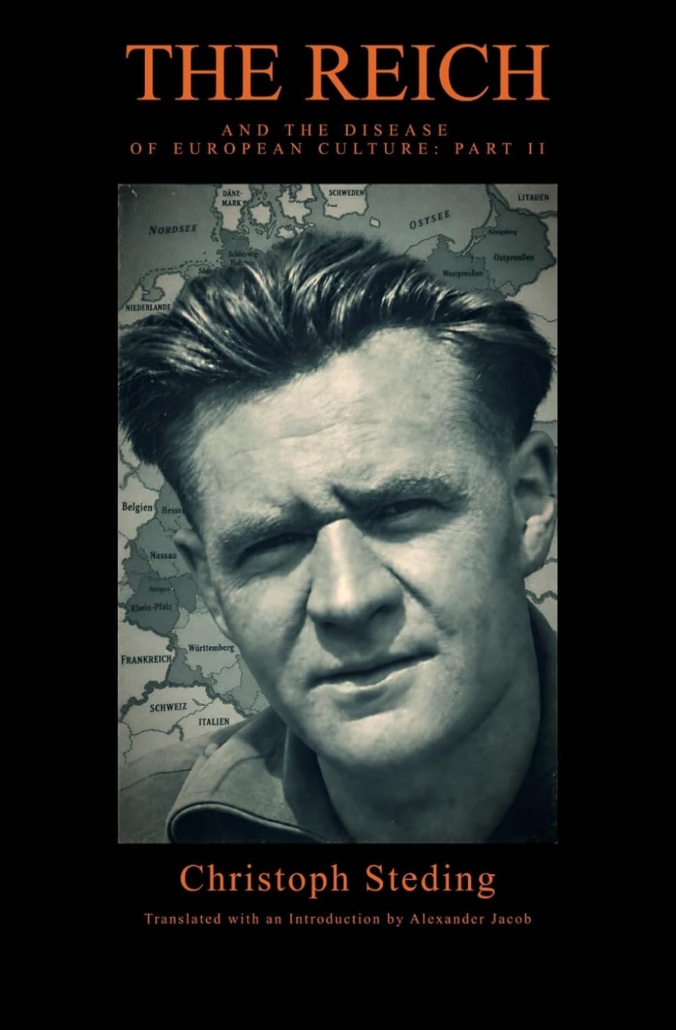
Dr. Alexander Jacob’s translation of Christoph Steding’s The Reich and the Disease of European Culture: Part II, previously reviewed here by K.R. Bolton.

Max Nordau in wolf’s clothing?
Steding a very forward-thinking spirit. Astonishing that
even back then (after the Weimar era), he foresaw that
“women’s lib” would lead to a decline in the birth rate.
https://pdfhost.io/v/jKcKubnKap_Steding_-_Weber_-_1932
https://archive.org/search?query=creator%3A%22Christoph+Steding%22
https://www.youtube.com/watch?v=iUhoKh94r8Y
https://de.zxc.wiki/wiki/Christoph_Steding
Christoph Steding’s Struggle Against the Neutralization of the Reich
by Armin Mohler
There is a certain kind of strong-willed writer who sharply divides opinion: some dismiss them as cranks out of hand; others regard them as trailblazers deserving of respect. Evenhanded judgments between these two extremes are strikingly rare. Our crisis-ridden century has produced a whole series of such unsettling thinkers, speakers, and writers. One especially extreme case is Christoph Steding (1903–1938), a farmer’s son from Lower Saxony who died young.
Friedrich Georg Jünger, a man devoted to proportion and form, gave him the nickname “the Nordic giant flatfoot.” For Carl Schmitt, whose instincts were always alert, Steding’s hefty tome The Reich and the Malady of European Culture was of great importance. It appeared in November 1938, ten months after the author’s death, from the Hanseatische Verlagsanstalt in Hamburg. Schmitt called it “the most intelligent book from the orbit of National Socialism” among his circle of friends. (Others even claimed to have heard Schmitt call it “the only intelligent book” of that kind.)
Steding, who died of kidney disease at just 35, is a typical one-book author. His Marburg dissertation, Politics and Scholarship in Max Weber, published by Korn in Breslau in 1932, was still the work of someone searching for direction; it scarcely bears comparison with his major work. And that major work itself was described by Steding admirer Carl Schmitt as “a brilliant torso … The whole thing seems more like the first draft of a cyclopean construction than a well-engineered architectural design.” Its structure reflects the condition of the manuscript. When Steding died suddenly on the night of January 8–9, 1938, only the 48-page introduction—which summarized his arguments—was ready for print. The rest of the manuscript consisted of a disordered heap of first drafts, barely revised and with little connection between them. A historian two years younger than Steding fashioned the book we have.
That coauthor was Walter Frank (1905–1945), who from 1935 to the end of 1941 headed the “Reich Institute for the History of the New Germany” in Berlin, which he had founded. He had achieved early success with bold yet well-grounded books on recent history: one on the Stoecker movement in 1928, and another on France during the Dreyfus Affair in 1933. He was not a member of the Nazi Party and was politically closer to an adherent of Ludendorff. He fell out of favor in 1941, endured years of factional struggles and intrigues, and killed himself on May 9, 1945, after American forces entered Bavaria.
Christoph Steding and Walter Frank met in late 1935 and discovered that they were kindred spirits. In the spring of 1936, Steding moved with his family from Lower Saxony to Berlin. As the powers’ struggle for hegemony was taking shape, Frank considered the book his friend was working on at least as important as tank regiments. He wanted Steding to become the figurehead in the Reich Institute’s campaign against the liberal school of history that still dominated university life. Frank’s response to the death of his friend and idol reflected the voluntarist spirit and style of the situation and the era: from June to September 1938, he shut himself away to turn that disorderly pile of loose pages into a book, using scissors, paste, and organizing headings and subheadings. The book appeared in the year Steding died, accompanied by a long essay by Frank, “Christoph Steding: A Memorial,” intended to prepare readers for what followed.
Carl Schmitt judged the result this way: “As a consequence, much of it is fragmentary, unsystematic, and subjectivist, even impressionistic”—for Schmitt, one of the worst insults—“with digressions and repetitions, mere flashes of insight and outbursts, the important and the less important placed side by side …” And yet, for Schmitt, Steding’s “posthumous book” was a work “whose horizon and dimensions, whose decisiveness and abundance of ideas, must inspire astonishment.”
The great legal scholar’s warning not to take Steding too lightly is as thought-provoking as the fact that his hefty tome, which demanded considerable effort from its readers, was a genuine popular success: it went through five editions. The third edition, of 3,000 copies, appeared in 1942; the fourth, of 5,000 copies, in 1943; and a fifth edition followed in 1944. At the same time, the Hanseaten Library, established for field-post mail, circulated an excerpt from the book under the title The Reich and the Neutral Nations.
Neither publication, however, enjoyed unqualified support from the official propaganda apparatus. Carl Schmitt’s classification of Steding as a National Socialist must be understood from Schmitt’s own perspective. Anyone who distinguishes between National Socialism and the Conservative Revolution must place Steding in the latter camp. The Hanseatische Verlagsanstalt was an exclusively Conservative Revolutionary stronghold, and Steding’s book soon became caught up, along with Walter Frank and his Reich Institute, in the kind of ostracism common even in the Third Reich.
What gave Steding’s tome its particular force, despite the obstacles just mentioned? Anyone who picks up The Reich and the Malady of European Culture today can still feel its driving energy—as though the fall of the Berlin Wall had brought it back to life. At a time when Fukuyama is proclaiming the global triumph of liberalism, one reads with heightened attention what an outsider like Steding said half a century ago about liberalism’s depoliticizing—and therefore existentially threatening—effects.
At the same time, one can see that this is an internal critique of liberalism. Steding cannot hide the fact that he had absorbed liberalism through every pore, like a country boy in the big city, and now wants to sweat it out through a drastic cure. That gives his book its momentum, even in its writing style—indeed, its almost manic intensity.
Steding’s book seems to have grown out of a conversion experience. From 1922 onward, he studied at various universities. His subjects included philosophy, history, German literature, and geography; later he added folklore and even Indology. By the mid-1920s, his research focus had crystallized around an attempt at a comparative cultural history of Java. Then, toward the end of the decade, came a shock. One day, it must have suddenly struck Steding how grotesque it was that, at a time when existential threats were visibly gathering over Germany, a young German should be occupied with—of all things—Java. From today’s perspective, what is astonishing is that this shock did not drive Steding, as it did so many others, into Hitler’s arms.
Drawing on conversations with Steding and the papers he left behind, Frank can outline his friend’s view of history precisely. For Steding, his homeland—“the farming country of Lower Saxony”—had been “without an hour and without time” since the fall of the Hanseatic League: in other words, “without history,” “apolitical,” and “neutral.” “Great history and great politics seemed to have passed by the ‘inward-looking’ and ‘self-contained’ region of Lower Saxony. Only in 1866 did they enter it again.” This is not meant in a merely military sense. For Frank, Steding embodied Prussia’s “old power: its ability to draw the strongest minds and souls to itself precisely from beyond Prussia, and to make them heralds of its glory.”
Steding’s personality fits neatly into this picture. He had no use for “fruitful chaos”; anything chthonic was alien to him. Farmers are often much more sober-minded than they are portrayed in novels or films—especially a farmer’s son like Steding, the eldest child, who was expected to inherit the family farm but became the first in a long line of generations to break away and choose an intellectual life, apparently leaving his family behind in the process.
For Steding, Hegel and Bismarck were “the most significant Germans of the nineteenth century.” By invoking these two names, he meant to show “what possibilities this wonderful people harbors within itself when a wandering, even wayward spirit—the spirit of Hölderlin—is held together by the iron bonds of a state.” This vision was quite distant from that of National Socialism, whose dynamism sprang from the dichotomy between people and state—or, more precisely, between movement and state. The Hitler movement arose out of the ethnic-national struggle in southeastern Europe; its opposition to the multinational Habsburg state prevented it from developing an unreserved relationship to the state, even if Hitler later knew how to make use of what remained of the Prussian state apparatus. For Steding, a Lower Saxon, ethnic-nationalist ideas must have been foreign.
Walter Frank defended his protégé’s abstention from such ideas at length in the context of 1938: “In that farming region of Lower Saxony, by contrast, which has the highest proportion of Germanic-Nordic blood in all Germany,” the ethnic substance was not under direct threat. The real danger to this people, he argued, was not foreign influence but neutrality, defined as “flight from world history into an excessively narrow attachment to one’s kin.”
This brings us to the question that truly drove Steding’s book: How did the “Germanic border states” become detached from the Reich, and why did they turn into such outright “enemies of the Reich”? Christoph Steding wanted to know. In the midst of the Great Depression, with help from a Rockefeller Foundation fellowship he had managed to secure, he set out on a study tour that lasted more than two and a half years, with a few short breaks. His “fieldwork” focused on the neutral states of Germanic character surrounding the Reich, including the Scandinavian countries, which had never belonged to it.
The journey began in Basel, which Steding’s book casts as a kind of secret counter-capital of the Reich. He stayed there from October 1932 to March 1933. His next stops were Zurich, Bern, and Geneva, from March to May 1933, followed by Leiden and The Hague, from June to October. In the winter of 1933–34, he sat down at his desk back home and continued writing the polemical book against liberalism and its neutralizing effects that he had begun in 1931. In May 1934, Steding set out again, this time for Scandinavia. His main stops were Copenhagen, Oslo, Uppsala, Stockholm, and Helsinki. He returned to Germany for good in April 1935. From then until his death in January 1938, he worked on his magnum opus.
I happened by chance to learn something about Steding’s working methods. In the first postwar years, I mentioned Steding’s name to a Basel historian about a generation older than I was. The man looked surprised, then drew me aside. It turned out that, as a student, he had befriended Steding during his stay in Basel and had supplied him for years with newspaper clippings from the local press. The historian clarified: “What was surprising was that Steding was interested not only in local politics and the political mood in the country—he also specifically asked for clippings about cultural events and economic developments.”
As we can see, Christoph Steding had renounced cultural history for himself and called for the restoration of the primacy of grand—that is, political—history, yet he did not abandon cultural history as a tool. On the contrary, he used it enthusiastically to investigate why the neutral countries around Germany had become such pronounced “enemies of the Reich.” The title The Reich and the Malady of European Culture is itself a challenge to every liberal. For Steding, the malady consisted precisely in the absence of the “Reich.” European culture was sick in the age of liberalism because, in forgetting the Reich, it had become mere culture—a “purely cultural” entity, living on borrowed time until higher authorities decided whether Europe would survive at all.
Steding had a rich arsenal of invective with which to denounce this “corruption of the instincts” and the “paralysis of Central Europe,” which, since the Thirty Years’ War, had increasingly paved the way for decadence. For Steding, decadence took the form above all of neutralization: people’s energies were diverted toward trivialities to keep them from tackling truly urgent tasks. The immediate gratification of private desires, the consumption of fleeting pleasures, and empty generalities took precedence over building enduring structures that could satisfy the mind and soul as well.
A telling example is Steding’s stigmatization of the North German who, in our century, most convincingly incorporated the irrational into his system of thought: Ludwig Klages. Klages’s move to Switzerland soon after World War I was, for Steding, a kind of geographical confirmation of his intellectual classification. He considered Klages just as much an “enemy of the Reich” as the Swiss theologian Karl Barth, with his rather bloodless dialectical theology.
Indeed, the Hanover-born Klages would have fit into Steding’s system even if he had moved only as far as the Titisee rather than Lake Zurich. Steding’s book gets its particular dynamism from a geographical twist. For him, the chain of neutral states running from Switzerland through Holland to Scandinavia, encircling the German Reich with their hostility, was only “the outer ring of neutralization.” The “inner ring of neutralization” ran in a mirror image within the 1937 borders of the Reich. Unlike the overt enemies of the Reich from Basel to Copenhagen, this inner ring was a zone where more covert enemies operated. The main corridor of this activity ran through the university cities of Freiburg im Breisgau, Heidelberg, Frankfurt am Main, Bonn, and Cologne. The significant details Steding—particularly sensitive to cities of this kind—gathered about them make nearly every one seem like a potential Basel, or perhaps a Zurich.
Anyone who was once moved by Steding’s book and picks it up again after several decades can hardly resist the temptation to adopt an ironic tone when describing it. Distance makes it easier to feel what Steding distorts and what he forcefully bends to fit his argument. Even during the Third Reich, critics pointed out that Steding’s two rings of neutralization—the outer and the inner—were not the end of it. Given the long list of men considered part of the national heritage whom Steding suddenly accused of hostility to the Reich, beginning with Nietzsche, Langbehn, and Stefan George, one had to wonder whether there was any German region at all that could not be accused of hostility to the Reich. A wit summed it up this way: On Steding’s map of the Reich, there is just one small spot that is white and clean. It says: Potsdam—Hegel …
Can Steding be better understood by looking at his enemies? That does not help either. What about the two groups from which official writers in the Third Reich usually drew their enemies? If I remember correctly, Freemasons do not appear in Steding’s work at all. Jews do appear, in a negative light, but they seem unimportant to him; they merely move into a vacuum created by others. These passages seem so contrived that one wonders whether the editor, Frank, may have added them. That is not so far-fetched, since Frank removed a number of passages from his friend’s text that would have been especially painful for the National Socialists. Why would he not also have inserted a few alibi passages to compensate for all the material in the book that still did not fit the official line? Where Steding’s text uses terms such as “extermination” and “liquidation of the resistance”—words that make us recoil today like Pavlov’s dogs—they are clearly directed against fellow members of the Germanic race.
Steding’s part of the book begins: “Since the French Revolution, the history of Europe has been marked by the retreat of the Germanic peoples from world history.” But, fundamentally, non-Germanic peoples do not appear in Steding’s work at all; they no longer interest him, and Java’s spell has worn off. For him, that retreat is solely an internal matter within the family of Germanic peoples. Here we reach a central point in Steding’s system. Its coordinates are not easy to trace, because he proceeds according to the maxim: “No phenomenon of an age stands alone; each conditions the others, and vice versa.” When the Germans’ power to build a Reich wanes in Central Europe, other Germanic peoples or parts of peoples turn outward or inward: “either withdrawing into themselves, as Switzerland does, or reaching out for foreign lands and seas, as the Netherlands or England do.”
Steding admired “a vision that takes in entire continents,” but he also recognized the danger of dissipating oneself in distant places. One cannot miss the Puritan tone in this North German. He despises the “Europe aligned with the victorious ideas of Western Europe, which lived outwardly in material prosperity and was therefore especially interested in the sanctity of treaties,” yet in truth lived “in the greatest unease.” Steding sets against these base passions the Germans’ passions for the Reich, as they believe themselves best able to understand “the true fundamental law, the true constitution of Europe.” He traces this “claim of the German world” to the fact “that God has prepared and made it ready in a very particular way, through infinite suffering, to gain the deepest insight into the structure of our world.”
This genuinely messianic claim may have kept Steding, despite his predisposition, from sinking into Puritan rigidity. A good example is how casually he treats the Second Reich, despite his admiration for Bismarck. It could be “a stage, not the goal.” Resistance to “the Wilhelmine hardening of Germany” had been necessary to keep the country from falling into “the hands of the traditionless capitalist bourgeoisie or of the nobility, hardening or softening as it reached the end of its time.” And what Steding goes on to say, in cautious terms, about Nazi Germany suggests that he, too, could see the Third Reich as “a stage, not the goal.”
Perhaps the best way to approach Steding is to take seriously his view of illness as an often necessary scourge. But while writing his book, he believed a point had been reached at which it had become nothing but a vice: “If the sickness of Europe, especially the sickness of the Germanic world, has until now been fate, doom, a God-sent affliction from which there was no escape; if sickness can sometimes be a blessing for a people or an individual, because it can preserve them and keep them from rushing prematurely into ‘business’ that can rob them of their soul—then a point has now been reached when resolution, catharsis, a turning point, a new verse, or catastrophe must come. The sickness of Europe is now a sickness unto death or a sickness unto life.” Steding wrote this by 1937 at the latest.
The writer has a complicated relationship with Steding’s book. On the one hand, as a native of Basel, I found it flattering because it cast my hometown, at least, as a kind of counterpoint to the Reich. On the other hand, the same book helped lead me, four decades ago, to leave my Swiss homeland. In the meantime, what I fled has caught up with me again in West Germany. The Swiss form of neutralization that Steding so sharply identified—self-righteousness and a cult of mediocrity—has since become the dominant life goal of the society where I now live. And it remains to be seen whether the events since November 1989 can change that.
Such conflicting experiences encourage me not to take the geographical framework of the book under discussion too seriously. Perhaps it was merely a tool for its author, a way to bring some order to material that weighed on and overwhelmed him. The drama Steding distributed among the choruses of various regional groups is probably, in reality, a drama that has been playing out for more than a century in the mind and soul of each individual German.
In his introduction, Steding’s sympathetic friend Walter Frank points out that Steding himself was receptive to the “bewitching charm” of dying liberalism, to its “thousandfold sparkle of lights like those of the modern metropolis, its very own child.” That, however, was also why Christoph Steding’s engagement with liberalism was not merely a staged fight, after which one could go backstage to remove the makeup. You can still feel that in his book today. For all its one-sidedness and fervor, it remains an exciting read.