
Tommy Robinson: GUILTY – the Case Explained
The Tommy Robinson verdict cements a dangerous double standard and exposes how the media and the state work hand-in-glove to attack political targets and silence dissident voices with impunity.
On October 28th 2026 Tommy Robinson was found guilty by majority verdict at Southwark Crown Court on two counts of harassment causing fear of violence. The jury had deliberated for over 11 hours before finally delivering their verdict; however, they were split 10-2, meaning that the decision was extremely close, and had one more of their number decided to acquit, then Tommy Robinson, real name Stephen Yaxley-Lennon, would have walked free from court with the case being ruled as a mistrial. This result is even more surprising due to the fact the case was held in Southwark, which has one of the most ethnically and religiously ‘diverse’ populations in the UK, with White Britons making up less than 36% of the population and more than 40% of the population being born outside of the UK. Given Tommy Robinson’s background, the prosecution would have no doubt believed that he would have fared much worse in Southwark, where the jury would likely be composed of individuals from ethnic minority backgrounds and White Britons with a more liberal mindset.
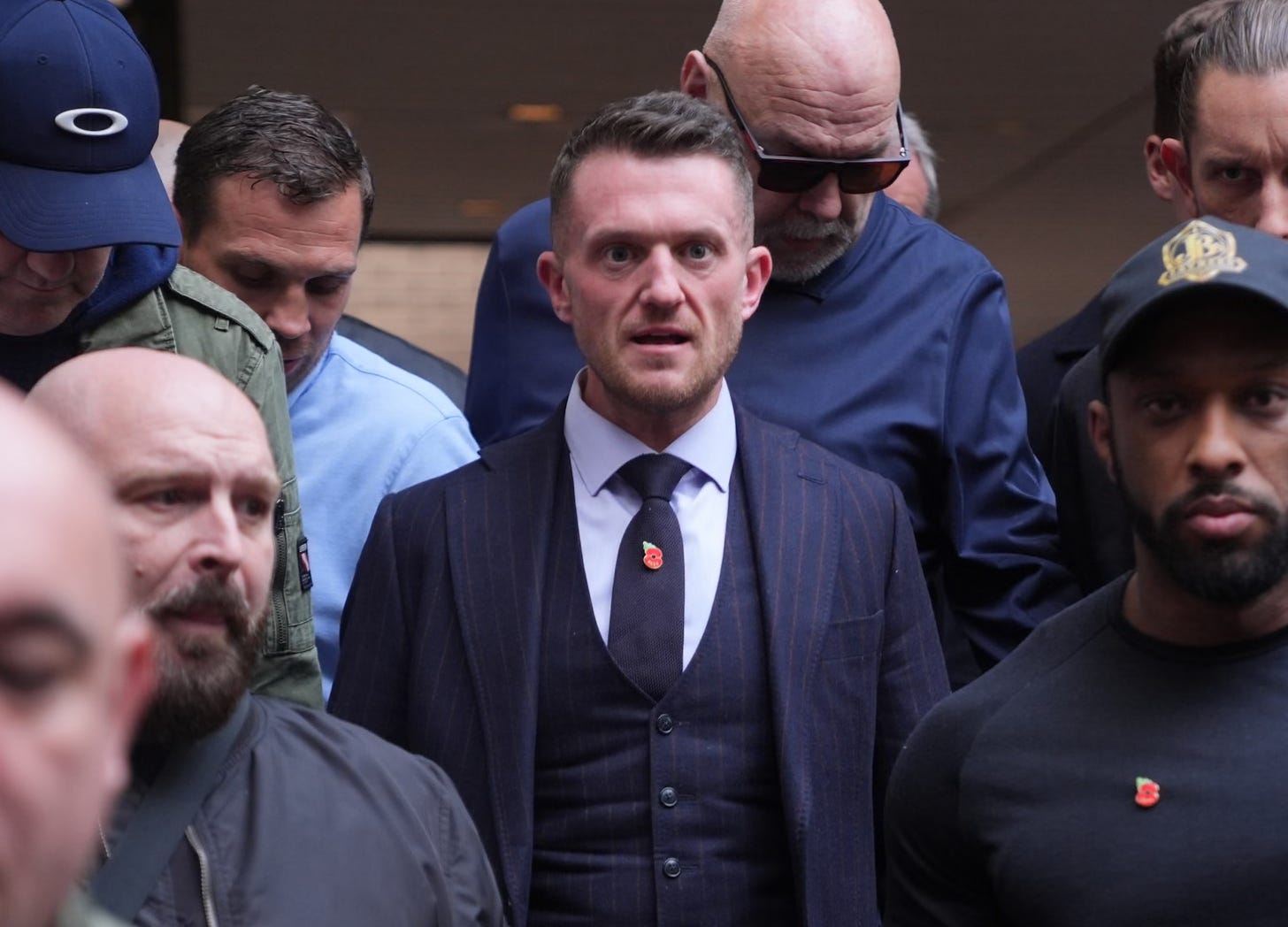
Yet despite this, the 10-2 split shows that even with a jury that was likely extremely diverse, Tommy Robinson was very close to achieving what is known as a hung jury, which results in a mistrial. At that point, the jury would have been discharged, Tommy Robinson would have walked out of the courtroom as a free man, and the Crown Prosecution Service (CPS) would have had to make the decision as to whether it was in the public’s interest to try him a second time. Defendants can be tried a second time if their first trial results in a hung jury; however, if their second trial also ends with a hung jury, they are discharged and the judge overseeing the case formally acquits them. Had Tommy Robinson been tried for the same offence but in another court, for example Chelmsford in Essex, where the population is 83% White British and made up largely of former Londoners who left the capital during a massive wave of ‘white flight’, it is highly likely that he would have achieved a hung jury or even been acquitted.
This inequality when it comes to jury trials is something that the establishment is well aware of. However, the establishment cannot just pick any court to try a defendant; under the Criminal Procedure Rules, a case must generally be heard in the criminal justice area where the alleged offence took place or where the defendant was arrested. In this particular case, because the ‘victims’, two Daily Mail journalists, were primarily headquartered in London at the newspaper’s central office, the Metropolitan Police were the investigating force, and that is why London was chosen as the location for the trial. At this point, HM Courts and Tribunals Service (HMCTS) chose Southwark as the venue. However, it must be noted, the alleged crimes for which Tommy Robinson was charged did not take place in the capital. But even though the case was to be held in London, it could have been heard at a number of other courts. The case could theoretically have taken place elsewhere, especially as Tommy Robinson’s legal residence is in fact in Bedfordshire.
Yet, the choice of Southwark ensured the trial would be anchored in the capital, setting the stage for a confrontation that was triggered not by geographical proximity, but by a bitter feud between the independent activist and the mainstream media. How Robinson actually ended up in that courtroom stems from a legal defence rooted in retaliation – a claim that he was not the aggressor, but was simply responding to extremely unfair treatment at the hands of the press, which he claimed had gone far beyond normal reporting and had put himself, his ex-wife, and his children at risk. What would follow was a high-stakes trial where the state would again attempt to elevate the press to a position where they are essentially untouchable – allowing ‘journalists’ to operate with impunity while effectively tying the hands of those whom the press seeks to make an example of.
The case itself had been several years in the making and began in the wake of the disturbances that erupted after the Southport killings. On August 5th 2024, the Daily Mail published a front-page story which included a picture of Tommy Robinson on a sunbed at a holiday resort in Cyprus. The Daily Mail headline read, “Stoking Race Riots From His Sunbed”, and the article alleged that Tommy Robinson had made a number of incendiary social media posts which included false or unverified claims, and as a result, he was inflaming tensions in the UK whilst essentially hiding abroad. But the paper did not stop there; the Daily Mail included a picture of Tommy Robinson’s ex-wife, who was with him in Cyprus along with their three children, and then went on to identify which resort they were staying at. Tommy Robinson was understandably furious about this and launched a retaliatory campaign against the two journalists named as the authors of the article – Andrew Young and Jacob Dirnhuber.
Tommy Robinson then employed the services of private investigators to track down the journalists and later posted images of Dirnhuber and Young outside their own homes on his X account. He then confronted the journalists over the phone, telling Dirnhuber, “I’ll be knocking on your door,” and telling Young, “I’m coming to get you.” He then vented his anger at the newspaper’s hierarchy, leaving an expletive-laden voicemail for Daily Mail editor Ted Verity promising to “make you famous and your families”. As a result, the Metropolitan Police initially arrested Tommy Robinson in August 2024 and he was later charged by the CPS on May 21st 2025 with two counts of harassment causing fear of violence. This set the stage for a trial which would begin on October 19th 2026 and result in the aforementioned guilty verdict by majority decision. But the differing perspectives on exactly what had occurred are extremely illuminating and point again to another strong example of an extremely unfair two-tier system.
During the trial, the CPS put forward the argument that the Daily Mail’s investigation into Tommy Robinson was merely legitimate reporting that fell well within the classification of public-interest journalism. They then put forward the assertion that Tommy Robinson wielded immense social media influence and was using that influence in an irresponsible manner during what they called a “period of national crisis”; as a consequence, they claimed that tracking his location and reporting on his current political messaging was deemed entirely justifiable. The prosecution then made the claim that Tommy Robinson’s response was wholly different and clearly crossed the line from a public dispute into criminal conduct. The CPS argued that publishing photos of a journalist’s family and then going on to send explicit threats like “I’m coming to get you” were a calculated attempt to weaponize his support base in order to terrorise and silence the press. As such, the CPS claimed that this was not only a criminal act, but also an attack on the freedom of the press and an attempt to censor the media.
Tommy Robinson’s defence framed the events very differently; they put forward the argument that the Daily Mail had gone far beyond what could be termed as legitimate journalism. The defence claimed the Daily Mail article effectively “doxxed” Tommy Robinson’s family by identifying their exact holiday resort, which led to immediate security threats and was an act of extreme provocation, which was then responded to in kind. Tommy Robinson put forward the argument that he reacted to such extreme provocation in a “panicked” manner and did what any father would do to protect his family. Tommy Robinson claimed that his subsequent actions – hiring private detectives and confronting the journalists – were not carried out in order to cause fear of violence, but instead were necessary and desperate measures to force the Daily Mail to take down the images of his family. He argued he was simply giving the journalists a taste of their own medicine in order to make them understand what they were doing to him and his family. Tommy Robinson claimed that his actions were not because of the negative press, which he regularly receives, but because the story went beyond an attack on him, and placed the crosshairs over his family as well.
Ultimately, however, the jury favoured the prosecution’s interpretation of criminal conduct over the defence’s argument of panicked paternal protection. With the 10-2 majority guilty verdict secured on both counts, the focus of the court immediately shifted from liability to punishment, triggering a strict judicial assessment of potential jail time. Each count carries a maximum custodial sentence of 10 years – with an absolute maximum of 14 years if the harassment was racially or religiously motivated, which would result in a 40% uplift. When determining the sentence, a judge follows a two-step sliding scale based on culpability (the offender’s role and planning) and harm (the impact on the victims). In this case, the prosecution claimed that there was a high degree of sophisticated planning. They pointed out that Tommy Robinson used private investigators, located home addresses, and then used those details to coordinate an online campaign that reached millions of his followers. This would likely place his actions firmly into what is known as Category A, the highest degree of culpability. Next, the judge would assess the harm caused by the crime. In this case, the court heard that one journalist was forced to move house, while the other claimed that he was so shaken by the events that it required his employer to provide him with round-the-clock close protection. This tier of disruption to the victims’ day-to-day lives meets the threshold for what is known as Category 1, the maximum degree of harm.
This places Tommy Robinson in the A1 bracket when it comes to sentencing. When an offender is judged as demonstrating both high culpability and maximum harm in this particular offence, the Sentencing Council’s standard starting point is 2 years and 6 months in prison, with a typical range of 1 to 4 years for a standard first-time offender or when dealing with an isolated offence. However, in the case of Tommy Robinson, the sentence will be further aggravated by his previous criminal history. Under English law, a defendant’s past criminal history is used to raise the sentence within or beyond its standard range. Tommy Robinson is known to have a significant history of public order offences, contempt of court rulings, and a previous 2021 Stalking Prevention Order specifically relating to the harassment of an independent journalist. Then there is the issue of the two separate charges, and the fact he was convicted of both.
Due to the fact that Tommy Robinson was convicted of two separate counts, one for each journalist, the judge has the legal authority to sentence him consecutively (running the terms back-to-back) or concurrently (at the same time). However, in this case, as both the offences are virtually identical and were committed at the same time, it is highly likely that the sentences for each offence will be served concurrently. If the sentences were to be served consecutively, which would be highly unlikely, the judge would still be bound by the principle of totality, which states that the total aggregated sentence must be just, proportionate, and not excessive to the overall offending behaviour. This would usually result in the judge lowering the length of both sentences so when added together the overall duration was not disproportionate. As a result of all of these factors—the high culpability, the maximum harm, and an extensive criminal history—Tommy Robinson will likely face a custodial sentence of between 2 and 5 years.
What is immediately apparent in this case is that Tommy Robinson responded in kind to the journalists who showed no reservations when it came to broadcasting his location, exactly where he was staying, and even included a picture of his ex-wife. As his ex-wife had nothing to do with the social media posts that the Daily Mail was reporting on, including her in the pictures was completely unnecessary. Usually, when the press reports on an individual, they either omit images of their family or blur the faces of those captured in pictures who are not directly involved in any alleged criminality or wrongdoing. Journalists do, however, have an interesting habit of engaging in the practice of ‘doorstepping’, where they arrive at someone’s home and surprise them on their doorstep before going on to publish photographs of the interaction, letting their readers effectively know exactly where the person in question lives. Journalists do this with impunity, and the practice is largely covered by what is known as ‘freedom of the press’. Bearing in mind that many publications have readerships that total in the millions, this practice could obviously place an individual at risk. However, according to the police, the CPS, and the courts, this is legitimate reporting.
Conversely, when Tommy Robinson engaged in similar activity, the journalists in question claimed to be in fear for their lives; one claimed to have to move home and the other requested that round-the-clock protective security measures be put in place. What’s more, the police, the CPS, and the judiciary take such actions extremely seriously. This is, of course, a rather interesting turn of events, and is a glaring double standard. The issue with this particular case is that it sets a precedent which essentially allows journalists to not only harass the subjects of their articles but also include images of the subject’s family in print, whilst any similar activity aimed at said journalists is absolutely off the table. Effectively, this creates a one-way street whereby journalists have a set of rights which benefit them, yet these rights are not extended to the people they harass. This allows journalists to target those with whom they have political differences and leverage pressure upon them through the practice of needlessly including their family members in articles and publications.
This privilege is not an accident of law, but a symptom of a deeper symbiosis, where the state – through the mechanisms of the police, the CPS, and the courts – actively insulates the mainstream press, effectively placing corporate journalists in a position of institutional power. Conveniently, the same journalists and the mainstream press often use that power to attack radicals and political dissidents who are viewed as enemies of the state in what can be seen as a reciprocal action. By operating hand in glove with government interests, mainstream outlets can systematically undermine activists who serve as a thorn in the side of the establishment. This no doubt pleases those in positions of authority, who then use their powers to protect and insulate those in the media from any blowback that they might receive when heaping unfair pressure on political activists whose activities and opinions are deemed ‘unacceptable’ by the government of the day. Some might wave this point away as being ‘conspiratorial’; however, another observation can be made that gives further credence to the theory of the state and press working hand in glove.
It can be clearly observed that the privilege of the press to harass and stalk is highly limited and only applies to journalists working for mainstream publications. While those working for papers such as the Daily Mail or for institutions such as the BBC are allowed to use a range of different measures in order to secure a story or create a shocking ‘expose’, citizen journalists are strictly forbidden from using the same methods. An example of this is observed by looking at the case of independent broadcaster Alex Belfield. Alex Belfield, who is a former BBC local radio presenter and later became an independent commentator with a large YouTube following, used his platform to publish the details of a number of his former BBC colleagues in relation to stories involving both corruption and the misuse of public funds. Yet despite operating as an independent citizen journalist, Alex Belfield was sentenced to five and a half years in prison for stalking and handed a number of indefinite restraining orders relating to those whom the court deemed as his ‘victims’.
The courts clearly draw a clear distinction between the activities of the mainstream press and citizen journalists who act outside of traditional channels and publish their material primarily on social media. This is another clear example of a two-tier system which benefits a protected class whose interests align with those of the state. As such, the courts argue that when the mainstream media publishes the location of a public figure like Tommy Robinson, such an action is legally protected under the Public Interest Exemption. Further to this, the courts state that publishing such stories does not carry the intent to cause violence, nor does it involve a direct, personal, or explicit threat. However, the courts state that when an individual such as a citizen journalist or a political activist responds to such an article by tracking down the private residential home addresses of individual reporters, publishing photos of their families, and sending them direct messages, this is no longer journalism, but instead, harassment and stalking.
However, a clear grey area can be observed which the courts seem happy to ignore. When a newspaper or broadcaster publishes a story about an individual, and that story is wholly negative and unbalanced, such a piece paints the subject of the article as a ‘villain’. This may be excused when reporting on a convicted criminal who has committed a violent or particularly heinous act. But when the story in question is about an individual who merely has a different political opinion from the publication or journalist behind the article, the subject of the article is painted as the ‘villain’ due to the fact they essentially have done nothing more than hold the ‘wrong opinion’. What’s more, such reporting does stir up anger and vitriol from certain sections of the wider public. As a result, when the individual who is the subject of the article is not only highly identifiable, but their location can easily be gained from pictures accompanying the piece and images of their family are also made public, this clearly does pose a serious risk not only to the subject’s safety, but also to their family.
The suggestion that the mainstream media knowingly places people at risk is not merely conjecture. Such an assertion can be evidenced by the fact that over the last two years there has been at least one attempt on Nigel Farage’s life. What’s more, Reform UK spokeswoman and former MP Ann Widdecombe was brutally beaten to death in her own home in a politically motivated act of terrorism. The man responsible for the attempt on Nigel Farage’s life was the very same man who went on to murder Ann Widdecombe. When the attacker was finally arrested, the police found a large number of press clippings relating to Nigel Farage, Ann Widdecombe, and Reform UK all over the walls of his bedroom. Bearing this in mind, any reasonable person would conclude that the Daily Mail’s decision to publish Tommy Robinson’s location and include images of his ex-wife could well have put him – and his children – at the risk of harm. This is exactly the reason why the prosecution would have been happy that his trial took place at a court where the jury was being drawn from a population that was likely to be far less sympathetic to him and his views.
Tommy Robinson indeed acted in a manner that was inadvisable and making threats to journalists or other members of the establishment will always play into the hands of the state and likely lead to a criminal conviction. However, in this case the threats followed what was a clear, obvious and rather egregious form of provocation which went far beyond any reasonable or measured form of ‘journalism’. Mentioning Tommy Robinson’s exact location and including a picture of his ex-wife added nothing whatsoever to the weight of the article in question. As such, the only reasonable conclusion that one could draw is that the Daily Mail and the journalists in question chose to add those extra details out of spite – as they would have known that doing so would likely place the family at risk, or at the very least, make them feel extremely uncomfortable. This assertion is backed up by the fact that the jury spent so long deliberating and two of the jurors refused to enter guilty verdicts. What’s more, had the case been heard in an area that would have provided a less diverse jury, it may very well be the case that Tommy Robinson would have walked out of court a free man.
Now Tommy Robinson has been convicted, he will likely face a lengthy jail sentence, and it would be very unlikely for him to walk free with either a suspended sentence or a community order. Considering that this court case is set to the backdrop of two extremely serious politically motivated acts of terrorism against leading members of Reform UK – one of which involves a brutal murder – it makes the actions of the aforementioned Daily Mail journalists at best extremely reckless, and at worst, a knowingly spiteful act that put a man, his ex-wife and three of their children at risk. However, the journalists who did this will be officially reported on as ‘victims’ and will never face any legal repercussions or censure for their actions. This essentially creates another two-tier system; one in which journalists working for state approved corporate media can do as they wish, operating with impunity and putting political dissidents who the state wishes to silence at risk. Meanwhile, those attacked by the media or those working as independent citizen journalists must operate within an entirely different and much more restrictive set of rules.
POSTSCRIPT: Both myself and many of my colleagues have been victims of the press and the media abusing their power. I myself have been ‘doorstepped’ and have had images of my house published by the press and the media. This has led to attacks on my property – windows were broken, my car was vandalised, and graffiti was left on the pavement directly in front of my house. Had I or any of my colleagues retaliated and attempted to ‘get even’ with the journalists who chose to clearly identify where we lived, we would likely have felt the full force of the law. As a final thought, it is extremely telling that while the press and the media love to ‘doorstep’ political dissidents and reveal the locations of their homes to the public, the media and press do not extend this practice to actual criminals. When reporting on sex offenders and paedophiles, the media often shows a remarkable amount of restraint in order to ensure that said criminals are not put at the risk of harm.

Leave a Reply
Want to join the discussion?Feel free to contribute!