
Mark Wauck on a J Street Poll
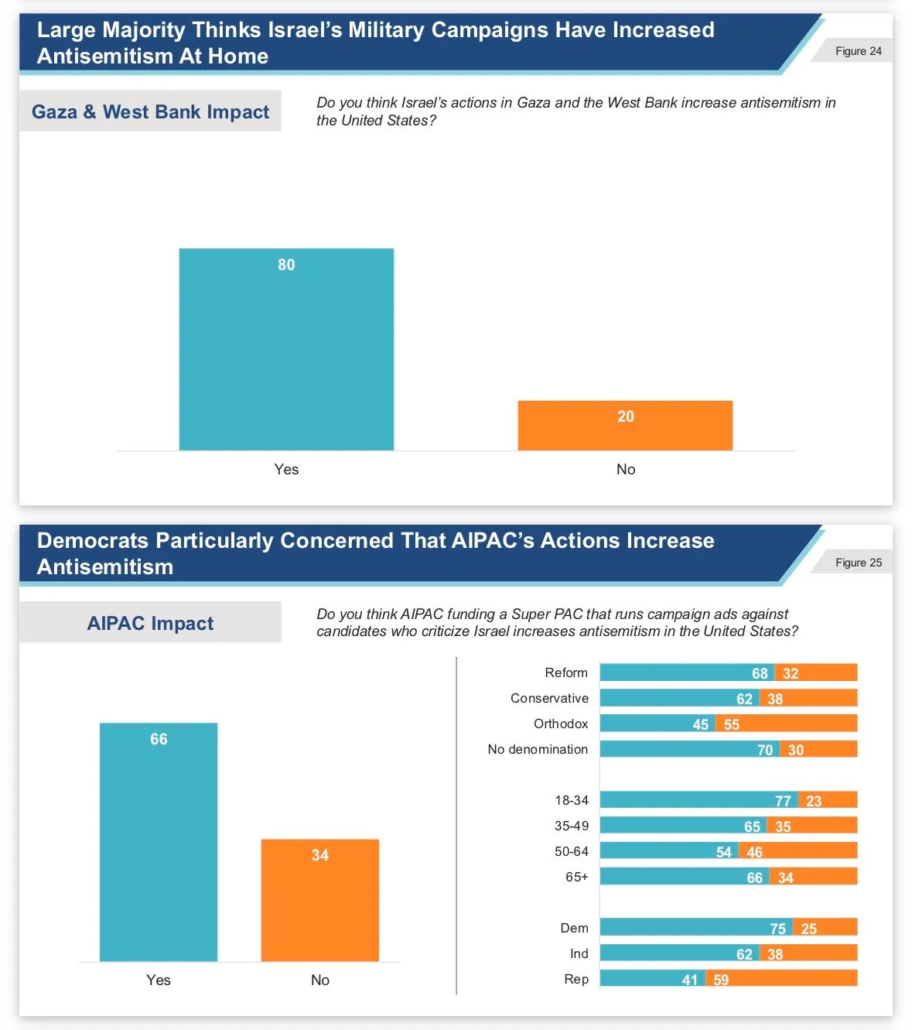
FWIW: Not sure any poll of Jewish attitudes is accurate because much depends on the current context (e.g., whether Jews feel safe; how they want to present themselves to the goyim), but it certainly makes sense that they would realize that Gaza increased anti-Semitism. Re Jewish attitudes on Palestinians, it’s doubtful that Jews saying they “sympathize with both” are really not more sympathetic with Israelis, and it’s not clear what “sympathy for both” would really come down to if Israelis were really in danger as Palestinians are every day in the West Bank and Gaza.
https://meaninginhistory.substack.com/p/talking-anti-semitism-blues
This is rather interesting—at least it is to me. Since I use the term “Jewish Nationalism” on a regular basis (Talking Anti-Semitism Blues), I want to offer this further update on the J Street poll, because it does shed light on that issue. When I looked at the graphic below—posted by Max Blumenthal—my reaction was as follows.
It appears that Jews who are less strongly affiliated to any particular denomination are—compared to more strongly affiliated Jews—significantly less supportive of Israel and more inclined to sympathize with Palestinians. That probably means a less strongly developed sense of identity with a general “Jewish Nation.” The further conclusion is that this breaks down by age—not entirely, but to a predictable degree—with younger Jews significantly more likely to fall into that less strongly identifying or less strongly affiliated group. It’s not a 1:1 correlation, but it’s predictive. Now, what “sympathetic to both” actually means is anybody’s guess. Still, the category works in a certain way because it allows one to gauge how strongly the other two categories are held.
Here’s one notable out-take. If we assume that Reform Jews are, by and large, the most liberal or progressive in a general political sense, it’s rather remarkable that sympathy for Palestinians is a low as it is. It’s only when you get to the “no denomination” category—which probably translates to a less strong sense of Jewish identity—that you find a truly significant difference. And here again we appear to see a strong correlation in terms of age. Overall, the <50 age cohort is more sympathetic to Palestinians than to Israelis—if you discount the “sympathetic to both” category. But this is where the strength of feeling analysis becomes important.
So, having come to my own conclusions I consulted Brave AI—and, as you might expect, there’s a poll for that. This is important for understanding what those numbers in the graphic really mean:
Based on 2020 Pew Research Center data, Reform Judaism is the largest denominational group among American Jews, followed by a significant portion of the population that identifies with no specific branch.
Current Denominational Breakdown (2020 Pew Survey)
- Reform: 37% (Largest affiliated group)
- No particular branch: 32% (Includes those who are culturally Jewish or unaffiliated)
- Conservative: 17%
- Orthodox: 9% (Includes Modern Orthodox and Haredi/Ultra-Orthodox)
- Other branches: 4% (Includes Reconstructionist, Humanist, and Jewish Renewal)
Key Trends and Demographics
Generational Shifts — Younger Jews (ages 18–29) are significantly more likely to identify as Orthodox (17%) or have no denominational affiliation (41%) compared to older generations, who predominantly identify as Reform or Conservative.
Retention and Switching
Orthodox and Reform communities have the highest retention rates, with 67% and 65% of adults, respectively, remaining in the denomination they were raised in. In contrast, only 42% of those raised Conservative remain in that movement; many switch to Reform (30%) or leave the faith entirely (7%).




Leave a Reply
Want to join the discussion?Feel free to contribute!