
Cognitive Biases, Polarization, Social Media and White Identity
Robert Wright’s review of Steven Pinker’s Enlightenment Now got me thinking about how politics is increasingly polarized—a good thing certainly, but Wright adds some interesting wrinkles. A few preliminaries: Ricardo Duchesne has already said all the necessary things about Pinker’s hostility to identity politics—and White identity politics in particular as somehow irrational (thus ignoring entirely Frank Salter’s work on ethnic genetic interests). The basic situation is that Whites are uniquely prone to individualism. The Enlightenment that Pinker is so enthusiastic about is a direct result of Western individualism and hasn’t taken root in other cultures. The problem is that if you invite millions of other peoples and other religions into the West, identity politics are inevitable. Wright notes “the obvious downside of tribal antagonism—the way it leads nations to go to war or dissolve in civil strife, the way it fosters conflict along ethnic or religious lines.” And the deeper problem is that there is every reason to suppose that individualism has been shaped by the unique evolutionary history of the West (the roots of Western individualism go back to prehistory, as among the Indo-Europeans), and that other peoples (certainly including Jews) will continue to practice identity politics for the foreseeable future.
The result is the classic group selection dilemma: inviting non-individualists into individualist societies means inviting people who will depart from the basic individualist assumptions of the society—the fundamental critique of Judaism made by Enlightenment intellectuals: As Count Clermont-Tonnere expressed it in addressing the French National Assembly in 1789, “The Jews should be denied everything as a nation, but granted everything as individuals… . The existence of a nation within a nation is unacceptable to our country.” From the standpoint of group selection theory, non-individualists in an individualist society are cheaters. So the problem confronting individualists in such a society is that if you don’t become part of an identity group, you will lose the competition—well-organized, intelligent groups always outcompete individualists. A basic theme of my book Separation and Its Discontents is that the most intense historical examples of anti-Semitism have arisen as a reaction to competition and group conflict with Jews. Eventually, even individualists assume a group identity. The Jewish solution (not all Jews, but that’s where the power has been at least since the 1940s) has been to encourage the migration of other identity groups to the West and to pathologize any hint of White identity politics while continuing to exist as a vibrant and influential entity with group interests within Western societies. I rather doubt this scenario will end well.
Pinker, who has assumed the Stephen Jay Gould Chair for Politically Correct Popularization of Evolutionary Biology/Psychology at Harvard, is one of those faux evolutionists who is on board with the research until it has anything to do with the evolution of group differences (except for Jewish IQ). Prof. Duchesne also emphasizes Pinker’s hostility to populism, which places Pinker in a long Jewish intellectual tradition going back to the 1930s and seen most strikingly among the New York Intellectuals (see also Chaps. 5 & 6 of CofC). Since objectivity and emotional involvement are key to this essay, I can’t help quoting Peter Novick from his book on objectivity among historians. Novick is quite explicit in finding that Jewish identification is important, attributing the negative view of American populism held by some American Jewish historians (Richard Hofstadter, Daniel Bell, and Seymour Martin Lipset) to the fact that “they were one generation removed from the Eastern European shtetl [small Jewish town], where insurgent gentile peasants meant pogrom.” This is a great example of how identity and emotions springing from that identity can and do influence academic research. One wonder to what extent Pinker’s Jewish identity is linked to his horror of populism among White people and White identitarianism in general.
But back to Wright’s review. He begins by summarizing some of the critical points made in other reviews, such as that “Pinker attributes too much of our past progress to Enlightenment thought (giving short shrift, for example, to the role of Christian thinkers and activists in ending slavery).” This criticism is quite accurate. I rather doubt that slavery would have been eradicated in the West if arguments depended on reason and logic. Instead, they focused on empathy for suffering Africans, typically embedded in Christian religious thinking (instigated in England by the hyper-egalitarian Quakers and in the U.S. by their Puritan cousins).
Wright’s basic point is that rationality is overrated as a cure to humanity’s woes. Wright takes it for granted that tribal antagonism will lead to conflict, and he emphasizes “the cognitive distortions that muddy our thinking about critical issues; it warps reason.” The problem is that basically we distrust and are prone to disliking people in other tribes. “The more you dislike the other tribe, the more uncritically you trust your experts and the more suspiciously you view the other tribe’s experts.” Moreover, “a key link in the tribalism-to-cognitive-distortion chain is this: The antagonism is directed not just toward the other tribe’s experts but toward their evidence. Seeing evidence inimical to your views arouses feelings of aversion, suspicion, perhaps even outrage.” In explaining the contemporary scene, Wright emphasizes social media: “If you don’t believe me, just observe yourself while on social media. Pay close attention to your feelings as you encounter, respectively, evidence at odds with your views and evidence supportive of them. It’s not easy to do this. Feelings are designed by natural selection to guide your behavior automatically, without you reflecting on them dispassionately. But it’s doable.”
I agree about the first part, but not at all sure it’s doable. People get involved in what Jonathan Haidt calls “tribal moral communities” with strong ingroup-outgroup feelings. These communities are not necessarily ethnic or racial, and indeed those on the left often claim to be completely non-ethnic, although one has to take that with a large grain of salt given the ubiquity of leftist ethnic identity politics. Such communities are ubiquitous, ranging from the notorious politically liberal/left consensus of social psychology and other university departments in the humanities and social sciences, to Twitter users and their followers. When people are on social media, in general they associate with like-minded people who all hate the outgroup, so they are constantly reinforced in their views. For example, on Twitter, there is something called “Follow Back Resistance” (#FBR) where people can get like-minded Trump-haters to follow them if they follow back. Lots of them say they will block anyone who takes divergent views. So they live in their own world, unburdened by dissenting views, and certain that their hate-Trump-hating posts will be liked and retweeted by their followers. Of course, the same thing happens on the right, although I don’t know of any formal follow-back program. And it goes way beyond Twitter. People read media that agrees with their point of view—Brietbart and Daily Caller versus Slate, Vox, and WaPo; Fox versus MSNBC, with CNN losing out because it is seen as not as far left as MSNBC.
It’s common on the Alt Right to note that without the internet we would be nowhere in terms of public visibility. Before the internet it was all newsletters delivered by the Post Office in non-descript brown wrapping. But the same goes for the left. Prior to the internet, there was a sort of moderate-liberal/left media consensus—as represented by NPR, PBS, the New York Times, TIME, etc.—with National Review not really threatening the consensus. This consensus and its monopoly was jealously policed and guarded from views either too far left or too far right—imagine a world where George Will was considered to be about as conservative as permissible. Immigration and its effects were pretty much ignored, lulling the public to sleep on the biggest issue of all. And since that was the only game in town, that’s pretty much all people were exposed to.
But with the internet, the left has moved further to the left, and the right has moved to the right. Whereas libertarianism was about as conservative as permissable, now we see a lot of White identity material, and a lot of implicitly White media from people like Tucker Carlson on Fox News. On the other hand, it’s routine now to see people on the left hating White people and their culture, wanting to remove the statues and rewrite our history, wanting open borders. The Alt Right has a platform, but so do the antifa, Black Lives Matter, The Huffington Post, and Slate. As CNN is learning, there’s no profit to being in the middle when the rest of the culture is rapidly polarizing.
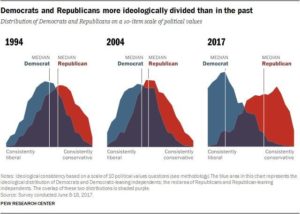
With every tribal moral community, there is a tendency to be more Catholic than the Pope, to be holier than thou. There is competition to be the most virtuous as defined by the community. So people get pulled in more extreme directions and they censure anyone who deviates from virtue as defined by the community. It’s amazing to me to look at the #FBR liberal/left Twitter feeds right now where all the talk is about Trump- and GOP-hate and getting rid of guns, while ignoring issues like the impending Syrian war instigated by the (completely unverified) gassing by Assad and Israeli domination of U.S. foreign policy. On the right, the danger is that extremes like swastikas will be embraced as more “authentic.”
These are tribal moral communities, with the emphasis on ‘moral’. People inside the group see themselves as morally good, and those outside the group are evil. Actually, I don’t see this on the right to anywhere near the extent that it’s a disease of the left. Issues are framed as a contest between the forces of good (our glorious multicultural future) versus evil (the “White supremacist” American past being promoted by the Nazi in the White House). So anything is justified. “No free speech for fascists,” and it’s entirely moral for the antifa to crack heads. The media ought to throw out normal standards of journalism and do everything they can to destroy White identity politics. Opponents are seen as not just intellectually mistaken but as evil incarnate. If you are an #FBR person, you wouldn’t tweet about needing proof that Assad did the gas attack, because one of your followers is sure to say, “but what about the children? How can you be so cruel?” Proof be damned. It’s a moral issue.
Wright thinks that teaching Buddhist mindfulness meditation—basically awareness of how emotions influence cognition—in public schools would be a good idea. I’m sure we would all be helped by an awareness of how emotions can influence cognition. Traditionally, academia socialized people to be objective and to try your best not to let emotions cloud your research. But that’s all gone now. Whole departments, like gender studies and social psychology, wear their politics on their sleeve. Their virtue signaling is a badge of honor—science is White supremacy. If objectivity is absent in much of academia—supposedly the source of all wisdom, why should we expect most people to want to or even be able to be objective? At this point, trying to get people, especially people on the left, to try to be objective would be greeted with nothing but hostility.
A big stumbling block from my standpoint as an evolutionist is that, underneath it all, people really do have interests. I have a definite interest in the outcome of all this. I want my tribe to survive and prosper—the fundamental principle of natural selection. I think this is rational and completely defensible, but it may shape emotions when I look at news articles and Tweets. I am horrified at what is happening in South Africa and by the mounting hatred for White people and their culture throughout the West that we see every day in the media and on Twitter. I am probably more likely to think that articles that agree with this are accurate and completely distrust articles that don’t fit with this.
The problem is to get other Whites on board with this, but so many are shut off in the tribal moral communities of the left. Like trained seals, they react with horror at anything resembling White identity politics. To get to where White identitarians are, their cult-like thinking would have to get deprogrammed. They would have to fight through what the mainstream media is saying and what they learn in school; they would have to ignore all the costs of being a White identitarian—the ostracism, the moral shaming and possibility of job loss. But without White identity politics, we will indeed be destroyed. We have to hope that at some point the reality of our brave new world will be so obvious that even the most blindered among us will begin to see the light.
In a previous essay, I wrote that polarization is good. But it’s also very dangerous. One might say, that’s it’s only good if it helps us win. If not, then we will lose faster and more violently than we would have if the center-liberal/left consensus had remained in place. Because of polarization, the gloves are coming off. For the left, the end has always justified the means, and we see ever more clearly the anti-White hatred hiding behind all the virtue signaling. Nothing is prohibited if you are on a moral crusade against evil. Shut them down, make them lose their jobs, kill them if necessary.


Comments are closed.