
A Model for Understanding and Confronting Western Decline
Version 1.0.0
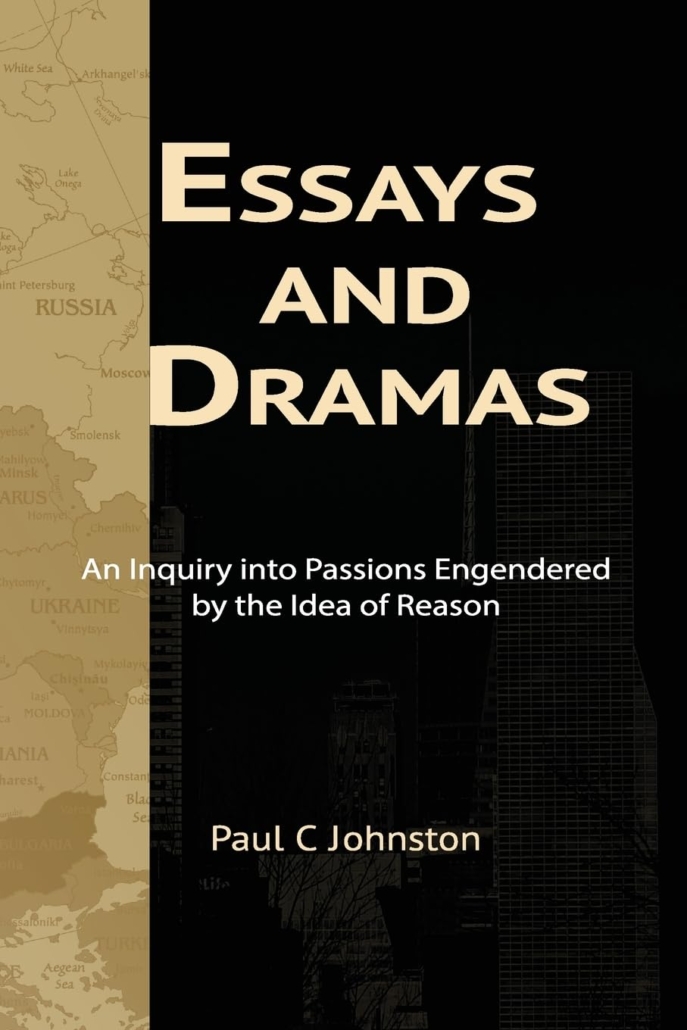
Essays and Dramas: An Inquiry into Passions Engendered by the Idea of Reason
Paul C. Johnston
New Atlantic Media, 2025, 188 pages, $20.00 paperback
The work under review here seeks to offer models for understanding ourselves and the trajectory of our civilization. These are complicated matters, which is why models are necessary. A model is a simplification: in the author’s own words, “a simple story about a complex story.”
He begins from a simple model of human behavior: “narrative engenders emotion and emotion issues forth into action.” He begins with narrative because man learns more from example than from precept. Directly telling a child how to behave is less effective than setting him a good example. But since we cannot personally demonstrate all the behavior we would like to encourage, we resort to stories. These may concern real, legendary, or even fictional people. The author writes that “the stories we hear growing up form our sensibilities.” A sensibility is “a repertoire of emotional reactions to the world around us.” Each individual’s sensibility will reflect some combination of his own nature and the stories he has heard, especially during his formative years.
Many of these will be common across a society. Homer, for example, was called the teacher of Greece because the stories he told became the common possession of his people and shaped a characteristically Greek sensibility. The narrative lore of a people embodies its ideals and is one of the most important components of its culture. So although hardly a complete account of human behavior, the author’s model in which “narrative engenders emotion and emotion issues forth into action” captures an important truth.
Next he proceeds to an extremely condensed review of human history, the latter part of which focuses on Europeans in particular. This story commences around two hundred thousand generations ago when a species of ape somewhere in Africa, for reasons still not understood, descended from the trees and began exploring the surrounding grasslands on its hind feet. This freed its hands for making tools and weapons, which led to hunting: the basic way of life of the ground-dwelling apes from their origin until the agricultural revolution a mere five hundred generations ago. The industrial revolution only goes back twelve or fifteen generations. Because agriculture is still fairly new in evolutionary terms, we remain largely adapted through natural selection to the hunter-gatherer way of life we no longer practice. Language and intelligence, for example, are key factors in human life which probably originated as adaptations to hunting, since hunting is a type of cooperative problem-solving. Language brought story telling with it, enabling the shaping of behavior through the emotions aroused by narrative.
The author observes that there are certain areas of life about which we are especially quick to tell stories, where these stories are especially quick to rouse our emotions, and where those emotions are especially quick to issue forth into action. These three primary narrative themes are “us and them”, “high and low”, and “sex.”
One consequence of our long time as hunter-gatherers is that we had time to achieve a high degree of concordance between our emotions and our strategies for making a living. We did not then suffer from the evolutionary mismatch of having to live in an agricultural or industrial society with the instincts of hunters. On this subject, the author quotes from the book The Cave Painters by Gregory Curtis:
The culture that produced the painted caves lasted almost unchanged for more than 20,000 years. To last so long, [it] must have been deeply satisfying—emotionally, spiritually, intellectually, and practically. It must have engendered and supported a social system that reliably produced and distributed material needs like food, clothing, and shelter. It must have fostered and protected the most basic human relations—friend to friend, man to woman, parent to child—or the society would not have been cohesive enough to survive.
Shamanism is probably the closest existing approximation to our hunter-gatherer ancestors’ approach to life, one in which “emotional connections to everything around them were deep” and “no sharp distinctions were made between animals, plants, people and the spirit world.”
A hunting way of life demands about three square miles per person to be sustainable, but the very adaptiveness of the stone age way of life meant that over time this became increasingly difficult to guarantee from incursions by rival bands. So instead of hunting animals and gathering plants, a few human groups began experimenting with raising animals and growing their own plants: the pastoral and agricultural revolutions. But
a man with emotions shaped over the millennia by the roaming life of a hunter was ill equipped to clear ground, scratch earth, plant seeds, pull weeds, harvest crops—then go through the same tedious process all over again the following year in the same place.
The first farmers succeeded in guaranteeing themselves a higher caloric intake, ensuring that the new way of life would spread. But they also faced an evolutionary mismatch, one from which we still suffer to some extent. The response to this dilemma was social stratification, which occurs in three stages. First, agriculture produces a surplus which permits a minority of men to impose themselves on everyone else and continue leading an adventurous fighting existence: history’s first ruling class. Of course, they also have to force the drudges who form their tax base to stick to their allotted task. In the second stage, a new narrative reflecting this new reality rises to dominance. Third, this narrative gradually “shapes the sensibilities of individuals in their various roles as lord, serf, priest, warrior, woman, and man.” Over the generations, this stabilizes the new way of life.
The author is reticent about the history of religion under the agricultural regime, contenting himself with noting that Christianity represents a continuation of this socially pacificatory function. The observed social order is willed by God, and living well consists in performing conscientiously the duties of one’s station within that order. But, of course, the faith was not simply a matter of dissuading the servants from stealing the silverware: “Much of the cultural material produced by Christians had the characteristics of a public good,” meaning that one person’s enjoyment of it did not prevent another’s. Cathedrals and sacred music were available to high and low. Manners, although originating among the higher orders, filtered down through the social order, facilitating complementary and workable relations between persons of various stations in life.
After several thousand years of learning to mitigate evolutionary mismatch in an agricultural economy, the industrial revolution through everything into confusion once again. The author defines industrialization as a product of technology and the exploitation of fossil fuels. Its initial effects were a massive increase in wealth among all strata of a population whose sensibilities and behavior were still informed by the Christian story. But under the new conditions, the Christian story lost its vitality over time and society became increasingly fragmented.
No one narrative has arisen to replace the Christian story, but the most important contestants for the succession, in the author’s view, have been various forms of contract theory: “rational human beings living in the state of nature meet, agree on a set of rules, and establish a government based on the agreed-upon rules.” He believes even Marxism failed to break decisively with the contract narrative.
The new society shaped by industrialization created an even starker evolutionary mismatch than existed in the preceding agricultural society. But the response followed the same pattern: first, a new ruling class imposes itself (the bourgeoisie, displacing the feudal aristocracy); second, the contract narrative achieves dominance; third, the sensibilities of new generations are shaped by the new narrative:
Six, seven, eight or more generations had to pas before contractarian stories altered, weakened, or washed out deeply ingrained Christian sensibilities, but it happened. The long-term effect was astonishing. Contract doctrine did NOT do what it purported to do, i.e., guide people out of a state of nature into civil society, but the opposite: take people living in a well-established, stage-three civil society back to nature, i.e., back to stage-one . . . a battle for dominance. Contract doctrine turned out to be a time bomb introduced into the heart of European civilization.
The author agrees with an old criticism of contract doctrine: that its “natural” men are really no such thing, but rational actors such as could only be produced by a highly evolved civilization. The founders of the American Republic, for example, were the products of such a civilization, and so
they were able to make a transition to a new form of government using civilized methods, i.e., debate, discourse, compromise, agreement, and ballot. They did not know—and it is hard to see how they could have known—that changing the rules, customs, and expectations of the game of politics would change the social conditions that produced men like themselves.
The result of this miscalculation is that we, their political and physical posterity, find ourselves in a raw struggle for dominance “being fought behind a façade of hollowed out stage three institutions.”
Today’s political scene in the West is, of course, a confusing and constantly shifting struggle between racial and sexual identity groups. As always, when faced with excessive complexity, we must resort to a model. Mr. Johnston takes his from the well-known lines of Yeats’ poem The Second Coming: “The best lack all conviction, while the worst are full of passionate intensity.”
As previously noted, all men are inclined to respond emotionally and through action to stories about “us and them.” What defines the better sort of men in today’s political environment is that
their sense of who they are is formed by stories about family history, communal history, architecture, science, literature, art, philosophy, and religion. Commerce and politics, they think, have to occur within a framework of rules. Adherence to procedure, coalition-building, amendments to a constitution, reforms carried out within the rules, better candidates—such are the tactics that the Best bring to the battle for dominance.
Mentally, such men still inhabit the stage-three civilization of their forefathers. The worst men are formed by cruder, simpler stories. As a result, they have the sense of self of a mafioso or gang member. But this makes them more effective in a struggle for dominance.
They know what they want—money and power—and act accordingly. They coil themselves tightly around the interests of a leader. This leader demands control over the men under him, [but] they understand that [this] is the source of their power over everybody else. No laws of man or providence do the Worst scruple to break in order to achieve power and money. Murder, blackmail, ginned up war, bribery, strategies based on deliberate lies—such are the weapons they bring to what for them is a stage-one fight for dominance.
Such men gradually spread into political organizations such as the CIA, and eventually we end up with a government of criminals and psychopaths.
The only effective way to fight back against this development is by telling a different story. Contract theory’s idyllic narrative of rational men uniting in their own interest does not describe the world as it is but, at best, as it ought to be.
Such utopian thinking is the besetting weakness of what the author calls “the Second Synthesis.” (The First Synthesis was that of reason and faith in the thought of Thomas Aquinas.) The Second Synthesis emerged from contract theory and early modern philosophy. Here we shall skip over the philosophical details, although these are quite interesting, and go straight to the conclusion: Immanuel Kant’s doctrine of the autonomy of the moral will. Mr. Johnston explains this as follows:
Because knowledge of the moral law is rational, it is secure. Because it is secure it is possible to know with confidence what should be done. To know what should be done means that it is possible for me to know what you should do and what we together should do. [This] means that nothing stops us from making the human community the way it OUGHT TO BE.
Contract doctrine turned the human individual into a “fundamental unit of account” and a “court of last appeal” in the political realm.
Groups exist for the individual, not the other way around. Because the individual is the fundamental unit of account, no reason exists why one individual should count more than another. Privileges of birth, tradition, caste, class, race, religion or any other non-individual category have no inherent moral standing.
What the Second Synthesis did was change who has the authority to define ideals [i.e., to define what ought to be]. Under the old Christian dispensation this authority resided with the custodians of the word of God, i.e., the Church, and also with those elevated by God to positions of high degree, i.e., the king.
After the Second Synthesis, this authority shifts to the individual, which makes the political realm into a kind of town where anyone is free to declare himself sheriff. In practice, the relevant “individuals” are those who participate in the political arena, and authority devolves upon whoever wins the political struggle. The game is played, as always, by weak individuals coalescing into a more powerful “us” in order to compete against a “them.”
Politics in the age of the Second Synthesis is a matter of rallying “us” by means of stories about how the world ought to be. This is the kind of politics Michael Oakshott described as “teleocratic.” One of its advantages is that it allows men to pursue two seemingly contradictory goals, namely, to embrace ideas about equality and to establish the hierarchies necessary for playing the games of life and politics.
The author lists some of the ideals of how the world ought to be as follows:
Liberté, égalité, fraternité, a classless society, careers open to talents, equal pay for equal work, from each according to his capacity and to each according to his need, equality under the law, men judged not by the color of their skin but by the content of their character, a level playing field, one man/one vote, a tobacco-free society, no child left behind, etc.
So there is no shortage of competing ideas about how the world ought to be, and—with the possible exception of the tobacco-free society—all in the above list involve some form of equality.
Once an ideal has been defined, citizens (or possibly humanity as a whole) can be divided into good guys and bad guys, with the good being those who move society closer to the ideal and the bad being those who stand in the way. The task of the good guys is to form a coalition to capture state power in order to eliminate the influence of bad guys (possibly by eliminating the bad guys themselves) and make society the way it ought to be. Necessary to this process is the idea of the victim. Depending upon the ideal, these may be “Africans, women, poor people, people in other countries (victims of imperialism), cigarette smokers, homosexuals, children left behind, etc.” The job of “us,” the political faction or party, is to protect the victims from their victimizers: capitalists, racists, male chauvinists, the heteronormative, the rich, big tobacco, etc. The stories based upon a supposed rational and moral imperative to protect victims and fight powerful victimizers have proved astonishingly successful at motivating men for over two centuries now: these are the “passions engendered by the idea of reason” which the author refers to in his subtitle.
But perhaps it is time to notice that the Second Synthesis and the style of politics associated with it have only really characterized the modern West, i.e., persons of European descent. Elsewhere politics has remained closer to the original model of competing kinship groups, a pattern going back to the days of hunting and gathering. But increasing contact of non-Europeans with the West have introduced them to ideological, Second Synthesis politics. They quickly learned to adapt their natural kinship preferences to such politics by identifying European Man himself as the quintessential victimizer. This has now had profound negative consequences for the West:
So conditioned by Second Synthesis narratives are we men of and from Europe that we now are comfortable linking ourselves together politically only in the name of pursuing abstract goals such as democracy, equality, the greatest good of the greatest number, or in the name of helping victims (blacks, women, foreign victims of imperialism, etc.). Appeals made to us as “white men” arouse suspicion.
Mr. Johnston suggests that this White man’s disease be called “social lupus,” since lupus is a disorder of the auto-immune system in which a person becomes, in effect, allergic to himself. Our diseased state “leaves us passive as other people occupy our lands.”
Another consequence of ideological politics is what Mr. Johnston calls the flat society. This happens because ideological politicians have every incentive to oppose all hierarchies other than their own. For example, if a traditional society permits slave-owning, slave-owners enjoy a certain amount of power independent of the state, and therefore not available to the politician.
How does the politician counter the power of the slave owner? By extending rights to everybody, including the slave. Second Synthesis ideology is the perfect vehicle for this endeavor. In the name of equality, the politician first eliminates the right of one man to own the labor of another. Next the politician weakens rich men and titled families via taxes, inheritance laws, and violence if necessary. Next, the politician makes gender roles grist for his mill. The politician’s ideal order is one in which NO links exist between individuals except for the links he controls. The landscape that reflects the politician’s ideal is a flat plain extending out in all directions, in the middle of which stands a single, tall mountain, the state, at the top of which he sits.
This is exactly what has happened to us, a story the author illustrates by considering the example of Thomas Jefferson.
He enjoyed a position of high standing which he did not have to fight to obtain. Social capital (narratives, habits, customs, laws, usages) guided him into the role of slave owner. The same inheritance of social capital guided other men into the role of slave. The existence of this social capital freed Mr. Jefferson from having to devote his energies to the task of beating other men into submission, one outcome of which was that he had the time and leisure to reflect, to explore topics of interest, to study political history, to play a key role in the construction of a new nation, to be the president of the new nation, to build Monticello, to found the University of Virginia, and much else.
One result of Jefferson’s leisured reflections was the conviction that the institution of slavery was unjust and should be abolished. He may have been correct about this, but if there had been no social capital in his Virginia, any man who wanted a slave
would have had to do the dirty work himself of beating another man into submission. Social capital established superordinate and subordinate categories of men, then conveyed these categories across the generations so brutal battles to establish stratification did not have to be refought in each generation.
Admittedly, Western civilization did not result from rational men designing a society the way it ought to be, as Second Synthesis stories would recommend.
But European peoples established their hierarchies so firmly that it was possible for those at the top to enjoy sufficient leisure and tranquility to create by talent and patronage an inventory of public goods of great value, e.g., delicate manners, beautiful architecture, a profound literature, mathematics, science, and an artistic tradition of beauty, depth and scope.
Egalitarian Second Synthesis politics will systematically destroy the conditions of such achievement—in addition to leaving us vulnerable to hostile outsiders. The White man’s lupus is clearly a sickness unto death. The author summarizes the development as follows:
People were confident that liberal values such as equality could be applied universally. This confidence was misplaced. This did not happen. Once the legacy of social capital that established rank peacefully lost vitality, what followed was not Mr. Jefferson’s liberal vision of society minus slavery. Rather, what followed was a raw fight for political power.
Namely, the fight between Yeats’ best and worst, in which the worst have all the advantages:
The problem with a flat society is that there are no men sitting at the top of their own montecelli—their own little mountains—with the education, resources, confidence networks, and discipline required to stop psychopaths, i.e., men of no scruples and no remorse, from reaching the top of the mountain and capturing the state.
And that, of course, is exactly what they have done. We are governed by an alliance between racial aliens and psychopaths which behaves like a criminal enterprise.
We noted above that the three principal themes of the stories people tell which engender emotions giving rise to actions are “us and them”, “high and low”, and “sex.” We have explained the effects of the Second Synthesis on the first two themes, but must not conclude without saying something about what it has done to sex. Nature assigns women the job of reproduction, and men that of dealing with the consequences of reproduction,
which, if unchecked, would soon lead to our extinguishing ourselves like yeast in a petri dish [through the overconsumption of finite resources]. The job of the male is to create space by confronting other males, by keeping them at bay, by showing them that our “us” is stronger than their “them,” by killing them if necessary.
This secures the territory necessary for the provisioning of women and children. So when the men of the European tribe contract social lupus and are left “passive as other people occupy our lands,” it represents a “failure in the most basic way that the males of any species can fail.” It is no wonder our females either forego procreation altogether or make themselves into the vehicles of an alien genetic heritage.
The industrial revolution and Second Synthesis, like all cultural achievements, were largely the work of men rather than women.
These men created wealth in the economy and in the political arena they created a decent approximation to the rule of law, both significant accomplishments, but achieved at a cost. In the past, boys were expected to defend themselves with their fists. [This was part of a male culture that] required of a man that he establish a reputation such that if you trenched upon him you could expect to trigger in him a strong response. With the rise of the rule of law among European peoples, life became easier for men. A man’s willingness to respond fiercely if trenched upon was no longer crucial to his maintaining his position in the community.
Violence came to be monopolized by the state, leaving men more concerned with “perks, salaries, and status based on money.” Male culture lost its vitality, and manipulation became more important for individual success than courage. And it is the resulting softer men who now find themselves faced with a stage-one struggle for dominance with ruthless psychopaths and hostile aliens from more primal cultures. We are going to need to rebuild our own male culture quickly. A necessary part of this will be foregoing familiar Second Synthesis stories in favor of narratives better attuned to the timeless requirements of evolutionary survival—and which will probably more closely resemble those of our stone age ancestors.
According to the brief biography on the back of the book, “Paul C. Johnston earned a bachelor’s degree in philosophy from Vanderbilt University and a PhD in economics from George Mason University. This is his second book.”




Press release dated 15 May 2026
2026年5月15日公告
Communiqué du 15 mai 2026
The text is in English in the first section, followed by the Chinese text in the second section and the French text in the third section
第一部分为英文文本,第二部分为中文文本,最后为法文文本
Texte en langue anglaise en première partie, suivi en second du texte en langue chinoise et en dernier en langue française
https://the-key-and-the-bridge.net/press-release-dated-15-may-2026.html
1 – 1/4 – The hidden political and sociological structure of power in the West and of Western society
1 – 2/4 – 西方权力及西方社会的隐性政治社会学结构
1 – 3/4 – Structure cachée politico-sociologique du pouvoir en Occident et de la société occidentale
1 – 4/4 – Documentation
文档
Documentation
https://the-key-and-the-bridge.net/ivy-lierre.html
2 – 1/3 – A reminder of the reason behind humanity’s current tendency to transform itself into a machine
2 – 2/3 – 关于人类当前为何注定要蜕变为机器的回顾
2 – 3/3 – Rappel sur la cause du déterminisme actuel humain à se métamorphoser en machine
Devlin is always sound.
Johnston’s ideas about “early man” are like most stuff of that kind – “it was a very long time ago and it all happened very slowly anyway”. In other words “who really knows?
The “Second Synthesis” can be roughly equated with the Enlightenment, I suppose.
America was built on the ideals of both the Enlightenment and Puritan Protestantism – no wonder it’s so screwy.
It was breaking away from a frankly power-based idea of the state to one with sentimentality at its heart – equality and the pursuit of happiness – that is destroying America and those states that follow its model.
Oswald Spengler died a decade before Israel and Red China arrived, but some of his predictions retain analytic value – e.g. the New Left + Black Power. Cf. “The Spectre of Spengler,” BRAZEN HEAD, May 8, 2025, online. He saw through a crystal ball darkly, but now we are left to face (up to) realities (I Cor. 13.12!).
Spengler was a jew, and hated antisemites
Spengler was 88% Aryan. Like everyone else, you judge people better by what they do rather what their great grandmother looked like. Despite the efforts of Nietzsche’s sister, Hitler and Spengler disliked each other, and differed on various issues such as the wisdom of a military adventure on the Russian steppes. He was no doubt mistaken in attributing antisemitism to the friction between cultural phases. See Kerry Bolton, “Spengler, Epigenetics and the Idea of Race,” HYPERBOREA, October 6, 2024, online.
Netanyahu is likely less then 12% jew, or any given modern day israeli.
Jews do the same thing throughout history, buyoff leaders, authors, anyone of influence.
They couldn’t care less what the average person thinks of them.
There’s a zero percent chance Spengler didn’t see Jewish influence during Weimar, zero percent
On Jewish Weimar & Spengler, see e.g. Harry Redner, “The Tragedy of European Civilization” (2020). No-one bought him off.
A Model for Understanding and Confronting Western Decline:
https://archive.org/details/the-death-of-fragility-2nd-edition
@ Gina Tingles
Who is to be the Leader of this Totalitarian State and organise the ruthless warfare against the defined enemies? The man quoted died 81 years ago. Will it be the Anonymous author of this regurgitation of failure?
The book cited has a useful bibliographical appendix, almost all of its revisionist items are well-known to me though not entirely supportive of the writer’s obsessively swastika-bedecked pages. Though not solely responsible, Hitler left most of the Eurasian heartland under communist control, Britain and France without empire, and Jews as an increasingly dominant force in America and its western satellites. We will not go through all that again.
Great article. So we have a man “of no scruples and no remorse” now as the President of the US. His ‘morality’ he says is His alone, achieved by feelings and no thought, except for the Old Testament ‘s jealous/angry god whose motivations are without reason, just passionate intensity stirred by rage/berzerker personal attachments
to Himself as the Supreme Leader of his tribe of more pre- Stone Age shrieking apes jockeying for raw power under the Mad Emperor, and possessed by Delusions of Grandeur (jewlusions of Grandeur). Cannibalism will find its way into such anarchy. (see The Road, by Cormac Macarthy, novel and movie. ?)
This indeed, per Johnson is to recapitulate, indeed Stone Age, or maybe better, ethnics struggling for land and resources in a post-industrial anarchy of scarcity and race struggle. On a probably more hopeful note, Trumpstein is on his way to political oblivion with 75% of US voters against him. Nevertheless, Johnson’s book is noteworthy.
We will know by the close of the midterm election. Maybe WNs should vote Democratic in November to bury Trump’s body in concrete
“Second Synthesis” is a “rationality” based on claimed universals and common sense agreement like Thomas Hobbes, classic liberals, and utilitarian ‘greatest good for the greatest number’ arguing that social peace is guaranteed by Agreement to Fairness in law and social/political policies. “Equal Opportunity” became the universal standard for social policy and Equality before the Law became the standard for legal justice .. (The story that Englishmen of noble social rank retained the right to be hanged by a silk rope, not a plebeian manilla rope (true??) for the same offense, became an irony on the theme of Equality.)
Of course this liberal claim of fairness in an egalitarian age became vulnerable to the claims of the “underprivileged”, of both race and economic status (poor v. rich folks) and ultimately of gender/sex and disability and on and on to the madness of today’s sexual egalitarian politics.
Thus the Liberal ‘rationality’ was challenged by the lessers, and the new rationality has become Equal Outcomes, the ultimate folly of Reason and Equality. So the Second Synthesis which tried to replace religion or God’s logic, has failed. And where are we left?
Biological logic (hated by the world improvers) remains the only possibility. This means fascism.
Fascism affirms Biology, Race, and Sexual Inequality. It also affirms nationality, competition between states, and economics suited to a particular group or race of people. Thus we have now the Chinese and others Capitalism with Chinese characteristics, etc.. It also means that various fascisms must have international agreements on a whole host of matters, to facilitate mutuality in trading, and so on. This is all logical and required to prevent war over markets, etc.
(Marxists have always argued that war results partly from economic imperialism, etc. They are at least partially correct (see Ukraine/Russia war as the West against Russia and ultimately against Brics.)
So where we are now is at least twofold. First is ethnic warfare in Europe and USA. Europe is only about 10% plus Muslim and is awakening to its crisis, much more so than in the anglo-phone countries with the US White % of the total population at only 57%. Europe stands a better chance to avoid bloodshed than the US.
Secondly, Economics seems to be the ultimate challenge to the Second Synthesis with Depression and consequent upheaval in the State’s financing of welfare and school costs of illegals and legal beaners who will join the niggers in their mau-mauing of the State for more free money. (I see locally already budget cuts in the Programs and Services to the muds.)
One man’s rationality is another man’s oppression. So much for Fairness and Rationality in Second Synthesis. We are heading for breakdown in our reigning “ideology” of how the West governs itself.
“ideology” was usually a term used to ridicule various liberal schemes, at least by critics and lefties.
I would like to see Jeffrey Sachs explain things today, particularly in the context of Johnston’s’ book, establishment Liberal that he is.
Inasmuch as history is driven by emotions, not intellect, more or less, we nevertheless try to “understand” history intellectually while history goes on blindly like Evolution, selection by social power of groups, mostly racial groups. Individuals only count thru Leaders who slog along raving like apes (think Trumpstsein) and most others who jockey for power to replace The Opposition. (think Dem demagogues).
The only exceptions are rare individuals like Douglas Macgregor right now, and maybe Eisenhower back in the 50s and John Kennedy in the 60s. (never mind correct but hopeless folks in the fascist camp). So here we are in the Commencement exercises of political/social, basically racial, struggle, the main event being whether Whites will awaken to their peril. Dems are going to win the next midterm election, and probably ’28 as well.
Trump’s forever war is the central reason for all of this.The Jews/Gaza help… And this is Good… the Contradictions of the Second Synthesis/Rationality of Individuals , etc. The nonsense of the Second Synthesis is unraveling before our eyes while race and class are returning as Group dynamics, not rational individuals “thinking” their way to resolve conflicts. In short, race and class warfare are returning. It is going to be a renewed primal struggle over resources, with the added bonus of depression on the way.
I had a chat in Menlo Park last week, with a couple, upper middle class, who knew what Bolshevism is. I talked about the Jew led campaign to install mud housing in downtown Menlo Park’s parking lots in its commercial area. Mud housing will be directly adjacent to residential, single family homes. I gave them just the facts Mam, from Richard Lynn’s work on race and IQ and psychopathy of blacks and similar material on beaners. They were open eyed and mesmerized. They went home with Richard Lynn’s books duly noted.
The Race Integration Plan is now lawfully beginning….per Sacramento’s beaner, White liberal, and nigger legislature with a Weiner Jew leading the operation which has targeted all of Caifornia’s cities. We shall overcome. I did not remark that these nice suburban upper middle class folks would be subject to their blonde daughters bringing home a nigger or beaner. I did not have to draw them a picture.
It took Bolshevik/Jew USSR to stir the pot in Germany, etc. We got a similar thing right now with Americans ignorant of Economic depression, 10 or 20 dollar gasoline, and Hard Times in general. So Keep on keeping on Trump, the World Destroyer.
Sure.
If any of us were yo syop the next man on the street, the man at the next barstool or next cubical, they would have ZERO idea who the “hostile aliens ” are, and think it might have something to do with Ihan Omar and don’t know about her jewish political handler(!) husband.
In short, societies flourish until jews are let in, they are always, ancient Palestine, Rome, Imperial Russia, today- the “hostile aliens”
In short, there needs to be a populist campaign to educate the common person. Jews are ripe for the pickin’
From Yagoda to Yeltsin the People who put them in were the People who got them out.
It has to be added that Spengler had an independent mind (like Nietzsche and Junger) and did not share NS Jew-monomania, his criticism of which in some respects justified. Remember he had roughly three years’ experience of the Third Reich and died roughly three years before Germany invaded Poland and other countries. There is a good online essay by Kyle Baasch on his “strange fate” that readers, also of independent mind, should peruse.