
“Citizen Vigilante”
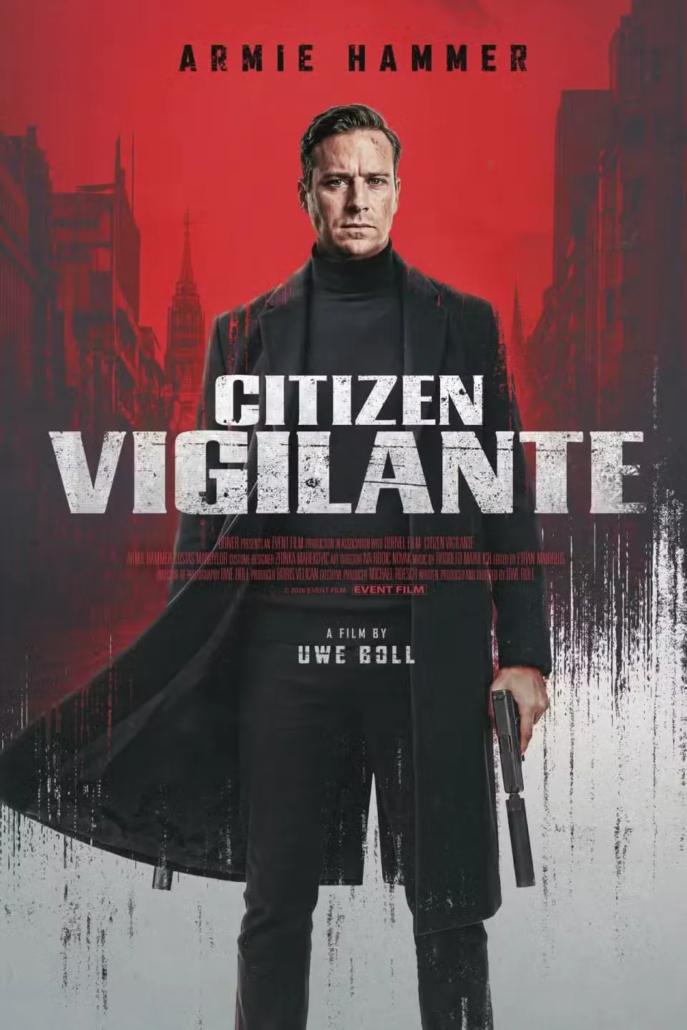 For those of us on the political Right, going to the cinema has been an increasingly unrewarding experience. Endless comic-book franchises, the absurd over-representation of ethnic minorities in Hollywood movies, the influence of “woke” and its resultant cinematic sermonizing; these are hardly the 1970s, perhaps the greatest decade in the history of cinema. Audiences get smaller as White moviegoers decide they are tired of paying a good deal of money to be scolded by a Hollywood screenwriting team.
The model of cinematic distribution has also changed, of course. You don’t need to go the movies now. In the era of Netflix et al, the movies come to you. The idea that consumers don’t have to leave the house in order to consume started with pizza-parlors and florists, but has now extended to most goods and services.
It’s not a new idea, you’ll find it in E. M. Forster’s 1909 novella, The Machine Stops. But when this domestic availability extends to movies, it presents something of a problem for the deep state. With the cinema and distribution model, then which movies people can see can be controlled. This is vital to the state as movies are what Western people replaced myth with. With the new “Netflix” model, that control has been relinquished. And if people can start watching what they choose to watch rather than a syndicate of Hollywood studio bosses and various psy-op departments in the countries who buy their movies, they have a potential problem.
Movies are powerful. It is said that Stalin, although he had many composers shot, spared Shostakovich because he could write film music, and film was important. Stalin, if the story is true, was right. Propaganda is not exactly hidden in plain sight, but we have known about psy-ops such as Operation Mockingbird for some time. Two parallel departments, RICU (Research, Information, and Communications Unit) and BIT (Behavioral Insight Team), have recently received unwanted media attention in the UK, and one of the functions of these so-called “nudge units” is to work with the producers of televisual media in order to transmit approved narratives via the movies and TV drama. A notorious recent British TV drama, Adolescence, is a prime example. The story is that of a young White boy who kills a White classmate, having been “radicalized” online. The writers based the story on an actual case, and made just one small adjustment to reality; both the actual killer and victim were black. Famously, outgoing Prime Minister Sir Keir Starmer referred to this drama, more than once, as a “documentary”.
Hollywood used to hold the reins of cinematic power, and we know how Tinseltown is run and by whom it is run. This is no longer the case, which makes it far more difficult to ban movies. Controversial movies being banned is not a new phenomenon. A Clockwork Orange was banned in the UK for 27 years at the request of its director, Stanley Kubrick. It was feared that the “ultra-violence” of Alex DeLarge and his crew of droogs would inspire copycat attacks of the kind—funnily enough—that now occur daily in the British Isles. Pasolini’s Salò, or the 120 Days of Sodom remains banned in some countries. In fact, the list of films which are or have been banned makes a neat little sub-library for movie buffs: The Devils, Last Tango in Paris, Life of Brian, The Exorcist, even Divine’s Pink Flamingoes, if that is to your taste. A Serbian Film, a snuff film with pedophilic and necrophilic themes is one of the toughest films to watch I have ever seen, and was banned on its release, the director almost going to jail over the movie.
But none of these films could be said to be political, Life of Brian’s debate on what the Romans have ever done for us notwithstanding. Perhaps you could make a case that the banning of The Battle of Algiers, which depicts the war between France and Algeria, in some countries was politically motivated, but that motivation was very localized, geographically speaking. Now, a movie has been banned for obviously political reasons, and deep states across the West are worried, to say the least.
Citizen Vigilante was directed by Uwe Boll and stars Armie Hammer as the vigilante of the title. Both men are Hollywood outcasts, for differing reasons. Boll has little to his credit, and Hammer is really making a comeback move after years in the wilderness. Hammer plays Michael Sanders, an American who has served in the military and is now in the property business by virtue of his father’s death. He is in some eastern European country, possibly Croatia, and he is not strictly there on legitimate business. He has another agenda. Sanders just sort of arrives, like Arnold in The Terminator, and starts wiping people out, enraged by the release of a gang of rapists by a liberal judge. He kills petty criminals, the police, judges, the family of a Muslim rape gang, purely because he sees the state as dysfunctional and in need of a corrective. This is the last message the Western gauleiters want to hear—or want their citizens to hear. This is a deeply flawed film in cinematic terms, but so are many important movies. What lands with Citizen Vigilante is that many people will see the bad guy as a good guy. There will be, unavoidably, spoilers here, so you may want to watch the movie first. Despite the German government effectively banning the film by refusing to grant an it age certificate (the British are still making up their minds), the film can be found online. Elon Musk ran it on X for 48 hours and, at the time of writing, it can be found on Internet Archive and YouTube. It is making a lot of money relative to its $9 million budget and currently has a 96% approval rating on movie evaluation site Rotten Tomatoes. Another new movie, Supergirl, typifies the new “go woke, go broke” model Hollywood has chosen, and on its opening weekend took just $36 million. It stands to lose $100 million, while Boll’s move is reputed to have made the same amount. But by banning Citizen Vigilante, the German government, and those following suit, have triggered the infamous “Streisand effect”, due to which the attempt to keep something out of the news does the exact opposite.

“Citizen Vigilante Director Uwe Boll Shares AI Image Of Armie Hammer’s Character Killing Supergirl”
The movie opens in a grocery store, where a mother and her young son are shopping. Once they leave the store, a non-White man passes them in the street, pausing only to plunge a kitchen-knife into the woman’s neck, and she explosively bleeds out in front of her child. We get it, it’s going to be a revenge movie, an eastern European Death Wish.
But who is the avenger? He is, we are informed by a newsreader, the “citizen vigilante”. A vox pop of non-vigilante citizens provides the government’s worst fear. “This guy’s a real hero”, says one woman. “We need more like him”. “This guy is taking out the trash”. “I want to marry him”, says another woman. That ought to be qualified. It is well known that women are always trying to marry serial killers who are in jail. It might be argued that the best way to get a marriage proposal from a woman today is to get yourself on death row.
What is rattling the cage of the establishment is that there is so much rhetoric in the vigilante’s broadcasts about the system failing. “What if everything they told you is nonsense?”, says Sanders in an unexplained TV broadcast. This is anathema to technocrats because the system is all there is for them. Were it to break down, they would be exposed. This is, incidentally, exactly what Forster’s The Machine Stops is about. The other major cause for concern for those trying to destroy the West is that Sanders specifically targets the whole idea of migration. This is the deep state’s major project, and the plebs are not supposed to notice it. They are supposed to be watching the World Cup or some reality TV show, not questioning the dismantling of the society they are being forced to live in.
Sanders is clearly something of a psychological enigma. He sleeps with a prostitute but stops the intimate act abruptly when he spots a patch of black mold on the wall. What now concerns him is the effect on his respiratory system. He is clearly disconnected from other people in the same way that Travis Bickle is in Taxi Driver, although a good deal more intelligent.
Talking his office manager through various property concerns, Sanders is balanced, terse, and precise. But he is also clearly psychopathic to an advanced degree. Having drugged a judge, he drives him out into the countryside in order to execute him. On the journey, he makes a small speech about the breakdown of a system which was supposed to protect people, and also points out the stupidity and sheep-like quality of those people. As an example, Sanders swerves the car into the other lane and straight at a car coming in the other direction. The other car swerves off the road, crashes, and explodes. Sanders calmly explains to the comatose judge that if the driver had broken the law, just for a moment, he could have taken the other lane and lived. But he didn’t. He couldn’t break the law and now he’s dead. The judge is not long in following, having acquitted both drug dealers and a gang of rapists. Having shot him full of heroin, Sanders slits the judge’s wrists and leaves him to bleed out.
Again, the semiotics here are going to cause grave concern in some quarters. Liberal judges and a biased judicial system are central to the current European program, and rapists and killers are frequently either acquitted or given light sentences. In Germany, a woman was raped and, while her attacker did not go to jail. She did, for comments made about him online. In the UK, ex-Home Secretary Suella Braverman even gave this version of anarcho-tyranny a name: two-tier policing.
This apparent failure of a system which should be there to protect the citizen is not, however, a glitch in that system. It is a feature. The glitch is the citizen vigilante, and deep state operatives across Europe will be thinking about how to keep the genie in the bottle, or even if that is possible.
What makes the ban politicized here is that the violence in the movie is of no concern to the censor; it’s the language. Sanders is unequivocal about who is the cause of the breakdown of the system. It is “an unfriendly takeover by Islamist extremists and the blind-sided woke Left”. Now, across Europe and certainly in the UK, Islamist extremists and the woke Left are very powerful. Both lobbies increasingly police language and set the limits of what is acceptable. A viral movie singling them out is putting a target on itself. And then there is the Muslim angle.
In one of the final scenes, Sanders has taken a Muslim family hostage in their apartment. The boy had been involved in the gang-rape, and Sanders has visited the victim in hospital. She has been terribly beaten and, when Sanders asks if she wants justice, she replies through her tears that she does. Tracking down the family, and prior to executing them along with the other gang members, Sanders has a brief conversation with the father in which he questions the man’s values. “They are Koranic values”, the man replies. Sanders calls those values archaic before shooting the entire family. Now, the British Muslim Council are, to put it mildly, going to have something to say about this scene, and the allocation of a certificate may rest on what imams say rather than the British Board of Film Censors.
This is a low-budget movie, but it is still riddled with avoidable faults. The plot is full of holes, and the shift in timeline is fairly pointless. Hammer’s central performance is strong, but the camerawork is unfocussed and sloppy. That said, this is not a film many will be viewing cinematically, but rather politically. Citizen Vigilante is a flawed film symptomatic of a flawed society. Leftist critics have been quick to dismiss it as far-Right slop, but at present Boll’s star is in the ascendant. In large part, the reason for the film’s success is due to a man who is something of a vigilante himself, minus the guns, explosives, and syringes.
Elon Musk could hardly avoid getting involved. As the world’s first trillionaire, he can also afford to be the world’s biggest troll, and it is becoming easy to predict what will attract his attention. He ran the movie on X for 48 hours, and there is already talk of a sequel set in America. With Musk’s endorsement, there won’t be much the US deep state can do about it, although they will try. Musk contacted Boll’s podcast personally — Boll’s people thought at first it was a parody account — and although the posting of the movie on X hurts potential revenue, it was a calculated risk which is paying off. Variety have just reported that the movie has secured worldwide distribution, although the magazine called Citizen Vigilante “a violent, incoherent, morally bankrupt slice of exploitation”. Boll is unfazed, saying that he likes exploitation movies, and doesn’t “try to be Tarkovsky”. The director also claims that a lot of the criticism of the film is politically motivated, while some in Hollywood defend him and his film, including Roger Avary, who wrote the screenplay to Pulp Fiction and won an Oscar for it.
Uwe Boll may not be a talented director, but he has a pulpit now and he is certainly using it. All his many interviews feature him talking about migration and the problems it has brought to Europe. He talks of the failure of social services, the acquittal of rape gangs, knife crime, all the things governments work hard to keep out of the public eye. And they are having to work increasingly hard, with several recent high-profile cases such as those of Henry Nowak in England and a boy only named as Louis in France having riled the respective publics of those countries in the same way as the Karmelo Anthony/Austin Metcalf case has galvanized America. If you are a Left-wing politician trying to keep the lid on things at the moment, Citizen Vigilante will be the last thing you wanted to see. The film gives the whole game away.
One of Sanders’ themes in his V for Vendetta-style broadcasts is not just the failure and collapse of a system which was supposed to guarantee law, order, and justice. “The system was never meant to give you justice”, he says. This is a key revelation, and I have written before about public reluctance to accept that their governments are not incompetent but malevolent. The flooding of Europe with migrants was never due to incompetence, but has been the long-term plan for decades.
It seems a long time since the 1970s, and the summer movie being Grease or Star Wars. Boll asks a similar question of contemporary Hollywood; where are the good movies? Where is this generation’s The Deer Hunter, Raging Bull, Apocalypse Now!, or The Godfather? Those movies had tough moral boundaries and they asked questions. Movies today are not designed to ask questions of the viewer, they are crafted to give that viewer answers to questions the producers think they ought to be asking. Is migration a good thing? Yes, diversity is our strength. Citizen Vigilante gives answers to questions no one in power wants anyone to ask, and the answers may lead to a very long summer indeed.




“The film gives the whole game away.”
Bullshit.
Classic deep state, ZOG at it’s finest, amplified by their best agent, Musk.
The Turner Diaries- stock up on 30k rds of 5.56 and wait for the coming putsch, this is just another variation.
They need, must have you to ‘do a terrorist,’ have you be the guy they can throw up when they convince some Eastern version of Oswald to drive his Opel thru the Kristkindlemarkt, and say ‘White people do it too’
This is so jewish, it gets a Kosher stamp
What if this is yet another covert operation to further inflame the already dire mood in Uropa, perhaps to the point where it boils over and what the lunatics, who want a nice big slaughter, have long planned will happen? You can’t think so sick as these mass murderers act every single day.
“Islam is the Iron Broom of Israel. Instead of us doing the work, we send Islam to solve the problem.”
— Rabbi David Touitou – https://youtube.com/watch?v=aDNhyrTjZ7M&t=22836s
Yep!
Thank you too!
Was beginning to think i was the only one who saw it as a jewop.
– but that’s how jews want you to think, that you’re all alone, you’re the one who’s insane.
Thanks again!
Standard Jewish “Let’s you an’ him fight!” Jews are proud of their tradition of infiltrating a society and then opening the city gates to the enemy.
Note the ‘hero’ massacres random people, just to make a point to a condemned man.
No different than any MSM drama, psycho White guy.
On X, YouTube you say?
Where are the Jew orchestrators of White genocide across the West, in this film?
Now that the Jew rat is out of the bag, and their fates are being debated in every White cranny of humanity, and the Jews know it, isn’t it strange how a film about a White Nationalist-like vigilante suddenly fills the nauseatingly woke latrine of money losing films that further fans the flames of violence between Islam and the West?
White protagonist excreting his spiritual creativity into an Asian whore? What a hero.
Consumption of Jew produced alcohol in a bar patronized by a racially diverse clientele? What a champion.
Aside from the few above mentioned questions/bad habits, I don’t quite get how the reviewer arrives at the conclusion that he is a psychopath?
Lots of blood plus obligatory prostitution scene. Not even a hint of Jewish involvement in 3rd world immigration.
Thinking unconscious, reflexive result of Jewish dominated media artificially created culture to promote White military enlistment for Iran ground invasion. Lessen revulsion from Gaza genocide.
Although Muslim conduct in Europe before Oct 2023 lessened revulsion from Gaza genocide all by itself.
Keep in mind the classic “superheroes” are vigilantes. Superman was kind of accepted because it was clear he could destroy the Earth if he wanted to – better be nice to him, folks. Batman was barely tolerated. Spiderman was eternally being pursued by J. Jonah Jameson.
Superheroes became a thing in the late 1930s, and were popular among a populace victimized by the probably Jew-orchestrated Great Depression. Crime was rampant in the 1930s, Prohibition (which gave us the Jewish mob) had recently ended, etc.
https://rumble.com/v7c2dq2-citizen-bolshevik-slopiganda.html
• CITIZEN BOLSHEVIK: SLOPIGANDA – Night Nation Review (Nick)
https://rumble.com/v7c2dq2-citizen-bolshevik-slopiganda.html
https://ftjmedia.com/watch/citizen-bolshevik-slopiganda_662d33ef557e437ba878.html
Nick breaks down the ’movie’ and those involved, exposing it as a jewish Bolshevik psyop
Interesting review, I watched the film over the weekend (can be found on link here – https://southfront.press/uwe-bolls-candid-film-the-dark-knight-censored-to-citizen-vigilante/ ) , entertaining enough as an action thriller and we all like to see “baddies “, in this case rapists & pedophiles, get their karma, though it does have it’s faults in that it concentrates solely on Islam, without getting into lengthy discussions on the grooming gangs which for instance would beg the question as to why the situation was allowed to continue when the police could easily have stamped it out…ie ; were they ordered to stand down in order to pursue the Deep State/Zionist “Strategy Of Tension”, the question must be asked of the director – if he is against groups of people being above the law as regards rape & pedophilia, then why did he not include the rapists and pedophiles of what is generally known as the “Epstein Class” ?
We need to make our own Anti-Jewish films and market them well.
Nowadays AI is good enough for production. But distribution and marketing will be tougher.
Any ideas?
Great idea!
there’s JakeGTV- NO IDEA how it stays up
https://www.youtube.com/watch?v=MGCE1kvKFGg
@ Frank
One could just re-rerun the 1940 NS classic “Der ewige Jude” with subtitles. It depicts all Jews as a plague of rats in human guise and ends by quoting the Fuehrer’s pledge to exterminate the pest. Right up your Strasse.
Of course, we now know that Adolf Nepomunk-Schicklegrueber failed to implement his promised Holocaust, and so this will have to be carried out by TOO supporters.
A hebrew tat on vigilante’s rib.
Thanks to @Tim ‘s link
Yep, jewop
The golden calf — Anti-Christ jewz, “Abraham Accords” Islamotards, Big Brother liberals and neocons — are really coming under the gun.
When Moses was killing these creatures, it was with a long sword, but the concept remains the same.
Articles, comments, and audio on AMERICAN RENAISSANCE have been indulgent of what the producer and editor and the grandson of Armanda Hammer “acting” are promoting thinking it entertaining. An officer with the NATIONAL ALLIANCE has spoken unnecessarily disparagingly about “Amerasians” which Vietnam simply deported to whomever would take them being stateless; we’ve met one who found it more difficult to find decent employment because of that status in the U.S. That middle-aged women had a mother affected by American political and military action in her country; her mother was either desperate or with less wisdom that the character Robin Williams courted in Good Morning Vietnam, maybe both. We need to think not only about what we’re allowing to take place in our own nation but what we are facilitating in other nations. Shooting a fictional immigrant family– men, women, and children because of a fictional crime by an adolescent member that family because some will find it entertaining is not something born and bred Western White men should be encouraging however good it feels to some who will pay to watch it.
The REALTY, developer, rental property manager angle doesn’t surprise me. Think Jared Kushner and Trump being tolerated behaving, leading, and representing the American people is an angle not confronted but lionized in the film. It ought to be embarrassing at least to White men of good character. Enough has been said about the brothel scene.
Now, this foolishness about Muslim immigration and two-tier policing being such a problem. It is a symptom and nothing more. “Armie” Hammer is a Jew genetically if not by the political, religious definition of the term; and if you don’t understand this problem then go figure some more because much of the content in the pages provided by Dr. MacDonald are still over your head. And until you understand this guaranteed, “You are being played.”
With the Jews ethnocentrism runs deep. They’re playing for keeps. This film furthers their agenda. They can’t help it any more than a skunk can help the way it smells. And you’re not going to talk either of them out of what they do; rather you must arrange your affairs such that your environment is safe from the side effects of their presence in the world. That means paying attention and insisting that the military, for example, supervise GI’s where they are necessary. meaning adopting a rational foreign policy as well. We’re capable of that. No nation wants an occupying army raping, whoring, and race mixing.
Lawyers, politicians, and judges need to be watched as well. We’ve had good experiences using the courts especially when REALTORS, developers and property manager behavior required accountability.
IHR.org has good essays by Mark Weber on why so-called antisemitism
has been ubiquitous for so long so many places. You might consider what American’s have done in this regard at this time: https://buildingjewishbridges.org/holidays/jews-and-the-4th-of-july/
The bottom line with murder porn I see in this movie is that it is simply target marketing. Those who know better like a genetics professor I had as an undergraduate whom a brighter professor who I palled-around-with couldn’t stand not only wore COKE-bottler-bottom-thickness glasses for myopia. He sort-of looked like the accountant murdered in the third episode of THE GODFATHER including the glasses. What that field biology professor couldn’t stand about the guy was that he had a passel of children who were also myopic and knew better which was selfish. Men-of-action which are entirely too few, if they’re not discriminating when consuming the Jews’ media can be encouraged to take themselves out of the game to prison or a hole-in-the-ground. I see this film discrediting lawful enforcement and prevention of the need for too much escalation of enforcement with smart policy administered timely. Individual lawyers including lawmakers, judges, politicians, soldiers and police can be heroic, but it is not the way to get promoted or rich these days. That can change and we see encouraging signs including Nick Griffin’s slightly less than biology informed critique of this film.
Make that “Armie” Hammer.
They’v been feeding us murder as entertainment for decades, so it certainly is refreshing to have murder of darkies on the entertainment menu.
Uwe Boll is playing the Jews. He’s already working on the sequel: Citizen Vigilante II – The Epstein Gang!
Mention has been made in the comments about someone doing a remake with the chosen ones – at the end of this very good review of the film by Sneako, there are a couple of clips of a send-up called “Gentile Vigilante” ! ; https://www.youtube.com/watch?v=EuJD6WOlDmw
Those 70s movies recommended above are, in my enfeebled mind as an old guy, still junk-ish. I have a couple of old movies channels that I go to to escape reality and there are a few that come to mind like High Noon with Gary Cooper and Grace Kelly..a real beauty… and from time to time a pretty good one like Beat the Devil, a comedy.
There are others and I recommend that folks go there rather than the junk of virtually all movies since ca. 1960, especially the nigger/amerindian loving westerns that are so bad, they’re good as in the old term, camp.
Another good one, is Shane, because it has some love, not sex, in it. I remember that one from my childhood, “Shane, come back, come back.” Stumbling on these oldies is a real pleasure, and personally gratifying that my childhood brain was functioning pretty well.
From a cinematic standpoint, it is just another run-of-the-mill revenge story featuring a superhuman fighting an evil that has spread and taken hold everywhere—classic assembly-line Hollywood fare. Of course, there are those who never tire of it and who will happily lap it up time and time again.
Indeed, the Hollywood system is so self-assured (and dominant) that it even indulges in “fascistic” excesses, knowing full well that the people who watch these kinds of movies will never budge from their sofas.
Fundamentally, I completely disagree with the approach to immigration that frames insecurity as the main problem—a claim that is not even objectively true.
I take a more direct stance: even in the absence of insecurity, immigration, racial mixing, and the disappearance of the white race are unacceptable.
Remember the saying: a falling tree makes more noise than a growing forest. A few rapes and stabbings make noise, but the real issue is this massive—and largely peaceful and silent—racial immigration.
I had an unexpected experience a few days ago watching a 1999 movie, “Pushing Tin.” It was not a very good movie, interesting partly because its fledgling stars were Angelina Jolie, Cate Blanchette, John Cusack, and Billy Bob Thornton. The plot was about air traffic controllers and their affairs with each other’s wives. (It all ended well, of course.) The controllers were all white men (except one white woman) showing them competently and jovially doing their jobs, enjoying backyard barbeques with their families, and hanging out together after work in bars. I don’t think there was one multicultural character in the movie. They were happy and behaved like Americans used to, as if this was our country and we were comfortable here. It gave me memories of how it used to be. No so many guilt trips or resentment, or fear of the future; no swarms of strangers from far-off places suddenly showing up. Kind of like watching home movies of when you were young and innocent. In 1999, the plot of Sept. 11, 2001 surely must have been underway so this is kind of a last hurrah, perhaps.
Ca, 1999 in California and the times generally I guess, were the low-water mark of Human Potential, Hippie-Feelie outfits that had regular fuckfests as part of their general routine. This was in the aftermath I think of Guru of the month touchy-feely proto Jonestown similars only without niggers and hyper crazies, like Chas Manson cult killers, which Greg Johnson, the self-identified White Nationalist, when I knew him, wanted to write a book about him since he, Johnson n, since he knew some of the principals around Manson
(sorry, my bungling on my keyboard..) and Johnson found him a very interesting character, grinning a kind of inside confidential information which I found utterly disgusting from start to finish and still do. I guess Johnson gave up on his GTM plan (Get The Money) of writing a smash hit, ka-ching!
So that hippie/free luv/commune, and often back to the woods too, was part of what KM has called I think, expressive individualism, and indeed it was, in all of its perversion, mostly sexual, and grandiosity of , uh, sex, drugs and rock n roll, and you are me and I am you and we are alltogether.
There was Werner ERhard (jew?) and several others that I have forgotten, and it was usually just sexual freedom, or as E Michael Jones put it, something like “libido liberation” (sorry, too lazy to look it up) and that was the 60s, 70s, and maybe a bit more but Greed came next after sexual revolution petered out , and the Yuppies and Money hunger of the 80s and 90s was the next big thing. Charles Manson/eat the rich, was out and Money was in.
getting back to the movies and the one cited by Susan, Pushing Tin ? so it was just bonking one’s friends, wife swapping was one name for it, and everybody was friendly, just another jew subversion Hollywood racketeering like porn to destroy White marriage, etc and corrupt the youth, and here we are with extreme low birth rates for Whites and beaner/nigger birth rates supported by lavish welfare and free schooling for the useless coloreds compliments of White folks money.
A useful slang term “Californacated” same up and now we got fornicating niggers and beaners, paid for by White taxpayers, and Whites Without Children, particularly of the upper middle class which I see everywhere. We deserve to die out I guess and let the wogs return us to the swamp and let the critters of the animal kingdom repopulate Mother Nature with animals who do what Nature tells them.
Awkward that the three innovative movie masterpieces were – “Birth of a Nation” (KKK), “Battleship Potemkin” (CPSU) and “Triumph of the Will” (NSDAP).
“Honey, I’ve shrunk the kids” they ain’t.