
Second Thoughts from an Ex-Feminist

The Goddess that Failed: Feminism’s Unending War Against Men, Families, and Civilization Itself
Janice Fiamengo
New English Review Press, 2026
Janice Fiamengo, born 1964, is a retired professor of English at the University of Ottawa. Entering the academy as an impressionable young woman in the 1980s, her initial acceptance of feminism must have been almost a foregone conclusion: “I have felt its euphoric exultation and its self-flattering conviction of moral purity,” she admits. She studied all the standard feminist texts and for many years took the validity of their analysis for granted. But The Goddess that Failed is not her personal story. However her disillusionment came about, she began speaking out against the movement in 2012. Her work can be followed online at The Fiamengo File.
The author does not blunt her message with any assumption that there must originally have been a good, moderate, or reasonable feminism that was later hijacked, betrayed, or taken to excess by wayward followers. She reminds us, for example, that the campaign for women’s suffrage in the United Kingdom over a century ago escalated from heckling politicians and smashing shop windows to arson attacks on homes and churches. Some suffragettes concocted letter bombs out of phosphorous and sulfuric acid. One threw a hatchet at Prime Minister Asquith:
Through all the destruction of property, threat to livelihoods, and physical harm to innocent bystanders, the suffragettes saw themselves as sacrificial heroines. Like many terrorists, they envisioned their cause as pure enough to justify nearly any level of violence…. They were successful in their campaign at least in part because the men they castigated as villains couldn’t bear to deal firmly with their maudlin claims and dangerous acts.
Fiamengo knows that a crucial element in feminism’s success has been the strong natural bias in favor of women that characterizes both sexes: a synergy between female in-group preference and the male protective instinct. There has been some objective research on this timeless phenomenon. In 1994, for example, psychologists Alice Eagly and Antonio Mladinic reported that both male and female research subjects were more likely to ascribe positive traits to women than to men, with the bias measurably stronger in women; they christened this the “women-are-wonderful” effect. Later studies found women’s in-group bias four and a half times stronger than men’s. In 2019 British psychologists Martin Seager and John Barry developed the concept of “Gamma bias” to describe “unconscious prejudice against men and boys,” as observed in the tendency of both men and women to sympathize more with women than men.
Such studies are valuable, but as with much of social psychology, they merely confirm something that has always been widely known: men are expected to put the needs of women and children first. As Fiamengo points out, feminists could never have achieved the success they have if men were remotely similar to the selfish brutes they depict. Even half a century of feminist fury has been unable to do away with men’s natural bias in women’s favor.
The other side of male bias in women’s favor is what the author calls “the empathy gap”—the often-shocking inability or unwillingness of many women to empathize with male suffering. She recounts that after the sinking of the Titanic, a group of women survivors organized to build a memorial to the men who had sacrificed themselves in the women’s favor:
Some feminists refused gratitude, noting that men had built the ship and therefore could be expected to take their lumps when it proved faulty. Some proclaimed with fury that women suffered daily under men’s cruelty; a single day of suffering and death paled by comparison.
During the First World War, thousands of British women participated in a mass-shaming ritual of their menfolk, accosting any man they found in civilian clothing to present him with a white feather as a symbol of his cowardice. They accompanied the gesture with rehearsed speeches making clear their furious contempt: “Why don’t you fellows enlist? Your King and Country want you. We don’t.” This went on for the entire duration of the war, and feathers were even given to wounded men on leave or underage boys. One sixteen-year-old was so mortified by the bullying that he lied about his age in order to enlist and was promptly killed. Fiamengo also mentions an officer awarded the Victoria Cross for bravery; that same day he changed into civilian clothes only to be given a white feather by some female passers-by: “He accepted without a word and, as a curiosity, put it with his V.C. He remarked to a friend that he was probably the only man who ever received on the same day emblems of bravery and cowardice.” The man later died at the front.
Such attitudes continue to this day, as feminists brag online about “bathing in male tears” and exult over various instances of male suffering.
The similarities between feminism and Marxism have long been noted: indeed, as far back as 1884, Friedrich Engels explicitly drew a parallel between wives and the oppressed proletariat. Most importantly, feminism shares the Marxist mental gestalt whereby society is envisaged in terms of conflicting innocent and guilty groups. As Fiamengo observes, this leaves feminism unable to affirm any universal principles of justice: “it is incapable of extending empathy to whose it has been taught to see as oppressors” or “of demanding accountability from those it has been taught to see as victims.” Because of this inability, “one of feminism’s biggest lies has been its declared aim to overthrow traditional Western gender arrangements in order to liberate men as well as women into an equal partnership.”
This last remark is a useful reminder: in the more optimistic days of early “second wave” feminism, back in the 1970s, the movement did indeed claim to seek the liberation of men as well as women from traditional arrangements. Female careerism, e.g., would supposedly ease the burden upon husbands to be sole providers for their families. Such talk has now largely disappeared.
The parallel with Marxism is instructive here as well. Officially, socialist revolution was supposed to liberate the bourgeoisie as well as the working class from the “alienation” that characterizes capitalism. The sons of capitalists would one day join hands with the sons of the proletariat in order to build the classless society of the future, and the unfortunate but necessary stage of “merciless class struggle” would barely survive as a memory. But Marxist practitioners such as Lenin quickly became too preoccupied with killing the class enemy to worry much about healing him of his capitalist alienation.
A similar development can be observed in feminism as well: an involuntarily divorced husband would not make much headway in family court by appealing to the supposed feminist goal of reducing his burdens as a provider. “The last thing aimed at by feminism,” Fiamengo notes, “is the liberation of men from their traditional roles and obligations.” Feminists alternate opportunistically between their explicit egalitarian ideology and appeals to traditional notions of male duty; logical consistency is not important to them.
For this reason, close analysis of feminist doctrine is perhaps of less use in making sense of the movement than a look at the psychological rewards it provides to adherents. A relevant 2020 study involving researchers from America and—perhaps not accidentally—Israel identifies what it calls “TIV,” the Tendency for Interpersonal Victimhood, as a stable personality trait involving a chronic, deep-seated feeling of being a victim across many different relationships and situations. Fiamengo summarizes:
Passionate belief in one’s victimhood creates an identifiable personality type, one that ruminates on grievance and interprets all experiences through the victimhood lens. Belief in victimhood need have no correlation with actual experience of victimization. The victim personality is characterized above all by a strong need to have one’s suffering recognized. With this need comes a conviction of immaculate morality, a resulting inability to accept criticism or disagreement, and a profound lack of empathy for those perceived as enemies. The researchers also found that people with a victim personality believe themselves justified in taking revenge on those who appear to oppress them. Even when presented with facts and evidence to rebut their beliefs, they are unwilling to relinquish their worldview, which becomes intimately associated with their sense of self. Anger at others and the belief in innocent victimhood create a toxic stew of self-righteousness and moral blindness.
Fiamengo notes that many young women experience something like a religious conversion upon “finding” feminism: “adherents feel washed clean, reborn, filled with purpose and zeal…. All of life’s dissatisfactions make sense and can be blamed on the oppressive system. Nothing is one’s own fault.”
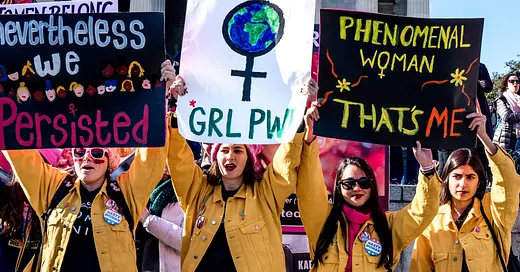
Caption on Fiamengo’s website: Feminism Cannot Be Reformed
Obviously, not all women are feminists. American conservatives have long taken comfort from the well-attested finding that a majority of women express reservations about the label. But all radical movements involve a small, hard core and a far larger and fuzzier periphery, and feminism’s periphery now extends deeply into Western society. Fiamengo writes that, while she tries to maintain the distinction between women and feminists, this can sometimes be difficult.
A 2020 Pew poll found that only 19% of American women say the term feminist describes them “very well,” but another 42% say it describes them “somewhat well.” So that makes 61% unwilling to distance themselves from feminism unambiguously. A closer examination of the other 39% would probably reveal plenty of feminist influence as well. As the author notes, most women now take for granted that they belong to a “historically oppressed group,” and accept as a matter of course that special legal protections and government programs should promote their advancement and well-being. People cannot be marinated in an ideology their entire lives without coming to believe that at least some of its claims must be true. Fiamengo also mentions the phenomenon of “confirmation bias:” applying a feminist lens when viewing the world helps one see evidence supporting it while screening out contradictory information.
The author is under no illusions that feminism can be reformed:
Even today, half a century after the implementation of equity hiring programs as well as ceaseless female empowerment campaigns in schools and universities, many women are still angry and many men still trying to make amends. It must be stopped. We will never reach a point where feminists decide to call off the gender war, accepting that men have done enough for them. There will never come a point where the suffering of boys and men matters more to feminists than their own power.
Women can destroy any society to which they belong simply by refusing to be wives and mothers. Feminism brings such a refusal about by directly undermining women’s ability to love. No less than other hostile forces discussed on this website, it is a deadly threat to European Civilization.




“Feminism” = femininity perverted by Jews to render Amalek childless.
This, exactly.
I have had about 6 Jew girl friends and they were ok. I guess that the chief reason femicommieism is so frucked up is that the jew gals have had lots of very bad experience with their jew boy friends, who are almost all crazy .
Where I live there are lots of Chinese. Having big mouth , a couple years ago I asked, in two different incidents, Chinese ladies why so many of them are with White guys. They both used the same language exactly, White men treat you betta….
Speaking of treating you better, similar experience with Persian gal….now married to a White guy. White guys treat you better….I guess, than Persian men.
So all you White guys, don’t put up with any femmiecommie crap. next?
men are rational. women are not. rationality can be used with men, not women. Nothing to do except let the ladies die with their cats and dildos.
I think, I guess, Femi lunacy is on the decline. We need war/depression/chaos for the ladies to grudgingly defer to real men, with guns, etc.
I stopped caring what women think a long time ago.
Never resign, hope dies last! Take a shining example from Sombrero-Torero Brandy Fartinez aka Mista Happy Pride, the tango-dancing incel-matador. He’s even dying to know what stupid negro women are thinking. https://www.youtube.com/watch?v=2h4uNYkOivY
As expected, he finally proved “Monkey.App” wrong after hard, unpaid capitalist labor. He’s thus proven himself to be a true alpha-chad. He even sat in front of his makeup mirror for two hours to style his mulatto hairstyle with fragrance from queer brand “Boy Smells.”
https://t.me/nazbertperspective/4444
“During the First World War, thousands of British women participated in a mass-shaming ritual of their menfolk, accosting any man they found in civilian clothing to present him with a white feather as a symbol of his cowardice.”
I didn’t know about this. But it reminds me of something that has recently occurred to me… why doesn’t “my body, my choice” apply to men who don’t want to be conscripted into a war?
All those “ my body my choice” thought nothing of “circumcising” their male children. I have boomer women fatigue big time.
When I birthed my first male child, we advised several “friends” (?) and acquaintances. Only two asked, right away, right off the bat: “Are you having the boy circumcised?” (I feel like puking when I remember this.)
Of those two prats, one is a homosexual and the other a jew. That ought to tell you something, namely, that women, boomer generation or otherwise, are not the only problem when it comes to a fixation on the denaturing of males.
Why didn’t it apply to the COVID “vaccine”? I’m from Victoria Australia and we had the most draconian measures on the planet. Needless to say feminist pigs were giddy about everyone being forced to get the jab.
https://x.com/shoe0nhead/status/2089153111394787556
Basically, now a heiress can marry a negro and
their “mixlings” will have rights to the throne.
https://www.bbc.com/news/articles/cn9nnxrxg4qo
Not so in Brunei https://www.dailymail.com/news/royals/article-16049417/Controversial-leader-Sultan-Brunei-advocated-death-penalty-stoning-homosexuality-adultery-strips-daughter-law-royal-titles-showing-lack-respect-him.html
Female “logic”: blind dog more important than own survival. https://www.straitstimes.com/world/final-act-of-love-woman-dies-shielding-blind-dog-in-colombia-earthquake
I’ve studied this issue for a few years and have come to a few conclusions.
Firstly, as the authoress of the book states, there is no ‘correct’ Feminism. Feminism in all it’s guises and methods is a disease. But it’s also a disease caused by a precedent.
Secondly, it is incorrect to lay the blame for Feminism at only the doorstep of the Jews. As with many ‘issues’ of our age, the soil was first ripe for it’s poisoning. Beginning in the 19th century, men of the West began the process of becoming feminized. We advanced our civilization and societies too fast. Treitschke, was one of a number of commentators writing in the end of the 19th century who complained of it in his time and place. This feminization of the White race was enormously exacerbated in Europe in particular by the dysgenic processes caused by two fratricidal world wars. These were wars the scale of which had no precedent, and as such, the dysgenic results also has no precedent in terms of scale (though there were precedednts in a smaller scale following, for example, Greece [5th cent. BC] and Rome’s own [1st cent. BC] fratricidal wars). British-Italian social philosopher Anthony M. Ludovici wrote of it extensively following the First World War (see ‘Man: An Indictment'[1927] and Woman: A Vindication'[1929]). David S. Jordan’s book, ‘War and The Breed’, written specifically on the topic of the dysgenic cost of the industrial slaughter of the First World War is also very much worth reading.
Thirdly, and directly connected to the above, women did not simply ‘adopt’ Feminism and declare war on men. Women are built as reactive creatures, and throughout the entire history of civilization, men have always been the tone-setters, the arbiters. Or at least, they’re meant to be. But Nature deplores a vacuum. The men became feminized, lost too many of the old masculine qualities, the women became masculinized and – most crucially – the women (at the collective-unconscious level) subtly lost respect for their menfolk.
Lastly, the most profound conclusion I have come to is that Feminism and many other aspects of recalcitrant behaviour exhibited by females (“the women are out of control”) are all efforts towards provoking men in order to elicit a response from men that may befit the default masculine nature of their ancestors – one of God’s/Nature’s great attempts at ‘resetting’ for the sake of returning to a healthier equilibrium. The problem – for many, many decades now – is that men have not been responding the way women/Nature/God would prefer and have instead been accomodating women’s displeasing unwomanly behaviours (the ‘tests’) and worse, giving them more extensive opportunities to displace us and undermine masculinity that remains in our civilization.
The women give the ‘tests’, but the men have been failing them, again and again and again (“Refugees Welcome”). The modern phenomenon of White women actively seeking out new arrivals right off the boats (often at cost of their lives – proof they are acting at an unconscious level) is a classic example of this GOADING that I am talking about. These women – unconsciously, making use of the ‘skills’ gifted to her by nature/God, are trying to provoke a reaction from the menfolk by using the interlopers as pychological weapons; they are trying to trigger a reaction that would result in the resetting of the national fabric to a status that is more conducive to a safer, healthier and more beneficial state for all the natives through extirpation of the interlopers. But the men are not doing this and the women willc keep performing these ‘tests’ until the men finally colectively respond, respond in a manner that is strictly exclusive of the trends of modernity or the wishes of foreigners. In their soul, Womankind understands that it’s the menfolk who determine the course of civilzation and whether the race thrives & multiplies or declines and dies out.
“The women are out of control” Because the men have lost the will to control them.
Feminism is more about men than women.
I agree that women are unconsciously hoping for us to take charge and restrain them. But this is difficult when doing so is considered “violence against women” and gets you jailed. So many men are simply shunning them altogether instead.
The men who created the laws that make it legally impossible for men to retake charge of societies are the same cut as the men who created the laws to extend the franchise to women. Those males failed women (and our civilization) in the same way that modern ‘common’ males are failing women by ‘shunning them altogether’.
I would like to add to my previous comment that an army of women today are acting in the manner of ‘Feminists’ either by accident or design through the failure of their own fathers. I’m sure we’ve all met plenty of women who have ‘daddy issues’. This happens as a result of an insular man who reneges his fatherly duties, leaving the girl to become a woman who questions her own self-worth. She then vents her psychological frustrations on men in general. Any conscientious father of daughters knows that a key role of his towards his daughter(s) is to be that masculine role model that will be a template for future standards of manhood to the girl. It is his job to validate her when she is a little girl by showing his affection. This is where so many White men have failed their daughters in the past several decades, and it has become so visible in the behaviour of the daughters when they become women, then left to function in society. They become an affliction of society and harm many of the healthy remaining pillars of it, perhaps through supporting socially destructive causes (LGBT ‘pride’ in schools, for example). It could have been at least partially avoided if only their fathers had shown them the time and affection they should have gotten as young girls.
This phenomenon has also had a negative affect on the White birth-rates.
There is a long YouTube conversation between Jordan Peterson and Camille Paglia from a few years ago. They both agree that the current state of affairs between men and women is destructive to society. Peterson says “Women have to do something”. Paglia responds “No. Men have to do something”. Paglia is correct, and so are you in this regard.
As far as your archetypical interpretation of women “provoking” men into action – I like it. In practice the mechanism appears to be quite mundane. Women are somewhat easily led by establishment narratives. The Western establishment is hostile to the long term success of the people they rule over, and perhaps here is were the JQ angle is most relevant. If the establishment changed, women would change with it. However, I don’t see a mechanism through which this might happen, and I don’t see current men in the current situation responding to the provocation. Miscegenation over time will make this prospect even less likely.
re our ladies, I sometimes remark to them: look around you , everywhere, past and present and find one thing not invented, developed, discovered, etc. that has not been so discovered, etc. by White men. I also say things like men hunt and kill enemies so ladies can bringup their children….women love, men organize, etc. Father Principle and Mother Principle, compare and contrast.
A couple years ago I saw a jewyorktimes or equivalent with a story on how lousy men are at childcare. Men need to solve puzzles, etc. not ooh and ahh over babies, etc. Women ooh and ahh, and where would we be without that sweet mothering of kids and taking care of hunters back from the hunt, bruised and battered and without a kill?
It is yin and yang, etc. Only deeply disturbed folks, especially ladies, reject the Natural Order. They of curse get to turn into hags with cats.
When I was a child, my natural association of male and female had dogs as male and cats as female. Not bad for a 5 year old.
The oldest mythic theme is man and woman. Goes on ’till you die. I observe some pond goldfish that I keep. The males pursue the females always and everywhere. Cherche la femme. Natural Order. Enjoy it and enjoy it in others. Non-possession for one-self when old.
We all talk a lot about Feminism which is fine since that ideology is pure cancer, but at the same time I do not see enough people condemning MGTOW at the same time since it’s the twin brother of Feminism.
The YouTube algorithm keeps showing me videos saying Men are better off single, Stoicism is better than woman, marriage is bad and so on (Some channels come to mind such as Manhood, Psycore, Dapper Dev and Better Bachelor)
My two biggest regrets at 27 is that I never experienced love at all and following MGTOW for most of my 20s
I even internalized stuff Redditors say about men who never experienced love before 20 or 25
Makes me wanna kill myself for being a failure of a human despite my other accomplishments
Turns out most men are not built to avoid women altogether
Even feeling that I have to rush before 30 as my final chance
I completely get that things are dysfunctional right now, but at the same time I, like most men, want a wife and kids. But all this Feminist evil and the fact I never experienced love makes me think I am a complete failure of a Human being, so much so I deserve to die.
I never saw the initials MGTOW prior to today, nor did I know that there was a more or less formalized interactive online community of men going it alone.
While little that I have learned about this movement in the last few hours strikes me as appealing, let alone sensible, I’m sure that it must have some worthwhile aspects. After all, if it didn’t, the SPLC, the Guardian, and even the UN Commission on the Status of Women wouldn’t be screaming about how evil and supremacist the movement is.
Unfortunately, unlike all our pre-20th century ancestors, most of us in this day and age do not receive a religious moral teaching that enables us to see MGTOW for the destructive fraud that it is as soon as we first encounter it. At root, MGTOW is misanthropy and a rejection of life. As you correctly discovered, it is a disease of the mind and should be considered as psychological cancer.
A man strides forward and embraces hardship. God gives us obstacles – often some that seem truly insurmountable – in order to give us opportunities to grow and become stronger. It has the added bonus of being a rich example to the youth.
The mind, even as it operates in this lunatic asylum of a century, has an incredible capacity towards adaptation so long as one perseveres. It’s true that so many women are lost to the many afflications of the mind that seem to be the defining characteristics of the 21st century. But many are not, and a few others – such as the authoress mentioned in the above article – have come out the other side, much as you came around to see MGTOW for the cowardly nonsense that it is.
Besides a basic traditional religious moral teaching, I think so many of our young men would benefit from reading combat memoir books, books on tales of exploration and other hardships in order to understand what true hardship really is and that with will and courage a man can get through almost anything.
As I stated before I used to follow MGTOW for most of my 20s, but at 27 I let basic biology to win over my mind.
But the fact that I followed this for so long as well as never really experiencing love makes me deeply ashamed of my current position, and since I cannot go back to my younger years I am depressed over whether or not I will die without experiencing intimacy with the opposite sex.
Doesn’t help that I internalized what Redditors say often: Not experiencing love before 20 is the End of the World for a man (and it makes me wish to die now).
Let’s look at some prime examples of countries that Jews want Whites to destroy themselves in, by starting wars against, on Jews’ behalves.
Iran: Men (especially fathers) in this nation keep their women on a tight leash. Women must dress more modestly. Many marriages are arranged. Virginity is demanded before marriage. Work, study, travel, entertainment etc., are restricted or chaperoned by male relatives.
If a women should dishonour the family by behaving immorally, they can expect severe repercussions, upto and including decapitation.
Jews are not even allowed a foothold in the liberal “feminization” of Iranian women for the same reasons.
Other objects of Jew take over, like China, N. Korea, Afghanistan, etc. are similar to Iran in how “retarded” women are treated,, and punishment against men who kill their irrationally behaving women is often considered light by Western, Jew controlled, standards.
Israel: Large families are subsidized, marriage outside the race or Talmudic ethos results in anything from shunning to violence and are simply illegal.
What all the above countries have in common is the broad societal recognition that women are simply irrational and must not be taken seriously.
Western men, chivalrous or not, have allowed Jews to infiltrate and corrupt, not just our women but, our societies as a whole.
Yes, I know, these are barbarian nations and we should not lower ourselves to their level, but they are winning we are losing.
Discussion of Feminism with Academic Intellectual and White Nationalists is excruciating. First off both always accept the conception of the generic Zionist Female – minus Race. You’ve lost that argument as a White Human already. Then its the White Male and White Female somehow opposing each other, and simpleton value and intellect absurdity and the gender opposites idea.
Its all pure Zionism / jew and I dont even know where to start. Any Manle that disparages a White Woman as a “woman” to me is a jew out of the gates – especially one that denigrates educated White Women. Its just more Zionist subversion and weakness.
I do think women are victims*.
Men do not have to change much to fit it. We naturally work, socialize and seek female company. Modern life requires little changes to that.
Women seek work, socializing and occasional male company. The chid rearing and technological realities have practically ruined that wish.
As we developed mentally as a species women have been unable to compete equally with men due to suckling babies and skirt pulling infants.
Then along came monogamy and completed the dependancy on just one man.
In a sense our technology is a curse for women. And womens inability to be economically independent as well as fulfilling motherhood means she will always be subjugated.
I think this explains female lack of empathy.
Jews are a special case – they developed national feelings of subjection which has created a community of victim-oppressors.
This post was embarrassing to read. Nonsense like this is why the right is getting mire and more backlash. Feminism is rising. Feminism is going nowhere. Feminism has nothing to do with jews. The jewish and maexist agenda started in 2015. All of a sudden they lumbed in feminism with LGBT with liberalism etc. there is a reason why you only see green haired extrimists on social media pretending to be feminists. In countries like Germany real Feminists like Alice Schwarzer get attacked for speaking out. They get censored.
I am getting sick and tired of this anti women bs. Cut it out.
Also in times like these peopke need to be united. And this problem goes even deeper. People like Jaques Ellul and the Unabomber talked about this
Post of the week, on Frank’s scale of all possible comments.
‘divide and conquer’, if anything ever was.
What Happened to Culture of Critique, where an issue was traced to Franz Boas, for example?
Thank you. We can see which side you are on.
It is wonderful that more women are speaking out against feminism.
In Ireland, it seems that when women vote, they prefer to vote for men. It’s 80% male representatives. And a while back an attempt to remove a reference to a “mother’s duties in the home” was defeated by a huge majority.
One way to reduce the harmful effect of women voting would be to create a Parliament of Women, alongside the male parliament. They would get nothing done but they would have a good chat.
The TradWife battle is interesting – the feminists hate the trad wives and the TradWives are openly mocking the fems:
“I’m lucky my husband is such a wonderful guy. It is such a luxury that I am not forced to work outside the home.” A trad wife on Irish radio boasted that she saw her husband as the CEO and herself as his right hand woman. She didn’t mind submitting to him, because he was not a tyrant.
TradWives are mocking the fems because they hooked up with some low status male.
We need to promote Trad Girls beauty and fashion pageants. Show the women that It pays to be a Trad Wife.
***“I’m lucky my husband is such a wonderful guy. It is such a luxury that I am not forced to work outside the home.” A trad wife on Irish radio boasted that she saw her husband as the CEO and herself as his right hand woman. She didn’t mind submitting to him, because he was not a tyrant***.
Er…these women better not be too sure. Trad husbands have a habit of cheating rather more than these trad wives would like to think. When a woman has a job outside the home, the husband worries that she may be having a good time with some co-workers or others she meets thru her work, so at least some of these men might be more careful of their own behavior. The rest…well, boys will be boys.
Chicago is calling. Here, once again, we see the sheer brazen hypocrisy of today’s women: In a rerun of a 7-year-old “Find My Family” video, it’s claimed that 85-year-old Edeltraut “had to” give up her daughter Anita 55 years ago at her husband’s insistence; he “forced” her to do it, and he was “a bad person” who also cheated on his wife with another woman while she was pregnant—so the daughter is told. (He probably also drank, beat her, and raped her, but you have to fill in the blanks yourself.)
Of all people, a military family from the U.S. occupation forces stationed in Germany adopted the baby. Who on earth believes this nonsense? No one could have forced this mother to do such a thing! In the 1960s, West Germany was already a so-called “constitutional state.” The woman could have gotten a divorce if her husband had done such things to her. Here, responsibility is being denied once again, exactly as Reinhard Sprenger describes in his books. And anyway: Why did this only occur to her at the age of 85? Supposedly, she had always been searching.
https://www.youtube.com/watch?v=uQJw0nuMbmM
https://en.wikipedia.org/wiki/Julia_Leischik
No matter how tragic these decisions may be, we said “Yes!”—and no power in the world can relieve us of this responsibility. We ourselves know better than any Jewish feminist TV show that seeks to portray women as saints, innocents, and victims. The Jewish media “empowers” women, rendering the Nazis’ view—that women are completely incapable of taking responsibility—obsolete.
I’ll say it again: This isn’t because women are “malicious” (as Jewish influences try to convince us), but because their brains are evolutionarily completely ill-equipped to foresee the consequences.
How can brain’s totally geared to obtaining safety, not be preoccupied with unforseen circumstances?
Recall your masculine instincts. A (racially conscious) evolutionary biologist would explain why women do not take any precautions against threats from foreign tribes—but presumably because their brains could only truly develop to their full size under the protection of male defenders.
However, it can also be assumed that women lack an internal psychological defense mechanism because they are always the ones who benefit genetically, even after being attacked by foreign—that is, neighboring—tribes for the purpose of genetic exchange to prevent inbreeding.
Stupidity, although generally characteristic of women, is of course not limited to them, but inevitably spreads to (character-wise feminized, i.e., weak) “men” as well. Just look at Trump: Satan unscrewed his head, took a dump inside it, stirred it up, and screwed it back on. A perversion.
I don’t care about Devlin or Fiamengo, who are just the opposite coin of the tiresome ‘women are wonderful’ effect – men are wonderful and never ever do anything bad (Fiamengo admits, at least, that she is likely channeling her maternal instincts into extreme male biases).
I agree that modern feminism is more about men than women. It’s called ‘shit test’, I believe. The more freedom and rights women have, the more they scream about ‘patriarchy’ and the more they write and read erotica with increasingly dominant and dangerous male characters. Similarly the more the White population is shrinking in numbers and power, the more abused and accused of ‘white supremacy’ we get.
While we’re on the unpleasant subject of shit, I’ve come to the conclusion that the insane dog obsession is just another facet of the Great Feminization. Both sexes are, unfortunately, enamored with the furry shitbeasts, but I’ve been seeing mainly female dog owners lately, with beasts so big they don’t even have the upper body strength to control them, wreaking havoc everywhere.
Not to mention that the disgusting ‘pet parent’ trend is also driven by women and effeminate ‘men’.
The whole pet culture is deranged, but for all the talk about crazy cat ladies, crazy dog ladies are infinitely worse and far more unhinged. Dogs need to be banned.
Well, banning mutts is a little excessive maybe, but I see your point as regards “crazy dog ladies”.
People who love their dogs, it’s because dogs are such a bunch of toadies. Their “owners”, both male and female, probably can’t have sensible relationships with other humans, so they get dogs to fill the gap – creatures who don’t talk back plus do what they’re told after proper training, of course, in Obedience School. LOL
Where I live, there are so many dogs it would amaze you. There’s a utility pole in front of my house and ALL the dogs walking past with their handlers stop there to lift a rear leg. And it seems they are all high class pure breeds. Probably 2/3 of these dog owners are young women (20-40 yr. old). The old women walking around this neighborhood don’t seem to feel a need for dogs. I guess they never graduated from Cat Lady. Quite a few of the small dogs on a leash are with men. By god, they look so silly, I have to stop and stare.
Despite Trump ending Affirmative Action by canceling LBJ’s EO 11246 Jan 21, 2025, apparently, it’s still going on:
“Costco Wholesale CEO Ron Vachris is set to receive the Muriel F. Siebert Leadership Award from 50/50 Women on Boards.”
Reported by Yahoo Finance 6-29-2026
https://finance.yahoo.com/markets/stocks/articles/costco-governance-focus-ceo-earned-011552457.html
” they christened this the “women-are-wonderful” effect. ”
What a crock. This should have been called the “women-are-where-you-get-laid” effect to explain how men will pay along with just about anything a woman throws at them as long as they get tits and ass at some point in the game.
I mean really.
Tits and ass?
Buddy homosexuality is bad. AIDS will make you see Elvis soon. Better for this planet though
Always a pleasure to encounter the sagacious and learned Dr. Devlin in my peregrinations across the Dissident Internet. I’ve learned much from him over the years (and I’ve been alt-right since before there was an alt-right).
I instinctively hated feminism when coming of age in the 80s, but I never really knew how to defend against liberal individualist feminist demands for equality. I could only remind discussants that Aristotle had argued that the essence of justice was that likes be treated alike, and unalikes unalike, and that males and females are the primordial unalikes.
If I have a single criticism of Dr. Devlin in his analyses of feminist ruin, it’s that he never offers a way out of the horrors he so expertly describes and diagnoses. Obviously, THE key is for white men to wise up, and then tribally toughen up. But how do we get enough white men to do so?
My extremely reluctant conclusion as to how all this will play out is that feminized white men will simply be replaced by alien but more masculine men, ones like the Muslims, who know how to control their women.
The late Far Right anthropologist Roger Pearson liked to say that the future belongs to the fecund. I would go further: the future belongs to those tribes whose menfolk control their females. Either way, the West on its present course is doomed to extinction.