
Why France is Burning
It is hardly news to observe that many of the European nations are struggling at the moment. Inflation, unemployment, budgetary crises, and high energy costs are all taking their toll. Many governments are also suffering a crisis of credibility, as they take extreme and anti-democratic action to ward off “the far right”—and in doing so, paralyze themselves, both through internal division and through weak leadership. Furthermore, European nations have collectively made some disastrous foreign policy decisions; they have gone all-in on their support and defense of Ukraine, they have done nothing to oppose Israeli crimes against humanity in Palestine, and they have done nothing to oppose the illegal and unethical US-Israeli war against Iran; they are losing on all three fronts, all at once.
Of all the nations in crisis at the moment, none are worse off than France. Nationwide riots are in the news every day, and the government, so far, has proven utterly incapable of an adequate response. News coverage and analysis is abominable; no one has offered more than the most trivial assessment of the situation (“crowded classrooms”, “underfunded social programs”, “high cost of living”, etc.).
One obvious approach to understanding why France is uniquely in such bad shape is to look at the underlying social demographics. Even the briefest of inquiries along this line is enlightening.
I would put forth the hypothesis that a Western nation’s social stability or unrest is a function of the presence of non-Western demographic factors—or in simple terms, a function of the number of people of non-Western ethnic origin. Those nations with the fewest non-Westerners will enjoy the greatest stability and harmony, and those with many will suffer the most discontent and unrest. Or so I contend.
For at least the past century, three non-Western demographic groups have historically been at the center of social disorder within Europe: Jews, Blacks, and Muslims. Thus, as a quick, first-order assessment of the situation, one can simply evaluate the numbers of each of these three ethnicities in the European nations and then look for correlations to social unrest.
If we do even a cursory assessment of these three ethnicities, we find that three nations have the largest populations: Germany, the UK, and France. (I exclude from this analysis the European micro-nations like Monaco and Andorra, and I exclude Russia, Ukraine, and Turkey, which, by some measures, are “European.”) On the one hand, this is unsurprising because these are the three largest nations by overall population, and thus it would be expected that they would have large numbers of all minority groups. Still, large numbers possess a mass-effect, especially when situated within a single nation. This is a well-established concept, going by various names, including ‘critical mass theory,’ ‘agglomeration theory,’ and in several aspects of social philosophy. As a result, Hungary, for example, has more Jews on a percentage basis than Germany, but Hungarian Jews do not possess the social capital or collective energy that the larger pool of German Jews do. And Sweden has a higher percent of Muslims (8%) than either Germany or the UK, but their small numbers yield a smaller overall effect.
My estimates of each ethnicity are as follows; where I found a range given, I used the higher figures, assuming that “official” numbers are almost certainly undercounts:
Jews:
Germany 170,000
UK 310,000
France 600,000
Blacks:
Germany 1,000,000
UK 3,000,000
France 5,500,000
Muslims:
UK 4,100,000
Germany 5,600,000
France 6,600,000
The immediately apparent fact is that France, by a far measure, has clearly the most of all three of these troublesome ethnicities—the most, in fact, of any European nation. Again, this is not obvious, especially considering that France has the smallest population of the three nations cited here.
These figures are charted below, first for Blacks and Muslims, then for Jews:
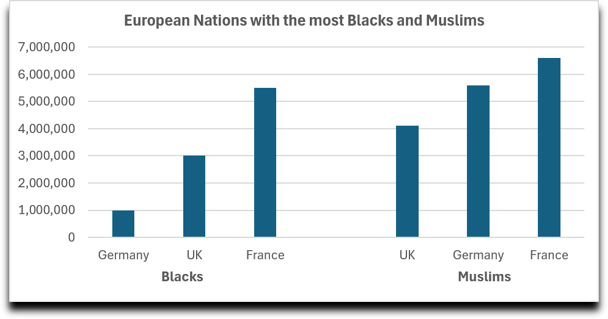
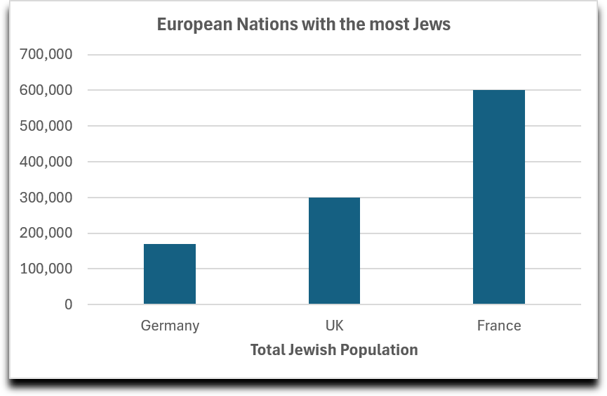
According to my thesis that these particular ethnic groups have traditionally been the most problematic in Europe, we should expect, given these numbers, that France would suffer from the most discord and most social unrest—and indeed, that now seems to be the case. This is not a new development; trouble has been brewing there for well over a century. Intensive colonization of both northern and sub-Saharan Africa began for France in the 1830s and continued well into the twentieth century; colonies are known, historically, to be the initial driving factor in non-Western immigration. As for Jews, they began flooding into the country from about 1700, with numbers rising to almost 100,000 by the late 1800s; it was at this time that such critics as Eduard Drumont could write his landmark work, Jewish France (1886), arguing for a large-scale corruption of French society already at that date. Drumont claimed, in fact, that Jews owned slightly over half of all wealth in France, despite being a 0.2% minority—an astonishing situation.
In any case, these conditions have clearly taken their toll. By my analysis, France today is in a near-terminal state. To have the most of any one of these three minorities is bad enough, but for a single nation to have the most of all three is catastrophic in the long run. On my thesis, France has no hope of social stability; continued decline is inevitable until it radically reduces its numbers of all three groups.
Under current conditions, with a presidential election coming in six months, it appears that Marine Le Pen is likely to become president. Were I an advisor to her, I would suggest a radical course of action: construct a plan to reduce all three groups by 90% within four years. Doing so would certainly lead to a miraculous resurgence for France, and Le Pen herself would be hailed as true national heroine—a Charles Martel and Joan of Arc rolled into one. Let us see how she fares on this front.
Finally, I note without comment that the US has large populations of all three of the unfortunate minorities: 6 million Muslims, 7 million Jews, and 53 million Blacks. I leave it to the reader to compare these numbers to France and to assess the future prospects of America.
David Skrbina, PhD, is a former professor of philosophy from the University of Michigan, Dearborn. He is the author or editor of a dozen books, including The Jesus Hoax (2nd ed., 2024), The Metaphysics of Technology (Routledge, 2015), and Panpsychism in the West (MIT Press, 2017).




BIEN DIT!
The UN Replacement Migration documents date from the early 2000s.