
Repentance has no place in politics
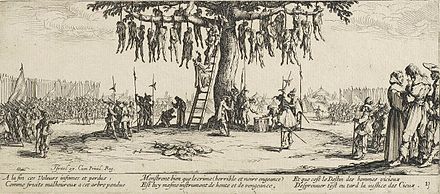
Jacques Callot (1592–1635) “Miseries of War”, engraving
Translated from the French by Tom Sunic
Below is the interview Alain de Benoist gave recently to Boulevard Voltaire
****
Q. Shortly before his death, François Mitterrand said those definitive words to the perplexed Jean-Pierre Elkabbach: “France does not need to apologize.” Mitterand spoke of those famed “darkest hours in our history.” Today, however, “repentance” has become fashionable. What does that mean?
ADB: To put it in its simplest terms, repentance can be summed up as follows: people apologize for some wrongdoings they did not commit in order to please those who were never subject to those wrongdoings. Those about to repent committed no harm; to those receiving apology no harm was ever inflicted. All of this is perfectly ridiculous. In fact, repentance means making a selective choice in our history by safeguarding solely some specific and same historical periods, i.e., slavery, colonialism, etc., considered “dark” in the light of the dominant ideas whose goal therefore requires official repentance. A much imagined inherited collective guilt adds up to this major anachronism which consists of “throwing backwards” into the past the value judgments belonging to our present time frame. The past, having being reduced to the “duty of remembrance,” the present, consequently, is bound to become fleeting, self-referential, and existentially empty.
However, the whole process, is more than just a fashionable discursive game. On the one hand, it is designed to convince our compatriots that each time, when turning back to their past, they are bound to uncover the horror only. Here is the corollary: identity is invariably of a questionable nature; novelty, by contrast, must be invariably better. On the other hand, and in an epoch when the victimhood status is becoming highly profitable, the whole point is granting to the alleged victims’ descendants all sorts of benefits; from bestowing on them good conscience to granting them moral superiority, all the way to the enactment of “memorial laws”, plus financial compensations. The focus of those invocations of the past is located in the present: the “dark days” are posited or exploited in order to either legitimize or delegitimize current opinions. Monsignor Nunzio Galantino, the Secretary General of the Episcopal Conference, stated recently that “our welcoming of immigrants is a form of compensation for all the damage we did over the years […]. We owe hospitality to migrants for all what we did to their lands in the past.” Thus, the issue of immigration is being processed under the guise of the mea culpa. Which in turn enables some minority pressure groups to plead by proxy their victimhood status and prop themselves up as the vigilantes of the present.
Q. During his time as pope, Pope John Paul II also made repentance for certain crimes committed by the Church in the course of its history. One can say in his defense that Catholicism is a religion that requires the faithful to regularly confess their sins …
ADB: What is certain, in any case, is that the dialectic of sin, repentance, atonement, reparation, or “teshuvah“, and forgiveness — all of them belong to the language of religion. They have, therefore, nothing to do with the political process. Across the board collective repentance should not, however, make us forget that European civilization is the only civilization to date calling itself into question, to the point of internalizing its own critique. As Jean-François Mattéi said: “in order to respond to its critics, reason needs to ask forgiveness, because it appears always before its own tribunal.”
Q. Is there a risk for those refusing to repent to fall into the opposite extreme, i.e. to deny purely and simply the existence of the gray areas in our history?
ADB. This, in fact, is a symmetrical risk. All the lands of the world have had their dark days and their shining periods. In a normal state, one teaches young people to be proud of their country by instilling in them the memory of what their country did in a most glorious fashion. This does not mean that the rest of the story did not exist; yet, one must firstly be aware that self-esteem begins with the respect of what was inherited, helping us thus to define ourselves. There is no reason to be proud of slavery, but there is no reason also to be proud of the sack of Béziers, or the massacre of Saint Bartholomew, or the “dragonnades,” the Vendee genocide, or the repression of the Commune. The whole question boils down to whether we wish to teach the French to be proud of themselves, instead of instilling in them shame or self-doubt.
As for the rest, it is useless and even harmful to harp ad infinitum on civil wars. History is wholeness and one won’t get very far by fingering rosary beads in a durable sequence of Clovis to Charles Martel, to Jeanne d’Arc, and imagine that this is the best way to answer those for whom History of France began with 1789 only. The past is not a “museograhic“ heritage, nor a static essence, but a complex narrative substance whose narration is constantly revisited, allowing a people to tell itself its own story. Wishing, on the one hand, to single out the “anti-France,” or for that matter restricting oneself only to a talk about “France, the land of human rights,” means in both cases to mutilate our history. Marc Bloch rightly said that to be truly French means to be able to vibrate with the memory of the coronation of Reims, as well as partaking of the Federation Feast during the French Revolution, July 14, 1790. This was also the opinion of Charles Péguy — and this is also mine.
Alain de Benoist is a philosopher.




Comments are closed.