Featured Articles

Falling down the memory hole: Reflections on the 1980s Soviet counterculture, Part 4

It was a cold and sickly gray February morning of 1983 when I walked into a shrink’s office and said that I had a severe mental and drug problem. The office belonged to Kirov’s District Psychiatric clinic of the city of Leningrad. The shrink I was to see was Dr. Dvorkin.  My ‘system’ friends especially recommended him to me as a man who could be trusted, who knew ‘what’s up’ and who ‘understood’ and ‘approved.’ It was a popular but totally fictitious belief: that some Jewish shrinks were such anti-Soviet dissenters that they knowingly granted the ‘system people’ fake diagnoses that released the latter from the draft. Of course, Jewish shrinks were more lenient to young Jewish patients, but still they followed the official regulations. I learned about this only later.

So here he was — a jolly Jewish fellow of staggering proportions with spectacular jowls hanging on a collar of his white medical coat (obese people were extremely rare in the Soviet Union — he was the third truly obese man I had met in my life).   Read more

Falling down the memory hole: Reflections on the 1980s Soviet counterculture, Part 3

The ‘system’ members always proclaimed that the drugs were necessary for artistic creativity. Using drugs was also a form of political protest and an activity that distinguished the self-ordained elite from the vodka-soaked proletarian crowd.

The most common drug — cannabis — was easily obtainable through friends and acquaintances, but it was also freely shared among the ‘people.’ Drug pushing in its pure commercial sense was uncommon, at least within the ‘system’ crowd. In fact, it was easy to obtain ‘weed’ for free.

Speaking of drug dealers, the first one I encountered was a 24-year-old Jewish guy nicknamed ‘Michael the Kind’. He was a truly mysterious figure, and incidentally, he was the person who gave me my first taste of pot. I met him through a personal introduction. Supposedly, he was an excellent guitar player who enjoyed being a local celebrity while leading the life of a carefree vagrant. What traditional Jews call a ‘luftmensch’.

According to rumors, his father defected to the West a long time ago while Michael continued to live with his mother who doted on him incessantly. He neither held a job nor did he study. This despite the Soviet law that people convicted of a ‘parasitical lifestyle’ could go to prison for three years. (You were a parasite if you were unemployed more than three months.) Read more

Falling down the memory hole: Reflections on the 1980s Soviet counterculture, Part 2

My personal involvement with ‘the system’ had seemingly innocent origins. All through my adolescent years, I had been dreaming of becoming a rock musician. Of course, harboring such dreams, especially by one born in the Soviet Union, smacked of a childish naiveté. For one thing, the Soviet authorities viewed rock music as a political and cultural deviation—and a sad result of the influence of ‘the rotten West.’ Theoretically, it was possible to join a low-profile commercial band and play in restaurants and at weddings, but I aspired to higher (or at least different) things.

But in pursuing my dreams, I did not appreciate another type of obstacle to my dreams.  Spheres of influence in the USSR were clearly divided along many lines, including nationality. The Russian majority firmly controlled the government and military (you needed personal connections or better still, you had to be born into the right family to be able to get on the fast track to success). The Jews dominated culture and entertainment—clearly a demotion from their former positions as leading communists. In fact, this demotion was one of the reasons the Jews felt wronged by the Soviet system and why many of them were in silent or no-so-silent opposition to it. But in all artistic spheres and in a great many other liberal spheres, the Jews reigned supreme. For instance, in the early 1980s, the vast majority of movie actors, musicians, writers and journalists were Jews. They were  slightly less represented in the medical and legal professions, but still Jews promoted Jews, so if you weren’t one, it was useless to try to squeeze into certain professions. Read more

Falling down the memory hole: Reflections on the 1980s Soviet counterculture, Part 1

This essay is a reflection on certain aspects of my past in connection with a counterculture of the former Soviet Union and its main architects, participants and driving force — the Jews.  I had been a disillusioned young man at the time I joined the so-called ‘system’ movement, and although my personal involvement with it was rather brief, the very association with ‘the system’ and its people — in itself quite a bizarre experience — has drastically altered the consequent course of my life.  It is still difficult for me to write about ‘the system’ (the original slang name for the Soviet counterculture was ‘the system’, or ‘sistema’; its participants or members often termed themselves ‘hippies’, ‘pacifists’ or ‘punks’, but those names were completely arbitrary. The general nickname they preferred to use was ‘a man of the system’ or, ‘sistemny’ or plural — ‘the people’/ ‘peoply’).

Although ‘the system’ was an important and visible feature of Soviet urban life, one hardly hears of it nowadays, as if this particular phenomenon had disappeared down the Orwellian memory hole without a trace. Allegedly, it had united hundreds if not thousands of young men, Jews and non-Jews alike, who shared a rebellious attitude towards the Soviet System. It promised to break stagnation by the united strength of the younger and disillusioned generation of Soviet youth who had nothing to lose, as they had not got even chains. Yet, all these silent protests and supposedly rebellious activities came to naught; they disappeared into the past, or they were deliberately erased. Read more

A Closer Look at What Happened to Pat Buchanan: Part II

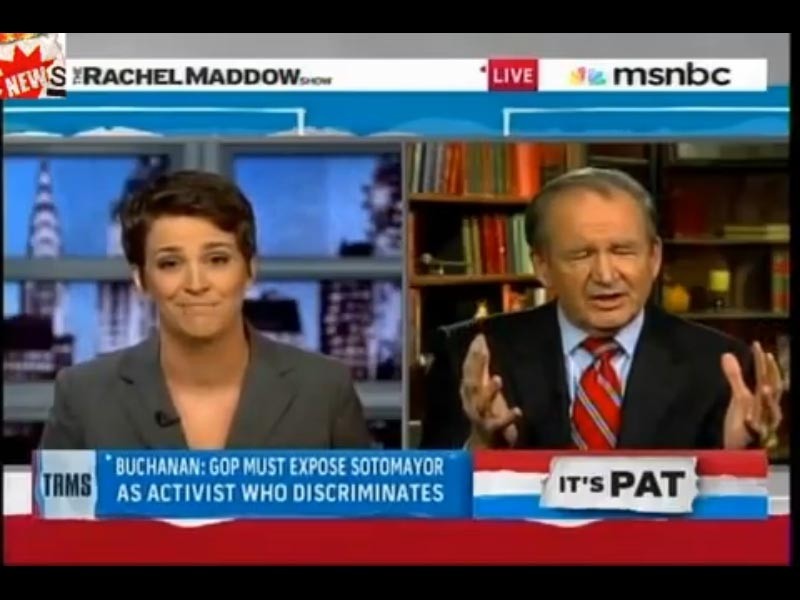
Rachel Maddow: Trying not to cry during interview with Pat Buchanan

Criticism of Zionist Projects Not a Problem at MSNBC

Having found defenders on the left, Buchanan started working for MSNBC in July 2002, the ADL’s disapproval notwithstanding. Criticism of Israel-First foreign policy never seemed to be a problem for him there. James Kirchick, a harsh critic, complains in the Columbia Journalism Review:

The very same “left” which Buchanan decries today as unwilling to hear his voice was more than happy to lap up his commentary in one crucial realm: foreign policy. [James Kirchick, “Pat Buchanan and His Enablers,” Columbia Journalism Review, 23 February 2011]

On Buchanan and Press, MSNBC’s imitation of CNN’s Crossfire, both the rightwing Buchanan and the leftwing Bill Press agreed that the United States should not attack Iraq. Opposition to Zionist or pro-Zionist aggression seems to have been more or less the established view at MSNBC when Buchanan started there.

In addition to Pat Buchanan and Press, MSNBC’s Phil Donahue and Chris Matthews were dishing out skepticism of the justifications for war on a regular basis. Since the current president of MSNBC, Phil Griffin, was the producer of Hardball with Chris Matthews during its strongest anti-war period, and since Griffin was also a longtime personal friend of Keith Olbermann’s from the 1980s when they both worked at CNN, it would appear that Griffin does not have any objection to airing anti-war commentary. Read more

A Closer Look at What Happened to Pat Buchanan, Part 1

Pat Buchanan has not appeared on MSNBC since October, when he began promoting his book, Suicide of a Superpower: Will America Survive to 2025? He expressed concern about “the end of white America” and the shrinking of the “European and Christian core of our country.” In January 2012 MSNBC’s president Phil Griffin said, “The ideas he put forth aren’t really appropriate for national dialogue, much less the dialogue on MSNBC.”

Following his dismissal from MSNBC, Buchanan named what he regards as the provocateurs of his downfall (see “The New Blacklist”). Buchanan blames “an incessant clamor from the left,” itemizing the Black-advocacy group Color of Change, Media Matters, and an unnamed LGBT group. After them, at the end of the list, Buchanan adds, “On Nov. 2, Abe Foxman of the Anti-Defamation League, who has sought to have me censored for 22 years, piled on.” Likewise  Congressman Tom Tancredo: “MSNBC’s decision to dismiss Pat Buchanan shows the depths to which the mainstream media has caved to far-left pressure groups like the Southern Poverty Law Center, the National Council of La Raza, Color of Change and Media Matters. There can be no doubt that these smear operations were responsible for Buchanan’s dismissal.”

I disagree with this, the prevalent view. I argue that what many people think were the causes of Pat Buchanan’s dismissal probably were not. What really hurt Buchanan was probably not the horde of angry enemies circling the walls of MSNBC and blowing trumpets, not the ADL, not Media Matters, not even Color of Change or the LGBT group. While the public is disposed to equate making noise with exerting influence, the decision of an executive in an office need not have been influenced by any of that in the slightest. I suggest that the decision to fire Buchanan from MSNBC may have been based on a consideration that is relatively or even completely obscure to the general public. Read more

Alan Dershowitz: Policing Jewish Opponents of a War with Iran

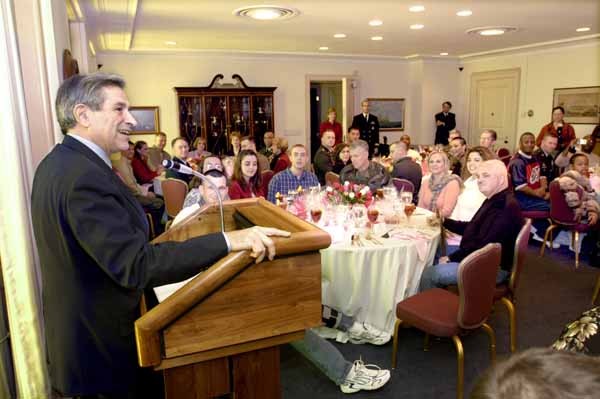
Israel Firster and Iraq War architect Paul Wolfowitz addresses soldiers wounded fighting in Iraq.

Jews have always policed their own—a basic element of any successful group and a central idea behind the cultural group selection model of Judaism. A good example is the drama playing out now on the attempt to police Jews who are critical of Israel’s desire for a war with Iran. Media Matters, the leftist news organization whose main goal has been to attack Fox News, has hired MJ Rosenberg, the former AIPAC operative who is now a prominent critic of Israel, to beef up its foreign policy coverage. Rosenberg commits the sin of using the phrase “Israel Firster” to refer to people like Alan Dershowitz and the Israel Lobby generally. (Rosenberg did not invent this label. As discussed here, the phrase had been used long before by Wilmot Robertson, David Duke, and the Vanguard News Network.) As Rosenberg has noted, saying that AIPAC has dual loyalty is giving them credit for one more loyalty than they actually have.

Rosenberg’s argument bears quoting:

Right now, there is only one interest group in the United States that absolutely opposes any diplomacy to avoid war with Iran and which insists that the United States expressly state (as it has) that war with Iran is definitely “on the table.”

In fact, that interest group, AIPAC, actually got Congress to pass a bill, which President Obama signed, that bans any diplomacy with Iran without express approval of four Congressional committees in advance — as if AIPAC will ever let that happen.

Just read this AIPAC-drafted language that is now law:

(c) RESTRICTION ON CONTACT.-No person employed with the United States Government may contact in an official or unofficial capacity any person that-
(1) is an agent, instrumentality, or official of, is affiliated with, or is serving as a representative of the Government of Iran; and
(2) presents a threat to the United States or is affiliated with terrorist organizations.

(d) WAIVER.-The President may waive the requirements of subsection (c) if the President determines and so reports to the appropriate congressional committees 15 days prior to the exercise of waiver authority that failure to exercise such waiver authority would pose an unusual and extraordinary threat to the vital national security interests of the United States.

Frankly, this makes me sick. Banning diplomacy almost guarantees war with Iran, a war that must not be fought.

I oppose war with Iran unless Iran attacks the United States directly. Period.

I do not want America to be dragged into a war that Netanyahu provokes and which the United States would then be dragged into. I favor diplomacy, unconditional diplomacy, with all issues on the table.

Another very ominous sign is that the Congressional forces advocating war have now settled on a weaker criterion for war—that Iran simply possess “the scientific knowledge and industrial means to build a nuclear bomb,” not necessarily actually build one or even intend to build one (LATimesObama likely to resist pressure to further toughen Iran stance“). As Philip Giraldi, writing at Council for the National Interest, notes: “There are about 50 countries in the world that have the capability to produce a nuclear weapon if they chose to do so, making Iran far from unique but for its persistence as a thorn in the side of Israel and Israel’s powerful lobby in the United States.” The LATimes article notes that 38 senators also signed a resolution that the Obama administration not pursue containment of Iran, a policy that leaves a military strike the only realistic option. The pressure on Obama is intense, especialy with all the Republican candidates except Ron Paul eager to flog him for not doing enough for

Read more