
The Forgotten Legacy of the Church Militant
5232 words
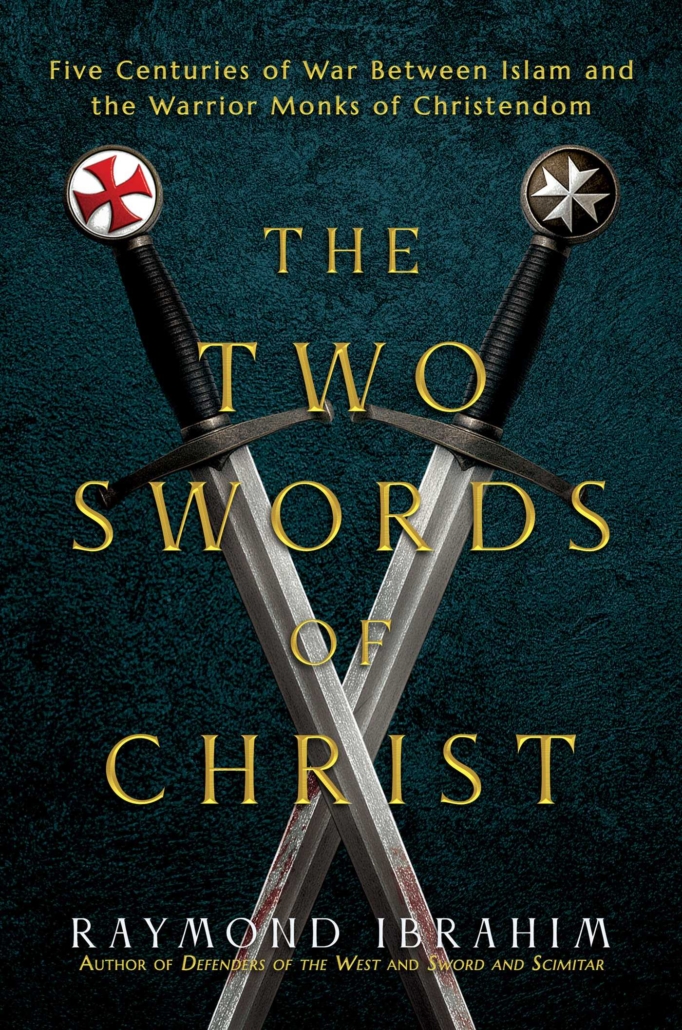 The Two Swords of Christ: Five Centuries of War Between Islam and the Warrior Monks of Christendom
Raymond Ibrahim
Bombardier Books, 2025
512 pages, $32.00 hardcover
The average American knows little about Islam apart from the bare fact that it is a “religion.” From this, certain things follow for that average American. First: Islam is a private matter which the state and all non-Muslims are bound to tolerate. Second: when Muslims fail to practice reciprocal tolerance toward non-Muslims, this cannot be due to their religion per se, but must have its source elsewhere—such as in a mysterious process called “radicalization.”
Americans believe these things because of a revolution in religious thinking carried out within Western Christendom in the seventeenth and eighteenth Centuries. This involved a shift away from understanding religion as a comprehensive set of beliefs and rules meant to inform society as a whole and toward considering it an affair of individual conscience. The practical goal of this “privatization of religion” was the worthy one of bringing an end to the destructive wars of religion which shook Europe in the century following the Protestant Reformation.
But the average American is not familiar with this chapter of intellectual history and hence does not understand that the modern ideal of religious toleration is not natural or universal. It is an historical achievement specific to European Christendom. He therefore assumes that the private character of religious belief and the moral requirement upon all of us to tolerate freedom of individual religious conscience are timeless and perhaps even self-evident. This is a good example of what novelist Gore Vidal meant when he famously said that USA ought to stand for the United States of Amnesia. We suffer from the provincialism of time in a way most of our enemies do not.
In fact, the revolution in religious thinking which accompanied the Enlightenment and the rise of liberalism never occurred within Islam. To this day, it is difficult for Muslims even to get their minds around the modern Western conception of religion as something private. For the Muslim, Islam is a total way of life and thinking which governs every aspect of social reality—law, politics, economics, war, and peace—and not primarily a matter of personal conscience. Muhammad taught that it is a duty incumbent upon every Muslim to support the struggle against all other laws and religions until Islam rules over the entire world. Unending warfare against the non-Muslim world is intrinsic to Islam.
Raymond Ibrahim is an American-born writer of Coptic Egyptian ancestry. As such, he has no illusions about Islam. He knows, e.g., that Muslims had to persecute the Christian native stock of Egypt cruelly for some seven centuries before a Muslim majority could emerge there, and that another seven centuries were required to reduce Christians to the 10 percent of the Egyptian population they constitute today. Before writing the work under review here, he produced Crucified Again (2013), an account of Christian persecution in the contemporary Islamic world, Sword and Scimitar (2018), an overview of Islam’s fourteen-century war against Christendom, and Defenders of the West, (2022) a collection of biographical sketches of eight men who led Europe’s defense against the Islamic enemy, including Richard the Lionheart and Spain’s El Cid.
The present book, The Two Swords of Christ, focuses on the Templars and Hospitallers, military and religious orders that played a central role in the Crusades. The title alludes to Luke 22: 36–38, in which Christ tells his disciples: “He that hath no sword, let him sell his garment, and buy one. And they said, Lord, behold, here are two swords. And he said unto them, it is enough.” During the Middle Ages, this passage was interpreted allegorically, as Ibrahim explains: “Christians were to fight two sorts of evils with two sorts of swords—a spiritual sword against spiritual enemies, and a physical sword against physical enemies.”
The Knights of the Temple and the Hospital were embodiments of this principle: they were monks subjected to a strict spiritual rule and soldiers ready at a moment’s notice to sacrifice their lives in defense of the faith. They did not believe that turning the other cheek was the whole message of the Gospel, nor did they believe themselves obligated to tolerate a religion that persecuted their own. Their story is especially worth recalling in an age when Christianity has largely been reduced to sentimental humanitarian universalism.
The story of the warrior monks begins in the time of the Crusades, following the capture of Jerusalem in 1099. Here already we must caution the reader against popular distortions of the historical record. Many of our contemporaries imagine the Crusades as a kind of early European imperial aggression against the Muslim world, projecting the nineteenth century back upon the eleventh. But at the time, everyone on both sides understood that the lands in which the Crusaders fought had been Christian for several centuries before being conquered by Islamic imperialists in the seventh century. This conquest subjected the Christian population to “massacres, enslavement, church desecration, and systematic extortion,” as our author puts it.
The extortion was a consequence of the new rulers’ eventual realization that Christians could be more profitable to them alive than dead. Accordingly, they were subject to an onerous tax called the jizya in exchange for being allowed to continue practicing their religion. This was not “tolerance” in our sense of the term, however. Christians remained subject to periodic violence from their Muslim neighbors, and they had no official recourse against it. Ibrahim tells this story in more detail in his earlier book Sword and Scimitar.
Pilgrimages to the Holy Land, especially Jerusalem, were an established practice long before the Muslim conquest, and Muslims allowed them to continue because they could profit from it by charging pilgrims for admission. But such payments did not always protect Christians from violence at the hands of locals. For example:
In the early eighth century, some Arabs—described as “untamed and beastly, illogical in mind and maniacs in their desires”—captured, tortured, and executed seventy Christian pilgrims for refusing to convert to Islam. Shortly after that, another sixty pilgrims were crucified in Jerusalem.
Such outrages continued periodically down through the centuries, but they increased in frequency and savagery following the appearance of the Seljuk Turks on the scene in the late eleventh century. Europe soon got wind of the atrocities through the reports of returning pilgrims, and it was indignation at the abuse of their coreligionists which inspired their war to free the Holy Land.
This war, known to history as the First Crusade (1095–1099), resulted in the establishment of four new states under European Catholic patronage, including a Kingdom of Jerusalem covering the Holy Land proper. Christians regarded these territories as part of Christendom which had temporarily been usurped by Islam but were now restored to their rightful owners. The indigenous Christian population agreed, seeing the Crusaders as liberators.
Pilgrimages became more frequent but were still not free of danger from the many Muslims who continued to live in the area. Indeed, as Ibrahim writes, attacks on pilgrims “not only continued but were marked by a special cruelty by vengeful Muslims still smarting over the Christian victory.” Even the main road from the port of Jaffa to Jerusalem, used by nearly all pilgrims, was not safe.
A veteran of the First Crusade, Hugh of Payns, learned that Christians watering their horses at a cistern not far from Jerusalem were frequently ambushed and killed. A Medieval chronicler writes: “Moved by a strong feeling of justice, he defended them to the best of his ability, often lying in ambush himself and then coming to their aid, killing several of the enemy.” Together with another knight, Godfrey of St. Omer, Hugh decided to form a permanent brotherhood dedicated to escorting and guarding pilgrims along the roads to and from Jerusalem. In 1119, Hugh, Godfrey, and seven other knights took vows of poverty, chastity and obedience before the patriarch of the Church of the Holy Sepulcher in Jerusalem. King Baldwin bestowed upon them the old al-Aqsa Mosque on the Temple Mount as a headquarters. This had been built over a famous church dating back to 543 AD. Long before that, of course, the site had hosted King Soloman’s Temple. Accordingly, the knights always referred to their disused Mosque as the Temple, and they became known as the Knights of the Temple, or Templars.
Life in the Temple was austere. A contemporary chronicler tells us that Hugh of Payns “lived there poorly dressed and ill-fed, spending everything he had on horses and arms, using all means of persuasion and pleading to enlist whatever pilgrim-soldiers he could either for permanent service or at least for temporary duty.” Hugh and Godfrey were for a time reduced to sharing a single horse between them in their sorties to protect pilgrims.
The little band’s fortunes picked up in 1129 when St. Bernard of Clairvaux championed their cause at the Council of Troyes.
They were formally recognized as an order—Christendom’s very first military order—and given a religious rule of seventy-two clauses, the prologue of which exhorts recruits “who up until now have embraced a secular knighthood in favor of humans only, to hasten and associate yourselves in perpetuity with the order of those whom God has chosen from the mass of perdition and assembled for the defense of the Holy Church.”
The Templars’ fame and prestige exploded; new recruits and donations poured in. Within twenty years, the Templars possessed a network of preceptories that covered Europe. At the order’s peak, these preceptories numbered close to one thousand.
The new order had critics who saw fighting as an unchristian occupation inconsistent with the monastic calling. Bernard, however, defended the Templars with a treatise In Praise of the New Knighthood. Ibrahim paraphrases his argument:
Fighting and even killing are not intrinsically evil; rather, it is the intention and motivation of the fighter that decides the matter. The new knights were engaged in malecide, not homicide; their purpose was to exterminate evil, not evildoers (who, in this context, were seen as collateral damage).
This did not amount to any general license to kill. Muslims should not be “slaughtered when there is any other way of preventing them from persecuting the faithful,” wrote Bernard, but centuries of experience had demonstrated that there often was not: “it seems better to destroy them than to allow the rod of sinners to continue to be raised over the lot of the righteous.”
Bernard also contrasted the new order with Europe’s secular knighthood, an institution derived more from old Germanic tradition than from Christianity. The secular knight fights from “irrational anger,” for “empty glory” or “earthly possessions,” adorning himself and his horses with baubles resembling the “trinkets of women.” But the Templars lived and dressed austerely:
When battle is imminent, they protect themselves . . . by iron, not gold, so that, armed and not adorned, they strike fear into the enemy rather than arousing his greed. They seek to have strong and swift horses, not ones decked out in many colors. They are intent on fighting, not pomp; victory, not glory.
It was an age when every noble’s principal business was warfare, but also an age of faith: so the Temple’s combination of the two ideals in a single vocation of “fighting for Christ” was nearly irresistible to many young men. During the ceremony of admission to the order, recruits were admonished that their service had three aspects: “the first is to abandon and leave behind the evils of this world; the second is to serve our Lord; the third is to be poor and to do penance in this life, for the salvation of the soul.” The average recruit was about 27 years old, and was expected to be adept at mounted combat before joining the order.
The Templars followed a monastic rule based on that of the Cistercians, with prayers beginning every morning at 4AM. Even in the field, they prayed and held masses, pitching their tents in a circle around the tent that served as chapel. The habit of discipline and obedience the men acquired by practicing the monastic life served them well in the field, and was one of the main reasons the military orders were more effective than the regular Crusader armies.
The nucleus of the Templar organization was formed by the Knights, of whom there were commonly about three hundred, although at the order’s height in the early thirteenth century the number may have grown as large as a thousand or more. But the Knights were assisted by the “serving brethren,” or sergeants at arms (sergeant means “servant” in Old French). These were freemen who held various important offices and fought side by side with the knights whom they greatly outnumbered. Many were the offspring of marriages between Latins and local women. There also existed a class of nonmilitary servants attached to the order: blacksmiths, carpenters, drapers, and so forth.
The Templars’ mission soon expanded from merely protecting pilgrims to going on the offensive against Islam, as Ibrahim explains:
This evolution appears to have been inevitable. If it was axiomatic that Muslims would always and everywhere prey on Christians, pilgrims and otherwise—and it was—and if the Temple’s entire purpose was to protect Christians, then by default the Temple was at war with surrounding Islam.
For four and a half decades following the capture of Jerusalem, the Crusader states remained relatively safe from outside attack due to the reputation they had gained during the First Crusade as well as to divisions within the Muslim world. This changed in 1144 with the Muslim siege and capture of Edessa, capital of the northernmost of the four Crusader states, followed by the usual rape, slaughter, and enslavement of the Christian inhabitants. In response, the pope called for what became known as the Second Crusade.
The Temple contributed 130 Knights and an unknown but much greater number of sergeants-at-arms from their preceptory in Paris under the command of Everard de Barres. These men accompanied King Louis VII of France into Asia Minor, where the Crusaders suffered a disastrous ambush. The King then put the Templars, whose discipline and frugality he admired, in charge of what remained of his army. An historian of the Crusades writes: “Only when an inept Louis VII allowed the Templar Master to reorganize his column of march were the undisciplined French Crusaders saved from certain annihilation.”
A force amounting to just ten percent of what had first set out arrived penniless in Antioch in March 1148. Once again, the Templars came to the rescue: Commander Everard traveled on to Acre, where he secured the necessary funds, bringing his own order close to bankruptcy in the process.
A council of local Frankish leaders, disregarding Louis’ wish to liberate Edessa (the original purpose of the Crusade), decided to employ the remaining forces in besieging Damascus, then seen as a serious threat to Jerusalem. The siege was brief and unsuccessful. The Second Crusade thus ended in failure, but the Templars had acquitted themselves well and prevented the worst; they alone emerged from the fiasco with an enhanced reputation. The King of Jerusalem subsequently wrote to Louis VII:
Above all, we earnestly entreat your majesty constantly to extend to the utmost your favor and regard to the Brothers of the Temple, who continually render up their lives for God and the faith, and through whom we do the little we are able to effect, for in them, indeed, after God, is placed the entire reliance of all [Christians] in the eastern regions.
The Templars began establishing fortresses across the Holy Land, with one of the first and greatest completed in Gaza in 1150. It served to protect Jerusalem against raids from Fatimid Egypt. But its usefulness was limited by the continued existence less than ten miles to the north of an extremely well-manned Muslim fortress at Ascalon.
In January, 1153, King Baldwin of Jerusalem led his forces, including a sizable contingent of Templars, to besiege Ascalon. The Christians were outnumbered about two-to-one by the fortress’s defenders, who were regularly provisioned by sea from Egypt. A chronicler writes: “Almost daily our people made attacks upon the city; scarcely a day passed without carnage.” Four months into the campaign, King Baldwin prepared to acquiesce to the pleas of his exhausted men to lift the siege—and was only prevented by the insistence of the Templars that the place could still be taken.
In August, Muslims succeeded in setting fire to a wooden tower manned by the Templars close to the city walls. Unfortunately for them, a shift in the wind blew the flames back upon their walls, causing one section to collapse. Forty Templars rushed into the breach and fought to the last man. Three days later, Ascalon surrendered. The historical records available to us prevent an exact reconstruction of these events, but Ibrahim suggests that “a strong desire to avenge the sacrifice of the Temple prompted the rest of the Crusaders to greater feats of arms.” Whatever the exact details, it is certain that the surrender of Ascalon was an important Christian victory, and that the heroic sacrifice of the Templars played an essential role in helping achieve it.
* * *
The Knights of the Hospital, or Hospitallers, emerged into prominence as a military order later than the Templars, but their origins go back farther.
Pilgrims to Jerusalem often arrived at their destination exhausted, starved and penniless, and could not expect help from hostile local Muslims. Long before the Crusading era, therefore, charitable establishments were set up in the Holy Land to minister to their needs. These were always subject to extortionate taxation by the local Muslim rulers and occasionally destroyed outright if the rulers were feeling especially pious.
At some point in the 1050s, a group of Italian merchants purchased a plot of ground in Jerusalem near the Church of the Resurrection, where they established a monastery that became a haven of refuge for pilgrims. It was soon found advisable to establish a separate accommodation for female pilgrims under the direction of local nuns, and this become the original “Hospital of St. John of Jerusalem” from which the Hospitallers would take their name. By 1080, an increase in pilgrimages led the same Italian merchants to establish a second “hospital” for men, distinct from the original monastery. A monk named Gerald of Sasso was appointed to run this institution, and he is viewed as the founder of the Order of the Hospital. In the early days, the monks of the hospital concerned themselves with providing a place of rest, food, and basic medical care—primarily to Christian pilgrims, but also to needy Muslims and Jews according to the Biblical principle “love your enemies and do good to those who hate you.” Following the Christian conquest of Jerusalem in 1099, donations increased and the hospital grew and flourished.
Gerald died in 1120 and for the next forty years the Hospital would be governed by a Frenchman named Raymond du Puy. Raymond perceived that “rather than caring for wounded and dying pilgrims after they had been attacked on the road, it seemed much more advantageous to protect them against being attacked in the first place.” He summoned his monks for a consultation.
The brethren accepted with alacrity the proposals. It was agreed that whilst they must in no way relinquish their original vows, or relax their care of the sick and the poor, a part of the monks should always be in readiness to take up arms against the attacks of the infidels. The new proposals were placed before the Patriarch of Jerusalem and received his blessing, and Raymond du Puy at the head of his monks, all armed and mounted, placed their services at the disposal of King Baldwin II.
Formally, the order of the Hospital was organized like that of the Temple, with distinct classes of knights, sergeants and arms, and non-military servants, but among the Hospitallers knights dominated numerically, and not only in terms of prestige. The day-to-day monastic life of the Hospitallers was also similar to that of the Templars, though governed by the Augustinian rather than the Cistercian rule. During its early years as a military order, the Hospitallers fought mainly in a defensive capacity, providing security for Christian pilgrims on the road in a manner similar to the early Templars.
* * *
Ibrahim notes that most Europeans naïvely thought of crusading as a matter of capturing Jerusalem, declaring victory, and going home. But the Christian kingdoms established in the Levant faced constant danger from the much larger Muslim principalities which surrounded them. Of these, the most important was Fatimid Egypt. The wisest Christian leaders felt that Jerusalem would never be secure until a Christian prince ruled in Cairo, and this was a much more arduous task than conquering Palestine had been.
Accordingly, beginning in 1163, King Amalric of Jerusalem began a series of campaigns against an Egypt weakened by a succession crisis. It is in connection with the Amalric’s fourth invasion in 1168 that we first read of the Hospitallers fighting offensively alongside the Templars. But these Christian incursions were not what would prove fatal to the Fatimids.
In 1169, the country’s ruler was killed by a thirty-two-year-old Kurdish military officer named Saladin at the instigation of his uncle, a mercenary commander in Damascus. The assassin soon assumed power as the founder of a new dynasty, the Ayyubids. He became Christendom’s most celebrated enemy of the Crusading era, immortalized in many romantic and fanciful European legends.
Arabic chroniclers who observed the man up close describe Saladin as a highly observant Muslim who loved hearing Koran recitals, prayed punctually, and
hated philosophers, heretics, materialists and all opponents of the sharia. . . . Jihad weighed heavily on his heart; he spoke of nothing else, was interested only in those who had taken up arms, had little sympathy for anyone who spoke of anything else or encouraged any other activity.
Saladin severely persecuted the Coptic Christians of Egypt, crucifying or hanging many thousands of them and desecrating their churches. Not content with the thought of driving the Franks from Palestine, he dreamed of pursuing them to Europe “so as to free the earth of anyone who does not believe in Allah.”
Saladin’s first efforts against the Crusaders were unsuccessful. In 1171 he attacked the Templar fortress of Gaza, but the Knights made a sally and “performed such prodigies of valor that Saladin abandoned the siege and retired into Egypt.” Six years later, in November 1177, eighty Templars contributed to the defeat of his second invasion of the Crusader Kingdom: a nearly naked Saladin is said barely to have escaped the final melee on the back of a racing camel. He sent out criers across Egypt to trumpet his “victory” in order to deceive the Muslim populace.
Two years later, he achieved his first important success over Christian forces, killing or capturing five hundred knights, most of them associated with the Temple or Hospital. But he did not rush to follow up this achievement, knowing that a final reckoning with the Crusader states would require uniting more of the Muslim side under his banner. Over the next few years, he made strategic truces with the Christian princes while bringing the remaining independent Muslim cities to the North under his rule.
In the spring of 1187, the Masters of the Temple and the Hospital were travelling together on a diplomatic mission when they learned that an invading party of Saladin’s men was nearby. They assembled all their available knights, about 140, and gave chase. Coming upon a force of 7000 near Nazareth, the badly outnumbered knights charged gallantly to a certain death. Historians refer to this self-sacrificial action as the Battle of Cresson, and have contrasted the knights’ behavior with the “pragmatic and often devious ploys” used by Muslim commanders who more often prioritized stratagems and missile warfare over bravery and hand-to-hand combat. The Templars and Hospitallers looked upon themselves as having already abandoned their lives to God when taking their vows. A Christian knight, they believed, must never ask how many the enemy are, but only where they are.
Tales of self-sacrifice by the military orders abound in the Christian chronicles of this era, but as one historian has written:
The Templar emphasis on the community of Brothers acting together was probably the reason why no individual Templars were recognized by the Catholic Church as saints. Because the whole Order had to work together in Christ’s service, the Order would have tried to discourage its members from venerating individual Brothers. If individuals were singled out this way it would encourage Brothers to “go it alone” in the search for martyrdom and glory, which would destroy the vital cooperation and discipline on the battlefield.
Two months after Cresson, Saladin led 20,000 men to besiege the castle of a Christian prince who had recently broken a truce with him. The Christian leaders in Acre decided to move against him with nearly all the forces at their disposal, leaving very few to garrison Jerusalem. 300 Templars and 250 Hospitallers participated. The two armies met at a spot called Hattin near the Sea of Galilee. The battle was among the greatest and most consequential of the Crusading era, and Saladin emerged victorious. All captured Templars and Hospitallers were given the choice between conversion and death, and all chose death. A Muslim chronicler wrote:
These two groups were especially selected for execution because they had the greatest valor of all the Franks. [Saladin] wrote to his deputy in Damascus ordering him to kill all of them who fell into his hands, and it was done. … It was Saladin’s custom to execute the Templars and Hospitallers because of their fierce enmity toward the Muslims and their great courage.
Another chronicler reports that Saladin swore a vow regarding the military orders: “I will purify the earth of these two filthy races.”
With Jerusalem now nearly defenseless, Saladin quickly besieged and captured it.
* * *
Ibrahim stresses that The Two Swords of Christ is intended as a history of Christendom’s two major military orders, not of the Crusades as such; still less can we cover all the vicissitudes of the crusades in this review. In general, the fighting monks’ role in the subsequent 104 years until the Franks’ final evacuation of Acre in 1291 resembled that of the Templars in the Second Crusade: they provided the few bright pages in a story otherwise marked by repeated setbacks and failures. Seven more crusades were proclaimed, but met with an ever-diminishing response from Europe. The miracle of the First Crusade was never to be repeated.
The history of the Templars came to a sad and terrible end. In 1307, King Phillip IV of France had them all arrested and thrown into dungeons.
They were charged with heresy, including by denying Christ, spitting and urinating on the cross during their induction ceremony, engaging in homosexual activities and sorcery, worshipping demonic idols—some smeared with the fat of children they had roasted, no less—and even “worshiping a certain cat that appeared amongst them.”
King Phillip had a history of making similar accusations against men with deep pockets, including Italian bankers and Jews. Many of the charges could be traced back to men of ill-repute, such as a disgraced knight and murderer who had been expelled from the order two years before and was out for revenge. The King of England and many others tried to come to the Temple’s defense, but to no effect.
Phillip announced that he would grant clemency to all Templars who “confessed” to their crimes, but show no mercy to the rest, who were subjected to interrogation with torture. Any American who wants to understand the historical basis of our constitutional guarantees against forced self-incrimination and the presumption of guilt could do no better than to read about the trial of the Templars. Many knights died under interrogation. Some confessed under duress only to disavow their confessions later: these roused the King’s special ire, and all were immediately put to death.
The pope seems to have been sympathetic but was himself largely a creature of the French king, who soon moved him to Avignon just to keep a closer eye on him. Realizing that regardless of the men’s innocence, the accusations had created a scandal surrounding the order that would never be forgotten, the pope ordered the dissolution of the Temple in 1311. Only when betrayed by Christians did the order fall; they “accomplished through treachery what Muslims could not through force,” as Ibrahim puts it. Some Spanish knights were so disgusted by the spectacle that they fled to Grenada and turned Muslim.
The Order of the Hospital endured longer. Fleeing the Holy Land in 1291, they established themselves at Rhodes. From that island they carried on a constant struggle against the rising might of the Turks until the most famous Ottoman Sultan, Suleiman the Magnificent, successfully drove them out in 1522. Charles V granted the knights possession of the Island of Malta eight years later, from where they carried on a struggle against the Barbary pirates and slave traders. They were responsible for ransoming countless Christian captives. In 1565, 43 years after their expulsion from Rhodes, the now-elderly Suleiman ordered a vast armada to sail against their Maltese fortresses, but the knights withstood a four-month siege. Suleiman vowed a further attempt but died before he could organize it. The Hospitallers’ career as a military order largely ends at this point, but under the name Knights of Malta, they exist to this day, pursuing humanitarian work similar to their original vocation of relieving suffering pilgrims in the Holy Land.
* * *
Europe is home to a uniquely dynamic civilization whose history often gives an impression of continuous transformation and innovation. Many changes in both religious and secular thinking have transpired since the heyday of the Templars and Hospitallers, making a proper appreciation of their vocation and deeds difficult for the modern reader. Islam, by contrast, does not change much. Fervor may diminish at times, but revival movements constantly emerge to return the faith to its original mission of waging war against the infidel until the entire world submits (“submission” being the literal meaning of the word Islam). We live today in an age of widespread and perhaps unprecedented Islamic revival.
Muslims marvel as our leaders—sure that Islam is simply a “religion” analogous to post-enlightenment Christianity—welcome them into the heart of Europe, subsidize them, and punish the locals who object. They can only conclude Allah must have addled the wits of the Christian dogs in order to prepare the way for their final defeat. And that is perhaps as good an understanding of contemporary European pandering to Islam as any our own unworthy rulers could offer.
Raymond Ibrahim knows that a war does not end simply because one side forgets it is being fought; all that happens is that the forgetful side ensures its own defeat. The war waged for so many centuries by Christendom’s military orders continues, but who is prepared to assume the burden once borne by the Knights of the Temple and the Hospital?




“ Europe is home to a uniquely dynamic civilization whose history often gives an impression of continuous transformation and innovation.”
Was home. I think jews have destroyed past the point of no return. To think even 50 years ago walking through Paris on a spring day was a delightful experience.