
“One Battle After Another” (2025): Radical Politics & Fetishized Miscegenation, Part 2 of 2
6075 words
VI. Christmas Adventurers Club
The Christmas Adventurers Club is a fictional, far-right, Christian Nationalist secret society composed of elite, White supremacist business and political leaders. The club uses its wholesome-sounding name, and suburban “southwest headquarters” access point, to mask sinister and xenophobic goals while aiming to control American society. (There is no such group in Pynchon’s Vineland, so this dramatic concept is entirely Anderson’s). We have the loaded connotations of Christ inherent in the word ‘Christmas’.
Lockjaw is being considered for membership in the Christmas Adventurers Club and is interviewed by them in a fancy hotel suite. Being a White supremacist himself, Lockjaw is of course eager to be accepted as a member of this exclusive group. Club member Sandy Irvine (played by Norm Macdonald’s old writing partner and SNL veteran Jim Downey) says to Lockjaw:
Steve, we have, in the past, offered membership to certain members of the military. We found their tactical battlefield expertise to be quite useful. Now, our aim and your aim is the same. To find dangerous lunatics, haters, and punk trash and stop them.
Then another, higher-ranking society member with the absurdly WASP name of Virgil Throckmorton (Tony Goldwyn) says to Lockjaw:
You’re doing great work. … Each and every day is hand-to-hand combat in the spread of uncontrolled migration, isn’t it?…
I don’t think I’m being immodest when I say that joining the Christmas Adventurers Club means that you are a superior man. No, not the best man, not the most intelligent, the most sophisticated, or the wisest. It just means that you are superior to other human beings, and you shall never want for riches or the greatest of friends.
Now, we report to ourselves with a freedom to be creative and cut through layers of bureaucracy. We live by the Golden Rule, in a network of like-minded men and women dedicated to making the world safe and pure.
What would you say to someone who believes that you have been soft in your duty to racial purification?
Lockjaw answers: “I would say they are a liar who has no business in society. Or on the planet, for that matter.” This impresses the Club members.
As part of the Club’s uber-thorough “Double Yankee White Inquisitions Completum” background check on Lockjaw, they ask him a series of questions that, as only a White liberal screenwriter can conjure, serve to signify conservative White males’ assumed aversion to psychotherapy, as well as the secret society’s anti-Semitism and organizing principle of White Gentile racial purity:
Throckmorton: Have you ever consulted with a mental health professional?
Lockjaw: No, sir…
Throckmorton: Have you ever engaged in an interracial relationship?
Lockjaw: No, sir.
Throckmorton: And you are American-born by Gentile?
Lockjaw: Yes, sir.
Later in the film, as the leaders of the Christmas Adventurers Club discover that Lockjaw has fathered a mixed-race child, they decide to take drastic measures to clean up the mess. We see a proper-looking White male drive a blue Mustang to an upscale home in an exclusive neighborhood that is the southwest headquarters of the secret society. In Pynchon’s Vineland, which Pynchon set in the 1980s, Ronald Reagan’s Presidential election is an all-important backdrop to the events of the novel. As a nod to this, Anderson uses Reagan’s posh home in East Sacramento – which he occupied during his stint as California governor from 1967 to 1975 – to represent the exteriors of the Christmas Adventurers Club’s southwest headquarters.
 As the man is driving to this house, the soundtrack plays an excerpt of the eighteenth-century English Christmas carol “Hark! The Herald Angels Sing” to further ridicule Christianity and associate it with White supremacism and murderousness:
Hark, the herald angels sing
Glory to the newborn King
Peace on earth and mercy mild
God and sinners reconciled
Joyful, all ye nations, rise…
Hail the Sun of Righteousness
Light and life to all he brings
Risen with healing in his wings
Mild he lays his glory by
Born that man no more may die
Born to raise the sons of earth
Born to give them second birth
Hark, the herald angels sing
Glory to the newborn King
The man knocks on the door and is instantly recognized and let in by a genteel elderly woman. She asks if he is hungry and offers to make him her “famous Alice banana pancakes.” The man politely declines, saying he’s about to be running late and that he “better get down there.” We then see the man enter the door to the basement which then leads to a vast, lighted, concrete corridor with numerous rooms off the corridor, finally arriving at the room to which he’s been summoned. Awaiting him are the elite leaders of the Christmas Adventurers Club. (In this setting, we have the tired liberal trope of wealthy WASP enclaves — and White suburbs in general — secretly harboring White supremacist viewpoints). The room is replete with hunting motifs (because to urban liberals, that’s what White racists in the suburbs do).
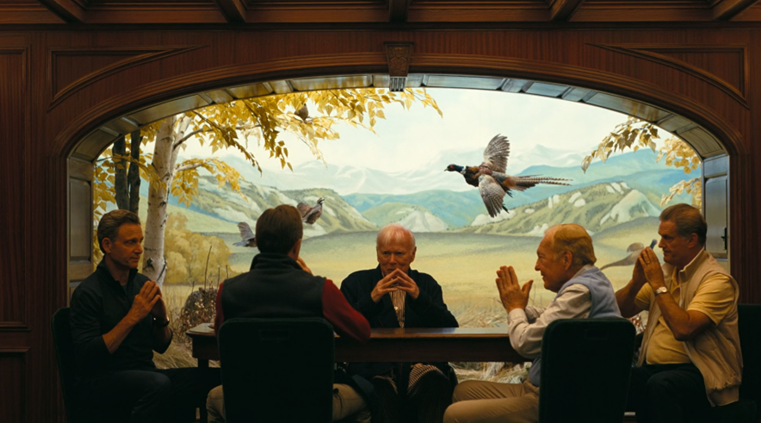
The man, despite his unassuming demeanor, is actually a hitman for the Christmas Adventurers Club. He is instructed to kill both Lockjaw and Willa. As the Club members adjourn, they say “All hail Saint Nick” in unison.
The attempt to kill Lockjaw and Willa fails. Due to his own effort to dispose of Willa having gone awry, as well as the Christmas Adventurers Club attempt to murder both Willa and Lockjaw having gone awry, Lockjaw’s face has become horribly disfigured (get it?). In the end, however, Lockjaw is lured back to meet with the Christmas Adventurers Club under false pretenses. They lead him to believe he’s been accepted as a member. “Congratulations, Steve, you’re a Christmas Adventurer.” Lockjaw is jubilant. “Oh, Mommy. Thank you, sir!” he says back.
Sandy Irvine leads Lockjaw to a corner office in an empty high-rise office building which offers an amazing view of the city, telling him:
Lockjaw, we’re lucky to have you. Now, obviously, goes without saying, this is just one place where you can hang your hat, take meetings, stow a few personal items. We like our members to feel they have a home away from home, any time, day or night. Now, it’s empty right now, but we’ll let you personalize it. A man’s taste defines him, doesn’t it?
Lockjaw asks if he can sit at the desk in the office, to which Sandy says “Absolutely.” As Lockjaw sits down, Sandy says “Damn it. I forgot your keys. Wait here, I’ll just grab ‘em from my office.” As he leaves (closing the door behind him), Lockjaw puts his feet up on the desk, basking in the glow of his personal moment of triumph. We then hear the sound of some sort of gas being pumped into the room from the ceiling air vent. In just moments, Lockjaw is dead — seemingly frozen into place — and two men in full hazmat suits arrive, carry his body out, and place it into an incinerator.
The Holocaust analogy here is so glaringly obvious and forced as to be embarrassing. Both the poison gas and the subsequent disposal of a body into a furnace is, of course, a twist on the Holocaust trope of telling Jews they’re just getting a shower (and not Zyklon B) and then their bodies being incinerated. Why this trope here? Because, according to the modern liberal mind, ‘White people’ are responsible for the Holocaust, an event which apparently began on June 6, 1944.
In the end, Lockjaw was sentenced to death for the sin of miscegenation, particularly the most egregious form of this sin: producing a child with someone who is Black.
VII. Racialized Sexuality as Revolutionary Political Activism
One Battle has been a pet project of Anderson’s since the early 1990s when he first read Pynchon’s Vineland and became obsessed with it, and he then worked on the eventual adapted screenplay for over 20 years. In a very significant way, the film can be seen as an extended therapy session for Anderson. He seems to be expressing his apparent fetishization of Black women in much the same way that Quentin Tarantino expresses his fetishization with women’s feet. Anderson also seems to be expunging a weird misplaced sense of guilt over his own Whiteness, maleness and heterosexuality in general, and addressing anxiety over the racial identity crises his miscegenated children have experienced, or will likely experience in their lives, to some degree. Anderson also seems to be trying to elevate his own mixed-race domestic situation as itself some sort of revolutionary act, which if true is a perfect example of elite, armchair LARP-ing, the sort of “revolutionary action” that doesn’t require getting one’s hands dirty.
There is a conspicuous amount of interracialized sexuality (of the White-with-Black variety) on display in One Battle, and it’s worth considering the possible autobiographical reasons why Anderson placed so much of this element into his film. How else to explain the random, disparate, and otherwise pointless displays of miscegenated eroticism in One Battle?
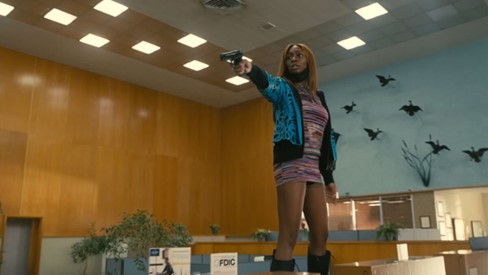
For example, in the aforementioned opening sequence of the film we see Bob kissing passionately with his Perfidia while they are escaping from their successful operation to liberate illegal aliens from a migrant detention center. (It is she who irrationally and recklessly initiates this moment of passion, which briefly confuses Bob). Later in the film, after Bob has detonated various explosives against other domestic targets, we see the two kissing passionately again as they are fleeing (and with her also wanting to stop to have sex). Then later we see Alana Haim (her Jewish physiognomy unmistakable), in a role so minor as to be almost pointless, as French 75 member “Mae West” who kisses a Black male French 75 member just before both of them participate in an organized bank robbery. During this robbery, another loud Black female member of the French 75 named “Junglepussy”, with gun in hand, jumps on top of a desk and shouts to the bank employees: “I am what Black Power looks like!”
The script never provides a satisfactory and internally coherent reason as to why Perfidia, the radical Black leader of a revolutionary Leftwing terrorist group, would decide she wants to have sex with a White man as odious as Lockjaw (and bear his child), let alone settle down with Bob, another White man. In fact, this has been a subject of contention among some liberal reviewers of the film. Regarding the ways in which Perfidia is sexualized by two White men, one critic for The Guardian trots out Cultural Marxism’s notion of the “White male gaze” as well as the “lived experience” idiom, writing:
And while I understand the context and meaning behind the villain’s sexual obsession as a—reflection of racist and rightwing viewpoints, it also reflects hyper-sexualization of Black women in cinema. Taking on the form of a thing in order to critique and satirize it requires careful and—informed perspective. Intentions can result in the opposite of what’s intended, and that’s why our—intentions with other people’s lived experiences need to be handled so carefully.
One Battle After Another portrays these themes and reflects these questions and issues in ways—that mostly point it out and train all of its satire and disdain for the white men guilty of that gaze,—attitude, and behavior. But in going so far into being the thing in order to mock it, sometimes the—line gets awfully blurry, and it starts to feel like the film isn’t so much pointing at racist/sexist—stereotypes and male gaze as becoming those things in order to provoke us to react. (Hughes, 2025).[1]
The anger rises with Ellen E. Jones, a mixed-race Black female critic for The Guardian, who bemoans the film’s “fetishised depiction of interracial relationships” and Perfidia’s “hyper-sexualized” nature. “Dear revered PTA,” she writes, “what is up with you and Black women?”
… Anderson went for extreme horniness instead. This is a choice. Just like it was a choice to name another of his Black female revolutionary characters “Junglepussy” — inspired by the performer’s real stage name, a sexualised spin on the old racist slur “jungle bunny”. Or to have Perfidia express her principled defiance of the fascistic state with the phrase “this pussy don’t pop for you”. (Note to white male screenwriters: not every Black woman talks like Cardi B. And even Cardi B doesn’t sound like a Cardi B record all the time) (Jones, 2025).
Of the scene where Lockjaw says to Bob: “Do you like Black girls? I love ‘em!”, Jones writes:
This is intended to demonstrate the character’s repellence, but would be much more effective as such, if we hadn’t just seen lovable Bob describe his attraction to Perfidia in pretty much the same terms, moments earlier. Or Avon Barksdale from The Wire (aka actor Wood Harris) fondly describing his girlfriend Alana Haim as “an ordinary, working white girl”. In the OBAA worldview, all interracial relationships are apparently founded on a race kink. (Jones, 2025).
I would contend that the two White men on either side of Perfidia — Bob and Lockjaw — represent Anderson’s own conflicted psyche about the very idea of White men being with Black women and producing mixed-race children, and his own family life within that context. Bob is the ‘good’ well-intentioned side of this struggle, and Lockjaw is the malevolent and repressed Shadow figure of this struggle. When the Christmas Adventurers Club asks Lockjaw point blank if he knows who Perfidia Beverly Hills is and whether he’s had a romantic relationship with her, Lockjaw lies to them, and the choice of words in Anderson’s script is quite interesting:
Gentlemen, I have engaged the enemy face-to-face in battle. And in the dark alleys and shadows of espionage, I was once raped in reverse. The enemy employed deception. I was drugged. And while unconscious. … I believe [my power] was taken advantage of. I believe she was a sperm thief. They saw the power of my mind and body. They desired it.
Teyana Taylor (who plays Perfidia), when asked about this mini-controversy being discussed within the Left’s media bubble, exudes the Harlem ghetto mindset she grew up in, telling an interviewer:
Is that not what Black women go through? We are fetishized, especially by creepy motherfuckers. And we are, unfortunately, the least protected people. Showing what Black women go through, that’s a hard reality to accept (O’Connell, 2025).
It never crosses Taylor’s mind that perhaps the creepy motherfucker doing the fetishizing might be Anderson himself. In fact, the awkward and incongruous placement of mixed-race sexualization in One Battle begins to make more sense if we see it as a reflection of Anderson’s personal proclivities and very odd conception of miscegenation as a revolutionary act.
Whichever way one cuts it, however, a consistent theme does emerge in One Battle: miscegenation is depicted by Anderson as a revolutionary act. The intertwining and association of sexual arousal with violent revolutionary action is most odd, and the intimate merging of an idealized Marxist political utopia with a racialized sexual utopia is something Frantz Fanon might have dreamt up. It’s important to note that in Pynchon’s Vineland, both the Bob character and the Perfidia-character are White, which therefore makes their daughter White. Thus, it is entirely Anderson who makes the Perfidia character Black, injecting the storyline with layers of miscegenation and a bizarre racialized-sexuality-cum-revolutionary-politics angle. In a kind of auteurist poetic gesture, sexual transgression is symbolically aligned with political rebellion. All of this seems to be towards Anderson’s goal of rendering interracialized sexuality as, at a minimum, a form of political activism, and possibly also a proper and useful ingredient for revolutionary politics. To better understand this, and why Anderson may have infused One Battle with so much of this theme, we need to briefly turn to his own domestic family life.
***
At the time of One Battle’s release, Anderson stands as a 55-year-old father to four mixed-race children, ranging from 12 to 19 — three of them daughters – whom he shares with Maya Rudolph, the former SNL cast member he’s been in an unmarried relationship with since 2001. Rudolph is herself mixed-race (her mother was Black and her father is Jewish). The theme of mixed-race individuals (particularly Black-White biracial) feeling like outsiders in both White and Black communities has been a topic discussed extensively in sociology, psychology, personal memoirs, literature, and online discourse. Never feeling fully at home or accepted in the White community nor in the Black community, mixed-race Blacks often have the biggest racial chip on their shoulders. There is a heightened racial resentment that is almost always targeted at the White aspect of their identity. Following the ‘one drop’ rule, such mixed-race individuals overcompensate by identifying as Black and implicitly or explicitly rejecting the White aspect of their identity. The anger from their conflicted psyches is channeled primarily through publicly avowed ideology rather than violence. They often lean into their ‘Blackness’ and espouse anti-White rhetoric as a way to prove their ‘authenticity’ to full-blooded Blacks. In essence, this public aspect, largely performative, functions as a virtue signal to prove and establish their ‘Blackness’. (Barack Obama is a prime example).[2]
Many of Anderson’s films feature fractured and dysfunctional family arrangements, and it may be the case that Anderson imparts autobiographical elements from his own domestic life into his films, namely the more trying times of his rather unusual family dynamics. It is not much of a stretch to imagine that the life of a successful, critically-acclaimed, auteur writer/director such as Anderson is fraught with domestic problems and emotional sacrifices. As we often see with many of the greatest artists, writers, and poets over the ages, dedication to their craft is their life, and everything else — family included — is a distant second. For instance, in There Will Be Blood (2007), Daniel Plainview’s (Daniel Day Lewis) ego and blind ambition are temporarily brought to their knees when a paster cajoles him to confess his sins, leading him to cry out “I have abandoned my child!” Similarly, in One Battle, Perfidia the dedicated Black female revolutionary essentially abandons her child, not so much for the revolutionary cause but to save her ass from federal prosecution and likely prison time.
In One Battle, Perfidia’s mother is called “Gramma Minnie,” a reference to Maya Rudolph’s mother Minnie Riperton, a renowned soul singer who died of cancer at 31.[3] In an essay about Maya Rudolph’s influence on One Battle, Desiree Bowie writes:
That sense of absence runs deep. Willa loses both grandmother and mother in infancy, and Perfidia parts from her own mom too soon. Each woman is marked by the loss of the one before her.
Teyana Taylor, who plays Perfidia, even said she immersed herself in Riperton’s discography to find the character’s pulse during the film’s long shoot (Bowie, 2025).
In terms of casting the role of Willa, and what led to his choice of Chase Infiniti for the role, Anderson told an interviewer “She reminded me of my daughters. She felt like a person who would be friends with my daughters, and I just connected to her as a human being” (Fear, 2025). In a sequence in the movie where Bob and Sergio are frantically trying to find Willa (whom Lockjaw has kidnapped), Bob laments to Sensei Sergio that after Perfidia left all those years ago, he still struggles with how to be a father to Willa, brushing up against World War Hair in the process:
Just never thought this fucker would come back for us, you know? I got lazy, man. I wasn’t paying attention. I thought the person coming through that door one day was gonna be her mom, not this fucking asshole. See her daughter, you know? She’d teach her girl stuff. She’d do her hair, she’d … be a mom. I can’t do her hair, man. You know that? I don’t know how to do her hair right.
Of this bit of screenplay dialogue, Anderson says in the same interview:
[It’s] no secret that Maya [Rudolph, Paul’s partner] lost her mother [the singer Minnie Riperton] when she was very young. And Maya’s father really struggled, as a single dad, to do her hair. Because, you know, I can tell you: As a father of mixed-race girls, it’s nearly impossible for me to do their hair as a white man. That was something that struck me as a father, and that I really knew was a challenge for her and for him. That’s a very personal line for me. (Fear, 2025)
In many ways, one can see DiCaprio’s hapless Bob character as a surrogate for Anderson himself. With the racially complicated nature of Anderson’s family, one senses a latent White Savior Complex in One Battle, albeit one that Anderson is simultaneously aware of but conflicted about, and so tries to mitigate.[4]
***
Through the repeated inter-racialized displays in One Battle, Anderson seems to be leaning heavily towards a Frankfurt School interpretation of sorts. The legacy of Freudian pseudoscience (and its inherent hostility to the prevailing Christian sexual norms of heritage America) looms large vis-à-vis the idea of sexual energy as a political force.[5] One need not believe that any of the associated theories capture anything objectively true — most are patently absurd — but it is important to note how these theories inform the Leftist and animate his political art and activism. The theories operate less as working empirical models but more as instruction manuals for activism. The notion of sexual energy as a political force can, of course, be traced back to the profound influence of Sigmund Freud, the Jewish father of psychoanalysis, particularly his theoretical framework of Eros and Thanatos as discussed in Beyond the Pleasure Principle (1920). In revolutionary contexts, so the argument goes, Eros (the drive toward union, pleasure, life) and Thanatos (the drive toward destruction and death) collapse into each other. Destruction becomes pleasurable; killing and dying are eroticized as forms of fusion and transcendence. Revolutionary violence thus becomes a Thanatotic act experienced through Eros.
This ‘dual-drive’ theory of Freud’s underlies several other influential Freudian-Marxists. In The Mass Psychology of Fascism (1933), the Jewish psychoanalyst Wilhelm Reich argued that sexual repression creates authoritarian character structures. Libido that cannot be discharged erotically is redirected into aggression, discipline, and ecstatic submission; mass political movements offer a quasi-erotic release through violence, spectacle, and collective action.
Similarly, the influential Jewish intellectual Herbert Marcuse explicitly links libidinal energy with political rebellion. He deploys a Freudian-Marxist concept of ‘liberation’ that promises a return of pleasure, intensity, and bodily freedom. In Eros and Civilization (1955), Marcuse argues that capitalist society represses Eros, and that when ‘sexual liberation’ is incomplete, revolutionary politics will absorb this repressed erotic longing. Later, in Counterrevolution and Revolt (1972), Marcuse suggests that radical politics often becomes aestheticized and eroticized, but that violence can function as a substitute gratification. It is why, he argues, some revolutionary movements become theatrical and performative, intoxicating even when futile.
It is also worth pointing out the undue influence that The Authoritarian Personality (1950) has had on Cultural Marxism. Theodor Adorno and his co-authors sought to frame traditional Christian norms — such as conventional moral values, respect for established religious authority, traditional gender roles, and adherence to conventional family and sexual ethics — as symptomatic of an underlying authoritarian personality syndrome. On the “F-scale” (fascism scale) personality test that the authors designed, high scorers were pathologized as psychologically rigid, prejudiced, and predisposed to ethnocentrism and fascism, effectively recasting ordinary Christian conservatism as a form of mental maladjustment rooted in repressed aggression and weak ego strength.
It is important also to note that the Weather Underground, who operated between 1969 and 1977, explicitly embraced sexual liberation as a revolutionary act and bought into the Neo-Freudian rhetoric of political violence (and even the outright murder of White civilians) as frenzied ecstatic transgression, all in service of the revolution. For instance, Bernardine Dohrn infamously praised the Manson murders as “wild.” Mark Rudd, the aforementioned Weather Underground leader, writes:
There were crazy discussions at Flint over whether killing white babies was inherently revolutionary, since all white people are the enemy. Out of this bizarre thinking came Bernardine’s infamous speech praising Charles Manson and his gang’s murder of actress Sharon Tate, her unborn child, and the LaBiancas. “Dig it!” she exclaimed. “First they killed those pigs, then they ate dinner in the same room with them. They even shoved a fork into the victim’s stomach! Wild!” We instantly adopted as Weather’s salute four fingers held up in the air, invoking the fork left in Sharon Tate’s belly (Rudd, 2009).
That Bernardine Dohrn was not instantly disqualified from a faculty position at Northwestern University’s Law School speaks volumes about the Left’s continued grip on academia. As with other militant 1960s radicals — Bill Ayers, Angela Davis, Kathy Boudin, Kathleen Cleaver, etc. — the disturbing pattern here is in how their terrorist activities were not socially punished but social rewarded: academic appointments and other comfortable sinecures bestowed where one might have expected lasting disgrace.
VIII. Conclusion
One Battle is a thoroughly Californian film. Its setting takes place entirely in California. It’s director and lead actor, both ardent progressives, have lived there for their entire lives. Thomas Pynchon spent formative decades living in California and his novel that One Battle is loosely based upon is set in California. “As California goes, so goes the nation” is an old political maxim that rings truer every day, and the madness that is California politics plays like satire itself. In a piece of trivia worthy of The Babylon Bee, prior to scenes being shot for One Battle in downtown Sacramento, authorities removed homeless tents — from ‘Cesar Chavez Park’ no less – presumably at the production’s request: ‘The Sacramento Homeless Union says tents were tagged with notices of filming Thursday and those living in the tents were forced to leave the area. “This permit should have never been given,” said Crystal Sanchez, President of the Sacramento Homeless Union’ (Trubey, 2024).
In the epilogue of One Battle, while Bob embraces a quiet life and is adapting to modern technology (Willa shows him how to take a selfie on his new iPhone), we hear a police scanner/radio announce that there is a new protest in Oakland. The radio acts as a link between the past French 75 era of Leftist political activism and the present, showing that the “battle” is never truly over but has passed on to a new generation. The present marks an era of female-dominated, Gen Z, Leftist activism. (Gen Z men are moving decisively towards conservatism). Willa immediately prepares to leave to join the rally, and Bob tries meekly to dissuade her. “You know, Oakland’s a three-and-a-half-hour drive from here,” he says to her, “It’s raining out.” We see unmistakably that this has absolutely no effect on Willa’s determination to go. “Be careful,” Bob says to her as she walks out the door. “I won’t” Willa replies, in the film’s last line of dialogue, before Tom Petty’s “American Girl” needle-drops onto the film’s closing credits, signaling Willa as a continuation of her mother’s activist legacy and the future of America.
One Battle is clearly a celebration of female leadership and an endorsement of the continued feminization of culture. The perceived “battles” that Anderson entertains as reality — the “eternal struggle” theme of the film’s title — comes from Anderson’s liberal White sensibility of what Black and Brown existence in America is comprised of. As one liberal reviewer of the film notes: “The terms of One Battle are not success and failure but action and inaction, and the belligerent, no-nonsense swagger Willa accrues as her own battles pile on suggests that the radical tradition of her parents’ generation will survive through her own” (Goi, 2025).
The more that one scrutinizes One Battle, the more apparent it becomes that Bob is Paul Thomas Anderson and that Willa is his daughters. “Like Bob,” one reviewer notes, “Anderson is an aging rebel reckoning with the nature of time” (LeBeau, 2025). Anderson himself, in an interview, frames the film’s message as one of persistence and stoicism:
Whether you’re talking about big things, finding one battle after another for the state of our world, or you’re talking about daily battles, from getting up in the morning and just getting your coat and getting your kids to school and brushing your teeth and stubbing your toe. I mean, that’s the job. Yes, fight these daily battles. Be nice. Keep your head down. Get on to the next fight, but don’t give up. (Fear, 2025)
In a Rolling Stone interview with both Anderson and DiCaprio, the interviewer tees them up with a loaded (and leading) assertion posing as a question:
So many people are asking, what can we do to fight back against this weird, fucked-up moment in American history. And One Battle After Another does kind of have an answer to that, which is: Look after your community and take care of your own.
DiCaprio agrees and then Anderson adds:
I think I what I’ve been noticing over the past two weeks since we’ve started showing the movie is, you know, maybe it’s not fashionable to make an optimistic movie right now. That was a risk. It’s fashionable to be cranky or something. But there’s a streak of optimism in the film. I hope there is, at least, I because I feel that way. I mean, I have four kids. I’d better be fucking optimistic. (Fear, 2025)
These sentiments aptly reflect where progressive culture is at the moment. Domestic politics is not seen as a slow and relatively boring, procedural endeavor with compromises being an often-necessary way station towards progress. Rather, it is a grand opera of mythic proportions, where each of us is either good or evil. (The moral absolutism inherent in this Manichaean worldview helps explain the performative aspect of Leftist activism today).
To this point, DiCaprio has compared One Battle to the film Star Wars (1977), something Anderson does not disagree with, noting that Willa can be seen as ‘the Chosen One’ (ala siblings Luke Skwalker and Princess Leia), Sergio/Sensei as Obi Wan Kenobi, Lockjaw as Darth Vader (relentlessly searching for Rebellion members, and secretly the father of the ‘Chosen One’), and the Christmas Adventurers Club hitman as bounty hunter Boba Fett. To this we can add Bob as comic relief ala R2D2/C3PO but with a father-daughter dynamic in play. In terms of making sense of the Left’s paranoid mindset today, of capturing the zeitgeist of their worldview, One Battle After Another in many ways is the Star Wars of today’s Left.[6]
In a rare moment where he steps outside of his usual, milquetoast NYT-acceptable ‘conservatism’, Ross Douthat fittingly contextualizes One Battle as a failure of vision:
In keeping with the current liberal mood, it feels trapped in a Boomer time warp, trying to speak to the Trump era but constantly pulled backward toward the America of 50 years ago. … Again, all this anachronism works fine in a story about futility and repetition. But Anderson wants to nod to those forces while still offering some sort of call to arms. And the trumpet is too tinny, a thin sound echoing down a long corridor from the Boomer past. History will not stop for this.
One can easily see a film like One Battle not aging well. In the unlikely chance that, in the decades to come, conservative common sense prevails in the culture wars, and race relations temper to a more rational level, it’s easy to imagine all sides retroactively deeming One Battle as itself borne of progressivism’s own ironic racist assumptions, that is, of White liberals continually perceiving the social reality of Blacks to be one of victimhood, and fostering this sensibility amongst themselves to a manic degree, of treating Blacks as near-sacred beings perpetually trapped in a system that is ‘against’ them, perpetually in need of assistance from Whites. In this way, and over time, One Battle After Another will stand as a cinematic manifestation of the heightened White Savior Complex that characterizes our current era.
REFERENCES
- “One Battle After Another FYC — Paul Thomas Anderson in conversation,” YouTube, uploaded by Nolan Archives, December 31, 2025, https://www.youtube.com/watch?v=S8Q35vXE9bI.
- “Paul Thomas Anderson on Quentin Tarantino’s Jackie Brown,” YouTube, uploaded by Xixax TV, January 6, 2018, https://www.youtube.com/watch?v=7VSACkqh9a4.
- “We talked real cinema with Leonardo DiCaprio and Paul Thomas Anderson,” YouTube, uploaded by Konbini, December 8, 2025, https://www.youtube.com/watch?v=E8WW4jJ59d4.
- Abramovitch, Seth. “Benicio Del Toro on Bonding With Leo, Rewriting PTA and His First Oscar Nom in Decades,” The Hollywood Reporter, February 23, 2026, https://www.hollywoodreporter.com/movies/movie-features/benicio-del-toro-interview-one-battle-after-another-oscars-1236510776/.
- Arblaster, Jeremy. 2022. “The Romantic Listlessness of Paul Thomas Anderson’s The Master.” Little White Lies, September 1, 2022. https://lwlies.com/in-praise-of/the-master-10
- Aron, Raymond (1957). The Opium of the Intellectuals. Translated by Terence Kilmartin. Garden City, NY: Doubleday.
- Bell, Daniel (1960). The End of Ideology: On the Exhaustion of Political Ideas in the Fifties. Glencoe, IL: Free Press.
- Bloom, Harold, ed. Bloom’s Modern Critical Views: Thomas Pynchon. Chelsea House, 2003.
- Bowie, Desiree. “Maya Rudolph’s Influence on ‘One Battle After Another’ – Plus 10 Fun Facts You Might’ve Missed,” Danger Bowie, September 30, 2025, https://dangerbowie.com/2025/09/30/one-battle-after-another-fun-facts/.
- Brody, Richard. “The Real Battle of “One Battle After Another,” The New Yorker, October 7, 2025, https://www.newyorker.com/culture/the-front-row/the-real-battle-of-one-battle-after-another.
- Burrough, Bryan (2015). Days of Rage: America’s Radical Underground, the FBI, and the Forgotten Age of Revolutionary Violence. New York: Penguin Books.
- Cuddihy, John Murray (1974). The Ordeal of Civility: Freud, Marx, Levi-Strauss, and the Jewish Struggle with Modernity. New York: Harper & Row.
- Dohrn, Zayd Ayers. “My Childhood in the Weather Underground,” The New Yorker, March 28, 2026, https://www.newyorker.com/culture/the-weekend-essay/my-childhood-in-the-weather-underground.
- Douthat, Ross. “One Battle After Another Fails the Urgency Test,” National Review, October 23, 2025, https://www.nationalreview.com/magazine/2025/12/one-battle-after-another-fails-the-urgency-test/.
- Dulberg, Zack & Max Horder. “Why Progressives Increasingly Support Violence,” City Journal, April 14 2025, https://www.city-journal.org/article/progressives-political-violence-donald-trump-assassination-attempt.
- Fear, David. “How Paul Thomas Anderson and Leonardo DiCaprio Made ‘One Battle After Another’,” Rolling Stone, September 27, 2025, https://www.rollingstone.com/tv-movies/tv-movie-features/paul-thomas-anderson-leonardo-di-caprio-one-battle-after-another-interview-1235425735/.
- Goi, Leonardo. “In Sunny Southland: Paul Thomas Anderson and Thomas Pynchon’s California,” Mubi, November 24, 2025, https://mubi.com/en/notebook/posts/in-sunny-southland-paul-thomas-anderson-and-thomas-pynchon-s-california.
- Green, McKenzie N. (2025). “Examining racial identity invalidation and well-being among Biracial adolescents using the identity capital model,” Journal of Research on Adolescence, 35, e70084, https://doi.org/10.1111/jora.70084.
- Green, Sam, and Bill Siegel, dirs. The Weather Underground. United States: The Free History Project, 2002.
- Hadis, Diego. “Dramas Keep Showing Us Hapless Men — and Hypercompetent Women,” New York Times, 1/14/2026, https://www.nytimes.com/2026/01/14/magazine/movies-hapless-men-hypercompetent-women.html.
- Hannah-Jones, Nikole. “Assata Shakur,” New York Times, December 16, 2025, https://www.nytimes.com/interactive/2025/12/16/magazine/assata-shakur-activist.html.
- Hughes, Mark. “Review: ‘One Battle After Another’ Enters The Oscar Race As Mixed Bag,” Forbes, September 27, 2025, https://www.forbes.com/sites/markhughes/2025/09/27/review-one-battle-after-another-enters-the-oscar-race-as-mixed-bag.
- Jones, Ellen E. “Jezebels, race kink and Cardi B: in One Battle After Another, Black women are still stereotypes,” The Guardian, September 29, 2025, https://www.theguardian.com/film/2025/sep/29/jezebels-race-kink-and-cardi-b-in-one-battle-after-another-black-women-are-still-stereotypes-paul-thomas-anderson.
- Kengor, Paul. “RIP Larry Grathwohl, Weather Underground Infiltrator,” The American Spectator, July 26, 2013, https://spectator.org/55174_rip-larry-grathwohl-weather-underground-infiltrator/.
- LeBeau, Ariel. “One Battle After Another Is Paul Thomas Anderson’s Most Personal Film,” GQ, September 23, 2025, https://www.gq.com/story/one-battle-after-another-is-paul-thomas-andersons-most-personal-film.
- Lichter, S. Robert & Stanley Rothman. “Jews on the Left: The Student Movement Reconsidered”, Polity, Vol. 14, No. 2 (Winter, 1981), pp. 347-366.
- Lordi, Emily J. (2020). The Meaning of Soul: Black Music and Resilience Since the 1960s. Durham, NC: Duke University Press.
- MacDonald, Kevin (1998). The Culture of Critique: An Evolutionary Analysis of Jewish Involvement in Twentieth-Century Intellectual and Political Movements. Westport, CT:
- Mendelson, Edward (ed.). Pynchon: A Collection of Critical Essays (1978).
- O’Connell, Mikey. “Teyana Taylor Takes Over,” The Hollywood Reporter, November 5, 2025, https://www.hollywoodreporter.com/tv/tv-features/teyana-taylor-interview-alls-fair-one-battle-after-another-1236417835/.
- Phillips, Maya. “The Politics of ‘One Battle After Another’ Are Clear on One Point,” New York Times, March 16, 2026, https://www.nytimes.com/2026/03/16/movies/one-battle-after-another-black-sexuality.html.
- Radish, Christina. “Paul Thomas Anderson on Phantom Thread, Daniel Day-Lewis,” Collider, February 9, 2018, https://collider.com/paul-thomas-anderson-interview-phantom-thread-daniel-day-lewis/.
- Reeves, Hope. “The Popcorn Resistance of ‘One Battle After Another’,” New York Times, March 8, 2026, https://www.nytimes.com/2026/03/08/opinion/one-battle-after-another-weathermen.html.
- Rudd, Mark (2009). Underground: My Life with SDS and the Weathermen. HarperCollins.
- Rudd, Mark. “Why Were There So Many Jews In SDS? (Or, The Ordeal Of Civility),” talk presented at the New Mexico Jewish Historical Society, November 2005, https://www.markrudd.com/indexcd39.html?about-mark-rudd/why-were-there-so-many-jews-in-sds-or-the-ordeal-of-civility.html
- Rufo, Christopher F. “The Left-Wing Terror Memeplex,” City Journal, September 30, 2025, https://www.city-journal.org/article/left-wing-political-violence-terror.
- Ruimy, Jordan. “PTA Confirms He Did Rewrites on ‘Killers of the Flower Moon’ and ‘Napoleon’,” World of Reel, September 24, 2025, https://www.worldofreel.com/blog/2025/9/24/pta-confirms-he-did-rewrites-on-killers-of-the-flower-moon-and-napoleon.
- Sailer, Steve. America’s Half-Blood Prince: Barack Obama’s “Story of Race and Inheritance”. VDARE Foundation, 2009.
- Scruton, Roger. “Why I became a conservative,” The New Criterion, Vol. 21, No. 6, February 2003, https://newcriterion.com/article/why-i-became-a-conservative/.
- Trubey, David. “Tents cleared from park ahead of movie filming, Sacramento Homeless Union says,” ABC10, February 10, 2024, https://www.abc10.com/article/news/local/sacramento/sacramento-movie-super-bowl-festivities/103-3c15a421-4cc8-4385-b303-aacb7212898c.
- Van de Camp, Morris. “The Terrorist Left of the 1970s,” Counter-Currents, October 20, 2020, https://counter-currents.com/2020/10/the-terrorist-left-of-the-1970s/
- Varon, Jeremy (2004). Bringing the War Home: The Weather Underground, the Red Army Faction, and Revolutionary Violence in the Sixties and Seventies. University of California Press: Berkeley and Los Angeles, California.
- Voegelin, Eric (1952). The New Science of Politics: An Introduction.The University of Chicago Press: Chicago.
- White, Armond. “There Will Be Bloodlust in One Battle After Another,” National Review, September 26, 2025, https://www.nationalreview.com/2025/09/there-will-be-bloodlust-in-one-battle-after-another/.
- Wolfe, Tom (1970). Radical Chic & Mau-Mauing the Flak Catchers. New York: Farrar, Straus and Giroux.
[1] There is a parallel here with the longstanding criticism by some Blacks of Quentin Tarantino’s use of the word “nigger” in his screenplays, a critique that is but another front in the “only we are allowed to say the magic word” culture war. Anderson and Tarantino, who both grew up in the L.A. area, are good friends. Amidst his praise for Tarantino’s Jackie Brown (1997), Anderson describes an intimate scene that brings him to tears between Pam Grier (who is Black) and Robert Forster (who is White) as being “so cool and so breezy … about middle-aged people that feel the clock ticking, … I consider Tarantino a peer, but that is a watermark for how to shoot and film a scene with delicacy and compassion.” See https://www.youtube.com/watch?v=7VSACkqh9a4.
[2] Regarding the psychological toll mixed-race adolescents experience, see Green (2025). Regarding Obama, see Steve Sailer’s America’s Half-Blood Prince: Barack Obama’s “Story of Race and Inheritance” (2009). Autobiographical aspects of One Battle have been touched upon by liberal writers: with respect to One Battle, see LeBeau (2025), and for autobiographical aspects of Phantom Thread, see Anderson’s own words in Radish (2018).
[3] Minnie Riperton is best known for the hit single “Lovin’ You” (1974), where her overall vocal style and rare falsetto range sounds very ‘White’, to the extent that club owners who booked her after only hearing (and not seeing) her, would be shocked that she was Black. Emily J. Lordi’s book The Meaning of Soul: Black Music and Resilience Since the 1960s (2020), which features Riperton on the front cover, places her in a broader Black musical-intellectual tradition related to the era’s ideas of Black resilience and, indirectly, the historical world around Black Power. Lordi writes: “Born in 1947 in the Bronzeville district of Chicago, Riperton was the youngest of eight children and the daughter of a homemaker and a Pullman porter. As I have noted, she studied opera for years. Although she knew well that opportunities for black classical singers were extremely limited, she did not, like Nina Simone, narrate her detour from concert music as a racial trauma. This might have been a matter of temperament or a strategic omission. Or it might have been due to the fact that Riperton had always had another place to land: she had grown up near Chess Records, the crucible of Chicago soul” (116-7). Of Riperton’s cover of Aretha Franklin’s “Respect”, Lordi writes that Riperton “recast Franklin’s signature song as an eerie exploration of interracial love” in a “seductive interracial duet” with White bassist Mitch Aliotta (62). Lordi later adds that Riperton’s “falsetto marked a refusal to shout and an embrace of an expansive, often buoyant interior life for which Riperton sought both musical and social space. Her quest was especially resonant in an era of black feminist emergence… Through her falsetto, as well as her often self-composed lyrics, Riperton contributed to these feminist efforts to make more space for black women’s interiority, both its pleasures and demands” (116).
[4] An important footnote in this regard, and one that amplifies the penchant of both Anderson and DiCaprio to romanticize the Other (and in the process espouse anti-White sentiment), is the fact that both were involved in substantially changing the storyline of Martin Scorsese’s 2023 film Killers of the Flower Moon (Ruimy, 2025). DiCaprio was originally slated to play FBI agent Tom White (ultimately played by Jesse Plemons), a character that was to be the lead role of the film, but was concerned that Eric Roth’s original script was too much of a ‘great White hope story’. Upon critical feedback from members of Oklahoma’s Osage tribe about portraying White men as heroic saviors of the Osage, Scorsese and DiCaprio decided to change the movie’s focus from the FBI’s point of view (as they investigated the Osage murders) to a focus on the interracial marriage between the villainous Ernest Burkhart (DiCaprio) and an Osage woman named Mollie (Lily Gladstone). One can see parallels between Ernest’s slow poisoning of his own wife with Lockjaw’s “poisoning” of Perfidia.
[5] An almost exclusively Jewish field, psychoanalysis was borne in a rigidly enforced, cult-like atmosphere, propagated by loyal sycophants to Freud. (Freud’s infamous break with Carl Jung, a Gentile, is instructive in this regard). Psychoanalysis has attempted to maintain a veneer of scientific respectability over the years but has since become thoroughly discredited and can now be seen largely as a Jewish attempt to pathologize Christian European norms. See Cuddihy (1974) and MacDonald (1998/2002/2025).




Yet another attempt to promote and protect Jewish supremacy.
As an old White dude, meaning that I may be way out of it, I doubt the importance of this color thang with regard to the White masses of young folks. The article sounds dated, like ten or 20 years ago.
White youth today is in some large part, woke and god knows what. I doubt that they care very much for the muds, especially niggers. This will be in large contrast to the 60s’ we shall overcome folks (like myself) who at least had a pretty good economics working for them…the family wage for example that was supposed to allow for the father to make enough to support the whole family, with Mom home taking care of the kids. That day is over, probably forever.
Again, I may be way out of it but what seems more important and will become more so as depression deepens and money becomes more and more an issue, that is, the lack thereof. Economics will replace race to some large degree.
Maga will desert Trumpstein as his sexual and Jewish filth becomes more evident.
Anti-capitalist rhetoric will increase and consequent concern with stock market, maybe even bond market, economics becomes more salient, especially for college educated youth and adults who have some appreciation for these arcane matters.
This is not to say that the Woke will abandon the wretcheds, just that their own economic troubles will become more painfully salient.
Trumpstein and Jews will become, psychologically speaking, more important than the muds. Anti-War animation will get even more vehement, assuming that the Jew Trump goes full gung-ho on the war which Macgregor still thinks is in the cards.
In a word or two, it is more class struggle and less race struggle. Then, the Dems will wave the White flag on the war, and demand that jewboy Trump resign, facing impeachment or 25th Amendment take down. Trump is not a murder-suicide type guy, as I repeat often, he is a preening fool for attention. The next few days seem to be the turning point for more war, or not.
The middle class and the working class have much in common now with pending hyper inflation. This can provide something somewhat novel for electoral politics. The left has always described it as proletarianization of the middle class (not the upper middle).
Where I live, near Menlo Park, Ca, the Jew Assemblyman Weiner, has passed legislation to require California cities to, in effect, build subsidized housing for the muds, big time. In Menlo Park, this means right now, turning much of city parking lots into mudvilles. The upper-middle folks are starting to revolt. This is cheek by jowl …whites next to niggers and beaners. The liberals are getting the inevitable irony…come let us reason together…black and brown together, we shall overcome. Construction is right around the corner, just in time for The
Depression. Bolshevization right here in Menlo Park, led by Jews of course.
Menlo Park city parking is immediately next to residential neighborhoods that require 2 to 3 hundred dollars yearly to buy into with single family homes. NIggers and beaners walking the neighborhoods, Hoo boy! Let the festivities begin! Oh, I forgot the war too…
correction…..that would be two to three hundred thousand dollars a year….
This is why Bernadette Dohrn is a full professor at prestige northwestern law school. Her father in-law Ayers father of weather underground Bill Ayers is a member of the northwestern university board of trustees a lifelong member. And a major donor tax deductible of course. Ayer’s family are billionaires. Own some of the biggest corporations in America. And major defense contractors..Typical successful communists. In Europe and Asia they used the workers as a front. In America used first the blacks then Hispanics Asians and homosexuals. Now the communists use transgenders Muslim invaders any group they can find or create
Bill and Bernadette were against south Vietnam and America fighting communist north Vietnam For just one reason. North Vietnam was communist.
Now the radical left is pro the strict Muslim government of Iran. Because America is against the Muslim fanatic government of Iran. The radical left funded by the richest people in America. All that money tax deductible donations to radical left NGOS
I forgot to write that although Bernadette Dohrn is a full tenured professor at prestige Northwestern law school. She is not a lawyer and doesn’t teach any classes She is executive director of something or other at the law school. Big suite of offices. Dohrn does have a mail order law degree obtained while in prison for bombing federal buildings killing some victims in the process. She can’t be an Illinois lawyer because the Illinois bar won’t license convicted felons as lawyers . Example of how the billionaires like Ayers Sr can do what others cannot.
A Jewish law firm brought Obama to Chicago sumner intern while in law school. Then a swift ascent from community activist to state legislature to the presidency. Ayers and Dohrn met him his first summer in Chicago and were his communist handlers as he rose to the presidency. I stopped commenting on this site years ago. Because the moderator never approves my comments Hope this informative comment is allowed. But I doubt it. Probably disapproved as usual. Second time not allowed to post because not a valid email address. Must be some blacklist for my comments
Globetrotting Irish-German couple ma-
kes shocking discovery: the West is lost.
https://www.youtube.com/@TwoMadExplorers/videos
https://www.voxeuropaherald.com/p/bjorn-hocke-the-man-whose-name-is
“Blow them off the face of the earth”…..another madman utterance of Trumpstein, just a day or so ago with regard to Hormuz.
‘Eye for an eye and a tooth for a tooth’..was actually an advance in Civilization because it recognized the rationality of proportionality which today is part of our international rules of warfare. OK fine. not two or three eyes…just one.
Let me suggest another rule for heads of state who call for genocide. Let them die slowly by whatever ‘death by a thousand cuts ‘ kind of punishment that generally obtained with our less civilized past. Trumpstein and his Jewish cult should be tortured for, say, at least and no more than two hours for being the immediate executor of genocide. Of course, they have to be captured first, then prevented from suicide until their time has run out and the punishment begins.
The argument that the death penalty provides no deterrence is absurd. Let the howls of the lard-ass Jew instruct.