
In Praise of North Germanic Man: Introduction to Julius Langbehn’s ‘Rembrandt as Educator‘ (Virtus Editions, 2026)
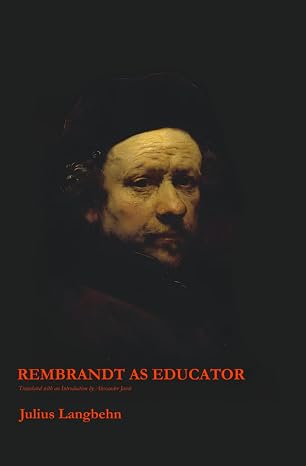
Julius Langbehn was born in 1851 in northern Schleswig. He studied natural science and philology at the University of Kiel, but his studies were interrupted by the Franco-Prussian War, in which he fought as a volunteer. After the war, in 1873, he travelled to Italy and, on his return to Germany, continued his studies at the University of Munich, where he obtained a doctorate in art and archaeology. His dissertation was written on the early Greek statues of Nike, the goddess of victory. After further travels and a short stay in Vienna, he settled down in 1885 in Dresden. In the winter of 1889 Langbehn visited Nietzsche, whom he considered a kindred soul, in his psychiatric asylum in Jena and requested that the philosopher be removed from the care of doctors whom he considered incompetent and that he be placed under his own psychological care. He did not succeed in his objective and returned regretfully to work on his Rembrandt book. The book was published in 1890 anonymously, ‘von einem Deutschen’ (by a German), and met with great success. It went through 40 printings in its first two years.
The title of Langbehn’s book was inspired by Nietzsche’s essay Schopenhauer als Erzieher (1874). Langbehn’s preference for the philo-Semitic Nietzsche over the anti-Semitic Schopenhauer may betray his own philo-Semitism, a trait that was detected by Theodor Fritsch, who indicated that, up to its 7th edition, Langbehn’s work was indeed quite philo-Semitic, and it was his own correspondence with Langbehn pointing out the necessity of anti-Semitism in such a worldview as Langbehn’s that prompted the latter to render his later editions more starkly anti-Semitic. At the same time the work became more pro-Catholic in its later editions and, in 1900, Langbehn even converted to Catholicism.
✤
The political successes of Prussia at the time of the unification of Germany in 1871 threatened to engulf Germany with its militarism, industrialisation, and rationalist tendencies in science and art. Marxists responded to this threat with essentially economic projects based on the principle of ‘class struggle’. Idealists on the other hand proposed a cultural revolution through the renewal of German culture itself. The latter effort led to what is generally called the ‘Conservative Revolution’, as constituted in works such as Oswald Spengler’s Preußentum und Sozialismus (Prussianism and Socialism) (1919), Arthur Moeller van den Bruck’s Das dritte Reich (The Third Reich) (1923) and Edgar Julius Jung’s Die Herrschaft der Minderwertigen (The Rule of the Inferior) (1930). Julius Langbehn’s call for a social aristocracy also found an echo in Stefan George’s influential poetical work Das neue Reich (The New Reich) (1929), which outlined a spiritual aristocracy as the ideal German society. Langbehn’s Rembrandt als Erzieher (Rembrandt as Educator) may be considered an early representative of the Conservative Revolution, since it sought to combat the evils of democratic culture at the turn of the century—established by parvenu cosmopolitan elites that promoted foreign, especially French artistic fashions—with a return to the natural aristocratic ethos of the strongest element in the German population, the North Germans. According to Langbehn, only a reversion of Germany to its North German character could effectively neutralise the materialistic scientific spirit that had begun to disintegrate its culture at the end of the nineteenth century.
At the same time, Langbehn’s work is also a major contribution to the series of works on the Nordic ideal that began with Arthur, Count Gobineau’s Essai sur l’inégalité des races humaines (An Essay on the Inequality of the Human Races) (1855) and continued with Houston Stewart Chamberlain’s Grundlagen des neunzehnten Jahrhunderts (Foundations of the Nineteenth Century) (1899), Alfred Rosenberg’s Mythus des 20ten Jahrhunderts (The Myth of the Twentieth Century) (1930) and Hans Günther’s Frömmigkeit nordischer Artung (Piety of a Nordic Character) (1934). These works formed the intellectual background of the German National Socialist racialist ideology that was sought to be practically implemented by Heinrich Himmler and the Rasse- und Siedlungshauptamt (Race- and Settlement Head Office), which Himmler established in 1931. However, Langbehn’s study is indeed a serious psychological one since it is based on his own origin in, and familiarity with, the Lower (= North) German culture of Schleswig-Holstein, as well as on his extensive studies in art history. Langbehn’s subtle and detailed analysis of the North German character aims at demonstrating its suitability to lead the newly formed German Reich, and to serve as a model for mankind in general.
Although Langbehn’s work was not a direct forerunner of the National Socialist movement, it was reprinted throughout the Third Reich. Indeed, many of the Heimatkunst (Homeland Art) items on display in the Great German Art Exhibition in Munich in 1937 corresponded to Langbehn’s exhortations to a patriotic style of German painting. Langbehn’s emphasis on the preservation and cultivation of the German physique as the outward manifestation of the ethical personality of the Germans also found practical application in the several youth movements that arose at the turn of the century, such as (and principally) the Wandervogel movement (a German youth organization founded by Hermann Hoffmann-Fölkersamb and Karl Fischer at the end of the nineteenth century for the promotion of outdoor activities and folk culture . Many of these movements, however, were banned in 1933 by the National Socialists, who created their own Hitlerjugend movement in order to deter any opposition from within other youth groupings.
✤
Langbehn begins his work by identifying the increasing devotion to recording and registering activity, rather than to an organic vision of reality, as the principal threat to German culture. Specialisation has led to a microscopic worldview that must be replaced by an artistic, macroscopic one. The glaring light of critical reason in science should be replaced by the light-and-shade that informs artistic creativity. The increasing sterility of modern science can be countered only by a regeneration of the psychological sources of creativity within the German character. These are, principally, the German’s sense of individuality and his developed personality. The modern Germans should learn from the best individuals and personalities of their historic past, and to facilitate this exercise Langbehn chooses the Lower German painter Rembrandt as the symbolic exemplar of the quintessential German spirit. Germanic character is based essentially on loyalty and is naturally opposed to all forms of frivolity. Tranquillity and depth are the marked qualities of this character, and both are reflected particularly in the light-and-shade effects of Rembrandt’s chiaroscuro. Rembrandt was indeed not classical but mysterious in his connection to the Dutch soil and peasantry as well as to the natural aristocratic ethos of the Lower Germans.
These sterling aspects of the Germans and their newly formed empire should be protected from foreign influences, especially Gallic and Roman ones. In art, the trend of following foreign, especially French, fashions is particularly deleterious since French painting is either excessively restless or excessively academic and rigid. The French preference for scientific realism, symbolised by Émile Zola’s Naturalist novels, should be countered by a return to German folkloric traditions. Architecture must eschew ornateness in order to express the spirit of the German people and must focus on the manly monumental style that is characteristic of it. Langbehn’s artistic ideals are, however, not only local but also moral. Thus Rembrandt is considered as representing a Protestant view of the world and his Christian figures are often drawn from lowly life. This simplicity of character may be encountered mostly in the country rather than in the metropolises. The latter have, through their modern ‘scientific’ specialisations, lost the sense of the whole that artistic culture should express. Thus, for example, the increased construction of museums in Berlin and other cities only obscures the lack of any true devotion to the Muses themselves in modern German cultural life.
In science, specialisation has resulted in a preoccupation with details that are not informed by any subjective apprehension of their true significance. Science should be infused with an artistic spirit in order to acquire a synthetic, multi-faceted view of the world—a philosophical worldview. Such a worldview would necessarily be a hierarchical one since objects have to be considered according to the degree of their innate human value and not as being of equal objective significance. Against the Darwinian worldview Langbehn proposes the organic and artistic one of Johannes Kepler, who viewed Nature as a unified organism. Historiography too has become cold in its neglect of values in favour of details. This is the result of Roman methods of historical writing, which the Germans would do well to discard in favour of more Germanic ones. Naturally, Langbehn is opposed to Roman Law as well, as an alien legal system that is unsuited for the Germans.
Medicine too must become more holistic focusing on the entire man rather than on individual illnesses. Langbehn even recommends doubtful experiments of the time in craniology, physiognomy, hypnotism, and spiritism as examples of a psychology that is more integral than current scientific approaches to the study of man. Generally, the external world studied objectively does not yield an adequate understanding of the organic natural universe. Only a philosophical science can do this. One of Langbehn’s models of an organic scientific worldview is the ‘Theory of Colours’ of Goethe, which, unlike Newton’s, is subjective and, unlike that of Emil du Bois-Reymond, the leading physiologist of his day, organic. The correspondences between macrocosm and microcosm should be studied meticulously in order to develop a ‘mathematical-tectonic’ system of Nature. Indeed if such a system were to be perfected, the laws of planetary motions could even be applied to the colouration of an insect’s wings.
In politics, the most popular form of government is a monarchy. The peasantry on their land already constitute an aristocratic order that is close to Nature and, like it, hierarchical. Between the ‘noble’ peasants and their king stand the formative artists, who represent the noble creative aspect of what is called the middle class. These three orders together constitute the fatherland. Now that Germany has acquired political unity it must attempt to achieve its spiritual and intellectual unification through a consolidation of these three orders. While Prussia was in a major way responsible for the political unification of Germany, it is rather too rigid in its predominantly military spirit. It should be made more German so that it may acquire a warmer patriotic appeal for all Germans and not remain a merely political model for the newly formed state. Further, Prussia should be represented by its provinces rather than by the ossified capital Berlin. Langbehn suggests that here again Prussia would do well to ally itself with Holland since the Dutch possess that ‘rhythm’ which can complement Prussia’s ‘symmetry’. In fact, Prussia itself was originally settled extensively by Dutch immigrants. More infusion of the Dutch strain into Prussia will therefore be salutary.
The Dutch are considered by Langbehn as the embodiment of the spirit of freedom that was expressed most strikingly in their war of independence against the Spanish Hapsburgs in the late sixteenth and early seventeenth centuries. Langbehn interestingly maintains that a truly conservative nation, that is, a nation that is strongly rooted in its traditions, is ‘liberal’ or devoted to freedom, whereas a liberally disposed people, on the other hand, need the discipline of conservatism. Other Lower German sources of the psychological quickening of the German spirit are Denmark/Sweden and England. Langbehn takes care to point out that his own homeland Schleswig-Holstein may be considered the historical centre of the Lower German lands, since the aristocratic Oldenburg family there provided kings and queens for the thrones of half the world. From this same source must the rule of modern Germany extend.
The colonising spirit of the Lower Germans is best illustrated by the flowering of the aristocratic Venetian Republic during the Renaissance, for, according to Langbehn, much of the ruling class was constituted of Lower Germans (Lombards) and Slavs (Croats). Langbehn describes the old Venetian culture as one based on a healthy combination of trade and art. It was also more Greek (i.e., Byzantine) than Roman in its style and, according to Langbehn, its cathedral, the San Marco, is similar to the Temple of Solomon as depicted by Rembrandt. Langbehn even goes so far as to infer from these artistic affinities that the way from Amsterdam to Jerusalem lies through Venice.
On the other hand, when Langbehn compares Venice to North America, which also was settled and developed by Lower Germans, he notes the marked contrast between the aristocratic nature of the former and the democratic one of the latter. Langbehn’s contempt for North American democracy is a counterpart of his aversion to French fashions in art and literature. However, he hopes that the natural aristocratism of the German Lower Germans will eventually inform the New World. In this he shows himself to be, sociologically, rather naive since the economic emphases of the Puritan founders of America, coupled with the increasing infiltration of the Jewish financial spirit in America, have now made the spiritual fertilisation of American culture by Germanic Europe an impossibility. Further, the very quality of individualism that Langbehn identifies in this work as the distinguishing mark of the Lower Germans has itself turned into the uncontrollable vice of present-day American society.
At any rate, Langbehn maintains that, like the Venetians, the modern Germans should develop a social aristocracy to oppose the increasingly popular movement of social democracy. The better elements of society must always rule the lower and a social aristocracy will be guaranteed only
if the morally and materially better placed classes of its inhabitants seriously act as the born advocates and guardians of the morally and materially worse placed classes and if this relationship finds its lasting constitutional expression [p. 262].
People should be judged not according to their wealth but also according to their moral, intellectual, social, and historical values. And the common man must always be protected by the noble:
To take care of the weak against the strong, of justice against injustice, the people against their oppressors is knightly: in this active sense should knighthood be reborn [p. 263].
In fact the rabble must be turned into a people by giving them higher wages and landed property. The aristocratic rule of Germany will be represented essentially by the Prussian officer and the Christian, particularly the Catholic, priest. For both belong to naturally aristocratic orders and symbolise the throne and altar. Both these orders rest on the agrarian order of the peasants, whose society, as indicated earlier, is also aristocratically ranked.
German politics should finally become a kind of artistic politics. Prussia, which had hitherto focused on scientific development, should now turn to artistic development. The childlike aspect of the German character that is represented by the German artists should be joined to the political aspect, which is represented by the German warriors, beginning with Siegfried. The artistic politician must draw out and develop the individuality and naturalness of the people. A nation’s culture cannot be revived by professors and museum directors. For, while the farmer and artist produce, the specialist scholar, like the businessman, merely markets intellectual goods. Just as all the arts must be considered together as a creative complex, so too all the different divisions of politics must be united in the goal of national development, which may then be extended even to international culture—so long as a nation takes care to absorb only the noble elements of another nation into itself and not the degenerate ones. Like the artist, the politician must be formed in old traditions, but be able to absorb new ones into his fully formed personality.
In considering German culture in greater detail, Langbehn points first to the defect of rationalism in writers like Gottfried Lessing (1729–81), who was detached from the German people, and was more universalist in his opinions than specifically German. His sort of Prussianism is too cold, too cosmopolitan. Similarly, the classical scholar and historian, Theodor Mommsen (1817–1903) was more interested in the Roman ethos than in the Greek or German and therefore alien to the German national spirit. The excessively rational and mechanical aspect of modern German culture is embodied most strikingly in its present cultural centre: Berlin. Berlin has a Jewish complexion, which Langbehn describes as a degeneration of the earlier healthy Jewishness that it contained in the salons of Rahel Varnhagen (1771–1833). Short-sighted focus on current events has led to the transient fashions of novelistic and other trivial salon literature. Love of triviality and hatred of genius are indeed the typical characteristics of philistinism, which Langbehn’s artistic politics vigorously opposes. The remedy for Berlin is the absorption of more diverse influences from outside it. Berlin represents only the petty officer spirit of Prussia, whereas the Prussian provinces contain more of the aristocratic officer spirit. This martially disciplined and hierarchical Prussia must be harnessed for the regeneration of German culture and in turn be enriched, ‘civilised’ by the humanity of the rest of the German population.
Another fault of present German culture is its overestimation of the importance of academia. Professors in fact represent a democratic multiplication of opinions that obscure through their narrow specialisations the genuine voice of the people. The ‘sense for the essential’ which is the mark of the genius, is quite lost. The French writer Émile Zola’s attempt to write scientifically ‘Naturalist’ novels is an example of the petty plebeian spirit of democratic culture. Art historians too, like the classicist Johann Winckelmann (1717–68), are not sufficiently German in their academic interests. Even Goethe flirted with classical style unsuccessfully, as in his drama Iphigenie. Its was only in the second part of his Faust that he discovered a German subject and a German style. This style was indeed perfected by the outstanding Lower Germans, Shakespeare and Rembrandt, the former through the breadth of his vision, the latter through his depth. Culture should be subjective, organic and artistic, not rational, objective, mechanical or materialistic. Germany should not classicise but create a classical culture of its own. Langbehn links classical art etymologically to the army and navy, and stresses that the classical virtues of the Prussian military spirit should now be formulated in an artistic manner in order to create a new classical German culture.
German culture is pre-eminently musical but, while the works of Richard Wagner established a sort of musical German imperium, his style is actually a loud Celto-Roman one, which is not simple as German music must be. German culture must be heroic, and Langbehn interestingly considers the mediaeval Nibelungenlied, in this context, as a more authentic expression of Germanic heroism than the Nordic sagas, which contain many foreign influences in their composition. Langbehn points to the Low German language itself as a model of simplicity and heroism that would serve well as a vehicle of great, even heroic poetry—if only it could find suitable poets for this purpose. At the same time, while German culture must be focused on the heroic, it must highlight also the ‘gentle’ quality of the hero. This quality is indeed consummated in the supremely gentle figure of Christ.
Finally, when considering the development of culture in Germany, Langbehn stresses the importance of corporeal culture so that the bodies of Germans may remain pure and healthy in form. Clothing should be natural and colourful, rather than dark and dreary as it currently is. The education of the youth should be relaxed from its present rigid discipline so that students are not frightened but free in their learning. The curriculum should be directed away from Roman studies to Greek and Germanic. Education should be restricted to a noble minority that is suited for it, and not made universal in a democratic manner.
In the final part of the work, on the universal significance of German man, Langbehn eulogises the German as a model of noble simplicity possessing a healthy balance of passion and reasonableness. Particularly interesting is his repeated reference to the ‘childlike’ nature of the Lower German as that which raises him above others. Indeed, Christ too had a childlike nature and he combined it with an artistic one insofar as he made his whole life a work of art by pouring out his blood for our souls. Artistic nobility and political nobility must go together since they seek to realise the same higher spiritual potential of mankind.
The highest goal of human development is morality. Germanic culture is based on the concept of honour and must be opposed to the greedy parvenu ethos of today. Thus it must conduct ‘a moral battle against money’. As he declares, ‘the modern Siegfried—the reborn German—should kill this glistening dragon’ (p. 169). Aristocratic intellectual circles like those which existed in Weimar during the days of Goethe and Schiller must be recreated in Germany in order to ennoble its culture. The ideal political ruler, the ‘secret Kaiser’ of German lore, must also be humble and selfless, like Christ. He must lose his individual personality in that of the nation and always seek to defend the intellectually weak in the same manner that a real Kaiser defends the economically weak. In order to reform the Reich, he should be an intellectually powerful leader. Indeed, the people always expect a strong genius to lead them. Langbehn’s descriptions of his ideal Kaiser are thus rather prophetic of the Führer principle that was actually realised in Germany thirty years after the publication of this book.
As in National Socialism, Langbehn stresses that German culture should be made popular, that is, based on local and not foreign, especially Gallic, fashions. At present, literature and the theatre are dominated by mercantile Jews who import foreign Gallic fashions into Germany. At this point, Langbehn undertakes a discussion of the crucial Jewish question, but first makes clear his distinction between those whom he considers authentic, noble Jews and the false, degenerate stock-exchange Jews. He insists that anti-Semitism should not become plebeian itself, but be able to separate the good Jews from the bad, though the bad should necessarily be removed from their positions of power.
German culture must be both artistic and warlike, since the latter aspect is necessary to defend the former. However, it should also be Christian since Germany’s traditions are in the main Christian ones. It is interesting to note that, unlike Nietzsche, who considered Christianity as an expression of a ‘slave morality’, Langbehn considers Christianity as an aristocratic spiritual religion that arose in conflict with the democratic rationalism of the Pharisees of the time. Langbehn points particularly to the excellence of Catholicism as a vehicle of spiritual culture compared to Protestantism, for it is indeed more artistic than the latter. Much was lost in German culture through the iconoclastic tendencies of many of the Protestant reformers. The creative spirit of Catholicism should therefore be revived now and to such a degree that Luther will eventually take a secondary place in the history of the Germanic peoples. It is through a return to original Christianity that the Germans will be able to recover the original aristocratic spirit that informed their culture when they were not yet Christian. Thus Langbehn advocates a return
back to the gentle, poetic, German aristocratic intellectual life of the Middle Ages, back to the deep motherly instincts of the earliest Christian-Germanic period, back to the strong, brave, childlike, pictorial and pictorially educated life of the most ancient German, to Germanness in its purest form [p. 451].
This revival of true Germanic culture, according to Langbehn, is of vital importance, not only for Germany, but for the whole of mankind, since the Germans, as the most childlike and vigorous of nations, will be able through such a revival to extend their benefits to other nations in much the same way that the Christians once spread their religion.




Very commendable. That said, the headline seems to have fallen prey to the confusion—often seen among Americans—between “North German” and “North Germanic.”
North Germans are, at least linguistically, West Germanic, even if they once had a great deal of Scandinavian (i.e., North Germanic) blood flowing through their veins.
Hugo Eckener was also from Flensburg. Yesterday I watched a reenactment documentary about the Hindenburg disaster, which, in light of the Third Reich, was a rather bad omen.
https://en.wikipedia.org/wiki/Hugo_Eckener
https://www.youtube.com/watch?v=CamkAonyprk
https://en.wikipedia.org/wiki/The_Hindenburg_(film)
https://www.youtube.com/watch?v=QfuAj5Os7PI
I visited the interview that David Duke did with Alexander Jacob about 20 some years ago. Why is he sporting an Anglo Jewish name, since he is an Asian Indian? Weird.
This essay is devoid of any science based considerations of race, genetics, biology, etc. How can any serious scholar overlook such fundamentals?
What we get in this article in just Philosophy, Religion, and Myth. And
we also have to wade thru an erudtional stew of details that add up to what? Academize. Call me lowbrow, but I must protest this kind of obfuscation or dated scholarship at best.
I think I’ve criticized Mr. Jacob before for something related to his reluctance to address certain issues as well, but I can’t recall the exact occasion (very likely over absence of race + JQ). Well, it’s always easy to criticize; the real art is doing it yourself. It’s astonishing that this Indian, despite all the malice he’s had to endure—for example, in Unz’s comment section—continues his, in my view, extremely valuable work translating “forbidden” (or long-forgotten) books. One cannot praise him highly enough.
I strongly suspect that his reticence on issues of race and the Jews is linked to his academic career, which he does not want to jeopardize—especially when staying, residing, or traveling in and to “Jewrope.” On the other hand, however, he doesn’t seem particularly interested in the matter, which, as an Indian, one can hardly hold against him. His old videos from the ’90s are interesting and worth watching. “Criticism” these days often lacks a certain degree of fairness and decency.
I would definitely declare him an “honorary Aryan,” even if he would, not without reason, retort with amusement that, at most, Indians and Persians could declare Europeans to be “honorary Aryans,” since only they are the true Aryans. In my opinion, one must give him great credit for the above article and the accompanying translated book, because despite everything, Mr. Jakob is putting himself at risk and bringing discredit upon himself in “certain (Jew-influenced mainstream) circles”.
And as for the name, it seems that the “biblical” surname Jacob is apparently present in India as well for some reason, most likely due to British influence. The first name “Jack” is, after all, an abbreviation of it. Incidentally, Duke also has a Jewish (“biblical”) first name (see also, for example, David Skrbina), as do, unfortunately, far too many Anglo-Americans, instead of the Germanic names that are sadly dying out. But it is the parents, not the children, who are responsible for choosing names.
2 out of 3 are Indians https://tinyurl.com/45tm28yr
PS: Furthermore, Mr. Jacobs’ unprejudiced view toward “anti-Semitic” and/or NS authors can already be inferred from the fact that he translates their books, of all things. So if one takes the time to look closely, one sees more than at first glance. After all, even what is “implied” speaks itself.
This is an interesting article.
So it’s not modern biological science – so what?
It’s not an essay on maths, moon landings or the current ME war.
You ARE our intellectual here, and i was wondering what to think of it, he’s suggesting a bunch of Intellectuals are defining the German Volk …
So, yep.
It does have many, many names for further reading, in its defense.
Jacob says he can’t comment on this site. He wants me to post this:
‘I have already indicated long ago – in a reply to a comment on an article in the ‘Occidental Observer’ – that the ‘Jacob’ in my name is due to my Syrian Orthodox Christian mother. My father, however, was Hindu. Both Hindus and Syrian Christians are ancient communities in India.’s this posted:
“Babies are born under a gooseberry bush,” goes an English proverb. That probably doesn’t apply anymore these days, because, first of all, there are hardly any white babies left, and second, those few mothers shave their pubic hair (a trend that came about primarily through the Jewish porn industry and also the growing influence of Muslim “customs” in the Western world). https://en.wikipedia.org/wiki/Ribes_uva-crispa#In_culture
Today, for the first time in my life, I ate “kiwiberries,” which look and taste like gooseberries but don’t belong to the same plant genus. I had to wait many decades for this rare highlight of my life. Billions of people die without ever having tasted a kiwiberry or even knowing they exist. It’s a tragedy. https://en.wikipedia.org/wiki/Actinidia_arguta
It is said that the first person to describe them was the forefather—and thus the founder—of Japanology, Philipp Franz von Siebold. Although his life reads like an adventure novel, and his achievements keep him famous in Japan to this day, he is far less well-known in his homeland than, say, Humboldt. Descendants of his still live in Japan today, but they have lost any resemblance to their German forefather. https://en.wikipedia.org/wiki/Philipp_Franz_von_Siebold
https://archive.is/2mR5k
https://archive.is/SQrbs
https://tinyurl.com/5n84x8ta
One of his relatives was Karl Theodor Ernst, whose collection of taxidermy specimens—amassed over the course of his lifetime—was largely lost as a result of the Anglo-American war crime of aerial bombardment against defenseless civilians, along with millions of other cultural artifacts and valuables. Instead, to this day, they complain about European works of art that wealthy Jews acquired and that were confiscated from them.
https://en.wikipedia.org/wiki/Karl_Theodor_Ernst_von_Siebold
https://en.wikipedia.org/wiki/Otto_K%C3%BCmmel
The Japanese imperial family even had a German personal physician.
https://en.wikipedia.org/wiki/Erwin_B%C3%A4lz
As might be expected, the Anglos—brazen and insolent as they have always been—claim that “Japanology” was their own invention, even though the Germans, such as Siebold (or even Kaempfer, long before him), laid the groundwork much earlier. Instead, they cite, for example, a Briton named Satow (and even he was half-German).
https://en.wikipedia.org/wiki/Japanese_studies
https://en.wikipedia.org/wiki/Engelbert_Kaempfer
https://en.wikipedia.org/wiki/Ernest_Mason_Satow
How fortunate that the world has English subtitles, because not everyone can understand Japanese like Jared Taylor—an Anglophile, Francophile, and Judeophile who, despite having spent his childhood in Japan as former German ally, is noticeably Germanophobic. Presumably, Americans weren’t held in as high regard in Japan after the war as Germans were. https://www.youtube.com/watch?v=QGXCtqnQJas
Von Siebold’s legacy is particularly evident in Nagasaki, where squares, parks, schools, and other places have been named after him. Parts of his collections are also said to have remained there after he returned home. One can only guess at what remained of them after the American “liberators” dropped their Jewish atomic bombs (once again on civilians).
Jared Taylor “noticeably Germanophobic”?
E.g. “Germany for the Germans”, UNZ Review, September 5, 2024?
Let’s have a go at enemies not allies.
Thanks. Interesting person. Would he view humanity today with sadness and/or despair?
Rembrandt is like the Bud Lite of Renaissance painters. Not surprised he attracts philosemites.
Nietzsche and Mommsen were shabbos Goyim, i looked in to the latter:
“Mommsen’s move to Switzerland involved two citizens of Zurich who had already belonged to his circle of friends in Leipzig: the brothers Caspar and Salomon Hirzel. After hearing Mommsen lecture, Salomon Hirzel’s publishing house asked him to write a history of Rome, and the book contract was signed in 1850.”
” … We speak of
the Jews. This remarkable people, yielding yet tenacious, was then as now everywhere and nowhere at home, and everywhere and nowhere powerful. The successors of David and Solomon were of hardly more significance for the Jews of that age than Jerusalem for those of the present day.”
Twain wrote glowingly on Mommsen, it’s quite remarkable.
Yeah. They control what’s written, even back then.
Gibbon, evidently, wasn’t favourable to our chosen friends, so we have Mommsen on Rome.
Nietzsche was quite perceptive on Jews but changed his mind on various issues over time, and can be cherry-picked according to the requirements of other ideologists; compare his self-appointed sanitiser Walter Kaufmann with Aryanist Abir Taha. Despite a shared rejection of altruism, the Atlas Society has a critique of the German philosopher by Michael Fram Cohen, “Nietzsche and the Jews…”, March 8, 2011, online.
Thanks. ‘Cherry Picked’ is the best word.
Everyone who reads this knows you don’t go anywhere without jews’ consent, and he criticized ‘anti-semites,’ Wagner specificly, and hung with them.
I no longer have any tolerance for shabbos Goyim, and Nietzsche knew.
@ Frank
To think omnipotent jooze “controlled” Nietzsche is beyond ridiculous. For a balanced and informative book on this subject, read both Jacob Golomb (ed) “Nietzsche & the Jews” (2002) and Alfred Baumler “Nietzsche – Philosopher & Politician” (1931/2024). On Mommsen, see the on-line essay by Rene Bloch – hostility to Judaism/Jews is widespread, persistent and of remarkable duration, whatever its cause(s). Of course, Frank, you possibly think only obsessive antisemites can be “balanced” and information from a Jew must be rejected beforehand.
Jacob is nothing if not extraordinarily prolific and eccentrically erudite as any search of his writings will amply prove. I may be wrong but I think his mother is a white Christian and his father an Indian. Not all his own stuff is sensible. His chief political interest is National Socialism. We should not judge a book by its cover or its author’s ancestry.
Regarding Nietzsche, whose sister supported Hitler before she died in 1935, the following prophecy is worth quoting: “Among the spectacles to which the 20th century invites us must be counted the final settlement of the destiny of the European Jews…to become masters of Europe or to lose Europe, as they lost Egypt in olden times.”
I would be interested to read Jacob’s assessment of Max Nordau, especially “Degeneration”. Cf. Tony Greenstein, “Nazi & Zionist Eugenics,” May 17, 2009 online; and his translation of Walter Grundmann, “Jesus der Galilaer und das Judentum” (1941) with notes.