
The Boss of Poss: Juggling a Jewish and a Gentile Giant of Science Fiction
Whether it’s in physics or math or linguistics, compression is a fascinating thing. In physics, the apparently simple act of compressing air and other fluids has led to huge advances in our understanding of matter. In math, compressing data with and without loss draws on brain-daunting theory for barrier-demolishing practice. And in linguistics, using a little to say a lot is a game we can all play. For example, what are the shortest ways of defining science fiction and fantasy fiction? Here’s my attempt: science fiction invokes the possible future, whereas fantasy evokes the impossible past.
Two Time-Trips
And so H.G. Wells looked forward for trips to the Moon and travel through time, while J.R.R. Tolkien looked back to fire-breathing dragons and walking, talking trees. Of course, science fiction can be set in the past and fantasy can be set in the future. And what seems possible or impossible may not actually be so. But I think orientation to future or past, to possibility or impossibility, is what separates the two genres. I’ve written about both science fiction and fantasy before at the Occidental Observer. Now I’d like to write about science fiction again. That’s because I’ve recently emulated one of H.G. Wells’ heroes and made a trip through time. In fact, I’ve made two trips through time. But only in a metaphorical sense. I’ve re-read two books by men who could each be described as a Boss of Poss, as a giant of science fiction and its exploration of what may be possible in the future.
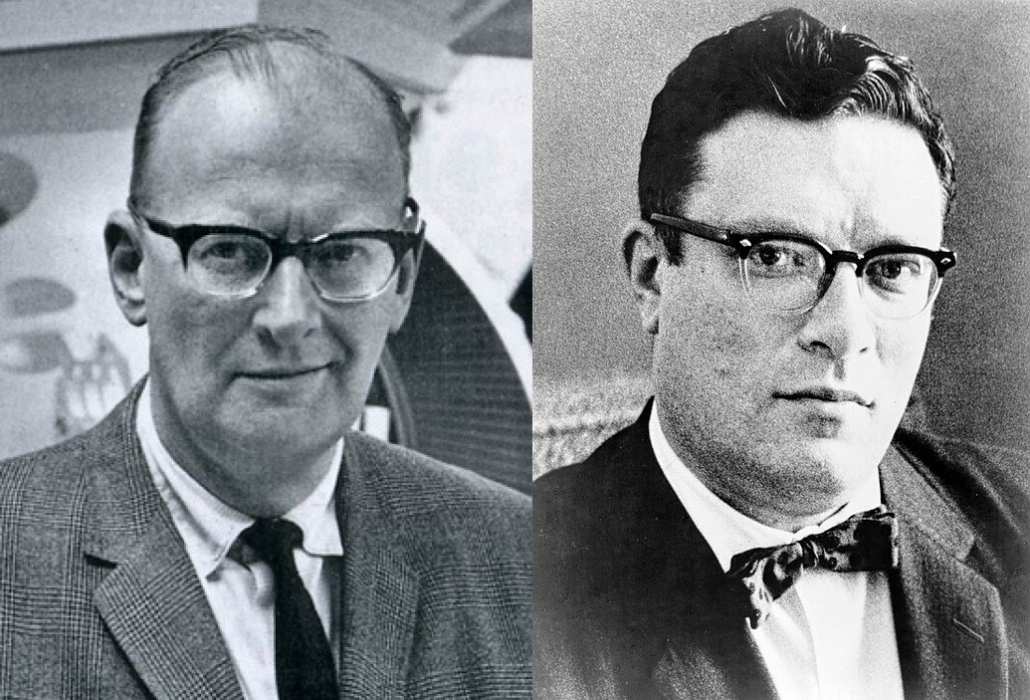 The Bosses: Arthur C. Clarke (left) and Isaac Asimov
Yes, I’ve re-read two SF classics that delighted me as a boy. I wanted to re-visit my memories of the books and see what I think about them now as an adult. And also to see something I didn’t care about as a boy: what each book says about the Boss of Poss who wrote it. In particular, I was interested in the race of each Boss of Poss. Back then I wouldn’t’ve cared about that. I would’ve said: What does it matter that Arthur C. Clarke (1917–2008) is gentile and Isaac Asimov (1920-92) is Jewish? What I say now is: It matters a lot. And I think you can see how it matters in the SF classics I’ve recently re-read: Arthur C. Clarke’s The City and the Stars (1956) and Isaac Asimov’s The Gods Themselves (1972), which I’ll abbreviate as TCaTS and TGT, respectively.
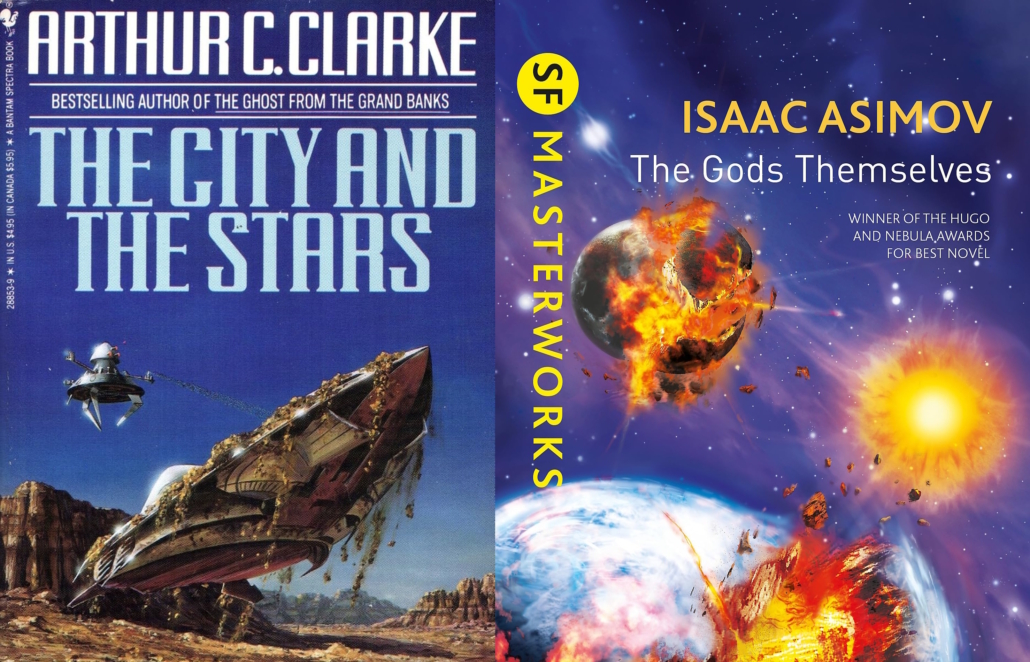 The Books: The City and the Stars (1956) and The Gods Themselves (1972)
I’ll also try some more compression right now and summarize the books as well as I can without giving away spoilers. The City and the Stars is about a dynamic youth born into a static, billion-year-old city-civilization that has turned its back on the Universe. The youth is determined to turn the city back towards the stars and travels out amongst them to discover how. The Gods Themselves is about two universes: this one containing humans and another containing very strange aliens. The laws of physics differ between the two, which is why an alien-arranged link between them seems to offer humans huge benefits without apparent cost.
“Beauty in many forms”
The two books are very different and have very different styles, themes and obsessions. And what are those different themes and obsessions? The first thing that comes to mind is beauty. And its absence. The City and the Stars is beautifully written and has prose that’s a pleasure to read.[1] The Gods Themselves isn’t and doesn’t. And TCaTS repeatedly talks about beauty, which is something that obviously mattered to Clarke:
Men had sought beauty in many forms — in sequences of sound, in lines upon paper, in surfaces of stone, in the movements of the human body, in colours ranged through space. All these media still survived in Diaspar and down the ages others had been added to them. No one was yet certain if all the possibilities of art had been discovered, or if it had any meaning outside the mind of Man. (The City and the Stars, Chapter 5; “Diaspar” is the City of the book’s title)
The planet they were approaching was now only a few million miles away, a beautiful sphere of multicoloured light. There could be no darkness anywhere upon its surface, for as it turned beneath the Central Sun, the other stars would march one by one across its skies. Alvin now saw very clearly the meaning of the Master’s dying words: “It is lovely to watch the coloured shadows on the planets of eternal light.” (Chapter 20)
The Gods Themselves, by contrast is not beautifully written and its prose isn’t a pleasure to read.[2] It’s not painful to read either, but Asimov’s style is much coarser and cruder than Clarke’s. And Asimov doesn’t create pictures in your head in the way Clarke does:
Denison looked about doubtfully. The Moon lay beautiful in the cold light of the Earth. It was black and white; a mild and delicate white as compared with the Sunlit views he had seen when he had taken a trip a week before to inspect the Solar batteries that stretched from horizon to horizon along the floor of Mare Imbrium. And the black was somehow softer, too, through lack of the blazing contrast of true day. The stars were supernally bright and the Earth — the Earth — was infinitely inviting with its swirls of white on blue, and its peeping glimpse of tan. (The Gods Themselves, Section 3, chapter 10)
That odd phrase “peeping glimpse of tan” is either a typo for “peeping glimpse of man” or a reminder that English wasn’t Asimov’s mother-tongue (if “tan” refers to the brown of deserts). He was born in Russia and his Jewish parents spoke Yiddish to him at home even after the family had emigrated to America in 1923. But I don’t think Asimov would’ve written beautifully in Yiddish or Russian either. After all, art is a universal language and American-based Jews from Russia like Mark Rothko and Adolph Gottlieb did not create beautiful art (see Brenton Sanderson’s discussion of Rothko and the central role of Jews in the decline of Western art). Beauty doesn’t matter to Jews as it does to gentiles. As Kevin MacDonald has noted, the Talmud advises Jews not to regard physical beauty as important in marriage: “For ‘false is grace and beauty is vain.’ Pay regard to good breeding, for the object of marriage is to have children” (Taanith 26b and 31a). And I’ve argued before at the Occidental Observer that ugliness is characteristic of Jews in their appearance, art and architecture. I’d argue here that the beauty in TCaTS and the lack of it TGT are truly representative of Clarke as a gentile and Asimov as a Jew.
The Guru and the Guide
But while Asimov’s aesthetics are inferior to Clarke’s, his inventions might’ve been superior. I was dazzled by the ideas in TGT when I read it as a boy and I was dazzled again on my re-read. The alien universe of the book — the parallel Universe or para-Universe, as the human characters call it — didn’t come alive in my head when Asimov took me there, but the central section devoted to it is by far the best and most memorable in the book. Indeed, I’d almost entirely forgotten the human-centered sections that come before and after it. I’d never forgotten the gas-based aliens with their three hugely different sexes or the aliens’ scientific ingenuity whereby they contact humans and arrange what seems a mutually beneficial exchange of matter. As one human character speculates in the first section: “In the parallel Universe, tungsten-186 may be as anomalous as plutonium-186 is here. It may begin as a stable substance and slowly become increasingly radioactive. It may serve as an energy source there just as plutonium-186 would here.”
If you’ve got the science to understand why tungsten-186 and plutonium-186 are “anomalous,” TGT might be just the book for you (if you’ve not already read it). It’s got solid chemistry and physics in it, because Asimov trained as a chemist and was very scientifically knowledgeable. TGT is, indeed, didactic in a way TCaTS isn’t: Asimov acts as a guru for the reader, Clarke acts as a guide. There were millennia of Jewish evolution as students and teachers of Torah and Talmud behind Asimov’s intellect, intelligence and personality. But Clarke’s surname reminds you that evolution for education and literacy has taken place among White gentiles too. Clarke means “clerk,” someone skilled in reading and writing.[3] But “clerk” itself originally meant cleric, and Christian clerics, unlike Jewish rabbis, were supposed to be celibate. In The Descent of Man (1877), the great Charles Darwin followed the even greater Francis Galton, arguing that this Christian celibacy was dysgenic for intelligence and other important intellectual traits:
At that early period, as Mr. Galton has remarked, almost all the men of a gentle nature, those given to meditation or culture of the mind, had no refuge except in the bosom of a Church which demanded celibacy; and this could hardly fail to have had a deteriorating influence on each successive generation. During this same period the Holy Inquisition selected with extreme care the freest and boldest men in order to burn or imprison them. In Spain alone some of the best men—those who doubted and questioned, and without doubting there can be no progress—were eliminated during three centuries at the rate of a thousand a year. The evil which the Catholic Church has thus effected is incalculable, though no doubt counterbalanced to a certain, perhaps to a large, extent in other ways; nevertheless, Europe has progressed at an unparalleled rate. (Darwin’s The Descent of Man, 1877)
Judaism, by contrast, mandated that its holy men marry and so was eugenic for intelligence. Is that part of why the small population of Jews can produce geniuses at a rate not far below that of the much larger population of gentile Whites? The highly intelligent Clarke and Asimov weren’t geniuses, but they were the two biggest names in SF during their lifetimes. Statistically speaking, that’s highly anomalous when it comes to Asimov, from the tiny world-minority of Jews, but much less so when it comes to Clarke, from the much larger world-minority of the White British. However, while Judaism was eugenic for intelligence, it wasn’t eugenic for aesthetics. The literacy of Jews was centered on convolved religious and legal texts until recent times; the literacy of Christian gentiles has ranged much further for centuries, from pagan classics to the Bible to plays, poetry, and novels to science and mathematics. Does all of that help explain why there’s much more wonder and beauty in the gentile Clarke’s book than in the Jewish Asimov’s book? You could also say there’s more width (and depth and height) in Clarke’s book too, although Asimov’s takes you to an entirely different universe.
An obvious Asimovian obsession
The trouble is, as I said above, that Asimov doesn’t evoke that other universe well. The tri-sexed alien gas-beings of the para-universe are excellent inventions, but they don’t come alive on the page any more than Asimov’s human beings do. The rocky, sun-starved planet of the gas-beings doesn’t have solidity and substance on the page either. In some ways, the para-universe seems to have been an excuse for Asimov to pursue his obvious obsession with sex. Threesomes are obligatory for reproduction in the para-universe, because each of the three sexes of alien contributes something essential: intellect, intuition, practicality. And the aliens don’t swap fluids: they merge gases, uniting in an individuality-annihilating ecstasy of oneness-from-threeness. On Earth we have couples; in the para-universe they have what Asimov calls “throuples.” He centers his para-section on a throuple whose names are Odeen, Dua and Tritt (based on the Russian words for “One, Two, Three”). In short, his ideas for the para-universe are excellent, even if his imagery is lacking. And there’s an ingenious twist to the throuple’s final throupling that casts the para-story in a sudden new light.
But Asimov can’t help himself where sex is concerned: beside the obligatory throupling, he invents a new form of masturbation for the para-universe. It involves not rod-rubbing but rock-rubbing. Again, it’s ingenious, but after reading TGT you won’t be surprised to hear that Asimov was a dedicated lecher and habitual groper. He was a true Semitic sex-pest à la Harvey Weinstein. There’s an obsession with sex in both the para-section of TGT and in the much less interesting section that follows it, when Asimov returns to this universe. He takes a male character to a moon-base to learn about the benefits of lower lunar gravity for the female breast:
The Earthman was staring at the nameplate she wore on the blouse covering the upper slope of her high, not-too-large left breast. She decided it was really the name-plate he was looking at, not the breast, though the blouse was semi-transparent when it caught the light at a particular angle and there was no garment beneath it. (Section 3, chapter 1)
No, it was the breast too, not just the nameplate. So you won’t be surprised from Asimov’s book to hear about Asimov’s lechery. And you won’t be surprised from Asimov’s lechery to hear about Asimov’s pornography. That’s the porn of Asimov Jr, Isaac’s son David, and it was “the biggest child pornography collection in Sonoma County, [California], history.” Interestingly, none other than Robert Mueller of the FBI helped David Asimov avoid a prison sentence and serve only home detention. Mueller was also involved when the Jewish child-rapist Jeffrey Epstein was treated with similar leniency. Many people have suggested that Jewish privilege was at work in both cases.
But another kind of privilege very likely explains why Arthur C. Clarke was never prosecuted for pederasty after he moved to Sri Lanka. Asimov fathered a male child; Clarke fornicated with male children. His fame, wealth and official connections seem to have ensured that the Sri Lankan authorities took no notice. I don’t think you would guess Clarke’s perversions from TCaTS, although I’ve realized that they are pretty obvious in some of his other novels. All the same, there is some sexual peculiarity in TCaTS, even if it’s not as obtrusive and obsessive as it is in TGT. As Vox Day has often observed and lamented: science fiction attracts pedophiles and other sexually peculiar people, both as authors and as aficionados (it’s said that when American police raid a pedophile’s home, they always find the pedo is also a Trekkie).
A jellyfish-genius
This may be related to the psychological factors of intelligence and openness, which will both be higher on average among authors and aficionados of science fiction. It may also be related to the psychological factor of autism, which is something I can see now in both TCaTS and TGT. But Asimov’s autism is more obvious: his characters are cardboard in a way Clarke’s aren’t. And Clarke’s most ingenious alien — a self-assembling and —disassembling jellyfish-genius — comes alive on the page in a way that Asimov’s ingenious aliens never do. But Clarke’s human characters don’t have life and vividness like those of Charles Dickens or Evelyn Waugh. Again, science fiction attracts the autistic both as authors and aficionados. That isn’t surprising, because science does the same. Science is about mechanism and it attracts and encourages a mechanistic, mathematizing mindset. I argued in my article “Contra Camera” that J.R.R. Tolkien opposed that mindset in Lord of the Rings (1954-5), where the evil wizard Saruman boasts of splitting white light into colors and the good wizard Gandalf rebukes him for leaving the “path of wisdom.”
I think Saruman is meant to represent Isaac Newton and his experiments with prisms. I also think Lord of the Rings is a much wiser, saner and healthier book than either The City and the Stars or The Gods Themselves. But I’m glad that I can appreciate all three books and I think all three contain things of value for Whites to learn from. And to be warned by. As Asimov might have said: the three books are a throuple and each brings something unique to the mix. But as an adult I’ve kept re-reading my boyhood favorite Lord of the Rings. I haven’t re-read those boyhood favorites among Clarke’s and Asimov’s books. Not until this year. I don’t think Lord of the Rings is as well-written as The City and the Stars and I know it’s not as intellectually stimulating as The Gods Themselves. Tolkien wasn’t a Boss of Poss like Clarke and Asimov. Instead, he was a lord of language and life in a way they weren’t and could never have been.
Juggling the Giants
But who do I think was the Boss of Poss when it comes to Clarke and Asimov? Well, having juggled the strengths and weaknesses of TCaTS and TGT, I think I agree with the SF giants themselves. They decided that Clarke could call himself the better author of science fiction and Asimov could call himself the better author of science fact. TGT is an intellectual adventure, true, but TCaTS is both an intellectual adventure and an aesthetic treat. Clarke could write good science fact himself, but he never matched Asimov and masterpieces of lucidity like Asimov’s The World of Carbon (1958).
I still can say of The World of Carbon what I can’t say of TGT: it’s a delight to read. As an introduction to organic chemistry, it’s unbeatable. But even as a boy I didn’t find Asimov’s science fiction particularly enjoyable to read. All the same, I might re-read his robot-stories in 2026, because I can see how prescient they are of the AI age. I will definitely re-read more by Clarke in 2026, because I know his other novels were prescient and I think they will still be enjoyable to read. The City and the Stars certainly was, jellyfish-genius and all. Clarke calls that ingenious alien “the great polyp” and homes it in a lake. He may have been nodding towards a lake-dwelling polypous monster in Lord of the Rings, but his giant polyp is tragic, not traumatizing:
Alvin realised that he would have to act quickly, or his opportunity would be gone — perhaps only for a few years, perhaps for centuries.
“What have you decided?” he said eagerly. “Is the robot coming with us?”
There was an agonising pause while the polyp tried to force its dissolving body to obey its will. The speech-diaphragm uttered, but no audible sound came from it. Then, as if in a despairing gesture of farewell, it waved its delicate palps feebly and let them fall back into the water, where they promptly broke adrift and went floating out into the lake. In a matter of minutes, the transformation was over. Nothing of the creature larger than an inch across remained. The water was full of tiny, greenish specks which seemed to have a life and mobility of their own, and which rapidly disappeared into the vastness of the lake. (Chapter 13)
[1] I don’t think Clarke’s prose matches the beauty and pleasure of P.G. Wodehouse’s or Evelyn Waugh’s, but it’s some of the best I’ve ever come across in science fiction. I’d also guess that Clarke was a fan of Wodehouse, because Clarke’s lucidity reminds me of Wodehouse’s.
[2] The Gods Themselves does have a good title, though, taken by Asimov from Schiller’s famous maxim Mit der Dummheit kämpfen Götter selbst vergebens, “Against stupidity, the Gods themselves battle in vain.” I’m still grateful to Asimov, because the title is where I first came across the maxim.
[3] In British English, clerk is still pronounced “clark” like the surname.




Now I want to read Arthur C. Clarke’s The City and the Stars, so thank you very much for reviewing both books.