
Prose and Prejudice: Cluing through Wu-2’s Views on Jews
If God doesn’t exist, how do you explain cats, peacock feathers, and the prose of P.G. Wodehouse? If the Devil doesn’t exist, how do you explain cats, plague, and the prose of Judith Butler? As you can see, cats turn up on both sides of the ledger: on God’s for their charm, beauty, and mystery; on the Devil’s for their selfishness, cruelty, and painful-by-design teeth and claws.[1]
Strangulation, Satanism and suicide
But I know a human being who turns up on both sides of the ledger too: the English writer Evelyn Waugh (1903-66). He usually wrote like an angel, but sometimes behaved like a devil. Like Wodehouse’s, his books are a joy to read; unlike Wodehouse’s, his books contain very dark and even depraved scenes and themes. Inter alia, there’s a decapitation with “carpenter’s tools” in Decline and Fall (1928); a cannibal feast in Black Mischief (1932); a literary, and literal, enslavement in A Handful of Dust (1934); two suicides and a supremely undignified cremation in The Loved One (1948); and strangulation, Satanism and state-sanctioned suicide in his short stories and novellas.[2]
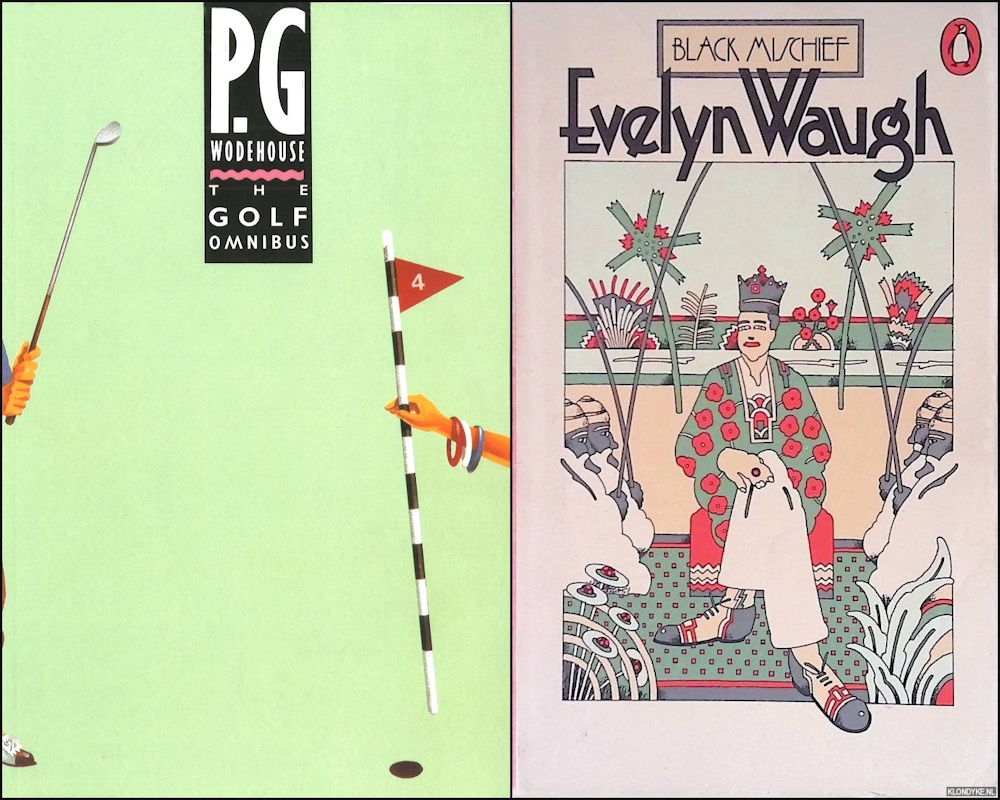 Prose by the prejudiced: P.G. Wodehouse’s Golf Omnibus and Evelyn Waugh’s Black Mischief
Waugh’s prose always reminds me of Mozart; Waugh’s scenes sometimes remind me of gangsta rap. What unites Wodehouse and Waugh — a pairing we can call Wu-2, if we adopt the name for “W” I proposed in “The World’s Worst Word” — is the beauty of their writing. What separates them is the sunniness of Wodehouse and the satire of Waugh. But something else that unites them is that they both wrote about Jews in what could be called anti-Semitic ways. It’s just that one of these sublime writers was subtle and the other was blatant in that prejudice. Who was which? Well, here are two pieces of blatant anti-Semitism from Waugh’s A Handful of Dust:
“Ben says natives aren’t humans at all really.”
“Ah, but he’s thinking of Negroes, I expect. These are pure Semitic type.”
“What’s that?”
“The same as Jews.”
“Ben says Jews are worse than natives.” (A Handful of Dust, chapter 3, part III)
“This place stinks of Yids,” said Baby.
“I always think that’s the sign of a good hotel, don’t you?” said Tony.
“Like hell,” said Baby. (A Handful of Dust, chapter 4, part II)
Yes, that is blatant anti-Semitism, but it isn’t being espoused by Waugh himself, rather by two of his characters. And their espousal damns them as inferior. The crudity of the prejudice establishes the crudity of the character: Baby is a working-class scold and possibly a prostitute; Ben is a working-class riding instructor whose views are being repeated by a naïve upper-class child. In Waugh’s fiction, speaking about Jews like that is a sure sign of inferiority.
Synagogues and snake-temples
And so, despite his well-established reputation as a curmudgeon and racist, Waugh was not blatant in his anti-Semitism. No, he was subtle. Waugh didn’t think Jews were at the bottom of the racial scale: he thought they were almost at the bottom of the theological scale. There’s enormous significance in the order he gives to various denominations and religions in one passage from his hilarious but highly un-woke novel Black Mischief. To set the scene: a pair of Englishwomen are visiting the African city of Debra Dowa during a “festival of sterility” and have climbed onto the roof of their hotel to escape an incursion of natives, who have been sold tickets to their room by Mr Youkoumian, the hotel’s unscrupulous Armenian proprietor:
[F]rom where they sat the whole city lay very conveniently exposed to their view. They could see the irregular roofs of the palace buildings in their grove of sapling blue gums and before them the still unfinished royal box from which the Emperor proposed to review the procession; small black figures could be observed working on it, tacking up coloured flags, spreading carpets and bobbing up the path with pots of palm and fern. They could see the main street of the city diverge to the barracks on one side and the Christian quarter on the other. They could see the several domes and spires of the Catholic, Orthodox, Armenian, Anglican, Nestorian, American Baptist and Mormon places of worship; the minaret of the mosque, the Synagogue and the flat white roof of the Hindu snake temple. (Black Mischief, chapter 6)
Waugh ordered the list by distance from Divine Truth: Catholicism possessed it entirely; then came the Christian denominations in order of their closeness to Catholicism; then came Islam, which at least honored Christ as a virgin-born, miracle-working prophet; last-but-one came Judaism, which had rejected and crucified Christ; and finally, most distant of all from the True Faith, came Hinduism and the absurdities of its animal-worship. Setting Judaism in last-but-one place like that was anti-Semitic by the standards of corrupt and decadent modern Catholicism. But it was perfectly orthodox Catholicism when Black Mischief was published in the 1930s. There was no nonsense about Jews being “elder brothers in the Faith” before the heretical innovations of the Jew-infiltrated Second Vatican Council (1962-5) (see articles on Vat II at TOO). Instead, millions of Catholics around the world prayed every Good Friday for God to lift the “blindness” of the “perfidious Jews.”
Magic but maleficent
It’s true that Waugh speaks earlier in the novel of a “Jewish nihilist from Berlin” throwing a bomb during an imperial coronation, but that’s anti-Semitic only in the sense that it reflected a negative truth about Jews rather than censoring it, as Jews would have preferred. In all likelihood a bomb-throwing nihilist from Berlin would have been Jewish in those days. That’s why I argue that the blatant anti-Semitism of the Wu-2 came not from curmudgeonly Evelyn Waugh, but from cuddly P.G. Wodehouse. However, I’m not talking about the accusation against Wodehouse that he collaborated with the Nazis during World War Two. That accusation was comprehensively refuted by George Orwell in his article “In Defence of P.G. Wodehouse” (1945).
Instead, I’m talking about a little-known Wodehouse story called “The Magic Plus Fours” (1922). It’s a characteristically sunny story, but it’s also as close as Wodehouse ever got to the sinister and supernatural. Narrated by the “Oldest Member” of a golf club, it’s about a dedicated but mediocre golfer called Wallace Chesney, who is always buying bizarre new clubs in a futile quest to improve his game. One day he sees a putter of “pre-eminently lunatic design” in the window-display of “COHEN BROS.,” a firm of Jewish brothers who run a second-hand clothing business but deal in what Wodehouse calls “derelict goods of every description.” Pursuing the putter, Wallace enters the shop:
The shop was full of the Cohen family, sombre-eyed, smileless men with purposeful expressions; and two of these, instantly descending upon Wallace Chesney like leopards, began in swift silence to thrust him into a suit of yellow tweed. Having worked the coat over his shoulders with a shoe-horn, they stood back to watch the effect.
“A beautiful fit,” announced Isidore Cohen.
“A little snug under the arms,” said his brother Irving. “But that’ll give.”
“The warmth of the body will make it give,” said Isidore.
“Or maybe you’ll lose weight in the summer,” said Irving.
Wallace, when he had struggled out of the coat and was able to breathe, said that he had come in to buy a putter. Isidore thereupon sold him the putter, a dog collar, and a set of studs, and Irving sold him a fireman’s helmet: and he was about to leave when their elder brother Lou, who had just finished fitting out another customer, who had come in to buy a cap, with two pairs of trousers and a miniature aquarium for keeping newts in, saw that business was in progress and strolled up. His fathomless eye rested on Wallace, who was toying feebly with the putter.
“You play golf?” asked Lou. “Then looka here!”
He dived into an alleyway of dead clothing, dug for a moment, and emerged with something at the sight of which Wallace Chesney, hardened golfer that he was, blenched and threw up an arm defensively.
“No, no!” he cried.
The object which Lou Cohen was waving insinuatingly before his eyes was a pair of those golfing breeches which are technically known as Plus Fours. A player of two years’ standing, Wallace Chesney was not unfamiliar with Plus Fours — all the club cracks wore them — but he had never seen Plus Fours like these. What might be termed the main motif of the fabric was a curious vivid pink, and with this to work on the architect had let his imagination run free, and had produced so much variety in the way of chessboard squares of white, yellow, violet, and green that the eye swam as it looked upon them.
“These were made to measure for Sandy McHoots, the Open Champion,” said Lou, stroking the left leg lovingly. “But he sent ’em back for some reason or other.”
“Perhaps they frightened the children,” said Wallace, recollecting having heard that Mr. McHoots was a married man.
“They’ll fit you nice,” said Lou.
“Sure they’ll fit him nice,” said Isidore, warmly.
“Why, just take a look at yourself in the glass,” said Irving, “and see if they don’t fit you nice.”
And, as one who wakes from a trance, Wallace discovered that his lower limbs were now encased in the prismatic garment. At what point in the proceedings the brethren had slipped them on him, he could not have said. But he was undeniably in.
Wallace looked in the glass. For a moment, as he eyed his reflection, sheer horror gripped him. Then suddenly, as he gazed, he became aware that his first feelings were changing. The initial shock over, he was becoming calmer. He waggled his right leg with a certain sang-froid.
There is a certain passage in the works of the poet Pope with which you may be familiar [said the Oldest Member to his audience of one]. It runs as follows:
“Vice is a monster of so frightful mien
As to be hated needs but to be seen:
Yet seen too oft, familiar with her face,
We first endure, then pity, then embrace.”
Even so was it with Wallace Chesney and these Plus Fours. At first he had recoiled from them as any decent-minded man would have done. Then, after a while, almost abruptly he found himself in the grip of a new emotion. After an unsuccessful attempt to analyse this, he suddenly got it. Amazing as it may seem, it was pleasure that he felt. He caught his eye in the mirror, and it was smirking. Now that the things were actually on, by Hutchinson, they didn’t look half bad. By Braid, they didn’t. There was a sort of something about them. Take away that expanse of bare leg with its unsightly sock-suspender and substitute a woolly stocking, and you would have the lower section of a golfer. For the first time in his life, he thought, he looked like a man who could play golf. (“The Magic Plus Fours,” 1922)
As the title foretells, the Plus Fours turn out to be magic, but in a maleficent way. Wallace becomes a crack golfer, but he loses his amiable personality in the process and alienates all his friends, including his fiancée Charlotte. To learn how he regains both his old self and his old friendships, you’ll have to read the story for yourself. Indeed, I recommend that any newcomer to Wodehouse read the whole of the Golf Omnibus in which “The Magic Plus Fours” is most conveniently collected.
Semitic stereotypes
After all, I hope the extract above has already shown the uninitiated how well Wodehouse could write.[3] He was called “English literature’s performing flea” in 1941 by the Irish playwright Sean O’Casey; he responded in 1953 by calling one of his own books Performing Flea. He was perfectly content not to be seen as a profound or intellectual writer. You don’t go to Wodehouse for deep or dark themes. Instead, you go for sunshine, light-hearted comedy and beautiful prose. “The Magic Plus Fours” is certainly light-hearted and written in beautiful prose. Nevertheless, it contains undeniable stereotypes about Jewish psychological intensity and dishonesty — and about Jewish predation too. Recall how Wodehouse describes the Cohen brothers “descending upon Wallace Chesney like leopards.”
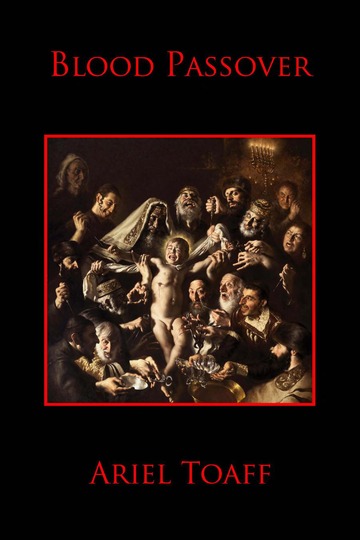 Passover of Blood (2007), a much-censored study of medieval Jewish sorcery and blood-trading by the Israeli scholar Ariel Toaff (see Ron Unz’s review)
There is also a faint but unmistakable echo of ancient religious anti-Semitism. A garment forced on a goy by Jews proves both magic and maleficent. The Cohen “brethren,” as Wodehouse calls them, are a secularized and softened version of the Jewish black magicians in Christian fables — and in historical fact. As Ron Unz has described in “Oddities of the Jewish Religion,” Jews both practised sorcery and trafficked in real Christian blood during the Middle Ages. The so-called “Blood Libel,” which claimed that Jews kidnapped Christian children and drained their blood, may well have been literal truth, not libellous fantasy. The Cohen brothers of Wodehouse’s story fall into that tradition of Jewish magic and maleficence. They hypnotize Wallace into buying a garment that turns him into a crack golfer at the expense of his friendships and his happiness.
Knockout Trousers Ltd
The goy therefore has to break the garment’s spell, that is, break the spell of Jewish black magic. Accordingly, I think that Jewish organizations like the Anti-Defamation League (ADL) in America and the Community Security Trust (CST) in Britain would condemn that story for its anti-Semitic stereotypes and insinuations. In other words, they would condemn its realism, because Jewish salesmen did behave like that. P.G. Wodehouse cast that behavior in a comic light; George Orwell cast it in a hostile light. Orwell was another writer of beautiful prose, although he wasn’t yet writing beautifully in pre-war novels like the depressive and depressing A Clergyman’s Daughter (1935). It tells the story of Dorothy Hare, a clergyman’s genteel daughter who has a nervous breakdown and is submerged in poverty after she runs away from her selfish and exploitative father. Here’s Orwell’s portrait in the novel of another Jewish garment-seller:
The autumn weather, though fine, was growing colder. Each day the sun, fighting his losing battle against the winter, struggled a little later through the mist to dye the house-fronts with pale aquarelle colours. Dorothy was in the streets all day, or in the public library, only going back to “Mary’s” to sleep, and then taking the precaution of dragging her bed across the door. She had grasped by this time that “Mary’s” was — not actually a brothel, for there is hardly such a thing in London, but a well-known refuge of prostitutes. It was for that reason that you paid ten shillings a week for a kennel not worth five. Old “Mary” (she was not the proprietress of the house, merely the manageress) had been a prostitute herself in her day, and looked it. Living in such a place damned you even in the eyes of Lambeth Cut [a lowly district of London]. Women sniffed when you passed them, men took an offensive interest in you. The Jew on the corner, the owner of Knockout Trousers Ltd, was the worst of all. He was a solid young man of about thirty, with bulging red cheeks and curly black hair like astrakhan. For twelve hours a day he stood on the pavement roaring with brazen lungs that you couldn’t get a cheaper pair of trousers in London, and obstructing the passers-by. You had only to halt for a fraction of a second, and he seized you by the arm and bundled you inside the shop by main force. Once he got you there his manner became positively threatening. If you said anything disparaging about his trousers he offered to fight, and weak-minded people bought pairs of trousers in sheer physical terror. But busy though he was, he kept a sharp eye open for the “birds”, as he called them; and Dorothy appeared to fascinate him beyond all other “birds”. He had grasped that she was not a prostitute, but living at “Mary’s”, she must — so he reasoned — be on the very verge of becoming one. The thought made his mouth water. When he saw her coming down the alley he would post himself at the corner, with his massive chest well displayed and one black lecherous eye turned inquiringly upon her (“Are you ready to begin yet?” his eye seemed to be saying), and, as she passed, give her a discreet pinch on the backside. (A Clergyman’s Daughter, chapter 2, part 7)
Again, the ADL and CST would surely condemn that for its anti-Semitic stereotypes, that is, for its realism about Jewish behavior. Like Wodehouse, Orwell had obviously seen Jewish salesmen in action and noted their psychological intensity. Unlike Wodehouse, however, Orwell also noted Jewish lechery. He could have written about Jews even more bigotedly, but no less realistically, by describing their central role in the “white slave trade,” as trafficking in coerced European prostitutes was then called.
Jew-on-Jew predation
But the term “white slave trade” was partly a misnomer, because although the prostitutes were from Europe and were coerced, they were generally Ashkenazi Jewesses rather than White shiksas. That is, Jewish women were being preyed on by Jewish men. You may be surprised to hear that you can find fuller details of this Jew-on-Jew predation at the heavily Judeo-policed Wikipedia. There’s a very interesting article there about a Jewish gang known as the Zwi Migdal, which was allied with the “Jewish Mob” and the “Ashkenazum.” Here are extracts from the article:
The [Zwi Migdal]’s main operation was the trafficking of Jewish women from Central Europe (mainly from Warsaw) into sexual slavery and forced prostitution. The organization, whose operators were Jewish, functioned from its foundation in the 1860s until 1939.
The organisation’s annual turnover was $50 million at the turn of the 20th century. After the First World War, it had 400 members in Argentina, Buenos Aires being its main centre of operations. It had branch offices in Brazil (Rio de Janeiro, São Paulo and Santos), the United States (New York City), Poland (Warsaw), South Africa, India and China.
During the 1920s the organisation grew to its largest-ever size. At its height, 430 individuals, acting as pimps and in other criminal roles, oversaw a network of 2,000 brothels and approximately 4,000 women in Argentina alone. The organization’s success stemmed from the fact that its members were bound by rules that were “based on order, discipline, and honesty.” The network was well-organized and members cooperated closely to protect their interests. […]
The organization lured girls and young women from Europe in several ways. [The researcher Tomasz] Pindel describes one ruse in which a well-mannered and elegant-looking man would appear in a poor Jewish village in Poland or Russia. He would advertise his search for young women to work in the homes of wealthy Jews in Argentina by posting an advertisement in the local synagogue. Fearful of pogroms and often in desperate economic circumstances, parents would send their daughters away with the man, hoping that this might offer them a fresh start.
Another popular ruse was to find pretty girls and marry them, usually in a quick wedding ceremony known in Yiddish as a “shtille chupah” [“silent canopy,” in reference to the traditional Jewish wedding-canopy and the absence of any official record of the marriage]. The girls bade their families farewell and boarded ships to Argentina, believing that they were on their way toward a better future. The rape of the girls and abuse as sex slaves often started on the ship. Some of them were married off to local men so that they could obtain entry visas.
Prostitutes who failed to satisfy their clients were beaten, fined, or sent to work in rural houses. Every business transaction was logged. The ruffians held a “meat market” where newly arrived girls were paraded naked in front of traders in places such as Hotel Palestina and Café Parisienne. These activities went on undisrupted because government officials, judges, and journalists frequented the brothels. City officials, politicians, and police officers were bribed. The pimps had powerful connections everywhere. The largest brothels in Buenos Aires housed as many as 60 to 80 sex slaves. Although there were brothels all over Argentina, most were in Buenos Aires, in the Jewish quarter on Junin Street. (“Zwi Migdal” at Wikipedia)
The prose at Wikipedia is rarely or never beautiful, let alone as beautiful as the prose of Wodehouse and Waugh. But weak prose can still convey powerful truths. And powerful truths about Jewish behavior are conveyed in that article at Wikipedia. The article says that the Zwi Migdal lasted from 1867 to 1939, but the central Jewish role in prostitution and pornography has never ceased.
Nowadays, however, the Jewish pimps and pornographers prey much more on shiksas, rather than on women of their own race. The Zwi Migdal might have preferred to prey on shiksas too, but anti-Semitism was stronger in those days and they must have feared a goyish backlash. In other words, gentile realism about Jewish behavior was much stronger in those days. In the 1920s even the amiable and light-hearted P.G. Wodehouse espoused realism about Jews.
A century later, in the 2020s, some of that realism about Jews has returned. The Jewish war on Nazi Germany enabled Jews to silence gentile tongues; the Jewish wars on Gaza and Iran are setting gentile tongues free again. It’s just a shame that we can’t break the ugliness and lies of Jewish control with the beauty and truth found in the prose of White writers like Wodehouse, Waugh and Orwell. John Keats, who wrote sublime poetry, told us that “Beauty is truth” and “truth beauty,” then asseverated that this is “all / Ye know on earth, and all ye need to know.” Alas, he was wrong. But it is important to know that Whites like Wodehouse, Waugh, Orwell and Keats have created beauty and spoken truth in a way that Jews never have and never will.
[1] A bite from a dog can do more much damage, but a bite from a cat can be much more painful. As solitary hunters, cats need to overcome their prey as quickly and efficiently as possible, so I’d suggest that their teeth and claws have evolved both to penetrate far and to be paralyzingly painful.
[2] The strangulation is in “Mr Loveday’s Little Outing” (1935); the Satanism in “Out of Depth” (1933); and the state-sanctioned suicide in “Love Among the Ruins” (1953). See Waugh’s Collected Stories.
[3] One example of Wodehouse’s skillful writing in that extract may be his choice of “smileless” in the description of the Cohen brothers. Why did he use that relatively rare word rather than the more common “unsmiling”? Well, try reading the sentence in question aloud using both. You’ll find that “smileless,” with its doubled liquid “l,” takes more effort and seems to last longer, emphasizing the smilelessness of the Cohens.

Leave a Reply
Want to join the discussion?Feel free to contribute!