
Thorn Again: Let’s Annul the Adulteration of an Ancient Alphabet
“Savor Flavor!” That’s good advice for enjoying food. But it’s also good advice for enjoying language. For example, I like alliteration because it adds flavor to writing and reading. I also like the American spellings in “Savor Flavor.” They’re simpler and sharper than the British spellings in “Savour Flavour.” And they’re the original spellings, the ones used in Latin millennia ago. They’re crisper, more concise, crunchier and punchier.
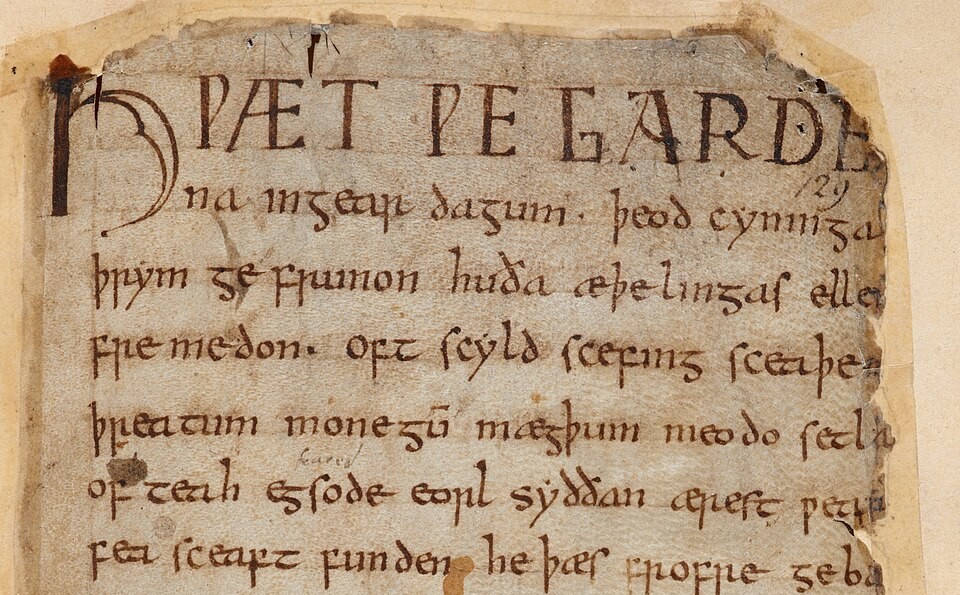 Back to Beowulf: some lost letters in an ancient alphabet (image from Wikipedia)
That’s why they were re-introduced to English by Noah Webster (1758–1843), the great American lexicographer. He thought the British spellings were clumsy, too long, too inefficient, so he reformed them for Americans. The British resisted his reforms, of course. The different spellings have become markers of identity, part of the distinct flavors of American and British English. The British have resisted reform and removal, just as the French would resist if you proposed removing accents — à, é, ô and so on — from written French. They’re one of the orthographic markers of French identity, a flavor you can savor as you read French:
Je me suis baignée seule dans la rivière de la forêt. Sans doute je faisais peur aux naïades car je les devinais à peine et de très loin, sous l’eau obscure.
Je les ai appelées. Pour leur ressembler tout à fait, j’ai tressé derrière ma nuque des iris noirs comme mes cheveux, avec des grappes de giroflées jaunes.
D’une longue herbe flottante, je me suis fait une ceinture verte, et pour la voir je pressais mes seins en penchant un peu la tête.
Et j’appelais: « Naïades! naïades! jouez avec moi, soyez bonnes. » Mais les naïades sont transparentes, et peut-être, sans le savoir, j’ai caressé leurs bras légers. (Pierre Louÿs, Les Chansons de Bilitis, 1894)Google translate:
I bathed alone in the forest river. No doubt I frightened the naiads, for I could barely sense them—and only from afar—beneath the dark water.
I called out to them. To resemble them perfectly, I braided irises—as black as my own hair—behind my nape, intertwined with clusters of yellow wallflowers.
From long, floating strands of grass, I fashioned a green girdle; and to catch a glimpse of it, I pressed against my breasts, tilting my head slightly.
And I called out: “Naiads! Naiads! Play with me; be kind.” But naiads are transparent, and perhaps—without even knowing it—I caressed their slender arms.
It would be linguistic vandalism against French to remove the accents from a passage like that. But you could say that invaders from France contributed to vandalism against English. Vandalism is what I’d call it, anyway: English was stripped of unique flavors centuries ago, because some letters used in Old English were slowly lost after, and partly because of, the Norman Conquest. Scribes and printers abandoned them, adulterated English with clumsy digraphs, double letters for single. The runic letter Ƿ/ƿ, called “wynn”, became vv (double v), which later melded into w.[1] The letters Æ/æ and Ᵹ/ᵹ, called “ash” and “insular g,” were replaced with A/a and G/g, respectively. Two more letters, Đ/ð and Þ/þ, called “eth” and “thorn,” became the one spelling Th/th. That’s why modern English has no good way to distinguish between two very common sounds: the distinct but related fricatives that start the words “then” and “think.”[2]
Unity, not uniformity
Those losses happened long ago, but I feel them still. That’s why, if I could, I would will that English be born again — and thorn again. That is, I’d like English to start using letters like thorn again, so ðæt ƿe þouȝt in ᵹood neƿ ƿays — “so that we thought in good new ways.” Or rather, in good old ways, because we would once again be using ancient letters. Or not-so ancient: the second unfamiliar letter in þouȝt, “thought,” is Ȝ/ȝ and was called “yogh” (pronounced yog). It was used in Middle English, not Old English, and was lost by neglect like the others. I’d like all those letters back, born again and thorn again. It would return ancient flavors to English, mark my mother-tongue out among the languages of Europe, because the Roman alphabet has both unified and uniformed Europe. That’s one of the reasons I like the accents in French and the adapted letters in Norwegian, like the vowel of brød, “bread”, and in Czech, like the first letter of Škoda. They create unique flavors in those languages, helping them resist assimilation and absorption.
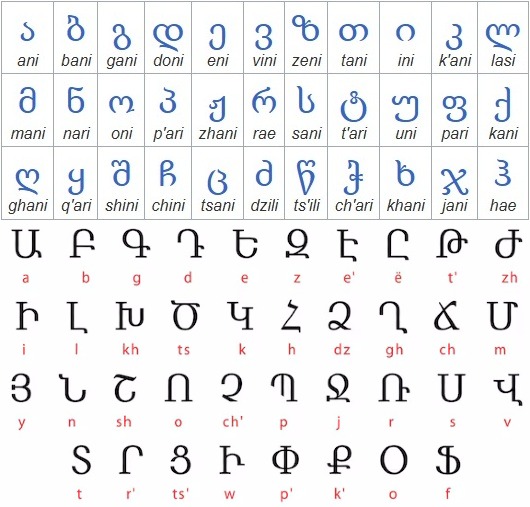 The unique but related Georgian and Armenian alphabets (images here and here)
Indeed, we could go further and call for all the nations of Europe to create and use entirely new and distinct alphabets, impenetrable to outsiders like the unique alphabets used in the ancient kingdoms of Georgia and Armenia. Those impenetrable alphabets help explain why Georgia and Armenia can be called ancient: they’re small nations that have survived amidst mighty empires in part because they have strong linguistic identities both when spoken and when written.[3] A distinct alphabet for each nation in Europe would strengthen national identity in a similar way. And would do more than that: all alphabets, all writing systems, work on the mind in profound but little-recognized ways. But I think distinct alphabets would be a step too far. Europe is rightly unified by the Roman alphabet. We simply need to ensure that unity doesn’t blur into uniformity. Resurrecting those ancient letters in English would assist that. It would make English more distinct, strengthen our identity, reaffirm our roots.
Walled-off words
And there’s an interesting precedent for all that: the resurrection of ancient letters for a modern language. Indeed, the resurrection of an entire ancient alphabet for a modern language. Not that the alphabet had ever fallen into disuse. Not for religious purposes, anyway. It was the Hebrew alphabet, written from right to left, and was used in the Jewish scriptures for the ancient languages of Hebrew and Aramaic. But Jews also chose to use the Hebrew alphabet for the new language of Yiddish, which is a Judaified dialect of German. In other words, they put up a linguistic wall to keep gentiles out. Spoken Yiddish can often be easily understood by German-speaking gentiles. Written Yiddish can’t be understood at all — not unless a gentile knows the Hebrew alphabet. That linguistic seclusion has some interesting consequences. Take this sample of Yiddish, which makes a very important political claim about America in blue letters:
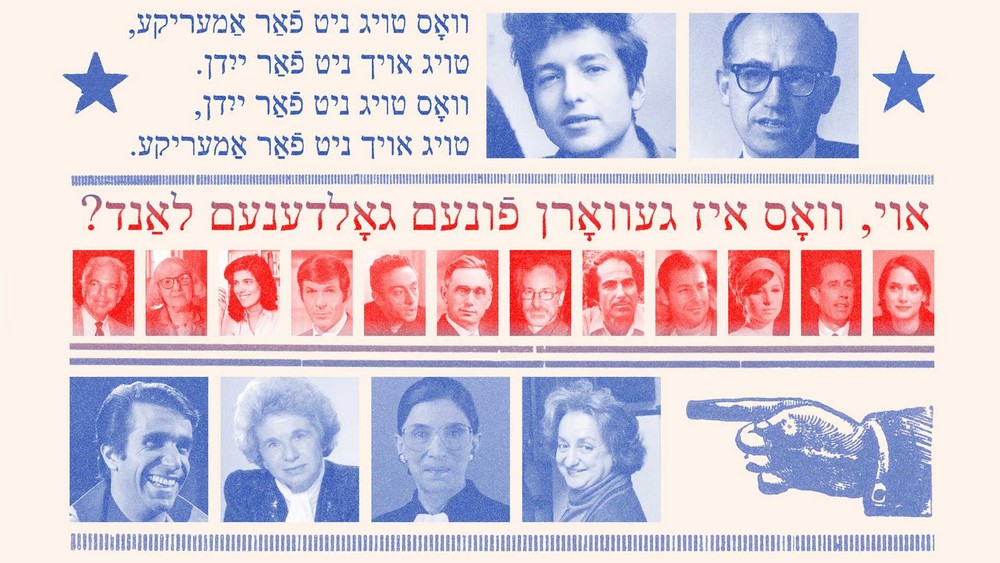 Walled-off words about America and Jews (image from The Atlantic)
What is the claim? For many decades, gentile Americans would have had no easy way of knowing, because the claim was cloaked not merely in a foreign language but in an alien alphabet too. Nowadays, thanks to artificial intelligence, it is easy to know what the claim is:
Top (blue text):
וואָס טויג ניט פֿאַר אַמעריקע,
טויג אויך ניט פֿאַר ייִדן.
וואָס טויג ניט פֿאַר ייִדן,
טויג אויך ניט פֿאַר אַמעריקע.
English:
What isn’t good for America
isn’t good for Jews either.
What isn’t good for Jews
isn’t good for America either.
This is a classic Yiddish formulation expressing that Jewish and American interests are aligned — what harms one harms the other. (AI translation of and commentary on the Yiddish text)
A lot of gentiles would disagree with that “classic Yiddish formulation,” but that’s precisely why Jews expressed it in a walled-off way. It was walled off from gentile scrutiny, because it proved that Jews had an arrogant, proprietorial attitude to America. And what about the text in red letters? What does that say? Again, AI makes it easy to find out:
Bottom (large red text):
?אוי, וואָס איז געוואָרן פֿון עם געלדענעם לאַנד
English:
“Oy, what has become of the Golden Land?”
“Di Goldene Medine” (or “Golden Land/Country”) was the traditional affectionate Yiddish name for the United States, especially among Jewish immigrants. The line is lamenting or questioning what has happened to that idealized America. (AI translation and commentary again)
That question was raised in The Atlantic by the Jewish writer Franklin Foer, because the Golden Land of America is becoming much less friendly to Jews than it used to be. After the huge success enjoyed in the past by Jews like Bob Dylan and Susan Sontag, the future is looking less and less good for Jews. As in Britain and Europe, anti-Semitism is rising in America, befouling city streets and university campuses under the guise of protests for Palestine. But all that is, in fact, a consequence of the “classic Yiddish formulation.” Jews thought that immigration by Muslims and other non-Whites would be good for Jews, therefore they proclaimed that open borders would be good for America and the rest of the West. That’s why the Anti-Defamation League (ADL) began to plug the oxymoronic and insidious idea that America is “a nation of immigrants” back in the 1950s and why Jewish activists like Emmanuel Celler worked to end immigration restrictions. After they succeeded in 1965, you could say that aqua regia began to drip onto the Golden Land. And what is aqua regia? It’s “royal water,” a powerful blend of acids that dissolves gold. In other words, non-White immigration, as organized and sacralized by Jews, has begun to dissolve the old White America where Jews did so well. When Susan Sontag proclaimed that “the white race is the cancer of human history,” she didn’t guess that Jews like herself would one day be seen by non-Whites as the worst and wickedest bearers of white privilege.
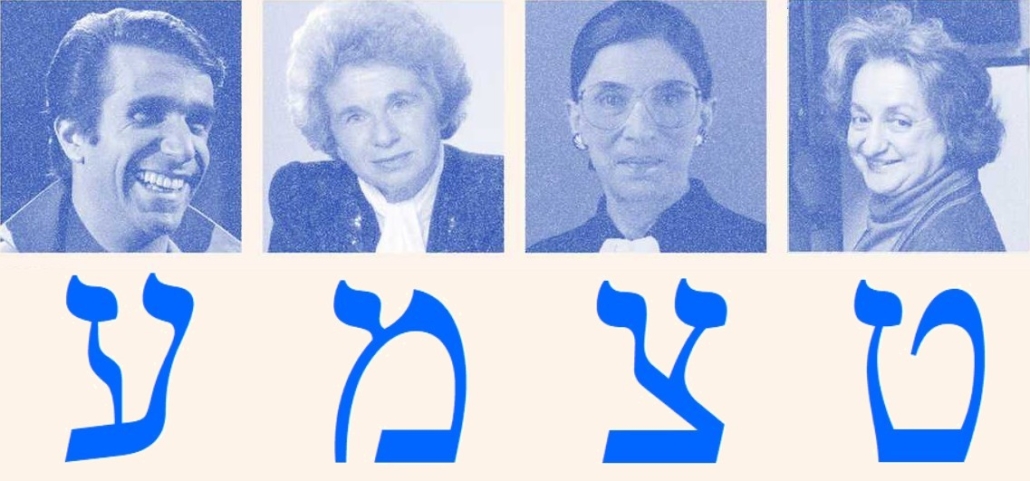 Ugly Jewish faces and ugly Jewish letters
There might be a Catch-Twenty-Jew there: if Jews hadn’t had so much power and influence, America might have remained the Golden Land for Jews. Yiddish helped Jews win power, because it concealed their arrogance and sense of ownership over America. But the opacity of Yiddish isn’t the only thing that strikes me about that image from the Atlantic. I’m also struck by a parallel between the Hebrew letters and the Jewish faces — in particular, the four faces in blue at the bottom. Running left to right, they’re the faces of the actor Henry Winkler, the sexologist Dr Ruth Westheimer, the jurist Ruth Bader Ginsberg, and the feminist Betty Friedan. What do the faces and the letters have in common? Simple: their ugliness and ill-proportion. I think Hebrew has an ugly alphabet, particularly when you compare it to the alphabet used for Hebrew’s fellow Semitic language of Arabic:
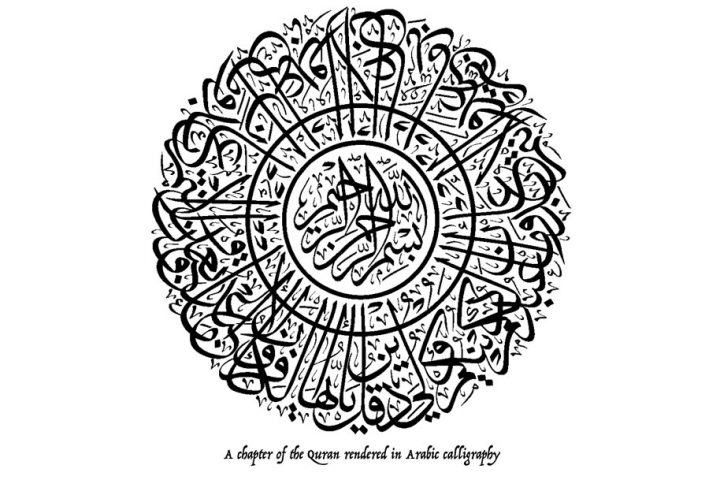 Some splendid circular script for a chapter of the Koran (image from the Claremont Review of Books)
The Hebrew and Arabic alphabets have the same origin, but the Arabic alphabet has evolved much further. In particular, it’s evolved to be beautiful. That pursuit of beauty was a conscious, characteristic choice made by Muslims that was never made by Jews. I think there’s the same aesthetic gulf between the Arabic and Hebrew alphabets as there is between the two most famous exemplars of Muslim and Jewish architecture. Just compare the Taj Mahal with the Wailing Wall:
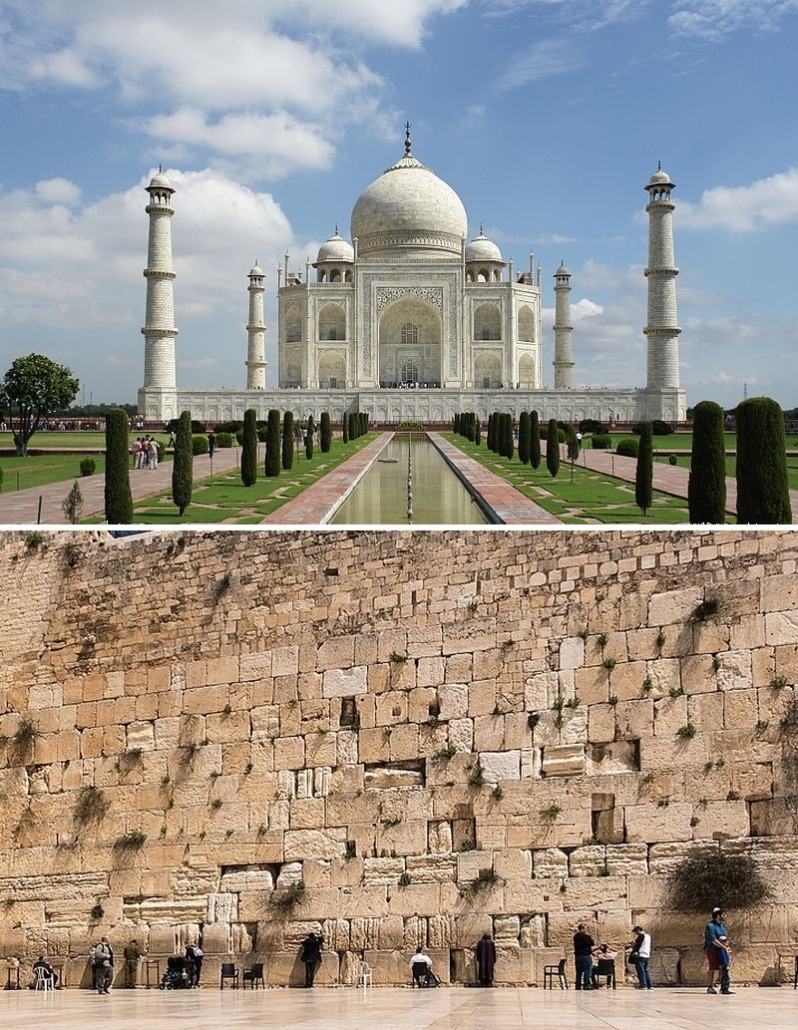 Muslim architecture vs Jewish architecture: the Taj Mahal and the Wailing Wall (images from Wikipedia)
But I won’t just hate on Hebrew: I’ll rebuke Roman too. I wish the standard Roman alphabet had some of the grace and grandeur of the Arabic alphabet, which brings beauty to the banalest labels and splendor to the simplest signs. Then again, without the Roman alphabet, which is much easier to learn and much easier to mechanize, Europe might not have risen so far and so fast. Perhaps the solution would be for us to imitate the Dwarves in Tolkien’s Lord of the Rings. They had an exoteric language and an esoteric language. That is, they used a lingua franca for speaking with outsiders but guarded a private language for themselves, unknown and untaught to outsiders.[4]
So perhaps each nation of Europe should have Roman as its exoteric alphabet whilst guarding an esoteric alphabet of its own. Or esoteric alphabets: cities and towns could have them, even single streets or single families within cities and towns. It would enhance identities, aestheticize the everyday and allow us to savor a myriad new flavors. But even if English acquired esoteric alphabets I’d like our exoteric alphabet to be thorn again. Roman should be refreshed with runic, so ðat letters like æš þrill ðe þouȝts of Ƿestmen aᵹain.[5]
[1] In fact, the story of wynn and “w” is more complicated: wynn replaced an original vv for the sound /w/ in Old English, then vv was used again.
[2] “Then” starts with a voiced dental fricative and would be written as ðen; “think” starts with an unvoiced dental fricative and would be written as Þink. In Old English those two dental sounds weren’t heard as distinct, but the two distinct letters were ready for them to become so.
[3] Communism didn’t succeed in imposing the Cyrillic alphabet on Georgian and Armenian as it did on languages like Uzbek and Tajik, which had previously used the Arabic alphabet.
[4] This use of public and private languages is another way in which Tolkien’s Dwarves resembled Jews.
[5] The adapted part of the sentence reads “…so that letters like ash re-thrill the thoughts of Westmen again.” Note “æš” for “ash”: I think the digraph sh should become a single letter too. I’d also distinguish ðat the conjunction (“so ðat…”, so that) from ðæt the demonstrative (“ðæt cæt,” that cat).




.jpeg)

Interesting, makes a lot of sense.
I read a year or so ago, Twitter stopped auto translation of Hebrew, bc the murderous posts by IDF and israeli officials we waking people up- things never change, eh
“Jews also chose to use the Hebrew alphabet for the new language of Yiddish, which is a Judaified dialect of German. In other words, they put up a linguistic wall to keep gentiles out. Spoken Yiddish can often be easily understood by German-speaking gentiles. ”
This is very interesting. The VOC seems to have kept two sets of books. 1 in Duh-tch and 1 in Yiddish. Crypsis seems to be highly valued by jews.
great article but how do i implement the reestablishment of these english characters?
Readers who want to follow up this subject without worrying about Mr Langdon’s opinion of “the Jew face” should get a copy of the final edition of “Sign, Symbol & Script” by the (previously NS) philologist Professor Hans Jensen, an objective, scholarly and beautifully illustrated study.
What puzzles me is the sharp difference between Welsh words and those of other I-E languages like English, French, German, Danish, Spanish, Latin, etc.
https://occidentaldissent.com/2026/05/21/donald-trump-boasts-about-his-99-approval-rating-in-israel/#comment-3755817