
1975 – The Mosley Remigration Interview on Thames TV
Back in 1975, they didn’t say “Remigration,” but “Repatriation.” For today’s viewer, this is perhaps the only interesting point that saves an otherwise rather lackluster video: even fifty years ago, people were talking about remigration, about return, and about encouraging return. And the exact opposite happened; migration flows to Western countries increased, as did miscegenation.
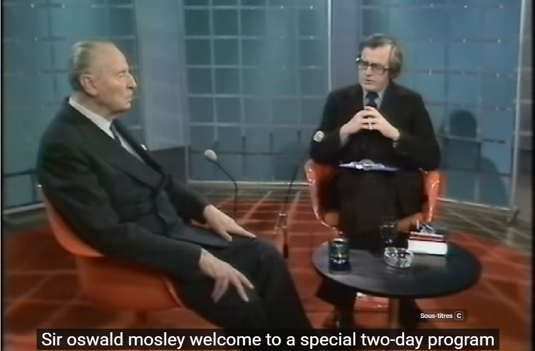 Sir Oswald Mosley, guest on Thames TV for a special program in 1975. https://www.youtube.com/watch?v=HNhF28fzN9I
Even back then, in 1975, Oswald Mosley explained that this “repatriation” had become a monumental task, given the sheer size of the immigrant population in Britain. It had reached such a point that, in his view, action was needed at the European level, leveraging the power and solidarity of the continent’s nations, for which —incredible as it may seem coming from a nationalist—he advocated a transnational government.
At almost 80 years old, Oswald Mosley still saw himself as a providential man who would be called upon by the country to face the imminent racial crisis. He acknowledged that, while he had withdrawn from English political life, this was to better prepare his mission at the European and international level: he spoke, he said, four languages and met more foreigners than any other English politician.
Today, we wonder how Mosley could have agreed to engage in such a charade. He was forced to say that he was not anti-Semitic—not on his life—that he was not so racist, that he abhorred force, that he was not a Hitler’s admirer, that he did not consider himself a hero. All this to fit into a pure marketing product of British entertainment television which aimed only to give viewers the thrill of history on the cheap.
A thrill from English history, of which we are the custodians in France.
Imagine that Mosley, who had married Diana Mitford in Germany at Goebbels’s place, lived after the war and until his death in France, in Orsay (91400), rue du Bocage, in a beautiful property called “Temple of Glory”, erected by general Jean Victor Marie Moreau, following his victory at Hohenlinden, on December 3, 1800.
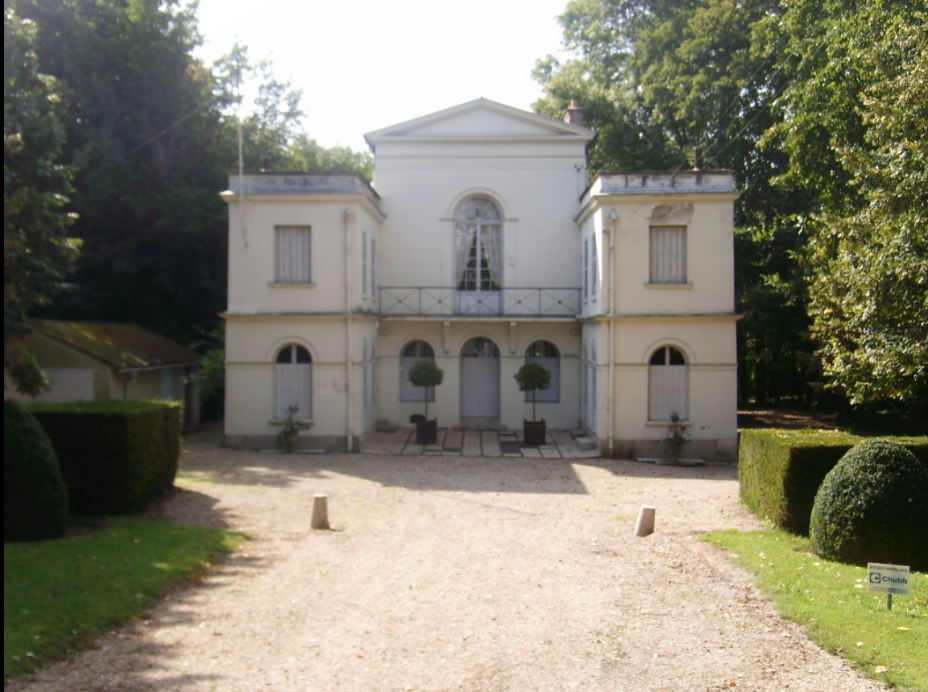 The “Temple of Glory” in Orsay became the Moslay family’s home after the war. He and his wife discovered it in December 1950.
Imagine, too, that the Mosleys thus lived just seven or eight kilometers from another prominent British exile, the deposed King Edward VIII of England, who, like Mosley, was a notorious Nazi sympathizer. The property, called Moulin de la Tuilerie, is located in Gif-sur-Yvette (91190), on Impasse de la Tuilerie.
 A visit to the Moulin de la Tuilerie, the property of Edward VIII in 1952, on the banks of the Mértaise. A tour around Le Moulin de la Tuilerie – YouTube
And imagine, finally, that the author of these lines lives 17 km from the Temple of Glory and 13 km from the Tuilerie Mill. The walk to the Tuilerie is very pleasant. The Temple of Glory, on the other hand, is not easy to reach coming from the west because there’s a motorway to cross: even though Mosley’s property seems peaceful and secluded, in reality, the motorway access is only a few hundred meters away… the modern world.
For this reason, and to re-establish some sort of mental contact, both with Edward VIII and with Oswald Mosley, we provide below the transcript of Mosley’s video (thank you to readers for pointing out errors and filling in missing parts, we know there are some).
We counted 20 “against” statements, roughly one per minute of Mosley’s speaking time. But to make history, one must not be “against,” one must be “in favor of”: this is how the poor man waited his whole life for a call from history that would never come.
(By the way, in 1955, he was also « against » the repatriation scheme, he preferred to stop new arrivals. In 1975, of course, he changed his mind: the population of the new incomer has considerably inflated since 1955).
Francis Goumain
Video transcript.
§§§§§§§
Sir Oswald Moslley, welcome to a special Today programme.
When I say welcome, you know and I know, that throughout London a great many Jewish viewers will not welcome your presence on this programme.
Why should any Jewish person now watch you and listen to you?
Well, if they were, some of them have abused me so much. They might be interested to see why.
But in fact, there are many great misunderstandings in politics. Now, let us be absolutely clear about this question.
I was never anti-semitic and I’ll define anti-semitic. By that I mean someone who attacks Jews on account of race or on account of religion.
I had a quarrel, not with all Jews, but with some Jews, about one subject: whether there should be a Second World War or not.
Now coming back from the First World War, after that time in the air and in the trenches and in the loss of all my friends, I was very strongly against another war. And it seemed to me rightly or wrongly, that’s a question we could debate, that certain Jews were trying to provoke a second world war because their compatriots or co-religionists were, admittedly, having a very bad time in Germany. Now, I do not think that a minority in this country should pursue a policy contrary to the national interest, which can end, in fact which did, in the loss of 50 million lives.
That gave rise to a very bitter quarrel of the period in which harsh things were said and harsh things done, that they attacked our meetings.
But I was not before that, and I have not been since, or even at the time, anti-semitic. Because not all Jews were involved but only some.
Sir Oswald, your answer, as you well know, begs so many questions that I have to put to you…
Well, which ones?
I’ll come to those in a moment. But let me stay with « not anti-semitic », not anti-semitic to refer to Hitler as the sweepings of the ghetto?
Well, the people who just came in, it is very rough these meetings, then shouting every insult, every abuse at the speaker. And he sees that they have just come in from Central Europe, and from totally different conditions to break up another meeting gives them a rough answer. I might have said that to any foreigners who came in to try and break up an English meeting.
Of course, it was rough. People don’t understand now in those great mass meetings in which some people were trying to break up and the speaker had to hold his own, and if you saw that they’d come from another country to break up an English meeting you gave them a rough answer.
Now you say that your argument with them was that you wish to prevent a second world war.
Certainly.
Would not your argument have been better addressed to Hitler?
The argument that there was not a second world war?
Yes, to prevent a second world war. If you wanted to have an argument with someone, would not the argument be better addressed to Hitler rather than the Jews?
Well, Hitler was driving east. I, my policy and my party, that’s a totally different thing. Fascism in every country was a strongly national movement. Therefore ours was totally different in its form, policy, and method.
I had wanted to conduct further and better a great Commonwealth of Nations, had to have a multiracial policy. He wanted to unite the Germans in Eastern Europe, and I did not want to intervene in a world war to stop him from doing it. I thought a war between Germany and Russia was better than a war between Germany and Britain. That gave rise to the quarrel.
Sir Oswald, do you now, looking back with the hindsight and knowledge of history, blame the Jews or Hitler for the Second World War?
I blame both. I blame both in that Hitler was impatient; he wanted to drive East, unite his own people, and when we signed the guarantee with Poland…
So rather like blaming the victim of a rapist for the rape, isn’t it?
Well, no, wait a minute, let us look at it clearly. While Hitler was driving east to unite his own people, we gave a guarantee to Poland which we could only implement by a world war. In fact, we couldn’t save Poland. We didn’t. It’s like signing a bouncing cheque.
Well now the agitation to make us do those ridiculous things like guaranteeing Poland and the other side of Europe was largely due to the influence of some Jews. Therefore, I say that both were responsible. Hitler for driving East before he had gotten a diplomatic arrangement with us, Jews for gradually persuading us, or the British people or government to do absurd things which were bound to result in war. All those people made tremendous mistakes. I was against both mistakes. I’m against the persecution of Jews or any other minority; I’m also against giving guarantees which [that] you cannot honor. That’s what caused the world war.
When did your conversion to be against the persecution of Jews begin?
Well, I never wanted to persecute Jews myself. I simply defended my meetings from Jewish attacks. Take the Olympia meeting. They marched two miles from East London. Afterwards, East London swung over to me. But at that time it was against.
What was it like?
I tell you exactly what it was like. I went along to make a speech to an enormous audience, a record audience opening the great Olympia hall. People who had marched from East London entered the hall in order to break it up. I had 1500 stewards in the black shirt, so they could recognize each other; that’s why, in order to stop them from doing it.The fighting was then very protracted, inside my meeting, I wasn’t going to break up my own meeting. They were doing that. Then the cinema lights, which were there in great force, were swung off the platform onto the audience, where the fights were occurring, and some people, very foolishly, said that I wanted that to happen.
Well, I’ve never known yet a speaker who wanted the searchlight turned off himself and on to other people. And that was done by the cinema lights naturally.
If I then had intervened by force, to ask my people to swivel the lights back on to me, what an outrage it would be. Supposing lights were then turned off me now onto something else and I had people around me who went and turned them back on to me, you’d rightly think it an outrage. And that was done by the cinema companies who wanted a story. It wasn’t done by me.
Quite and you’ve described what was happening in there. But what I’m actually asking you is how you felt addressing what was by any standards a huge rally. Did you then feel that the millennium had come and that power was yours for taking?
Oh good heavens, no. It took me, I’ve spoken all over the country for seven years. I spoke at enormous meetings, far the greatest ever held in this country, and three years later after that I addressed an audience twice as big, no four or five years later, in 1939, twice as big exhibition hall at Earls Court, never been filled for a meeting on any other occasion and that meeting was absolutely orderly, immensely enthusiastic, because the attempt to break up our meeting had been defeated. Force was used against us and we used force in return. I hate force. I had more than enough, of course, for the fighting in air and trench in the first war. Then when my meetings were attacked, I either had to close down or defend them, and I organized their defense and we won. We had orderly meetings and that was our whole offense.
Do you really hate force, Sir Oswald? Or do you not in fact have a hankering, as a man of action, for the quick result that force can achieve.
Oh no, no, no. All that nonsense was knocked out of my generation in the First World War. I was flying against the Germans in 1914 to 1915 when the average life was three months. All my friends were killed. I was later in the trench of my own regiment. With my whole generation, well practically my whole generation was wiped out. A man who’s been through the first war had a real hatred of war and of violence.
But then, if you found a political movement and come out of politics with a certain praise of what you thought about and what you’ve done and you try to go on, talking to the same audience as you have before, and people with armed force come to break it up, what do you do? Blow them a kiss and say “Goodnight, I’m retiring from politics”, or say “you are not going to do this, I’m going to defend my meetings.” I stood firm and defended them.
But does not violence attract violence?
Precisely, they used violence against us and we had to use violence in return. But I don’t like it. I hate it.
Do you have in you, however, Sir Oswald, a concept of the hero?
Of the hero?
Yes
Well, I think that an element of the heroic is necessary to all great nations. Britain was founded, the British Empire and everything else that we have, was founded by heroism. Men who went out to the far corners of the world and did heroic things. But it should be constructive heroism in the service of great people, in the service of humanity.
People who have done marvels in medicine and in science and that sort of thing are equally heroic. It’s not simply a military virtue. That I think an element of heroism is what is perhaps lacking today, but I’m convinced the British people are still capable of it and in a great crisis can show heroic qualities, which should be evoked.
Who are your heroes?
In History? In our history, the great Chatham. They kept him out of politics, out of power all his life. They gave him four years toward the end of it, and he gave them in return everything they’ve got. Immediately performed that service, they got rid of him again and any man of action who does anything for our people or any people for that matter, he’s well-advised when he’s done, he stops, he’s performed his great service to go into retirement when he’s done it.
Chatham was one example but there are many others. In British history I also give a great part to Marlborough, the original Churchill, who was a great, two great men, Marlborough and his descendant Winston. Extreme opposite of character in every respect, and Marlborough and Chatham, I would put with the two great Latins: Julius Caesar and Napoleon, and with the two great, two great Teutons, the Hohenstaufen and the Hohenzollern Frederick’s, and I should give those six men as the examples of supreme men of action in history.
And when sometimes I’m accused of having modeled myself on this man or that and all sorts of stuff, my simple reply is when I, going in for action, study the great models, if you are going to play tennis, then study the champions at Wimbledon, study their strokes. See how they do it and I did study all those, that kind of person, and it’s very essential to do it. That doesn’t mean you identify yourself with them. It merely means that you learn from great performers how to do certain things.
I did interest of course that you can choose Chatham who, as you say, was kept out of political life nearly all his life and then drawn back. In a shorter interview that we did recently, you gave me the impression that you still believe the call might come for you. Do you really believe that?
Oh yes, I’m much better now than I’ve ever been in my life; I’ve still got…
Better at what Sir?
Better at politics. That is I’ve got health and vigour, every capacity I ever had, and added to it, a vast experience and, I hope, more wisdom than when I was young. At least that seems to be the impression of a good many people. Therefore, while you have the health and strength, you go on improving. Experience, and wisdom which comes with age, is a splendid thing. Of course when you get past it all, and the physical is feeble and the rest of it, then it is over, and any man of any sense recognizes it.
Happily history abounds in cases of men who went on ten or fifteen years older than I am now and did extraordinary things. Therefore, I found that I feel that my whole life has been a training for what can now come. And if I was wanted to perform any part – I don’t care what – I would gladly do anything I could for this country.
But who on earth would ask you?
Well, they only ask people when it’s necessary. When that man alone has the experience and the proved capacity and willpower to meet a difficult and desperate situation. Anyhow, my life has proved a certain willpower, and a certain capacity to endure and come through supreme difficulties. Which are exactly what this nation will be faced with very shortly.
The Poet Yeats said «Why should not old men be mad?». Isn’t it a form of madness to believe at 78 that the country will call you?
No, because countries have called back men much older than me with great advantage, and things have been done in other spheres of literature, of art, of philosophy as well by very old men. The only one of two questions are: does the situation require such a man? Is he still capable of doing something effective? Those are the two questions which our audience and the British people are perfectly capable of judging for themselves. That I have not yet seen anybody else in the present situation who can meet the crisis which is coming.
So what would your nation be like then? What would your Britain be like?
I’ll tell you exactly what I should propose. I think in a crisis, you should have a government drawn from the whole country. I don’t mean just a coalition of parties which have failed – that will probably happen like it did with Baldwin and McDonald before.
Would it include Jews?
If they are any good, yes. I know there’s certainly one or two of them who are absolutely first-rate, particularly in science and so on. Now what I propose is a government drawn from the whole country at a certain point, from politics the best, certainly from business, from some of the younger trade unionists who certainly would be available I think, from the universities. From the fighting services I should certainly include as well, because in a very dangerous situation you want a few members of my original profession, the professional army, because men that are trained to danger, in that situation, are very valuable.
And such a government, elected by the people at a general election entirely democratically informed, subject to dismissal any day by the consequent Parliament if they abuse power, but given the power to act while they are there, just as the Board of Directors is given the power to act by the shareholders and sacked if they don’t do the job properly. I think that it is the modern form of government entirely democratic, combining the two essential things: the power to act with individual liberty, which must be scrupulously preserved.
No suspending of the Habeas Corpus Act. With all those outrages from which I suffered myself. Habeas Corpus Act. Personal liberty, always there in this country till it’s needed. The moment of crisis they scrap it and put people in jail, without trial. Absolutely wrong. Give a government power to act, certainly, dismiss it if it doesn’t do the job and preserve with cost…
How do we dismiss it out there; there would still be elections?
Oh certainly, exactly as today that any party might enter the election and that the people should choose. But if they give a party, or a newly constituted government, or a proposed government, if they give it power, that there is a parliamentary majority, that majority should give it the power to act and should sack them if they don’t act properly. We have little until the people vote for them, the question doesn’t arrive.
We have a substantial black, brown, and colored population in this country now. Would they be represented in your government?
They’d have a vote in every constituency
They’d be in your government?
If any of them was a first-rate man, he certainly would be, yes.
What’s a first-rate man, Sir?
First-rate man: approved capacity in any sphere. Scientists and people like that who had nothing whatever to do with politics would certainly be included in the kind of government I suggest. The politicians would be a minority. And if some black, or some Asian had proved himself in some sphere as an outstanding man, he’d obviously be a most welcomed member of any government that was formed
If he hadn’t been sent home under your repatriation scheme.
Well, repatriation, now. That is, I was against, of course, and that was quite often discussed at the time, against another coming here. That is I took a stand way back in 55. I fought an election on the subject in 59, the very strange and dubious election, and I stood for that policy, I think several years before Mr Powell ever thought of such a thing while he is Minister of Health and introducing colored nurses into the hospital service. Then I was strongly against the scheme from the start when it was perfectly easy to stop it.
But now that we’ve got anything, well figures are very much disputed, but we have a very large number here, it’s a much bigger operation to secure any repatriation. And it can only be done in a humane and a decent way. And I think that means the whole of Europe facing the problem together and enabling conditions in their homelands to which they will wish to return. I think it’s possible to solve that problem in a decent and humane way, but it is miserably more difficult than it was in 1955 when I first stated publicly that immigration of that kind should be stopped.
This seems to me the thing that has bedeviled you all your life
Yeah
That you put forward in advance ideas, obviously in the 1930s, major economic ideas that might have – probably should have been taken up. But all this shall be deviled by this desire to find a scapegoat which will rally people around you in the thirties, the Jews, in the 50s and the 60s and the 70s, the blacks, who next?
No well, the answer is, I think, very plain and simple. I was against certain Jews, not all Jews, because they were agitating for war. I was against the import of a completely different alien population which would bedevil all our civilization and has done it, but that is the only form of prejudice of that kind which can ever be charged against me. For instance, as the Times reported recently in a long article, a study of that period, I stood against the persecution of the Irish, having had to fight them as a professional soldier at the end of the first war. I strongly opposed the treatment of them by the Blacks and Tans, and I was appraised in my early life for my humane treatment of such people. I stand against atrocity and bullying and I still feel the same today. I am passionately against any ill treatment of prisoners or the underdog.
But in those two cases, it was necessary to take action against a minority who was agitating for war or against the import of another population, in an overcrowded island, which has done us immeasurable harm. But we cannot deal with it brutally and inhumanly; we’ve got to deal with it – if we deal – on a great scale with the whole of Europe, making arrangements for a fair return of people to their native lands, and that means an enormous enterprise because there’s got to be conditions to which they wish to return.
When you say, and when you think about this call, that will come, why should the call come? What is wrong with the political leaders now?
Well, I tell you exactly what is wrong. They’re running into a supreme crisis because they failed to solve all the main problems. But now what is the main problem? The main problem is the failure to adjust consumption to production. That is in plain language, to give the mass of the people the power to consume the goods the mass of the people produce.
Not an insoluble problem, it’s a matter of creating conditions in which it can be done. Now before the war, in my early days in politics, we had deflation, which was a disaster, and some people are proposing it again. They’re dressing it up in another new jargon. It’s exactly the same policy we saw applied before. All this Keith Joseph policy of deflating and the rest of it, means doing what we did in the forties, the creation of enormous unemployment.
Now in an effort to escape from that, they’ve had the countrary: inflation. What you want is a perfectly stable price level with production matched by consumption, and that means two things: a viable area, and within that area, a government given the power to act.
I know days in my youth in politics, we had the British Commonwealth, that is a viable area and if government had had the will ready to act, we could have solved the problem there. That was thrown away in the Second War. I’m greatly denounced for opposing the Second War, but it lost us everything.
And after the war, I said we must go right into Europe. There’s another valuable area, and if you have the whole of Europe, and a government capable of running the whole of Europe, central government for the main subjects, national governments of the next level, exactly like we got today, and regional governments, Scotland, Wales, possibly even Yorkshire and Lancashire, with a great devolution; you can solve the problem.
If you are insulated from the chaos of world markets and world finance, a viable area and the power to act, those are the two things which are necessary in this. Endless details could be added but in broad outline, that is what has to be done, and you need a government with the will to act within an area where action is possible.
Don’t you understand, Sir Oswald, that what is tied to this will to act is that people can see and accept the will to act, but what they are also afraid of are the consequences of the man of action, and they look at Europe and they look at other countries which have chosen men of action, some of the left, some of the right, and they see where that ends, and maybe they say our nice little model is rather better than what men of action give us.
You are absolutely right, you’ll put your finger on the whole complex and a number of intellectuals say are making these points very fairly the other day, I said well what you’re saying that any man who’s any damn good is always dangerous, you see.
Well now that is the question, is it possible they have men who are capable of great action who are not madmen, who are sane and who are constructive. That is you have a load of manure which has to be shifted, and you have a strong elephant capable of doing the job for you. Can you be assured that instead of doing the job, he doesn’t run amok and run berserk. Now that the people have got to make up their mind about it, sooner or later. In ordinary times, and I quite see why, they say no. They’re strong people and strong action is not necessary, and it is dangerous. But when things go wrong, it’s a bigger risk to let the muddle go to a disaster, then they have a man of action, and in those days, I think they will turn to action. I never blame the people, as some of my friends do, for not being ready to take action when the crisis is becoming perfectly obvious, when everybody in the know is aware that there is a crisis, and the people are still perfectly content.
Now I say an answer to that: if I read the journals and newspapers in four languages, try to read books in four languages as well, if I travel continuously over Europe, America and everywhere else, seeing every sort of person, far more than any other English politician has ever seen or done, of that so, I can just, working the whole time, keep abreast of events. How on earth can a chap coming out of a factory, or coming out of an office, having a drink at the local on the way home, keep abreast with events. And when they say never had it so good, and when wages are going up faster than prices, how can they know what is happening? The question is, when things go wrong, when they wake up, when we see England awake instead of asleep, will they or will they not then want men of action. Well, they do want men of action that have certain proposals to make to them.
Who would you have around you now? If you had to, if you walked into power and you were asked to form this government of men of action of a met of talents. Who would you have around you?
I deliberately now have no one around me at all in that area. To be precise, in 1966, I finally severed myself from all parties, from all connections, so I could speak in this country.
Who would be your cabinet?
Well, the first step is to see why I separated myself, which was that I didn’t want to avoid the charge, or wanting through an organized party to impose myself, or through a clique or through intrigue or anything else, what I do is…
Another reason might be that only two thousand dot people voted for you in Nothing Hill gates, of course.
Well, 8% of the electorate voted for me, which is more than the difference between the parties. It was a very curious election, a long story could be told,
It was hardly a famous victory; what I’m saying, what I’m suggesting to you, is that you have been rejected by the people when it came to polls. But what you are now saying is that you would form this government or talents; what I’m trying to find out, is who would you actually have in that government among our contemporary politicians and contemporary talents?
Yeah, and let’s deal with the two points, low votes, I’ve had not more than eight percent since the war, perfectly true, but I could give you many examples from recent history of people polling far, far less than that, who were in power very few years later. Because great country people, quite rightly, it’s sensible, don’t want drastic things to be done before it’s necessary.
Now coming to your second point, which is easy.This is very sound; who would you put into a government of that sort? Well, now you would look around you, if you were what anyone who was charged with tasks, for the man who has most succeeded in their particular line of business. Particularly men like scientists of all kinds, particularly men who have succeeded in business there, and reasonable trade union leaders particularly among the younger man, and in fact in every sphere there are outstanding people who never fail in public…
Sorry, can you think of the reasonable trade union leader whom we might include?
But I can think of that; I expect that they will promptly be turned out of the trade union if I mention their name. I know among the younger men quite a lot who I will call highly reasonable and ready for action. And in fact I’ve seen trade union leaders on television with you, who I don’t think would be unreasonable in a situation of great crisis. They know when everything is easy and going relatively smoothly, they want, and it’s their job, to get as much as they can for their members. But the moment things go wrong, those men will be looking for some way out. If the house is on fire, as a trade unionist, a young man…
Sorry we are in the last two minutes, believe it or not. Isn’t it in fact a reflection on a political figure, a man who is devoted to politics, that the only way he can conceive of coming to power or achieving his aims and ends is through a crisis, is through a breakdown in the system as it stands
Well, no if he’s always foreseen that a crisis was inevitable. After all, it has been admitted, very generously, by opponents that I could have been Prime Minister in either of the two main parties. But I could not do what the country wanted done with their policies and with their personnel; therefore, it was inevitable to act in view of the approaching crisis in a different way, which I have done, and my whole life has been a training for that crisis, which I am certain will arrive, but other people think will not.
Has your whole life not also been a failure?
Well, the whole of my life has been a failure if the premise on which I based it, our crisis, does not occur; even then, I have had some thoughts to offer to my country in the world, some of which have been accepted. But I agree with you that I’ve never been given a great part in action; then being a man of action, my life would have been a failure.
So you don’t get it; you failed,
If I don’t get that in my terms, as a man of action, I should have failed
Sir Oswald, thank you very much indeed.




Just as jews have reduced the dialog to “are you an antisemite?” we need to redistill this into “are you a Zionist?”. Do you support Levantine Genocide for the benefit of jews? Do you support Israeli interests over western values? Are you an Israeli citizen?
Na.tional Zi.onism makes up NaZi
Sorry A.H. very bad joke… but still a joke
Fun Fact: The National Socialists didn’t like the shorthand term “Nazi” for their party and movement. So NAtional ZIonists it is.
It was a sort of shorthand term of abuse from the start – coined by a Social Democrat. The National Socialists returned with Sozis! (Social Democrats); it’s not that they did not like it; they just never referred to themselves as anything other than National Socialists. And 95 years later it remains a universal term of abuse one of the conveniences of which is that it conceals that that NSDAP were, in fact, Socialists of some flavor and socialism is a good-think word (no Nazis allowed!).
In the early years of the 20th century, “Socialist” was a sort of Good Housekeeping Seal Of Approval for political parties. Kind of like how the US/ZOG puts “Freedumb” on things.
It meant progressivism, real progressivism not the white-suicide ZOG version we understand it to be now. No racial quotas no mass importations of nonwhites etc. It meant pensions and free education and things like Hitler’s program of “Winterhilfe” or “Winter Help” which was a program to make sure older people didn’t freeze and/or starve to death over winters, a thing the Weimar regime was apparently OK with.
But yes, National Socialists, NSDAP, perhaps NSAAP in the US, or NS as in, “Vote NS” is the proper way to make reference to the thing. NaZi will always mean National Zionism, the ZOG or Zionist Occupation Government, we’re suffering under now, heading into the future. Time to call a NaZi and NaZi.
All: Please steal my ideas!
I’d rather think that Nazi was coined by a Jew, since “Nazi” is very close to “Nazir”, hebrew: נֶזֶר, –> I let you skim through Google.
The interviewer is Llew Gardener; he is quite smart, we must admit.
You would think he would be familiar with the hostile interview format,
1. Start out putting you in a corner, forcing the statement ‘not all jews’
2. Once you’ve compromised yourself, then they make you look like a crackpot.
3. And the last question is always a ‘gotcha,’ and it wasn’t even a question ‘you’ve failed in life’
Sad he fell for it
I read this carefully and being acquainted with Mosley’s writings and speeches, and the books by his opponents (Thurlow and Pugh are best), and aware of the lies and mistakes made about him online, I can confirm that this transcript is accurate, though I never saw it on television.
His post-WW2 policy was for Britain to lead, not hide from like Powell and Farage, an economic and political union of western Europe, South Africa and Rhodesia, plus the antipodean Dominions, self-contained in supplies and markets, as a third force between the Kremlin commissars and the Wall Steet bankers. This would have strengthened white civilization at its heartland, rejecting Global South mass-immigration, Islamic jihadism and Chinese imperialism, opposing universal multiracial mess but with a friendly attitude to other races.
He had some private admirers after he “withdrew from party warfare”, ranging from Cecil King and Colin Wilson to Dominic Purcell and Kenneth Williams. The historian A. J. P. Taylor described him as a “superb political thinker”.
When he originally resigned from government as Labour minister, he said that what he feared most was not another massive slump but a “slow crumbling down the years”, which is what happened, the political racketeers moving from miserable dole to military death and now to multi-million debt. Mosley cannot be faulted for what his opponents have done to the British people, but hopefully his courageous example and some of his remaining ideas can rescue us at the eleventh hour.
Your words represent the building-blocks of actual-history. So Nice!
https://www.politico.eu/article/eu-watchdog-moves-ban-afd-far-right-party-over-breach-eu-values/
Mosley’s “UE” was radically different from the present “EU”. His “National Party of Europe”, started with German, Italian and Belgian signatories, lacked funds. Some of his latter-year comments are videoed online.
Sir Oswald will *not* be forgotten, and will be studied in the future when the parasites are long forgotten.
In the USA, Senator Pat McCarran’s speech of March 2, 1953 is worth remembering:
“I believe that this nation is the last hope of Western civilization and if this oasis of the
world shall be overrun, perverted, contaminated or destroyed, then the last flickering
light of humanity will be extinguished. I take no issue with those who would praise the
contributions which have been made to our society by people of many races, of varied
creeds and colors. … However, we have in the United States today hard-core,
indigestible blocs which have not become integrated into the American way of life, but
which, on the contrary are its deadly enemies. Today, as never before, untold millions
are storming our gates for admission and those gates are cracking under the strain. The
solution of the problems of Europe and Asia will not come through a transplanting of
those problems en masse to the United States. … I do not intend to become prophetic,
but if the enemies of this legislation succeed in riddling it to pieces, or in amending it
beyond recognition, they will have contributed more to promote this nation’s downfall
than any other group since we achieved our independence as a nation.”
Senator McCarran was right. And the problem won’t be solved until the US realized its more dire enemy is within, one whose “brand” is opening the gates of whatever nation they’re parasitizing to its enemies, then plundering their host, now fighting for its life, for every last shekel.
In the same way that in the process of evolution some animals lose their ability to synthesize Vitamin C or lost their immunity to various pathogens, I believe the US, in its rather chaotic formation, lost the natural immune response to the parasite, Judaism. History is full of examples, over thousands of years, of nations defending themselves against this parasite and at least cutting its harmful actions way back if not eliminating it.
The US, like a New Zealand parrot that has no fear of snakes, let Jews in from the start and even our Founding Fathers* told them, “Come on in, the water’s fine!”. These were otherwise very intelligent men. The Jewish pathogen bided its time over the centuries and new we’re seeing the end stage. US whites (and anyone else who stands in the Chosenites’ way) are to be used, abused, consumed, enslaved, etc. because to the parasite, they’re mere fodder.
*Ben Franklin seems to have been an exception. He wanted the “swarthy German” kept out, and anyone with eyes to see can see that he meant Jews coming in from Germany, speaking Yiddish which is just a pidgin German, and who are, in fact, swarthy compared to actual Germans. Another briefly flickering light was US Grant, I believe, who wanted Jews kept out of the South after the Civil War and that was not allowed to stand.
An addendum on Mosley.
The savage violence against him began quite early with his pre-fascist New Party; for example, razor gangs attacked a major meeting in Glasgow. The media-misrepresented weaponised Olympia violence was organised by Jewish Communists and these followed suit against UM meetings after WW2. In 1938 he predicted that either the system would begin to crash the following year or it would “escape into war”.
The independent journalist Beverley Nichols before the war described him as the “only man who has in him the qualities of that hero for whom this country has waited so long and in vain”.
He was particularly struck by his “personality”; and after the war this impression was also recorded in detail by others including the historian David Cannadine, the senior journalist W. F. Deedes and the Jungian psychologist Anthony Storr. The novelist Henry Williamson stuck by him after the war and he made a good friends in the Arabist Desmond Stewart and the Afrikaner Oswald Pirow.