
A Note on Jews and Feminism
My recent review of Janice Fiamengo’s The Goddess that Failed cited her summary of a study by four Israeli social psychologists of a personality trait they called “TIV,” or the Tendency for Interpersonal Victimhood. Fiamengo considered it valuable as a description of a kind of woman frequently met with in feminist circles, and I agree. I also noted in my review that the Israeli origin of the researchers might not be an accident: readers of this site are familiar with the salience of victimhood within the self-concept of many Jews. I did not explore this question in the review, because I wished to keep the focus on Prof. Fiamengo’s ideas, but will try to address it briefly here.
Here, as a reminder, is Fiamengo’s summary of the TIV type:
Passionate belief in one’s victimhood creates an identifiable personality type, one that ruminates on grievance and interprets all experiences through the victimhood lens. Belief in victimhood need have no correlation with actual experience of victimization. The victim personality is characterized above all by a strong need to have one’s suffering recognized. With this need comes a conviction of immaculate morality, a resulting inability to accept criticism or disagreement, and a profound lack of empathy for those perceived as enemies. The researchers also found that people with a victim personality believe themselves justified in taking revenge on those who appear to oppress them. Even when presented with facts and evidence to rebut their beliefs, they are unwilling to relinquish their worldview, which becomes intimately associated with their sense of self. Anger at others and the belief in innocent victimhood create a toxic stew of self-righteousness and moral blindness.
A look at the original paper by the Israeli psychologists (which can be read here) reveals that the ethnic angle did not escape the authors’ attention. They refer explicitly to the cult of the holocaust, and recognize that it can represent a moral hazard for their own people by way of the TIV personality. Good for them: we all know what epithet would have been assigned to any gentile researcher bold enough to make the same point.
Group differences are statistical, and the TIV personality presumably occurs at different rates in different races and ethnicities. It is likely to be elevated among Jews, although it would probably be futile to expect any objective research on this question in our current cultural and intellectual environment. But the TIV type can and does occur within other races.
Indeed, much group conflict over the past forty years has been aptly described as a “victimhood sweepstakes” wherein not only Jews and feminists but blacks, homosexuals, the handicapped, and other identity groups competitively jockey for moral authority by signaling their victimhood. The only group not allowed to participate in the sweepstakes—White, heterosexual, able-bodied men—are by now a distinct minority of the American population (possibly a third). So the increasing prominence of the personality type described by these Israeli researchers would seem to help explain many aspects of our historical moment, and not just feminism or Jewish-gentile conflict.
Anyone who writes against feminism as I do eventually encounters the thesis that it is all simply a product of Jewish subversion, often backed up with long lists of prominent Jewish second-wave feminists. Here is a popular graphic currently doing the rounds on the internet that embodies this thinking:
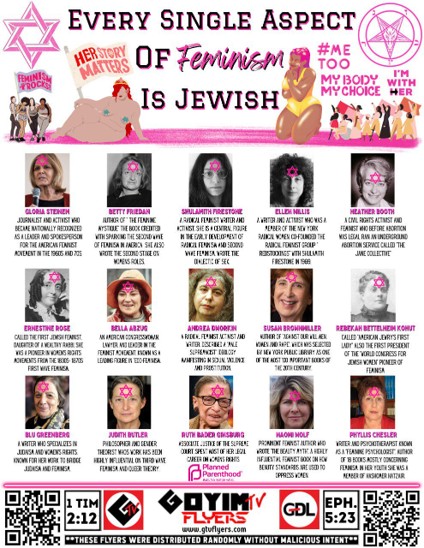
This view is historically myopic: it requires that one’s familiarity with feminism be limited to the American second wave, usually dated from 1963. But feminist ideas have been widely circulating in the West since the eighteenth century, and not only in the form of Mary Wollstonecraft’s celebrated tract. A review of long-forgotten German debates for and against the “emancipation of women” in the 1780s and -90s, for example, reveal that there is not much novel in twentieth century feminism (cf. Klaus Epstein’s The Genesis of German Conservatism pp. 229–236). Indeed, we have plentiful evidence that similar ideas were discussed in ancient Athens, as witness book 5 of Plato’s Republic and Aristophanes’ comedy The Assemblywomen. Western man did not need the Jews to invent feminism for us.
It remains true, however, that Jews have been massively overrepresented in second wave feminism—by far the most successful version, as they have been in other forms of twentieth-century radicalism, and this calls for explanation. A good place to start might be the work of the above-discussed Israeli psychologists on the Tendency for Interpersonal Victimhood. If Jews are indeed especially susceptible to this “toxic stew of self-righteousness and moral blindness,” it would explain much of their involvement in destructive movements such as feminism without our having to assume the existence of a conscious conspiracy to subvert alien races.




The Entitled Victim has been on the rise for many decades now. As Christianity fades away in the West, we still have the structure the Sacred Innocent Victim cult, with the TIV groups you mentioned, plus The Planet/Environment, replacing Christ in the role of suffering savior.
Years ago when I was involved with Jungians, it was a Jewish woman herself who talked about the victim-tyrant pattern, whereby victims, once recognized and empowered, engage in whatever tyranny they can attain, with the indestructible belief that no matter how powerful they actually become, they are Victims Eternal, granting them an inexhaustible supply of pure motivation, despite becoming the very thing they claim to suffer from.
Contemporary Jews are THE post child for this game. They are more secure, wealthy, influential and powerful than Solomon could ever have imagined and yet, as we know, they are always on the verge of another Holekost…..
Victims Rule!
It’s about damn time Christianity fades away in the West. The Abrahamic religions, the first of which is Judaism, is what gives us the idea that the earth is a thing to be used up, that Man is separate from Nature, etc. Christianity is a huge con-game that benefits the Jews.
“Their broader political commitments reinforce the pattern of Jewish activism that seeks to disrupt the mores and demographics of broader gentile society.” https://www.unz.com/jnino/the-jewish-matchmakers-who-reshaped-american-romance/
Das rite, and the vast majority of dating-app “failures” (who nevertheless parted with their money to the Jews) are already being targeted by the gigantic Jewish porn industry. Anyone who claims there’s any connection to anything here is anti-septic!
And to ensure no white children are born, Jews invented the “birth control pill” (which replaced the principle of responsibility with the pleasure principle—through whose lens even Freud “interpreted” the world).
And if something were to “go wrong” after all, there are always all those Jewish abortion clinics. The combination of a black man and a white woman is also promoted by advertising (which is also based on Bernays’ mechanisms) as the ideal couple.
Furthermore: according to Jewish “feminists,” white women are supposed to pursue “careers” and “free” themselves from “dependence” on white men, thereby removing themselves from the marriage market.
In addition, they thus serve as an economic factor for Jewish businessmen, who become even richer as a result. Alternatively, white “shiksas” can also serve as sex objects for Jewish pervert rings like Epstein’s.
The avarice of Jews is the factor in the porn industry, but it is a stretch to say that “they” invented the pill to exterminate the white race, even though Pincus was a Jew. Anyway, what do the stars tell us about this, Tim?
The pill has legitimate uses. But yeah, to the Jews, whites are “Amalek” and they are supposed to exterminate Amalek so …
1. It wasn’t just Pincus, but also Djerassi and Rosenkranz. To attribute “progressive intentions” to them—even though they prevented the conception of millions upon millions of white children—is the mark of “naive philosemitism”.
2. What “the stars tell you” is beyond my knowledge. They tell me nothing. (I have no idea who you’re always trying to include in the word “us” without asking.) Astrology can be used to describe character, not to “interpret destiny.”
“Wizardry” is not part of my expertise (most definitely not in “Zog”).
The Pill enables a woman to prevent unwanted children without abortion or to choose how many children she can have. That is its use. It does not sterilise them, so it is not an extermination tool. The Jews did not invent the condom, or perhaps they did, along with video games and fish-and-chips. Onan was out of them at the time.
More plausibly, the atom bomb as a Jewish invention (see Matthew Gindin, “Forward”, April 21, 2017). They beat “Uncle Adi” to it. So the Japs got it in the neck, instead of the Russians and British. Now the world faces not only Israel with the deadly things but 8 others, and more to come.
One could just as easily claim that the Jews did not invent the atomic bomb. And that everything they conceive is for the good of humanity. The exact opposite is true. Whether they do it “with malicious intent” or simply because it is in line with their inner (anti)nature is completely irrelevant. What matters is what “fruits” their tree bears in the evolution of humanity—that is, what effects their thoughts and actions produce.
Ultimately, everything can be justified and sold “in the name of humanism.” Incidentally, it was a Jew accompanying Columbus who brought the tobacco plant to Europe and thus contributed to its “cultivation.” Millions upon millions have died prematurely and/or become seriously ill as a result of smoking. Through his deceptive marketing methods, the Jew Bernays also enticed women en masse to smoke, suggesting it was something desirable.
One could also say that Levi Strauss meant no harm in adding rivets to a pair of blue-dyed cotton work pants, thereby ultimately supplanting the skirt and dress as expressions of femininity to a large extent. It’s no coincidence that feminists “wear the pants.” Bernard Lichtenstein (Wrangler) was also Jewish, just like Henry I. Siegel, the man behind “H.I.S.” jeans in Germany. Incidentally, it has been proven that wearing jeans makes men more impotent than they would otherwise be due to the tightness in the genital area (what a cohencidence!).
One could also say that Julius Fromm commercialized the rubber condom as “protection against sexually transmitted diseases.” In any case, the outcome was even fewer white children. The Catholic Church—which, at least since the Second Vatican Council, has been the willing servant of the Jews—continues to this day to oppose the distribution of the pill and condoms in sub-Saharan Africa, not even as protection against HIV and overpopulation. The so-called Pillenknick (“pill bend”) clearly shows a massive decline in white population growth following the introduction of the “pill” in the 1960s.
The Jew Jacques Heim developed the bikini; the Jew Rudi Gernreich then the “topless” monokini, popularized as “thong” in America by the Jews Calvin Klein and Barry K. Schwartz, and in the UK by Jew Michael Marks. Nail polish & lipstick were commercialized by Jews Revlon and Lauder and popularized by Jewess Sarah Bernhardt. The trick behind it was to psychologically deceive biology and, through this blood-red illusion, suggest to men that women past menopause were still “fertile.” The Nazis rejected these as lascivious, decadent, and unnatural. It’s no coincidence that the Jewish demoness Lilith is regarded as a symbol of feminism and “women’s lib”.
You are correct that the graphic is a little myopic, but you change the definition by moving the history back too far.
What are the definitions of the first, second, third, and fourth waves of feminism? Concensus seems to be that the first wave was the suffragettes, prohibitionists (or temperance advocates), and the war-mongers of the white-feather movement, whose leaders had been suffragettes.
The first major writer of the second wave was Simone de Bovine, or Beauvoir, certainly not jewish, but a collaborator with the German occupation government in France, yet strangely avoided having her head shaved and so on.
That is because her husband Sartre, identified with jews. Their marriage was very sleazy and perverse, she would often seduce younger women to deliver them to le boudoir du Sartre. However, she did write the original ‘second wave’ text, in English, ‘The Second Sex’.
Except for the omission of Helen Gurley Brown, the Hugh Hefner of second-wave feminism, and Germaine Greer, neither of whom, AFAIK, were jewish, the graphic is largely accurate on ‘second-wave’ feminism.
As for the ‘third wave’, Valerie Solanis, a jewess, along with a few in the graphic you posted, were leading figures. So, too were non-jewish fantasists like Mary Daly, really one of the most important figures. Unfortunately, supported to her death by a supposedly Catholic university in the U.S.A. The main theme of the third wave was female homosexuality.
As for the ‘fourth wave’, it seems to be the same as the third, but with opposition to male trannies in womyns spaces and sports (fair), and women chimping out and stripping off, as in anything from Pussy Riot to various ‘femen’ events, and many similar others.
Really, that seems much like some accounts/mythological memories from pre-classical Greece.
The Roman accounts of the ancient Germanic tribes are quite different, men and women were loyal to each other.
The Frankfurt School Long March to burn down Western Civ.
Feminism IS yet another form of jewish subversion. This is obvious to anyone who looks into it. In fact, feminism has jewish fanaticism written all over it.
https://www.theoccidentalobserver.net/2021/06/29/jews-and-competitive-victimhood/
Feminism has a broad “definition”. An early impetus for women in politics was driven by Gentile lesbians; some prominent suffragettes were anti-Jewish. See Kara Jesella’s “Feminist Antisemitism” on the latest twist, underneath the usual “even they hate us” whine. Also Mad Melanie’s “The Sex-Change Society” written long before she “enlisted in the IDF” and vocal marriage defenders from Gertrude Himmelfarb to Jonathan Sacks. Not quite as simple as the simple-minded think.
Nor as complex as knee-jerk apologists for the “good Jews” (aka “the 3 percent”) are wont to assert.
“After the incorporation of Austria into Germany, Siegmund Freud, founder of psychoanalysis, was admitted into England with none of the usual formalities, and, against all the rules, was made a British citizen the next day. The membership roll of the Royal Society, which had never left the Society’s premises before, was taken to Freud’s house for his signature.” AJP Taylor
Yes, it seems Jews have re-categorized various evil behaviors that they are particularly prone to, as ‘psychological conditions’ and have made the villain the victim.
Just as with feminism, the Jews did not invent capitalism either. Rather, they perverted it through speculation and usury. Nor did they invent socialism; rather, Marx perverted socialism to “internationalist communism as an endless class struggle.” This was carried forward by Jewish cultural Marxists of the Frankfurt School. And that’s where the circle closes with (perverted) “feminism.”
Tim is absolutely right about that: As we can see (and experience every day), astrology is ultimately no different from, say, particle physics (or any other conceivable field): The vast majority of those individuals who feel “called” to “express an opinion” on the subject don’t have even the slightest clue about it. They make themselves (vene by their manifold “nicknames”) ridiculous time and time again, without even realizing it.
And so it comes to pass that it has been brought into disrepute by (still clueless) “critics.” But that wasn’t always the case. Centuries ago, only a few people were even allowed to read books, and many of these books dealt with astrology, which—in the age of the (so-called) “enlightenment”—then became the purely materialistic, instinct-free, and unworldly/otherworldly “astronomy.”
Yet even today, they [the “astronomers”] talk and write about things they cannot prove, because they have (almost) no physical access whatsoever to the objects of their “observations.” Thus, anyone can construct their own theories based on the Jew Einstein’s “theory of relativity,” for after all, everything is relative: dimensions, races, norms, values, interpretations.
In the past, a few people knew everything; today, many “know” nothing. Precisely because of that, those annoying “nitwits” and “know-nothings” constantly feel the need to spout an (unsolicited) “opinion” on everything. They are thus a truly unbearable “phenomenon of our time” who seek to confer a sense of pseudo-importance upon themselves. But they are clearly even a nuisance to themselves.
I didn’t watch the Galou/Taylor interview; instead (I keep an eye on Taylor from an astrological perspective), I looked at the cosmic energy of his guest. I don’t need confirmation from the course of the “conversation.”
What stands out at first glance about Gallou? Saturn in Virgo stands in opposition to everything that defines Virgo (cleanliness, order, health, etc.). Despite his apparent amiability, this man delves deep (strong Scorpio influence), while at the same time striving for harmony (Libra nature). What can be said about Taylor?
A contradiction in terms: analytically brilliant (Virgo), yet emotionally unstable (Moon Pisces). He oscillates back and forth between extremes—wants to dissect the world, yet embrace it at the same time. Only stabilizing factor: power-hungry Pluto in Leo (strong inclination toward self-presentation and a desire for recognition).
One could also say that Gallou views Taylor as a sort of “little brother” (the water sign Scorpio forms a triangle with the earth sign Virgo, and is therefore in harmony with it, albeit not in the best possible way). Virgo will quickly recognize the power of Scorpio and submit to it.
https://www.astrotheme.com/astrology/Jean-Yves_Le_Gallou
Anyone who observes Taylor or Unz feels an immediate aversion to their closed-off, reserved, and unapproachable nature. Although Mercury is in its own sign in Virgo, here it tends toward introspection, secrecy, and aloofness. Here, it does not act as a bearer of the latest news, but rather as a (mostly pessimistic) brooder and ponderer.
One could also say that here, even the spiritual aspect seeks to become a “possession” (Virgo is an earth sign)—one that is not shared freely and selflessly, but rather comes with a “price.” For us air signs, such an attitude is, of course, absolutely unacceptable.
Error correction “Scorpio forms a triangle with the earth sign Virgo” Wrong.
No, a triangle can only ever be formed with the same element. Of course, it meant a sextile. Since earth signs and water signs are both passive and feminine, there is a certain harmony between them, and love is possible. So, with the Sun in Virgo, all water signs are feeling pretty good right now—though not perfectly—except for Pisces, which is in opposition to Virgo and is experiencing a great deal of tension.
Let’s return to the Saturnian principle. We’ve learned that it signifies a basis, structure, foundation, and framework. But it also signifies trials, a willingness to make sacrifices for the greater good, duty, and order. When you die, your flesh decays, but your bones endure.
Nothing but “hot air” remained of the exploded Zeppelin—only its skeleton, its framework. The Nazi Reich was a product of Saturnian forces. Even though it arose under the inventive sign of Aquarius, where Saturn feels just as at home. This requires deeper knowledge.
https://www.astrotheme.com/astrology/Nazi_Germany
Saturn gathers and mobilizes all the forces within us and deploys them sparingly yet effectively. Concentration is its watchword. It draws all forces together. It is thus the antithesis of the wasteful American Jupiter, which regards growth and expansion at any cost as its “calling.”
When a bullet pierces a hated enemy who made our lives a living hell—that isn’t the scattered, disorderly Jupiter; it’s the concentrated power of Saturn, which, in a tiny point and with massive ballistic force, decides between life and death, thereby making reality “tangible” (finally, even for him). That is the “discipline” of the created material!
When a bullet pierces a hated enemy who made our lives a living hell—that isn’t the scattered, disorderly Jupiter; it’s the concentrated power of Saturn, which, in a tiny point and with massive ballistic force, decides between life and death, thereby making reality “tangible” (finally, even for him). That is the “discipline” of the created material!
A Jewish book designed to destroy white cohesion. It doesn’t sound like love, but rather like a manual for training a slave. Well, I’d like to “run into” that “Madam” myself! https://en.wikipedia.org/wiki/The_Rules
Taylor’s patience and perseverance with the French language are commendable. I myself could never stand hearing French all day long. But in France, that’s impossible anyway, since the national language is Arabic.
I find Dutch (closely related to German) pleasant, but Danish (influenced by us, yet belonging to the Nordic branch of our Proto-Germanic ancestors) is actually even more soothing to the ear.
I really love hearing Danish—it’s such local color; it sounds just as cute as Swiss German. I’d love to marry a Danish woman. Anyone who speaks like that definitely can’t be a threat to others—they’re just nice.
The poor “continental” Danes are often the butt of jokes from their (supposed) Nordic relatives. Norwegians and Swedes make fun of each other, but Denmark gets made fun of by both, and Denmark makes fun of both.
Here we can observe a young Norwegian woman—who clearly dominates the conversation, and is thus tainted by feminist ideology—engaging in a sort of communication exercise with a possible Danish Mr. Right.
https://www.youtube.com/watch?v=95eq0AzQ7Mw
If Clancy gets off based on “postpartum whatever” then every man for now on should plead for leniency based on high testosterone levels.