Featured Articles

“Suppressing a Truth of Nature Does Not Make It Go Away”: Guillaume Durocher Interviewed by Hubert Collins

Hubert Collins: You have written a lot—you have nearly 100 posts on Counter Currents alone, plus dozens more spread out across American RenaissanceThe Occidental ObserverThe Occidental Quarterly, and Radix. In as few words as possible: what motivates it?

Guillaume Durocher: I am thinking out loud, clarifying and systematizing my thoughts, sometimes encapsulating them in a succinct and evocative way. I am also trying to entice others to come down the rabbit hole . . .

Were you a voracious writer before you got involved in the dissident right? What did you write on before your primary focus became race? How did that transition take place?

I wrote about politics and economics. If you are really pursuing the truth and sticking to it, as I like to think I am doing, you’ll fall foul of some dogma sooner or later. In my case, this was the value of the nation. The nation-state is something which the authorities in Europe today openly despise. Raised as a good “end-of-history” democrat, I was appalled that European elites were shifting ever-more power from citizens to unaccountable international bureaucrats and rootless economic forces. In this respect, our leaders are going completely against the republican tradition of the Enlightenment. Rousseau and Jefferson valued sovereignty and autarky. John Jay and Henri Grégoire affirmed the importance of a cohesive national identity to social harmony and civic politics. I was greatly impressed by Raymond Aron, a liberal-conservative Jewish intellectual, who called the homogeneous nation-state “the political masterpiece,” the key to Western nations’ remarkable social organization and dynamism.

When I realized that this identity of Western nations was being almost irreversibly shattered through mass immigration, I went into something of a shock. The rest of the “awakening”—a new understanding of the most taboo topics, namely the Jews, fascism, and race—was very gradual and tortuous. Step by step the assumptions I had been brought up with, which we were all brought up with, were broken down. This was not easy. I try to remember that when I grow impatient with relations and a society still largely in the grip of political correctness.

As anyone familiar with your writing knows, you have spent quite a bit of time in both western Europe, particularly France, and the United States. Which society do you see as more degraded, more unlikely to right its ship? Why?

I’d say we are about equally awful. America tends to obesity, Europe to effeminacy. These are the two poles of postwar democracy, to which each nation gravitates, more or less.

In the short term, a successful national-populist turn, really curbing immigration, seems quite possible on both sides of the Atlantic. As to something more radical . . . we can only speculate. Western Europe is too comfortable. Eastern Europe is too disorganized. Russia may have potential. In America, secession seems like a viable option in the long run. Read more

William Pierce and a Play by George Bernard Shaw

William Pierce

The only real tragedy in life is being used by personally minded men for purposes you recognize to be base.

All civilization is founded on [man’s] cowardice, on his abject tameness, which he calls his respectability.

Men will never really overcome fear until they imagine they are fighting to further a universal purpose—fighting for an idea.

George Bernard Shaw

In the early part of this century, I published a portrait, as I called it, of the white activist William Pierce, who died shortly thereafter, called The Fame of a Dead Man’s Deeds.   I called the book a portrait rather than a biography because it was basically my sense of Pierce after spending a month living in close contact with him on his remote compound in West Virginia.

Pierce was the most remarkable human being I have ever been around.  He was incredibly intelligent and enormously committed to doing something of lasting worth with his life.   In stark contrast to how his adversaries depicted him, he was a decent and kind person, a gentleman, a gentle man.  I’ve never seen anyone work that hard—ten, twelve, fourteen hour days, seven days a week.  One of Pierce’s prime traits, he took ideas very seriously and lived in accordance with the ones that gave him direction in his life’s project of living an honorable and meaningful existence in the time he had allotted to him on earth (it turned out to be 68 years).   One major source of perspective and guidance for Pierce was a stage play, Man and Superman, by George Bernard Shaw.  The following is an excerpt from the Fame book about that play’s impact on him.

“As an undergraduate in college [at Rice University in Texas],” Pierce told me, “I had a nagging worry about whether I was doing the right thing with my life.  Did I really want to be a physicist, the route I was taking at that time?  What standards best assess the paths in life I might take?   I had an awareness of my mortality from a very early age, and it seemed to me that I shouldn’t waste my life doing things that weren’t truly important.  I didn’t want to be on my deathbed thinking, ‘I’ve blown it; I had one life to live, and I didn’t do what I should have done.’

“When I got to Oregon State as a professor of physics [in 1962], I started to do more general reading—before, with all my science courses, I hadn’t had the time—and gradually things started to take shape about what was important in my life.  It was a process of taking the insights and teachings from what I was reading and refining them and learning how to exemplify them.

“One of the things that helped me find direction was a play I first came upon at Caltech [where he had gotten his doctorate] back in 1955 or so—Man and Superman.  Act three of the play was the one that really struck me.  It expressed the idea that a man shouldn’t hold himself back.  He should completely use himself up in service to the Life Force.  I bought a set of phonograph records that just had that act.  As I remember, it had Charles Laughton, Charles Boyer, Agnes Moorehead, and Cedric Hardwicke—it was well done.

“Don Juan’s expositions were what resonated with me.  I listened to that set of records over and over and let it really sink in.  The idea of an evolutionary universe hit me as being true, with the evolution toward higher and higher states of self-consciousness, and the philosopher’s brain being the tool for the cosmos coming to know itself.  Over time, I elaborated upon this idea—I came to call it Cosmotheism—and discussed it in a series of talks I gave in the 1970s.” Read more

“Let My People Stay!” The Jailing of London Forum’s Jez Turner

There are two great figures in British nationalism today. One is the most respected and oldest campaigner Richard Edmonds, known affectionately as ‘The Father of the House’ and ‘The greatest prime minister Britain never had.” Hear a speech by him below:
https://www.bitchute.com/video/R6isFzdNJfo8/
Without doubt the second is the younger and more radical James ‘Jez’ Bedford Turner, the founder of the London Forum, a distinguished assembly which has been addressed by some of the greatest nationalist thinkers and academic advocates of the White race of our time.
No British nationalist leader ever has spoken with the bravery, candour and disregard for the personal consequences to his own safety and liberty than Jez. His rousing speeches have been shared and banned repeatedly across YouTube, and he has often been the leading voice at demonstrations against Jewish power in Britain.
Turner’s humility in the cause is such that he does not present himself as a leader, and is only seen by the more perceptive as such. But a leader he is — a general in the making, a man who leads from the front and is ready to take the enemy full on without apology, reservation or fear of any kind.
Despite the Crown Prosecution Service’s hesitation to put on trial an intellectual, a truth teller, an upstanding citizen, a patriot, and a man who was prepared to lay down his life for his country in war, they were forced by the extra-judicial demands of the Sanhedrin to do so, and this modern Cheka managed to squeeze out of a reluctant court one year’s imprisonment for “incitement to racial hatred,” a Talmudic verdict forced on the British legal system by that very group who is insistent in Britain that they are not a race but a religion.


Jez Turner is a profound classical scholar who derives much from his education, something which, as one unschooled in that field, I am not fit to pay tribute to, nor explain here. But it is that grounding in the very roots of the thinking and philosophy of our civilisation, and of that group of tribes we call the White race, which gives him the intellectual strength of an oak and a parlance with the ancients which informs his message.
Jez Turner’s favourite book on British nationalism was never published in hard copy but released as an audiobook. It was banned from YouTube but is available on Bitchute and for those interested in an approximate outline of his political thinking it is worth a listen to:
The Coming Of The King Of The Britons by Simon of Kent.
https://www.bitchute.com/video/8QhnfkhCa6uo/

What the West Can Learn from the Buddha and Gandhi

Writing during the Second World War, Julius Evola observed: “If one day normal conditions were to return, few civilizations would seem as odd as the present one, in which every form of power and dominion over material things is sought, while mastery over one’s own mind, one’s own emotions and psychic life in general is entirely overlooked.”[1] He who wishes to change the world should first of all start with himself: the insight may seem trivial, but we should bear this in mind in all our pursuits.

Evola made this comment in a ground-breaking work on Buddhism, a spiritual path which he believed had much to teach the West. Actually, there is nothing particularly Eastern about the ideal of self-mastery through a disciplined daily spiritual life. There are clear Western analogues in the Greco-Roman philosophical tradition to many Buddhist insights and practices. From Socrates onwards, the ancient philosophical tradition recognized that the first good was that of our own soul, the state of one’s psyche. The Stoics in particular seem similar to the Buddhists, emphasizing our relative impotence over the world’s constant flux, and that the only thing we should rightly seek to control is our own mind.

The French academic Pierre Hadot has emphasized that ancient Greco-Roman philosophy, unlike its modern Western counterpart, was not a purely intellectual or theoretical enterprise. Rather, the ancient philosophers practiced spiritual exercises and a particular way of life in order to train and transform their minds, and to prepare themselves for the acquisition of wisdom. Typical practices included physical austerities, a frugal lifestyle, contempt for material possessions, living in a community of like-minded philosophers, disinterested dialogue, mathematical abstraction, prolonged meditation, and the contemplation of death. Many of the basic insights and practices of late Hellenistic philosophy would be codified by and live on in Christianity.

Today however, Buddhism has an enormous advantage over Greco-Roman philosophy: it is a living spiritual tradition, rather than reduced to dusty books, however valuable they might be. There’s no comparing fossil bones with a live-and-kicking dinosaur. The teaching and law given by the mysterious Prince Siddhārtha Gautama, the Buddha, some 2,500 years ago has stood the test of time. Buddhism, unlike Greco-Roman philosophy, was institutionalized in a large monastic community, the sangha, which explicitly and systematically enjoined a particular spiritual way of life. Through the practice of contemplating the workings of the mind and the world in a spirit of detachment, the Buddha claimed we could learn to see existence as it truly is.

Ethics and politics, if they are to be lasting and healthy, must be grounded in an accurate conception of the way things are, and in particular of human nature, which is grounded in biology. Any political order, such as communism or multiculturalism, which is grounded in a false conception of human nature, is bound to collapse. The current liberal-egalitarian order is based on false assumptions about the genetic component of human biological nature, radically underestimating the importance of inborn qualities and of the differences in inborn qualities both between individuals and between populations. I do not need to tell the readers of The Occidental Observer that this leads to tremendous negative social consequences, particularly for the European peoples. In the long run, these false ideas make liberal-egalitarianism unsustainable. Read more

Operational Hygiene: Spheres of Activism for the Alt Right

I was relieved to note that towards the end of 2017 after serious infighting, public arguing, and hurt feelings, not to mention cases of business rivalry gone awry, several major outlets of the AltRight addressed what is — my mind— a vital topic of internal and organizational discipline. Among the people who talked about what I would like to dub “Operational Hygiene” were Caerulus Rex of TheRightStuff.biz and Richard Spencer. In the following, I will try to flesh out this concept some more and hope to give my kind reader an idea of its importance for establishing a staunch and steadfast operational structure capable of braving the challenges lying ahead. I feel compelled to make clear that I do not intend to spoon-feed any AltRight activist or sympathizer in the United States while riding the not-so-enlightened Old World horse (as some of my similarly inclined colleagues within the European New Right have done, especially in the aftermath of Charlottesville; some still do). On the contrary, I hope to draw attention to an issue that might be of even more importance for the ossified political right in Europe and might become worth considering after it is successfully proved in the US, which is where Europeans are by and large still prone to look for ideas or guidance.

When I was asked to give a lecture in Munich in late June 2017 about what was to be learned from the AltRight’s sweeping performance during the later stages of the Trump campaign and afterwards, I chose the working title “Ethnostate, Movement, /pol/,” playfully channeling Carl Schmitt’s infamous 1933 essay Staat, Bewegung, Volk in which Schmitt, whom I consider one of my prime influences in the political realm, for the most part cheered the Gleichschaltung legislation of the early National Socialist government.[1] My ambition in the following is not to evoke a forthcoming seizure of power by the National Policy Institute or Andrew Anglin’s media-hyped troll army, but rather to stress the structural concept of the (meta-)political triad Schmitt had hinted at with his title (and in doing so, to take little to no account of its historical implications). The three catchwords I chose for my lecture were meant to represent the three spheres of Alternative Right work in order to make it more understandable for people who had never before heard of it, let alone actively followed its development online: 1.) the realm of Realpolitik, whether in collaboration with the GOP or not, aiming at a reversal of the catastrophic developments ever since at least the mid-1960s; 2.) the realm of the activities of all the people and organizations associated with the term “AltRight”, such as conferences, public speeches, tiki torch marches und so weiter; and 3.) the realm of informational warfare—trolling and memeing, and using sophisticated, but at the same time tongue-in-cheek anarchical, anti-establishment culture jamming. And while I tried to use these three spheres to outline a rugged morphology of the diffuse political and cultural landscape that is the AltRight, I found a (slightly forced) way to apply this triad to European and German political developments. This application, however, evidently works as well across the Big Pond. Read more

Ben Stiller and Keeping the Faith

The year 2000 was a busy one for actor Ben Stiller.  Starring first in Keeping the Faith, which is the focus of today’s analysis, Stiller went on to take the lead role in Meet the Parents, which I recently reviewed here.  As we saw in my review, Meet the Parents, while ostensibly a comedy, it’s also infused with hostility on both sides, as the lone Jew Greg Focker (Stiller) enters into the domain of gentiles, a situation intrinsic to diaspora Jewry. It is, literally, Focker’s “ordeal of civility.”

Keeping the Faith is an entirely different beast. In this film the contrast between the White goy world and the Jewish world could not be starker, for two of the three main characters are a blond Catholic priest and a rabbi. (Notice that in flashbacks to their childhood, the Catholic boy with blond hair always wears light clothing; in contrast, the young Jewish boy wears dark clothes.) Further, the shiksa lust is front and center, as the rabbi dates (and will likely marry) a very, very goyish woman. What makes this film absolutely fascinating, however, is that these contrasts and conflicts are treated openly, compassionately, intelligently and — gasp — honestly. Certainly, see this film, since Hollywood rarely offers such a balanced and insightful look at how Jews interact with and affect their host culture — it even shows us what many Jews think about us, including their negative thoughts.

Here is the cast: Ben Stiller stars as Rabbi Jacob “Jake” Schram. Edward Norton is Father Brian Finn. And Jenna Elfman is Anna Reilly. As children, they went to school together in New York City, but Anna moves to California with her family and loses touch with her two male friends. Later, she returns to New York on business and resumes contact with these two men, who are now men of the cloth.

Before addressing the film, however, I simply must discuss the identity of the actor and director of Keeping the Faith, Edward Norton. In this film, he plays, quite frankly, a mildly effeminate man, though that’s neither here nor there, since he’s a priest. Read more

Warrior-Hero of the West: Erich Hartmann, the Blond Knight of Germany, Part 2

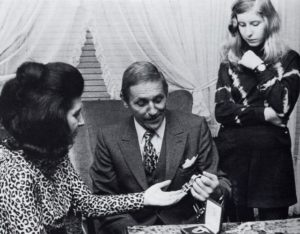
Erich Hartmann with wife Ursula and daughter Isabel (b. 1957)

Go to Part 1.

Handed Over to the Russians

At war’s end, Hartmann was based in Bohemia. Here began his personal tragedy. His commanding general ordered him and Hermann Graf, as famous holders of the Diamonds and much desired by the Russians, to leave their unit, fly west, and surrender to the British. Hartmann and Graf decided to ignore this order because there were thousands of German civilians fleeing the Russians attached to their unit; some of these civilians were relatives of the airmen. They felt responsible for these unfortunate refugees.

On May 8, 1945, Hartmann’s unit destroyed their remaining planes and moved west. They surrendered to American forces at Pisek, fifty miles south of Prague. The Americans plundered them thoroughly (Erich’s detailed logbooks were lost here and never recovered) and penned them up in a barbed-wire enclosure. Eventually 50,000 Germans, civilians included, were collected there. For eight days the Americans provided them with no food, other than a few handouts from individual GIs; they also lacked any sanitary facilities.

Take a moment to imagine that.

The Americans eventually told them they would take them into Germany to be processed. U.S. forces trucked a large group of Germans, including Hartmann and his men, away. To the east. They soon stopped in a meadow surrounded by Russian troops, and the Americans ordered the Germans to get down. The Americans had secretly agreed to turn over to the Soviets any personnel they had captured east of a certain line that had been allocated to Russian occupation.

The Russians were obviously drunk. They immediately separated the German women from the men, in full sight of the Americans. They held the German men at gunpoint, and began savagely beating the women, dragging them away, and stripping off their clothes. The Americans were horrified and protested strenuously; gunplay seemed likely between the “allies.” Some of the Americans drew their weapons; many more Russians drew theirs. There was a standoff until an American captain radioed HQ, received an order to leave the Germans to their fate, and that was that. The Russians had free rein for their barbarism. They dragged the women away and mercilessly gang-raped them, from the elderly down to girls of six or seven, then strangled, shot, or beat many of them to death. Thirty or forty Russians assaulted each victim. The German men were in a state of indescribable agony. Some of them tried to intervene—Hermann Graf even attacked and walloped a Russian—but they were beaten back or shot. They could not save their women; they could only watch in horror. Hartmann was sickened to see that the Russians even continued to rape the deceased. The Russians “passed around bottles of vodka and sang songs, as if they were having a party,” he said years later. He added, “I had never hated before, but I did then.” (Heaton and Lewis 75-6) He was mightily relieved that his wife was back home in Stuttgart. Next morning Hartmann woke to a fresh horror: many Germans had committed suicide rather than go on.

That was Hartmann’s introduction to Russian captivity. It was a scene that was duplicated everywhere in Germany where Russian boots trod. Read more