English version here
Article d’origine publié le 21 avril 2014
La récente étude (discutée ici) de Maureen Craig et Jennifer Richeson sur la façon dont réagissent les Blancs à l’idée de devenir minoritaires comprenait une expérience où les sujets étudiés (tous blancs) lisaient un “paragraphe lénifiant” destiné à calmer leurs craintes concernant le passage imminent des Blancs à l’état de minorité. Ce paragraphe affirmait avec beaucoup d’aplomb que “malgré le changement de composition démographique, on observerait très probablement une stabilité du statut sociétal relatif des différents groupes raciaux” et qu’il était prévu “que les Blancs américains continuent d’avoir des revenus moyens plus élevés que les membres d’autres groupes raciaux”.
C’était une simple manipulation expérimentale. Les expérimentateurs n’ont pas prétendu que leur paragraphe lénifiant sur le statut social des Blancs était vrai. Mais, puisqu’ils proposent l’idée que la peur de perdre son statut social est réellement le mécanisme central qui explique le résultat de leurs recherches, il est important de se demander si leur paragraphe lénifiant est vrai ou pas. Encore une fois, le schéma qu’ils proposent est que les Blancs, face à leur statut imminent de minorité démographique, craignent de voir leur statut social se dégrader, ce qui les encourage dans un deuxième temps à adopter diverses positions associées en Amérique aux idéaux politiques conservateurs, par exemple en s’opposant à l’intervention du gouvernement dans le domaine de la santé, en étant pour de plus fortes dépenses militaires, et sans doute contre le mariage gay, l’avortement, et les restrictions sur le droit de port d’arme.
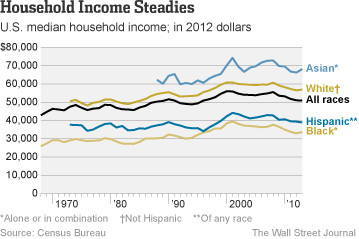
Comme le montre le graphique ci-dessus, on aurait tort de croire que les Blancs “ont des revenus moyens plus élevés que les membres d’autres groupes raciaux”. Les Asiatiques, depuis qu’ils constituent un groupe démographique important, ont toujours eu des revenus moyens plus élevés. En outre, dans des États comme la Californie, les Blancs perdent des plumes du fait de la concurrence avec les Asiatiques et les Latinos sur des ressources précieuses telles que l’admission à l’Université de Californie (“Les étudiants de Californie frappés par la restriction des admissions à l’UC“). Les Blancs (26,8%) représentent maintenant le troisième groupe racial le plus nombreux dans le système de l’UC, après les Asiatiques (36,2%) et les Latinos (28,8%) (ce dernier groupe est sans aucun doute aidé par la règle qui accorde automatiquement l’admission aux étudiants qui font partie des 9% de meilleurs élèves de leur classe en dernière année du système secondaire ; les Noirs sont sous-représentés parce que la race n’est pas admise comme critère et qu’il y a peu de lycées (high-schools) entièrement noirs du fait que les Latinos ont colonisé de nombreuses zones autrefois noires. L’immigration a un coût énorme pour les Noirs comme pour les Blancs).
Un autre aspect du futur déclin de la situation économique des Blancs se trouve mis en évidence dans un rapport récent de James G. Gimpel, un professeur de sciences politiques à l’Université du Maryland. Ce rapport a été publié par le très utile Center for Immigration Studies (L’Impact de l’immigration sur les perspectives politiques des Républicains, de 1980 à 2012). L’arrivée de millions d’immigrés pauvres et sans instruction aspirera de plus en plus les ressources de la société dans son ensemble, et créera une pression politique pour des mesures redistributives imposées au détriment des Blancs. L’étude du professeur Gimpel a pour principal objet de montrer que l’immigration est une stratégie perdante à long terme pour les Républicains – ce qui n’a rien de surprenant, vu la racialisation de la vie politique américaine, qui fait que les non-Blancs se regroupent au Parti Démocrate. L’argument de Gimpel est que l’arrivée de millions de gens sans instruction entraîne une plus grande inégalité des revenus et produit une grande masse d’électeurs favorables à la redistribution:
Les données du Bureau de Recensement indiquent que l’immigration a considérablement accru la population à faible revenu dans le pays. Les immigrés et leurs enfants mineurs représentent un quart des pauvres et un tiers de ceux qui n’ont pas d’assurance santé (Camarota 2012; Rector 2006). McCarty, Poole et Rosenthal (2008) ont décrit assez précisément le lien entre hausse de l’immigration, augmentation de l’inégalité économique, et renforcement au niveau national de la polarisation entre les deux partis. Un bon nombre des immigrés arrivés après 1965 se sont trouvés être des gens sans qualification, qui vivaient avec de bas salaires, et exposaient la population pauvre locale à la concurrence salariale.
En outre, c’est dans les territoires où l’inégalité de revenu est la plus forte qu’il existe le plus fort soutien, non seulement de la part des immigrés, mais de tous les citoyens, à un gouvernement fort avec un rôle important de redistribution et de régulation économique. Les comtés présentant une forte inégalité de revenus ne se contentent pas de davantage voter Démocrate aux élections présidentielles, mais produisent en outre de grands mouvements d’opinion locale favorables à davantage de réglementation gouvernementale et à des politiques d’imposition et de redistribution de la fortune.
Gimpel montre qu’il y a une corrélation entre l’inégalité des revenus mesurée par l’indice de Gini, et le soutien accordé à des politiques libérales favorables à la régulation gouvernementale et à la redistribution.
Pour résumer, le paragraphe lénifiant de Craig et Richeson, qui est fait pour rassurer les Blancs, ignore le coût futur de l’immigration pour les Blancs. À mesure que les États-Unis continuent de faire venir des gens pauvres et sans instruction, il y aura un renforcement du pouvoir électoral en faveur de politiques redistributives alimentées par des augmentations d’impôts qui frapperont particulièrement les Blancs. Et à mesure que le pouvoir électoral des Blancs diminue, la pression en faveur de telles politiques deviendra politiquement irrésistible. On peut faire le même raisonnement à propos de la tradition conservatrice américaine, attachée aux libertés individuelles et à un gouvernement limité.
Dans sa conclusion, le professeur Gimpel suggère qu’on ne peut pas raisonnablement s’attendre à ce que la multitude d’immigrés peu qualifiés connaissent une ascension sociale, étant donné la pression continue vers le bas qu’exerce l’immigration sur les salaires.
Les Républicains ont raison de vouloir attirer les électeurs latinos. Ils constituent incontestablement une part croissante de la population et de l’électorat. Mais d’après les éléments présentés ici, renforcer le flux d’immigrés peu qualifiés s’avèrera contre-productif dans une économie qui est mal adaptée pour assurer leur promotion sociale.
Le raisonnement tenu ici est que les immigrés peu qualifiés vont souffrir à mesure que les États-Unis continuent de faire venir des millions d’immigrés peu qualifiés comme eux. Le Professeur Gimpel suggère que les Républicains devraient tourner leur argumentation de façon à dire, en gros, que limiter l’immigration est une bonne chose pour les immigrés qui sont déjà là :
En même temps, les réserves exprimées par les Républicains concernant de hauts niveaux d’immigration peuvent trop facilement êtres cataloguées comme racistes et xénophobes. C’est parce que les élites du parti n’ont pas réussi à clairement faire passer le message qu’ils veulent une politique pro-immigrés basée sur une politique d’immigration réduite, et que ces deux objectifs sont complémentaires. Une telle politique sera aussi le meilleur moyen de faire évoluer les immigrés vers un niveau de revenus supérieur ou moyen, ce qui favorisera leur mobilité géographique et politique.
Du moment que ça marche.
Cependant, il est intéressant de souligner que l’un des coûts bien connus du multiculturalisme est que les gens sont moins disposés à contribuer aux services publics comme la santé et l’éducation quand les bénéficiaires sont des (membres de) groupes ethniques étrangers – un phénomène qui s’explique facilement par le point de vue évolutionniste. Si le professeur Gimpel a raison de penser que l’immigration conduit à créer une sous-classe persistante, en constante expansion, et incapable de se hisser plus haut sur le plan économique, alors le résultat sera explosif. À mesure que leur pouvoir politique décline, les Blancs pourront de moins en moins échapper aux impôts finançant des services publics pour cette sous-classe constituée de non-Blancs, pauvres et sans qualification.
Et même si le professeur Gimpel préfère présenter son raisonnement en termes d’effets de l’immigration sur les salaires et la mobilité ascendante des immigrés, la même conclusion s’impose lorsqu’on adopte un point de vue réaliste sur les différences de QI entre races et ethnies, comme le fait Jason Richwine.
Dans les deux cas, le résultat sera d’augmenter le ressentiment des Blancs, avec des implications politiques cataclysmiques. Quand il deviendra impossible de remédier par les urnes électorales à des griefs légitimes, les Blancs envisageront d’autres moyens d’atteindre leurs objectifs. Les travaux de Craig et Richeson suggèrent que les Blancs voient leur mise en minorité comme une menace pour leur statut social, et observent que la polarisation raciale en sera sans doute renforcée. Lorsque dans un contexte où les méthodes démocratiques sont inefficaces, la position économique des Blancs va être de plus en plus clairement menacée (malgré le black-out actuellement imposé par les médias), les choses pourraient changer de façon spectaculaire. On conçoit facilement que dans ce cas, le discours explicite sur l’identité et les intérêts des Blancs tomberait sur un terrain fertile, et que la rhétorique qui met l’accent sur la perte de l’Amérique traditionnelle rencontrerait l’approbation des Blancs qui ont perdu leur pouvoir politique.
Les promoteurs de l’immigration jouent un jeu très dangereux. Quand l’ancienne majorité dominante est non seulement en train de perdre son pouvoir, mais qu’elle continue en même temps à financer les services sociaux de la majorité ascendante, la polarisation raciale est alors une bombe à retardement sur le plan politique.