The Heartlander News reports that in the final months of the Biden administration, the EPA rushed a $5 billion grant out the door to an outfit called the Coalition for Green Capital. That group just happened to be run by former Clinton, Obama and Biden officials.
Turns out this was just a graft payment to Democrats private equity firms in the waning minutes before President Trump’s inauguration.
We don’t know where the money went, but we’re fairly confident the money is NOT being used to solve climate change.
How many homeless people or disadvantaged kids could be served with $5 billion? Or, here’s a crazy idea, it could have been used for deficit reduction.
The Trump administration is trying to claw this money back, but they’ve run into stiff opposition from the courts Audrey Streb reports at Heartlander News:
The Trump EPA froze the Citibank accounts where most of the GGRF funds were being held and Congress rescinded the program’s funding through the One Big Beautiful Bill Act (OBBBA).
CGC and several other grantees filed lawsuits against the EPA and Citibank following the freeze, claiming there is no legal justification to withhold the funds and that the Biden EPA acted appropriately in distributing them.
An appeals court intervened to stay an earlier ruling that would have forced the agency to release the frozen funds. Litigation has continued since, with the full D.C. Circuit ruling Tuesday to affirm the lower court’s block on EPA’s grant termination order. The decision was fractured and further complicated by OBBBA’s repeal of the underlying statute.
https://www.theoccidentalobserver.net/wp-content/uploads/2018/06/TOO-Full-Logo-660x156-1.png00Kevin MacDonaldhttps://www.theoccidentalobserver.net/wp-content/uploads/2018/06/TOO-Full-Logo-660x156-1.pngKevin MacDonald2026-08-26 10:16:102026-08-26 10:16:10The Left Got Rich Off of Biden’s Green Energy Scam
LARRY C. JOHNSON • AUGUST 24, 2026 • 1,600 WORDS • 6 COMMENTS • REPLY
The Western commentariat filed the Mecca agreement under a comfortable
heading. When Saudi Arabia, Turkey, and Pakistan signed the Makkah Joint
Defence Agreement on August 7 — an armed attack on one to be treated as
an attack on all — the reflexive label was “Islamic NATO,” a Sunni bloc,
three of the Muslim world’s largest militaries welded together by
sectarian identity. That reading was obsolete almost before the ink
dried. What is actually taking shape is not a Sunni alliance against
Iran. It is the first load-bearing beam of the post-American security
architecture that Russia and China have been calling for — and Tehran is
about to walk through the door.
The language was not accidental, and it did not originate in Riyadh. On
April 27, in St. Petersburg, after meeting Iranian Foreign Minister
Abbas Araghchi, Vladimir Putin called for a new security architecture in
the Persian Gulf. One week later, on May 5–6 in Beijing, after his own
meeting with Araghchi, Chinese Foreign Minister Wang Yi said essentially
the same thing — that Beijing supports the establishment of a regional
peace and security architecture in which the regional countries
themselves participate, safeguard common interests, and pursue common
development. Araghchi, for his part, told Putin that Iran supports a new
post-war regional architecture that can coordinate development and security.
Note the two nouns Araghchi paired: development and security. That
pairing is the tell, and I will return to it. Russia has floated a
collective security concept for the Gulf since 2019; Lavrov reiterated
it on February 28, 2026 — the very day the war began. The consistent aim
is a multilateral, regionally led framework that replaces the American
defense umbrella over the Gulf, installs Moscow and Beijing as the
guarantors alongside the regional states, and — crucially — treats Iran
not as a threat to be contained but as a legitimate pillar of the order.
As Araghchi paraphrased his Chinese hosts: Iran after the war is a
different country, its standing improved, a new era of cooperation ahead.
Hold that blueprint in mind, and look again at Mecca.
The first pillar
The Makkah agreement was signed in wartime, and that context is
everything. Nearly six months into the war that began on February 28,
Saudi Arabia had absorbed repeated missile and drone strikes, and
confidence in Washington’s willingness to actually backstop Gulf
security in real time had visibly cracked. Out of that erosion came a
treaty binding Pakistan — the only nuclear-armed Muslim state, with an
arsenal near 300 warheads — to Turkey, which fields NATO’s
second-largest army, and to Saudi Arabia, the Gulf’s financial anchor
and custodian of Islam’s holiest cities. Nearly 1.4 million active
personnel and some $124 billion in combined annual defense spending,
joined under a single mutual-defense formula for the first time since
the Baghdad Pact era.
The signatories were careful to call it purely defensive and, in
Erdogan’s words, open to other countries. Ankara floated Egypt; Dhaka
signaled interest. The Western analysts who noted that all three members
are American partners — Turkey in NATO, Pakistan a major non-NATO ally,
Saudi Arabia the largest buyer of U.S. arms — and concluded the pact was
therefore no threat to Washington, made the same error as those who
called it a Sunni NATO. They read the founding membership and missed the
trajectory. A pact “open to others,” signed by states that have lost
faith in the American umbrella, in the middle of a war against Iran that
Iran is surviving, was never going to stay a three-member Sunni club.
Here is what the public analysis has not yet caught up to, and what I
can report from firsthand sources. On Monday morning, Field Marshal Asim
Munir — Pakistan’s chief of army staff and the real architect of
Islamabad’s regional strategy — is in Iran. The subject of his talks is
Iran’s accession to the Mecca agreement as its fourth member.
Read that slowly, because it detonates the entire “Islamic NATO”
framing. A mutual-defense pact led by the Sunni heavyweights of the
Muslim world, admitting Shia Iran, is not a sectarian bloc. It is the
opposite: the dissolution of the very Sunni-Shia fault line that Western
strategy has exploited for a generation. And what remains, once Iran is
inside, is not “NATO” of any confessional flavor. It is precisely the
inclusive, regionally led architecture that Putin and Wang Yi described
— a framework in which Iran sits as a legitimate pillar rather than a
quarantined enemy. Mecca provided the structure. Tehran’s entry supplies
the meaning.
It does not stop at Iran. Bahrain — a Gulf monarchy that hosts the U.S.
Fifth Fleet — is, I am told, negotiating with Pakistan to join the
military alliance with Saudi Arabia. Consider the weight of that. The
Gulf state most physically entangled with American naval power is
hedging toward the regional bloc. Each such accession chips another
brick out of the American security order in the Gulf and mortars it into
the new structure rising beside it.
Recall Araghchi’s pairing — development and security. A security
architecture that does not carry an economic circulatory system is a
paper alliance. The Mecca pact is acquiring one, and here again Pakistan
is the hinge.
Islamabad — with China standing behind it, through the CPEC investment
and the Gwadar port that already give Pakistan its overland corridors
into Iran — has decided to deepen its economic integration with Tehran
dramatically. Munir is negotiating a tenfold increase in Pakistan-Iran
trade over three years. That is not a rounding error in a sanctions
regime. It is a demolition of one.
And it is, to put it plainly, a slap across the face of Scott Bessent.
The US Treasury Secretary has spent the war promising the toughest
sanctions in history, an unprecedented campaign to isolate Iran
economically and starve it into capitulation. He is now watching a
nuclear-armed American ally, financed and backed by China, move to
multiply its trade with the very country he vows to strangle — trade
that will run on yuan and barter and regional currencies, outside the
dollar clearing system his sanctions depend on. The security
architecture and the economic architecture are being built in the same
motion, by the same man, on the same trip. Bessent’s isolation strategy
is being answered not with defiance in words but with integration in deeds.
There is a deeper irony here, and it is worth naming, because it indicts
a generation of American strategy. For decades Washington treated the
Sunni-Shia divide as an asset to be worked — arming and tolerating Sunni
militants as instruments against Shia Iran, from the redirection of the
Bush years through the Syrian war. The entire logic depended on the
divide staying open. Now the principal Sunni powers of the region —
Saudi Arabia, Turkey, Pakistan — are themselves closing it, folding Iran
into a shared framework of defense and commerce. The wedge Washington
spent twenty years driving is becoming the foundation of a bloc that
answers to Moscow and Beijing rather than to Washington. That is
blowback of the highest order: not a weapon turned on its maker, but a
fault line the maker relied upon, sealing shut.
An opinion is not worth much if it cannot survive its own
qualifications, so here they are. Munir’s trip is a negotiation, not a
signing; Iran’s accession and Bahrain’s are, as of this writing, in
motion, not concluded, and either could stall. The Sunni-Shia trust
deficit is real and decades deep — Gulf monarchies have long feared
Iranian subversion, and a defense treaty does not erase that overnight.
Prior mutual-defense pacts in the region, including the Saudi-Pakistani
agreement of September 2025 and the older GCC arrangements, never once
triggered a NATO-style collective response, and this one may prove as
declaratory as those. All three Mecca signatories retain deep, live
relationships with the United States and will not sever them lightly;
much of this may be hedging rather than a clean break. And the firsthand
reporting above describes intentions and negotiations, which are not yet
treaties.
But direction is not the same as arrival, and direction is unmistakable.
Every one of these hedges points the same way — away from the American
umbrella and toward a regional order underwritten by Russia and China.
The Mecca agreement was sold to Western audiences as a Sunni bloc and
dismissed as a club of American clients. It is neither. It is the first
pillar of the security architecture Putin and Wang Yi named this spring
after sitting with Iran’s foreign minister — a regionally led, Russia-
and China-backed framework that folds Iran in as a legitimate power and
pushes the United States out as the indispensable one. When Asim Munir
walks into Tehran on Monday to discuss Iran’s membership, and negotiates
a tenfold expansion of trade in the same breath, he is not conducting
two errands. He is laying two courses of the same wall. The Americans
built their Gulf position on keeping Sunni and Shia apart and keeping
the dollar in the middle. Both pillars are being pulled at once — and
the structure going up in their place was drawn in Moscow and Beijing.
https://www.theoccidentalobserver.net/wp-content/uploads/2018/06/TOO-Full-Logo-660x156-1.png00Kevin MacDonaldhttps://www.theoccidentalobserver.net/wp-content/uploads/2018/06/TOO-Full-Logo-660x156-1.pngKevin MacDonald2026-08-25 14:03:362026-08-25 14:03:36Not an Islamic NATO: The Mecca Agreement Is Building the Post-American Security Architecture — and Iran Is About to Walk In
The narrative of the innocent black kid standing up to “white bullies” is falling apart. Karmelo Anthony, age 19, was convicted in June 2026 of murdering 17-year-old Austin Metcalf (who was also 17 at the time) by fatally stabbing him in the chest during a confrontation at a high school track meet in April 2025. A Collin County jury sentenced him to 35 years in prison. Anthony claimed self-defense; arguing that Metcalf “shoved him” and that he was protecting himself.
Anthony’s family raised $634,000 from gullible liberals on claims self defense and racism, but their story started to fall apart early in the trial. His conviction was met with outrage by progressive commentators and Democrat politician who continue to assert that Anthony should be freed from prison. Efforts were immediately launched for a new trial.
However, Kaufman County Judge Michael Chitty (appointed after the original trial judge was recused) denied the motion in a brief order after a two-day hearing, stating he had reviewed the motion, record, evidence, arguments, briefs, and case law.
During the new-trial hearing, previously excluded character evidence was discussed that was kept out of the original trial. Under an informal “gentleman’s agreement” between prosecutors and defense, this evidence was omitted and focus was limited to the day of the incident in order to avoid “inflaming racial tensions”.
This new evidence included text messages and notes from Karmelo Anthony expressing extreme violence. Examples included messages about stabbing someone and “licking the blood off the blade.” There were threats toward an ex-girlfriend, including a photo of a knife and Anthony saying he was “low key on the verge” the day he murdered Austin Metcalf.
There were also reports of Anthony stalking his ex-girlfriends, other threats of violence, school disciplinary issues involving fights, jokes about school shootings, and related content.
These revelations help to paint a picture of a warped individual that seemed to be looking for an opportunity for a violent encounter. This helps to explain why Anthony invaded the tent of an opposing high school team and refused to leave – He may have wanted someone to confront him, and that person just happened to be Austin Metcalf. Had it not been Metcalf it’s likely that Anthony would have simply killed someone else down the road.
Defense lawyers say they plan to appeal the case to the 5th Court of Appeals in Dallas.
The incident became a flashpoint for racial tension in the US, with leftists and black activists celebrating the murder of Metcalf as “payback” for the “crimes of white America.” It’s a trend which has been gestating for many years due to woke ideology and the concept of social and financial “reparations” in the name of righting the wrongs of the past by punishing white people today.
The case also brought many misconceptions about self defense law to the surface and proved that, sadly, far too many people are ignorant of how these laws work. Deadly force cannot be used without a legitimate threat to life and limb. Feeling insulted because someone call you out for bad behavior, or being shoved out of a tent, is not legal grounds to murder that person.
Ultimately, the Karmelo Anthony case once again exposed a dangerous disconnect between black culture and the rest of America. Their seething obsession with “respect” that they have not earned is leading the black community down a path to disaster.
https://www.theoccidentalobserver.net/wp-content/uploads/2018/06/TOO-Full-Logo-660x156-1.png00Kevin MacDonaldhttps://www.theoccidentalobserver.net/wp-content/uploads/2018/06/TOO-Full-Logo-660x156-1.pngKevin MacDonald2026-08-24 18:14:092026-08-24 18:14:09Karmelo Anthony Request For New Trial Denied After Disturbing Revelations
Reminds me of the Postville Jews having no respect for local customs and not caring in the least what non-Jews think of them.
In mid-August, a video filmed at the Les Deux Alpes resort in Isère—located at the gateway to the Écrins massif—went viral on X. It shows a shopkeeper leaning against the counter of her refreshment stand, telling an Orthodox Jewish man: “The Jewish community—there are too many of you. At a certain point, it becomes too much for people.”
Readers interested in the event can refer to an AFP article with an evocative title:
“They bother us—we’ve had enough.”
In the Alps, kosher summer tourism has been a draw for decades, yet this coexistence also gives rise to tensions and friction.
What is interesting is that this AFP article was picked up by the Swiss daily *Le Temps* (the Swiss version of the French newspaper *Le Monde*): because the Swiss are fed up too.
And here is a firsthand account from a French-speaking Swiss person—the kind of testimony *Le Temps* dares not quote.
Alas, fresh air cannot purify anything on its own.
This phenomenon is also very prevalent in Switzerland. These “aliens” settle at the outdoor tables of resort restaurants without ordering anything—much to the dismay of the restaurateurs, who lose money because of them. However, they generously leave their trash scattered on the tables, since they consume only their own kosher food and drink.
But as soon as you move away from the center, the flat-footed ones miraculously disappear… They have balance issues from top to bottom…
But hoteliers have found a clever trick! As soon as they spot the minibus pulling into the hotel parking lot, the receptionist places a “Fully Booked for the Season” sign on the front desk—before the “Black-and-Whites” (black trousers, loose white shirts, black hats, screaming kids, etc.) come waddling over. The receptionist then puts on a look of dismay, insisting that there isn’t a single room left. … But he offers to make a call to see if there are vacancies elsewhere. In reality, he dials an internal line where an accomplice—posing as the manager of a nearby hotel, surrounded by staff who are lapping up every moment—confirms off-air that kosher tourists are welcome, that he has room, and so on. He then gives directions, but in such a confused and muddled way that the eagerly awaited guests are bound to get lost in the thick fog of a remote mountain pasture. The Jewish man claims he has understood perfectly… while the staff in the back room roar with laughter as they watch the couple turn on their heels and leave!
https://www.theoccidentalobserver.net/wp-content/uploads/2018/06/TOO-Full-Logo-660x156-1.png00Francis Goumainhttps://www.theoccidentalobserver.net/wp-content/uploads/2018/06/TOO-Full-Logo-660x156-1.pngFrancis Goumain2026-08-24 08:25:432026-08-24 10:40:26Alps ‘N’ Jews – Kosher vacations – The French are fed up (and the Swiss too)
Mike Rogers, Michigan’s Republican nominee for the U.S. Senate, has asked AIPAC not to run ads supporting his campaign, fearing that backing from the pro-Israel group could hurt him among voters angered by the war in Gaza, Axios reports.
Rogers discussed the issue with AIPAC chair Michael Tuchin in Los Angeles last week, and the group shelved a video ad targeting his Democratic opponent, Israel critic Abdul El-Sayed, the following day.
Declining U.S. power:
Iran has reportedly been invited to join the Mecca Joint Defence Agreement between Saudi Arabia, Pakistan, and Türkiye.
Mehdi Rahimi, head of the Iranian parliament’s official news agency Khaneh Mellat, told Al-Mayadeen that Iran received an invitation and that “the matter is under consideration.”
For now, however, the invitation has not been independently confirmed by Iran’s Foreign Ministry or senior leadership, nor publicly by Saudi Arabia, Pakistan, or Türkiye.
This falls in line with earlier reports out of Iran:
محمدباقر قالیباف | MB Ghalibaf @mb_ghalibaf
1/2 We’ve received numerous messages from neighboring countries about shaping new security arrangements and economic cooperation in the region.
The United States put the security of every single one of its allies at such risk through bullying and pure disregard for their interests for the sake of Israel that they briefly saw their entire existence on the line.
A homegrown, independent order is what will actually deliver peace and security.
As best I can remember, it started with leaks that Trump was considering—once again—using nukes on Iran. But wait, it turned out that Hormuz was open and there was a virtual bottleneck of tanker traffic, so forget the nukes. Then Bessent intervened in the bond market. Woops! When that effort came a cropper Trump weighed in with his threat to bomb anyone selling treasuries. Then Trump and Bessent finished off the week that was with their proposed Economic D-Day, without prior consultation with, like, anybody. Capped by Bessent telling China to “get with the program” or the US would cut them off from Persian Gulf oil. Then Trump pulled the rug out from under Mark Carney. As I understand what happened, Trump and Carney had a deal that would have cut Canadian trade with China. It was all read for signing, but then Trump tried to insert a clause that said Trump could raise tariffs on Canada anytime he wanted to in the future. Now Carney is reminding Trump how much the US needs Canadian oil—which is true—and threatening economic war on is own part.
And to cap it all, Trump asserted that he wasn’t even thinking about the midterms, much less concerned about them. A dead giveaway of exactly the opposite.
What’s going on here?
One place to start might be this article today at AmCon:
A new biography of the notorious lawyer sheds light on the Trump era.
It can’t be emphasized enough that Roy Cohn was Trump’s mentor before Trump hooked up with Epstein. To give you a flavor for this book review:
In the 11 years since Donald John Trump crashed American politics at the end of a golden escalator ride, oceans of ink have been spilled attempting to explain his and his movement’s political origins. …
Kai Bird points us … to a universe where ideology matters less than crass opportunism in the pursuit of money, sex, and power—where extreme narcissists will shatter everything around them to get their way. This was Roy Cohn’s world; Donald Trump is his inheritor.
… So how did a self-described “biographer of the American establishment” choose an embodiment of its antithesis? Bird admits that a few years ago he had “an epiphany and realized that with the political rise of Donald Trump I had somehow underestimated the significance of Roy Cohn.”
Readers of this page-turning, sometimes cringe-inducing book may agree that Cohn’s stamp on history has heretofore been underappreciated. They may also feel the need to take a shower after spending so much time with such a despicable man.
…
“Trump learned from Cohn that the court of public opinion is far more important than a court of law,” Bird says. Had he lived long enough, Cohn might have coined “fake news,” one of the current president’s favorite insults. Both men, of course, loved the media spotlight and privately sought favorable coverage to reinforce their strongman reputations.
Also like his mentor, Trump inspires hatred in his enemies. Indeed, he seems to feed off it. Readers who endure Cohn’s remorseless crime spree across four decades of American life will better understand how his kindred spirit and protege could eventually make it to the White House.
OK, so, what’s going on? Maybe this past week reminds you a bit of the beginning of Trump 2.0. Remember the tariff shock and awe, with which Trump was going to strongarm the world with his “strongman reputation”, forcing the world to disgorge trillions to send to the US, where Trump would distribute the largess to his tech bro allies (and others) and pay off the debt? Or at least reduce the debt to manageable proportions? Or refinance it by rejiggering global trade? Or something? All while littering the Imperial City on the Potomac with monuments to himself—the new Genghiz Khan, or Napoleon? Venezuela was supposed to be a lesson to the likes of China and Russia and Iran to “get with the program.”
But Trump progressively lost control of that program, and my suspicion is that the antics of the past week were his attempt to regain control. But with some serious aspects. I can’t prove this, but I do suspect that the outrageous lies about 40 tankers transiting Hormuz in a single night—put out by Trump’s favorite Mossad scribe at Axios—was bluster aimed at, well, certainly at Canada, which supplies the US with similar grades of oil. Possibly at China, too, although the Chinese are probably immune to that sort of nonsense. Certainly all the over the top threats fit within Trump’s Cohnian mold. The apple doesn’t fall far from the tree.
My prediction is that all this bluster will be to no effect, so in the meantime lets round things up a bit. Because there are some interesting things going on. Let’s start with the shifting tectonic plates of American politics and the limits of money.
Megatron @Megatron_ron
Aug 22
 Mike Rogers, Michigan’s Republican nominee for the U.S. Senate, has asked AIPAC not to run ads supporting his campaign, fearing that backing from the pro-Israel group could hurt him among voters angered by the war in Gaza, Axios reports.
Rogers discussed the issue with AIPAC chair Michael Tuchin in Los Angeles last week, and the group shelved a video ad targeting his Democratic opponent, Israel critic Abdul El-Sayed, the following day.
Speaking of shifting tectonic plates, that could be happening in West Asia, as well. Although unconfirmed, this is being widely reported. If true, it’s very big. I would expect—again, if true—that Egypt would be in line as well. It would spell the end of US dominance in the region:
Clash Report @clashreport
NEW: Iran has reportedly been invited to join the Mecca Joint Defence Agreement between Saudi Arabia, Pakistan, and Türkiye.
Mehdi Rahimi, head of the Iranian parliament’s official news agency Khaneh Mellat, told Al-Mayadeen that Iran received an invitation and that “the matter is under consideration.”
For now, however, the invitation has not been independently confirmed by Iran’s Foreign Ministry or senior leadership, nor publicly by Saudi Arabia, Pakistan, or Türkiye.
This falls in line with earlier reports out of Iran:
محمدباقر قالیباف | MB Ghalibaf @mb_ghalibaf
1/2 We’ve received numerous messages from neighboring countries about shaping new security arrangements and economic cooperation in the region.
The United States put the security of every single one of its allies at such risk through bullying and pure disregard for their interests for the sake of Israel that they briefly saw their entire existence on the line.
A homegrown, independent order is what will actually deliver peace and security.
Here’s a burst of Iran updates:
The Hormuz Letter @HormuzLetter
9m
BREAKING: US House Speaker Mike Johnson says the Iran war is going to enter a “new phase very soon,” declaring “we’ll get this finished.”
Dutifully talking up Economic D-Day?
BREAKING: Iran views the war as restarting in the coming days, with Marandi saying “In the coming days, it is very likely that the military conflict will be renewed.”
I wonder whether this signals a kinetic Iranian response to Trump’s Economic D-Day?
BREAKING: The Trump administration has asked Pakistan to send a new peace deal proposal to Iran to keep Iran’s “IRGC backchannel” open, coming as a senior Iranian official says Trump is using Pakistani officials to announce fabricated talks rumors to stabilize the oil market, per Reuters and a senior Iranian official in Tehran familiar with the matter.
Iran, however, continues to refuse reopening the Strait of Hormuz or return to negotiations unless Trump agrees to all of Iran’s conditions, including $300 billion in US compensation, the lifting of all US sanctions, the release of all Iranian frozen assets, and the end of the US naval blockade of Iran.
BREAKING: Iran announces the discovery of major gas reserves [in southern Fars province] worth over $165 billion, containing more than 7.5 trillion cubic feet of “sweet” natural gas, the highest quality type with close to zero impurities, plus significant gas condensates, Iran’s oil minister told IRIB.
BREAKING: U.S. service member casualties in the Iran war have just jumped to 774 wounded or killed, after the Pentagon added scores of new troops to the wounded list in the last few days, per WaPo.
BREAKING: Iran’s IRGC has successfully shut down a UK power plant for 4 days in an unprecedented cyber attack, believed to be the first time Iranian-affiliated hackers have successfully shut down a UK facility of this kind, per The Telegraph.
BREAKING: Trump made over 1,000 stock trades in June alone worth up to $263 million tied to market events he created, often buying and selling the same security on the same day after the event was over, per new government ethics filing.
Recent purchases include Visa, Berkshire Hathaway, Mastercard, and Cintas, following 3,642 trades involving stocks of public companies between January 1st and March 31st. Trump also made more than 21,000 securities trades in 2025 in bursts tied to market events he created, with the total value between $600 million and $1.86 billion, occasionally buying and selling the same security on the same day.
The White House claims Trump’s trades pose “no conflict of interest” as they are “independently managed,” coming amid Trump already being sued in federal court over Trump Media selling advance access to his Truth Social posts to subscribers paying up to $100,000 per month via Truth API.
BREAKING: Iran warns it “will respond with an earthquake-like retaliation” in response to Trump’s economic warfare, directly warning all Gulf countries not to join the economic war, and saying Iran will strike all US-backed Gulf energy infrastructure and Hormuz bypass oil routes, including Yanbu and Fujairah, Iran’s SNSC chief Rezaei told IRIB.
On the financial front Trump 2.0 is encountering open skepticism, even from the establishment media—but bear in mind that everything Trump/Bessent do is connected:
JaguarAnalytics @JaguarAnalytics
Financial Times:
“Scott Bessent’s running battle with the bond market is starting to look like his boss’s war in Iran — started by his own hand with a tangled set of objectives, an underestimated opponent and an implausible path to victory. And like the conflict in the Middle East, we are all going to suffer its effects.
Three weeks ago, of course, he inserted himself in the market for the Japanese yen, of all things, buying the currency to prop it up in what was painted as a friendly act of solidarity with an ally in need.
The link back to Treasury bonds may not be immediately obvious, but bond market insiders are not buying the friends-helping-friends explanation, and instead see it as an effort to stop Japan from fixing its yen problem by selling down its gigantic stash of US debt.
So now, no fewer than three times in three weeks, Bessent has given the message to investors to please stop selling his bonds. But they are selling his bonds anyway.”
Was this the wrong time to anger Canada?
Could be a wild ride coming up.
https://www.theoccidentalobserver.net/wp-content/uploads/2018/06/TOO-Full-Logo-660x156-1.png00Kevin MacDonaldhttps://www.theoccidentalobserver.net/wp-content/uploads/2018/06/TOO-Full-Logo-660x156-1.pngKevin MacDonald2026-08-23 15:01:082026-08-23 15:01:08Mark Wauck: What a Week!
Southern community leaders are deeply concerned about a lack of transparency from the military ■ A tour in Gaza leaves no room for doubt that the massive destruction was premeditated ■ The Americans are starting to lose patience with Netanyahu ■ The forever war is preventing the IDF from preparing for future campaigns
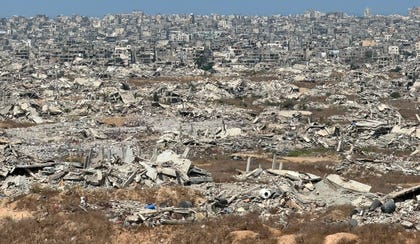
Destruction in the Gaza Strip, this week.Credit: Amos Harel
Every time one enters the Gaza Strip, the scale of the destruction caused by Israeli aircraft, bulldozers, artillery and tanks in the war that erupted following the October 7 massacre is cause for renewed astonishment. Anyone who fought in the Western Negev communities on the day Hamas invaded, or who came there in the immediate aftermath, saw the results of the atrocities there on a biblical scale. The response inflicted on the Palestinians in their wake fomented a kind of lethal natural disaster.
This appears to have been a conscious Israeli decision, even if it’s unlikely to have detailed documentation. The policy of destruction was implemented systematically in the years since then. The devastation was deliberate; only a small part of it “escaped” the commanders.
The ruins stretch almost to the horizon in every possible direction. In a short tour of the Strip on Wednesday, one could see that the work of the bulldozers didn’t stop in the past year. It has also continued after the shaky cease-fire that was declared by the United States, along with the completion of the last hostage deal in October 2025 and in conjunction with the 20-point plan presented by U.S. President Donald Trump.
The Shujaiyeh neighborhood in eastern Gaza City was largely razed in the first months of the Israel Defense Forces’ activity in the enclave, during the fall and winter of 2023-2024. The IDF expelled most of the population from there, and they haven’t returned, other than for brief transition periods. It was from here that the first Nukhba squads set out on October 7, on Toyota pickup trucks and motorcycles, captured Kibbutz Nahal Oz and the adjacent military base without much difficulty, going on to slaughter civilians and kill soldiers for many hours.
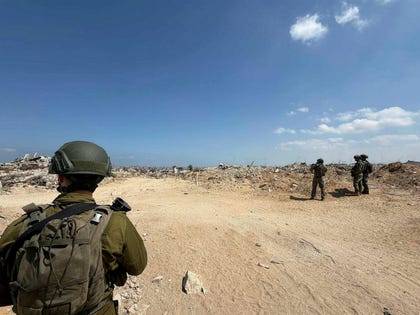
Israeli soldiers in Gaza this week. In Shujaiyeh only a small Palestinian militia force is operating, in cooperation with Israel, according to Arab media reports.Credit: Amos Harel
When the IDF subsequently entered Gaza, fierce battles were fought against the Shujaiyeh Battalion of Hamas’ military wing and against the battalions nearby. Dozens of IDF combat troops and hundreds of Palestinians were killed in the fighting.
More than two years later, the destroyed neighborhood is deserted, other than a small force of an armed Palestinian militia, which according to Arab media reports is acting in cooperation with Israel. The devastation hasn’t passed over the adjacent neighborhoods, either – not a single habitable building appears to remain in them. Only west of there, in the direction of the center of Gaza City, can one see multistory buildings that are still intact; the damage some of them sustained in the war is visible even from afar.
The line of outposts created by the IDF, known as Meteor, extends up to a kilometer west of the border fence, inside Palestinian territory. In the case of Shujaiyeh, the outpost is situated on the ruins of the neighborhood’s eastern fringes. More than 30 similar outposts have been built, at a cost of hundreds of millions of shekels, from the area of the former Israeli settlements of Dugit and Elei Sinai in the north of the Strip, which were evacuated in 2005, to the Philadelphi route in Rafah in the south. Vast sums of money have gone into building fortifications and setting up masts, cameras and communications systems.
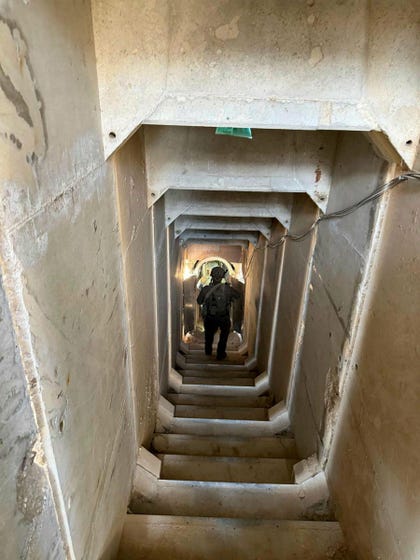
A dramatic change is occurring here. The soldiers constitute a physical buffer between the civilians in the Western Negev and the danger – in contrast to the situation on October 7. The line of outposts along a ridgeline known as the Seventies is slightly higher than the communities on the Israeli side. Hamas militants have been driven away from it. Before the war, a large part of the tunnels that were dug in the direction of the border fence were concealed under Palestinian homes. Clearing the rubble helps expose the tunnel shafts and renders it difficult to dig new routes.
A tunnel in Gaza this week. Unlike on October 7, soldiers are separating Israelis near the border from the danger.Credit: Amos Harel
About 3 kilometers (1.86 miles) west of the line of outposts is the Yellow Line, to which the IDF withdrew as part of the agreement last October. That left Israel in control of approximately 53 percent of the Strip, with more than 2 million Palestinians crowded into the remaining area under Hamas’ boot.
Since then, while the Americans haven’t been paying attention to the developments, Israel has moved the Yellow Line westward and to control 60 percent of Gaza’s territory. But at the beginning of this month, the Board of Peace’s high representative for Gaza, Nickolay Mladenov, presented his 15-point plan – an updated version of the Trump plan. Washington stepped up the pressure somewhat, and the IDF moved the Yellow Line eastward, back to the original location.
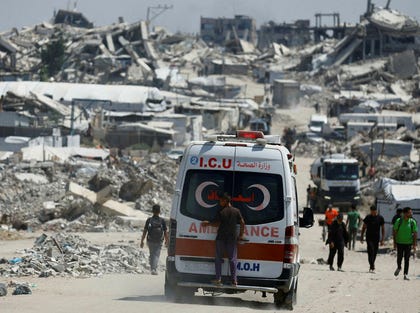
The IDF has designated the whole area between the line of outposts and the Yellow Line a “kill zone” where it’s permitted to shoot anyone who enters, and usually no special effort is made to ascertain whether those who do are civilians.
In recent weeks, soldiers in the Strip report that somewhat more stringent rules of engagement have been introduced: More rigorous authorizations are now required to respond to suspicious movements in the area under Hamas control, west of the Yellow Line.
During this period, three Hamas-made explosive devices were detonated against IDF units in the area, without causing any casualties. A minor furor erupted in the media, which as usual included allegations that the lessons of October 7 haven’t been learned. But the problem actually appears to be deeper and more complex than is reflected in the sensational headlines. At this stage, the main concern is not the danger of an incursion into Israeli territory, like on the day of the massacre. There is much doubt as to whether Hamas, in its present condition, is capable of executing an ambitious plan along those lines. And the IDF, for its part, is capable of handling a higher level of threat to the outposts, as long as the communities behind them are relatively protected.
The threat lies in Hamas’ force-building processes in the longer term. Hamas is rebuilding its military wing’s battalions and manning them with armed terrorists. A focused drone offensive, along the lines of what Hezbollah has been doing in the north, is not an implausible scenario. The leaders of the Western Negev communities are worried – and constantly complain about the difficulties of communicating with the IDF.
Abandonment issues
First and foremost, the communication issues look like a problem of trust, which was completely lost on October 7, partially restored in the years since, and is now in danger of being eroded again. This is happening despite the IDF’s deployment deep in Gazan territory, despite the line of outposts and notwithstanding the fact that the IDF has more than tripled the size of the forces in the Gaza sector compared to the pre-massacre numbers.
The main complaint of the local community heads is that the IDF is not informing the residents about the full complexity of the security situation and the dangers to them, and doesn’t involve their representatives in formulating policy. The fear is that in these circumstances, the development of a renewed security risk will prompt residents – especially the strongest ones, with the most potential – to abandon the area, after over 90 percent have returned home.
Northern Gaza on Tuesday. The IDF considers a certain sector a “kill zone.”Credit: Mahmoud Issa/Reuters
The recurring complains focus on arrogance, excessive complacency and inadequate communication on the part of the army. Stepping into this vacuum is the media, with reports of suspicious movements by Hamas personnel, a training exercise conducted by dozens of Nukhba terrorists and recordings of spotters warning of security deterioration along the line.
All these reports generate anxiety among the Western Negev residents, and they don’t get enough answers. When the army insists that everything is under control, the residents leave it to their imagination to fill in the gaps. And when IDF officers talk in some of their background briefings to the media about the resounding victory that was achieved over Hamas, the residents don’t buy it.
There are also concrete arguments: about the number of reservists stationed in the kibbutzim, about how many reserve-duty days allocated to members of the local first-response teams (the army is suffering from an excess of reserve-duty days and is trying to cut down, including in the scarred front in the Strip), and about the number of observation posts for the communities’ situation rooms (the IDF suggested recruiting young women volunteering for national service instead of the army for this task, but they don’t serve on Shabbat).
The council heads also know all the tricks. Occasionally they bypass the IDF and go straight to Defense Minister Israel Katz, who is eager to position himself as one who is demanding that the army correct its deficiencies.
The Multinational Force base in Kerem Shalom this month. When the army insists that everything is under control, people fill in the blanks with their imagination.Credit: Eliahu Hershkovitz
In June, the heads of the councils in the south sent a letter to Shmuel Ben Ezra, the new chair of the National Security Council, requesting that he act to institutionalize working relations with the security establishment, as a lesson from the massacre. The story is not about the fitness of the defense units and the condition of the security infrastructures in the communities, but about the need for regular joint dialogue. The authors of the letter requested a binding definition of goals, joint steps and a professional attitude toward the communities as a defensive system that is ready and able to absorb enemy penetration and defend the civilian population.
At the beginning of this month, Sha’ar Hanegev Regional Council head Uri Epstein sent a missive of his own to the IDF Chief of Staff Eyal Zamir. “Today I am placing before you a strategic warning about the accumulation of three processes that could bring about a crisis of trust between the residents of the Western Negev and the IDF,” he wrote. “Frequent changes in the defense forces deployed to the communities, the absence of an authoritative picture regarding the threat posed from Gaza, and reports about the possibility that the IDF will withdraw from the Yellow Line, while Hamas’ military and governmental capabilities have not yet been dismantled in accordance with the goals of the war: each of these developments requires a response.”
Epstein further wrote, “The accumulation of developments, without an authoritative explanation connecting the threat, the defense doctrine and the forces that are stationed in practice, the residents might arrive at a dangerous conclusion: that the defense envelope is shrinking even as the threat remains the same, and that they are being called on to bear the danger without sufficient certainty…
“The Western Negev is the first test case for the restoration of the security contract between the state and the communities on its borders. Continuation of the ambiguity could transform the local erosion of confidence into a nationwide process that will be hard to stop.”
Benjamin Netanyahu last month. The Americans are losing patience with his playing-for-time gimmicks.Credit: Oliver Fitoussi
Plenty of playing with fire
On Monday, Benjamin Netanyahu met in Jerusalem with Trump’s envoy and son-in-law, Jared Kushner, as well as with Mladenov and Tony Blair of the Board of Peace. Netanyahu’s people were walking a thin line; they leaked that the prime minister reprimanded Kushner for meeting in Cairo the day before with Hamas’ leaders. Yet they intimated that there was no crisis between Jerusalem and Washington; Netanyahu had the president’s full support.
The guests offer a less harmonious picture. The meeting was tense and the Americans are losing patience with Netanyahu’s playing-for-time gimmicks. This ties in with the impression gleaned by Israeli officials. Relations with Washington have been in decline since mid-April, when the first cease-fire was declared in this year’s war on Iran. The president is frustrated by his inability to get the Iranians to surrender, and he’s accusing Netanyahu of selling him a half-baked plan to topple the Tehran regime.
So far, that frustration is being vented in anti-Netanyahu leaks to the U.S. media and occasionally comes out in measures to restrain Israel. But anyone who waited for a resounding confrontation between Washington and Jerusalem is still waiting. It also looks like the guideline that the government gave the IDF at the beginning of the month – ease up on your attacks in Gaza and set a stricter authorization regime for assassinations of Hamas terrorists active on October 7 – quickly faded.
Donald Trump in the White House on Thursday. More than 10 months have passed since he presented his Gaza plan, but nothing has happened.Credit: Jacquelyn Martin/AP
In the past week, against the backdrop of Kushner’s visit, Israel attacked almost daily and killed more than 10 Palestinian civilians, in addition to the assassination targets. Netanyahu seems to be pushing the envelope without being rebuked.
In Mladenov’s 15-point plan, the critical clause is the eighth, which talks about disarming Hamas. The problem is that now the weapons are supposed to remain in Gaza after being collected, in contrast to Trump’s plan. And the document deliberately engages in what used to be called “constructive ambiguity.”
So when does the rebuilding of Gaza begin in relation to the disarming of Hamas? Each side will provide its own interpretation. What’s clear is that Washington is looking for a political and diplomatic achievement. More than 10 months have passed since Trump presented his plan. The president is also the chairman of the Board of Peace. What has happened since then? Nothing.
In recent months, the Americans have pressured Netanyahu to make some small goodwill gestures in Gaza and help the Board of Peace. Quite late, before leaving for Washington late last month, the prime minister approved the deployment of an international stabilization force for Gaza. An area has been stipulated for the headquarters, in a zone under Israeli control in Rafah in Gaza’s far south.
Settlers beleaguering the Palestinian village of Qusra last week. The Americans are often rebuking Israel publicly for the rampaging in the West Bank.Credit: Itai Ron
Another major clause is stuck. All the sides went over a list of potential police officers for Gaza, people not linked to Hamas. Some 40,000 candidates were whittled down to about 6,000. But Israel is still delaying their departure for training in Egypt. If it’s up to Netanyahu’s government, this certainly won’t happen before Israel’s October 27 election.
The tension between Washington and Jerusalem is more conspicuous in other arenas. The Americans are often rebuking Israel publicly for the rampaging settlers in the West Bank. American observers are collecting information on incidents of Jewish terrorism against Palestinians.
The bluntest Israeli action was taken this week in Syria and was aimed at Turkey. The air force bombed a Syrian air base near Idlib not far from the Turkish border. What was initially whispered to journalists was later stated directly by Netanyahu’s office: Israel warned Syria not to allow the Turks a military foothold at the base. When this was ignored, an airstrike sent a message.
Trump envoy Tom Barrack, the U.S. ambassador to Turkey, criticized the Israeli attack. Netanyahu is playing with fire on this front, too, and his motives are far from purely strategic. The prime minister is constantly playing to the polls, which are predicting failure for him in the election. A military flare-up and sense of emergency could serve him as an October surprise. Defense officials are well aware of this.
A shelter at Beit Zayit in central Israel this month. Despite everything, national resilience remains high.Credit: Itay Cohen
Open-ended fronts
Israelis have largely normalized the longest war in the country’s history. The constant sense of emergency has all but passed, save for communities near the border. The burden is being borne by a relatively thin layer of both reservists and non-reservists, their families and the border communities.
We have to admit that despite everything Israel has absorbed, national resilience remains high. The economy has been affected far less than the pessimists predicted, despite the war’s astronomical cost. (The latest estimate talks about 420 billion shekels, around $140 billion.)
The war atmosphere faded during the current campaign against Iran, as did the threat to the home front, especially when Trump’s threats to relaunch the war big time turned out empty, at least for now. Israel believes it has military superiority over its adversaries, despite October 7 and its aftermath. Some people in the IDF claim that a military victory has actually been achieved, or at least a clear-cut advantage on the fronts.
The problem, as I’ve often noted, is that none of the fronts have been truly wrapped up. This is largely because Netanyahu is avoiding political settlements, fearing that right-wing voters will perceive him as weak. And under cover of the lengthening war, all of Israel’s rivals, with the possible exception of Hamas, have returned to a state of significant military prowess.
Israeli soldiers last month. At 160 billion shekels ($53.5 billion) annually, the defense budget is twice as large as before the war.Credit: Olivier Fitoussi
In the past three years, the IDF has added 8,000 career-army slots; the career army now has 48,000 officers and noncoms. The current defense budget, at 160 billion shekels annually, is twice as large as before the war. The military possesses 10 times as many munitions and has established 91 new units.
Between 51,000 and 60,000 reservists are serving on any given day. The IDF plans to reduce this in the year ahead to 40,000 or even 30,000, but this depends on security constraints and the maintaining of the security zones that Netanyahu takes pride in – in southern Lebanon, in the Syrian sections of the Golan Heights and Mount Hermon, and in Gaza.
The current cost of maintaining the reservists is beyond belief: 2.17 billion shekels a month. That could buy seven F-35 jets every month and around 70 Merkava Mark 4 tanks, the ones most heavily armored and sophisticated. About 100 days of reserve duty impose an intolerable load on combat troops and erode the economy. This has begun to be understood.
The constant sense of emergency also harms preparations for another high-intensity war. Just recently, two brigades resumed training. The resumption of training is necessary for a rehabilitation that will counter the long war’s erosion of discipline, norms and morality.
Last week I reported on the IDF’s intention to set up a factory to make 100,000 attack drones a year. That’s only part of the plan. A directorate under a major general is slated to be created to manage the whole realm of unmanned vehicles – air, sea and land.
Three critical directions have been targeted in the IDF’s multiyear plan: unmanned vehicles, space and satellites, and artificial intelligence. A large question mark hovers over the scale of American security aid. The current agreement ends in 2028, and Trump is eager to end this affair that costs U.S. taxpayers $3.8 billion a year.
On one of Netanyahu’s recent visits to the White House, he announced that Israel would suffice with half the aid in the coming decade. At the moment, no one knows for sure what will be decided.
https://www.theoccidentalobserver.net/wp-content/uploads/2018/06/TOO-Full-Logo-660x156-1.png00Kevin MacDonaldhttps://www.theoccidentalobserver.net/wp-content/uploads/2018/06/TOO-Full-Logo-660x156-1.pngKevin MacDonald2026-08-22 08:36:582026-08-22 08:36:58“A tour in Gaza leaves no room for doubt that the massive destruction was premeditated”
British men who protested outside an Essex asylum hotel have been locked up for far longer than the migrant whose sexual assaults on a 14-year-old girl and a woman triggered the demonstrations.
Charlie Land, 24, and Jonathan Glover, 48, received 32 months and 30 months respectively at Chelmsford Crown Court for violent disorder during the July 2025 clashes at The Bell Hotel in Epping. The Ethiopian national at the centre of it all, Hadush Kebatu, got just 12 months.
This is the latest chapter in a pattern that has already seen multiple local men handed heavier sentences than the man whose crimes set off the backlash.
Epping asylum hotel protesters jailed for longer than migrant occupant who assaulted woman and girlhttps://t.co/lO70iA2I01
Kebatu arrived in Britain on a small boat and was housed at the Bell Hotel. Within days he approached a 14-year-old girl on a bench in Epping, tried to kiss her, made sexually explicit comments, placed his hand on her thigh and later assaulted a woman who had offered help.
He was convicted of multiple sexual offences, including two counts of sexual assault, and sentenced to 12 months in September 2025. A judge described him as manipulative with a “poor regard for women” and said he posed a significant risk of reoffending.
He was later mistakenly released from HMP Chelmsford due to an administrative blunder, triggering a multi-force manhunt before he was finally deported to Ethiopia.
The protests that followed were initially peaceful. They escalated on 17 July 2025 when counter-demonstrators arrived and disorder broke out.
Hundreds gathered. Police vehicles were attacked. Officers were shoved, punched and kicked. Essex Police said the overall policing operation cost more than £1.5 million.
Land was captured on drone and bodycam footage repeatedly damaging police vehicles, punching windows, kicking off wing mirrors, letting air out of tyres and climbing onto one vehicle to kick the windscreen while wearing a banned face covering. Judge Mills called him a “full and enthusiastic participant in the violent disorder” who showed “no regard” for officers’ safety. The mask, the judge said, “contributed to an atmosphere of intimidation.”
Glover was filmed shouting at officers and impeding police carriers. He claimed to be a journalist. The judge rejected that outright: “Genuine journalists record events – they do not manufacture them. You were not a reporter being picked on by the police; you were not the victim of so-called two-tier justice – you were the antagonist. Far from seeking to calm tensions, you repeatedly inflamed them.”
These are not the first such sentences. In October 2025 Stuart Williams received 28 months, Martin Peagram 26 months and Dean Smith 22 months. In June 2026 Lee Gower, a local father and youth football coach, was jailed for 33 months. Shaun Thompson received 31 months. Phillip Curson later got 27 months. Combined custodial terms for those convicted already exceed 17 years.
Chief Inspector Terry Fisher of Essex Police said the disorder left the community “scared and anxious,” disrupted daily life and damaged local businesses. “Whilst many people who wanted their voices to be heard on an important issue did that safely, a number chose to behave well beyond that and these convictions and sentences show that behaviour is and was entirely unacceptable.”
The contrast is stark. A foreign national who sexually assaulted a schoolgirl days after arriving by small boat served 12 months (and was released early by mistake). British men who turned up to protest the housing of such offenders in their town are serving two to nearly three years. The courts have repeatedly stressed that peaceful protest is not the issue – the violence is. Yet the disparity in outcomes has fuelled widespread anger over two-tier justice.
Meanwhile the Labour government continues to free space in overcrowded prisons by releasing thousands of criminals early. Prisons are operating near capacity. Successive schemes have already seen tens of thousands leave early. Further releases are planned under the Sentencing Act, with adjustments after public backlash to exclude some of the most serious sex offenders, yet thousands of other prisoners will still walk free ahead of schedule to ease the crisis.
BREAKING?More than 70,000 criminals freed from prison under Labour’s early release schemehttps://t.co/ftAnnKYHYZ
British towns are told to accept mass arrivals. When one of those arrivals attacks local children and women, residents who object too vigorously find themselves behind bars for longer than the perpetrator.
The system prioritises capacity management and narrative control over equal application of the law.
Secure borders, swift deportation of foreign offenders and consistent justice for British citizens are not radical demands. They are the baseline of a country that still claims to protect its own people.
https://www.theoccidentalobserver.net/wp-content/uploads/2018/06/TOO-Full-Logo-660x156-1.png00Kevin MacDonaldhttps://www.theoccidentalobserver.net/wp-content/uploads/2018/06/TOO-Full-Logo-660x156-1.pngKevin MacDonald2026-08-21 16:32:162026-08-21 16:32:16British Protesters Jailed For Longer Than Migrant Who Sexually Assaulted Girl
We may request cookies to be set on your device. We use cookies to let us know when you visit our websites, how you interact with us, to enrich your user experience, and to customize your relationship with our website.
Click on the different category headings to find out more. You can also change some of your preferences. Note that blocking some types of cookies may impact your experience on our websites and the services we are able to offer.
Essential Website Cookies
These cookies are strictly necessary to provide you with services available through our website and to use some of its features.
Because these cookies are strictly necessary to deliver the website, refusing them will have impact how our site functions. You always can block or delete cookies by changing your browser settings and force blocking all cookies on this website. But this will always prompt you to accept/refuse cookies when revisiting our site.
We fully respect if you want to refuse cookies but to avoid asking you again and again kindly allow us to store a cookie for that. You are free to opt out any time or opt in for other cookies to get a better experience. If you refuse cookies we will remove all set cookies in our domain.
We provide you with a list of stored cookies on your computer in our domain so you can check what we stored. Due to security reasons we are not able to show or modify cookies from other domains. You can check these in your browser security settings.
Other external services
We also use different external services like Google Webfonts, Google Maps, and external Video providers. Since these providers may collect personal data like your IP address we allow you to block them here. Please be aware that this might heavily reduce the functionality and appearance of our site. Changes will take effect once you reload the page.
Google Webfont Settings:
Google Map Settings:
Google reCaptcha Settings:
Vimeo and Youtube video embeds:
Privacy Policy
You can read about our cookies and privacy settings in detail on our Privacy Policy Page.


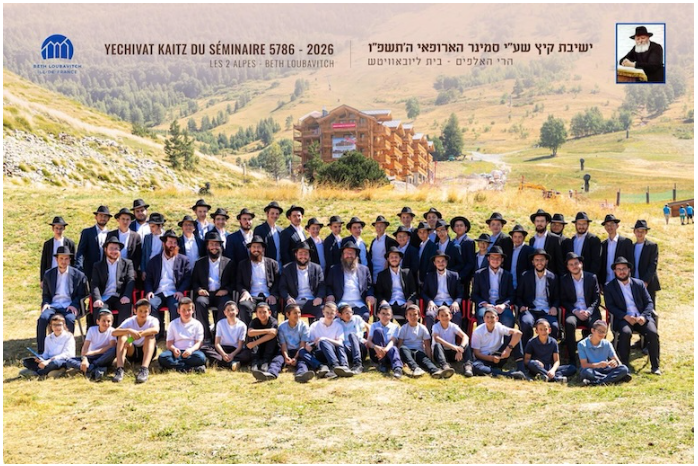 In mid-August, a video filmed at the Les Deux Alpes resort in Isère—located at the gateway to the Écrins massif—went viral on X. It shows a shopkeeper leaning against the counter of her refreshment stand, telling an Orthodox Jewish man: “The Jewish community—there are too many of you. At a certain point, it becomes too much for people.”