As the man who righteously ran for the White House on the most anti-war platform of any Republican nominee this century, the president wanted to use diplomacy, not missiles, to deal with Iran. He said so on Thursday.
“I don’t want [Israel] going in because I think [an attack] would blow” America’s opportunity to reach a nuclear deal with Tehran, the president told the press before the Israelis did precisely that.
He also made his wishes clear to Benjamin Netanyahu, reportedly telling the prime minister as recently as last week to stop pushing another war in the Middle East.
So how did Netanyahu react? Did he pause and think that maybe, considering America dumps fortunes of taxpayer dollars into Israel each year, he should show its leader some respect, adhere to his wishes, and not hijack his negotiations by launching a strike before they concluded? You know the answer. He committed an act of war, bombarding the Islamic Republic with dozens of missiles, striking its top nuclear facility, and killing members of its leadership brass. Thanks to that, U.S. troops soon may die, and the chances of America and Iran reaching a deal any time soon feel microscopic.
Regardless of how you feel about Israel, and we happen to think it’s a nice place to visit, it’s hard to see that behavior as the kind of thing a “special ally” of America would do. They went out of their way to spoil our diplomacy, and we paid them to do it. Doesn’t that strike you as backward?
https://www.theoccidentalobserver.net/wp-content/uploads/2018/06/TOO-Full-Logo-660x156-1.png00Kevin MacDonaldhttps://www.theoccidentalobserver.net/wp-content/uploads/2018/06/TOO-Full-Logo-660x156-1.pngKevin MacDonald2025-06-16 11:42:362025-06-16 11:42:36Is This the Behavior of an Ally?
Also, From an Israeli-centered email list. Zaka Tel Aviv:
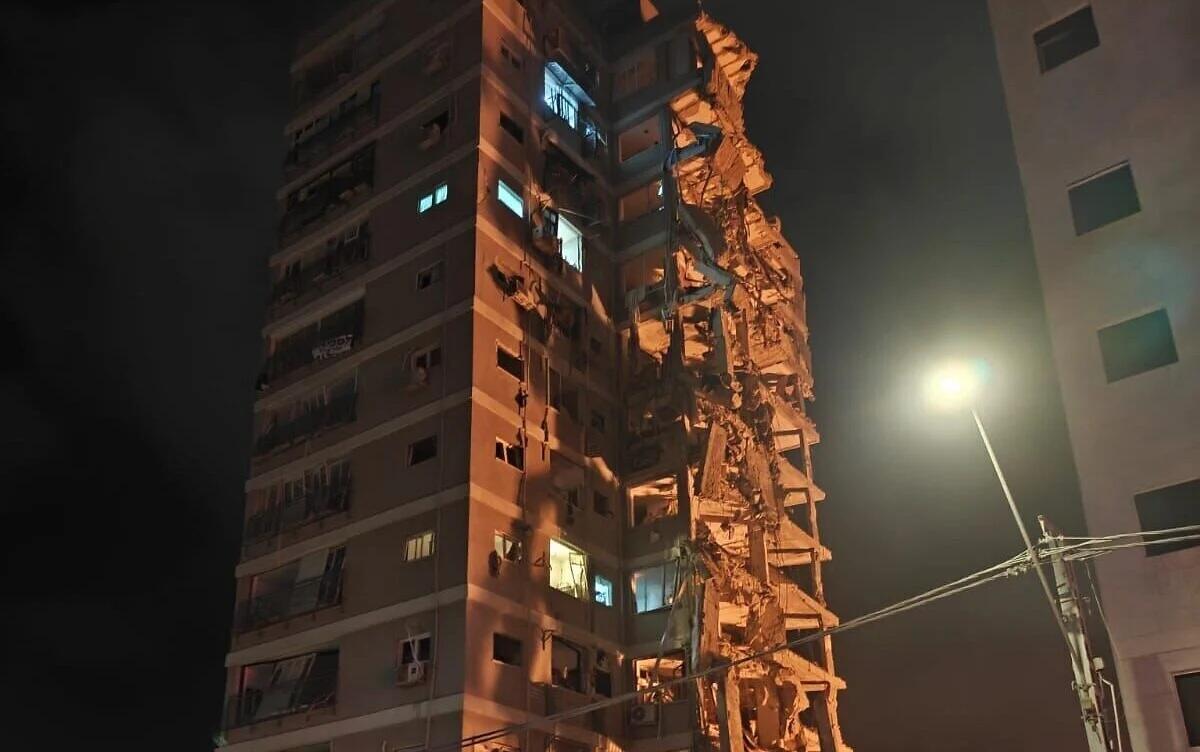
For the past 33 hours our volunteers have been digging through rubble in Bat Yam after a direct hit by an Iranian missile. So far, our teams have recovered six bodies: a 60‑year‑old woman, a 70‑year‑old man, a 10‑year‑old boy, an 8‑year‑old girl, a 55‑year‑old woman, and an 18‑year‑old teen. We continue the search for others who may still be trapped alive.
This tragedy is a part of an unprecedented attack of hundreds of ballistic missiles and drones targeting Israel since Friday. According to the latest information, the Bat Yam building collapse resulted in at least 35 people reported missing, hundreds are injured, and additional damage to 61 nearby buildings. In addition to our efforts to save those who are stuck under rubble, our teams have also established a makeshift mortuary to ensure victims are handled respectfully before transfer for forensics.
Trump showing some spine against Israeli demands. Surprising.
In the past 48 hours, Israel has asked the Trump administration to join its war effort, per Axios
Israel seeks help targeting & destroying the fortified Fordow uranium enrichment site
Axios says the Trump administration is so far rejecting the Israeli request
But if Fordow remains intact, Israel’s mission to dismantle Iran’s nuclear program will be considered a failure
AJ: At least 80 people – including 20 children – have been killed in Iran and four in Israel, with hundreds wounded on both sides in the ongoing tit-for-tat attacks.
Axios underscores that “Israel lacks the bunker buster bombs and large bomber aircraft needed to destroy Iran’s Fordow uranium enrichment site, which is built into a mountain and deep underground. The U.S. has both within flying distance of Iran.”
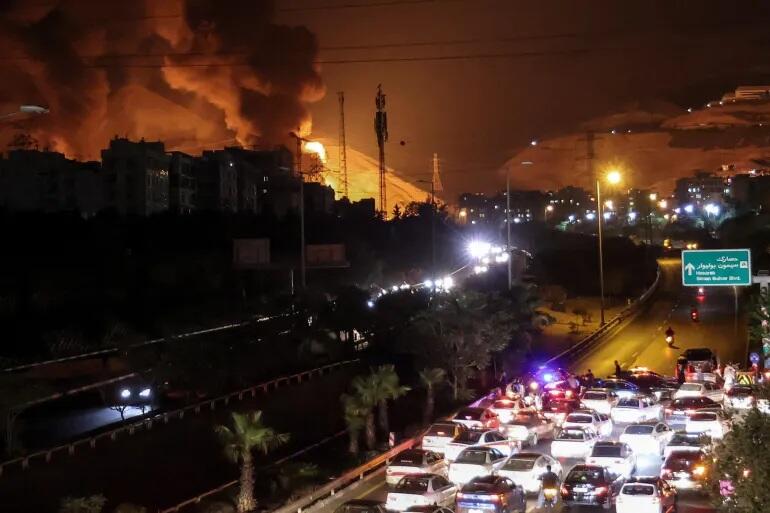
Meanwhile, the images coming out of Iran show unprecedented and shocking scenes of oil refineries burning uncontrollably while nearby highway traffic has been forcibly stopped…
Via AFP
Reports of an Iranian hypersonic missile strike on Haifa earlier:
And this stunningly close and at a good angle video shows major impact in Tel Aviv:
Some regional accounts are speculating this was a hypersonic strike on Tel Aviv:
These missiles are clearly causing significant damage in Israel — an unprecedented first:
TOI: Damage seen in a building in Bat Yam, on Israel’s Mediterranean Sea coast, following an Iranian missile barrage, early June 15, 2025
* * *
Latest updates (1850ET):
An unconfirmed Israeli airstrike has targeted Iran’s defense ministry headquarters, causing minor damage.
The Israeli Air Force reportedly bombed the Shahran oil depot near Tehran, Iranian state media reports.
Two Israeli citizens have been arrested on suspicion of carrying out security offenses under instructions from Iran.
Iran struck a two-story home in Tamra, east of Haifa, killing three.
Jordan has suspended all flight operations in its airspace until further notice
Several missiles were observed streaking above Jerusalem on Saturday night
Israel also carried out airstrikes in Yemen Saturday night, aiming to eliminate Abdul Malik al-Houthi, a senior Houthi military leader
Al Jazeera, citing Iran’s Tasnim news agency, reported that an Israeli airstrike targeted the country’s defense ministry headquarters in Tehran on Saturday evening, causing minor damage to one of its buildings
“[A]n attack on Tehran this evening by the air force of the Zionist regime, the headquarters of the defence ministry was targeted. One of the headquarters’ buildings was lightly damaged,” the state news agency reports.
The Iranian government did not comment on the reported strike.
Additionally, Iran’s Islamic Revolutionary Guard Corps (IRGC) claimed its missiles and drones targeted fighter jet fuel production facilities and energy supply centers in Israel, according to a statement reported by state media. The IRGC warned that its “offensive operations will continue more fiercely and widely” if Israel’s actions persist.
The IDF has not confirmed the attack.
* * *
Several missiles were observed streaking above Jerusalem on Saturday night, a witness told Reuters, as Iran launched another direct assault on Israel.
The IDF confirmed that missiles fired from Iran had been detected, with defense systems actively engaged to intercept them.
“Upon receiving an alert, the public is instructed to enter a protected space and remain there until further notice,” the IDF said in a statement, Reuters reports. The IDF did not comment on possible injuries or damages.
Meanwhile, Israeli authorities have arrested two citizens suspected of carrying out security offenses under instructions from Iran, officials told the Jerusalem Post. A gag order has been issued on further details, according to Channel 12’s Amit Segal.
* * *
Jordan has suspended all flight operations in its airspace until further notice due to escalating tensions between Israel and Iran, the Guardian reported, citing Jordan’s state news agency. Similarly, the Syrian Civil Aviation Authority announced a temporary closure of Syrian airspace to civilian flights, according to SANA.
* * *
The Israeli Air Force reportedly bombed the Shahran oil depot near Tehran, Iranian state media reports. The IDF said not officially commented on the alleged strike. The purported attack comes after Iranian media said Israel struck on the South Pars field in the southern Bushehr province.
The strikes have disrupted electricity supply in the area, though the full extent of the damage remains unclear. The Israel Defense Forces have not yet commented on the operation.
* * *
Iran confirmed an Israeli airstrike struck the Shahran oil depot but said the situation was “fully under control,” according to SHANA, the news agency of Iran’s oil ministry, Reuters reports. The state media outlet reported that the targeted tank contained a limited fuel volume. No further details on damage or casualties were disclosed.
* * *
Israeli Defense Minister Israel Katz wrote on X, “Tehran is ablaze” amid reports of the strike on the oil depot.
* * *
Update (1713ET): ‘Hundreds’ of Iranian missiles were launched at the Israeli cities of Tel Aviv and Haifa – which Iran described as ‘cluster missiles’ in what was the fifth salvo today.
Iran launched shortly after Israeli Air Forces completed “a wave of strikes against military and strategic assets, nuclear program sites and high-ranking figures” according to a Saturday evening statement by the IDF. The latest Iranian launch came after Iranian state TV said ‘heavy and destructive’ attacks against Israel were expected within hours.
Air raid sirens could be heard in Haifa and northern Israel.
It appears that Israel intercepted most of the rockets, though some got through – as footage has been posted on social media of a refinery on fire in Haifa.
“At this hour, Israeli Air Force pilots continue to conduct widespread strikes across various regions in Iran — an ongoing operation lasting nearly 40 hours and targeting over 150 objectives,” said IDF spokesman Brig. Gen. Effie Defrin, who added that protective measures will remain in effect.
According to the Times of Israel, one of the missiles hit a two-story home in Tamra, east of Haifa, killing one woman and injuring 13 others.
The death toll from the Iranian ballistic missile strike on a two-story home in Tamra, east of Haifa, has climbed to three, first responders told the Times of Israel. A 20-year-old woman was killed when missile directly struck her home, according to authorities. Firefighters extracted four individuals from a four-story building in the area, but two were pronounced dead at the scene, according to the Jerusalem Post.
Meanwhile in Iran…
Israel also carried out airstrikes in Yemen Saturday night, Israel’s military carried out airstrikes in Yemen on Saturday night, aiming to eliminate Abdul Malik al-Houthi, a senior Houthi military leader, according to Israel Defense Forces (IDF) sources cited by the Jerusalem Post.
The operation’s outcome remains uncertain, with one Israeli official tell the Israeli publication, “We will soon know if it succeeded.”
The IDF has not issued an official statement on the airstrike.
The airstrike in Yemen comes as the IDF continues conducting strikes on targets in Tehran while intercepting a barrage of ballistic missiles launched from Iran, the IDF said.
Earlier, the International Atomic Energy Agency announced on Saturday that there was “no damage seen” at the Fordow Fuel Enrichment Plant or at the Khondab heavy water reactor under construction in Iran. There has also been no further damage at the Natanz nuclear plant since Friday.
* * *
Update(1300ET): Israel’s military on Saturday has been busy touting that its warplanes have total air superiority over Western Iran and the capital area, as the Islamic Republic’s defenses have been largely degraded and destroyed. A senior IDF military official has been cited in local media as saying very significant damage has been inflicted on key nuclear sites and that the IDF will “continue”.
“Since the beginning of the operation, Iran’s nuclear project has suffered heavy blows in two main areas: Damage to the production of the weapon core through strikes on uranium enrichment and conversion sites in Natanz and Isfahan [and] damage to the regime’s weaponization group through the elimination of nine nuclear scientists with unique knowledge and experience in developing the nuclear detonation device,” the official said. And further that “all the scientists eliminated in the opening strike had, over the years, been involved in developing the nuclear detonation device.”
The CIA at this moment still assesses that Iran does not produce a bomb, and was likely not actively seeking it. Iran’s latest response is as follows:
“This aggression pushes the region into a dangerous cycle of violence,” Iranian Foreign Minister Abbas Araghchi says during a call with his Chinese counterpart Wang Yi, according to a statement from his ministry. “Iran has responded and will respond in a firm manner to the barbaric actions of the Zionist regime.”
Netanyahu is meanwhile maintaining that the has the “clear support” of US President Donald Trump, in a new televised address:
In an English video statement, Prime Minister Benjamin Netanyahu says Iranian leaders are “packing their bags” amid Israel’s airstrikes.
“I’ll tell you what would have come if we hadn’t acted. We had information that this unscrupulous regime was planning to give the nuclear weapons that they would develop to their terrorist proxies. That’s nuclear terrorism on steroids. That would threaten the entire world,” he says.
He adds that the operation has the “clear support” of US President Donald Trump.
“Our enemy is your enemy… We’re dealing with something that will threaten all of us sooner or later. Our victory will be your victory,” Netanyahu says, wishing the US leader a happy birthday.
“This is what Israel is doing with the support, the clear support of the president of the United States, Donald Trump, and the American people and many others in the world.”
At least 80 people – including 20 children – have been killed in Iran and four in Israel, with hundreds wounded on both sides in the ongoing tit-for-tat attacks.
US President Donald Trump has lauded Israel’s premeditated assault and warned of much worse to come unless Iran quickly accepts the sharp downgrading of its nuclear programme.
Continuing Iran-US nuclear talks is unjustifiable while “barbarous” Israeli attacks persist on the country, Iranian Foreign Minister Abbas Araghchi says.
The Israeli military says its air strikes on Iran killed more than 20 Iranian army and Revolutionary Guards commanders.
Israel’s latest attacks on an Iranian gas field takes tensions to a different level
* * *
Overnight has seen the continual trading of tit-for-tat missile salvos between Israel and Iran, with Israeli fighter jets busy over western Iran, where they’ve claimed to have achieved complete domination of the skies after taking out anti-aircraft missile batteries.
Images of large-scale destruction have emerged from both capitals, with Israeli authorities saying at least four citizens have been killed – though casualty figures could be much higher amid an ongoing emergency response – and Iran says Israeli attacks have killed at least 78, including women and children, and wounded over 320 others.
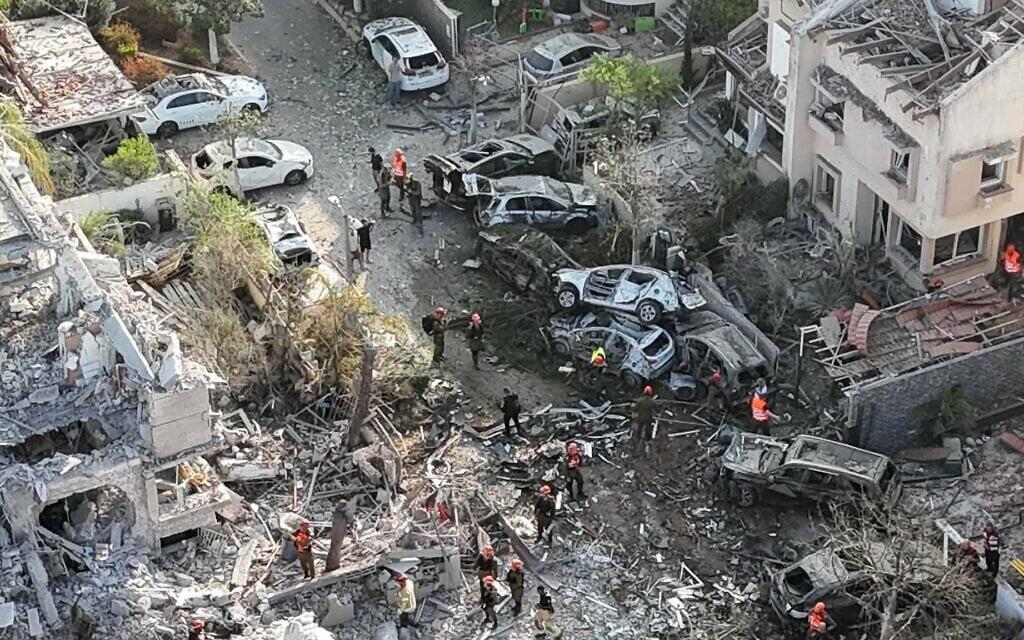
Destruction in Rishon Lezion following an Iranian ballistic missile attack, which killed at least two and injured dozens more, TOI.
Israel has shared footage of successful aerial attacks on Iran’s ballistic missile launchers in some cases, while the IDF has announced that 70 Israeli Air Force fighter jets participated in the overnight operation in Tehran to establish “aerial freedom of action” over the Iranian capital.
Some 40 sites were targeted, including air defense systems, IDF Spokesman Brig. Gen. Effie Defrin has said. Israeli jets were able to fly over and around the capital for some two-and-half hours.
“The dozens of aircraft are flying freely over Tehran, thanks to the opening blow that removed the threat of Iranian air defense systems,” he declared. Characterizing this as the deepest operation the Israeli Air Force (IAF) has ever been involved in over Iran, he announced:
“Tehran is no longer immune; the capital is exposed to Israeli strikes.”
Israeli jets have yet to strike all of Iran’s nuclear facilities, and Prime Minister Netanyahu has warned that this could continue for several days more. There is serious damage reported at Natanz nuclear site. There have been conflicting reports over whether there is any radiation or chemical contamination at the site.
Some sections of the Isfahan site have been damaged, the IDF has said, while the other key site of Fordo has yet to be targeted.
Important, Israel says that nine nuclear scientists have been killed as a result of Friday aerial operations. Clearly Israel is going for leadership decapitation of military and nuclear programs.
Impact scene from Tel Aviv:
Still, even with Iran’s military capabilities now being steadily degraded, the Islamic Republic has to some degree shown it can regroup and hit back. Israeli media has described a state of panic on the streets, and in some cases residential areas have been demolished:
Israelis on Saturday described the fear, chaos and confusion as several Iranian missiles slammed into houses and apartments in central Israel overnight, causing widespread destruction, killing three people and wounding dozens.
Warning sirens sent millions of people rushing for safe rooms and bomb shelters as Iran fired several waves of missiles in response to Israeli strikes on its military leadership and nuclear program. While the IDF said most were intercepted, several missiles — apparently armed with large explosive warheads — slammed into homes in Tel Aviv, Ramat Gan and Rishon Lezion.
“We shut the door, started watching the news through the computer, and suddenly there was a boom so loud that the whole building teetered,” Tali Horesh, resident of a Tel Aviv high-rise that was hit Friday night, told the Ynet news site.
Meanwhile President Trump has been nowhere to be seen, and certainly hasn’t faced reporters’ questions on where the United States stands in all this.
Is Israel committed to full war for regime change in Iran at this point?
developing…
https://www.theoccidentalobserver.net/wp-content/uploads/2018/06/TOO-Full-Logo-660x156-1.png00Kevin MacDonaldhttps://www.theoccidentalobserver.net/wp-content/uploads/2018/06/TOO-Full-Logo-660x156-1.pngKevin MacDonald2025-06-15 08:54:052025-06-15 08:54:05Trump Shows Some Spine—Rejects Netanyahu’s Request To Join War, As Israel Needs Large US Bunker Buster Bombs
This gives further credence to the view that Trump was trapped by Israel into supporting their war because of the power of the Israel Lobby in the U.S. Trump would like it to end but the Israelis are in the driver’s seat and they will not stop. I rather doubt that Israel should be concerned at all. Trump doesn’t have a politically viable choice. From the New York Timestoday:
Israel’s military spokesman, Brig. Gen. Effie Defrin, said Israel was not ceasing its attacks on Iran “for a moment.”
“At this hour, too, we continue to strike dozens of additional targets in Tehran. We are deepening the damage to Iran’s nuclear program and its military capabilities,” he said in a televised address, without elaborating.
The path to diplomacy appears limited after officials called off talks set for Sunday between Tehran and Washington on the future of Iran’s nuclear program. …
Expanding scope of attacks: Israeli strikes, initially focused on nuclear sites, air defenses and military targets, are also now targeting the energy industry that underpins much of Iran’s economy. The Israeli military’s chief spokesman said its forces had achieved “freedom of action” in the skies over Tehran, indicating they could strike targets without expecting major interference.
Israel’s leadership is concerned that international pressure may force the IDF to stop striking Iran before its mission is complete, an Israeli security source told Jewish Insider on Sunday.The source spoke a day after President Donald Trump wrote in a Truth Social post that “this war in Israel-Iran should end,” and continued to express hope that a deal could be reached between Washington and Tehran, even as the next round of negotiations between the U.S. and Iran over Tehran’s nuclear program was postponed.The president’s remarks came two days after Israel began targeting Iranian nuclear and military sites and Tehran retaliated by striking sites across Israel, including residential areas.“We want the U.S. to understand our point of view,” the source said. “The goal is for Iran not to have capabilities that endanger the State of Israel and its existence.”“If we’re paying a maximal price” — 13 fatalities, 380 injured in 22 missile impact sites as of Sunday morning — “we should get maximal achievements. That is the approach,” the source added, saying that Iran’s nuclear program should not be destroyed and not “wounded.”
The official aim of Operation Rising Lions, authorized by Israel’s Security Cabinet on Thursday night, is to damage Iran’s nuclear and ballistic missile programs.The goal did not include toppling the Iranian mullahs’ regime, in part because Israel would be unlikely to have “international legitimacy” to do so, the Israeli source said. In addition, the cabinet did not say its goal was the total elimination of Iran’s nuclear program, because it wanted to set attainable goals.
https://www.theoccidentalobserver.net/wp-content/uploads/2018/06/TOO-Full-Logo-660x156-1.png00Kevin MacDonaldhttps://www.theoccidentalobserver.net/wp-content/uploads/2018/06/TOO-Full-Logo-660x156-1.pngKevin MacDonald2025-06-15 07:23:112025-06-15 07:41:04Jewish Insider: Israel concerned U.S. will push for end of Iran operation before its aims are met
It’s not just Soros et al. The massively subsidized left: A political engine for the open-borders left was given $34 million by the government
Los Angeles has erupted into violence and at the center of it stands a cast of progressive activists and political operatives – some generously bankrolled by California taxpayers.
One organization in particular has emerged as a key player: the Coalition for Humane Immigrant Rights, or CHIRLA. The LA-based nonprofit has long pushed radical positions on immigration – for example, in 2018, it spearheaded a campaign to abolish ICE. Its stated mission is to “build power, transform public opinion, and change policies” to achieve “full human, civil, and labor rights.”
Critics might describe CHIRLA instead as a well-funded political engine for the open-borders left.
And taxpayers might question the source of that funding. According to its 2023 audit, CHIRLA received $34 million from the government, with 96 percent from the State of California. State funding of $32.5 million in 2023 represented a dramatic increase from $11.4 million in 2022.
CHIRLA leads the LA Rapid Response Network (LARRN), a hotline launched in January to collect tips about ICE activity and dispatch activists to intervene. Mayor Karen Bass herself has admitted that the city relies on this network to monitor federal immigration enforcement.
The LA protests kicked into high gear after David Huerta, president of the Service Employees International Union (SEIU) in California, was arrested for allegedly obstructing ICE officers. Huerta is a major political player in the state, leading a union of 750,000 workers that is a major donor to the Democratic Party. Though his spokesperson claimed he was merely observing, video released by the US Attorney appears to show him blocking an ICE vehicle.
CHIRLA sprang into action, organizing a rally to protest Huerta’s arrest. Demonstrators waved signs from the Party for Socialism and Liberation, a Communist group, and chanted familiar slogans: “No justice, no peace!” and “Stand up, fight back!” CHIRLA’s executive director referred to Huerta as her “brother,” highlighting the group’s close ties to organized labor.
Mayor Bass joined posted on X, “We will not stand for this” – “this” referring not to street violence, but to ICE enforcing federal law. In Spanish, she was more direct: “We are not going to permit these actions.”
Bass has a long-standing relationship with CHIRLA. Just last year, she congratulated the organization for acquiring a new building to continue advancing “justice and full inclusion for all immigrants.” In August, her office issued a press release bragging about securing federal funds for CHIRLA.
Roughly 37 percent of CHIRLA’s expenditures last year went to legal services, including representing both legal and undocumented immigrants in deportation proceedings. Whether California taxpayers should foot the bill for such services is an open question.
Dr. Rosemary Kelanic is the director of the Middle East program at Defense Priorities.
The United States is alarmingly close to getting dragged into yet another military entanglement in the Middle East, this time by Israel — which is looking less and less like a true friend.
Israel’s surprise attack on Iran on Friday has almost certainly blown up any chance of reaching the nuclear deal the United States was pursuing for months. Prime Minister Benjamin Netanyahu of Israel has also recklessly endangered the 40,000 U.S. troops deployed in the region, putting them at immediate risk of Iranian retaliation, which could draw America into a war with Iran.
However Iran interprets our role in the attacks, Israel appears to have acted without giving the United States enough warning to take adequate precautions. Though President Trump acknowledged on Thursday that an Israeli attack might be imminent, the United States only began voluntary evacuations of military families and nonessential embassy personnel on Wednesday afternoon, while the State Department began drawing up plans for mass evacuation of U.S. citizens mere hours before the attack.
Mr. Trump, and all Americans, should be furious. Now Mr. Netanyahu and hawkish voices in the United States will almost certainly put pressure on Mr. Trump to assist Israel in destroying Iran’s nuclear enrichment sites, something that will be difficult for the Israeli military to do on its own and that even the U.S. military might be unable to accomplish. It would be the worst mistake of Mr. Trump’s presidency.
A war with Iran would be a catastrophe, the culminating failure of decades of regional overreach by the United States and exactly the sort of policy that Mr. Trump has long railed against. The United States would gain nothing from fighting a weak country halfway around the globe that causes problems in its region but does not pose a critical security threat to us. And the United States would lose much: most tragically, the lives of U.S. service members, along with any chance of escaping our tortured past in the region.
Americans of all political stripes oppose war with Iran, presumably because they understand the two big lessons from U.S. experiences fighting in the Middle East over the past 25 years. Not only do preventive wars not work; they also have unintended consequences with lasting impact on America’s national security.
The misguided 2003 invasion of Iraq was also a war to forestall nuclear proliferation. Disaster ensued, and not just because Saddam Hussein didn’t have weapons of mass destruction. The U.S. invasion triggered chaos and civil war in Iraq and tipped the regional balance of power toward Iran by allowing it to establish new proxy militias in the country. It also led to the eventual rise of ISIS.
There is no reason to think that a war with Iran would go any more smoothly — and it could turn out considerably worse. If drawn in, the U.S. military’s involvement would likely begin with airstrikes rather than a ground invasion, given Iran’s large size and forbidding mountainous terrain. But as the fruitless $7 billion campaign against the Houthis showed, airstrikes are exorbitantly expensive, entail significant risks of American casualties and are likely to fail anyway. The United States never even gained air superiority over the Houthis, a ragtag militant group with the resource base of an impoverished country, Yemen, over which it couldn’t even consolidate control.
Iran is far more capable of defending itself than the Houthis are. If airstrikes fail to destroy Iran’s nuclear capabilities, pressure would dramatically increase on U.S. forces to pair an aerial barrage with a ground component, perhaps something akin to the “Afghan model” the United States used to topple the Taliban. We know how that went. Despite the intent to keep that war small and brief, an engagement that started with just 1,300 U.S. troops in November 2001 snowballed into a disastrous 20-year occupation that reached some 100,000 U.S. troops at its height in 2011 and ultimately caused the deaths of 2,324 U.S. military personnel.
Even a best-case scenario, in which the United States helps destroy the majority of Iranian nuclear sites, would only delay Iran’s progress toward developing a bomb. War cannot prevent weaponization in the long term, which is why either diplomacy or benign neglect have always been better choices for handling Iran. Its enrichment program is over 20 years old, spread across multiple sites in the Islamic Republic, and employs untold thousands of scientists — 3,000 at the Isfahan facility alone. It’s probable that enough Iranian scientists know how to enrich weapons-grade uranium that Israel would not be able to kill them all, despite its airstrikes explicitly targeting them.
Assuming some continuity of technical knowledge persists, Iran would likely be able to rebuild its nuclear facilities quickly. And a defiant Iranian regime would no doubt be determined on weaponizing to deter future Israeli and U.S. attacks.
That likelihood, coupled with Israel’s insistence that Iran must never get the bomb, suggests that Mr. Netanyahu’s theory of victory could be premised on an underlying logic of regime change. Supporting that point, Israel appears to be engaging in strikes aimed at disabling the regime’s leadership in Tehran.
The Israeli leader has long embraced the desirability of regime change in Iran, and hinted in September that it could happen “sooner than people think.” As a French diplomatic source told Le Monde last fall, “The idea is circulating in certain circles that perhaps the Israelis are leading us toward a historic moment, that this is the beginning of the end for the Iranian regime.” The fall of Syria’s Bashar al-Assad in December intensified speculation about similar upheaval in Iran. Some U.S. policy hawks and members of the Iranian diaspora now claim regime change is becoming inevitable; as Mr. Trump’s former national security adviser John Bolton put it, “It’s now time to think of the campaign for regime change in Iran.”
That is magical thinking. History has shown again and again that bombing a country turns its people against the attacker, not against their own regime, despite its deep unpopularity. Images already show Iranians demonstrating in the streets — not to oppose their government but to urge retaliation against Israel. And even if the regime were to be deposed, what then? For all the Iranian government’s faults, a bad government is preferable to the chaos of no government. Do we really want to turn Iran into a failed state, like Iraq or Libya after the United States attacked those countries?
Mr. Trump often touts his record during his first term of having started no new wars. That is a record worth turning into a legacy. He must resist pressure from Mr. Netanyahu and hawks at home to avoid tragic, irreparable self-harm.
https://www.theoccidentalobserver.net/wp-content/uploads/2018/06/TOO-Full-Logo-660x156-1.png00Kevin MacDonaldhttps://www.theoccidentalobserver.net/wp-content/uploads/2018/06/TOO-Full-Logo-660x156-1.pngKevin MacDonald2025-06-14 12:07:102025-06-14 12:07:10A U.S. War With Iran Would Be a Catastrophe
Wir werden Tel Aviv ausradieren [We will wipe out Tel Aviv.] From a French website hostile to Israel in English translation, courtesy of Francis Goumain.
’Promise kept 3′, Iran responds to the Israeli attack. “Unprecedented images in Tel Aviv” Two F-35s shot down, an Israeli pilot captured.
Israel, one of the few countries allowed to buy and use this aircraft, received its first F-35 jets around the year 2016. These were provided by the United States under a program called the Foreign Military Sales (FMS). Israel later developed its own version of the aircraft, known as the F-35I, which includes special changes to better suit its military needs.
The F-35I is equipped with powerful technology that helps it avoid enemy radars and perform deep missions with low chances of being shot down. Because of these features, it is seen as a major part of Israel’s air power.
That is why the downing of not one, but two of these jets by Iran is a very big deal. It shows that even the most advanced aircraft in the world are not impossible to stop. …
This development has sent shockwaves through military experts worldwide. It challenges long-held beliefs about the F-35’s invincibility and raises questions about how future air battles might look in a world where stealth is no longer a guaranteed shield.]
It was not until 18 hours later that Iran responded to the large-scale offensive launched since the dawn of this Friday by the Zionist entity against its territory.
Baptized ‘Promise kept 3’, in the continuity of the previous two that had been carried out in 2024, it was launched at the beginning of the evening, directly after a speech to the Iranian people by the supreme leader of the revolution Imam Khamenei in which he stated that “the Zionist entity will undergo a difficult punishment.”
Iranian media reported four waves of ballistic missiles launched at four points during the evening. The Israeli media have mentioned two of them. There are 200 ballistic missiles, according to the public Israeli broadcasting company Kan.
Missiles bypassed the Iron Dome and fell in 7 areas of Tel Aviv. Israeli channel 13 reports several dozen damaged buildings and cars. Nearly 7 missiles crashed on Gush Etzion in central Israel
Israeli media reveal that 9 regions were targeted by Iranian missiles, including Haifa, Beersheba (Bir as-Sabaa)
The images of destruction in the center, especially in Tel Aviv, are unprecedented, commented Israeli media according to which they were caused both by Iranian missiles and by the fragments of Israeli interception missiles.
There were reportedly 40 injured, according to Israeli relief workers.
It is difficult to identify the places that were hit, especially since Israel asked people not to photograph them.
However, the media had reported that the Ministry of Defense building was hit twice. And a fire broke out near him.
The spokesperson of the occupation army was in the middle of a press conference when the Iranian response was launched. He had to interrupt it. The Israelis had been asked to hide in the shelters before the missiles arrived. While the alert sirens sounded throughout the territory.
Ballistic missiles were seen flying over the Galilee from southern Lebanon.
In its statement, the Islamic Revolutionary Guard Corps (IRGC) said it had launched “its overwhelming and precise response against dozens of targets, military centers and air bases of the usurping Zionist regime in the occupied territories.”
The missiles were fired from several Iranian provinces, report the Israeli media which also broadcast images of missile launches from Iranian submarines.
During the day, Israel launched dozens of air raids via 200 fighter jets that targeted nuclear and ballistic facilities in Tehran, Tabriz, Hamadān, Mashhad, and Bushehr. A hundred targets were targeted.
According to the Iranian media, they targeted among others:
+ the Natanz uranium enrichment plant in Isfahan province. According to the deputy director of the Atomic Energy Organization of Iran, the damage caused is in the buildings on the surface. The International Atomic Energy Agency (IAEA) confirmed that the important uranium enrichment site at Natanz had been targeted, but stressed that the level of radiation in the area had not increased.
10 other regions in this province had also been subject to raids.
+ the region of the Fordo nuclear reactor
+ the capital Tehran where the Milad tower was damaged, and were targeted among others the Qouy Nasr neighborhood and Zawiyat al-Nasr
According to official figures, 78 people were martyred and more than 320 injured in Tehran.
+ Tabriz airport in the north of the country where a fire broke out and strong explosions occurred with plumes of black smoke
+ the Nojeh air base, military centers in Nahawand, the two airports Mehr Abad and Bouchehr
+ Qasr Chrine city and Kangaour city in the province of Kermânchâh.
+The holy city Qom
+ the border crossing in East Azerbaijan where a border guard fell martyred
+ Local media reported an Iranian soldier killed in a strike on a military base in the north-west near Iraq.
While the Israeli army also claimed to have eliminated missile launchers and air defenses, an air battle occurred in the evening between Israeli fighter jets and Iranian air defense over the capital Tehran.
The Iranian army later reported shooting down two F-35s and capturing a female pilot who ejected from one of them. The fate of the second pilot has not been specified.
Very disappointing. At about the same time as Trump was involved in giving the Iranians a false sense of security despite his supposed break with Netanyahu and his many anti-war declarations (see Glenn Greenwald’s previously posted video), he backtracks on immigration enforcement. The long-term result will be further demographic shifts toward Third Worldism and further deterioration of White political power as the illegals become citizens, get married, have citizen children, etc. Somehow parts of the country that have thus far escaped the onslaught manage to find workers for farms, restaurants, and hotels.
Yet another example of the weakness of democratic systems where politicians fail to take a long-term view of the country’s interests because they are subject to pressure from various groups, particularly from billionaire donors like Ike Perlmutter and Miriam Adelson (Adelson gave Trump $100 M in 2024 and Perlmutter has donated millions for Trump’s campaigns; both Perlmutter and Adelson reportedly called Trump to urge U.S. involvement in Israel’s war against Iran).
My optimism about Trump 2.o has given way to cynicism and doubt—which seem to be the only sane default position on American politics. Nothing will change despite all the promises.
The abrupt pivot on an issue at the heart of Mr. Trump’s presidency suggested his broad immigration crackdown was hurting industries and constituencies he does not want to lose.
The Trump administration has abruptly shifted the focus of its mass deportation campaign, telling Immigration and Customs Enforcement officials to largely pause raids and arrests in the agricultural industry, hotels and restaurants, according to an internal email and three U.S. officials with knowledge of the guidance.
The decision suggested that the scale of President Trump’s mass deportation campaign — an issue that is at the heart of his presidency — is hurting industries and constituencies that he does not want to lose.
The new guidance comes after protests in Los Angeles against the Trump administration’s immigration raids, including at farms and businesses. It also came as Mr. Trump made a rare concession this week that his crackdown was hurting American farmers and hospitality businesses.
The guidance was sent on Thursday in an email by a senior ICE official, Tatum King, to regional leaders of the ICE department that generally carries out criminal investigations, including work site operations, known as Homeland Security Investigations.
“Effective today, please hold on all work site enforcement investigations/operations on agriculture (including aquaculture and meat packing plants), restaurants and operating hotels,” he wrote in the message.
The email explained that investigations involving “human trafficking, money laundering, drug smuggling into these industries are OK.” But it said — crucially — that agents were not to make arrests of “noncriminal collaterals,” a reference to people who are undocumented but who are not known to have committed any crime.
The Department of Homeland Security confirmed the guidance.
“We will follow the president’s direction and continue to work to get the worst of the worst criminal illegal aliens off of America’s streets,” Tricia McLaughlin, a department spokeswoman, said in a statement.
For months, Mr. Trump and his aides have said they would target all immigrants without legal status in the United States to make good on his campaign promise for mass deportations. While the administration came into office saying it would initially target undocumented immigrants with criminal records, it has in recent weeks expanded to raiding work sites and sweeping up other undocumented immigrants broadly.
An Immigration and Customs Enforcement bus leaving after a raid on Glenn Valley Foods in Omaha on Tuesday.Credit…Nikos Frazier/Omaha World-Herald, via Associated Press
On Thursday, Mr. Trump acknowledged that the crackdown might be alienating industries he wanted to keep on his side.
“Our great Farmers and people in the Hotel and Leisure business have been stating that our very aggressive policy on immigration is taking very good, long time workers away from them, with those jobs being almost impossible to replace,” he said on social media.
Mr. Trump posted after Brooke Rollins, the secretary of agriculture, informed him of farmers who were concerned about the ICE enforcement affecting their businesses, according to a White House official and a person familiar with the matter. Mr. Trump has for decades owned luxury hotels, an industry with a strong immigrant labor force.
A former Trump administration official added that throughout his first term, Mr. Trump often heard concerns from some Republicans from rural states about how the immigration crackdown would hurt the agricultural industry.
The decision to scale back operations at work sites comes at a crucial time, and the implications of the guidance are still to be determined on the ground. The guidance did not appear to rule out raids at work sites in other industries, like the one at a garment factory in Los Angeles that sparked the protests.
In recent weeks, Stephen Miller, the White House deputy chief of staff, has publicly pushed for a “minimum” of 3,000 arrests per day.
Following Mr. Miller’s comments, arrests shot up to over 2,000 a day last week, and in recent days and weeks, ICE officials have conducted operations at restaurants, factories and business across the country.
One Department of Homeland Security official with knowledge of the email said that agents had felt the pressure for more arrests and that the guidance took them by surprise. Agents were still digesting the long-term implications without a direct signal from the White House about how to carry out the new guidance, the official said.
Mr. King seemed to acknowledge that the new guidance would hurt the quest for higher numbers of arrests.
“We acknowledge that by taking this off the table, that we are eliminating a significant # of potential targets,” he wrote.
https://www.theoccidentalobserver.net/wp-content/uploads/2018/06/TOO-Full-Logo-660x156-1.png00Kevin MacDonaldhttps://www.theoccidentalobserver.net/wp-content/uploads/2018/06/TOO-Full-Logo-660x156-1.pngKevin MacDonald2025-06-14 07:14:372025-06-14 07:22:51Trump Shifts Deportation Focus, Pausing Most Raids on Farms, Hotels and Eateries
We may request cookies to be set on your device. We use cookies to let us know when you visit our websites, how you interact with us, to enrich your user experience, and to customize your relationship with our website.
Click on the different category headings to find out more. You can also change some of your preferences. Note that blocking some types of cookies may impact your experience on our websites and the services we are able to offer.
Essential Website Cookies
These cookies are strictly necessary to provide you with services available through our website and to use some of its features.
Because these cookies are strictly necessary to deliver the website, refusing them will have impact how our site functions. You always can block or delete cookies by changing your browser settings and force blocking all cookies on this website. But this will always prompt you to accept/refuse cookies when revisiting our site.
We fully respect if you want to refuse cookies but to avoid asking you again and again kindly allow us to store a cookie for that. You are free to opt out any time or opt in for other cookies to get a better experience. If you refuse cookies we will remove all set cookies in our domain.
We provide you with a list of stored cookies on your computer in our domain so you can check what we stored. Due to security reasons we are not able to show or modify cookies from other domains. You can check these in your browser security settings.
Other external services
We also use different external services like Google Webfonts, Google Maps, and external Video providers. Since these providers may collect personal data like your IP address we allow you to block them here. Please be aware that this might heavily reduce the functionality and appearance of our site. Changes will take effect once you reload the page.
Google Webfont Settings:
Google Map Settings:
Google reCaptcha Settings:
Vimeo and Youtube video embeds:
Privacy Policy
You can read about our cookies and privacy settings in detail on our Privacy Policy Page.