• MISSION STATEMENT
  • TERMS
  • PRIVACY
The Occidental Observer
  • HOME
  • BLOG
  • SUBSCRIBE TOQ
  • CONTACT USPlease send all letters to the editor, manuscripts, promotional materials, and subscription questions to Editors@TheOccidentalObserver.net.
  • DONATE
  • Click to open the search input field Click to open the search input field Search
  • Menu Menu

General

On Resistance to Replacement by Force

July 5, 2026/16 Comments/in General/by Nick Griffin

On Resistance to Replacement by Force

The Morality of the Coming Long Struggle for the Survival and Dignity of Our Peoples

‘Violence is never the answer’, according to virtually everyone on the ‘right’, particularly when popular anger against one or other of the many evils of mass immigration spills over from words to action. We heard it most recently after the protests in Southampton over the despicable, anti-white behaviour of the police towards Henry Nowak, as they mocked and handcuffed while he bled to death. We hear it every time.

‘Violence achieves nothing’ is how many others express the same sentiment. Which is rather odd, since every scrap of history reminds us that ‘they’ – the various elites who are, or have at times been, our masters, ALWAYS use violence against us at home, and against those whom they deem to be their enemies abroad. The conditioning against violence is for us, not for those who rule us, or for those who enforce their rules.

Those in power routinely use violence, or the threat of violence, against us. And – with the exception of the all too rare elites genuinely influenced by traditional Christian teachings – every concession, every last shred of decency and justice which rulers have granted to their subjects, has been won not by polite requests and obedience to the law, but through violence, or the threat of violence.

All the rights we have already lost to the creeping tyranny of totalitarian liberalism were extracted from former elites by militant struggle, confrontation and martyrdom by our ancestors.

Those few rights which still remain were not given to us out of the goodness of the hearts of kings, popes, archbishops and politicians, but because there were more of ‘us’ than them, because ‘We the People’ organised to turn those numbers into power, and used force or the threat of force – sometimes implicit, often explicit – in order to compel them to do the decent thing.

Rights are never granted, they are taken. And if each generation does not organise to secure them then, sooner or later, they will be taken away. Such is the natural, eternal tension between those with formal and economic power, and the rest of the population.

‘Violence is never the answer’, say those who parrot the containment propaganda with which all citizens are brainwashed throughout their school years, continually reinforced by the elite’s media outlets, and by politicians who lecture us on the sacrosanct nature of peaceful submission, while constantly threatening us with the violence of their police, courts and prisons if we fail to obey their demands.

‘Violence is never the answer’ is at the dark heart of the conditioning process whereby We the People are trained from the start of our schooldays to obey and submit. It is one of the most ridiculous of the control myths they stuff into minds of the children groomed through the ‘education system’ to be obedient citizens. It is, needless to say, closely related to the tale that having a lifetime ration of pencil crosses, to use in elections dominated by plutocratic media outlets and social media algorithms, in some way gives you a say in the running of your country.

But here’s the plain truth: Violence is almost always their answer to their enemies – and, make no mistake, they know far better than we do that we are potentially their most dangerous enemies. This is true not just of the actual physical violence which the state and ruling class deploy through police batons and soldiers’ guns when all other means of persuasion and control fail.

Their courts and prisons are methods of compulsion as well. Their force is ritualised and legitimised by custom, and often by our own agreement, since it is often directed against individuals who thoroughly deserve it. But, if push comes to shove, the ruling regime will empty prison cells of real criminals, in order to free up space for political prisoners and those who dare to resist their nation-killing agenda. Their rule is enforced through violence.

‘Violence is never the answer.’ Really? Let us consider a few historical examples which give the lie to this convenient elite untruth.

Why do we in Britain have a parliamentary democracy under a constitutional monarch? Because we cut the head off one king, chased another out of his kingdom, defeated him, his son and his grandson in a series of rebellions which lasted more than fifty years, and repeatedly slaughtered their supporters.

Did the United States celebrate the 250th anniversary of writing a polite letter to King George which persuaded him of the justice of releasing the colonies from his rule and from the financial death-grip of the Bank of England? Or is the United States an independent nation because American rebels threw tea into Boston harbour and then killed thousands of British soldiers and German mercenaries who were sent to crush them?

For that matter, how did a small group of colonies on the eastern seaboard expand until they stretched ‘from sea to shining sea’? By sitting down with the Red Indians and convincing them that they should stop butchering and scalping white settlers, and that they would be far better off accepting rule from Washington?

The abolition of slavery and the granting of votes to upper-class women before they were given to working-class men were changes advocated by peaceful argument. But that was not the only method used. Slavery was ended on the High Seas by the armed might of the Royal Navy. The Pankhursts and other feminist harridans pressed their case by smashing windows, burning down shops and churches, burning down Arsenal football ground, horsewhipping politicians and inventing the letter bomb.

The extreme physical force employed by the suffragettes is glossed over by the liberals who celebrate their victory, and it is clear that the positive work done by decent women during the First World War was far more important in winning the argument for votes for women than all the mayhem caused by the extremists. But they are liberal icons nonetheless.

Ulster stayed British in the early part of the 20th century not because the majority of her citizens desired it, or voted for it, but because they organised an army of 100,000 men, smuggled in 30,000 Mauser rifles and five million rounds of ammunition in one weekend, and made it clear that, if necessary, they would fight the entire British Empire, in order to resist Irish Home Rule.

On the other side of that fence, Irish independence came not from ballot boxes packed with Sinn Fein votes, but from the rifles, grenades and bombs of the Irish Brotherhood and the IRA. They never defeated the British, but the level of violence the Irish rebels applied, and the way they kept applying it, generation after generation, eventually helped to convince the Westminster elite to grant them the freedom which, more recently, their descendants so carelessly gave away to Brussels.

Coming right up to date, Sinn Fein/IRA now run the government of Northern Ireland. Not because of the reasonableness of their arguments, but because of the damage their bombs did to the City of London, and because the women of their community had more babies than the Prods.

The state of Israel was born out of the genocidal violence launched with the massacre at Deir Yassin. The Arabs weren’t convinced to share their land by gentle debate, but by having their throats cut and their corpses thrown down wells, compelling hundreds of thousands of terrified survivors to flee. The Zionist state was created through psychotic violence, and has been sustained and expanded by it ever since. Did you ever hear a British politician trying to tell the IDF that ‘violence never achieves anything’?

More mundanely, the entire liberal establishment romanticises the Stonewall riots whose violence marked a key point in the long cultural and legal war for the legalisation – and current exalted status – of homosexuality.

The most bestial violence becomes acceptable when the liberals agree with its aims and targets. The same elite who so often tell patriotic dissidents that ‘violence is never the answer’ stood foursquare behind the ANC when Winnie Mandela’s ‘football squad’ militia were busy placing burning tyres round the necks of Africans who refused to support their war against white minority rule.

I could give many more examples, but that should be enough. So let’s leave the final word on the verdict of History to the Communist theorist who was such a strong influence on the ’68 generation and their proteges who now run every institution in our society – Chairman Mao: ‘All political power comes out of the barrel of a gun.’ Actually, as we will see, there are other sources of power, but that is what the left believe.

Force in all its forms determines relations between nations and governments, but also of the balance of power between governments and their subjects. Can you name any government that changed its fundamental direction, any oppressive system which reformed, any rights won by any oppressed people or group, without the use of force?

With the exception of Sweden granting independence to Norway, and the mutually agreed ‘Velvet Divorce’ between the Czech Republic and Slovakia, the answer is ‘no’.

Now, before various fools and low-level touts start screaming ‘fedpost’, let me make one thing very clear: I am not calling for the use of violence. Not against either our oppressors or any of their pet ‘minorities’. Far from it.

In exploring this question in depth, we should start at the very top. If anyone really believes that violence is ‘never the answer’, yet claims to be a Christian, let them consider Jesus. Faced with the stinking corruption of the money-changers and the Sanhedrin’s hangers-on in the Temple, He didn’t waste time debating the problem. Christ didn’t try to convince them to mend their ways with kindly words.

He sat down and spent several hours braiding a cat of nine tails, a ferocious whip, then He rushed in, threw over the tables, and drove the crooks and hypocrites from the House of God with the lash. An act of premediated, calculated, morally inspired, ‘cold rage’.

I am not, however, going to argue that the violent example of our Lord gives us the right to turn to violence whenever we feel that our rights, or the boundaries of fairness, have been trampled upon.

Far from it; a proper understanding of the problems of oppression, resistance and violence tells us that physical violence must always be a last resort. It should also tell us that – even under a ruling elite which has empowered the invasion of our country and turned us into second-class citizens in our own land – we are, at the time of writing, nowhere near that point.

Let us move the discussion on from indoctrination and containment propaganda by doing away with the loaded term ‘violence’. Things will become much clearer if we instead use the neutral term ‘force’.

Next, let us recognise that, when it comes to human relationships, whether oppressing a people, securing rights or suppressing wrongdoing, there are two different categories of force: Physical Force and Moral Force.

They are of course related. In a savage world without rules or concern for consequences, moral force would count for nothing. In the diseased and dangerous world which exists in the brains of Nietzscheans, ‘Might is Right’ and moral force is some sort of weakness.

Strangely, this individualistic, anti-nationalist poison invariably infects the brains of the physically weakest and most mentally delicate specimens. Giving credence to the syphilitic Nietzsche (or, more accurately, to the works edited by his equally disturbed sister) is a vice of soft-handed intellectuals, so let’s recognise that moral force exists, and move swiftly on.

Good governments use moral force – custom, beliefs and institutions whose power rests largely on tradition and consent – to nudge their subjects into conformity with commonly agreed values. In a healthy society with a monocultural base, such moral power is enough to maintain order and good behaviour among the vast majority of the population.

The dual nature of the obligations and restrictions on state and governments are mirrored by those which apply to individuals, local communities and the nation. The state is ultimately subordinate to the nation; no government may place itself above the nation – the collective will of the majority, informed by loyalty to the legacy of the past and tempered by the interest of those still to be born.

In a good state, run for the current and future generations of the people who created it, and based on the customs and morality of their ancestors, citizens freely give their right to self-defence over to it. The right to declare and wage war becomes a matter for the head, rather than the body, of the nation. When a state goes bad, there comes a time when the people can and should take back their right to self-defence.

Similarly, with war, there can come a time when the state and its allies are so perverse, so wicked and so dangerous to the nation that it can become necessary to seek to turn its wars into a civil war, in which the nation overthrows the tyranny which, if left in charge, would bring all to ruin.

In a normal, healthy society, however, such drastic measures are wholly unnecessary. Physical force may properly be used by the state, although, in practice, it rarely is. It is generally deployed, with near unanimous popular support – only against those who break tradition and accepted norms. In a state whose laws grow from the people and tradition, only those who refuse to comply become outlaws.

Elite use of physical force beyond these traditional boundaries turns the state itself into the outlaw. Our ancestors groaned under, and fought to end, such evil in past centuries. The two-tier ‘anarcho-tyranny’ which is a noted feature of late-stage liberalism is an example from our own times.

This is not a matter of ‘moral force good, physical force bad’. There are times and places for each. Whether in an argument between two individuals, two communities, a people and their government, or two states, there is invariably the option of using moral force or physical force. The question of which should be used and when, was developed most fully in the traditional Christian doctrine of the ‘Just War’.

As we will see, the theory set out by the Church Fathers is every bit as valid for nationalists and traditionalists up against the repressive force of the liberal state and the violence of its favoured client minorities, as it is in the case of quarrels between nations.

Christian Just War theory developed as an attempt to reconcile the Christian commitment to peace with the reality that governments may sometimes need to use force to protect the innocent and preserve justice. It was part of the broader Church effort to house-train the Dark Age warlords, a feat without which High Medieval Europe could not have been created. The theory was shaped primarily by Augustine of Hippo and Thomas Aquinas.

According to their traditional theory, a war must satisfy several criteria before it can be considered morally justified. First, there must be a ‘just cause’, such as self-defence against aggression or the protection of innocent people from grave harm.

Second, the war must be declared by a ‘legitimate authority’, typically a recognised government rather than private individuals or groups.

Third, those waging war must possess ‘right intention’. The aim should be the restoration of peace and justice, not revenge, conquest, or economic gain.

Additional criteria were developed over time. War should be a ‘last resort’, undertaken only after peaceful alternatives such as negotiation or diplomacy have been seriously attempted. There must be a ‘reasonable chance of success’, since launching a hopeless conflict that causes suffering without achieving its goals would be immoral.

Finally, the expected good achieved by the war must be ‘proportional’ to the harm it will cause. The Church Fathers were far too worldly wise to believe the old lies about war being ‘glorious’.

Just War theory also places moral limits on conduct during war (‘jus in bello’). Combatants must distinguish between military targets and non-combatants, and force used must be proportionate to the military objective. Deliberate attacks on civilians are morally unacceptable.

In summary, traditional Christian Just War theory holds that war is never a positive good in itself, but may be morally permissible under strict conditions. A just cause, legitimate authority, right intention, last resort, probability of success, proportionality, and respect for non-combatants are the key criteria that must be met for a war to be considered ‘just’ within the Christian tradition.

‘Just War’ theory is not generally taught in state-approved education systems. For one thing, it’s rather too complicated for dumbed-down modern brains. More important is the fact that an appreciation of what constitutes a ‘Just War’ rapidly produces the understanding that the vast majority of the wars waged by successive elites in our name, and with our blood and our taxes, are thoroughly unjust – and thus illegitimate. Which is why they are always preceded, sustained and excused by warmongering propaganda and fictitious atrocity stories.

The most important contribution to ideas on the subject in recent times is On Resistance to Evil by Force, in which Ivan Ilyin sought to provide moral support for the anti-Bolshevik struggle. As the White Russians called for armed resistance to Lenin’s coup d’etat and the depraved brutality of Bolshevism, Ilyin set out to answer the question that had become particularly urgent in the aftermath of revolution and civil war: What is the moral duty of a Christian when confronted by real evil?

His work was written largely in response to the Christian pacifism of Leo Tolstoy, whose interpretation of the Gospel emphasised non-resistance to evil and the rejection of all violence. While Ilyin admired the moral seriousness and sincerity of this position, he asserted that it failed to reckon adequately with the reality of evil and the obligations that human beings owe to one another.

Evil, Ilyin maintains, can be real, deliberate, destructive and implacable. Some individuals and movements consciously seek domination, cruelty, and the destruction of moral order.

In such circumstances, he argues, appeals to conscience, persuasion, and personal example may prove insufficient. A person who encounters evil cannot always overcome it through passive endurance alone.

A person who refuses to resist an aggressor may keep his own hands clean, but in doing so he leaves the innocent undefended. Christian love, in Ilyin’s view, is not merely a matter of refusing to do harm; it also requires the active protection of others. Under certain circumstances, therefore, resistance to evil may require coercion and even physical force.

Yet Ilyin is careful not to portray violence as something good in itself. Force remains a tragic necessity rather than a positive moral achievement. The soldier, police officer, judge, or citizen who acts to restrain evil does not escape moral burden simply because his cause is just. The use of force inevitably involves suffering, guilt, and spiritual danger, but it remains – in the face of genuine evil – a moral necessity.

This understanding extends to political authority. Ilyin argues that the state exists in part to restrain evil and preserve the conditions necessary for moral and social life. Courts, police, armies, and other institutions of coercion perform an indispensable function.

A society which renounced all forms of force would not become a realm of universal peace; rather, it would leave itself vulnerable to those without scruples or compassion. The existence of lawful authority is therefore justified not by a desire for domination but by the need to defend justice and protect the innocent.

Themes of conscience, sacrifice, responsibility, and moral burden occupy a central place in Ilyin’s argument. The defender of justice appears not as a triumphant hero but as a tragic figure who accepts painful duties for the sake of protecting others.

On Resistance to Evil by Force is an attempt to grapple with a profound moral dilemma. Ilyin sought to explain how a Christian could remain faithful to the demands of love while acknowledging the existence of genuine evil in the world. His answer was that love sometimes requires resistance and that resistance may sometimes require force. Such force is never pure, never desirable for its own sake, and never free from moral cost. Yet in a fallen world, he believed, a refusal to oppose evil can itself become a form of moral failure.

Thus, far from force never being the answer, in a Fallen World, in which evil is rampant, force is very often the answer.

When faced with real evil, it is refusal to use force which is impermissible. Knowing the intended audience of this essay, I will take it as a given that you already understand that there have been few things in History more evil than the systematic and sustained effort to impose policies and conditions which are ethnocidal, arguably even genocidal, on the English, the other home nations, and all the other peoples of European descent who make up no more than 8% of the world’s population.

It would be evil if done to any of the divinely-ordained separate nations or peoples of humanity. It is doubly so since the targets have, over many centuries, produced the highest expressions of religious and political thought, architecture, music, art, culture, technology, law and decency ever seen on God’s good earth.

We are not merely entitled to defend our people, we are duty-bound and morally compelled to do so, since decades of trying to do so through appeals to reason and fairness have manifestly failed. A poisonous cocktail of greed, ideology, racial hatred, religious bigotry, power-mania and jealousy in an interconnected network of elite groups – together with many failings of our own – has marked our peoples for dispossession, replacement and elimination.

Complaining about the Great Replacement is no longer sufficient. Force is required. The only question is: What sort of force? Politics being in itself a form of warfare, this question can only be answered properly by reference to Just War theory.

We have already seen that there are six principal requirements for a Just War, and understood that they are every bit as applicable to tensions and conflict within nations as well as between them. Let us look briefly at each in turn, and decide whether the threshold has been crossed:

First, there must be a ‘just cause’. We hold it to be self-evident that securing a future for our kinsfolk does indeed qualify.

Second, the war must be declared by a ‘legitimate authority’, typically a recognised government rather than private individuals or groups. Equally clearly, this is not the case. However, taken literally, it would make resistance to the most monstrous and brutal tyranny impossible. A tyrant might be elected, supported by the leaders of the mainstream churches, backed by the whole of the plutocratic media and funded by the richest corporations.

In strictly legal terms, he and his supporters would form the only ‘legitimate authority’, but once his regime starts robbing and oppressing people, is it necessary to wait until it begins torturing them to death, or until one of the bought-and-paid-for bishops finally finds the courage to speak out, before taking steps to end his tyranny? Of course not! And, when the ‘rebellion’ in question fits with the liberal agenda, our masters certainly have no such scruples – just check out the terrorist activities of the Communist bomber Nelson Mandela, and his ‘necklace’-happy wife.

The ‘legitimate authority’ in our case is provided not by the voice of a pope or bishop, or a high-profile political opponent of the regime. As nationalists, we understand that tradition gives voices and moral votes to the dead of our folk, and enfranchises the unborn of the nation too.

Despite decades of deliberate dumbing down and deracination of our education system, despite years of liberal brainwashing, we – and growing millions – know what freedom really means, and which freedoms must never be relinquished.

We know who are ‘our people’, who we are prepared to accept as permanent guests, and who should be on the first plane out. We know the difference between legitimate ‘free enterprise’ and corporate looting. We know the difference between tolerance of the odd and the essentially harmless, and surrender to foul and dangerous perversions.

We know this from what we feel in our own bones, but also by giving due consideration to the writings and example of past heroes of our people’s long struggle against oppression and looting by previous elites every bit as wicked, albeit in somewhat different ways, to that under whose heel our folk suffer in our own time.

The great William Cobbett, for example, wrote in his epic and indispensable Rural Rides:

“The people have (the right) to insist upon measures necessary to restore the greatness and happiness of the country”, and if our rulers “show not that disposition, it will be my bounden duty to endeavour to rive (them) from the possession of power.”

We know, in short, that the time has come for resistance, and we do not need anyone’s permission to organise for resistance and to begin its goodly – and Godly – work.

Third, those waging war must possess ‘right intention’. The aim should be the restoration of peace and justice, not revenge, conquest, or economic gain.

Now, we have to face the truth: There are some among the indigenous would-be resistance who have already been driven mad by the injustice of what has already been done to our people and by the fear of what is yet to come. Repression has already begun the familiar cycle of alienation, hatred, violence and more repression. There are some out there, people who parrot what we say, or preach hatred and impossible ‘solutions’, because such soundbites get them hits and make them money.

The vast majority of people in our wavelength, however, are motivated by completely legitimate grievances and genuine fears and aspirations. ‘Right intention’ is indeed all present and correct.

The road to Hell is, however, paved with good intentions, and even when these conditions are met, it is still not enough. War – and, in internal affairs, physical force short of war – must be a ‘last resort’. It must be undertaken only after peaceful alternatives such as negotiation or diplomacy have been seriously attempted.

Among the alternatives open to a people in legitimate struggle against unjust government, moreover, are various moral force tactics which are not available in the case of clashes between nations.

Do not be confused by that word ‘moral’. Yes, moral force does include rational argument – the works of Thomas Paine, for example, played a major role in the success of the American revolution against King George. It takes in all sorts of things, including appeals to the better nature of the rulers and their enforcers, mass prayer, hunger strikes, having extra babies, and protests which remain peaceful even in the face of brutal provocation and repression.

One of the best examples of this is also in our native tradition of resistance to tyranny. Shelley’s Masque of Anarchy was written in 1819, in direct response to the Peterloo Massacre, where cavalry charged a peaceful crowd demanding parliamentary reform, killing around 18 people and injuring hundreds. It includes a call to passive resistance which predated, for example, Gandhi, by more than a century:

Stand ye calm and resolute,

Like a forest close and mute,

With folded arms and steady eyes,

And little fear, and less surprise,

Look upon them as they slay

Till their rage has passed away.

Then they will return with shame

To the place from which they came,

And the blood thus shed will speak

In hot blushes on their cheek.

Every woman in the land

Will point at them as they stand.

They will hardly dare to greet

Their acquaintance in the street.

And the boldest will turn pale,

When they hear the people tell

Of the meeting, and the rout,

And the trampling, and the shout,

And the cry of “Liberty!”

‘Ye are many—they are few’, the poet concluded, echoing the position of Etienne de Boetie as he sought to galvanise the French against absolute monarchy.
https://www.theoccidentalobserver.net/wp-content/uploads/2018/06/TOO-Full-Logo-660x156-1.png 0 0 Nick Griffin https://www.theoccidentalobserver.net/wp-content/uploads/2018/06/TOO-Full-Logo-660x156-1.png Nick Griffin2026-07-05 09:24:172026-07-05 09:24:17On Resistance to Replacement by Force

Gilad Atzmon on Athens vs Jerusalem

July 4, 2026/19 Comments/in General/by Kevin MacDonald

Gilad Atzmon — jazz musician and “ex-Jew” — makes great posts on his Facebook page. Here’s a recent one:

Gilad Atzmon

18h ·
Athens, Jerusalem and the Genocide
The best way to grasp the dichotomy between Athens and Jerusalem is to understand that Jerusalem has replaced ethics with litigation. Jerusalem is the institutional lack of ethics. It mimics ethics deploying a set of Mitzvoth.
In Jerusalem a genocide is kosher as long as you get away with it. How do they get away with it? They will do whatever it takes. They will dismantle the ICC ability to operate, they will threaten the prosecutors, if needed, they will wipe out The Hague together with the UN.
Athenians fail to grasp Jerusalem until it is too late because Athenians project their own ethics. Humans find it very hard or even impossible to imagine an operation out of the ethical ‘box’. Even the worst criminal tend to sense guilt and empathy.
These two (guilt and empathy), are the exact elementary human features that we don’t find in Jerusalem.
Since the lack of empathy and guilt is widely considered a core and defining feature of psychopathy, we may have to reach the conclusion that we are dealing with a collective psychopathy.
I wish I was original here. Jesus realised it 2000 years ago. The Hebrew Prophets also saw it. The Jewish State is in big trouble right now because the whole of humanity is experiencing this epiphany right now…
https://www.theoccidentalobserver.net/wp-content/uploads/2018/06/TOO-Full-Logo-660x156-1.png 0 0 Kevin MacDonald https://www.theoccidentalobserver.net/wp-content/uploads/2018/06/TOO-Full-Logo-660x156-1.png Kevin MacDonald2026-07-04 16:38:132026-07-04 16:38:13Gilad Atzmon on Athens vs Jerusalem

The Quiet Operational Architecture Behind U.S.-Israel Integration

July 4, 2026/8 Comments/in General/by Kevin MacDonald

21st-Century Wire: The Quiet Operational Architecture Behind U.S.-Israel Integration

The Quiet Operational Architecture Behind U.S.-Israel Integration – 21st Century Wire

Freddie Ponton
21st Century Wire

GenXGirl’s recent article, “Backdoor Alliance With Israel,” does a good job of tracing the policy architecture behind the deepening U.S.-Israel security relationship. She correctly identifies how NSPM-12, several legislative vehicles, and Pax Silica are being used together to create pathways for greater integration. Her framing is useful and timely.

What GenXGirl’s piece does not fully develop is the operational layer already in motion beneath those policy instruments. The reporting maps the intent. This article today is the part that moves the story from mapping the policy architecture to showing the operational layer already in motion. It shows how access is already moving through procurement channels, certifications, and existing legal authorities, and how new legislation is being used to make that access harder to reverse.

The evidence does not point to a future architecture waiting to be assembled, but to systems already operating within U.S. federal networks that are now being legally fortified. We can demonstrate that the implementation proof exists and can be mapped.

The legal root was already there

The current debate often begins at the wrong point. It treats the new bills and memoranda as the starting gun, even though the legal foundation predates them by decades. The 1982 General Security of Information Agreement (GSOIA) — effected by exchange of notes in Tel Aviv on July 30 and Jerusalem on December 10, 1982, with an Industrial Security Annex dated March 3, 1983 — already created the bilateral framework for classified exchange between the United States and Israel, including controlled information sharing involving cleared contractors and project agreements. That is not a theory. The old legal spine of the relationship needs to be described in detail if one is to understand what is being implemented today. 

Under the GSOIA framework, Project Agreements can be concluded by designated Executive Agents on each side. On the U.S. side, through the relevant Military Department or Defense Agency, and on the Israeli side, through the Director of International Programs and Cooperation at the Directorate of Defense Research and Development (DDR&D / MAFAT). This means Israeli entities do not require new legislation to receive classified material under a co-production arrangement. They need only a valid Project Agreement under the existing GSOIA. The five bills and NSPM-12 do not create this pathway. They supercharge it.

Our analysis shows that the new legislation is not inventing access from scratch. Instead, it is widening, modernizing, and hardening a channel that already exists. Therefore, the practical question is not whether the United States and Israel can share classified material. They already can. The question is how much further that exchange is being normalized, how many systems are already inside the orbit, and how much discretion is being removed from future reversals.

The operational layer is already inside the machine

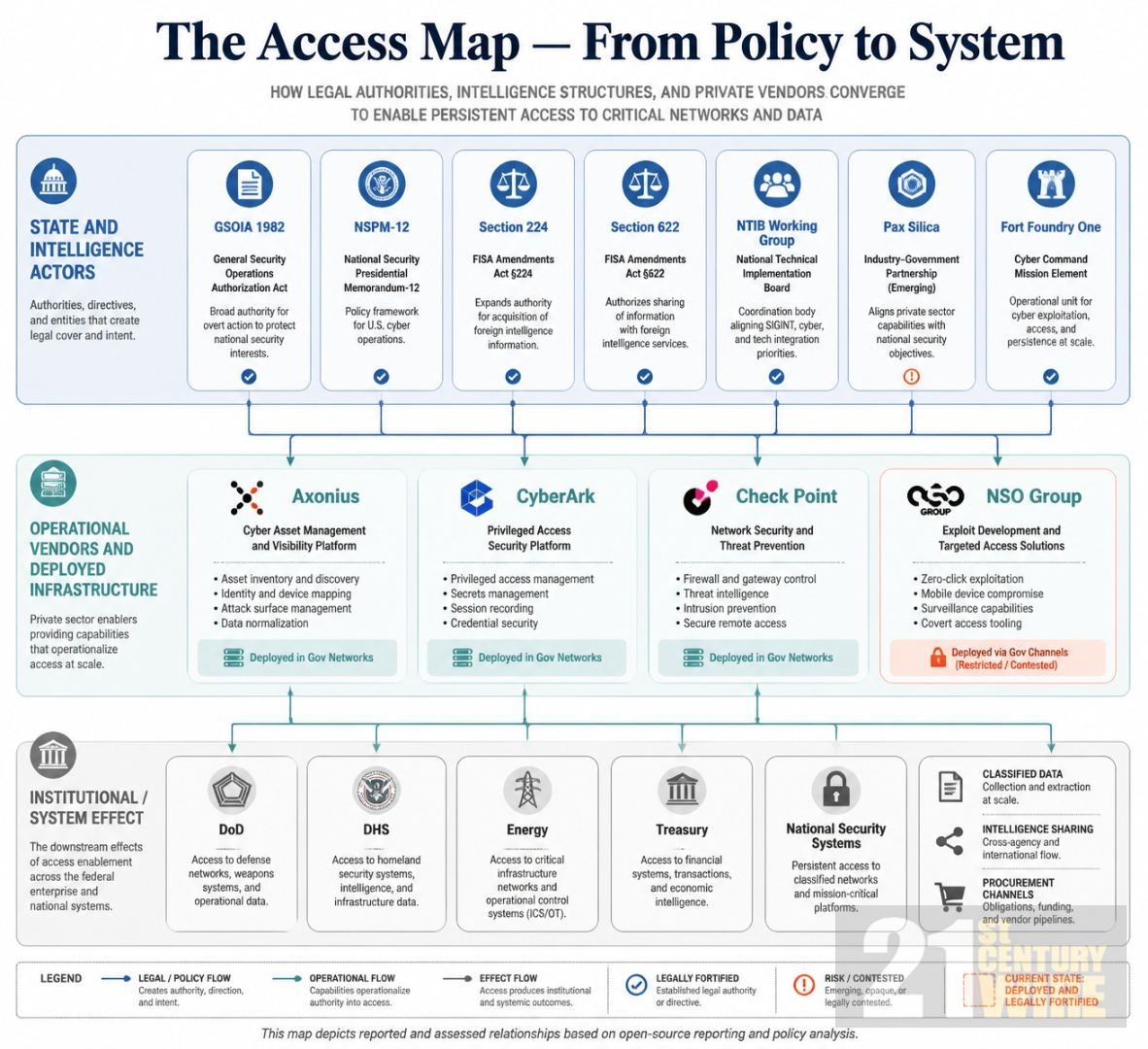
The clearest example is Axonius. Founded by three Unit 8200 veterans — Dean Sysman, Ofri Shur, and Avidor Bartov — who met while serving on the same team, the company is already running inside more than 70 federal agencies, including DoD, DHS, Energy, Treasury, Transportation, Agriculture, and Health and Human Services. It passed a Defense Innovation Unit prototype and a Defense Information Systems Agency production pilot for Cyber Asset Inventory Management. The solution met the criteria for success and was approved for DoD-wide use. It is now available under DoD Enterprise Software Initiative Blanket Purchase Agreement N66001-23-A-0050 through DLT Solutions GSA Schedule GS-35F-267DA. Any DoD component can procure it without a separate acquisition action. The platform gives operators unified visibility and control over devices, monitors privileged accounts, detects unsanctioned applications, and supports Zero Trust enforcement across DoD networks.

This is not a minor administrative detail. Asset-management software defines what the network looks like, who is connected, and what can be isolated. Whoever controls that layer controls the map of the machine. Once a vendor is embedded there, the relationship becomes harder to challenge because it is no longer a political abstraction, and it becomes an operational dependency.

CyberArk, founded by Unit 8200 alumnus Udi Mokady, manages privileged credentials on National Security Systems, the highest-value access layer in any classified environment. Privileged access is not a side function. It is the key to the vault. A company that handles it helps determine who gets inside the network, when, and under what authority. CyberArk achieved NIAP Common Criteria certification, explicitly validating its Privileged Access Security Solution meets strict security requirements for U.S. National Security System procurement. Its products are available through multiple federal procurement vehicles.

Check Point completes the perimeter. Also tied to Unit 8200 founders, it holds DoD certifications for enterprise software and has achieved NSA certification under the Commercial Solutions for Classified (CSfC) Program. The program explicitly enables the use of commercial products to protect classified National Security Systems data. Check Point’s firewall and security products are embedded across DoD and allied networks. In January 2026, China’s government banned cybersecurity products from Check Point, CyberArk, Palo Alto Networks, and Fortinet, specifically citing concerns that “data are being sent out” and that these firms have “deep ties to intelligence agencies.”

Taken together, Axonius, CyberArk, and Check Point show a pattern that is not incidental. Israeli-intelligence-linked firms are already embedded in the U.S. security stack across monitoring, privilege, and transport. The scale of this presence is documented. As of August 2025, more than 1,400 veterans of Israeli intelligence were working in U.S. tech, with more than 900 from Unit 8200 alone. Microsoft alone employs approximately 250 Unit 8200 alumni. Unit 8200 was also documented to have stored 8,000 terabytes of surveillance data in Microsoft Azure before Microsoft partially severed the relationship in September 2025.


GRAPHICS: The Access Map – From Policy to System

Description: This graphic summarizes the layered access already achieved through validated U.S. procurement and certification channels. It shows how policy instruments connect to deployed companies and federal systems.(Source: Created by Author)

The procurement route is the real story

This is where the story stops being abstract. The Defense Innovation Unit (DIU) and the Defense Information Systems Agency (DISA) are not ceremonial bodies. In fact, they are the practical gates through which technologies move from pilot to production and then into wider federal use. It was through those channels that Axonius was approved and pulled into the federal environment as a trusted capability.

Once a system passes through DIU or DISA and becomes available through procurement vehicles, it ceases to be a speculative vendor relationship, and the same logic applies to the NSS certification path used by CyberArk and the classified-data certifications associated with Check Point. Look at it as admissions tickets into the most sensitive rooms in the building.

The new laws are reinforcement, not origin

The legislation now moving through Congress does not create the relationship. It formalizes it. Section 224 of the FY2027 NDAA points toward an executive-agent model for synchronizing U.S.-Israel defense technology cooperation. The language that requires people’s attention is not the boilerplate, but the reference to “network integration” and “data fusion.” That is not ordinary diplomacy. We are looking at an architecture of technical merging.

Quincy Institute analyst Ben Freeman understood the implication immediately. The provision creates a path where U.S. military data could become Israeli military data. That does not mean the transfer is automatically total tomorrow morning. It means the statute builds the administrative skeleton to make such a transfer appear increasingly normal, increasingly defended, and increasingly difficult to reverse once the structure is in place.

Section 622 of the FY2027 Intelligence Authorization Act is the same kind of move in a different domain. It is designed to make intelligence sharing with Israel a default condition, while limiting the president’s ability to suspend it without specific findings and notice to Congress. Suspension would require a positive presidential finding of a specific, identifiable national security concern, followed by a 15-day advance congressional notification covering the categories withheld and an anticipated regional security impact assessment. As analyzed by ICBRIEF, this “renders the presidential carve-out functionally inert” because organized opposition to any suspension is built into the procedural requirement. In my book, this is not a trivial procedural tweak, but a lock. It takes a policy that could be managed discretionarily and pushes it toward a statutory default that is much harder to unwind.

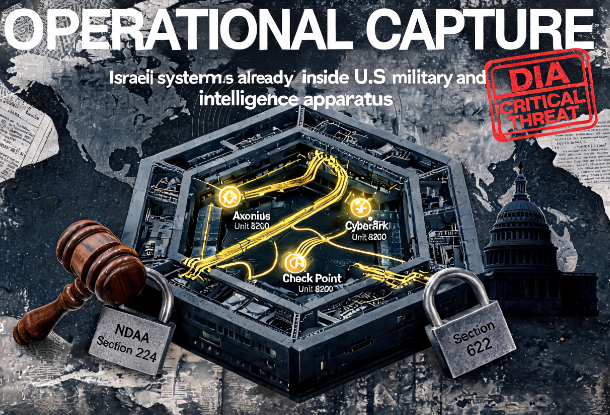
And the timing holds importance too. The DIA reportedly raised Israel’s counterintelligence threat level to “critical” at the same moment this legislative lock was being discussed. That is the contradiction at the center of the story. The U.S. intelligence apparatus is reportedly warning about the threat while Congress is moving to harden the channels anyway. Go figure!

Fort Foundry One and the dual-use problem

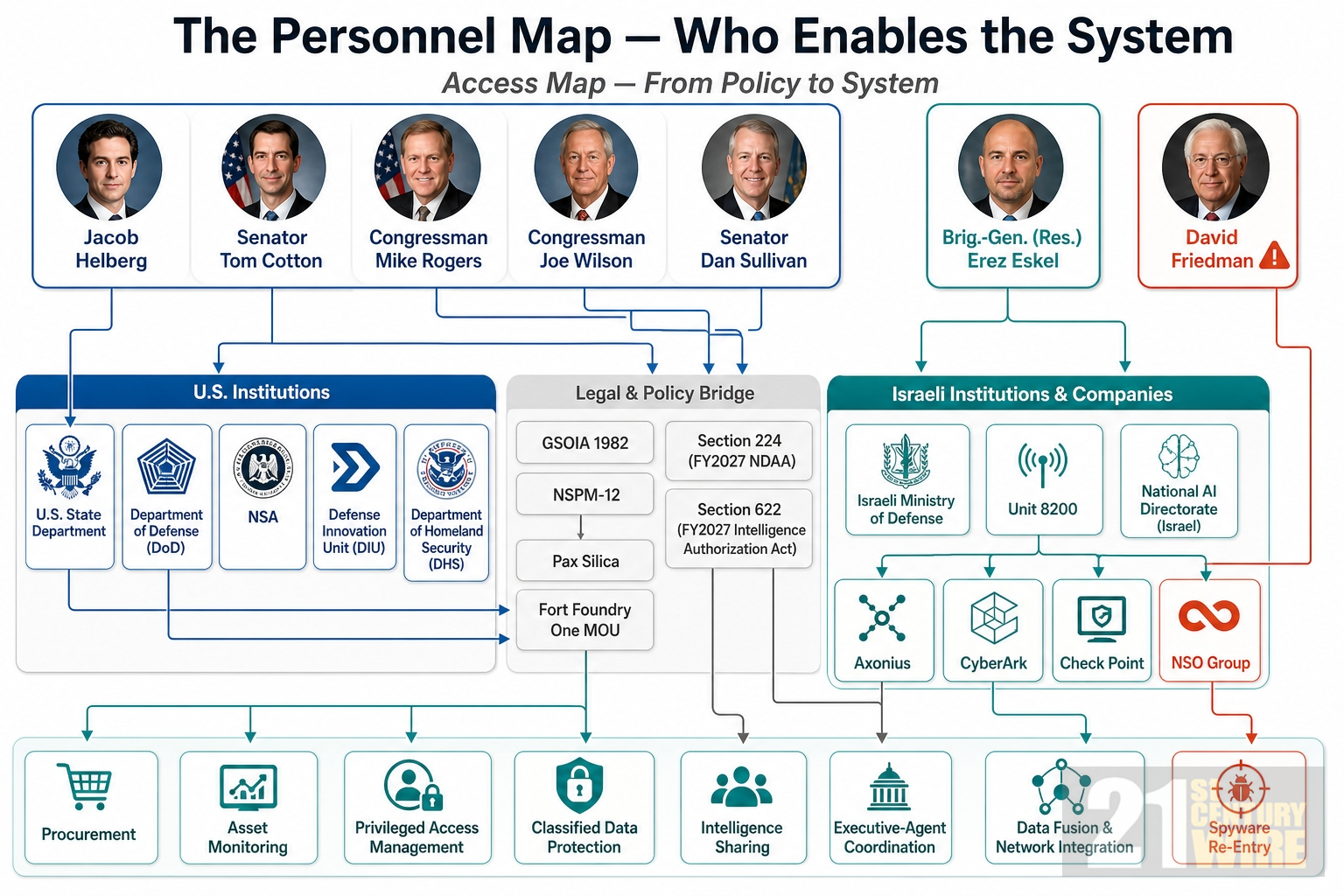
The personnel map and bilateral agreements add another layer. On January 16, 2026, the U.S. and Israel signed a Memorandum of Understanding for “Fort Foundry One”, a 16,000-dunam technology park in the Negev or Gaza border area. Signed by Brig.-Gen. (Res.) Erez Eskel, head of Israel’s National AI Directorate, and U.S. Under Secretary of State for Economic Affairs Jacob Helberg, the MOU grants the U.S. a 99-year lease while day-to-day management and primary investment remain American, with U.S. and Israeli technology companies operating side by side on chip production, advanced computing, and AI development. The MOU provides for “expedited regulation” with licensing and permits capped at 120 days. It also raises the possibility of a U.S.-regulated nuclear power plant to supply the energy demands of AI data centers.

Israel was the first country to sign a bilateral agreement under the Pax Silica framework. The Fort Foundry One MOU itself states it “creates no legal rights or obligations”, standard MOU language, but it establishes the political commitment and operational framework, with implementing legislation and project agreements to follow. Given that the semiconductor and AI technologies being developed there feed directly into NSPM-12-governed NSS domains, and that NSPM-12 explicitly enables NSA agreements with foreign governments for security material, the park creates an environment where the line between civilian AI R&D and classified technology transfer is structurally blurred.

The personnel map tells the same story

The people involved are not random. They are the connective tissue. Jacob Helberg, U.S. Under Secretary of State for Economic Affairs, sits at the State Department point of contact for the Pax Silica and Fort Foundry One ecosystem. Brig.-Gen. (Res.) Erez Eskel, Head of Israel’s National AI Directorate, anchors the Israeli AI side of that arrangement. Senator Tom Cotton (R-AR), Chairman of the Senate Intelligence Committee, is driving the intelligence-sharing push. Congressman Mike Rogers (R-AL), Chairman of the House Armed Services Committee, is carrying the House defense integration language. Congressman Joe Wilson (R-SC) and Senator Dan Sullivan (R-AK) are advancing the broader defense partnership bill. The pattern is not of one-off initiatives, but of a coordinated institutional push.

David Friedman at NSO Group adds a separate but relevant layer. In November 2025, NSO Group, maker of the Pegasus spyware, appointed David Friedman, Trump’s former Ambassador to Israel (2017–2021), as Executive Chairman, simultaneously announcing that a group of American investors had taken controlling ownership. NSO retained the Vogel Group, a lobbying firm with close ties to the Trump administration. In December 2025, the Trump administration separately lifted sanctions against three executives tied to the Intellexa spyware consortium. The Commerce Department Entity List blacklisting of NSO remains nominally in place as of mid-2026. However, NSO executives have themselves downplayed its practical significance. Under NSPM-12, the NSA Director’s authority to certify tools for NSS use, combined with the bills’ push to integrate Israeli-origin cybersecurity technology, creates the procedural pathway for Pegasus-class tools to receive NSS accreditation, the Entity List notwithstanding, if the NSA Director makes a national security determination and the NSC concurs.


GRAPHIC: The Personnel Map – Who Enables the System

Description: This graphic shows the individuals, institutions, and companies driving the integration. It maps how key officials connect to agencies and companies, and how those connections feed into operational functions. (Source: Created by Author)

Section 622 is where the floor drops. On paper, it’s another intelligence‑sharing clause. In practice, it plants the flag on one simple idea, in which information moves to Israel as a matter of course. Interrupting that flow becomes the abnormal act, the thing that needs explanations and paperwork and a president willing to spend political capital.

The delicate part of any intelligence partnership isn’t what leaders say into microphones. It’s whatever moves on autopilot, the cables and feeds that no longer trigger a debate before they go out. Section 622 pushes this relationship into that zone.

Once it’s written that way, the burden flips onto whoever wants to close the valve. You are no longer continuing a cautious norm. You are “disrupting” a statutory default. You have to sign your name to that and walk into a fight.

All of this is happening while the Defence Intelligence Agency is reportedly flagging Israel as a “critical” counterintelligence threat. So the machinery is being told, in effect, to keep the pipe open at the same moment the warning lights are flashing red.

The data-fusion clause is the deep cut. Section 224 is where the article’s missing depth becomes most visible. The words “network integration” and “data fusion” are not decorative. They are the textual hinge on which deeper interoperability can be built. That is why the Quincy Institute warning matters. If military systems are integrated at the network and data layers, the boundary between allied cooperation and foreign visibility starts to erode.

This is the point readers need to understand. The statute does not have to explicitly say “give Israel your data” for the result to move in that direction. It only needs to build the legal and administrative conditions in which such access becomes routine, defensible, and normalized. That is what real operational capture looks like. Not a dramatic seizure, but a controlled, lawful, and increasingly permanent embedding.

The authorization test

The crucial test is whether any of these instruments actually authorize the access being implied. The answer is yes, but only partially and in layers. The 1982 GSOIA authorizes bilateral classified exchange under controlled procedures. NSPM-12 authorizes foreign-government technical-security agreements within the National Security System framework, though it does not grant a free pass. Section 224 and Section 622 do not prove that all implied access is already fully open, but they do create a stronger legal basis for broadening it and making it stick.

At this stage, it would be wrong to claim that every implied channel is already wide open in its maximum form. It would be equally wrong to pretend this is merely a future risk. The better reading is sharper. The access already exists in operational form, and the new law is being used to widen, normalise, and legally fortify it.

Why the original article needed this layer

GenXGirl’s reporting identifies in great detail the political convergence. This article is not meant to be better. Its aim is to add the missing implementation proof that is so much needed. It shows where the access already lives, how it entered through procurement and certification, which laws already authorize parts of the exchange, and which new clauses are now being used to lock the structure in place.

As I understand it, and what the evidence shows, is that the story is not only about a future architecture being assembled in Congress, but about a current architecture already embedded in U.S. systems, now being hardened through law.

The operational capture is not complete. NTIB inclusion is under review, Section 622 and Section 224 are pending final passage, and NSO remains on the Entity List. But the monitoring and privileged access layers are already deployed. The intelligence statutory lock is moving through Congress on a bipartisan basis. The legal and procurement infrastructure to expand it is being constructed in parallel. The story here isn’t just a future architecture under construction. We are witnessing a live deployment, and Congress is busy bolting the doors around it.

https://www.theoccidentalobserver.net/wp-content/uploads/2018/06/TOO-Full-Logo-660x156-1.png 0 0 Kevin MacDonald https://www.theoccidentalobserver.net/wp-content/uploads/2018/06/TOO-Full-Logo-660x156-1.png Kevin MacDonald2026-07-04 13:10:052026-07-04 13:10:05The Quiet Operational Architecture Behind U.S.-Israel Integration

German Feminist Activist Calls For White People To Stop Having Children And Accept Refugees

July 4, 2026/14 Comments/in General/by Kevin MacDonald

German Feminist Activist Calls For White People To Stop Having Children And Accept Refugees

Via Remix News,

Germany’s Verena Brunschweiger, a self-described “radical feminist,” is promoting the slogan: “My lineage ends with me.” She says she hopes to encourage people, especially White people, to stop having children.

She claims that Western pro-natalists only want to “control women, and keep refugees out.”

The article on her views, from Australian broadcaster news.com.au, is entitled: “‘My bloodline ends with me’: Why feminist ‘childfree icon’ wants fewer ‘white babies’ and more refugees”

The report quoted her as saying: “We have a proud slogan, ‘My bloodline ends with me.’ I think this is a responsible choice.”

Brunschweiger said that Europeans are to blame for the poor quality of life in Africa, and she would invite the entire world to Europe.

“So I would take all immigrants and refugees in because we ruined the world, so to speak.”

“We produce the climate change which makes life in Africa, for instance, miserable and horrible. So of course, why not invite [them] if they want to come?”

She said that in her home country, “populist nonsense” is being promoted by the German party Alternative for Germany (AfD).

She claimed the party wants Germans to have more babies so “they can say, ‘Oh, I’m sorry, dear refugees, go back and drown or die or starve or whatever, because we have so many of our own people and we have to care for them first.”

“They say we need our own kids because German white kids are better than other kids who immigrate into the country,” she added.

“All the white people go, ‘Wouldn’t it be so horrible if we lost the white people, the white majority?’ They always want white women to have more babies to in order to be able to say, ‘Oh, stay the way we are, we are already full,’” she added.

She says Western countries have a moral duty to accept refugees.

“Because we produce all the climate change and all those things which make them leave [their] country,” she said.

Despite immigrants producing children at a much higher rate than White people, especially African migrants, she dismisses any argument against restricting immigration.

She said that she “of course” targets Whites specifically to stop having children.

“My focus, and that’s what drives the AfD nuts, is we have to cut back our numbers,” she said.

Read more here…

https://www.theoccidentalobserver.net/wp-content/uploads/2018/06/TOO-Full-Logo-660x156-1.png 0 0 Kevin MacDonald https://www.theoccidentalobserver.net/wp-content/uploads/2018/06/TOO-Full-Logo-660x156-1.png Kevin MacDonald2026-07-04 06:50:432026-07-04 06:50:43German Feminist Activist Calls For White People To Stop Having Children And Accept Refugees

Douglas MacGregor on Judge Nap: “Well, it’s good to know that our Jews are talking to their Jews…”

July 3, 2026/14 Comments/in General/by Kevin MacDonald
Bing Videos ~10’00
Douglas MacGregor: Well, it’s good to know that our Jews are talking to their Jews and their Jews are talking to our Jews and the Jews have decided they don’t like each other. I suppose I find the whole thing reprehensible. I don’t even want to talk about it. I’m disgusted. I’m tired of listening to people talk about Jews instead of talking about Americans and American diplomats and American governmental officials and an American president.

Transcript

Napolitano:  I’m going to ask you in a minute uh your opinions on whether Prime Minister Netanyahu uh will engage in the systematic sabotage of the memorandum of understanding. But before I ask and obviously before you reply, I want to run a clip from uh Jake Tapper. Now, Jake, whom I’ve known for years, I believe to be intellectually honest, is paraphrasing a tape from a transcript that he verifies as a call between President Trump and Prime Minister uh Netanyahu. It’s pretty graphic. Chris, cut number one.

Trump told Netanyahu he was sick of his antics. “I’ve done everything to protect you. You better go along with this. Everybody’s sick of you, BB,” Trump said. All the Jews are sick of you. Even the two Jews on this call are sick of you,” Trump added, referring to Jared Kushner and Steve Whitkoff. “You can’t back out of this,” Trump ticked through the list of controversial decisions he had made supporting Israel through both of his presidencies.

Now, does that in your view manifest a serious effort to make the MOU work or just performative by the president?

MacGregor: Well, it’s good to know that our Jews are talking to their Jews and their Jews are talking to our Jews and the Jews have decided they don’t like each other. I suppose I find the whole thing reprehensible. I don’t even want to talk about it. I’m disgusted. I’m tired of listening to people talk about Jews instead of talking about Americans and American diplomats and American governmental officials and an American president. Okay, I got that off my chest. It’s early. All right, this that’s Go ahead, please. I’m just sort of sick of that now. Is this real? Yeah, it probably is real. But what difference does it make? How much freedom of maneuver does President Trump really have? What have they got on him? Is he under duress? I think he’s under duress. This man never wanted to go to war with Iran to begin with, as far as I can tell. That was certainly the case 5 years ago. So what made him do it to begin with? And then once he got into it and he figured out this was a catastrophe, the Israelis and their agents in the United States wanted him to continue to bomb and bomb and bomb. You know, bomb your way to success. Kill your way to success. Just keep bombing. You know, the old Air Force argument. Well, drop some more bombs. Eventually, it’ll work. He rejected that to his credit. That’s a good thing. He went along with this although he hates it because he knows he’s effectively admitting that, you know, we lost militarily. But you know I think it’s probably real but again what difference does it make? The only way out of this is a military solution and that military solution is not to attack; it’s to disengage which is why I wrote the piece I did on the Substack. …

Judge: Will Netanyahu do his best to sabotage the MOU because he can’t stay in power and probably can’t even stay a free man if he doesn’t have a war to fight.

Oh, I’m sure that’s true. But I also don’t see any evidence that he or the people around him are prepared to stop any of it. I think they’re clinging to the notion that if they can keep this going long enough, they will somehow or another be victorious. And I don’t think that’s going to change. So the answer to your question is President or or Mr. Netanyahu will do everything in his power to sabotage any agreement whatsoever with Iran. And unfortunately, I think that President Trump is being duplicitous because on the one hand, it’s clear that he does want to disengage and he would like to find a way out of this. But at the same time, he’s got the CIA, MI6, and Mossad working out to drag Syria’s head chopping brigade into the war against Hezbollah in Lebanon. and he’s actually given the green light to the sale for $700 million of jet engines to the Turks that they’re going to put in their new jet fighter, the Khan. So, it looks like we’re trying to bribe the Turks to turn their gaze away from Lebanon, and allow us access to the Arabs they control in uh Syria, the head choppers, and move them over to fight Hezbollah. Uh, this doesn’t sound like a man who’s trying to disengage and restore stability, does it?


https://www.theoccidentalobserver.net/wp-content/uploads/2018/06/TOO-Full-Logo-660x156-1.png 0 0 Kevin MacDonald https://www.theoccidentalobserver.net/wp-content/uploads/2018/06/TOO-Full-Logo-660x156-1.png Kevin MacDonald2026-07-03 10:39:402026-07-03 10:39:40Douglas MacGregor on Judge Nap: “Well, it’s good to know that our Jews are talking to their Jews…”

Dred SCOTUS: This is more embarrassing than Roberts’s Obamacare decision.

July 1, 2026/8 Comments/in General/by Ann Coulter

Obviously, the Supreme Court’s ruling on anchor babies in Trump v. Barbara is ridiculous. Chief Justice John Roberts, along with the Papist nut and the three witches, has apparently decided the “FREE MONEY” sign on our border was not good enough. We need to give the third world an even bigger incentive to flock here. Henceforth, we will lure illegal aliens with the guarantee of American citizenship for any kids they give birth to on U.S. soil. Welcome Hamas! (And you thought Democratic primaries were already wild!)

Inasmuch as no one on TV seems to have bothered reading the opinions, here are a few highlights.

1) Justice Clarence Thomas’s dissent is a tour de force. It will go down in history with Justice Benjamin Curtis’s dissent in Dred Scott and Justice Frank Murphy’s dissent in Korematsu. (It’s also a good primer for snowbirds, who plan to avoid state taxes by moving to Florida, on the vital importance of “domicile.”)

By contrast, Roberts’s opinion for the court will go down with Justice Neil Gorsuch’s opinion in Bostock v. Clayton County, finding that the Civil Rights Act of 1964 prohibited discrimination against transgender employees—a ruling that was so embarrassing it was immediately ignored by everyone, including Gorsuch. That was clear this week, when, for the fourth time since Bostock, the court rejected similar claims by transgenders.

2) I’m sorry to mention that Gorsuch was on the right side of the anchor baby case. Which reminds me, could the conservatives confidently informing us that anchor babies are required by the constitution (Bill O’Reilly, John Yoo, The Wall Street Journal, etc.) cite a single other case with Roberts on one side and Thomas, Alito, Gorsuch and Kavanaugh on the other, where Roberts was right? How about that terrific Obamacare ruling, deeply grounded in the text of the constitution?

3) Thomas’s central point—appalling to liberals, but true nonetheless—is that the purpose of the 14th Amendment was to overrule Dred Scott, which held that Black Americans were not citizens and therefore could not sue in federal court.

Black slaves and freedmen alike, Thomas writes, “were unambiguously Americans. They were not foreigners. They were not aliens. They owed no foreign allegiance.” He quotes Frederick Douglass’s plea for the citizenship of blacks: “We address you not as aliens nor as exiles … We are Americans.”

In response to Thomas’s manifestly obvious point that the Fourteenth Amendment was “enacted … with the one pervading purpose of securing equal citizenship for the freed slaves,” the great legal scholar Justice Ketanji Jackson ripostes: “The teacher who scolds a student for bullying a classmate hopes the student learns the broader lesson of treating everyone with kindness, not just that one kid.”

3) In his 91-page dissent, Thomas cites 42 legal cases, 19 historical letters or diplomatic dispatches, 6 formal Attorney General opinions and 11 statutes, including The Civil Rights Act of 1866, The Expatriation Act of 1868 and the Naturalization Acts of 1790, 1795 and 1802. All directly on point.

This, Roberts calls “scant evidence.” Whereas he cites a mighty three cases for his majority opinion: an inapposite one from Britain; the opinion of a New York assistant vice chancellor in an 1844 inheritance dispute in New York (BIG, if true); and one, Wong Kim Ark—the “strongest support for today’s decision,” as Alito put it—using dubious dicta from a wandering opinion that primarily relied on the parents having been “legally domiciled” in the U.S. when the child was born. Not to be confused with, “living here illegally.” (Or “wintering in Palm Beach.”)

It’s as if Roberts didn’t realize the case was about kids born to illegal aliens.

5) Roberts’s weirdest citation is to an 1872 letter from Attorney General George Williams describing Francois Heinrich, a child born to Austrian parents while they were “temporarily residing” in New York City, as having been “originally clothed with American nationality.”

Wow, great quote. But one thing Roberts neglects to mention—it falls to Thomas to do so—is that the child’s claim to American citizenship was then promptly denied by Secretary of State Hamilton Fish, who proclaimed Heinrich “an Austrian subject …not an American citizen.”

6) Alito’s dissent includes a lengthy description of the border states’ many attempts to deal with the crisis of illegal immigration, but being repeatedly thwarted by the federal government—including the Supreme Court, “from the comfort of chambers more than 1,000 miles from the southern border.”

Here’s one I did not know from the Biden years: After Border Patrol officers ripped down the barbed wire fencing Texas had erected on the border, “federal officers installed a climbing rope on the Texas side of the river.”

A climbing rope for illegals!

7) Alito demolishes Roberts’s argument that “the British rule of birthright subjecthood” was, with minor exceptions, “transplanted intact to American soil.” As indicated by the devastating phrase “birthright subjecthood,” the British rule did not concern “citizenship” at all:

“There was no such thing as a ‘citizen’ of England, Scotland or Ireland. The inhabitants of the British Isles were the King’s ‘subjects’ [and his] authority was understood to come from God. … The Declaration of Independence emphatically rejected the British theory of government. It proclaimed that governments “deriv[e] their just powers from the consent of the governed,’ not divine right.”

As Alito says, how ironic that Roberts makes this profoundly ahistorical claim only days before we celebrate the 250th anniversary of our Declaration.

It’s one thing for Roberts to forget the Civil War. Liberals do that all the time, quickly turning the 14th Amendment into an instrument for the advancement of gays, immigrants, lesbians, the disabled, etc. —wait, what were you saying about slavery? But to forget the American Revolution sounds more like galloping Alzheimer’s.

In light of the court’s majority opinion requiring the country to commit suicide, how about we agree to take all of Latin America, Africa and the Middle East in exchange for deporting Roberts?

COPYRIGHT 2026 ANN COULTE

https://www.theoccidentalobserver.net/wp-content/uploads/2018/06/TOO-Full-Logo-660x156-1.png 0 0 Ann Coulter https://www.theoccidentalobserver.net/wp-content/uploads/2018/06/TOO-Full-Logo-660x156-1.png Ann Coulter2026-07-01 12:29:402026-07-01 12:45:42Dred SCOTUS: This is more embarrassing than Roberts’s Obamacare decision.

Jonathan Turley: “White Time”: Dutch Professor Argues that Time Itself is Racist

June 30, 2026/25 Comments/in General/by Kevin MacDonald

“White Time”: Dutch Professor Argues that Time Itself is Racist

We have previously discussed how many professors seem to compete in finding new forms of racism in every facet of society and education. Astrophysics, math, runoffs, science, statistics, and meritocracy have all been denounced as racist. In this academic cottage industry, professors secure publications and speaking opportunities by identifying racism in the expressions, images, or entire fields. It was, therefore, only a matter of time before time itself was declared racist.

Zakia Essanhaji, a professor of “organizational ethnography” at Vrije Universiteit Amsterdam, is the latest to make the case against “white time.” Her recent paper titled “Academic time theft: stealing time, producing racialized inclusion in Dutch academia” builds on prior work condemning time as racist.

Rutgers Women’s and Gender Studies/Africana Studies Professor Brittney Cooper has also written about how time is racist. Mainstream media has positively cooed at the suggestion, including an interview with NPR. Cooper claimed that “white people own time” after framing the concept of time in “histories of European and Western thought.”

There is also apparently black time: “Time has a history, and so do black people. But we treat time as though it is timeless, as though it has always been this way, as though it doesn’t have a political history bound up with the plunder of indigenous lands, the genocide of indigenous people and the stealing of Africans from their homeland.”

Likewise, in “The Chronopolitics of Racial Time,” Jamaican academic Charles W. Mills described the  “Euro-chronometer” as a Western-centric, linear timeline.

These works are often heavily laden with jargonistic narratives. In one study from Brazil, academics argue that “thinking of time outside and against the Euro-chronometer requires decolonial epistemologies that have the potential to disrupt racist chronologies.”

Professor Essanhaji continues this scholarship by “drawing on critical race theory and decolonial scholarship on chronopolitics and white time.” She applies with earlier work “to academic time theft to theorize how universities extract, fragment and defer the time of academics of colour through racialized institutional processes.”

“White time is not simply the time of the privileged, but the power to define temporality and progress itself. It is the colonization of time, known as the system of modernity/coloniality. As Vazquez […] argues, this system is maintained by erasing cyclical or relational understandings of time, ensuring that time is perceived as racing towards unattainable, more modern futures. In that sense, white time is both prescriptive and pre-emptive, foreclosing alternative futures and experiences of the past by delegitimizing other temporalities.”

Academics have long argued that non-white histories and figures are often “erased’ in scholarship. Such arguments have led to a move away from Western works or classics in favor of non-Western sources in higher education. However, the time scholarship suggests that the very construct of time has been shaped and furthers white domination and privilege.

In Professor Essanhaji’s work, this scholarship is used to challenge the demands placed on minority academics in publishing and other measures of academic achievement. Again, the work is heavily layered with jargonistic language. Here are her findings:

“The analysis identifies three mechanisms of academic time theft. First, prolonged uncertainty operates through racialized precariousness that keeps academics of colour in a condition of academic probation through insecure contracts and housing precarity. Second, ongoing disruption emerges through everyday racism that fragments attention, diverts emotional and intellectual labour, and interrupts academic continuity. Third, recursive evaluation operates through the continual resetting of inclusion and promotion criteria, producing perpetual states of “not yet” recognition and deferred academic futures. Together, these mechanisms sustain racialized temporal regimes in which academics of colour are positioned as perpetually “almost there” while white institutional time remains uninterrupted.”

These authors largely cite each other with little attention to countervailing viewpoints. It becomes a closed, self-perpetuating system as academics invite one another to speak at their universities and feed off one another. Few academics are willing to challenge such scholarship. Indeed, as we have discussed, departments have largely purged their ranks of conservative or contrarian voices.

As shown in this latest scholarship, the work in this area jettisons such “colonial” or “white” forms of analysis in favor of storytelling:

“I depart from a critical race perspective, employing counter-storytelling to construct (counter)narratives grounded in the lived experiences of people of colour. This method recognizes the connections between the historical impacts of colonialism and contemporary exclusions within organizations. By highlighting the experiences of people of colour navigating the university’s racism, I seek to provide rich accounts that reflect on how time is racialized and experienced in Dutch universities.”

There is a faux statistical framing based on “data” that is largely the subjective descriptions of minority academics:

“Initial open coding focused on participants’ descriptions of inequality across social, material and affective dimensions, including social, material and affective inequalities. While time was not predefined as an analytical category, it emerged inductively through participants’ recurring temporal framings of inequality.”

When one tries to drill down on the “data,” it appears entirely anecdotal and subjective, often turning on one or a handful of “narratives.” These stories are used to claim that academic measurements of success, driven by “white time,” are unfair to minority faculty: “these mechanisms position academics of colour perpetually as ‘almost there’ while their academic futures remain deferred.”

The thrust is that minority faculty should not be subject to traditional or accepted pathways for tenure or promotion:

“Academic time theft is not an incidental by-product of exclusion but a structural mechanism through which universities sustain white institutional time. It works by continuously delaying, interrupting and recalibrating what counts as academic legitimacy, ensuring that the labour of academics of colour remains productive for the institution while their progression is indefinitely postponed.

…To ensure that people of colour have academic futures, researchers and policymakers must break with the white temporality of academic work within which progress for some is enabled and for others is ongoingly deferred.”

Academia has already embraced narrative-driven scholarship in many departments as an alternative to traditional academic analysis. The Critical Legal Studies movement, for example, has challenged conventional scholarship as too restrictive and exclusionary. Few academics today dare to challenge such scholarship on the merits. To do so is to risk being labeled as reactionary or, even worse, racist.

This latest scholarship further challenges the time and structure for advancement for minority faculty as inherently racist. The question is whether the appointments and promotion process is at risk of losing objective and consistent measurements of scholarship.

Jonathan Turley is a law professor and the New York Times best-selling author of “Rage and the Republic: The Unfinished Story of the American Revolution.”


https://www.theoccidentalobserver.net/wp-content/uploads/2018/06/TOO-Full-Logo-660x156-1.png 0 0 Kevin MacDonald https://www.theoccidentalobserver.net/wp-content/uploads/2018/06/TOO-Full-Logo-660x156-1.png Kevin MacDonald2026-06-30 21:21:512026-06-30 21:21:51Jonathan Turley: “White Time”: Dutch Professor Argues that Time Itself is Racist
Page 20 of 255«‹1819202122›»
RSS Feed Logo RSS Feed Logo Subscribeto RSS Feed

Kevin MacDonald on Mark Collett’s show reviewing Culture of Critique

James Edwards at the Counter-Currents Conference, Atlanta, 2022

Watch TOO Video Picks

video archives

DONATE

DONATE TO TOO

Follow us on Facebook

Keep Up To Date By Email

Subscribe to get our latest posts in your inbox twice a week.

Name

Email


Topics

Authors

Monthly Archives

RECENT TRANSLATIONS

All | Czech | Finnish | French | German | Greek | Italian | Polish | Portuguese | Russian | Spanish | Swedish

Blogroll

  • American Free Press
  • American Freedom Party
  • American Mercury
  • American Renaissance
  • Arktos Publishing
  • Candour Magazine
  • Center for Immigration Studies
  • Chronicles Magazine
  • Council of European Canadians
  • Counter-Currents
  • Curiales—Dutch nationalist-conservative website
  • Denmark's Freedom Council
  • Diversity Chronicle
  • Folktrove: Digital Library of the Third Way
  • Human Biodiversity Bibliography
  • Institute for Historical Review
  • Mondoweiss
  • Pat Buchanan
  • Paul Craig Roberts
  • Project Nova Europea
  • Red Ice
  • Richard Lynn
  • Rivers of Blood
  • Sobran's
  • The Occidental Quarterly Online
  • The Political Cesspool
  • The Raven's Call: A Reactionary Perspective
  • The Right Stuff
  • The Unz Review
  • VDare
  • XYZ: Australian Nationalist Site
NEW: Individualism and the Western Liberal Tradition

Also available at Barnes & Noble

Culture of Critique

Also available at Barnes & Noble

Separation and Its Discontents
A People That Shall Dwell Alone
© 2025 The Occidental Observer - powered by Enfold WordPress Theme
  • Link to X
  • Link to Dribbble
Scroll to top Scroll to top Scroll to top

By continuing to browse the site, you are legally agreeing to our use of cookies and general site statistics plugins.

CloseLearn more

Cookie and Privacy Settings


How we use cookies

We may request cookies to be set on your device. We use cookies to let us know when you visit our websites, how you interact with us, to enrich your user experience, and to customize your relationship with our website.

Click on the different category headings to find out more. You can also change some of your preferences. Note that blocking some types of cookies may impact your experience on our websites and the services we are able to offer.

Essential Website Cookies

These cookies are strictly necessary to provide you with services available through our website and to use some of its features.

Because these cookies are strictly necessary to deliver the website, refusing them will have impact how our site functions. You always can block or delete cookies by changing your browser settings and force blocking all cookies on this website. But this will always prompt you to accept/refuse cookies when revisiting our site.

We fully respect if you want to refuse cookies but to avoid asking you again and again kindly allow us to store a cookie for that. You are free to opt out any time or opt in for other cookies to get a better experience. If you refuse cookies we will remove all set cookies in our domain.

We provide you with a list of stored cookies on your computer in our domain so you can check what we stored. Due to security reasons we are not able to show or modify cookies from other domains. You can check these in your browser security settings.

Other external services

We also use different external services like Google Webfonts, Google Maps, and external Video providers. Since these providers may collect personal data like your IP address we allow you to block them here. Please be aware that this might heavily reduce the functionality and appearance of our site. Changes will take effect once you reload the page.

Google Webfont Settings:

Google Map Settings:

Google reCaptcha Settings:

Vimeo and Youtube video embeds:

Privacy Policy

You can read about our cookies and privacy settings in detail on our Privacy Policy Page.

Privacy Policy
Accept settingsHide notification only