
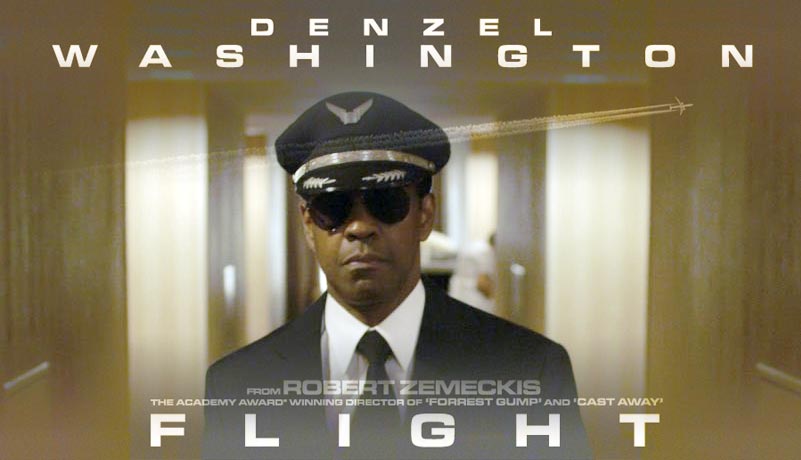
“Flight”: Denzel Washington’s New Movie, Part I
I find myself in a conflicted position. While I enjoy being right as much as the next guy, it hurts to be right about something with negative consequences. Imagine, for example, that you are convinced you have a serious malady, yet your stubborn doctor pooh-pooh’s your concerns. As a result, you conduct a grueling online search and eventually pin down your ailment to an obscure but quite harmful degenerative disease.
You take these results to a more accommodating doctor, who indeed confirms your suspicious. You, then, are left congratulating yourself for outwitting your original doctor — but you have also confirmed that your quality of life is inextricably going to erode. Mixed emotions, right?
I suffer from a parallel syndrome. For well over a decade I’ve been parsing Hollywood films and finding in them a pronounced bias against straight White European-derived males. To be sure, we still have traditional fare with White male stars as the lead — think George Clooney, Brad Pitt, Leonardo DiCaprio, even Mel Gibson now and again. But we also find so many films in which only the White guy is bad.
What really troubles me is the fact that so much of this imagery is counterfactual. We race realists know that it is White males who have built so much of civilization over the last five centuries and that now it is we who bear the brunt of the anti-White multicultural onslaught. The cultural Marxists have cleverly used women and minorities against White males, and we see this imagery many times a day now. Go to your bank’s website, for instance, and I’ll bet you’ll see a parade of non-White faces and smart White women staring back at you. Try, however, to spot the White males. It’s often not easy.
A key bastion of this distortion of reality, I believe, is Hollywood, which will surprise no reader familiar with my work. Further, I have argued (see Understanding Hollywood I) that it is not just cultural Marxists in general but Jewish directors, screenwriters, agents, studio moguls et al. who are pushing this. Come on, what power do women or other non-Jewish minorities have in Hollywood? Essentially none.
What is really astounding, however, is the fact that this Hollywood cabal (see here, p. 386) has over the last few decades used the most downtrodden, least accomplished group in America and featured them as saviors, heroes and geniuses, in contrast to the dim-witted, unaccomplished or outright evil White men they appear with. I am, of course, talking about African American men. Hollywood’s celluloid promotion of such has, some have argued, resulted in the first African American occupying the Oval Office.
I wrote about this extensively for the print journal The Occidental Quarterly, specifically in my essay Understanding Hollywood III: Racial Role Reversals. There I borrowed the phrase “Numinous Negro” from Richard Brookhiser, who had coined the term for an Aug. 2001 article in National Review. The two leading examples of such Negroes, I argued, are Morgan Freeman and Denzel Washington. Even before Brookhiser’s term ever saw the light of a computer screen, I had noticed how consistently Hollywood was boosting the images of these two men.
Paul Kersey, founder of the Stuff Black People Don’t Like blog, has also examined this counter-factual phenomenon, particularly in his book Hollywood in Blackface: Black Images in Film from Night of the Living Dead to Thor. The book description reads:
Filmmakers skillfully manipulate character and dialogue, conflict and action, in ways that allow them to cast positive and negative images; in so doing, filmmakers profoundly shape the perceptions their audiences hold of different racial groups which they, the audience, rarely encounter in real life. It is through this constant and careful manipulation of Black characters in popular films that has manufactured a positive representation for all Black people. Black Fictional Images (BFI) from the character of Captain Stephen Hiller played by Will Smith in Independence Day to Miles Dyson played by Joe Morton in Terminator 2: Judgment Day, from the character of Azeem played by Morgan Freeman in Robin Hood: Prince of Thieves to Terence Mann as played by James Earl Jones in Field of Dreams, these and numerous other actors and films have done more to burnish the image of Black people in America than all the Civil Rights activists combined. Indeed, the manipulation of characters like these and numerous others over the years have gone far toward manufacturing perceptions of Black people that reality just cannot replicate.
This is where the story of my own “malady” comes in. As part of my teaching, I unpack various Hollywood films to show my students how the image of the White man has taken a relative fall in the last two or three decades. In contrast, that of Black men has soared (though, for some reason, that of Hispanics and Asians has remained understated).
I had plenty of ammunition to argue my point, too. By the time I was teaching, I could use the explosive race film American History X to show how Hollywood manipulates images. For consistency, however, I found the two Numinous Negroes to be more reliable. For instance, Morgan Freeman’s 1998 film Deep Impact featured him in the modest role of President of the United States. The Jack Bauer TV series 24 also promoted the meme of Black presidents. As a writer for the Los Angeles Times noted, “Black presidents, in fact, have been our awesomest presidents ever: Morgan Freeman in ‘Deep Impact’ and Dennis Haysbert in ‘24.’ And their approval ratings . . . have been huge.”
A few years later, in The Sum of All Fears (2002), Freeman played the director of the Central Intelligence Agency, who mentors a younger White agent, Jack Ryan, played by Ben Affleck. The next logical step up for Freeman was to play God himself, which he did in Bruce Almighty (2003) opposite Jim Carrey. (Freeman played God yet again in Evan Almighty (2007) co-starring Steve Carell.)
The films I’ve really gotten educational mileage out of, however, are those of Denzel Washington. It’s as though he was anointed “the race guy” from his first films. In 1987’s Cry Freedom, for example, he played South African anti-apartheid martyr Steve Biko. In 1989’s Glory he played an escaped slave who joins the Union army in the Civil War. In 1991’s Mississippi Masala, Washington’s character falls in love with an Indian immigrant from Uganda who somehow finds herself in racist Mississippi. Washington’s big breakthrough, however, was his title role in the 1992 Spike Lee film Malcolm X. (Talk about a race film!) In 1999, Washington played the title role in The Hurricane, about boxer Rubin “Hurricane” Carter, allegedly imprisoned falsely for the 1966 murders of three New Jersey Whites. Other race-charged Washington films include The Siege (1998), Training Day (2001, where he appears out of character as a corrupt — but cool — cop), John Q (2002), Antwone Fisher (2002), Man on Fire (2004), Inside Man (2006), Déjà Vu (2006, which features truly vile imagery of the White man), American Gangster (2007, again out of character for good-guy Washington), and The Great Debaters (2007, featuring a Southern lynching, etc.).
Regarding the theme of White displacement, however, two of Washington’s films stand out: Crimson Tide (1995), directed by Tony Scott and produced by Don Simpson and Jerry Bruckheimer, and Remember the Titans (2000), directed by Boaz Yakin and produced by Jerry Bruckheimer. Power is central in Crimson Tide, as emphasized by the opening statement that the commander of a nuclear ballistic missile submarine is one of the three most powerful men in the world, following the leaders of Russia and the United States. The film also harks back to racism in the Deep South because it is set on a submarine named the Alabama. The struggle between slave and master is exemplified by the rivalry between the Executive Officer Hunter, played by Washington, and Captain Ramsey, played by Gene Hackman.
The stage for a confrontation is set early in the film when a fire breaks out in the galley, and Hunter leads the effort to extinguish it. The captain, meanwhile, takes this opportunity to run a missile launch drill. Because of the stress of the drill immediately following the fire, an overweight Black cook succumbs to a heart attack. Hunter protests the decision to run a drill at such a risky moment, but Captain Ramsey refuses to accept any blame.
This initial Black vs. White confrontation quickly escalates into a major showdown when the submarine receives ambiguous transmissions seeming to order the launch of nuclear missiles against targets in the former USSR. Ramsey, who has risen through the ranks of the Navy the hard way, favors an immediate launch. Hunter, a graduate of Annapolis Naval Academy and Harvard, insists upon confirmation of the order before possibly precipitating World War III. Though Ramsey attempts to remove Hunter from his post so that he can unleash the missiles, he fails in his efforts by losing his temper and impulsively straying from standard operating procedure. The cool-headed Hunter then takes advantage of this lapse and has the captain himself relieved of command. Ultimately, Captain Ramsey relinquishes command and walks off stage, old and tired. Metaphorically, this can be interpreted as an attempt to read White males out of the story of a new America, one in which Blacks are set to assume their turn at the pinnacles of power.
Perhaps more than any other Hollywood movie, Remember the Titans (2000) reveals the template for the planned replacement of the American majority. Ostensibly a heart-warming tale about a group of high school football players working to overcome racism in turbulent times, the barely buried subtext is that Whites should gladly — altruistically (see this fantastic review of “pathological altruism”) — hand over everything that they value to Blacks. The football team represents American society in microcosm, Black, White, and tense. Subtlety is not this film’s forte.
Into this tense situation comes a new Black coach, Herman Boone (Washington), who moves his family into an all-White neighborhood. At the recently integrated school, the men find out that Boone will replace Yoast, the White coach, as head coach, a proposition that the White coaches find unpalatable. The White players, too, object, threatening to boycott the Black coach. Yoast, however, convinces them that the right thing to do is play ball.
Play they do, beginning with a bus trip to summer camp. To no one’s surprise, the bus scene is used to highlight segregation. Coach Boone is eager to establish his dominance and does so when Gary, the White quarterback, tries to act as master of the coach. Boone neatly turns the tables by humiliating Gary (with all the White parents watching), badgering the boy with taunts of “Who’s your daddy?” Meekly, Gary gives in and rides the integrated bus.
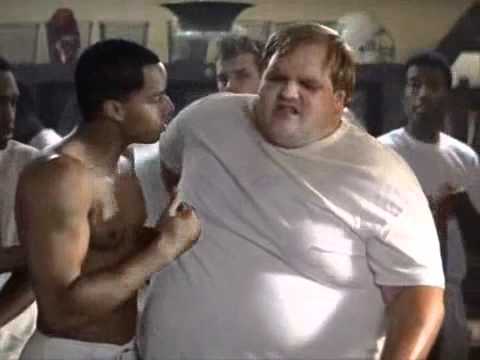
Upon arrival at the camp, Boone demands that White and Black players share rooms. Clashes erupt over tastes in music as well as responses to a poster of Black athletes using the Black Power salute at the 1968 Mexico City Olympics. An obese White lineman confesses to all in the cafeteria that he is too stupid to go to college. To remedy this, a brilliant Black player volunteers to tutor the grateful White, who acknowledges that he is nothing but “White trash.”
Injecting historical seriousness into the film, Boone runs his charges through the dense woods, coming upon a fog-shrouded battlefield cemetery. He then speaks of the background of the Civil War and its attempt to erase the wrongs of slavery. Let us not, he intones, forget those goals and sacrifices, nor let those past hatreds persist.
A particularly egregious co-optation of a Christian theme, I felt, comes when quarterback Gary is driving his ’69 Chevy Camaro through town after another Titans’ victory. His car is broadsided by an old pickup truck, and he is permanently paralyzed from the waist down. In the hospital, Gary watches on TV as his team fights its way to victory in the Virginia State Championship. Jewish director Yakin sets up a shot where White light from above shines over the prostrate Gary, who then lifts his arms in a Christ-like pose. He has given everything so that his Black teammates may play. No opportunity is missed to show that the world is a better place when Blacks replace Whites. The lesson for American society in general is clear.
I suppose it is painful for any racially aware White to view, let alone teach, such replacement-theme films. My conflict, however, comes with each new year proving me so right. Have a look at my movie reviews for TOO recently, paying special attention to Washington’s 2010 film Unstoppable. The same old “replace the inept White males with multicultural stars” has become routine.




Comments are closed.