Homer’s Odyssey: The Return of the Father; Part 2 of 2
Odysseus in Ithaca: The Father’s Revenge
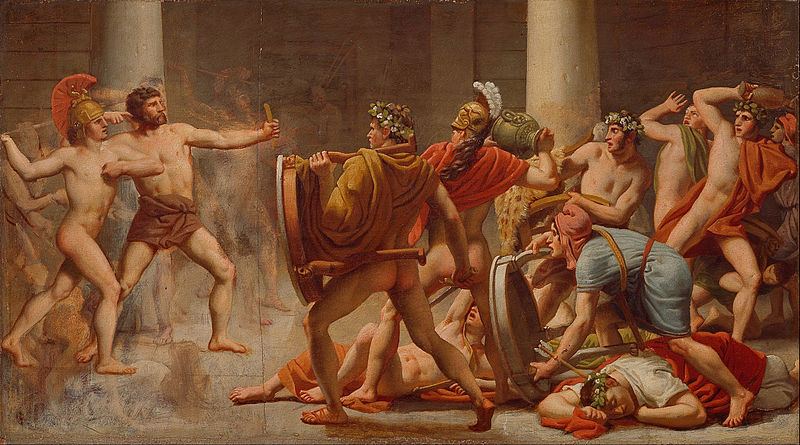
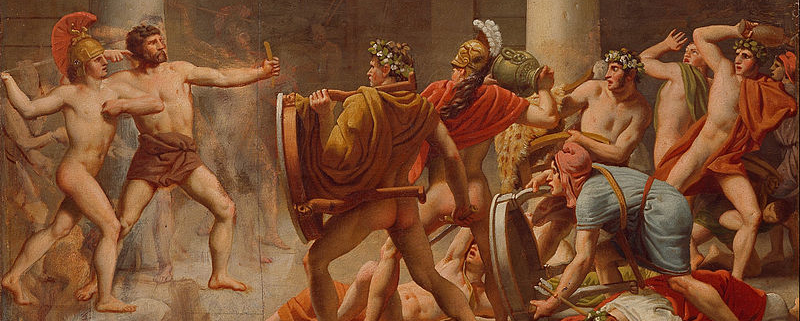
Odysseus engages the suitors in combat. 1814 painting by Christoffer Wilhelm Eckersberg
Finally, Odysseus makes his way home and “he rejoiced to be in his own country” (13.165-243); “King Odysseus was filled with happiness, filled with joy that this land was his. He kissed the grain-giving soil of it, then prayed to the nymphs with uplifted hands” (13.332-422). Athena transforms Odysseus’ appearance to that of an old man, to better gather allies, observe the suitors’ misdeeds, and prepare his revenge.
Odysseus enters the palace as an elderly beggar and is mistreated by the suitors, who have been scheming to murder Telemachus. The task will not be easy, but Odysseus asserts that he would rather die than live with such indignities: “I would rather perish, rather meet death in my own palace, than look on perpetually at things as detestable as these” (16.41-133). Finally meeting Telemachus, the two emotionally embrace, but Odysseus quickly turns to business: “at Athena’s bidding, I have come to this place to consult with you on the slaughtering of our enemies” (16.222-311).
When Odysseus reveals himself to the suitors, he will not be turned away from vengeance against those who “devoured my substance, forced my serving-women to sleep with you, and in cowardly fashion wooed my wife while I still was living” (22.1-122). One of the suitors offers tribute, but Odysseus will have none of it, dishonor cannot be redeemed with gold:
Not if you all gave me all your patrimony, whatever you have and whatever more you might come to have, not even then would I hold back my hands from slaughter till every suitor had paid for the whole transgression. (22.39-122)
Through subterfuge and prowess, Odysseus and his few allies are able to overcome and kill the suitors. They are not the only ones who must pay. While the few in Odysseus’ household who helped the suitors unwillingly are spared, the willing collaborators must pay, notably the servant-women, who are hanged. As Telemachus says: “Never let it be said that sluts like these had a clean death from me. They have heaped up outrage on me and on my mother; they have been the suitors’ concubines” (22.375-466). The punishments are monstrous, but the guilty perpetrated evil deeds, and the gods willed retribution.
The suitors overthrown and his authority restored, Odysseus can then finally unite with Penelope, who recognizes him in their own bed. Penelope has remained faithful to Odysseus and, with her handmaidens, maintained “the hearth’s unflagging fire” (20.122-93). Thus, the family has been saved. There is something touching in the couple’s complicity. As Odysseus had previously said: “There is nothing nobler, nothing lovelier than when man and wife keep house together with like heart and with like will. Their foes repine, their friends rejoice, but the truth of it all is with her and him” (6.121-200). The family members’ faithfulness to one another has allowed their collective survival.[1]
This is only a brief respite, for in a social world defined by kin, Odysseus knows that the suitors’ families will not be long in retaliating for what has happened. But the three generations, Laertes, Odysseus, and Telemachus, find confidence and joy in the honor and prosperity of their line:
King Odysseus . . . said forthwith to his son Telemachus: “My son, when you enter the battlefield where warriors prove their mettle, you need not be told not to shame the lineage of your fathers. In courage and manliness we have long been foremost, the whole world over.”
Thoughtful Telemachus replied: “Father, if you are minded so, you shall watch me in my present spirit by no means shaming the lineage that you speak of.”
So he spoke, and Laertes, in his joy cried out: “Dear gods, what a day is this for me! What happiness, when my son and my grandson are vying for the prize of valor!” (24.442-525).



 The most comprehensive prostitution decriminalization effort ever initiated in the United States has commenced in New York, led by