
Secret Semitic Censorship: How a Miniature Masterwork Was Perhaps Muzzled by Metus Judæorum
“If you read it once, you’ll remember it for ever.” I can’t say that of most short stories I’ve read. But I can definitely say that of “What Was It?” (1859). It’s the most famous story by the boozing and brawling Irish-American writer Fitz-James O’Brien (1826-62). In a few thousand words, O’Brien wove deep mystery, tragedy and horror around an alien creature with only three certain characteristics. Two of them are that it’s humanoid and malevolent. And what is the third? Well, that’s described by the narrator after he’s attacked by the creature one night in “the most profound darkness” of a bedroom. In a fierce struggle he manages to subdue it. And then, naturally enough, he wants to see what’s attacked him:
Never losing my hold for an instant, I slipped from the bed to the floor, dragging my captive with me. I had but a few steps to make to reach the gas-burner; these I made with the greatest caution, holding the creature in a grip like a vice. At last I got within arm’s-length of the tiny speck of blue light which told me where the gas-burner lay. Quick as lightning I released my grasp with one hand and let on the full flood of light. Then I turned to look at my captive.
I cannot even attempt to give any definition of my sensations the instant after I turned on the gas. I suppose I must have shrieked with terror, for in less than a minute afterward my room was crowded with the inmates of the house. I shudder now as I think of that awful moment. I saw nothing! Yes; I had one arm firmly clasped round a breathing, panting, corporeal shape, my other hand gripped with all its strength a throat as warm, and apparently fleshly, as my own; and yet, with this living substance in my grasp, with its body pressed against my own, and all in the bright glare of a large jet of gas, I absolutely beheld nothing! Not even an outline,—a vapor! (“What Was It?,” 1859)
Yes, the creature is humanoid, malevolent, and completely invisible. This is the first appearance of a literary trope that would be taken up by much more famous authors in much more famous works like H.G. Wells’ novel The Invisible Man (1897) and Guy de Maupassant’s short-story “Le Horla” (1887). Maupassant died tragically young like O’Brien himself and like Edgar Allan Poe, a big influence on O’Brien. But Maupassant and Poe have never lost the huge fame they acquired in their short lives. O’Brien wasn’t hugely famous even during life and might be forgotten now if it weren’t for three miniature masterworks, his three best short-stories. The first and most famous is “What Was It?,” followed by “The Diamond Lens” (1858) and “The Wondersmith” (1859).
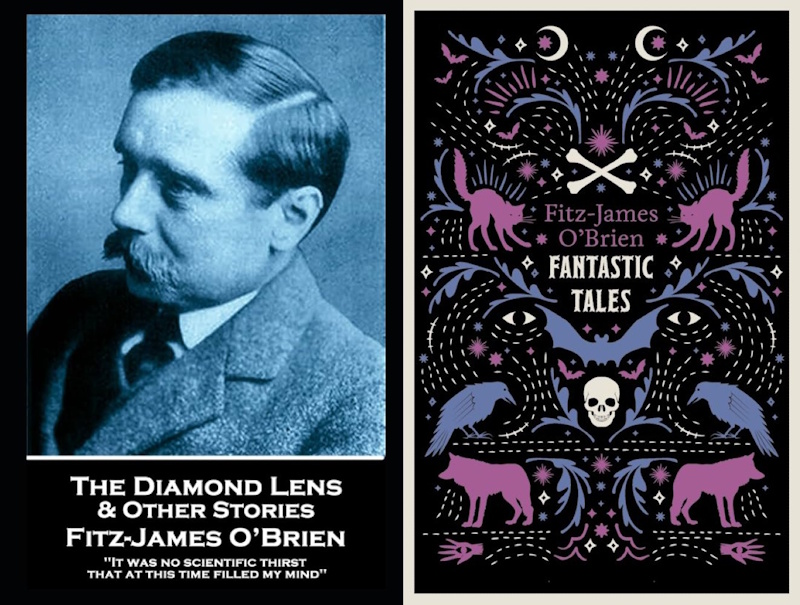 Books by a boozing brawler: Two collections of Fitz-James O’Brien’s stories
Those three stories continued to appear in anthologies and genre collections, keeping O’Brien’s name alive down the decades. But I’d read only “What Was It?” when I picked up Fantastic Tales, a welcome new collection of O’Brien’s stories published in 2025. Now I’ve read and rated “The Diamond Lens” and “The Wondersmith” too. How did I rate them? Well, “The Diamond Lens” is in some ways even more imaginative and memorable than “What Was It?.” It’s about another strange and symbolically seductive creature. But this one is beautiful, not malevolent, and appears not in a dark bedroom but in a drop of water.
I won’t say any more, because I recommend that you read the story for yourself and see how Fitz-James O’Brien is much less famous than he deserves to be. But I will say more about O’Brien’s story “The Wondersmith,” because I think it’s an example of something that’s also much less famous than it deserves to be. Or rather: much less infamous than it deserves to be. And what is that? It’s what you might call S.S.C. — Secret Semitic Censorship. The full story of Jewish censorship has never been told and never will be, because most of it has taken place in secret and without publicity. Jewish gatekeepers in journalism, publishing, academia and politics have squashed stories, suppressed facts, silenced crime-thinkers long before the gentile general public could glimpse the toxic truth. But even more Semitic censorship may have been indirect, carried out not by Jews themselves but by gentiles intimidated by metus Judæorum.
Lost in mistranslation
Metus Judæorum is a Latin phrase that strikes a repeated ominous note in the Evangelium secundum Johannem or the Gospel of John. In rather earlier Greek it runs ὁ φόβος τῶν Ἰουδαίων, ho phobos tōn Ioudaiōn, and in much later English it runs like this:
7:13 Howbeit no man spake openly of him for fear of the Jews.
19:38 And after this Joseph of Arimathaea, being a disciple of Jesus, but secretly for fear of the Jews, besought Pilate that he might take away the body of Jesus.
20:19 Then the same day at evening, being the first day of the week, when the doors were shut where the disciples were assembled for fear of the Jews, came Jesus and stood in the midst, and saith unto them, Peace be unto you. (See The Gospel of John at Bible Hub)
Ironically enough, some modern translators of the New Testament are motivated by ho phobos tōn Ioudaiōn when they mistranslate that very phrase as “fear of the Jewish leaders” and “fear of the Jewish authorities” or the even weaselier “fear of the leaders” and “fear of the authorities.” Jews have long condemned the New Testament as “anti-Semitic” and blamed it for inspiring the millennia of persecution and pogroms that culminated in the horrors of the Holocaust. That’s why they’ve striven mightily to replace Christianity with Israelism and Holocaustianity, and that’s why modern translators are frightened to translate simple Greek as equally simple English.[1]
A Christophobic Conspiracy
But it could be worse for Jews. Linguistic change has obscured in English a clear and obviously deliberate connection made by the Gospel in Greek and Latin, where “Judas” and “Jews” are Ioudas / Ioudaioi and Judas / Judæi, respectively. In the Gospel of John, malevolent, demon-driven Judas is meant to personify the malevolent, demon-driven Jews. That was in the 1st century A.D. But you can find the same themes – metus Judæorum, “fear of the Jews,” and malevolentia Judæorum, “Jewish malevolence” – in the 19th century A.D. and Fitz-James O’Brien’s story “The Wondersmith.” Or rather, you can’t find them, because the metus has censored the malevolentia. That’s what I’d claim, anyway. See if you agree with my reasoning.
“The Wondersmith” is a highly imaginative and logophilic story of a conspiracy to defile Christmas and kill Christian children using magically animated toys with poisoned weapons. Does that conspiracy sound Jewish to you? It does to me. The chief conspirator is the Wondersmith of the title, who owns a shop in the Lower Manhattan district of New York. He’s called Herr Hippe and has three co-conspirators: Kerplonne from France, who’s a maker of artificial eyes; Madame Filomel, a fortune-teller also from France; and Oaksmith from England, whose profession is never revealed. The four conspirators belong to the same alien race, which is mentioned by Herr Hippe when he gloats over their conspiracy and the “manikins” he has made to fulfil it:
“I long to test them,” cried the Wondersmith, rubbing his hands joyfully. “I long to see how the little devils will behave when I give them their shapes. Ah! it will be a proud day for us when we let them loose upon the cursed Christian children! Through the length and breadth of the land they will go; wherever our wandering people set foot, and wherever they are, the children of the Christians shall die. Then we, the despised Bohemians, the gypsies, as they call us, will be once more lords of the earth, as we were in the days when the accursed things called cities did not exist, and men lived in the free woods and hunted the game of the forest. Toys indeed! Ay, ay, we will give the little dears toys! toys that all day will sleep calmly in their boxes, seemingly stiff and wooden and without life,—but at night, when the souls [supplied by black magic] enter them, will arise and surround the cots of the sleeping children, and pierce their hearts with their keen, envenomed blades! Toys indeed! oh, yes! I will sell them toys!” […]
“Good!” cried Kerplonne, rubbing his hands joyously. “It is close upon New Year’s Day. We will fabricate millions of the little murderers by New Year’s Even, and sell them in large quantities; and when the households are all asleep, and the Christian children are waiting for Santa Claus to come, the small ones will troop from their boxes and the Christian children will die. It is famous! Health to Abigor!”[2] (“The Wondersmith”, 1859)
So the four conspirators are described as “gypsies” in the story. But they’re not behaving or talking like Gypsies. No, they’re behaving and talking like Jews. First of all, Gypsies were not prominent in the United States at the time of the story and especially not in New York. But Jews were prominent, especially in New York. Further, the hand-rubbing Herr Hippe and Kerplonne are educated and eloquent (the “Abigor” saluted by Kerplonne is a pseudo-Hebraic “demon of soldiery” in medieval magic). Gypsies were not associated with education and eloquence. But Jews were. Okay, Gypsies were indeed associated with fortune-telling and black magic like Madame Filomel, but Jews too were associated with black magic. Gypsies had never been associated with shopkeeping, manufacture and commerce like Herr Hippe and Kerplonne. Jews were certainly associated with those three things. There was no tradition in Europe or America about Gypsies despising Christianity and seeking to murder Christian children.[3] But there was certainly a tradition of that about Jews. And there was no tradition about Gypsies using poison and subterfuge against their enemies. But again, there was certainly a tradition of that about Jews. Finally, the megalomaniacal claim to be once and future “lords of the earth” was not associated with Gypsies. But it was certainly associated with Jews (and still is). Here’s some more from “The Wondersmith,” a description of the conspirators poisoning the toys, then gloating over the coming slaughter:
The anointing of the [toys’] swords [with deadly poison] went on rapidly, and the wine went as rapidly down the throats of the four poisoners. Their faces grew more and more inflamed each instant; their eyes shone like rolling fireballs; their hair was moist and dishevelled. The old fortune-teller rocked to and fro in her chair, like those legless plaster figures that sway upon convex loaded bottoms. All four began to mutter incoherent sentences, and babble unintelligible wickednesses. Still the anointing of the swords went on.
“I see the faces of millions of young corpses,” babbled Herr Hippe, gazing, with swimming eyes, into the silver bowl that contained the Macousha poison,—“all young, all Christians,—and the little fellows dancing, dancing, and stabbing, stabbing[!]” (“The Wondersmith”)
The Christophobia and gloating do not sound Gypsy: they sound Jewish. Gypsies were associated with petty theft, not with grand conspiracies to slaughter Christians and rule the world. Nor were Gypsies associated with the destruction of beauty and the cruel killing of animals. But Jews were associated with both and the conspirators in “The Wondersmith” want to test the murderous manikins. So they sneak into the shop of a goy called Pippel and set the manikins loose on his stock. Pippel is a bird-fancier from Germany and this is what his shop looks like before the conspirators have taken great satisfaction in “[saving] alive nothing that breatheth” there:
It was a little world of birds. On every side, whether in large or small cages, one beheld balls of various-colored feathers standing on one leg and breathing peacefully. Love-birds, nestling shoulder to shoulder, with their heads tucked under their wings and all their feathers puffed out, so that they looked like globes of malachite; English bullfinches, with ashen-colored backs, in which their black heads were buried, and corselets of a rosy down; Java sparrows, fat and sleek and cleanly; troupials, so glossy and splendid in plumage that they looked as if they were dressed in the celebrated armor of the Black Prince, which was jet, richly damascened with gold; a cock of the rock, gleaming, a ball of tawny fire, like a setting sun; the Campanero of Brazil, white as snow, with his dilatable tolling-tube hanging from his head, placid and silent;—these, with a humbler crowd of linnets, canaries, robins, mocking-birds, and phoebes, slumbered calmly in their little cages, that were hung so thickly on the wall as not to leave an inch of it visible.
“Splendid little morsels, all of them!” exclaimed Monsieur Kerplonne. “Ah, we are going to have a rare beating!” […]
“Come,” said the Wondersmith, producing the box of manikins, “get ready with souls, Madame Filomel. I am impatient to see my little men letting out lives for the first time.” (“The Wondersmith”)
Pippel from Germany loves and nurtures birds; Herr Hippe, also from Germany, despises and kills birds. Is Pippel meant to represent goyim and Hippe Jews? After all, Pippel sounds like “people” and goyim literally means “peoples,” being the plural form of Hebrew goy, “a non-Jewish people or race.” A logophile like Fitz-James O’Brien would surely have known that. I can’t see any obvious parallel wordplay in the name Hippe, but it does remind me of “hip-hooray,” which comes from earlier “hep-hooray.” Apocryphally, “Hep! Hep!” was the cry of the Christian mobs that attacked Jewish ghettos in the Middle Ages and later. It was supposed to be an acronym for Hierosolyma Est Perdita, “Jerusalem Is Lost” – that is, lost to Christians by Jews conspiring with Muslims.
Again, Fitz-James O’Brien very probably knew that story about the origin of “Hip-hooray.” He certainly knew the origin of the word “ghetto,” as he makes clear in the opening paragraph of “The Wondersmith.” That’s where he describes the scene of Herr Hippe’s shop and the Christophobic conspiracy:
A small lane, the name of which I have forgotten, or do not choose to remember, slants suddenly off from Chatham Street [in Lower Manhattan], (before that headlong thoroughfare reaches into the Park,) and retreats suddenly down towards the East River, as if it were disgusted with the smell of old clothes, and had determined to wash itself clean. This excellent intention it has, however, evidently contributed towards the making of that imaginary pavement [the highway to Hell] mentioned in the old adage; for it is still emphatically a dirty street. It has never been able to shake off the Hebraic taint of filth which it inherits from the ancestral thoroughfare. It is slushy and greasy, as if it were twin brother of the Roman Ghetto. (“The Wondersmith”)
The “Roman Ghetto” was the Jewish district in Rome, named after the Jewish ghetto in Venice. And I think that O’Brien’s opening paragraph is like the “gills” on a human embryo.[4] It’s an unmistakable clue to what was originally there: the development of the embryo into a fish; the expansion of “The Wondersmith” into a story about Jews, not about Gypsies. If the story was originally about Gypsies, why did O’Brien set it in a district of New York strongly associated with Jews? And why did he describe the district as smelling old clothes at a time when Jews were associated with selling used clothing? Why did he talk about the Jewish district of Rome and the “Hebraic taint of filth”? It doesn’t make sense. But it makes perfect sense if the story was originally about Jews and then re-written to be about Gypsies. The opening paragraph also makes perfect sense if O’Brien wanted to tell his readers Lisez le blanc, lisez ce que je n’ai pas écrit et ce qui y est pourtant — “Read the white, read what I did not write and what is there nonetheless.”
Creditors and editors
After all, O’Brien was certainly anti-Semitic. How else do you explain a phrase like “the Hebraic taint of filth”? That taint is inherited “from the ancestral thoroughfare,” the street where Jews specialized in the used-garment trade in New York just as they did in London and Paris. I think O’Brien was using streets as symbols: the “ancestral thoroughfare” is the ancient Jewish hatred of Christians and Christianity, which is still active in the off-slanting “lane” of the Jewish presence in contemporary America.
But O’Brien was doubtless well-acquainted with Jews long before he lived in America. He was born in County Cork, Ireland, then lived in London and likely visited Paris several times to use his fluent French. Having squandered his large inheritance, he next set off to find fame and new fortune in America. He did win some fame as a writer but never made a second fortune. He was born Irish and remained faithful wherever he roamed to the great Irish traditions of boozing and brawling. Michael Hayes, the editor of the new collection of O’Brien’s stories, describes what happened after O’Brien arrived in America in 1851:
In the next eleven years, O’Brien was to produce a mass of writing — poetry, plays, stories, essays, satires, criticism and journalism. He had to. He invariably lived beyond his means, often drank to excess, borrowed from Peter to pay Paul, and generally led a Bohemian existence. He dashed off stories and poems to settle his rent and placate impatient creditors. Hard times were his constant companion. It was also said that you were not considered his friend unless he had fought with you. In fact, he was kind to an extreme, well loved and a lively, amusing companion — at times truculent, at other times gentle and delightful. He never failed to enjoy a good fight. (Fantastic Tales, Fitz-James O’Brien, Alma Classics 2025, introduction by Michael Hayes, p. viii)
It’s highly probable that those “impatient creditors” included some Jews. And Jews almost certainly edited some of the magazines and newspapers O’Brien wrote for. If so, O’Brien may have reacted to Jewish creditors and editors like many writers before him and since: with distaste, irritation, and a desire to get his own back by satirizing Jews in print.
A Fantastic Fraction
Charles Dickens was one of the earlier writers who reacted like that to Jews, as I’ve described in “Minority Malice: The Curious Case of Daniel Quilp.” Saki and M.R. James were two of the later writers, as I’ve also described at the Occidental Observer. But have I described the same kind of writer in this article? Was “The Wondersmith” really aimed by Fitz-James O’Brien at Jews?
I believe it was and I’d predict there’s more hating on Hebrews by O’Brien in the “mass of writing” mentioned in that introduction to Fantastic Tales. Only a fraction of his writing is collected in the book, but the fraction proves that O’Brien was a very good writer and strongly suggests in “The Wondersmith” that he knew the Jew. So I heartily recommend Fantastic Tales to any aficionado of fantasy and horror. What’s true of “What Was It?” is true of the whole book: If you read it once, you’ll remember it for ever.
[1] Well, I say “simple Greek,” but in fact Ioudaioi doesn’t mean what “Jews” has come to mean. For further discussion, please see my article “Survival or Suicide: Italy Will Follow Meloni’s Melody, not the Schlein Whine.”
[2] Abigor is a powerful demonic entity primarily documented in the 16th and 17th-century grimoires (most prominently those related to the Solomonic tradition). He is a Great Duke of Hell who commands up to 60 infernal legions. The demon is typically associated with the power to foretell the future (especially in war) and to secure favor with military commanders. That’s why his counsel was explicitly sought in matters of war and generalship. He is also one of the demons that grant command and bestow martial knowledge upon the summoner.
[3] Gypsies were rumored to steal non-Jewish children, not murder them.
[4] Strictly speaking, the “gills” on an embryo are pharyngeal arches. But they look like gills and would have developed into gills in our piscine ancestors.




“Hippe” may suggest “Hebrew” or h**by. And it shares four letters with “Pippel” but doesn’t end (w)ell.
Hip Hip Hooray!
Is this treasure trove of anti-Jewish satire online as yet?
There’s a big market for anti-Jewish satire right now and it would be well worth republishing.
I’m under the impression that James Melville and Edgar Allen Poe were not well recognized and even sank into obscurity for a while. Likewise H. P. Lovecraft.
I’m also, these days, under the impression that for every noted Jew author, there’s at least one “Goy” author who was more brilliant, who had the same ideas, etc., who was overshadowed or even had their life destroyed so there would be no one to squawk when the the Jew credited with those ideas, gets credit for them.
This applies to all the arts and sciences with classic examples ranging from Albert Einstein and Mileva Maric, who seemed to have quietly disappeared, to the very commercially-minded “Big Daddy” Ed Roth vs. the actual genius, “Von Dutch” https://en.wikipedia.org/wiki/Kenny_Howard who was the real genius of “Kustom Kulture” and who died in obscurity. A friend of mine knew him as “Crazy Kenny” and he became, sensibly, quite the anti-semite, living in a trailer in a junkyard and working as an informal security guard.
I also learned in the Jew classes I was taking that the modern Jews are exactly one and the same with the “Pharisees” Jesus rants against, and they’re proud of it.
Another excellent observation.
There was a novel with the same plot/ideas as Catch-22.
Did (((that author))) and Heller make claims against one another?
Nope.
Call me the site’s biggest antisems, but I’d guess ((their))) works are all collaborations, they get together and assign a fellow chosenite on top in Goyland thru a common work.
We can’t imagine that level of collaboration, but it sure explains, perfectly, why middling jews get to high positions, eh?
Heller is/was a Yid also https://en.wikipedia.org/wiki/Joseph_Heller#Early_life
So it’s a matter of two parasites fighting with each other. Reminds me of the old joke about how copper wire was invented by two Jews fighting over a penny.
Yes, thanks. What I was getting at was Catch 22 was a collaborative, between several yids. They said Heller or, the collaborative, borrowed from Joseph asek, who wrote the good soldier Swek. Heller acknowledged that he borrowed from him.
It is most bizarre that just a few years after world War ii, a war were told we were fighting against the most evil entity that had ever appeared on earth, Heller writes a book that disparages all the men and women that died for their six gorillion cause.
That’s just plain evil
Hip Hip Hooray!
Didn’t know there were any significant amount of 🧃 in the U.S. before 1880, i recall 1844 ‘Natavist’ riots were started by one though.
People took the same offense to jews then as now, as before. Funny how that is.
Hep Hep riots; perfect.
https://counter-currents.com/2026/08/a-ride-through-the-plot-part-1/
Holey, aka “van Helsing,” is a nutcase, but a shrewd businessman (like everyone in this “esoteric-alternative scene”). They’re only marginally interested in “truth.” The fact that he establishes Nazi UFOs as credible entities is, in my view, an absolute plus—nothing could satisfy us more than the subversion of Jewish rule, by whatever means necessary!
I’ve never read a “book” by him, nor do I intend to. Yesterday I watched a 30-year-old video of him in which he “argues” that the “powers behind the scenes” (in reality: the JEWS) have shut down further sales of his bestseller. Curiously enough, he’s absolutely right about that. The Jews protect their unchallengeable power over us even against such small-time figures.
He doesn’t speak like someone who thinks or reasons spontaneously, but like someone who has rehearsed a script or is being fed lines from somewhere near the camera—no “normal” person talks like that. The filmmaker, of course, is completely on his side.
https://www.youtube.com/watch?v=WREynqL-SX0