
On Late Loyalism: Rescuing the Lost Sheep of Greater Britain, Part Two of Two
The Invisible Race at the End of the Axial Age
While Maoris still practiced an immanentist religion, white Anglo-Saxon Protestants were already becoming transcendentalists in both politics and religion. Two-and-a-half centuries later, the fundamental truths guiding spiritual life for American WASPs, even the ethical truths and legal norms governing the secular realm, have become fully universal in scope and effect. As the universalist logic of the Axial Age unfolded and the global American empire extended its geopolitical hegemony, it became axiomatic among American WASPs that one’s religious identity transcends both politics and ethnicity. Accordingly, the contemporary rise of interest in Christian nationalism presents WASPs with a problem: how can a universal Christian religion accommodate particularistic national, much less racial and ethnic identities? Wouldn’t that be akin to squaring a circle?
In 2025 two important American Christian Nationalist conferences were held, the themes of which illustrate the two horns of that dilemma. One, sponsored by Right Response Ministries in Texas was devoted to discussions of Christ the King: How to Defeat Trash World. The theme itself echoes seventeenth-century Anabaptists, English dissenters, and reformed American colonists who swore allegiance to “No King but Jesus” as a call for fidelity to Christ, lawful resistance to tyranny, and spiritual freedom. Clearly, the conference organizers were invoking the transcendent authority of Christ in opposition to those ostensibly in charge of a fallen “Trash World”.
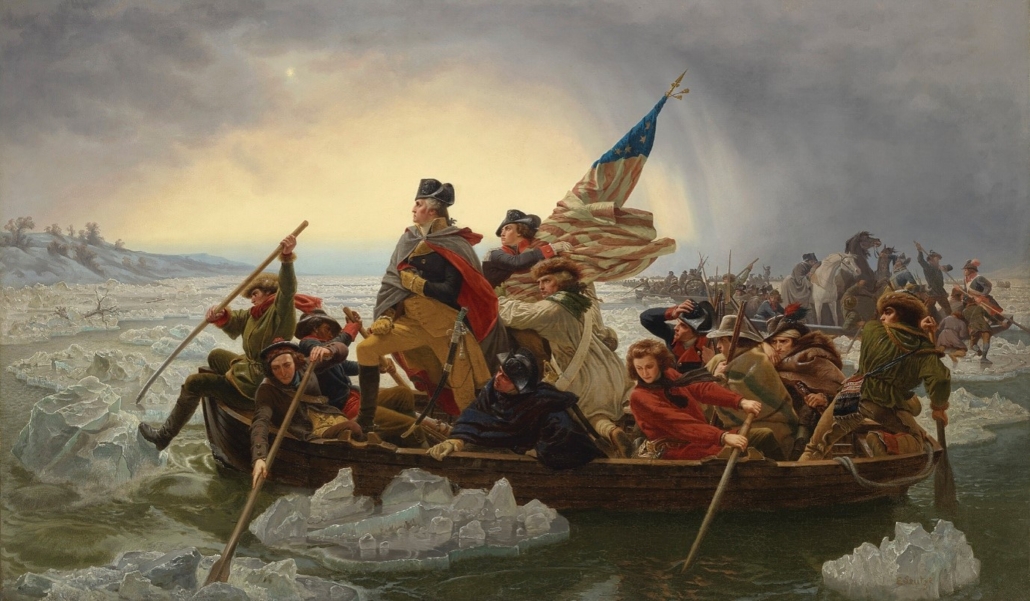
In Utah, a second conference was organized by The New Christendom Press and featured an array of Christian nationalist speakers addressing the theme of “Safety Third,” thereby implicitly calling upon attendees to summon up the courage to combat the forces now waging a spiritual war against both Christianity and Americanism. For online followers at least, the most striking aspect of the Utah conference, was visual. On the wall at the rear of the stage a huge screen displayed the famous painting by Emanuel Leutze portraying George Washington as a resolute revolutionary general crossing an ice-choked Delaware river, leading his troops on a victorious assault on British forces. This iconic image of Washington came to personify the new nation, the American Adam created ab initio in a revolutionary republic thanks to the god-like courage of a conquering hero.
The founding myth of the American nation celebrates the transcendent character of the “glorious” War of Independence. This has become a central and recurring theme in Christian nationalist rhetoric. As Steven K. Green puts in his book on Inventing a Christian America: “The American colonies did not simply sever their political ties with Great Britain; they also renounced their identity as British citizens [or “subjects”], with that long national heritage.” It was essential, therefore, to muster patriotic sentiment not just to avert military defeat but also to meet the challenges associated with creating a new government that had the support of the people. According to Green, such circumstances called for a narrative of origins to reinforce the idea of national independence.[1]
The road to revolution did not immediately foreshadow the eventual victory of transcendence over the immanent authority of the British past. At first, the colonists invoked the traditional rights of Englishmen in their struggles with the Crown and Parliament. The revolutionary leaders who fought and won the War for Independence laid “the foundations for such a narrative in the colonial past … and in the religious predispositions of many who were positioned to influence popular attitudes.” To “legitimize their cause and unify a new people,” political and religious leaders did celebrate the supposed “contributions” of New England Puritans (such as covenant theory, self-governance, natural law, and human depravity) to the foundation of the new nation. But Green sees no “direct connection” between the finer points of Puritan political theology and the founding period.[2]
In any case, once the decision for independence was set in stone, appeals to either the colonial or the ancestral English past lost their cachet. Carl Becker’s classic study described the Declaration of Independence as “an event, or at least the symbol of an event of surpassing historical importance.” That document “indissolubly associated” the foundation of the American republic “with a theory of politics, a philosophy of human rights which is valid, if at all, not for Americans only, but for all men.” After American independence became an “accomplished fact,” the Declaration acquired “a distinction, a fame, which could not be ignored, and gave to its philosophy of human rights the support of a concrete historical example.”[3]
As for George Washington, he was an enlightened Freemason as well as, inter alia, a planter, land speculator, soldier, and statesman of the Axial Age. He certainly did not present himself as a cosmic man bearing mana from the gods of his ancestors. His theological beliefs and religious terminology indicate the “unmistakable influence of rationalism, if not deistic thought.” Green cites “Washington’s disdain for church doctrines and religious enthusiasm,” along with the complete lack of any references by him to Jesus or his salvation mission” as evidence that “he rejected many Protestant core teachings.”[4] In short, he was anything but a poster boy for Christian nationalism.[5]
Modern Christian nationalists beg to differ. Certainly, the organizers of the Utah conference held up George Washington for public veneration as an iconic figure central to “the myth of the religious founding.” In their view, the diversity of Anglo-Protestant experience during the colonial era culminated in a founding generation, symbolized by Washington, the creator of what once was and, they hope, will become, again, a Christian nation.[6]
Yet Anglo-Protestantism provides an unstable foundation for American republicans whose roots in the Puritan tradition admit no contradiction between the worship of “no king but Jesus” in his heaven and the sanctification of the Almighty Dollar here on earth. Civic nationalists to the core, Anglo-American Protestants proudly pretend that their American ethnicity was born of their revolutionary struggle against royal tyranny. In contrast, the Loyalists grounded their identity in British race patriotism manifested in ancestral loyalty to throne and altar. American patriots have had only the Constitution (along with the efforts of Emanuel Leutze, Parson Weems, and others devoted to “the sanctification of George Washington and his re-casting as an orthodox or evangelical Protestant”) to provide a functional substitute for the metapersonal image of the Crown at the mythic centre of Power in Great Britain.[7]
The revolution left a permanent spiritual vacuum at the heart of the secular republic: the Divine Economy fills the God-shaped hole in our transient lives here on earth while Christian churches order their flocks to their eternal, heavenly end, humbly praying for the return of King Jesus in fulfillment of his eschatological promise.
Failure of the American Experiment
From a metahistorical perspective, the closing phase of the axial age within the Anglosphere manifests itself most conspicuously in the progressive devolution of the American republic. The WASP Question discusses the first three stages of that process: The First (Federal) Republic, 1789–1860 was replaced after the War Between the States by the Second (Bourgeois) Republic, 1865–1932, which itself was succeeded by the Third (Managerial-Therapeutic) Republic. The WASP Question was completed and published in 2011 in the first term of the Obama presidency which, it now seems clear, inaugurated what became the Fourth, and probably final (Transnational/Transracial) Republic.
Spiritual sterility and political corruption have led to widespread recognition that the “American experiment” has failed. What is to be done? At least four major dissident strategies propose remedies for the terminal crisis of the Republic:
- American Christian nationalists hope to make America Christian again. But their institutional response to the evident failure of the American experiment goes no further than a call to move beyond denominationalism, while maintaining orthodox unity on primary theological principles. Baptists, Presbyterians, Anglicans, Methodists, and other Protestant churches must put aside their creedal differences on secondary and tertiary theological issues and unite as Protestants (while retaining their historical resistance to Popery and Eastern Orthodoxy). Pastor Joel Webbon dreams of incorporating the Nicene Creed into the preamble of the Constitution.[8] More minimalist approaches focus on Sabbatarian laws, school prayers, outlawing abortion and so on.
- Liberal-minded process theology presents a second strategy: struggle against the demonic powers embodied in the global American Empire. This would amount to a globalist campaign waged in the name of universal human rights.[9]
- Race realist Jared Taylor prefers a secular strategy focused on secession as one possible mode of ensuring the survival of the White race on the North American continent.[10]
- Neo-reaction (NRx) or the Dark Enlightenment proposes a technocratic model of an authoritarian, corporatist monarchy focused on the capture of Power. Curtis Yarvin’s article on “The Situation and the Solution” clearly outlines the strategy necessary to create a one-party state capable of rescuing America from the failure of a constitutional republic grounded in the civic virtues of its citizens.[11]
From Late Loyalist Schadenfreude to the Rebirth of British Race Patriotism
Those of us who grew up with ancestral memories of the Loyalist regime established in Upper and Lower Canada after the American Revolution can perhaps be forgiven for indulging in a bit of Schadenfreude when contemplating the “progressive” mutation of the American Republic into what has long been characterized by the dissident right as the Zionist-Occupied Government (ZOG) now manifest in its final, most grotesque form as the Age of Trump.[12]
None of the major dissident strategies on offer for the salvation of the republic seek to restore the fusion of ethnicity, race, and religion that American Loyalists vainly sought to preserve. Nor do these strategies recognize or orient themselves towards the tribal future of the West as portrayed in the final chapter of The WASP Question. The hope held out there for the palingenesis of the founding race of the Anglosphere has taken on a new urgency with the publication of Mike Maxwell’s book on the Tribal Future of the West.
That future, as conceived by Maxwell, will present WASPs with unavoidable, existential challenges as intractable, “essentially ethnic and kin-based” conflicts produce recurrent tribal warfare:
The struggles to come will be non-civic, non-propositional, and non-consensual in character—rooted not in ideological belief or institutional allegiance but in ascriptive bonds of kinship and inherited identity. Tribal war captures the devolutionary direction of political life: a reversion from the scale of great nations to smaller, more organic groupings. It emphasizes that lower orders—families, clans, and local loyalties—are the real buttresses of higher structures, and that when those foundations fracture, so too do states.[13]
Looking on the bright side, neo-tribalism holds out some hope of a return to new (hopefully more refined) incarnations of immanentist ritual and religious discourse, fusing ethnicity and religion across the British diaspora. Stiff doses of reality as tribal warfare becomes normalized will certainly reconnect “the future to the deep past, acknowledging that nothing fundamental has changed in human organization since prehistory. Only the outer form and technologies have shifted; the human material remains the same.”[14] Should Angelcynn tribes revert to immanent forms of religious experience, the world itself may, once again, be filled with gods.[15]
In that advanced model of primordial cosmoreligions, personal adherence to transcendental creedal orthodoxy will no longer suppress ethnoreligious identities. Instead, a long transition towards the orthopraxis of an Angelcynn ethnoreligion will begin with the emergence of a Broad Church grounded in transnational ethnoreligious unity among WASPs throughout the Anglosphere. This process will ground neo-Angelcynn identity in institutions and communities outside and apart from the state. Any such expectations contradict the statist assumptions underlying all the reactionary alternatives on offer.[16]
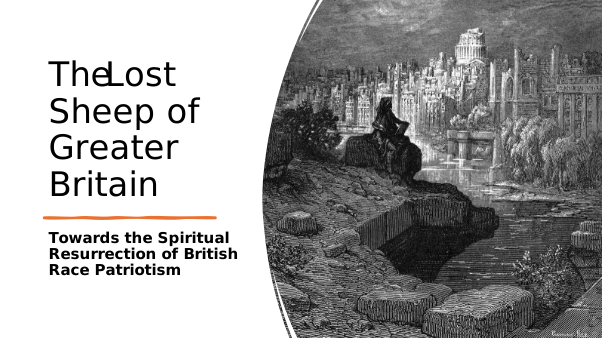 Gustave Doré “When London is in Ruins”
The reinvention of Angelcynn tribal confederations throughout the post-Christian Anglosphere will draw upon a metapersonal, monarchical myth of Power rooted in an ancestral folk-religion re-embedded in the ritual cult of a Patriot King.
Such a new-modelled Angelcynn Network requires, at a minimum:
- The transformation of Anglo-Protestant, especially Anglican, churches into the institutional medium for the emergence of a folkish/ancestral religion with its own ethnohistorical mythology; and
- a process theology that recognizes Anglo-Saxon/British identity as a divinized work-in-progress emerging as a process of theosis within the lifeworld of today’s deracinated “heritage Americans,” Anglo-Australians, Anglo-Canadians, etc.; and
- the emergence of Angelcynn (formerly WASP) elites capable of countering the crypto-Jewish supremacism of the so-called techno-populism promoted by Yarvin and other leading figures of the Dark Enlightenment; and
- “Christian nationalists” who clearly and unambiguously acknowledge that the words “Christ” and “Messiah” in the original Greek and Hebrew meant “anointed” and could, in principle, be applied to historical figures emerging within a self-consciously, ethnoreligious “Angelcynn” tradition at some point in our own future; and
- the recognition of Jesus the Christ as a (possibly) historical and/or mythological figure whose universal pre-eminence has long compromised manifold particularistic projects of peoplehood, as varied as the Hebrew Bible, a somewhat suppositious first-century Jewish-Christian movement, the Greek and Roman literary circles which created the New Testament canon, their imperial sponsors, as well as the Roman Catholic, Eastern Orthodox, and myriad Protestant and other churches over the past two millennia; and
- acknowledgement, therefore, that Sola Scriptura cannot serve as the sole inspiration or the foundational text for an Angelcynn ethnotheology in the current post-Christian age; and, finally
- WASP churchmen ready, willing, and able to act on Sir John Seeley’s recommendation that the Anglo-Protestant churches create their own Bible. While they are at it, they must infuse folkish themes into liturgies and homiletics. The intellectual and spiritual armoury of a post-Christian WASP project of peoplehood also requires Anglocentric forms of practical, historical, and geopolitical theology enabling Angelcynn communities the world over to navigate the differences between friends and enemies.
In summary, The WASP Question mourns the collapse of British race patriotism which left Anglo-Saxon Christendom subject to the financialized streams of irresponsible Power emanating from the Divine Economy. The formerly White Dominions of the British Crown were absorbed seamlessly into the postwar globalist American empire managed by cosmopolitan client regimes rapidly taking on the character of multicultural police states.
The spiritual reformation and temporal survival of the Anglosphere require a post-Christian Angelcynn geopolitical theology adapted to a world in which the core ethnic identities of Western nation-states have been hollowed out. As a result, the sovereign legitimacy of those regimes is visibly withering away. Stateless WASPs will have to create and maintain tribal confederations at scale, across land and sea, if they are to survive as a recognizable ethnic group.
The collective strength and unity of widely scattered Anglo-Saxon diaspora communities will be conditional upon the creative re-configuration of constitutional authority on the terrain of civil society, not in the realm of formal state power. In the tribal future of the Anglosphere, any such institutionalized efflorescence of WASP civic authority will require a profound and continuous cultural revolution. Paradoxically perhaps, these innovations will call for the restoration of civic virtues pioneered by the republican polities of Greco-Roman antiquity—within which tribal identities and tribal gods still played a prominent role.
Unfortunately, ever since the Puritan Revolution every Anglo-Saxon country has been dominated by mercantile and financial elites driven by the pursuit of wealth rather than civic virtues. Consequently, our managerial, professional, and political elites are steeped in the social psychology of “hedonic maximization,” valuing short-term gratification over long-term flourishing. By contrast, ancient Aristotelian ethics prized eudaimonia (lit. good spirit), the divine state of being generated by consistent activity reflecting virtue and excellence.
Successful Angelcynn resistance to the increasingly corrupt (and corrupting) mercantilist regimes of our time must reanimate the good spirits once incarnate in the triadic social structures of early medieval Anglo-Saxon kingdoms—and secure their long-term flourishing. This will require another “great replacement,” that of the one-dimensional man spawned by the plutocratic, corporate oligarchies now misruling the hollow states and degenerate cultures of the Anglosphere. A postmodern Angelcynn reformation will reconstitute re-tribalized societies on the model of the three-legged stools which supported the authority of Anglo-Saxon kings: “those who work” will be governed by an alliance of “those who pray” with “those who fight.”
Facing the postmodern descent into decentralized forms of tribal warfare, recovering WASP elites must cultivate the heroic character that, in days of yore, belonged to Anglo-Saxon men of steel in ships of wood. Only such an archeofuturist model of social order can resurrect the ancestral ethnoreligious spirit which, in the guise of Alfred the Great, brought the sweet dream of a Patriot King down to earth.
Endnotes
[1] Steven K. Green, Inventing Christian America: The Myth of the Religious Founding (New York: Oxford University Press, 2015), 101.
[2] Ibid., 101-102.
[3] Carl L. Becker, The Declaration of Independence: A Study in the History of Political Ideas (New York: Vintage, 1922), 225.
[4] Ibid., 147-148.
[5] Washington, it should be noted, was partly of Huguenot descent, as were Alexander Hamilton and John Jay. Marco de Wit contends that the “leading Huguenot families were uniformly philosemitic and often connected to Jewish merchants through trade, politics, and Freemasonry. In fact, the philosemitic Huguenot Freemason from New York, John Jay served as the Revolution’s spymaster” worked closely with a “highly positioned Huguenot-Jewish-Freemason circle to feed information to Washington.” Significantly, there is also “evidence suggesting George Washington oversaw extensive homosexual and bisexual ties among his officers and intelligence agents.” De Wit suggests as well that Washington’s “opposition to strict conservative Christianity” and advocacy “for the more ‘tolerant’ Freemasonry,” along with a long, childless marriage and an “obsession with clothes” might account for his own “apparent homosexuality.” See:
[6] Green, Inventing Christian America, 101-102; cf., Stephen Wolfe, The Case for Christian Nationalism (Moscow, ID: Canon Press, 2021), 399, 431.
[7] Green, Inventing Christian America, 209.
[8] Pastor Joel Webbon, “Denominationalism is Dead,” https://www.youtube.com/watch?v=PBDrMAYKK2w&t=1751s
[9] David Ray Griffin, The Christian Gospel for Americans: A Systematic Theology (Anoka, MN: Process Century Press, 2019).
[10] Jared Taylor, “The American Experiment Has Failed,” https://www.amren.com/features/2025/11/the-american-experiment-has-failed-2/
[11] Curtis Yarvin, “The Situation and the Solution,” https://substack.com/home/post/p-181216819
[12] The transnational character of the 4th Republic is formalized inter alia “in Section 622 of S. 4615, the Intelligence Authorization Act for Fiscal Year 2027. Its title is anodyne: ‘United States-Israel Intelligence Sharing Enhancement.’” This obscure statutory provision routinizes intelligence sharing between the USA and Israel in such a way as to effect “the quiet conversion of an ally into a co-sovereign.” Ronald Dodson, “Section 622 and Israel,” https://rondodson.substack.com/p/section-622-and-israel, June 24, 2026.
[13] Mike Maxwell, Tribal Future of the West (Perth: Imperium Press, 2025), 349.
[14] Ibid., 349.
[15] John Michael Greer, A World Full of Gods: An Inquiry into Polytheism Revised and Expanded Edition (UK: Aeon Books, 2023).
[16] This Preface is not the place to develop a systematic critique of those alternatives. Readers interested in my take on alternative dissident strategies can find such critiques in a series of books that I have published after the appearance of The WASP Question in 2011. See, Dissident Dispatches: An Anglo-Identitarian Guide to Christian Theology (Arktos, 2017); Reinventing Aristocracy in the Age of Woke Capital: How Honourable WASP Elites Could Rescue Our Civilisation from Bad Governance by Irresponsible Corporate Plutocrats (Arktos, 2022); and Christian Nationalism vs Global Jesus: Projects of Peoplehood from Biblical Israel to the Collapse of British Patriotism (Arktos, 2025).




Leave a Reply
Want to join the discussion?Feel free to contribute!