
On Late Loyalism: Rescuing the Lost Sheep of Greater Britain, Part One
When asked sometime in the 1970s what impact the French Revolution had on world history, the Chinese Premier Zhou Enlai replied that it was too early to tell.[1] The historical significance of the American Revolution, on the other hand, is now coming into sharp relief. Having reached their 250th anniversary, the WASP epigones of the founding fathers have all-but-exhausted the rich reserves of the biocultural capital their revolutionary ancestors inherited (or wrested away) from the King and country of their fellow British subjects.
The people of the newly independent thirteen colonies were overwhelmingly of Anglo-Protestant stock. Not surprisingly, when the First Amendment mandated the constitutional separation of church and state, the question whether the American republic was a Christian nation had been thrown open to debate. Today both Anglos and Protestants are shrinking minorities of the American population.
Some historians concede, of course, that whatever the founders may have intended, something resembling an Anglo-Protestant nation emerged out of the mid-nineteenth century revival movements. Even so, a century and a half later it is difficult to deny that the Anglosphere has entered a post-Christian age. Given the massive demographic changes that have occurred in every once Anglo-Saxon nation in the postwar era, neither political citizenship nor the Christian religion provided effective solutions to the identity crisis plaguing the dispersed British-descended peoples of the Anglosphere.
Yet, fifteen years after The WASP Question (Arktos, 2011) was published, it now seems possible that the devolution of the Anglosphere into multicultural tribalism might precipitate the resurrection of a postmodern British race patriotism. Heightened awareness of the friend-enemy distinction in everyday life could produce an unexpected fusion of the modern WASP bioculture with ancient religious sensibilities throughout the Anglosphere.[2]
If so, the idea of “late loyalism” might take on a metapolitical significance far beyond the significance attached to the label in Upper Canada in the early nineteenth century. Then it referred to the large influx of American settlers seeking cheap land in the newly opened Upper Canadian wilderness. Even when the War of 1812 brought the threat of an American invasion of Canada, the late loyalists kept their heads down and minded their own business.[3]
In our own future, an altogether unexpected manifestation of late loyalism may reflect the recovery of a shared sense of British identity among all the White Anglo-Saxon Protestant peoples. Certainly, they share a common experience, outside and apart from the states deliberately promoting their replacement through mass non-White immigration and forced multiculturalism. This is true everywhere in the Anglosphere, both in the diaspora and in an ever more dystopian “Yookay”. Indeed, even within the Anglo-Protestant minority in the rapidly browning Rainbow Republic, late loyalism could (and should) become a real possibility.
Nevertheless, the fundamental problem posed in The WASP Question remains unresolved: the founding peoples of the Anglosphere, white Anglo-Saxon Protestants, suffer from collective amnesia. By way of remedy, this book prescribed a deep cultural and spiritual rebirth—palingenesis—among the descendants of those who created Angelcynn Christendom. Restoring the cultural memory of that folkish faith is the precondition for the resurrection of British race patriotism. Only a spiritually reborn Anglosphere can effectively resist dissolution into the multiracialized mélange of mere “populations” managed by corrupt, irresponsible, and soulless corporatist plutocracies. The “invisible race” of WASPs needs a post-creedal, ethnoreligion capable of generating a geopolitical theology of their own making.
No doubt the American Revolution dealt British race patriotism a crippling blow. But the English ruling elite had already shot itself in the foot more than a century earlier when it provoked a fiery Puritan revolution which denied the divine right of English kingship. Not surprisingly, the emigré descendants of those English Puritans took the lead in the abolition of kingship, once and for all, in a revolutionary American republic.
Since the creation of the republic, the historic, vestigially sacred character of the British monarchy has withered away, not just in the United Kingdom itself but also, much more visibly in the old white dominions of the Crown in Australia, Canada, and New Zealand. Moreover, Christendom itself has become a constitutional dead letter in the English-speaking world. Eventually, as the American revolutionary process ran its full course, a transnational corporate welfare state displaced the sovereign authority of every ostensibly liberal democratic regime throughout the Anglosphere. Ironically, the American republic itself is now little more than a polite constitutional fiction.
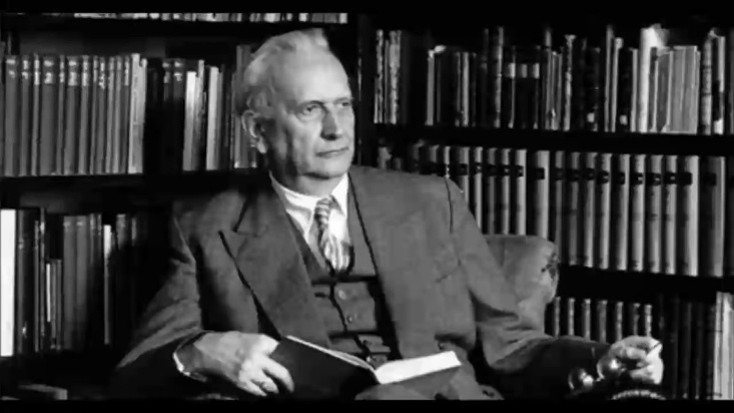
Karl Jaspers (1883–1969)
In this context, it may be that the current decline of the global American empire holds more than merely historical significance. The Anglosphere (indeed, Western civilization at large) has passed a turning point of metahistorical significance. Fundamental assumptions grounding politics, government, and religion for centuries, if not millennia, have been reshaped beyond recognition. In no more than a single human lifetime, the Axial Age, identified in 1949 by a German-Swiss philosopher of religion, Karl Jaspers, as the metaphysical culmination of human history, now seems to be on its ignominious way out.[4]
The Cosmology of the Original Political Society in an Enchanted Universe
To properly understand what may await us in a future post-Axial Age we must understand what came before it. In Jasper’s narrative of the Axial “breakthrough” in the history of religious discourse, the new age began circa 500 BC with “a profound transformation of religious presuppositions” which in turn carried major social and political consequences.[5] The myth of the Axial Age held that the transcendent “roots of modernity” lay in the more or less clear apprehension of classical civilizations that “there is but One Truth and One Mankind.” Christianity emerged as the Jewish/Roman religious apprehension of that transcendent Truth. “In Jasper’s rather tragic view of universal history,” not all those early Axial “breakthroughs” survived “their later institutionalizations.” Given that so many of the roots of modernity were ploughed under over the passage of time, modernity appears to be a still “unfinished project.”[6]
In contrast to the proto-modernist pursuit of the transcendent divine, archaic, pre-Axial religious discourse imagined the gods belonging to a multiplicity of tribal cultures as immanent in nature . In sharp contrast, the universalistic “transcendental visions” of the Axial Age laid “claim to absolute, unconditioned Truth, with a capital ‘T’.” In other words, “an exclusively Axial concept of transcendence” presupposed “a cosmological chasm between a transcendental and a mundane sphere.” An “immanentist” understanding of the divine is typically much more conditional and relativistic in the sense that the gods immanent in nature belong to “another” world without being “extra-mundane.”[7]
According to C.A. Bond, the Neolithic cultures associated with the development of agriculture, the domestication of animals, and, thus, the change from a hunter-gatherer lifestyle to settlement were “were not states of anarchy, nor were they sovereign orders.” It seems that they were “uniformly ritualistic and sacrificial in their organisation,” observing “law as handed down by god, ancestors, or spirits.” The rituals and sacrifices “seem to have been a means of communication with this other world.” Law givers in these orders were not presented as giving the laws themselves; rather, they functioned as “conduits of the gods”. Pre-Neolithic cultures did not have domesticated animals at hand for sacrificial purposes. Nevertheless, for them, too, hunting likely involved “the killing and butchery of the animal in a precise manner so as to mitigate the risk of alienating the animal’s spirit or any tutelary gods linked to the animal.” In all of these pre-Axial cultures, the “gods and spirits of their systems of belief actually exist and inhabit the world.” Indeed, gods and spirits are as much part of such polytheistic social orders as biological people.[8] Some scholars try to capture this pre-Axial presupposition of the cosmic immanence of the divine by substituting the term cosmotheism for polytheism.[9]
Marshall Sahlins portrays human society in a “state of immanence” as:
a fractional part of a much larger cosmic society populated by a multiplicity of different kinds of persons, many organized in their own societies, and all more or less empowered, and encompassed by the greatest of them, deities of this cosmic polity—this cosmopoliteia.[10]
Clearly, if such cosmic polities were present within what we understand as a primordial “state of nature,” that realm did not correspond to a state of anarchy as imagined by social contract theorists of seventeenth century such as Hobbes and Locke. Instead, it was a world filled with other-than-human persons [‘metapersons’] endowed with greater-than-human powers.”[11] In such “immanentist” cultures, as described by Sahlins:
personhood is virtually everywhere and in almost everything. The universe is full of persons from whom emanate forces that constitute the world as objectifications of their intentions … animistic spirits, demons, ghosts and ancestors, species and place master, and high gods and others.[12]

Marshall Sahlins (1930–2021)
Sahlins adds that in such “enspirited societies, political relations are metahuman relations, and human political authorities are cosmic persons” insofar as they act as intermediaries between other-than-human metapersons (on whom they modelled their own personhood) and the mundane people groups which they govern. The heil or charisma emanating from chiefs, kings, amounted to “the human appropriation of divinity,” thereby introducing into human society, as their own, “potencies appropriated from the cosmic host.” [13]
On Marshall Sahlins’ interpretation of immanentist cosmology, the universe is enchanted. Even in the smallest tribal societies, a cosmic state grounded people’s dependence on the “encompassing life-giving and death-dealing powers, essentially persons like themselves, who rule earthly existence.” Whatever the social contract theorists of the Enlightenment may have thought, in the prehistoric state of nature, from the very beginning, the cosmic state was the general condition of mankind.[14] What has changed? Or, have things changed?
The Persistence of Immanentist Political Theology
Well, Jaspers might say, the Axial Age came along and with it, the disenchantment of the world. To our more enlightened, modern minds, it seems obvious that prehistoric, primitive peoples “invented” the spirits, simply creating the gods in their own image, thereby according to them the ultimate power to determine their fate. But, Sahlins insists, it is a mistake to embrace the “enlightened” and “modern” understanding of political theology. He flatly asserts that:
People did not create the gods out of thin air; they only hypostasized the forces that were already conditions of their existence. I repeat, humans did not imagine the gods, they only objectified, or more precisely, subjectivized, the extra-human forces by which they themselves lived and died.[15]
One might even say that the religious base of society determined the mundane superstructure, at least “until religion went from an imminent infrastructure to a transcendent superstructure.”[16] Once the idea of transcendence established itself as fundamental Truth, residual traces of immanentism were routinely condemned as pagan heresy. Axiality entailed significant political and social changes, most importantly perhaps, the desacralization of political domination and a growing separation between ethnicity and religion.[17] It is not impossible, however—should the as-yet unfinished project of axiality finally founder—that the separation of ethnicity and religion could be reversed. If so, future generations might even experience the resacralization of political authority.
Such a transformation would reverse the triumph of Christianity in the Roman Empire, the quintessentially transcendentalist religion. In principle, the Christian faith separated the universal (albeit triune) God from ethnicity while drawing bright line distinctions between the spiritual realm of the church and the temporal powers vested in the state. At its peak, Christendom was effectively a metonym for the Axial Age, especially in the West.[18]
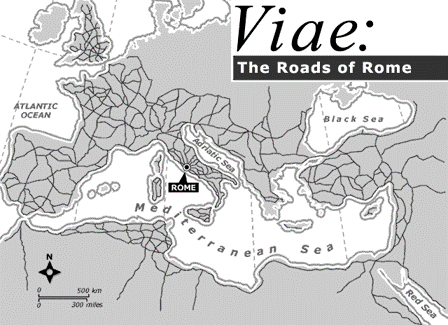 All Roads Led to Rome in the Early Axial Age (https://ar.inspiredpencil.com)
Even in Western Europe, however, especially during the first millennium (described by one Orthodox priest as the Age of Incarnation) transcendentalism developed in an uneven manner.[19] Sahlins noted that “a transcendent God abides over a human population on familiar terms with saints, ghosts, witches, and ‘nature spirits,’ including monks who were not technically human since they lived the life of angels.” Nor was the “spiritual” realm sharply divided from the “secular” administration of justice. As late as the year 1050, “it was possible to use the same pool of water” in Canterbury Cathedral, “on the same day, to baptize an infant as a Christian and immerse an adult to solicit a divine verdict in a judicial case.”[20] In the subsequent Age of Disincarnation, the fate of ordeals by water, fire, and combat became “emblematic of the displacement of divinity from the earthly city in Latin Christianity.” Such ordeals were abandoned in the thirteenth century when they “came under heavy clerical criticism as an ancient, vulgar, and lower-class custom” tolerated for centuries only “as a concession by the Church to the hard hearts of the German barbarians.”[21]
The Retrojection of Transcendence
By the time of the American Revolution, the idea of divine transcendence had become so entrenched in political theology that those same “German barbarians” were transmogrified, at least in the minds of the social contract theorists then shaping Anglo-American political discourse. In their imaginations, violent berserkers (engaging in ritual assemblies where horses and humans were sacrificed to propitiate wrathful gods) were distilled, as if by magic, into well-mannered WASPs attending an orderly town meeting in the enlightened American republic. For prosperous and enlightened elites “at home” and in the American colonies, the supposedly democratic tribal assemblies of the German peoples in the first century AD were the model from which “the English have borrowed the idea of their political government. This beautiful system was invented first in the woods.”[22]
In fact, both English social contract theorists, and the American revolutionaries influenced by them, simply retrojected the transcendentalist ideals of the Enlightenment in “the claim that English law rested on an unbroken line of pre-Norman customs” dating back to the forests of Germany. It was the Roman historian Tacitus who first transcendentalized the ritual tribal assemblies in his brief Germania by omitting “details the Romans would have taken for granted—such as animal sacrifice and accompanying ceremonies.”[23]
But their true nature was suggested in Tacitus’ “note that the assembly was overseen by priests and held on a date judged auspicious.” As Bond remarks, who knows “what people were thinking in such a situation, or how they would have interpreted the proceedings.” But one thing seems certain: they were not “engaged in what we would call rational, secular deliberation and casting votes as though at a town hall meeting.” More likely, chiefs or kings presented their proposals as figures regarded as bearing something akin to the will of the gods, or a force comparable to mana,” much like the cannibalistic Maori tribesmen British traders and colonists encountered in New Zealand in the early nineteenth century.[24]
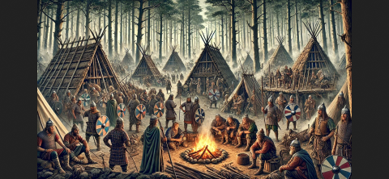 AI Image of Germanic Tribal Democracy
Endnotes
[1] Zhou may have thought the questioner was referring to the 1968 student rebellion in Paris.
[2] According to Carl Schmitt, the distinction between friend and enemy is the essence of “the political.” The enemy has traditionally been seen as “the alien other, the racial enemy whose threat came from beyond the borders of the state,” Today, however:
amid the radical demographic transformation and corresponding civilizational decline unfolding throughout the Western world, driven in large measure by “liberal politics” and by the increasingly zero-sum struggle among rival racial and ideological blocs within multicultural societies, the political enemy emerges from within the state itself. Internal divisions have attained such intensity that rival groups no longer recognize one another as members of the same political community, bringing domestic conflict to the threshold of civil war.
See, Chad Crowley, “Carl Schmitt and the Political: The Friend-Enemy Distinction Explained,” Riding the Tiger, July 30, 2026, https://substack.com/inbox/post/209032821
[3] Alan Taylor, “The Late Loyalists: Northern Reflections of the Early American Republic,” (2007) 27(1) Journal of the Early Republic, 1–34.
[4] Karl Jaspers, Vom Ursprung und Ziel der Geschicte, 1949; English: The Origin and Goal of History, (Yale University Press, 1953). Cf., Matthew J. Carlisle, A Simple Introduction to the Axial Age: How Humanity Learned to Think Morally, Philosophically, and Spiritually (Independently Published, 2026). On the concept of “metahistory” (i.e., not just what historical narratives are but also how and why they take particular forms), see Hayden White Metahistory: The Historical Imagination in Nineteenth-Century Europe (Johns Hopkins University Press, 1973).
[5] Hans Joas, “The Axial Age Debate as Religious Discourse,” in Robert N. Bellah & Hans Joas, eds. The Axial Age and its Consequences (Belknap Press, 2012), 12.
[6] Jan Assmann, “Cultural Memory and the Myth of the Axial Age,” in Ibid., 367.In my first book, I examined the sacrifice of classical republican traditions in service to the “unfinished project” of modernity; see, Andrew Fraser, The Spirit of the Laws: Republicanism and the Unfinished Project of Modernity (University of Toronto Press, 1990).
[7] Assmann, “Cultural Memory,” 367, 371.
[8] C.A. Bond, Themis: A Science of Human Orders (Imperium Press, 2025), 10-12, 15, 26.
[9] Assmann, “Cultural Memory,” 371.
[10] Marshall Sahlins, The New Science of the Enchanted Universe: An Anthropology of Most of Humanity (Princeton University Press, 2022), 124.
[11] Ibid., 70.
[12] Ibid., 72–73.
[13] Ibid., 120, 123 (emphasis in original); Bond, Themis, 29, 70.
[14] Sahlins, Enchanted Universe, 137.
[15] Ibid., 174 (emphasis in original).
[16] Ibid., 175.
[17] Joas, “Axial Age Debate,” 11–12.
[18] The birth of Christianity was made possible by the Roman imperial order imposed upon the Mediterranean world by Augustus. “Augustus revolutionised conceptions of space and time. He created a new image of the world centred on Rome, and on his person. … This powerful sense of a unified, centred world stimulated ways of imagining the interconnectedness of humankind—a message that came out in the earliest Christian texts’ vision of a universal alliance in Christ.” Tim Whitmarsh, Rome’s Age of Revolution: Augustus, Empire and the Making of Christianity (The Bodley Head, 2026), 228.
[19] Fr. Andrew Phillips, Orthodox Christianity and the English Tradition (English Orthodox Trust, 1995), 281–284.
[20] Sahlins, Enchanted Universe, 9.
[21] Peter Brown, “Society and the Supernatural: A Medieval Change,” Daedelus 104, no. 2 (1975) 135–36.
[22] Charles Montesquieu, quoted in Bond, Themis, 48–9.
[23] Ibid., 49–50.
[24] Ibid., 51–52; cf., Paul Moon, This Horrid Practice: The Myth and Reality of Traditional Maori Cannibalism (Penguin, 2008).




Leave a Reply
Want to join the discussion?Feel free to contribute!