Why Russia expelled USAID
Glenn Greenwald interviews Alexandr Dugin: USAID as an instrument of US foreign policy, e.g., funding Ukraine media, corrupting journalists, fomenting color revolutions, etc.
5-minute video

General
Glenn Greenwald interviews Alexandr Dugin: USAID as an instrument of US foreign policy, e.g., funding Ukraine media, corrupting journalists, fomenting color revolutions, etc.
5-minute video

Ann Coulter is definitely not a fan of the Race Lady. Here’s what she wrote for Thanksgiving, 2023. Takeaways:
You were admitted to Harvard with SAT scores that would have gotten an Asian kid disowned by his parents. People try harder to laugh at your excruciating jokes than they would for a male of any race.
The current article:
To the eternal misfortune of Black Americans, the left decided to take them as pets, then patronize them to death.
I gotta admit, Joy Reid was indeed blindsided when she was fired from MSNBC this week. How could she possibly have seen this cancellation coming? Sure, by the end, she was down to 11 actual viewers nationwide, eight of them in hospital ICUs, their charts indicating coma protocol.
Of her remaining three viewers, one was a gentleman named Nelson, sitting in a Detroit gastropub, who kept screaming at the bartender, “What is this shit? Dude, turn the f-ing channel. Damn! Bitch crazy.”
Data seem to indicate that the remaining two viewers were at a Frontier Airlines departure gate, where “The ReidOut” was being broadcast without sound. It’s unclear whether these two were traveling as a couple or did not, in fact, know each other.
But how was Joy to deduce from all this that her show was in trouble?
Fortunately for Joy, there is no truer Friend-of-Black-People than her erstwhile MSNBC colleague Rachel Maddow, who lives in a town, Cummington, Massachusetts, that is “0.0%” black. (I wouldn’t mention this, except liberals pioneered the art of counting the number of Black faces at any conservative gathering in order to call them racist. Oh, who am I kidding — yes, I would.)
Here are the highlights of Rachel’s self-aggrandizing, on-air tribute to Joy on Monday night:
(Do we think three “very’s” is enough? If she really meant it, wouldn’t there be six or seven?)
“In all of the jobs I have had in all of the years I have been alive, there is no colleague for whom I have had more affection and more respect than Joy Reid. I love everything about her. I have learned so much from her. I have so much more to learn from her.”
“(Goddamn it, this may cost me my career but I’m going to speak up for a black person and let chips fall where they may!)”
“Personally, I think it is a bad mistake to let her walk out the door. … ”
(Clarification sought: Did Joy really “walk out the door”? Are we absolutely sure she wasn’t lifted up and dragged to an elevator by security? I guess we’ll have to wait for the Zapruder film.)
In any event, Rachel has spoken. She came down from the mountain with her tablets and made her ass-kissy pronouncement. Perhaps she can take some solace in knowing that one of the Democrats of Color taking over Joy’s time slot, Alicia Menendez, has a father in federal prison.
This is how White liberals talk about Black people, as if there’s a Race Stasi ready to turn them over to authorities if they’re not effusive enough. But Blubberbutt Maddow stands out in a field with stiff competition.
Here are a few standard intros:
“Joining us now is a woman who couldn`t sound stupid if she practiced it for a week, Melissa Harris-Lacewell …”
“Melissa Harris-Lacewell, associate professor of politics and African American studies at Princeton University. You’re wicked smart.”
“Melissa Harris-Lacewell, Princeton professor, MSNBC contributor, of which we are very proud.”
“Melissa Harris-Lacewell, Princeton professor, MSNBC contributor, and one of the smartest people I’ve ever talked to about anything, anytime, anywhere.”
“Every Tuesday, you’ve been doing this to me, Melissa. Every Tuesday my whole adult life.”
She’s such a pro, I can’t believe Rachel forgot to call Harris-Lacewell “articulate.” Black people love that.
For comparison, here’s how Rachel introduces a Qhite guest: “Joining us now is the chair of the Senate Rules Committee, Minnesota Senior Sen. Amy Klobuchar. Senator, it’s great to see you.”
Liberals have leapt way beyond “the soft bigotry of low expectations” and are now showcasing “the suffocating, smug bigotry of wildly, hysterically overpraising average individuals just because they’re Black.” If a straight White male talked to any presentable-looking female on the air like Rachel talks to Black women, he’d end up in HR.
To the eternal misfortune of Black Americans, the left decided to take them as pets, then patronize them to death.
COPYRIGHT 2025 ANN COULTER
The AfD’s rise isn’t just another ripple in Europe’s growing nationalist tide — it carries deeper echoes of Germany’s past. Some of the party’s leaders have ties to neo-Nazi rhetoric and have downplayed the Holocaust. Perhaps most alarming is the party’s growing support among younger voters, many of whom are increasingly disconnected from the country’s reckoning with its role in World War II.
And it isn’t only in Europe where AfD’s rise echoes, Vice President JD Vance and Elon Musk have both expressed support for the party. …
Germany’s far-right surge is not happening in a vacuum; it’s part of a broader global trend. At a speech in Munich earlier this month, Vance criticized Germany’s mainstream parties for maintaining a “firewall” against the AfD. Musk made headlines by addressing an AfD rally via video, drawing criticism for lending it legitimacy.
forward.com
Benyamin Cohen
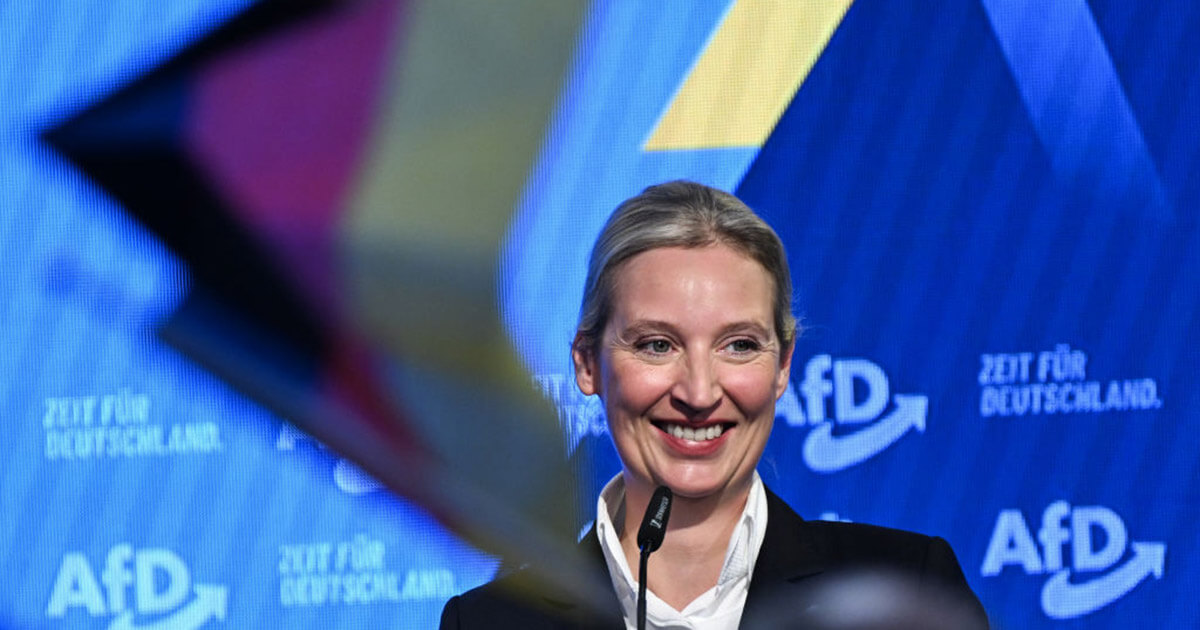
Alice Weidel, co-leader of Germany’s far-right Alternative for Germany (AfD) party, reacts during an election night rally in Berlin. Photo by Ralf Hirschberger/AFP via Getty Images
Germany’s election on Sunday sent a clear, unsettling message with record turnout and a clear anti-immigration pitch. While the center-right Christian Democrats secured victory, it was the far-right Alternative for Germany (AfD) party that delivered the biggest shock, capturing around 20% of the vote — double its support from 2021, though not as high as some had feared.
“It could’ve been worse,” Meron Mendel, an Israeli-German historian and director of the Anne Frank Education Center in Frankfurt, said in an interview. “But it’s still devastating.”
The AfD’s rise isn’t just another ripple in Europe’s growing nationalist tide — it carries deeper echoes of Germany’s past. Some of the party’s leaders have ties to neo-Nazi rhetoric and have downplayed the Holocaust. Perhaps most alarming is the party’s growing support among younger voters, many of whom are increasingly disconnected from the country’s reckoning with its role in World War II.
And it isn’t only in Europe where AfD’s rise echoes, Vice President JD Vance and Elon Musk have both expressed support for the party.
So, what’s behind the AfD’s recent surge? Why is this development particularly concerning for Jews? And how does it tie into broader global trends? Here’s what you need to know.
The AfD was founded in 2013 as a party initially focused on opposing Germany’s participation in the European Union and rejecting the euro currency. But the party quickly shifted toward nationalist, anti-immigration rhetoric — especially after 2015, when Germany welcomed hundreds of thousands of refugees, mostly from Middle Eastern countries.
Over time, factions within the AfD have embraced far-right ideology more openly. According to Mendel, figures like Björn Höcke, a regional AfD leader, have promoted rhetoric that minimizes Germany’s responsibility for the Holocaust and echoes nationalist themes reminiscent of Nazi-era ideology.
For Jews in Germany, the AfD’s surge has painful historical resonance. While the party publicly denies antisemitism and even brands itself as pro-Israel, some of its leaders have undermined Holocaust remembrance efforts. Höcke, for example, referred to Berlin’s Holocaust Memorial as a “monument of shame,” sparking outrage.
But the concern extends beyond rhetoric. Mendel warned of the broader danger to democratic values. “In my view, it’s in the vested interest of any minority, and especially for Jews, to preserve the liberal order,” he said. “So if these values are eroded in the free world, it’s another warning signal for Jews around the world.”
While most German Jews oppose the AfD, a small minority has been drawn to its strong anti-Muslim stance — a sentiment that has intensified in the aftermath of the Oct. 7, 2023, Hamas attack on Israel. “The AfD is trying to position themselves as the only one that protects Jews against Muslims,” Mendel said. “And they have radical ideas: for example, ‘remigration,’ which means to send migrants back to their homelands. And for some Jews, it seems like an attractive answer.”
Several factors contributed to the AfD’s growing support:
Economic anxiety: The German economy has been hit hard by the fallout from the war in Ukraine, particularly the loss of cheap Russian gas. Industries like German car manufacturing have struggled, feeding economic frustration and fueling support for the AfD’s populist messaging.
East-West divide: The AfD has found its strongest support in former East Germany, where feelings of marginalization and disillusionment remain more than 30 years after reunification.
Immigration fears: The party has capitalized on anxieties around immigration, especially among those who feel left behind by mainstream politics. The center-right Christian Democrat party — which won the most votes but must form a coalition government — also campaigned on an anti-immigration platform, an issue which drove many voters to the polls. After the election results were announced, President Donald Trump praised the win by the Christian Democratic party as “a great day for Germany,” and noted that voters were “tired” of a more open immigration stance.
Appeal to young voters: The AfD has gained traction with younger Germans, many of whom don’t have direct family connections to the Holocaust. The party’s social media campaigns have tapped into anti-establishment sentiment and a resurgent nationalism.
Germany’s far-right surge is not happening in a vacuum; it’s part of a broader global trend. At a speech in Munich earlier this month, Vance criticized Germany’s mainstream parties for maintaining a “firewall” against the AfD. Musk made headlines by addressing an AfD rally via video, drawing criticism for lending it legitimacy.
This growing global network has helped normalize far-right rhetoric and expand the AfD’s platform. By aligning with international voices, the party has managed to soften its image for some voters — despite the continued presence of factions within the party that openly embrace neo-Nazi sympathies.
While the AfD didn’t win the election, its rise has already shifted Germany’s political landscape. Mainstream conservatives have begun to show a new willingness to cooperate with the far right, breaking long-standing taboos around engaging with extremist parties.
For many Jews in Germany and around the world, the election results are a reminder that history’s darkest chapters can resurface in new forms. “The wish to get rid of the past was always part of the German discussion,” Mendel said. “But these voices are now coming from the second-largest party.”
Excerpt:
…
Albert Memmi was a Tunisian Jew who emigrated to France and then bitterly blamed the French because he did not feel at home. Like a fastidious vegetarian recoiling from a chunk of beef on the fork of his carnivorous host, Memmi recoiled, with an indignant sense of injury, from the offensive Christianity and Frenchness of narrow-minded France. But in Memmi’s telling his recoil was not Memmi’s rejection of France. It was instead France’s rejection of Memmi.
“I have not rejected anything; unfortunately it is the nation that has rejected me, that leaves me outside.”*
France was inhospitable to Memmi simply because it was French. Its landscape everywhere bristled with menacing Christian spires; many of its towns bore the dreadful names of Christian saints; men and women under strong suspicion of antisemitism stalked the pages of its history books.
“Whether I like it or not, the history of the country in which I live is, to me, a borrowed history. How could I feel that Joan of Arc is a symbol for me? Would I hear with her the patriotic and Christian voices?”*
No, probably not. And the only solution, in Memmi’s opinion, is that the symbol of Joan of Arc be retired to the museum, and no doubt there problematized by a critical reinterpretation— that the native French no longer hear with her (and through her) those patriotic and Christian voices.
This is of course akin to the iconoclastic purge that recently toppled so many statues here in the United States. Can Robert E. Lee be a symbol for descendants of American slaves? Can George Washington be a symbol for the an immigrant who “borrowed” American history only the year before last? Can sons of the Ganges and Niger hear with Robert and George those patriotic and Christian voices?
No, probably not. And so neither will ancestral Americans if men like Memmi have their way.
No Gauls, please. Enough of Celts, ancient Germans, Slavs, conquering Romans and conquering Arabs! For then, I find myself naked and alone: my own ancestors were neither Gauls, Celts, Slavs, ancient Germans, Arabs, or Turks . . . . I have never been able to say ‘We’ in referring to those historical pedigrees on which my fellow-citizens pride themselves. I have never heard another Jew say ‘We’ without wincing, without vaguely suspecting him of an inadvertent blunder, of complacency or of a slip of the tongue.
* * * * *
So then, is the accusation confirmed? As a Jew, you admit to being stateless and cosmopolitan? Of your own accord, you reject the nation! I do not reject anything! What is confirmed? Do I really suffer from my own refusal or from what other men refuse me?”
Who is to blame for the alienation of the alien? Is the alien to blame because he refuses to change, is perhaps incapable of change? Does the fault lie in Memmi’s prejudice against Christian churches, Christian saints, and the myth of Joan of Arc? Or are the French to blame because they refuse to change—because thy are too prejudiced to make Memmi feel at home by pulling down their churches, renaming their towns, and problematizing the Maid of Orlèans?
It was Memmi’s opinion that the fault lay with the French and their offensive insistence on remaining French in a French France. It was Memmi’s opinion that the French should yield to his insistence on remaining a cosmopolitan Jew and feeling at home anywhere he liked. He was, in fact, like the intolerant vegetarian who insists upon remaining vegetarian wherever he dines, and who cries out in pain if every plate at the table is not heaped with beans and kale.
I suppose we should have a look at what our newspaper of record says. Notice the typical German voters in multicultural Germany in the photo below.
5 Takeaways From Germany’s Election
Listen to this article · 6:22 min Learn more
After the Christian Democrats fell out of power in 2021, Mr. Merz assumed leadership of the party and drove it to the right on migration and other issues. He was most comfortable campaigning on the economy, promising to peel back regulations and reduce taxes in a bid to reignite economic growth.
Mr. Merz is tall and sometimes stern, with a dry wit. Polls suggest that only about a third of the country believes he will make a good chancellor. Even some of his own voters said on Sunday that they are not enamored of him. But if he can quickly forge a government, he has a chance to step into a leadership vacuum in Europe as it struggles with the strains on its relationship with the United States under President Trump. …
Musk Did Not Seem to Sway Voters

Elon Musk was shown on a large screen as Alice Weidel, co-leader of the Alternative for Germany party, spoke last month at a lectern, far right, in Halle, Germany.Credit…Sergey Ponomarev for The New York TimesThe hard-right Alternative for Germany, or AfD, doubled its vote share from four years ago, largely by appealing to voters upset by immigration. In the former East Germany, it finished first, ahead of Mr. Merz’s party.
The AfD’s vote share appeared to fall short of its high-water mark of support in polls from a year ago, however. Many analysts had been expecting a stronger showing, after a sequence of events that elevated the party and its signature issue.
The AfD received public support from Mr. Vance and an endorsement by the billionaire Trump adviser Elon Musk. It sought to make political gains out of a series of deadly attacks by migrants in recent months, including in the final days of the campaign.
But that boon never materialized.
The surprise of the night
Reaction to the recent attacks and the support from Trump officials may have even mobilized a late burst of support to Die Linke, the party of Germany’s far left, which campaigned on a pro-immigration platform, some voters suggested in interviews on Sunday.
Two months ago Die Linke was dying. Sahra Wagenknecht, its most popular member, started a new party last year that was more friendly to Russia and tougher on migration. Many followed her, thinking that she was the future. Die Linke languished at 3 percent.
But Die Linke managed to turn things around in just months, thanks to a new pair of charismatic and social-media savvy leaders and the alienation that many young voters feel with mainstream parties. It surged to what appeared to be nearly 9 percent of the vote and more than 60 seats in Parliament.
Its campaign events started attracting so many young people that they became must-see affairs, as much dance party as political rally.
The party leaders became social media stars. Heidi Reichinnek, who is credited for much of the turnaround, told a crowd on Sunday night that they owed their success to the many volunteers who went from door to door talking to people about pocketbook issues. Ms. Reichinnek told supporters they “did everything right.”
Scholz is out, but his party marches on.
Despite polling predicting his third-place finish, Chancellor Olaf Scholz had insisted until the very end that he would somehow retain his job. He was wrong. His Social Democratic Party won a record-low 16 percent, coming in third place. Though Mr. Scholz will continue as a caretaker chancellor until Mr. Merz is sworn in, he is widely expected to step down from active politics. …
Excerpts from Matt Goodwin: “Ordinary Germans have had enough. Why Germany is moving right
Bad news first:
And now they face one final betrayal. Even though the right-wing CDU and AfD got nearly half the vote and over half the seats in Parliament, the CDU will now refuse to go into coalition with the AfD.
Instead, it seems likely they will go for the “Kenya” coalition, with the left-wing SPD and Greens.
What does this mean?
It means there will be no end to the ongoing immigration crisis.
It means there will be no end to the broken borders.
It means there will be no end to the rocketing energy prices.
And it means there will be no end to fixing the abuse of the welfare state by foreigners.
All in the name of maintaining the firewall that is blocking the AfD, and in turn millions of ordinary Germans, from power —from having their entirely legitimate and reasonable concerns addressed.
The only thing a coalition between the centre-right and the left will ensure is that all the mainstream parties will now fail together.
And as that happens, as the German people are forced to watch yet more shocking failures, more chaos, and more managed decline, in the end only one opponent to alp this will be left standing.
Good news:
The centre-right Christian Democratic Union (CDU) have the most votes and the most seats in the Bundestag, but fewer than in previous victories.
Voters don’t want the left but they also don’t trust the centre-right party which first opened Germany’s borders to millions of refugees, either.
At the same time, astonishingly, the Alternative for Germany (AfD), the national-populists, have doubled their share of the vote and finished in second place.
It is a truly seismic moment in German and indeed European politics, providing further evidence for what we have long argued in this newsletter —that national populism is not only here to stay but reflects an ongoing ‘realignment’ of Western politics which is pushing rising numbers of voters away from the established liberal consensus into the arms of parties that are mainly critical of mass uncontrolled immigration, broken borders, globalisation, and the ongoing destruction of Western nations..
Remarkably, the AfD has achieved this despite enormous opposition. They’ve been labelled fascists. They’ve been derided as Nazis. They’ve had the media all but openly campaign against them. They’ve had every other party condemn them.
Constantin von Hoffmeister: ‘The AfD and the Axe of History”
The figures of the 2025 German federal election slice through the stagnant air like jagged glass, a brutal revelation of a system nearing its own self-inflicted collapse. The CDU/CSU (Christian Democratic Union) limps forward at 29%, dragging its reanimated corpse through the political landscape, the SPD (Social Democratic Party) slumps to 16%, drowning in its own irrelevance, and the Greens — those eco-puritans in love with multiculturalism and decay — cling desperately to 12%. But the real tremor, the subterranean growl of an awakening beast, comes from the AfD (Alternative for Germany), surging to a staggering 20%, its ascent shaking the foundations of a West that has lost its will to live.
Aristotle, the ancient diagnostician of democracy, looms over this spectacle like an unblinking oracle. He saw this coming over two thousand years ago. In Politics, he warned of democracy’s slow suicide, its descent into ochlocracy, the rule of the mob, where plebeian apathy and elite corruption conspire to suffocate the soul of the polis. And now? Germany, the heart of the European project, is gasping in its terminal stage, a civilization devouring itself in the throes of bureaucratic sterility. Aristotle’s nightmare — where democracy degenerates into oligarchic tyranny — has unfolded before our eyes, and the people, battered and betrayed, have turned to the AfD in search of salvation.
This is not just another election. It is an insurrection of the disillusioned, the dispossessed, the ones cast aside in the great sacrificial burning of European industry, European identity, and European will. The AfD’s 20% is more than a number. It is a hammer blow to the temple of a senile establishment that clings to power like a parasite to a dying host. Oswald Spengler, always lurking in the shadows of decline, grins from the abyss, his vision of the West’s Untergang — the inevitable sinking into civilizational night — now fully realized in the pale, hollow eyes of Merkel and Scholz’s progeny.
Germany, once a titan of industrial might, now watches its factories shuttered, its energy bills soaring to heights unknown, its streets flooded not with the march of progress but with the quiet desperation of a people abandoned. Unvetted mass immigration further strains an already collapsing system, diluting national cohesion, fueling rising crime, and deepening economic turmoil.




