Why Argentina May Be the Jewish Diaspora’s Next Frontier

Argentina’s election of Javier Milei in December 2023 has provided international Jewry with an intriguing opportunity.

To say that Milei’s administration is pro-Zionist would be an understatement. Apart from his promises to make the Argentine economy attractive to international finance, Milei has gone out of his way to kowtow to Jewish interests — from honoring the Bibas family with a national mourning period and altering the name of a Buenos Aires street, to designating Hamas a terrorist organization and vowing to relocate the Argentine embassy to Jerusalem. The lengths he’s going to advance Jewish interests make one wonder if he belongs in the Israeli Knesset as opposed to Casa Rosada.

Or perhaps there’s something much bigger at play. Despite having a sovereign state for the first time in two thousand years, it remains widely acknowledged that Jewish history is marked by repeated expulsions from numerous countries around the world. Statecraft has rarely been a historical strength for Jews, and the so-called curse of the eighth decade serves as a stark reminder of the deep instability that often plagues Jewish states.

Relentless attacks from Hamas, Hezbollah rockets in the north, and Iranian missile strikes on cities like Haifa and Tel Aviv—paired with growing internal rifts between secular and religious Jews and the burden of a welfare-dependent ultra-Orthodox population—are fueling doubts about Israel’s long-term viability as a functional state. In light of these alarming trends, a long-term exit plan may be in order.

Enter Plan Andinia.

Milei’s moves to secure Argentina as a refuge for global Jewry have reignited claims that a broader Zionist plan exists to colonize Argentine and Chilean Patagonia.

The theory was put forward by members of Frente Nacional Socialista Argentino (the Argentine National Socialist Front) in the mid-1960s and later disseminated by Chilean diplomat and esoteric Hitlerist Miguel Serrano. The former Chilean diplomat contended that for over twenty years, Jews disguised as backpackers and poor hikers have been traveling through the most remote and strategic regions of southern Chile with the support of Chilean authorities, the army, the navy, and the National Forest Corporation (CONAF), fully aware that they actually belong to the Israeli military, air force, or intelligence services.

In fact, Radio Universidad de Chile reported that a significant number of Israelis travel through South America, often right after completing their compulsory military service. Patagonia has emerged as one of their preferred destinations. Notably, in late December 2011, Israeli tourist Rotem Singer accidentally sparked a major wildfire in Chile’s Torres del Paine National Park, which ended up consuming more than 17,000 hectares of pristine terrain.

Chilean authorities detained Singer, who ended up negotiating a deal to pay approximately $10,000 in restitution to CONAF before leaving the country. The leniency of the resolution sparked public outrage in Chile, where many had anticipated a prison sentence for Singer. Demonstrators gathered in front of the Chilean Supreme Court to voice their anger with the court’s decision to ratify the sentence.

In a 2017 interview, CONAF’s director of the Magallanes region revealed that Israeli tourists were responsible for nearly two-thirds of all expulsions from Torres del Paine over a five-year period. This troubling pattern led many local hostel owners to adopt informal policies of refusing service to Israeli nationals.

Curiously, the Jewish diaspora has built solid roots in Argentina for well over a century. Jewish migration to Argentina goes back to the late 19th century, when the Argentine government pursued an aggressive policy of mass migration to populate its vast, underdeveloped territories. From 1850 to 1913, Argentina welcomed 6.2 million migrants from Europe — largely coming from France, Germany, Italy, and Spain.

European Jews, fleeing ethnic conflict in Russia and Eastern Europe, were among those who arrived in Argentina. Between 1889 and the early 20th century, thousands of Jewish immigrants arrived, establishing agricultural colonies in provinces such as Entre Ríos and Santa Fe. The most famous of these, Moises Ville, became known as the “Jerusalem of Argentina” and was supported by the Jewish Colonization Association, founded by the Jewish philanthropist Baron Maurice de Hirsch.

These settlements were intended to function as autonomous communities. The concept of Jewish settlements outside of Palestine was seriously considered by several early Zionists. Theodor Herzl, in his foundational work Der Judenstaat (The Jewish State), listed Argentina as a potential site for Jewish settlement, alongside Palestine. Herzl noted Argentina’s vast, fertile lands and sparse population as advantages, but his vision was for local autonomy rather than an independent Jewish state. This idea of a Jewish homeland outside Palestine eventually led to the schism of the Jewish Territorialist Organization, which sought to establish Jewish autonomy anywhere in the world, but these plans never materialized.

Nevertheless, Jewish migration continued trickling into Argentina. At its peak, the Jewish Colonization Association owned over 600,000 hectares of land, and by 1920, more than 150,000 Jews lived in Argentina. The country’s sparsely populated territories and its tradition of religious tolerance made it an attractive destination for Jews in the Old World who wore out their welcome in the Russian Empire. With around 250,000 Jews, Argentina currently has the largest Jewish community in Latin America and the fifth largest outside of Israel.

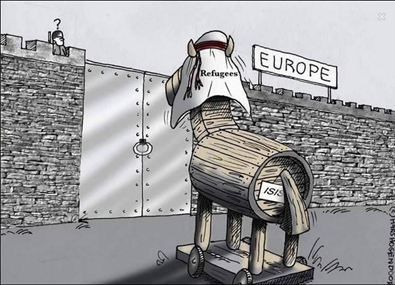
Now that Milei is transforming Argentina into one of the most pro-Jewish countries in the world, it may emerge as a refuge for Jews. As instability clouds Israel’s future, Argentina’s calmer geopolitical environment and vast, untroubled landscape could make it an appealing fallback if the Zionist project falters.

In a world where Israel’s permanence is no longer guaranteed, Argentina is quietly positioning itself as a Plan B.

Random Racial Reflections: Similarity and Stochastics in Sub-Saharans, Felines and Lepidoptera

Butterflies? Emphatically yes! Blacks? Emphatically no! Cats? Emphatically maybe. Those are my varying answers to the question of “Do you want more of this group in your your life?” Butterflies are beautiful and benign, so I’d be delighted to have more of them. Blacks are uncouth and criminal, so I want fewer of them, not more. As for cats: they’re beautiful too, but they’re very bad for wildlife, so I’m ambivalent.[1] The three groups are obviously different in their effects, ecology and esthetics. That’s why I separate them in my answers: yes; no; maybe.


As above, so below? A butterfly, a cat and a Black rapper (top images from Wikipedia)

In another way, however, I think there’s something that unites the three groups. I think they’re all designed by evolution for randomness. In other words, I think there’s something about the evolved neurology of butterflies, Blacks and cats that makes their behavior unpredictable in a way that isn’t true of related groups like bees, Whites and dogs. Watch a bee or a butterfly; a White or a Black; a dog or a cat. Watching bees, Whites and dogs, you see rationality and regularity. Watching butterflies, Blacks and cats, you don’t. That is, you can understand and predict behavior and reactions with the former set in a way you can’t with the latter set. That’s why I think there’s some kind of randomizer in the neurology of butterflies, Blacks and cats.

The yoke of smoke

And what advantage would that randomizer confer? Well, take butterflies and cats. Butterflies are prey and cats are predators, but both groups would benefit from being unpredictable. The jigs and jags of a butterfly’s flight make it harder for a bird to catch the butterfly; the shifts and swirls of a cat’s movements make it harder for a mouse to escape the cat. Imagine being a mouse hiding from a hunting cat. Could you predict what the cat will do next and make your escape? Not easily. Cats shift and swirl like smoke. And I compared Blacks to smoke in a previous article at the Occidental Observer, when I discussed the cover of the first album by the Chicago rapper Chief Keef (born 1995). He looks menacing as he releases marijuana smoke from his mouth:

It’s a good cover in a bad way, entirely appropriate for the cretinous and corrupting genre of rap. Keef looks both dirty and dangerous, both menacing and malevolent. But I think there’s something in the photo that’s working at a subconscious level to maximize the menace and the malevolence. What is it? It’s the smoke spilling from Keef’s mouth. And why is the smoke important? Because it’s chaotic. I mean that mathematically, not just metaphorically. Smoke is an example of the mathematical phenomenon of chaos. The movements of smoke are notoriously difficult for scientists to model and predict. Smoke is a kind of miniature meteorological phenomenon and, like the weather as a whole, it’s very sensitive to tiny changes in the variables that govern its behavior. … Like smoke, Black behavior is chaotic. And I think that’s why the smoke on the cover of Chief Keef’s Finally Rich is so powerful, subconsciously reinforcing the message of menace and malevolence. And of mindlessness. The smoke is an active, exterior symbol of the evolved Black psychology inside Keef’s dreadlock-draped head. Keef is captured in a moment of stillness, but you can ask the same question of him as you can of the smoke spilling from his mouth. What is going to happen next? You can’t predict what the smoke is going to do and you can’t predict what Keef is going to do. In an instant, he could be active and on his feet, dishing out violence, dealing death or committing rape. Like smoke, Blacks are volatile and chaotic, shifting suddenly and sharply from one pattern of behavior to another. (“Mo with the Flow,” The Occidental Observer, 11th October 2024)

The randomness and unpredictability of Black behavior would again confer advantages in their ancestral environment.[2] Survival in tropical Africa doesn’t require foresight and planning in the way that survival in temperate Europe or America does. If you don’t plan for winter in Europe, you freeze or starve. Or you did, before the welfare states and minority-worshipping bureaucracies that now feed, clothe and house millions of improvident, impulsive Blacks in Europe and America. Those Blacks commit a vastly disproportionate amount of violent and acquisitive crime. And I think they’re impelled to that, and aided in it, by an evolved randomizer in their neurology.

The ferality of felinity

It wouldn’t be a true randomizer, of course. Is true randomness even possible? And how do you define and test for randomness anyway? Those are fascinating questions that have occupied some of the greatest brains in PhyPhiM (Physics, Philosophy and Mathematics). But those brains haven’t been Black, because Blacks have never mattered in STEM (Science, Technology, Engineering, Mathematics). And it’s Black stochastics that accounts for Black STEM-lessness. Or so I suggest. I also suggest that stochastics is part of why we find cats so fascinating. Cats have the chaos of smoke or flames: you can never predict exactly what comes next. And that explains, I suggest, why cat videos are a popular on-line genre in a way that dog videos aren’t. Someone called Gwern has a different explanation for the popularity of cat-videos:

Cats As Horror Movie Villains

Speculation on cat-human fascination being ancestral vigilance triggered by their behavioral similarity to major primate predators, evolutionarily, creating a compelling ‘safe danger’ like watching a captivating villain. […]

Do people like watching cats because of their neotenous appearance? I doubt it, but then why do we have this odd fascination with every ordinary action of a cat and treating them as instances of the Platonic Cat?

I speculate that there may be an evolutionary psychology reason: cats in Africa prey on primates to a degree I suspect few people appreciate, and this seems to have been true for millions of years.

So perhaps we are still slightly hardwired to closely observe cats, in a way we aren’t for most other potential pets. This accounts for the indefinable appeal of cats: they are paradoxically both pleasant and unpleasant, like horror movies. (“Cats As Horror Movie Villains,” Gwern.net, 11th May 2025)

It’s an interesting theory, but I think it fails to account satisfactorily for the “indefinable appeal of cats.” Like a lot of people, I don’t find cats unpleasant in any conscious way. I find them both beautiful and uncanny. Cats are like bats or butterflies: they don’t seem wholly of this Earth, of this plane of reality.[3] And that uncanniness may be explained partly by the unpredictability of cat behavior and movements, by that hypothetical randomizer in feline neurology. And try examining your own reactions to watching cats or butterflies, on the one hand, and watching tigers or snakes, on the other. There’s a fascination in watching all four groups, but with tigers or snakes we can detect fear and a sense of danger powering our fascination. I for one can’t detect those things in myself with cats or butterflies.

The flame of the game: both jazz musicians and flames constantly improvise (images from Wikipedia)

Instead, the fascination of watching cats or butterflies feels to me more like the fascination of watching smoke or flames. The shifting and the swirling, the unpredictability and chaos, compel my eye and fix my attention. But it’s physics that, in the mathematical sense, explains the chaotic behavior of smoke and flames. It would be biology that explains the chaotic behavior of cats and butterflies. And of Blacks too. Randomness would reign through the brain. And that random reign would help explain why “Blacks Blight Britain.” And perhaps it also helps explain why Blacks are so popular as entertainers and sportsmen. Blacks are interesting to watch in a way that more predictable — and more intelligent — races aren’t. Aesthetically and intellectually, cats and butterflies appeal to me in a way that Blacks definitely don’t. Evolutionarily, the three groups may be much more similar than I’d prefer to think.


[1]  Much as I like cats, I would prefer that zoologically rich islands like Australia, New Zealand and Hawai’i were cat-free zones. That sort of suggestion can earn you death-threats from some cat-lovers, who may in fact be cat-crazed in more ways than one. See my discussion of a cat-conveyed brain-parasite called Toxoplasma.

[2]  I read somewhere that police surveillance of Black gangs doesn’t work as well as for non-Black gangs like the Mafia, because Black gangs act on impulse, with little or no planning. With Blacks, deciding and doing aren’t necessarily distinct.

[3]  I find bats fascinating too, but bats are not beautiful like cats or butterflies. Quite the reverse, for some chiropteran species. Even so, I would rather have more bats and fewer cats in Britain, at least until we can find a way of stopping cats preying on bats. And on butterflies (I know someone who had to cut down a buddleia because it was used as a snack-bar by a neighbor’s cat).

Israeli Migration Sparks Debate in Cyprus

Map of Cyprus. The gray line separates the northern part, occupied by Turkish Cypriots, from the southern part, occupied by Greek Cypriots and the Jewish settlers.

What began as a quiet migration of affluent Israeli families to southern Cyprus has now triggered fears of foreign encroachment and strategic displacement.

Since 2021, nearly 4,000 properties have been snapped up by Israelis, particularly in the southern districts of Limassol, Larnaca, and Paphos. But this isn’t just a real estate story—it’s a political one. High walls, religious schools, kosher shops, synagogues, and business hubs are emerging in these areas, forming what critics say resemble “settlements in all but name.”

The backlash has been swift. Stefanos Stefanou, the General Secretary of Cyprus’s main opposition party Akel, voiced his concerns about Israel’s growing influence on the Mediterranean island: “At some point, we’ll discover our own land doesn’t belong to us,” he warned. “These are not just holiday homes. These are settlements in all but name.”

Outside observers increasingly describe the wave of Israeli migration as a “strategic settlement enterprise.”

The migration has come in waves. Israelis first started showing up during the COVID-19 lockdowns, then again amid Netanyahu’s 2023 judicial reforms, and now in the wake of the Iranian missile strikes of 2025. Today, more than 15,000 Israelis live in southern Cyprus. The trend shows no sign of slowing. Many of these settlers are not disillusioned liberals but deeply Zionist and well-resourced.

Though modern headlines paint Israel and Cyprus as close energy and security partners, the relationship has long been complicated—and often adversarial.

Jewish ties to Cyprus stretch back more than two millennia, beginning in the 4th century BCE, when Jewish communities were firmly established under Hellenistic and later Roman rule. By the Roman period, Jews had built synagogues in cities like Golgoi, Lapethos and Constantia-Salamine. However, this early flourishing came to a violent end during the Kitos War (115–117 CE), when Jewish rebels led a revolt that, according to Roman historian Cassius Dio, ended in the massacre of over 240,000 Greek-Cypriots. The Roman historian provided a particularly gruesome account of Jewish behavior during this war, describing how Jews would “cook their flesh, make belts for themselves of their entrails, anoint themselves with their blood, and wear their skins for clothing.”

In response to these acts of brazen savagery, Roman authorities imposed a total ban on Jewish presence on the island, which lasted for centuries. Despite this ban, Jews gradually returned during the Byzantine period, with evidence of synagogue renovation and renewed community life. Tensions, however, persisted.

Under Emperor Heraclius, Cypriot Jews reportedly attacked Christian monasteries, and subsequent Arab raids in the 7th century led to widespread displacement. By the 12th century, Jewish traveler Benjamin of Tudela observed that Cyprus was home to a variety of Jewish sects—Karaites, Rabbanites, and heretical groups like the Epikursim—concentrated in cities such as Famagusta, Nicosia, and Paphos. Yet even during this medieval renaissance, discrimination remained: Jews in Cyprus were required to wear the yellow badge throughout the 14th century, and their communities existed under legal and religious constraints.

The Ottoman conquest of Cyprus in 1571 brought renewed opportunities. Sephardic Jews expelled from Portugal and Spain found refuge on the island and other key hubs of the Ottoman Empire such as Constantinople and Salonika. Famagusta became a key commercial hub, though by the late Ottoman period, the Jewish community in Cyprus had again begun to decline.

Under British rule from 1878 to 1960, Zionist thinkers briefly entertained Cyprus as a substitute homeland. Several agricultural settlement attempts were made—most notably the Margo settlement near Larnaca—but all ultimately failed, as younger generations opted to occupy territory in Palestine. Following the end of British rule, Cyprus’s Jewish population dwindled to just 25 individuals by 1970.

The modern Jewish revival began in the early 2000s. From a few hundred residents in 2003, the population ballooned to over 12,000 by 2023. By 2025, it is estimated that there are roughly 12,000 to 15,000 Jews living on the island, many in gated compounds complete with religious and economic infrastructure—sparking fresh controversy among Cypriots.

Parallel to this long community history is the evolution of state-to-state relations between Israel and Cyprus, which have fluctuated between mutual distrust and strategic cooperation. Diplomatic ties were formally established in 1960, the year of Cyprus’s independence. Yet during the Cold War era, Cyprus maintained a cautious distance, aligning with Arab states and reacting warily to Israel’s military ties with Turkey, especially after the 1974 Turkish invasion of the island.

The 1980s marked a low point in bilateral relations. Cyprus recognized the State of Palestine in 1988, hosted Yasser Arafat, and allowed Palestine Liberation Organization (PLO) operations. Diplomatic tensions flared, including the infamous Larnaca yacht killings in 1985 and the car bombing of PLO officials in 1988. In 1993, a notable diplomatic incident occurred when Israel declared Cypriot First Lady Androulla Vassiliou—wife of then-President George Vasiliou—persona non grata after she led a delegation seeking to meet Palestinian Authority President Yasser Arafat, who was under Israeli house arrest in Ramallah. Relations remained strained until the 1993 Oslo Accords, after which a thaw began, marked by increased diplomatic engagement and cooperation.

By the 2010s, Cyprus-Israel relations had transformed dramatically. A 2010 agreement to delimit their Exclusive Economic Zones (EEZ) set the stage for joint natural gas exploration and a broader strategic partnership. In 2011 and 2012, both Cypriot and Israeli heads of state — Dimitris Christofias and Benjamin Netanyahu — made historic reciprocal visits, cementing this energy-driven alliance.

In the 2020s, bilateral ties deepened further. Cooperation expanded to include emergency response, innovation, and infrastructure projects like the Great Sea Interconnector. However, regional instability has put this alliance under scrutiny. In 2024, Hezbollah warned Cyprus against supporting Israel militarily, while Turkey issued similar threats. Cyprus has nevertheless served as a critical logistical hub for Israeli operations, including humanitarian efforts during recent conflicts.

Most recently, Israeli real estate investment in southern Cyprus—largely post-2021—has sparked domestic controversy. As thousands of properties have been purchased and a growing Israeli population has settled, some Cypriot politicians have accused Israel of creating a “backyard” on the island.

The current migration wave cannot be understood apart from the post-October 7 landscape. The Hamas attack shattered Israel’s aura of invincibility, while Hezbollah’s ongoing rocket threats and Iran’s dramatic missile salvos in 2024 and 2025 have upended the once-common belief that Israel was the safest place on Earth for Jews to live in.

In 2024 alone, 82,700 Israelis were recorded as having left the country, up from around 55,000 a year before, according to figures from the Central Bureau of Statistics. That figure itself was a sharp increase from the previous decade, when approximately 35,000 people left each year.

A 2025 AllJobs poll revealed that 73% of Israeli workers are now contemplating emigration, citing personal safety, political instability, and disillusionment with the state as key factors. Among the preferred destinations: the United States, Greece, and Cyprus.

In a symbolic sense, the dream of “Aliyah”—the Jewish return to Zion—has been replaced by a new exodus. Cyprus, with its close proximity, EU perks, and already growing Jewish infrastructure, has become an attractive haven.

Yet this migration is not without consequence. With settlements expanding and local resentment growing, Cyprus may find itself on the fault line of heightened ethnic tensions. As Israel’s security erodes and its citizens flee, Cyprus could become the latest stage in a long historical sequence where Jewish migration enables subversion and communal backlash.

Cypriot leaders would be wise to close their doors to Jewish migration, lest they want their country to become the latest victim of Jewish perfidy.

Trump Gaslights His MAGA Base: Is This Supposed to be “Winning”?

Trump Gaslights His MAGA Base: Is This Supposed to be “Winning”?

Trump recently expressed his disinterest in perusing the Jeffrey Epstein matter after the Justice Department on July 7th released a memo detailing how Epstein died at the Metropolitan Correctional Center (NYC) in 2019. Not only was foul play ruled out with Epstein committing suicide in his jail cell (rather than being murdered by someone else as most people probably think), but there was reportedly no blackmail client “list” used to incriminate those involved in any sex crimes on his island.

This is precisely what Trump’s attorney general, Pam Bondi, has publicly said adding that “no further disclosure” on Epstein-related material “would be appropriate or warranted.” Bondi’s announcement, of course, directly contradicted her public statements back in February when she said that the “list” was literally sitting on her desk: “It’s sitting on my desk right now to review,” she told ‘America Reports’ host John Roberts (FOX News). “That’s been a directive by President Trump.” And what about all those “The Epstein Files: Phase 1” binders that were given at the White House to the social media influencers just a few months prior? What was that all about if there was no client list to begin with?

Attempts to explain away this glaring contradiction have not been successful and has only managed to stir up more criticism from Trump’s own political base.

Trump feigns bewilderment over why Americans are still interested in the Epstein affair when his administration has been accomplishing so much good for the American people and when more pressing matters need to be addressed (e.g., his [hopeless, feckless] efforts at securing a peace deal between Russia and Ukraine, his bombing of Iran [that will lead to more war because Israel says Iran still has ability to build bomb “within days”], rebuilding the economy, the recent Texas floods, etc.). He has labeled the entire Epstein case as “sordid and boring” and has even gone as far as to accuse Obama, former FBI Director, James Comey, and the Biden administration of ‘making up’ the Epstein files!?

On Truth Social, Trump went on tell his supporters not to “waste time and energy on Jeffrey Epstein” (July 12th) — and that’s precisely what several prominent conservative pundits have obediently done in urging their followers to ‘move on’ from the Epstein matter. Charlie Kirk on July 14th said that he was “done talking about Epstein for the time being” and that he would “trust” his “friends in the government to do what needs to be done.” Dinesh D’Souza said essentially the same thing stating that it’s “time to move on” and “it seems pretty clear we’re not gonna get more information out of the government.”

Aside from the fact that Trump himself declared during his 2024 campaign efforts that he would release the Epstein files, there are a plethora of good reasons to be concerned about the sexual crimes that Jeffrey Epstein committed against hundreds of underage girls, including the many important and influential persons who fell prey to what appeared to have been an obvious ‘honey pot’ scheme possibly orchestrated and funded by the Mossad. There is also the matter of justice and what kind of country has the U.S. morphed into by having allowed a widescale pedophile rape network to go unscathed. One also wonders why Epstein’s partner-in-crime, Ghislane Maxwell, is still in prison serving a 20-year sentence if no client “list” ever existed and if there was no evidence that sexual crimes against underage children occurred?

Several theories have been advanced as to why Trump wants to place the Epstein matter behind us and move on to better things.

One view is that behind-the-scenes Trump had to promise that he would jettison the Epstein affair altogether in exchange for strategic votes he needed for the passing of his ‘Big Beautiful Bill.’ It’s also thought that Trump’s reversal on the Epstein list might assuage some hostilities between Democrats and Republicans and that cooperation might occur between those on both sides of the aisle over future legislation. This is possible, I suppose, but I’m not so sure this was basis for Trump’s reversal on the Epstein matter. I’m not aware of any evidence in support of it.

Another view is that Trump is on the Epstein blackmail list and not just on the “Lolita Express” flight log to Epstein’s Island. This is what Elon Musk had maintained since breaking with Trump a few months earlier when he wrote on X: “Time to drop the really big bomb: (Donald Trump) is in the Epstein files. That is the real reason they have not been made public. Have a nice day, DJT. Mark this post for the future. The truth will come out” (June 5th).

Judge Andrew Napolitano likewise on a recent YouTube interview thought that Trump’s change of mind about the Epstein client list is because he’s on it: “I think Trump’s name is on the list. I think Mossad knows it. I think Mossad told their American stenographer, who happens to be the director of the CIA (John Ratcliffe) who takes down and regurgitates everything Mossad told him, and I think that stenographer whispered it into the president’s ear, and he’s terrified that this will come out because he knows that it will be the beginning of the end” (George Galloway’s YouTube channel, July 9, 2025).

Although it’s true that Trump’s name is on the flight log (seven times!), this alone doesn’t constitute any proof that he engaged in sex with minors. These flights appear only to be business or vacation related. There were other important figures listed on the flight log as well, but that wouldn’t mean anything in a court of law by itself as ‘evidence’ of partaking in a sex-trafficking ring.

I’m not inclined to believe that Trump is guilty of committing sex crimes against minors, although I would not put it past Trump in an absolute sense because he was rumored to have had multiple affairs and allegedly cavorted with high-end prostitutes. Trump’s only real vice appears to be his sexual weakness for women because he doesn’t drink, smoke or do illegal narcotics. He’s also alleged to have made some inappropriate sexual comments about his 16-year-old daughter, Ivanka, in 1997 while watching the Miss Teen USA pageant: “Don’t you think my daughter’s hot? She’s hot, right?” He later referred to Ivanka as “voluptuous” and has allegedly described her as “a piece of ass,” even stating according to one report that if she wasn’t his daughter, “perhaps [he’d’] be dating her.” He agreed with Howard Stern in 2004 that Ivanka was indeed a “piece of ass” (see the article in the Independent, “Donald Trump’s Unsettling Record of Comments About His Daughter Ivanka,” by Adam Withnall, 10/10/2016).

I think only a person who is very sexually driven would think such things about his own daughter and dare to make such statements in a public forum. It’s downright creepy and perverted to say the least. Despite his hedonism, I doubt that Trump’s name is on the Epstein client list since he seemed to have preferred fully adult females rather than underage girls.

What I find interesting, however, is how many MAGA folks automatically shut down even the remote possibility that Trump might be on that infamous list. This is because in their minds they have turned Trump into some messianic ‘God-Emperor’ who can do no wrong—typical cult behavior. They seem to have little awareness of how sexually driven Trump appears to have been throughout much of his adult life, and the seedy characters that he partied with. Trump referred to Epstein as a “creep” in a recent press conference, yet most people are unaware that he partied and hobnobbed with the guy for over 15 years!

In a 2002 article in New York magazine, Trump admitted during a phone interview that “I’ve known Jeff for fifteen years. Terrific guy” . . . He’s a lot of fun to be with. It is even said that he likes beautiful women as much as I do, and many of them are on the younger side. No doubt about it – Jeffrey enjoys his social life.” If the kind of people you hang out with says something about your character — especially when such a friendship has lasted for 15 years — what does this suggest about the moral character of Trump? But as the old adage goes, “The best of men are men at best.”

One argument says that Trump couldn’t be on the client list because if he were, the democrats would have already exposed it. Maybe, yet I’m not so sure of this. If Trump were exposed as a client of Jeffrey Epstein, it surely would have exposed many others as well (or, at least the possibility of it). If the Democrats were to have revealed Trump’s name on that list, it would have opened an entire Pandora’s Box of legal complexities and disclosures that would have jeopardized the reputation and livelihood of many important persons, including Democrats.

Knowing how vindictive Trump is, including the legal and propaganda war he would have waged if someone exposed his name as being on the blackmail list, it would have been an extremely dangerous endeavor indeed to have tried it without also exposing the lives of so many other important persons, including world leaders, popular entertainers, dignitaries, high ranking judges, and other elites. This, then, might have been a rare instance when the Deep State realized that it would be better to keep their mouths shut because to do otherwise would have invited endless legal inquiries or discoveries as to who else is on the list and brought enormous levels of immeasurable damage.

Exposing the list would also reveal the degree to which Israel in cooperation possibly with the CIA was involved in blackmailing American citizens. Making public the Epstein list, then, is a much bigger problem than that of simply discrediting Donald Trump.

Some have surmised that Trump was threatened by the Deep State. Perhaps even threats against his family were made? This is certainly a possibility. I wouldn’t put it beyond the Deep State to do such a thing. After all, Trump would not have been the first U.S. president assassinated by operatives within our own government. At this point, I just don’t know. We may never know.

Another scenario explaining Trump’s reversal on the Epstein matter argues that releasing the “list” (regardless of what form it may have taken) would unsettle or destabilize our society. I don’t think so for even a minute. Most people would just go back to their lives and do as they have always done. I seriously doubt there would be any widescale riots or a national revolution. Most Americans don’t care and are too preoccupied with the passing pleasures of this world to make an issue over a blackmail list they’ve never even seen over a bunch of rich perverts who diddled underage girls on some strange island.

Nothing about the Epstein files would “shock the conscience” of a nation that condones the deaths of millions of aborted and partially aborted babies each year, including the constant stream of pornography that Americans regularly consume and the low brow, raunchy entertainment that has become the norm among us.

The only persons who would be destabilized by a public reveal of the list would be the perpetrators and those who enabled them. They apparently don’t have anything to worry about now.

There is perhaps an even greater and more probable reason why Trump won’t release the Epstein files — namely, Mossad’s fingerprints seem to be all over it. It is believed by many in Washington (though practically no one will come out and say so) that Mossad had recruited and funded both Jeffrey Epstein and Ghislane Maxwell to create a ‘honey pot’ scheme that would document and implicate important persons having sexual relations with underage girls as a means of blackmailing them. If such persons refused to support Israeli political or military interests or funding for the State of Israel, they could always be threatened with revealing photographs or videos of them engaging in felonious sex crimes with minors.

It’s also important to understand that Israel is considered a strong U.S. ally. The United States provides billions in funds to Israel annually, and the majority of our congress not only supports Israel, but most congressional republicans have an AIPAC person to help guide them on any legislation that impacts the State of Israel. In 2024, Rep. Thomas Massie (R-KY) exposed it all during an interview on The Tucker Carlson Show. He described these AIPAC persons as “babysitters” to make sure a congressman votes ‘the right way’ (meaning, their votes support the national interests of Israel and not necessarily that of the national interests of Americans).

Thus, Trump’s unwillingness to pursue the Epstein matter any further might be an effort to protect Israel, including at least one former Israeli prime minister who is alleged to have engaged in criminal sex acts with underage girls which he has denied (see “Ehud Barak Met with Jeffrey Epstein Dozens of Times, Flew on Private Plane – Report,” The Times of Israel, by TOI Staff, 5/4/2023).

If indeed the bigger picture is about protecting Israel as our ally, then think about the implications of such a cover-up. It would mean that U.S. officials knowingly allowed for almost twenty years an Israeli ‘honey pot’ enterprise to occur on American soil. The federal government, then, permitted a foreign government to entrap and blackmail American citizens for the express benefit of that foreign government!

This is treasonous to the core.

And if anything, it demonstrates just how much power and influence the State of Israel has over the United States.

Some pundits have surmised that Trump’s recent public statements about the Epstein files may have been a signal to those on the list that his administration will protect them and not disclose its contents. This very well could be the case. I imagine that a good many of the criminal perverts who flew to Epstein’s magical sex island were quite consoled by his words. Yet, in the end, Trump has betrayed his base, including the entirety of the American people who deserve to see what a vile and wicked federal government we have inherited. But don’t blame the Feds for too long because the American people allowed and tolerated this lying bureaucratic monstrosity to not only exist but flourish all the while doing nothing about it. We Americans, then, get the kind of government we deserve.

It’s also important to remember that under four years of the Biden administration, there was no significant effort to publicly reveal the Epstein list. As much as democrats like to talk about women’s rights, they fell silent and never collectively demanded answers from the Biden administration on behalf of the many victims. Like opposing war, negating the military industrial complex, and defending women’s rights, the democrats are only outspoken when a republican is in the Oval Office.

What about the future of MAGA? I don’t think there’s much to it, at least not under Donald Trump’s leadership. If there’s any hope, it has to be a strictly ‘America First’ kind of vision, one that doesn’t kowtow to Israel or tied exclusively to Jewish interests. It has to eschew warmongering and the military industrial complex. It has to eschew America as an empire and promote America as non-interventionist and peaceful toward other nations. It has to see both political parties as essentially a uniparty with relatively minor differences and more that unites them together than divides them (e.g., perpetual war, high taxes and low wages, foreign entanglements, endless support for Israel, continual foreign aid, unchecked immigration, discrimination against its founding stock (whites), and the list goes on).

But none of this will occur under a Trump presidency in light of current trends in which he has threatened Putin and vowed to send billions in armaments to Europe that he knows will be given to Ukraine to bomb Russia. Trump has wed himself closer to Israeli interests and has employed more military force than his prior presidential term.

It would be naive, then, to imagine that Trump would ever end the infinitely stronger and more complex Deep State. The Deep State is here to stay so long as the federal government continues to maintain its same destructive foreign policies, its excessive bureaucratic ways of governance, and its tyrannical nature that assumes every problem must be solved through military might and endless political meddling among foreign nations.

But what else should we expect from Trump when so much of what he promises either never actually occurs or is left incomplete? I’m thinking of the ‘Big Beautiful Wall’ that was at best a half-measure; declaring that there will be mass deportations of illegals that will likely turn out to be nothing more than national amnesty for third-world invaders (similar to what Reagan had done in the 1980s); the promise that he would end America’s warmongering only to engage in the very same military trajectory as former U.S. presidents; the campaign promise to expose the Epstein list only to reverse himself and declare there was no Epstein list and you should not waste time inquiring about it; or the passing of his ‘Big Beautiful Bill’ that has some good things in it, but also a lot of wasteful pork that only served to increase the national debt by trillions more.

Sadly, this will be Trump’s legacy. Though he was supposed to have saved us from the Deep State, he has chosen instead to join them.

This is not to say that Trump is all bad. He should be commended when he makes wise national decisions and supports policies that help to improve the lives of the American people. But he should also be rightly criticized when he fails to fulfill campaign promises, particularly when he allows Benjamin Netanyahu to take him by the snout and guide him to fight Israeli military conflicts that the U.S. should clearly avoid.

British Free Speech and J.S. Mill

Article 19 is an organization which monitors global free speech, and it issues an annual report which grades countries into five categories of freedom of expression: Open, Less Restricted, Restricted, Highly Restricted, and In Crisis. In its most recent report, the United Kingdom has been demoted from the highest category to the second for the first time since records began. From 2000, the UK’s grading had held steady at 88/100 before dropping to 87 in 2014. The decline accelerated, and Article 19’s latest report rates it at 79. Of the 161 nations for which data are available, Denmark ranks first with 94, and North Korea last with 0. The US, with its famous First Amendment, is in 21st place with 85.

Disparities are not necessarily regional. Nicaragua is at 160, just above North Korea, with a rating of 1, whereas neighboring Costa Rica — in which I am writing this –— comes in level with the US on 85. This means I have more freedom of expression in a Central American country than I would in my native UK. Although Article 19 notes that a downward slide is apparent across Europe, there is something particularly unnerving about the UK’s declining freedom of speech. To attempt to discover why this is so, perhaps it may help us to go back 170 years, from the heart of one declining empire to the center of one long vanished, and revisit a philosopher who has much to say about freedom in general and freedom of expression in particular.

In January of 1855, John Stuart Mill, the English radical philosopher and Member of Parliament, was in Rome. One beautiful morning, he climbed the Capitoline Hill and had an epiphany he noted in his Autobiographical Study. Mill had, the previous year, written a short essay on the subject of liberty. Now, he knew he had not said enough, and that he had to grow this fledgling into a book. He says of the revelation: “[O]pinion tends to encroach more and more on liberty, and almost all the projects of social reformers in these days are really liberticide”.

Friedrich Nietzsche was 15 years old when Mill published On Liberty, but the German would have appreciated both Mill’s epiphany — won by walking, as Nietzsche said his own best ideas were — but also that the line with which liberty bisects free will and determinism is as fine as Penelope’s thread. Indeed, the opening line of Mill’s treatise takes up that very thread: “The subject of this essay is not the so-called Liberty of the Will, so unfortunately opposed to the misnamed doctrine of Philosophical Necessity…”

Free will and determinism, that ageold philosophical agon, are present in today’s conflicts over free speech, with Western governments determined to erase the former and replace it with the latter. But this is determinism in what we might call a genetically modified form. Free will — whether it exists or not — is now what it always has been throughout the history of philosophy, that of the individual. Determinism has a mixed provenance. It could be scientistic, religious, or philosophical. Now, the source of the deterministic matrix has changed into something else, something highly temporal and hidden in plain sight; the State. On Liberty is not so much about “freedom to” as it is “freedom from”.

Mill is what we would call a “free speech absolutist“If the teachers of mankind are to be cognizant of all that they ought to know, everything must be free to be written and published without restraint”.

I don’t want to give an overall review of On Liberty, but rather a forensic audit of its second chapter, “Of the Liberty of Thought and Discussion”. This is the key in terms of the modern debate among Mill’s countrymen concerning free speech, and “Of the Liberty of Thought and Discussion” calls directly to the British state as it stands, although possibly doesn’t shout loud enough. But before noting any congruencies between Mills account of liberty and our present predicament, a note on the important difference between Mills age and our own.

Where Mill, in Chapter 2 and thus talking about freedom of expression, writes “the press”, we must read “everyone online” today. Thus, the American Constitution’s famous protection of freedom of assembly must be similarly extended into the virtual community. Freedom of assembly today does not mean a mob of ranchers gathering at the Union Hall to make their feelings known to the Governor, it means billions of people who don’t even have to leave their homes to assemble freely. On Liberty was written a century and a half before the internet would amplify expression and make information more readily available to both the rulers and the ruled than it could ever have been in his time. This discrepancy is analogous to the argument that America’s Second Amendment is seriously outmoded because it was written in the age of musket and flintlock, not our present era of the AK47.

But, at its core, On Liberty has much to say to us, and has taken on a particular resonance all these years after Mill’s death. Once merely a humdrum, course-work, stock-issue, universitycurriculum regular, On Liberty has suddenly come to life. Mill’s country is today under scrutiny because its rulers are blatantly curtailing the freedom of its citizenry, and in particular their freedom of expression. Keir Starmer, who looks permanently startled to begin with, was not expecting Donald Trump and Elon Musk (before he went rogue) to upbraid him over free speech in the Oval Office. “Two men will not be together for half an hour, writes Dr. Johnson, “but one will try to get the better of the other”. It took Trump around half a minute with Starmer, which is the behavior of a ruler. But what of Mill’s ruler?

Mill presents the ruler and the ruled already imbued with a mutual tension. His simple analysis of societal dichotomy is anatomically precise:

“It was now perceived that such phrases as ‘self-government’ and ‘the power of the people over themselves’, do not express the true state of the case. The ‘people’ who exercise the power are not always the same people with those over whom it is exercised”.

If you are outside the political class in Britain, you will be becoming increasingly aware that they are no longer your peer group. They neither serve the state nor pay it undue respect, because they are the state, supposedly there to protect its citizenry, but increasingly that from which the citizens feel they need protection, as they did for Mill.

But it is not merely the apparatus of the state that citizens need to be shielded from: “Protection… against the tyranny of the magistrate is not enough; there needs protection also against the tyranny of the prevailing opinion and feeling…”

We’ll return to opinion and feeling, but for now the tyranny of the magistrate may be precisely what the British public do need protection from. Legislation is being proposed to abolish jury trials for rape cases in the UK and, if it goes through, there is no reason to think this government will stop at rape. In a jury trial, the judge represents the state, the jury the citizenry. Remove the jury, and a defendant’s guilt or innocence will no longer be decided by a jury of his peers, but directly by the state. How long before “hate speech” cases are tried by a judge alone, with the state deeming “12 good men and true” superfluous to requirements?

Mill’s argument in Chapter 2 revolves around the encroachment of tyranny through the suppression of dissident opinion. But in Mill’s time this suppression was of opinion, often religious, the authorities fervently believed to be false. Now, the tyrant knows perfectly the opinions it suppresses to be true, and the citizenry can go hang, or at least go to jail: “[I]t is not, in constitutional countries, to be apprehended that the government … will often attempt to control the expression of opinion, except when in doing so it makes itself the organ of the general intolerance of the public”.

Today, the intolerance of the public means nothing. They have no tolerance to spare, in any case, as it has all been requisitioned by the government and expended on foreigners. But governmental control of the expression of opinion has two facets, the actual performative, the expression of opinion by an individual agent, and the meaning and significance of the opinion itself: “First: the opinion which it is attempted to suppress by authority may possibly be true. Those who desire to suppress it, of course deny its truth; but they are not infallible. They have no authority to decide the question for all mankind, and exclude every other person from the means of judging”.

The question of authority has today come to the fore. Authority is implicitly bound up with the social contract, which the government honors if authority is used in a representative fashion, and disabuses if it uses its authority merely to instantiate that very mode of domination and keep itself in power. The beginning of tyranny. And authority can even tinker with epistemology, despite Mills rather Nietzschean dismissal of this: “There is no such thing as absolute certainty, but there is assurance sufficient for the purposes of human life”.

Mill is, of course, the great utilitarian. He is not selling his utlilitarianism here, however, merely offering up the idea of utility as a deciding factor in deciding what is true and what isn’t: “This mode of thinking makes the justification of restraints on discussion not a question of the truth of doctrines, but of their usefulness”.

“The truth of an opinion is part of its utility”, he writes. Truth under the auspices of utility does have something of the casino about it. And what happens in a casino is not merely down to the behavior of the gamblers, but also depends on the policy of the management.

This section on truth and certainty is relevant to us moderns, seeing as we do have a ruling class which is attempting to conflate the truth of what it says with mathematical truth“The peculiarity of the evidence of mathematical truths is, that all the argument is on one side. There are no objections”.

This was exemplified by the command to “follow the science” during Covid.

But Mill is aware of the tyrannical turn, and its roots in the nature of the true. Thus, the ruler may “assume that their certainty is the same thing as absolute certainty”. If not, they can manipulate it until it is certain. I believe President Obama was the first to talk of the necessity for “curating the truth”. Such a religious term for such an irreligious act.

Truth should also be communal, Mill believed, and the necessity of sharing it is a social contract broken by interfering with freedom of expression: “But the particular evil of silencing the expression of an opinion is, that it is robbing the human race; posterity as well as the existing generation; those who dissent from the opinion, still more than those who hold it”.

Mill finds a sense of duty in the transmission of improving information, an office each individual owes to a wider humanity: “To discover to the world something which deeply concerns it, and of which it was previously ignorant; to prove to it that it has been mistaken … is as important a service as a human being can render to his fellow-creatures”.

In fact, it is the intellectual wellbeing of his fellowcreatures which completes the objections to the censorship of freedom of expression for Mill“But it is not the minds of heretics that are deteriorated most, by the ban placed on all inquiry which does not end in the orthodox conclusions. The greatest harm done is to those who are not heretics, and whose whole mental development is cramped, and their reason cowed, by the fear of heresy”.

And social relations are the salve for erroneous beliefs: “He is capable of rectifying his mistakes, by discussion and experience. Not by experience alone”.

This is Socratic, and Mill devotes a page or so of On Liberty to Socrates rather than Plato. And the transmission of opinion is also one of the checks and balances democracy requires“If any opinion is compelled to silence, that opinion may, for aught we can certainly know, be true. To deny this is to assume our own infallibility”.

What of those most affected by the suppression of free expression, those ultimately imprisoned for it? And what is the nature of their crime? “To calumny of this sort, those who hold any unpopular opinion are peculiarly exposed, because they are in general few and uninfluential, and nobody but themselves feel much interest in seeing justice done them”.

This is increasingly becoming the case in the UK, where the appellation “far Right” has been mobilized to segregate the patriotic who are prepared to voice their opinions. Thus, truth is molded via social engineering creating an ideologically atomized populace“[T]here is never any fair and thorough discussion of heretical opinions... [and this leads to] the dread of heterodox speculation.”

This leads, in turn, to “The deep slumber of a decided opinion”. Public opinion, acceptable public opinion, has now been formed by social coercion.

But Mill also discusses the giving of offence, perhaps the element today which has taken on supreme importance. “Our merely social intolerance kills no one, Mill writes, and the litmus test of opinion versus offence is made clear: “[I]f the test be offence to those whose opinion is attacked, I think experience testifies that this offence is given whenever the attack is telling and powerful…”

It is worth noting that when “freedom of speech” is discussed, what is generally meant today is freedom of writing. Unless speech is recorded, each speech act is discrete and non-scriptive. Litera scripta manet, as John Dewey noted. “That which is written down remains”. That which is spoken and unrecorded is not. Recording it turns it into a type of writing, a type of inscription. Without straying too far into Jacques Derrida territory, speech and writing are intertwined, but freedom of speech itself appears to remain untouchable in the absence, for example, of witnesses. Now, the British government is seeking to change that with its Employment Rights Bill.

This is one of those legislative instruments which hides behind an apparently beneficent title. Who could argue against the rights of employees, particularly the right not to be harassed in the workplace? But in practice the bill has no interest in physical or sexual harassment, but rather that of overhearing speech which may offend the hearer and thus count as harassment. And the punishment for heresy is not just reactive, but also proscriptive.

An English YouTuber by the name of Andre Walker told a very indicative story in a recent episode. Talking to his friend’s teenage boy and his friends about their experience in school, the boy told him of a lesson they had on slavery. The teacher sternly informed them that if anyone even mentioned the fact that Britain was instrumental in dismantling the slave trade, they would be dismissed from the class.

For Mill, the price society must pay for the suppression of opinion is high: “But the price paid for this sort of intellectual pacification, is the sacrifice of the entire moral courage of the human mind”.

And if what is required seemed unattainable to Mill then, what prospect does it have now? We would have to reach “a stage of intellectual advancement which at present seems at an incalculable distance”.

We have the intellectual advancement, but the political class are concerned that it is being shared around and democratized. A technocratic elite operating the machinery of state has no need of a populace keen and able to use its collective intellect.

Some politicians are not even attempting to hide the suppression of free expression. The new Mayor of New South Wales in Australia informed his citizens that they did not have the same freedom of speech as America. That was it; that’s how policy gets made in the area of freedom of expression.

Mill was areligious, if anything. But On Liberty often displays a Biblical framework. There is a lot of “Do unto others” in there. Civic Christianity can set good laws, so there is nothing wrong with that, but for a man so seemingly uninterested in the religious impulse, his own is analogous: Doing unto others certainly adequately describes the current British government, just not in the traditional, Biblical sense.

But there was enough cynicism in Mill to span the ages: “But, indeed, the dictum that truth always triumphs over persecution is one of those pleasant falsehoods which men repeat after one another till they pass into commonplaces, but which all experience refutes”.

On Liberty is a work of limits and boundaries, transgressed and untransgressed, and, although it speaks again from the past to the UK’s present predicament, Mill perhaps did not go far enough, and could not see, could not have seen, what might happen with the return of tyranny to the country of his birth. He did not see just how far power was prepared to go: “In England, from the peculiar circumstances of our political history, though the yoke of opinion is perhaps heavier, that of law is lighter, than in most other countries of Europe; and there is considerable jealousy of direct interference, by the legislative or executive power, with private conduct”.

The yoke of law is not so light now, 170 years after Mill walked the Capitoline Hill. And it is weighing heavier on the shoulders of the British people week by week, month by month, as more of them are arrested for social media posts than in Russia. There is still a long way down from Mills country’s position in Article 19s league table, but that just means there is further to fall.

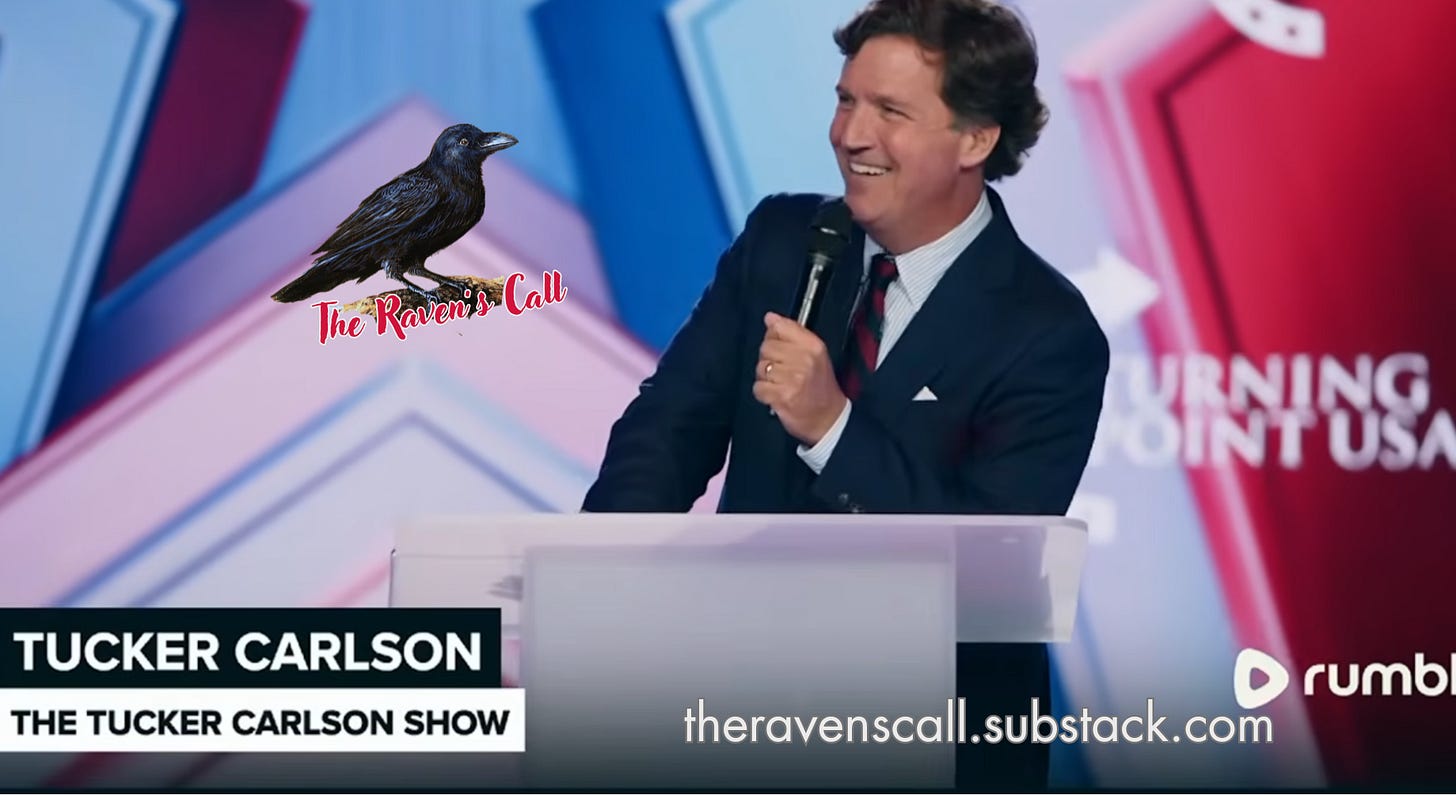
Tucker Carlson at Turning Point USA: Epstein was a Mossad agent and IDF soldiers should lose U.S. citizenship

Things are looking up for being able to be honest about Jewish issues in mainstream forums. I couldn’t be happier that this is coming out from a mainstream conservative at a major mainstream conservative conference. It’s been a long time coming, and we are still not there. But there is a light at the end of the tunnel. Carlson is much hated by the ADL which oddly has not commented on this latest faux pas. But they have lots to say about Turker’s endorsement of the great replacement “conspiracy theory.”

Carlson claimed that Epstein had “connections to a foreign government”:

“It’s extremely obvious to anyone who watches that this guy had direct connections to a foreign government.” “Now no one’s allowed to say that that foreign government is Israel because we have been somehow cowed into thinking that’s naughty.”

Lots of Jewish angst about this — and about Carlson’s statement that Jews who served in  the IDF should lost their U.S. citizenship. Common sense, but since when has common sense been relevant to anything related to Jewish power. Any accusation of dual loyalty is considered anti-Semitism according to the official definition of the International Holocaust Remembrance Alliance, so I guess Carlson is now officially an anti-Semite, along with Charlie Kirk and a whole lot of people who attended the conference.

From the Forward:

Tucker Carlson, the former Fox News host and a leader in the Republican Party’s isolationist wing, said that Americans who previously served in the Israeli Defense Forces should have their U.S. citizenship revoked over concerns of dual loyalty. At the same time, he also criticized the Trump administration for trying to deport pro-Palestinian students who engaged in anti-Israel activity on campus.are a lot of Americans who’ve served in the IDF — they should lose their citizenship,” Carlson said in a 45-minute speech on Saturday at the Turning Point USA Student Action Summit in Tampa, Florida. “You can’t fight for another country and remain an American, period.”

Carlson, who has promoted antisemitic tropes [simply for saying Zelenskyy is a dictator who has suppressed Christianity] and has been associated with white nationalists [i.e., Darryl Cooper!!], explained that his position is an “obvious recognition of the truth” and applies to all countries. He mocked his critics — “they just write you off as some sort of internet freak, hater, Nazi” — and said it is “fair to demand that the people running my country love it every bit as much as I do.”

The founder of the organization Carlson spoke to is Charlie Kirk, a conservative podcaster who has accused Jews of financing “anti-white causes.” Several Trump cabinet members and Republican officials attended and spoke at the three-day conference.

And of course, Jews in high places deny Epstein had any connections to Mossad.

From the JTA comment on Naftali Bennet’s tweet:

Carlson has long faced allegations of antisemitism, including over his promotion of white supremacist ideas while on Fox News and his hosting of a Holocaust denier on his X stream last year.

More recently, he has been at the vanguard of a different divide within the MAGA movement over foreign policy, centering on Israel. Carlson and others heavily criticized Trump’s decision to join Israel’s military offensive against Iran’s nuclear program, with Carlson accusing Trump of being “complicit” in Israel’s “act of war.”

Carlson sends out a daily email to subscribers. This is from the July 14th email and basically summarizes his points at his talk. Notice he highlights Jewish activist Ben Shapiro as wanting to move on.

It seems likely that Jeffrey Epstein worked on behalf of an intelligence service. Probably not an American one.

So which country was it? The fact that so few reporters have bothered to dig into that question could prove to be this century’s most egregious example of journalistic malpractice. How did the notorious pedophile go from being a high school math teacher with no college degree to having a private island and one of the most luxurious residences in Manhattan? Doesn’t that seem weird? What was the source of his money? Why has nobody ever really looked into it?

To anyone paying attention, the obvious conclusion is that Epstein had direct connections to a foreign government. To the Israeli government. That is true even though saying it out loud is forbidden in mainstream political discourse, but there’s nothing wrong with having the gall to do just that. It doesn’t matter what screeching shills like Mark Levin say. Telling the truth is not hateful, nor is it anti-Semitic or even anti-Israel.

Criticizing the behavior of a government agency, any government agency, does not make you a bigot. It makes you a free person. You are allowed to hold them to account because you’re not a slave; you are a citizen. That means you have the right to expect your government to act in your interest and to demand that foreign governments that suck up your tax dollars do the same. Israel using America’s most famous serial sex criminal as an intelligence asset would not fit that description.

So did it happen? A few people have asked the Israeli government that question, but they’ve received no real answers. That is unacceptable. As long as America keeps cutting generous checks to that foreign power, it should have to report to us. If it refuses, no more payments. The rules are simple.

In the meantime, we can’t help but notice a strange new talking point emerging on the Right.

“The Epstein story doesn’t even matter!” the Ben Shapiros of the world now claim. “So shut up about it already!”

That is obvious nonsense. The truth behind Epstein, his death, his connections, and how he got so rich matters a lot. The pedophile wasn’t killed during a walk down the street or even in his own home. He died in a high-security prison in the heart of America’s largest city. It was supposed to be among the most secure places in the world. That means whatever force is responsible for Epstein’s demise orchestrated the killing in among the most difficult conditions possible, and they did it while hardly breaking a sweat. Whoever pulled that off really runs our country. If they could do it to him, they could definitely do it to you, too.
Why would the Shapiro caucus not want to get to the bottom of that? You know the answer. It’s because they have something to hide

The refrain on the right is that Epstein matters because he is a window into who rules the U.S. And one would be forgiven for thinking that the reason for the cover-up is to hide the involvement of Mossad in an elaborate blackmail scheme. We also deserve to know what the deep state is hiding about the JFK assassination—another phenomenally important event in which there is good reason to think that Israel and the CIA were involved, and another incident where Trump said he would be completely transparent.

Napolitano interviews Mearsheimer: Genocidal Israel and its domination of U.S., the never-ending Ukraine war

Napolitano’s podcast is the best mainstream podcast out there. Likely the most negative about Trump among conservatives and he has people who are very knowledgeable about Israel, its power over U.S. politics, and its genocide against the Palestinians. I have supported Trump—anyone but Harris, and he is certainly doing some good things, like DEI, deporting illegals, etc. But his foreign policy has been a disappointment to say the least.

Prof. John Mearsheimer, co-author of The Israel Lobby and U.S. Foreign Policy, is a foreign policy expert and the best academic critic of Israel. His views are always worth hearing. His critiques of Trump are devastating.

Mearsheimer: Israel is totally dependent on the U.S. The absurdity of warmonger Netanyahu nominating Trump for the Nobel Peace Prize, but flattery will get you everywhere. Epstein likely very connected to Mossad and CIA; Netanyahu may have pressured Trump not to release Epstein files. Israel aims for complete dominance of the Middle East. Iran still has nuclear material, setting up another war. CIA Director John Ratcliffe as Mossad’s stenographer. Iran as strategically very important. Iran has learned that cooperating on nuclear deterrence doesn’t work; U.S. and Iran relations were getting better until the Israel Lobby stepped in and said that was unacceptable. Iran did “an enormous amount of damage to Israel” in the 12-day  war and neither Israel nor the U.S. are enthusiastic about another war. Israel wanted to end the war. Iran has missiles that Israel can’t stop, and the Trump administration fears Iran’s ability to shut down the Strait of Hormuz. Lots of people think Iran should not have agreed to stop the war because “they were in the driver’s seat.” Israeli “humanitarian” camps; Israelis as Nazis.

Re Ukraine, Russia won’t change its terms for a ceasefire; they see the war as existential. Unless the U.S.-Ukraine agree to Russia’s terms the war will continue indefinitely. The negotiating is a charade. Trump will end up being Joe Biden 2.0 in Ukraine and the Middle East. Trump administration is “the gang that can’t shoot straight.” Russians are slowly but surely “rolling back the Ukrainians.” At some point Ukraine is likely to collapse, and we will have something like the Afghanistan withdrawal catastrophe all over again. Neocons have basically triumphed despite Trump’s rhetoric prior to the election. Expects a “frozen conflict” with Russians taking a big chunk of Ukraine. This will result in forever conflict between Russia and the West even long after the results are settled on the battlefield. “You can’t trust anything this administration says.” Gabbard has been marginalized and has fallen in line with Trump’s line. Trump uses intuition to solve problems, as he said on his tariff policies; doesn’t make calculations or consult others, thinks he’s a genius. Result is a lawless president who thinks he can lie and get away with it. “We are paying a serious price for this.”