
Such Skill Beneath the Skull: Celebrating the White Genius of Dutch Art
Thunderclap: A Memoir of Art and Life & Sudden Death
Laura Cumming (Chatto and Windus, 2023)
Reading is richer for racists. That’s on the good side. On the bad side, reading can be more regretful for racists too. You’ll find both the good side and the bad side of racist reading in Laura Cumming’s excellent book Thunderclap. It’s partly a study of art in the Dutch Golden Age and partly a memoir of how the author came to know and love that art. And to base part of her career on it: Cumming has been “chief art critic of the Observer since 1999.” That is, she’s a Guardianista (the Observer is the Sunday edition of the Guardian). And she wrote this book for other Guardianistas. But it isn’t Guardianistas who will get the most out of the book or the art it discusses and displays.
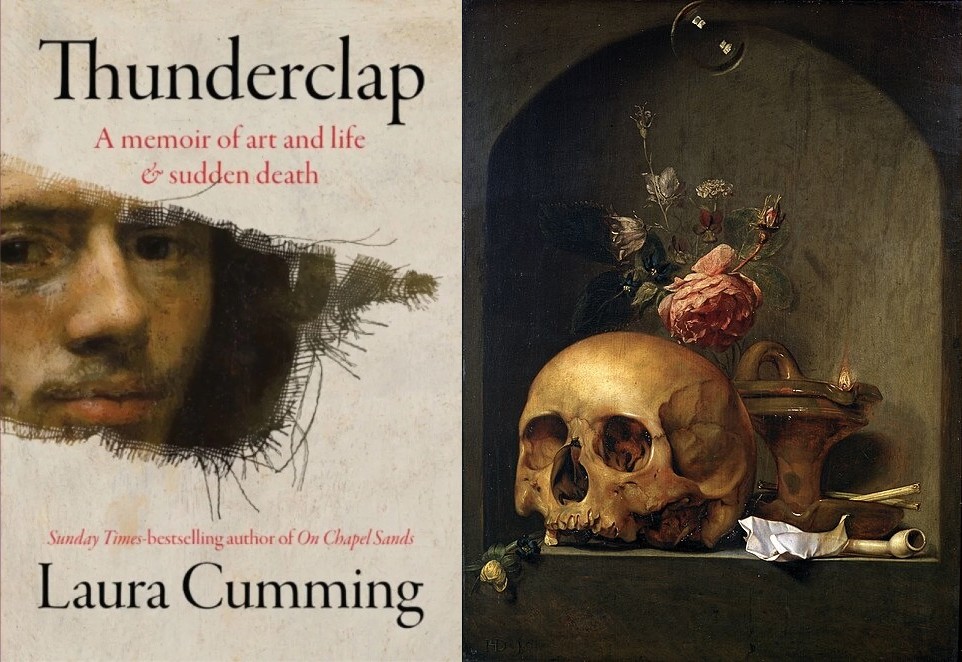 Thunderclap with a skilful skull, Vanitas by the Flemish master Hendrick Andriessen[1] (Wikipedia)
No, it will be racists and sexists like me. This is because Guardianistas won’t notice, or won’t dare to notice, some fascinating and important questions raised by the book. The Netherlands — the Low Countries comprising modern Holland, Belgium et al — is a small region whose population numbered perhaps two million by the Golden Age of the seventeenth century. And yet from the Middle Ages that small population turned out painters of astonishing subtlety and skill. They outcompeted in quality and quantity the far larger and more populous nations of France, Germany and Britain, and were matched or surpassed only by Italy. The Netherlands was the birthplace of Van Eyck and Hieronymus Bosch, Rembrandt and Vermeer, creators of immortal art whom we can justly call geniuses. Yet Cumming never asks why and how this could be so. How could such a small region produce so many world-conquering painters?[2] And such good painting in such quantity?
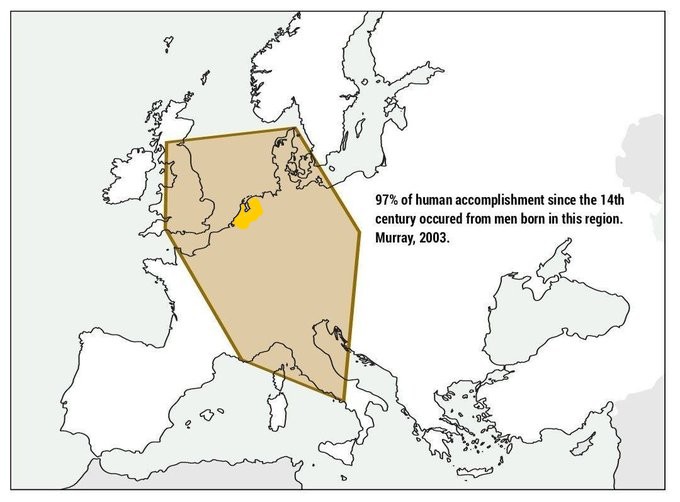 Holland in the hexagon: We owe “97% of human accomplishment” since the 1300s to White men in this region
If she had asked those questions, she would of course have confined her answers entirely to culture and invention. And yes, culture and invention — glass and lenses, for example — do undoubtedly explain some of the Dutch success in art before and during the Golden Age. But those things alone don’t and can’t explain all of it. Genetics played a central part too, because genetics was involved in all of it: the art, the culture, the invention. Those sublime skills arose within skulls of a particular kind. Dutch genius was a subset of White genius, of the evolved intelligence and inventiveness of White northern Europeans. Holland sits inside a hexagon of achievement identified by Charles Murray in his book Human Accomplishment (2003): “97% of human accomplishment since the 14th century occurred from men born in this region.” Among the men discussed by Murray are Rembrandt and Vermeer, two Dutch masters who are also discussed by Cumming in Thunderclap. But her book centers on a Dutch master whose art is now far better known than his name. Millions of people are familiar with this painting, for example:
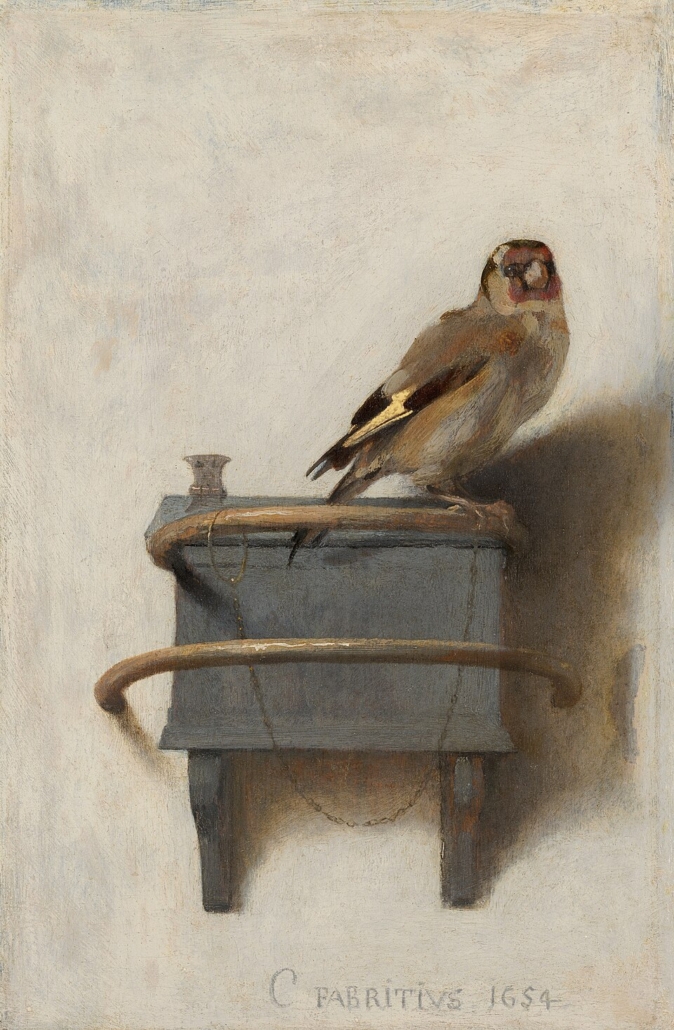 The Goldfinch or Het puttertje (1654) (Wikipedia)
But who painted it? I knew the painting when I picked Thunderclap up earlier this year, but I couldn’t have told you the name of the painter. He was Carel Fabritius, born in 1622 and killed thirty-two years later in the huge accidental explosion from which Thunderclap takes its title. The Dutch town of Delft was deafened and part-destroyed in the mid-morning of 12th October 1654, when the carelessness of a government official ignited stocks of gunpowder held in a vault near the center of the town. This is how Cumming describes the disaster:
Trees are torn from their roots, bodies lifted into the air in a torrential uprush. It takes a while for the living to rise up from the ground, stunned and terrified of another blast. Which comes, as 90,000 pounds of black gunpowder stored in barrels in the vault detonate in a rapid bombing pattern of explosions that rip through Delft, exactly as happened in the present century when the port of Beirut exploded, the sound heard as far away as Cyprus. Some citizens are tormented by tinnitus for weeks. Others are permanently deafened. (“Three,” p. 223)
Fabritius was carried severely injured from the ruins of his house and died shortly afterwards. It was the final tragedy of a tragic life, for he had lost his first wife in childbirth and three children to disease by then. Death came early and often in those days, but Cumming understands only the tragedy of that, not the implications for human evolution. Fabritius seems to have left no descendants: he failed genetically. But he triumphed memetically, because one thing survived from his shattered house. As Cumming describes on the final page of Thunderclap, modern scanning has revealed that his most famous painting was there on that thunderous day. But the fragments driven against it by the blast “did not split or shatter” its surface “because it was not dry.” No, “The Goldfinch was still wet, still drying, a work in progress like its maker, a living thing in the studio when Fabritius was dying.” (p. 256)
That’s a memorable image to end a memorable book, a celebration of some of the world’s greatest art and greatest artists in one of the world’s smallest and least geographically fortunate nations. Vermeer is celebrated in Thunderclap, of course, and Cumming casts a skilful and appreciative eye over masterpieces like View of Delft (c. 1660):
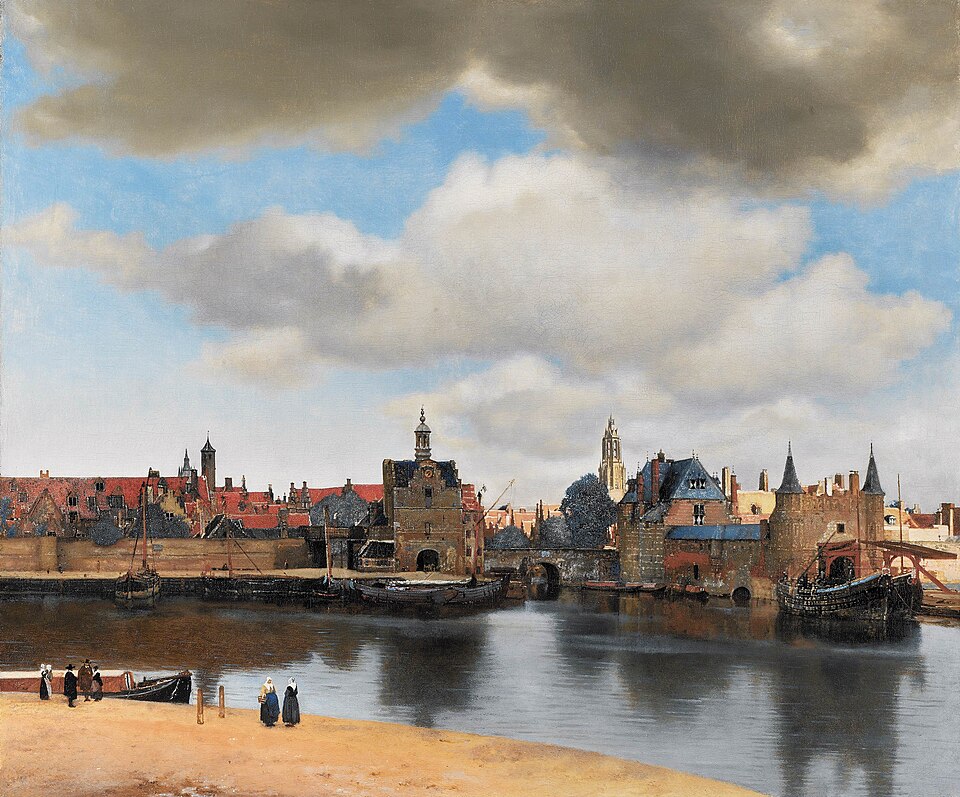 Zicht op Delft or View of Delft by Johannes Vermeer (c. 1660) (Wikipedia)
But she centers the book on Fabritius and does her best to give him some of Vermeer’s stature. I don’t think she succeeds. Yes, The Goldfinch is a masterpiece, but not at Vermeer’s level and I wouldn’t apply the same label to the rest of what has survived of Fabritius’s art. Instead, I’d call it strange and interesting. Perhaps if he had lived longer or painted more, his name would be better known today. But he was neither prolific nor fortunate, and it was obviously the tragedy and mystery of his life that drew Cumming to him. He’s a tragic hero, bereaved early and often before dying young and suddenly, having just created what would become a world-conquering piece of avian art. But I think a piece of vegetable art included in the book is greater than almost anything that has survived by Fabritius. It’s Still Life of Asparagus by Adriaen Coorte (c. 1665–c. 1707):
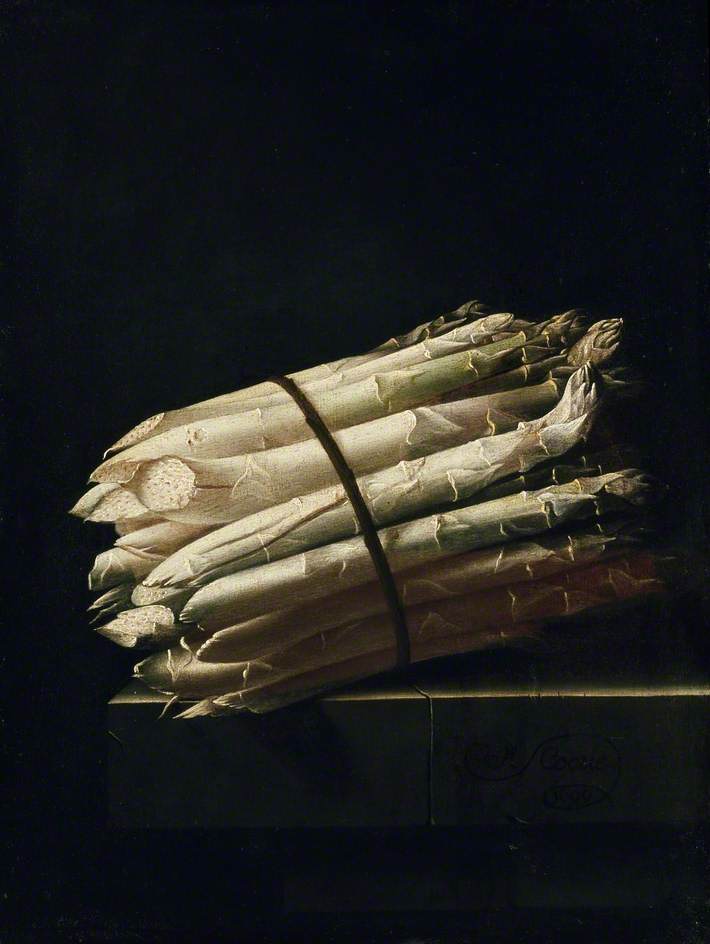
Coorte, Adriaen; Still Life of Asparagus; The Ashmolean Museum of Art and Archaeology; http://www.artuk.org/artworks/still-life-of-asparagus-141862
Still Life of Asparagus or Stilleven met asperges by Adriaen Coorte (version in the Ashmolean Museum, Oxford)
To invest a face or a finch or a flower with sublimity is high achievement for an artist. But higher still is to invest vegetables with sublimity. That’s what Coorte did in the still-life above. And in Laura Cumming’s own life, his painting would be a leap to the sublime from the ridiculous. How so? Well, she describes how she was studying literature at Oxford and went to see the “French philosopher Derrida” speak at the Modern Languages Faculty. But Derrida was delivering his “impeccably difficult lecture” in French and she felt ashamed not to follow it well. To console herself afterwards, she visited the Ashmolean Museum next door. It was there that she “saw a small painting glowing in a gallery dim with shadows.” It was her first encounter with the art of Coorte, whom she would come to regard as “the greatest” of “Dutch still-life painters”:
It showed a bunch of asparagus lying on a shelf, perhaps a dozen spears, running from white to silvery-green at the tips. This humble sheaf, tied up with string, is positioned at a curious tilt. But what strikes first and last is the black and white thunderclap — the obliterating darkness from which these stalks stand out in a light so bright it appears to come from within as well as from without. Young asparagus has that pale metallic sheen, as if it had stored up some internal power from growing up out of darkness. But this light was almost supernaturally bright, darting along the edge of the stone shelf like a laser, igniting the nubs and tips and woody root where the blade has sliced right through — such modest vegetables held in such glory. (“Two,” p. 139)
Those seven final words are an excellent summary of the appeal of Dutch art in the Golden Age: “such modest vegetables held in such glory.” The Protestantism of Vermeer and Rembrandt had replaced the Catholicism of Bosch and Van Eyck, the mundane had replaced the Madonna, but Dutch art was still celebrating miracles. Indeed, paintings like Coorte’s still-life make a miracle out of the mundane and the material. In a sense, he sanctified the bunch of asparagus, investing its color and shape and fleeting presence with an awe that escapes any hint of incongruity. Yes, the painting tells you, matter is miraculous and the modesty of Still Life of Asparagus multiplies the miracle.
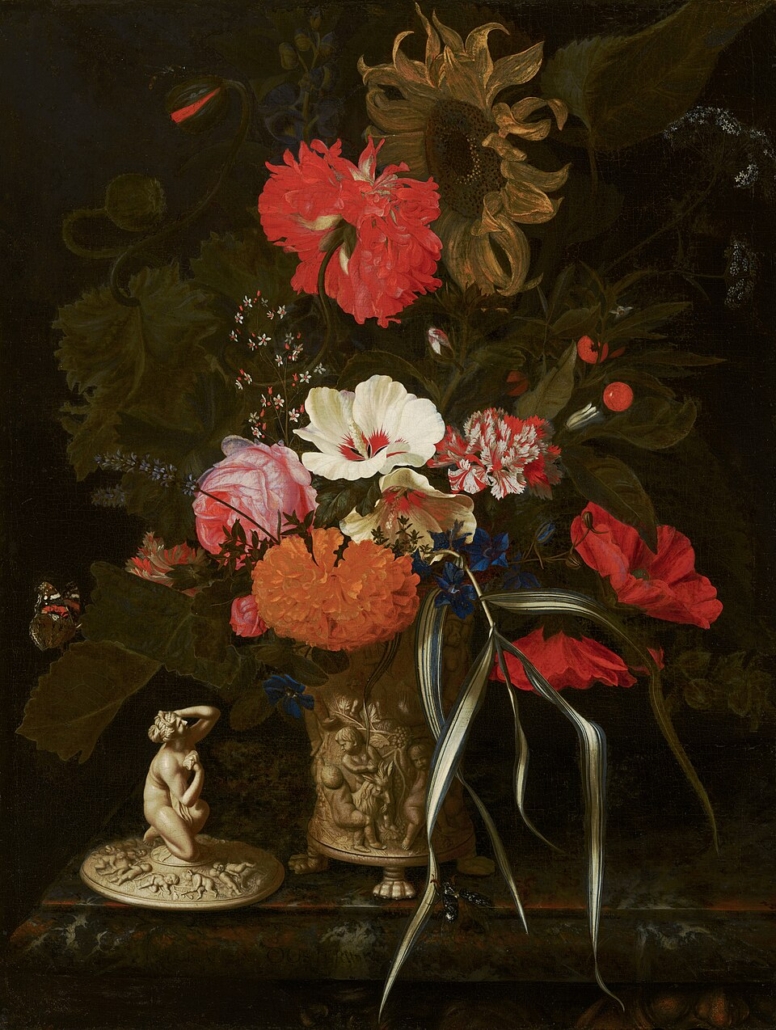 Flowers in an Ornamental Vase or Bloemen in een siervaas by Maria van Oosterwijck (1670) (Wikipedia)
A couple of pages before that, there’s a fiery and flamboyant still-life of flowers by the female artist Maria van Oosterwijck (1630-93). It’s an excellent painting, full of color, detail and what Cumming rightly calls joie de vivre. But it isn’t full of genius in the way that Coorte’s “modest vegetables” are. And that raises another question that Guardianistas like Cumming do not like to ask or even acknowledge. Why is genius so much a male phenomenon? Why do men invent and innovate on a scale and over a range far beyond women?
More particularly — and more unspeakably still for Guardianistas — why do White men have such a disproportionate share of genius? As Charles Murray said, “97% of human accomplishment since the 14th century occurred from men born” in that north European hexagon with its corners over lowland Scotland, Denmark, central Europe, central Italy, southern France and southern England. It’s a hexagon of White male genius: there has been no female Vermeer just as there has been no female Mozart or female Newton.[3] Guardianistas would of course attribute that over-achievement of White men entirely to culture, contingency and male evil, because their leftist dogmas state that all human groups, men and women, Whites and Blacks, gays and straights, are the same under the skin and should therefore succeed or fail at exactly the same rates.
“A team of brilliant women”
That isn’t true and leftists don’t in fact behave as though it’s true. That’s why they believe that male evil explains male success and White evil explains White success. While leftists preach equality, they practise hierarchy, because they believe in privilege for their pets, like women and Muslims, and punishment for their enemies, like men and Christians. That’s why they’re concerned about unequal outcomes only when their favorites are on the losing side. When their favorites are on the winning side, inequality ceases to matter. You can see that double standard in the book under review. In the acknowledgements, Cumming thanks “a team of brilliant women” at her publisher Chatto & Windus, which is now dominated by women like most big publishers in the English-speaking world. Is that female domination a good thing? Of course it is! Does it represent prejudice against men and self-centered scheming by women? Of course it doesn’t! Unlike men, women dominate on merit, not malevolence. Those are the answers you’d get from leftists. But female domination of modern publishing isn’t a good thing. For a start, women are less adventurous and more censorious than men. I don’t think Thunderclap would have been as lyrical or as emotionally rich if it had written by Edward Dutton, but it would have been far more insightful, far more thought-provoking and far readier to ask uncomfortable questions about the racial, sexual and cultural patterns in the art it addresses.
 Brilliant Female Publishing: Europe becomes the Black Continent for these travel-guides by Dorling Kindersley
But Dutton’s iconoclasm and intellectual buccaneering are precisely why the “team of brilliant women” at Chatto would reject any book by him about any aspect of European art or culture. Dutton is a racist, sexist and homophobe with, for leftists, unspeakably wicked ideas about genetics, psychology and racial difference. He belongs to a thoroughly unfavored group, that of the White Heterosexual Able-bodied Male or WHAM. So we have the irony of a modern publishing world where it’s women deciding what can be said about the work of White male geniuses like Vermeer and Rembrandt. But I need to give Cumming her due: she isn’t hostile to WHAMs in this book. She doesn’t belong to the Culture of Critique and she doesn’t shoehorn slavery or colonialism anywhere into her analysis. She celebrates Dutch culture and the Dutch throughout rather than denigrating or deconstructing them.
No risk of wrath
And the book is, in part, a celebration of the WHAM responsible for her own existence: her father James Cumming (1922-91), a Scottish modernist painter who helped waken her love of art and of Dutch art in particular. I don’t like the paintings by him reproduced here, but I did like the irony of the final image in the book being a detail from his colorful painting Chromosomes II. Cumming muses on the painting and its title earlier in the book: “Chroma: colour. Soma: body.” (p. 108) But she doesn’t acknowledge and would never admit that real chromosomes underlie what is celebrated in her book: the embodied genius of White men who could capture color and shape so skilfully on canvas.
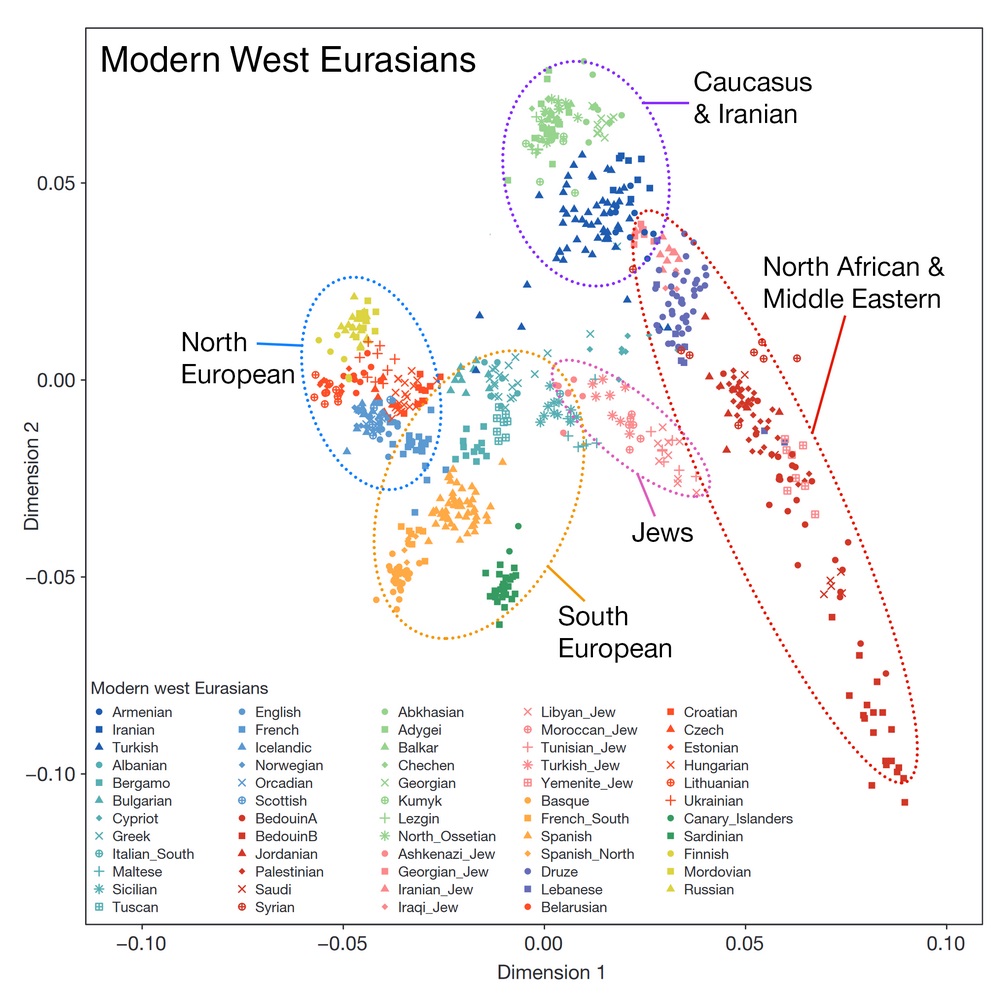 The color of chromosomes: how race is obvious in genetic geometry
Her father wasn’t a genius, but it’s perfectly understandable that she should seek to celebrate him and make his art more widely known. He’s family and leftists don’t condemn Whites who celebrate and defend their own family. But they do condemn Whites who celebrate and defend their super-family, that is, their race. Cumming runs no risk of leftist wrath in Thunderclap. She doesn’t celebrate her own race or even acknowledge its existence. She presents Dutch artistic genius as though it emerged ex nihilo and owed nothing to genetics or evolution. That’s why she doesn’t write as richly as Dutton might have done. It’s also why her book won’t be read as richly by Guardianistas as it is by racists and sexists like me.
Deliberate disaster
But her book won’t be read as regretfully by Guardianistas either. I both relished and regretted the celebration of Dutch artistic genius in Thunderclap. What did I regret? I regretted what I knew lay ahead for the nation of Vermeer, Rembrandt and Fabritius. A much slower and much more insidious disaster awaited Holland than that accidental detonation of gunpowder stocks in 1654. And it wasn’t an accidental disaster. No, it was the deliberate opening of Holland’s borders to the Third World. Laura Cumming can feel the tragedy of Carel Fabritius losing his wife and children in the seventeenth century. Why can she not feel the tragedy of the native White Dutch losing their nation in the twentieth-first century?
And not just losing their nation: losing it to groups of far lower intelligence and far less achievement. Non-White groups like Moroccan Muslims didn’t give the world sublime art when they lived in their homelands and the magic dirt of Holland hasn’t enabled them to do so after they moved there. What they excel at is not art or invention, but violent crime, welfare dependency, fraud and political corruption. Like Britain, Holland has Muslim rape-gangs and, like Britain again, Holland has leftists enabling and excusing the rape-gangs. Cumming discusses and praises female artists like Maria van Oosterwijck and Rachel Ruysch in her book. But what about the female descendants of those Dutch female greats? Those descendants are at risk and under attack in ways that their ancestress-artists could never have foreseen. Because who could have foreseen in the Dutch Golden Age that the civilized Christian Netherlands, newly liberated from Catholic Spain, would open its borders to Muslim barbarians?
Genius and genetic pacification
Cumming regrets vanished art again and again in Thunderclap, like “the treasury of Golden Age art lost [aboard ship] off Finland in 1771 on its way to Catherine the Great in Russia.” (p. 129) She laments that “Dutch painters are always in debt, verging on destitution: Van Goyen, De Hooch, Fabritius, Vermeer, Rembrandt above all.” (p. 191) But she doesn’t regret or lament what is happening to the whole of Holland in the twenty-first century: submersion beneath a mud-flood and the conversion of what could have been a golden future into something quite different. Now Holland’s future, like Britain’s, threatens to be a bloody chaos of civil war and ethnic cleansing.
But perhaps the atrocities of Holland’s future were predictable from the art of Holland’s past. The art discussed and displayed in Thunderclap is sublime, subtle, spiritual. But it could also be described as subdued and even subjugated. It occasionally contains soldiers but it isn’t martial or militant. It has genius but also gentleness, because it expresses the psychology of a genetically pacified people who had lived for many centuries under a strong state that executed criminals and protected the law-abiding. That’s genetic pacification: a strong state removes genes for violence, sensation-seeking and criminality even as it protects genes for self-control, industry and resistance to boredom. So was this painting by Carel Fabritius an unintended prophecy of Holland’s future?
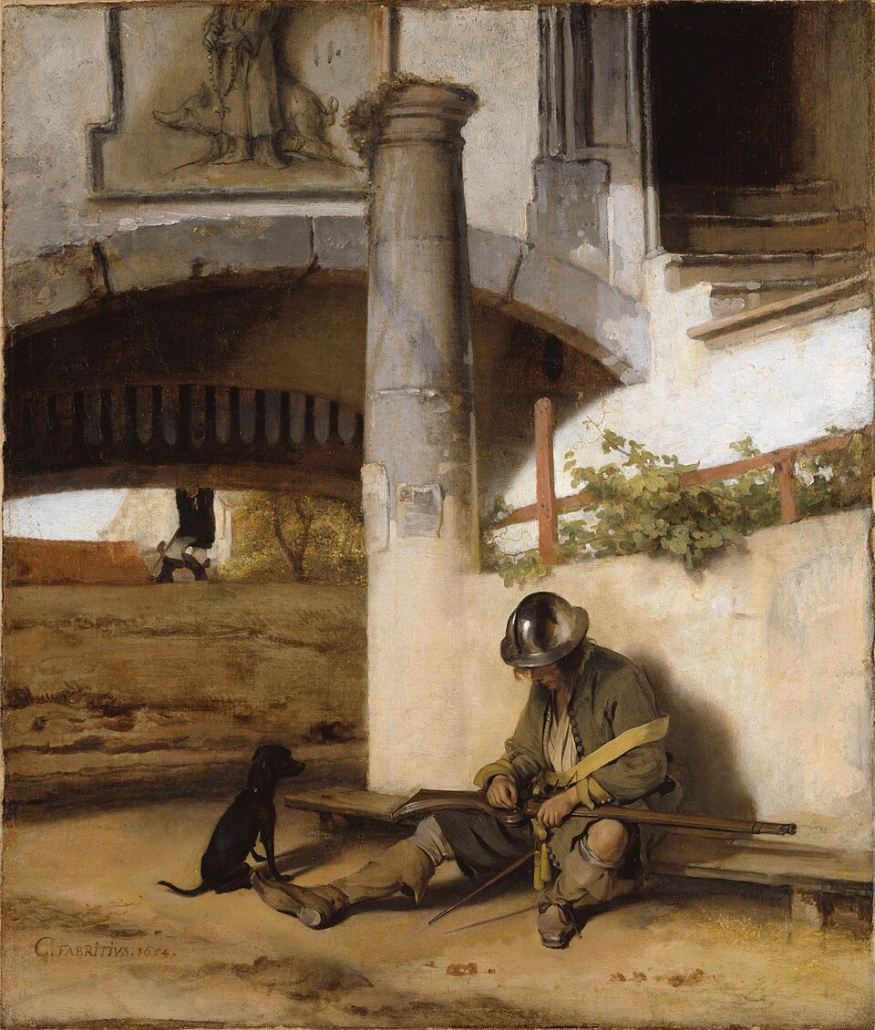 The Sentry or De poort bewaker by Carel Fabritius (1654) (Wikipedia)
What does The Sentry mean? Art-critics are still arguing about that: as Cumming says, it “is the most enigmatic of Fabritius’s scant few works.” (p. 159) But it could be read as an unintentional allegory of Holland asleep as traitors prepared to release the mud-flood of unassimilable and under-achieving tribalists from the non-White regions like Turkey, Morocco and the Moluccas (a former Dutch colony today part of Indonesia). Those non-White homelands have never produced a Vermeer or a Leeuwenhoek, the great Dutch microscopist who also appears in Thunderclap. He’ll remind some readers that Holland has oversized achievements in science and technology too. Holland’s heritage is mighty and worth fighting for.
And it will be fought for, because the true White Dutch are not dead. The genius of Vermeer, Van Eyck, Rembrandt and the rest now has to be seen not as ars gratia artis, “art for the sake of art,” but as ars gratia Martis, “art for the sake of Mars.” If the White Dutch want to retain their nation and the glories of its art, they will have to fight. And I think they will fight. When I read Thunderclap, I found it impossible to believe that a nation capable of such greatness would ever be defeated by enemies of such inferiority. That’s the final of the racist messages in Thunderclap that its Guardianista author never intended to put there.
[1] This painting doesn’t appear in Thunderclap, but I needed something both skilful and skullful.
[2] Vermeer was not properly recognized outside the Netherlands until long after his day, but his art has now conquered the world.
[3] As the provocateur Camille Paglia once put it: “There is no female Mozart because there is no female Jack the Ripper.”




.jpg)


.jpg)
I’m guessing the explosion of excellent Dutch art had much to do with money from the slave trade flowing in to allow wealthy jews to buy it. Interestingly, Dutch are pretty awful at music. Germans seem to be able to do both.
Allow me to disagree. Hollanders did bless us with memorable tune-smiths; Sweelinck comes immediately to mind. Röntgen (Dutch-German) comes to mind, as well. De Fesch and Wassenaer are two big names of the Late Baroque.
But, overall, the Dutch are more renowned for their Art.
I have some as desktops and they are mesmerizing.
Bosch, Monet, Caravaggio are my faves with only one being Dutch.
Sometimes I find myself shock by the asseverations of some Historians/Philophers that I was never taught eventhought I attended Catholic Jesuit School up to my 9th grade. The figure of Baruch Spinoza and his excellent exposition of the MYTHS of Judaism. Spinoza’s surgically lingustically breaking the original Hebrew version of Genesis. It clearly shows that the “promised LANDs” citation is purely a THEOLOGICAL concept, spiritual archetype. Genesis is referring to a promise land of Human existance in peace, love and solidarity with all beings. It also explains that “chosen people” and “promised lands” are contingent on being TRUTHFUL to universal LOVE of all Humanity and all of Gods creations. Teh Best Part is that Spinoza explains the parctical POLITICAL Economic use and abuse of Jewish Choseness and claiming Jerusalem and their eternal capital to promote and build JEWISH power over humanity goyim.. God doesn’t need temples, sacred lands, GOD lives, dwells in the Universe not just Jerusalem/Israel..,The Romans, Muslims imitated the Jewish strategy to force people to make Jerusalem the Chosen sacred city.. Because IT gave inmense POWER to the elite institutional Rabbinical Sanhedrin. That profitited from allowing animal sacrifices, pilgrimage, and Palestine being the cross Geopolitical Global Trade in commerce adn its related TAXES. This being the main reason that Caiphas and his rabbinical allies decided to crucify JesusChrist that oppose the idea that God could NOT love NONjews, based on cincumsicion and other dark sexual sorcery butchery. And that only and only Jerusalem was /is the Sacred exclusionary city of God.
Now that You mention it. I went to Catholic School up to my High School….It is indeed odd that (the Jesuits) never took time to DEBUNK the main false tenets of Judaism. I never heard the word JEW. They never exposed the lies of The Talmud Judaism.. I still remember during the hysterical approach to the Sex Priest Scandal..I found it very strange that the Catholic Church/Vatican never used its Pulpits/Media/Legal resources to counter the widespread Lies by the Jewish media cartels, that not only fabrictaed de sex priest epidemic but the jewish LEGAL firms collected BILLIONS. At the expense of Innocent priest being accuse without evidence. But the same jewish media never covered the large evidence against Jewish rabbis abuse pedo/porno/child rapist talmudic Rabbis..an untouchable topic.
If you read the above footnote, on Camille Paglia and search the reference to her work, it is delightful to find her again raising hell, the way I recall her from many years ago.
Leaving aside the Freud mumbo jumbo, but recognizing the importance of sexuality in any Evolution based theory of our biological being, reckoning with Paglia’s wit is a pleasure.
The only thing right now I have to say, is that our feminized society has castrated the fundamental Male Appollonian, culture necessary for any rational, future oriented as well as present day awareness of social reality. Men have been turned into the acolytes of the Great Mother, welcoming the wretcheds of the earth. No mother is capable of destroying one of her freak children/babies…it takes the father to do it.
We men are liberals, socialists, communists, and Lovers of Mankind. Our women are worse. It will take extreme chaos to retrieve our Realism and of course, our ferocity. Trump has become the burlesques parody of the Male and thus spawns more Democrats and Humanitarians. Blood and Soil and male predominance is the biological necessity.
As for women, when they voluntarily enter into the pleasures of Polarity with men, then Nature will be happy to provide the bower and the home.
I’ve noticed that very few researchers like Emil Kirkegaard have any interest in the innate personality trait of Altruism and its subdomains of Sympathy, Empathy, and Guilt. They more or less exclusively focus on General Intelligence. Only Michael Woodley of Menie found Altruism to be just as important as intelligence. Since he is heavily interested in Group Selection vs. Individual Selection, personality is just as important to him as intelligence. And for me, since I am very much interested in ethnic nationalism, I also find it very important that each member of the ethno-nation be highly Altruistic as well as intelligent. High altruism makes each member of the nation use their high intelligence for the collective advancement of the nation, instead of just the self. I would prefer a nation just go extinct if it does not possess both high intelligence and high altruism.
I’ve been following Kirkegaard’s research for years, and it’s virtually all about IQ (and sometimes Neuroticism), but never about Altruism. What does that say about him? I know that while he was being interviewed by Dutton live on air, he stated, “I don’t believe in Group Selection.”
It’s as if all these psychometricians are fascinated by their own above average IQs but don’t care about Altruism because they don’t really see themselves as part of a race/nation. Do these researchers lean towards being Individually Selected?
Thanks, Tobias for this thought-provoking piece.
I too, have a high regard for the Dutch Masters mentioned above.
I live in Australia and was able to view the Dutch Masters Exhibition at the state gallery where I live when it visited about a decade ago.
I don’t want to be too verbiose other than to make one observation about the third footnote in this piece viz.: The quote cited which is credited to Camille Paglia does an injustice to the fairer sex IMO by trivialising and minimising the role women have played through history. By this, I mean that there may not have been as many female geniuses, child prodigies or polymaths historically, however, they were arguably doing the most important work of all; raising and caring for the aforementioned geniuses etc. which, many men are loathe to admit, was essentially a mother’s role through most of known history. Let us not forget that although males have been a dominant force for most of time, the role of women as family, nurturers, muses and influences should not be totally discounted as a force for men of good character and goodwill. Yin and Yang, if you will.
Thank you.
Camille Paglia is very anti-White, by the way. She has made some good observations – my favorite is the quote ‘If civilization had been left in female hands we would still be living in grass huts’ – a bit exaggerated, but generally correct. However, I view her as pretty obsolete now. She called blondes ‘oppressors’ and praised ‘jewish revolutionary spirit’.
Not to mention that the aforementioned quote would be more impactful as ‘There is no female Leonardo da Vinci because there is no female Stalin/Green River Killer’ – more fitting examples of male extremes that are out of women’s reach (thankfully).
White art is pure splendor.
“When I read Thunderclap, I found it impossible to believe that a nation capable of such greatness would ever be defeated by enemies of such inferiority.”
Western nations are not being defeated by inferior enemies. They are being brainwashed by jews who cleverly instill guilt and altruistic suicide in whites… especially the females of the race. It is (((they))) who have to be dealt with. Once they are completely removed, repatriating the third world invaders will be much easier and less bloody.
‘Everybody thought it was a good idea to put a bell on the cat, but none of the mice could figure out how to do it’
Jews ain’t going anywhere without a lot of hard work, and that doesn’t include posting on Gab
Also embedded in that hexagon of creation are the greatest composers of all time.
• Bach
• Beethoven
• Brahms
• Haydn
• Mozart
• Chopin
• Liszt
• Wagner
• Schubert
• Schumann
• Handel
• Vivaldi
Such greatness all within this small region of the planet. It’s race… pure and simple.
Great article- not so sure about the Finch though.
What lead to this innovation, skill?
There were Europeans in Europe for millennia, for the most part banging bears over the head with rocks to eat like everyone else.
The structure and teaching of the Church, especially their elimination of slavery, was what the difference was, and why it accelerated.
Other related European peoples, while just as intelligent, didn’t innovate.
If you rely on slavery, you just get more to accomplish whatever you want to do, you don’t need innovation or skill-
When you don’t have slaves … ‘Necessity is the mother of invention’ is the best way to sum it up.