Catholic Church

Synagogue of Satan? The Theological Significance of the Destruction of the Jerusalem Temple in AD 70, Part 2

Was the Destruction of the Jerusalem Temple an Act of Divine Vengeance?

At least one mainstream scholar, GWH Lampe, acknowledges that the belief “that the fall of Jerusalem avenged Christ’s death became a commonplace of later Christian apologetic.”[1]  Most famously, Augustine of Hippo (354-430 AD) declared that “the Jews who slew Him, and would not believe in Him…were yet more miserably wasted by the Romans, and utterly rooted out from their kingdom” to be “dispersed through the lands” as “a testimony to us that we have not forged the prophecies about Christ.”  Augustine specifically rejects the notion that an “inseparable relationship” exists between Old Israel and the Christian church: “those Israelites who persist in being His enemies…shall forever remain in the separation which is here foretold.”[2]

The church historian, Eusebius of Caesarea (263–339 AD) was of a like mind; he thought it fitting that three million Jews thronged into Jersusalem, “as if to a prison” to “receive the destruction meted out by divine justice.”  He related some of the horrors of that tragedy “so that readers may learn how quickly God’s punishment followed their crime against Christ.”  Moreover, Eusebius, attributed to Josephus the belief that these “things happened to the Jews as retribution for James the Just, who was a brother of Jesus who was called Christ, for the Jews killed him despite his great righteousness.”[3]  Justin Martyr (100–165 AD) agreed that it was right and just that Jerusalem was destroyed for the Jews “killed the Righteous One and his prophets before him.”  Origen and Tertullian also shared that view.[4]  Melito of Sardis (died ca 180 AD) gave a compelling poetic expression to the view that the Jews had received their just deserts when “the Lord thundered out of heaven, and the Highest gave voice to his vengeful wrath against Old Israel by dashing the Temple to the ground.[5] Read more

Synagogue of Satan? The Theological Significance of the Destruction of the Jerusalem Temple in AD 70, Part 1

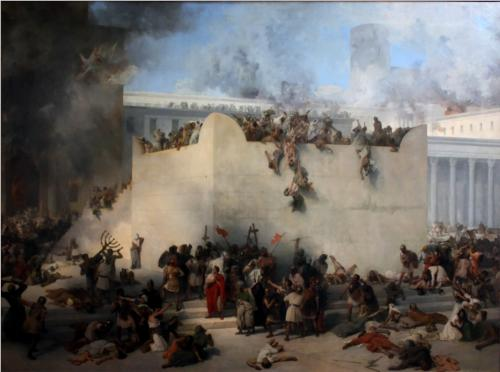
Destruction of the Jerusalem Temple by Francesco Hayez

Introduction

Trudy Pert suggests that the crisis of modern Christianity deepened when mid-nineteenth century Protestant theologians embraced the higher criticism.  Especially in Germany, the traditional devotional approach to the Bible was replaced by the “objective” techniques of historical and literary criticism.  As a consequence, educated Christians turned their attention away from the “supernatural Christ” to the “historical Jesus.”  A new sort of Kulturprotestantismus, or cultural Christianity, was born: Jesus Christ became a teacher of ethics rather than the incarnation of the divine.  The crisis was real enough; it reflects a continuing failure by Christians to recognize the pivotal moment when the “supernatural Christ” burst back into human history to avenge both the crucifixion of the “historical Jesus” and the persecution of his faithful followers during their forty year mission to the ends of the earth.

In AD 70, Roman armies under Titus besieged Jerusalem to crush a long-running Jewish rebellion.  Their triumph was a bloody affair; not only was the city sacked and pillaged but, according to the contemporary Jewish historian Josephus, the dead, most of whom “were pure and holy” Jews, numbered over one million.[i]  The Romans also systematically destroyed the massive Temple complex.  In doing so, they ripped out the redemptive heart of Old Israel.  The massive Temple complex was the hub around which revolved the ritual observance of the Mosaic Law underlying Israel’s covenant with Yahweh.  For Jews and Romans, alike, the destruction of the Temple was an act of world-historical significance.  But the meaning of that cataclysmic event was not confined to the realm of secular history. Read more

FSSPX and the One-Sided Relation of the Vatican with the Jews

The discussions between the Pius X-Brotherhood (FSSPX) and the Vatican are drawing to an end and never has FSSPX been so close to a full reunion. The possible reconciliation between the Vatican and FSSPX is making the Jews very nervous.

The relationship between FSSPX and the Jews was already hostile before the Williamson affair in 2009. In 2006 FSSPX was accused of anti-Semitism in a report on Traditional Catholicism by the Southern Poverty Law Center (SPLC) (see also here). The allegations include Holocaust-denial, spreading of conspiracy theories about Jewish domination and negative stereotyping of jews. The Anti-Defamation League (ADL) has branded FSSPX as being “mired in antisemitism.”  FSSPX is negative about the French revolution and its republican ideals and is positively inclined towards the Vichy Regime (1940–1944), which was strongly Catholic and imposed anti-Jewish policies in France. FSSPX officially has no political affiliations, but there are strong links with leading members of the National Front, like Marine Le Pen.

FSSPX is basically a protest-movement within the Roman-Catholic Church, founded by the late Mgr. Lefebvre in 1970 as a reaction to the outcome of Vatican II. According to FSSPX, Vatican II has led to the dominance of the cultural left in the Church and important breaches with tradition, especially the Holy Mass. Vatican II has led to a more positive official attitude towards Jews: “Jews should not be presented as rejected or accursed by God.” The prayer for the conversion of the Jews on Good Friday was dropped.

This one-sided outreach towards Jews has until now not been met by similar gestures from the Jewish side, despite persistent insulting religious texts against Christ (and Christianity). In 2007 Cardinal Francis George of the Archdiocese of Chicago had the courage to bring op this topic with a call of a more two-sided approach, mentioning as particularly offensive “descriptions of Jesus as a “bastard.”

It does work both ways. Maybe this is an opening to say, “Would you care to look at some of the Talmudic literature’s description of Jesus as a bastard, and so on, and maybe make a few changes in some of that?” Read more

Projection: Who Were the Victims in the Ukraine?

The current TOO blog by Kevin MacDonald addresses Alexandr Solzhenitsyn’s Chapter 19 of Solzhenitsyn’s book on Jews and Russians, 200 Years Together. The main point is that:

The decade of the 1930s was tragic almost beyond description. . . . However, the suffering of Jews pales in comparison to the suffering of the Ukrainian and Russian farmers undergoing forced collectivization. Moreover, Jews were never targeted as Jews, and in general Jews remained vastly overrepresented in elite positions throughout the period, even after the purges.

MacDonald notes that “Solzhenitsyn emphasizes the culpability of the West.” In particular, we have this damning point:

In 1932–33, in Russia and Ukraine —on the very outskirts of Europe, five to six million people died from hunger! And the free press of the free world maintained utter silence… And even if we take into account the extreme Leftist bias of the contemporary Western press and its devotion to the socialist “experiment” in the USSR, it is still impossible not to be amazed at the degree to which they could go to be blind and insensitive to the sufferings of even tens of millions of fellow humans.

One powerful clue we have to this twisted mystery is the effort even now to grotesquely turn the genocide of Ukrainians in the 1930s into a story of the victims themselves slaughtering the actual murderers. In a review of a new book, Professor David O’Connell, writing in Culture Wars, finds that canny efforts by those in the Jewish community have again succeeded in getting a Catholic spokesman to do the propaganda bidding of the Jews. Read more

Charles Dodgson’s “For God and the Reconquest of the West!”

Charles Dodgson’s current TOO article is a particularly well-articulated comment on Christianity as a vehicle for ethnic interests. Dodgson is certainly not blind to the failings of contemporary Christianity:

In the face of diversity’s many sins, not one major Christian denomination stands with the majority of Westerners in opposing mass Third World immigration. Nor do they defend voluntary reciprocal segregation in multi-ethnic societies or criticize the elites that are forcing diversity on an unwilling but leaderless public.

Dodgson provides an excellent point about “the truth of Christian universalism. … Just as the Church protects parental rights and the autonomy and dignity of families, so it should defend national rights. It would be wrong for Chinese bishops to promote mass foreign immigration to China, or for Japanese monks to undermine Japanese homogeneity. ”

But his main point is that we have to think historically. And in that regard, there is no question that the Christianity has had a vital role in the development of the West. Here Dodgson goes into a great many positive aspects of the Christian legacy of which the following is only a partial listing:

Not for nothing was the West known as Christendom. The Church acted to save bodies and posterity as well as souls. It blessed new knights in the ceremony of knighthood, sanctified the new code of chivalry that forbade harming civilians and enacted the first codified rules of war. War was justified when it advanced Christendom an ethnic-friendly legitimization that reduced or at least regulated fighting among Christians and culminated in the Crusaders’ attempt to wrest Near Eastern lands of the Eastern Roman Empire back from the Arabs. The Church defended the ordinary man from a parasitic aristocracy. It helped forge nations with responsible governments. It protected the mass of the people from enemies without and within. The English Church promoted the expulsion of Jews — who had become a predatory financial elite — from the country in 1290 as a pastoral duty, also a trend elsewhere in Western Europe. Throughout Europe the Church was Gentiles’ repository of sophisticated culture, of literacy and record keeping. It was indispensible for governance, advising kings and educating princes. It prevented the Jews from monopolizing the niche of trans-generational literary group strategy. It underwrote the earliest stirrings of modern science. The university, one of the greatest creations of the West, was founded under the Church’s auspices. Professors were priests of learning. Gregor Mendel was an ethnic German monk!

Some of this touches on themes of anti-Semitism in Ch. 4 of Separation and Its Discontents:

The Church was at the apogee of its power over secular affairs during the 13th century, and an important aspect of the economic policy of the Church was to remove Jews from the economic life of Christendom. “It was not sheer accident” (Cohen 1982, 41) that both the Dominicans and the Franciscans developed a Christian theology of commerce and trade or that St. Francis was often described as the patron saint of merchants.  Jordan (1989, 27) describes the efforts of the Church to remove Jews from the economic life of France in the 12th through the 14th centuries as an aspect of its program to develop a corporate Christian economic community by pushing Jews out of occupations and professions they formerly engaged in. Similarly, in England the Christianization of national life excluded Jews from public administration, trade, and agriculture (Rabinowitz 1938, 37). This suggests that the rise of gentile middle classes in Western Europe was facilitated by the exclusion of Jews by the medieval Church as an exclusionary, collectivist entity (see also PTSDA, Ch. 8). Houston Stewart Chamberlain apparently held a similar view. When asked to propose a Jewish policy for Romania, Chamberlain noted that the exclusion of Jews from England from 1290 to 1657 had, according to Field’s (1981, 222n) paraphrase, “enabled a strong, vigorous British race to grow and sustain itself.”

King Louis IX of France (Saint Louis), who lived like a monk though one of the wealthiest and most powerful men in Europe, was a particularly zealous warrior in carrying out the Church’s economic and political programs. Louis attempted to develop a corporate, hegemonic Christian entity in which social divisions within the Christian population were minimized in the interests of group harmony. Consistent with this group-oriented perspective, Louis appears to have been genuinely concerned about the effect of Jewish moneylending on society as a whole, rather than its possible benefit to the crown—a major departure from the many ruling elites throughout history who have utilized Jews as a means of extracting resources from their subjects. [In order to finance his first crusade Louis ordered the expulsion of all Jews engaged in usury and the confiscation of their property.]

The important point that expulsion of the Jews allowed for the formation of a native middle class is elaborated in the section “Is Ethnic Conflict Rational? Historical Data” in this article which also comments on the predatory lending practices of Jews during  the Middle Ages:

Loans made at interest rates common in the Middle Ages (oftentimes 33%–65%) are simply exploitative, and there is little wonder that they caused hatred on the part of ruined debtors and deep concern on the part of the Church. Moneylending under these circumstances did indeed benefit moneylenders and their aristocratic backers, but, as with loan-sharking today, it simply resulted in destitution for the vast majority of the customers—especially the poorer classes—rather than economic growth for the society as a whole. Loans were made to the desperate, the unintelligent, and the profligate rather to people with good economic prospects who would invest their money to create economic growth; they were made [citing Parkes]  “not to the prosperous farmer…but the farmer who could not make ends meet; not the successful squire, but the waster; the peasant, not when his crops were good, but when they failed; the artisan, not when he sold his wares, but when he could not find a market. Not unnaturally, a century of such a system was more than any community could stand, and the story of Jewish usury is a continuous alternation of invitation, protection, protestation and condemnation.”

This is important, and we shouldn’t forget it. Hence the cover photo of my book Cultural Insurrections: Notre Dame, which was being built during the reign of Saint Louis.

Tom Sunic’s "Camp of the Holy Ghosts"

Tom Sunic’s “Camp of the Holy Ghosts” raises a number of important issues. Should White advocates curry favor with Zionists in the hope of getting Jewish support for their aims? Sunic thinks not: “Such pathetic comments by the Vlaams Belang or the BNP, and by some American White advocates, won’t help their White constituents in the long run, nor will they appease their Jewish detractors.”

I suspect that is correct. The only reason the organized Jewish community would really get behind White advocacy in a quid pro quo for support of Zionism would be if White advocacy already had substantial power — which it does not. Jewish power and influence will be directed at supporting their own ethnostate of Israel and dispossessing Whites in the Diaspora for exactly as long as that strategy continues to work. If White activism makes headway, Jews will certainly attempt to participate in order to promote Jewish interests within that new environment.

If this is the case, then it certainly makes sense for at least some factions of White advocacy to continue to document and critique the role of Jewish power and influence in the dispossession of Whites, if only in the interest of historical accuracy. But I also think that Whites who understand Jewish influence are simply more aware of how things work and therefore less likely to succumb to Jewish ideologies like neoconservatism as a solution for White dispossession. For example, it horrifies me that even people like Glenn Beck — probably the most implicitly White mainstream conservative and regarded as an extremist by the ADL — is nevertheless solidly in favor of legal immigration:”I’m not a racist. [Illegal immigration] isn’t to be confused with legal immigration.”

Another important point in Sunic’s article is the contrast between Catholicism in Eastern and Western Europe:

The Catholic Church in Central and Eastern Europe is a projection of local White national identity and not so much the symbol of spiritual salvation. Catholic Poland, Slovakia, Croatia and Hungary take special pride in calling themselves “antemurale cristianitatis”, or “antimurale occidentis — i,e,, the “bulwark of Christianity” and the “rampart of the West” — first against Turkic Islamic invaders, then against godless communism.  Seen in retrospect, communist repression in Eastern Europe strengthened the role of the Catholic Church and the White consciousness of its congregation. By contrast, in Western Europe the liberal system is now quickly turning the Catholic Church into a multiracial clearing house.

Catholicism and Christianity in general have been harnessed to the power of the multicultural left which has reigned supreme since WWII. The power and influence of the multicultural left has permeated all aspects of Western intellectual and political life, including all mainstream Christian sects. But there is nothing inherent in Christianity that implies that it will inevitably cooperate in the suicide of the West. What is needed is to change the secular power structure and to actively encourage ethnically defensive forms of Christianity.

Bookmark and Share

Nietzsche on Religion

I went through a Nietzsche phase as an undergrad philosophy major but never read The Anti-Christ, so Thomas Dalton’s current TOO article “Nietzsche and the Origins of Christianity” was a real eye-opener — the ultimate conspiracy theory: St. Paul as the center of a plan to counter Roman power by recruiting non-Jews to “to steal away their moral authority and place it, ultimately, in the hands of a Jew who would sooth their suffering, and ‘save’ them.” The result of the triumph of Christianity was a Jewish slave morality — “a catastrophe of the highest magnitude. … countering every aspect of Roman morality and spirituality, and … establishing a system favorable to Jewish interests.” A morality born of “the hatred and revenge of the Jews.”

What an incredible feat:  to turn Europeans away from their own western heritage — a noble, life-affirming Greco-Roman culture — and toward a foreign, alien, decadent, Oriental worldview.  And it was done as revenge, out of hatred, and built upon lies.  An ancient religion — Judaism — born of falsehood and lies, creates another born of falsehood and lies.  It is done for reasons of power, control, wealth, and survival.  And the lie prevails.

Anything bordering on religion is always likely to provoke intense feelings and for good reason. Since I am an evolutionist, I see all religion as a sort of ideology — a belief system that gives meaning and coherence to the world, and motivates behavior. The only important question is whether the ideology furthers or hinders the evolutionary aims of the people who believe in it. In that sense, Jewish religious ideology has tended to be quite adaptive for Jews — regulating marriage and providing for group cohesion and negative views of non-Jews, etc.

What about Christian ideology? Here the record is quite a bit more mixed, but in general I am much more positive about Christianity than Nietzsche. Regarding the ancient Roman world, the following is a passage from my review of David Sloan Wilson’s Darwin’s Cathedrals:

Particularly interesting is the discussion of early Christianity based on the work of Rodney Stark (1996). Early Christianity emerges as a non-ethnic form of Judaism that functioned as a way of producing cohesive, effective groups able to deal with the uncertainties of the ancient world. The ancient world was a very unpredictable place indeed, characterized by natural disasters such as earthquakes, fires, rioting, epidemics, brutal military campaigns against civilians, famines, and widespread poverty. Navigating this world was greatly facilitated by co-religionists ready to lend a helping hand and to establish economic alliances. Wilson has no hesitation in supposing that Christian charity in extending aid to fellow Christians suffering from the plague involved altruism, as indeed it did. But the result was that more Christians survived these disasters than did Pagans: Christianity was adaptive at the group level. The adaptiveness of Christianity also stemmed from its emphasis on several attitudes that were notably lacking in the Roman Empire: encouragement of large families, conjugal fidelity, high-investment parenting, and outlawing of abortion, infanticide, and non-reproductive sexual behavior. The bottom line is that Christian women did indeed out-reproduce Pagan women. Other obvious examples of religiously mandated fertility and family-promoting values in the contemporary world are the Amish and Hutterites, the Mormons, and Orthodox Jews. All of these religions are characterized by social controls and religious ideologies that promote adaptive behavior at the group level.

Further, Christianity has at times been a very effective force against Judaism. Indeed, in Ch. 3 of Separation and Its Discontents I argue that the institutionalization of Christianity in the late Roman Empire was fundamentally an anti-Jewish movement. See here for the short version. I note there that these fundamentally anti-Jewish attitudes remained Church teaching and influenced Church policy until Vatican II. I also note that

on the one hand, there is no question that Catholicism was able to serve as a viable institution of ethnic defense in other historical eras, notably the Middle Ages when, as James C. Russell notes, the Church was influenced by German culture. On the other hand, the strands of Christian universalism can lead to compromising the ethnic interests of Christians. Indeed, since Vatican II, Catholicism has become part of the culture of Western suicide. In the US, it is in the forefront of the open borders movement. It is therefore not at all surprising that Jewish organizations would be dismayed by any retreat from Vatican II.

As Russell notes, Germanic culture was not submerged by Christianity. My view is that a biological tendency toward individualism is a far better explanation of Western institutions since the Enlightenment than Christianity. There is much else to be said — too much to get into in a blog.  Suffice it to say that whatever St. Paul intended in creating Christianity, he could not control the outcome in its long later history.

Nevertheless, I do think that Christian universalism remains a problem for European survival. In commenting on Evangelical Protestants in the US, I noted their high fertility and strong sense of family values as clearly adaptive.  However,

A great many Christian denominations, including some evangelical groups, are strong supporters of multi-racial immigration and quite a few Christian groups avidly seek converts from all races and ethnicities. My impression is that most white Christians live in an implicit white world. Their gut instincts are to preserve an America that has at least a vague resemblance to the world in which they grew up.

There is no question that Christian Zionism has been a negative force on US foreign policy in the Middle East, although. as Mearsheimer and Walt note, it is very doubtful that they would have any influence at all without the support and encouragement of the Israel Lobby.

I do think that race will trump religion in American politics in the sense that White Americans will realize that importing millions of non-White Christians from Mexico and elsewhere is a horrible idea. Race is a far more powerful variable in predicting people’s political affiliations than religion, and that will continue as the racial polarization of America continues and the Republican Party (or, hopefully, the A3P)  becomes the party of Whites. Implicitly at least, White people who are strong Christians understand that they have far more in common with atheists, agnostics and liberal Protestants who are White than they do with non-White Christians. The fact that Conservative Protestants defied their leaders and were strong supporters of immigration restriction in the period of ethnic defense that culminated in the 1924 law shows that they can be rallied to sensible causes. The fact that so many of them are now involved in the Tea Party opposition movement and the rallies against immigration amnesty of recent years shows that they have healthy instincts.

So I remain optimistic that Christianity will ultimately prove to be an evolutionarily adaptive ideology for Christians.


Bookmark and Share