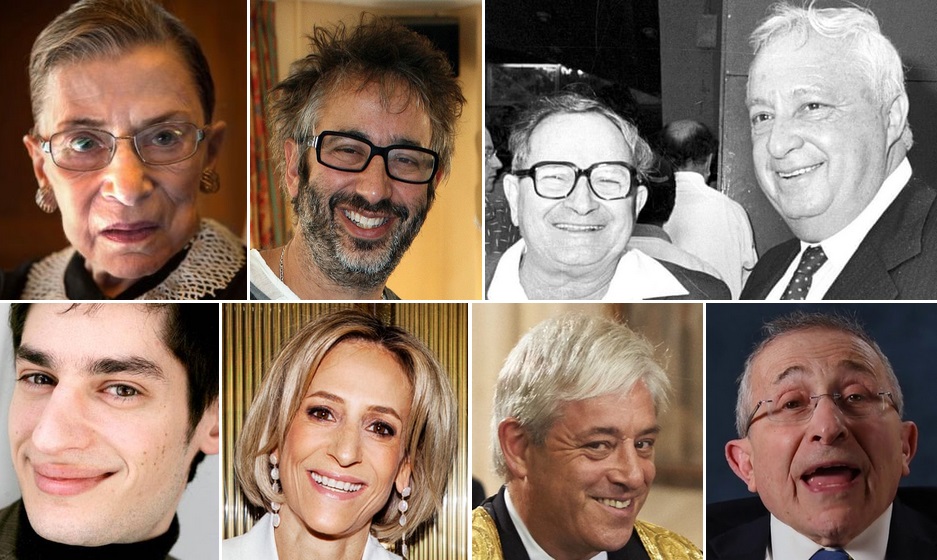
Featured Articles

A Traditional Catholic Ponders the West and Its History, Part 1 of 2: My Intellectual Journey

All the utopias dreamed up by the Left inevitably lead to bloodshed—because they conflict with human nature. The classical Marxist Utopian vision of a classless society in the Soviet Union self-destructed, but only after murdering millions of its own people. Now the multicultural utopian version that has become dominant throughout the West is showing signs of producing intense opposition and irreconcilable polarization.
Individualism and the Western Liberal Tradition: Evolutionary Origins, History, and Prospects for the Future by Kevin MacDonald

Something broke in me.

*        *        *        *

To the extent that I have “future” readers — ones who will have read my observations and musings chronologically in my many reviews and articles — I will not now belabor how it is that I arrived here. Suffice it to say, my opinions have dramatically changed over several years. While I have always been politically minded and politically literate, my conventional conservatism gave way to something much more, at least in modern terms, extreme. To be sure, I do not view myself as an “extremist,” whatever that means, but many of the authors I now read and consider — and, indeed, with whom I now agree — are veritable intellectual and cultural pariahs. Even though I am far from a public figure, publicizing my agreement with these social excommunicates would be career suicide for a relatively successful professional. That says much more about the world we live in than it does me or my views, but, regrettably, such is the world we now live in. The dystopic realm of thought crimes and thought punishment is well upon us. Notwithstanding the social opprobrium associated with it, I refuse to concede the privacy of my mind. While there is no particular courage in recording my thoughts and saying “NO” in the secrecy of my mind, the first “NO” must be articulated privately before it is expressed publicly. Eventually, however, that “NO” must be said publicly.

My journey into, euphemistically anyway, political “nonconformity” had an important antecedent; I had been “red-pilled” many years ago if one counts Traditional Catholicism. More than anything else, Traditional Catholicism, which is a dissent from the modern heterodoxy and effeminacy of the flaccid, homosexual-ridden, modern Catholic Church, opened my mind to the idea itself of challenging an omnipresent narrative. Part of coming to terms with Traditional Catholicism is an openness to skepticism, which, in and of itself, is ironic given that Traditional Catholicism is based, at least in part, on a robust return to living within the dogmatic past and truth of historic Catholicism. In other words, Traditional Catholics are now revolutionaries (or, perhaps more aptly, counterrevolutionaries) who are undermining and destabilizing the authorities who govern the very institution that Traditional Catholics wish to save and rehabilitate. Like virtually all Western institutions, the Catholic Church was co-opted during the 1950s and 1960s by Leftist revolutionaries bent on destroying the established understanding and role of the institution. As a result, we, as Traditional Catholics, do more than worship God in an antiquarian way — we are latter-day Catholics who seek to demolish the destroyers (and present-day leaders), who are now firmly entrenched in power. The world is always rich with irony when the revolutionaries themselves become entrenched in power and become, as it were, the establishment — as if true to a political axiom, they are always better at destroying than governing (see, e.g., Lenin, Castro, Mao). For an otherwise conformist conservative, the migration into Traditional Catholicism made a vast difference, and I moved from someone seeking modestly to “conserve” the traditions of my fathers into someone who was in open revolt against those who were actively destroying them. Traditional Catholicism was the first time in my life that I saw myself as subversive, but it would not be the last.

Traditional Catholicism was then a gateway to much more than traditional worship. It carries within it a scathing critique of the entire Enlightenment project and many of the philosophical tenants that we take for granted as ordinary Americans. To be deep into Traditional Catholicism then is to make it difficult to remain a typical conservative Americanist. Indeed, what was Vatican II if not a triumph of the Americanist forces over the retrograde forces of medieval “fortress Catholicism”? Thoughtful Traditional Catholics (pardon the redundancy) are more than merely subversive concerning the leadership of the modern Catholic Church, they begin to subversively question many American sacred cows like “freedoms” of religion, speech, economic exploitation, and eventually democracy itself. While I do not suggest that Traditional Catholicism led me to consider — or even hold — the particular views discussed below, it certainly opened my mind to think more critically. Put differently, if I could not trust the messaging of the contemporary Catholic Church and my Americanist public schooling, then what else was untrustworthy and potentially wrong?

Long after I became a Traditional Catholic, I began to question still other maxims of American social and political life. If I could organize the threads of dissent that put me firmly outside of the mainstream in political and social thought, it has been the slow and painful recognition of reality based, at least in part, around groups. Namely, things like: “diversity” and “pluralism” are destructive notions; “race” is a meaningful scientific concept; the respective races differ on average in various talents and attributes and create different civilizations on account of those differences; relative racial homogeneity — and its preservation — is positive for a given society; and that European people (i.e., “Whites” for a lack of a better term), have an interest in perpetuating their race and associated cultures and civilization. These ideas, taken together, are verboten among American elites of all stripes, conservative, liberal, or otherwise. Indeed, it is socially appalling and “racist” to suggest otherwise — meaning that the self-evident propositions that diversity is good and racial homogeneity are negative (at least among Whites), the non-existence of biological race and biologically based racial differences, and the obvious evil of a conscious White racial identity (unless that identity is invoked to apologize or otherwise self-flagellate) are ideas that no respectable American should hold. Indeed, holding such views publicly is to invite social and economic ostracism.

But my unconventionality goes further. If the celebration of diversity, the denial of race, and the destruction of European-peopled societies in terms of their self-sought racial extinction are cultural and political axioms that must be accepted without question or complaint, the question becomes who created the axiom, and why. In other words, who turned the world upside down and began the process of dissolution of European-peopled countries? The answer that I arrived at, again painfully, is that the Jews are the revolutionary agents who have not only sowed racial disharmony in the United States (and elsewhere), but they are largely responsible for the rapid moral degradation in our societies. True enough, Jews are not singularly responsible, but the point is that their contribution to the social well-being and flourishing of the non-Jews with whom they share territory — from a collective point of view — is always negative.

As I have cataloged repeatedly, given my profession and my geography, individual Jews have played an outsized and unique role in my life — and it goes without saying that whatever views I hold towards Jewry as a whole are not animated by personal animosity towards any particular Jew that I have ever known. Indeed, if anything, I hold the views about Jewry generally despite my long and varied history with individual Jews. Parenthetically, this is a key distinction that is not allowed within the intellectual framework of the post-Christian, multicultural West — that is, recognition of group dynamics and group predilections are not allowed. Put simply, we are not allowed to stereotype anymore based on group activity even though the basis for the stereotypes is punctuated by the reality of what we see and experience. It is like a type of lobotomy in which the brain is no longer allowed to process and analyze data because the conclusions are deemed socially impermissible. Notwithstanding my affinity towards most of the Jews that I have known, the moral rot, the manic push towards racial heterogeneity in European-peopled countries, and social dysfunction in the modern West are collectively a Jewish project. Thus, if it weren’t enough that I hold odious “racist” views, I also hold equally odious “anti-Semitic” views.

Truly, I am who Secretary Hillary Clinton described as “deplorable”.

*        *        *        *

Now, of course, I am no racist or anti-Semite but holding the views that I hold now makes me liable to the charge per se. No, if I get down to brass tacks, the change that occurred in me was a willingness to see what I refused to consider before: namely, that groups exist along racial lines, that they exist with differing talent and attributes, and further that they exist with differing moral sensibilities and with differing social aims. Moreover, I have grown to see Jews as a special group that collectively — and euphemistically — is always unhelpful to their non-Jewish neighbors. If there is such a thing as Western/European conceit, it is not that which we are typically accused of; rather it is that we project on to non-Western and non-European peoples our sensibilities, temperaments, and talents — we assume that everyone essentially is just like us. As it turns out, at least in my provisional thoughts, that projection and assumption are wildly unwarranted, i.e., all men cannot be us, all men do not make the civilizations we make, and simply uploading non-Europeans in our midst will not transform them into us. The reverse is true too: adding Europeans to another civilization will not transform us into East Asians or Africans. We are who we are, and they are who they are. Without being biologically fatalistic or deterministic, there are real biological differences and temperaments between the various races. That America and Western Europe are rapidly becoming Third World countries in which systems, infrastructure, and bureaucracies no longer function and our national moral consensus is disintegrating is proof positive that the pluralism, which is hailed as a great social benefit, is instead a great social evil. In particular, my steadfast belief in the essential individuality of people and their functional malleability — a bedrock component of conventional Americanism — gave way to seeing myself and others from a group perspective. And the supreme irony of my change of heart, as it were, is that it was driven precisely by the elites who relentlessly preach something that can only be described as true cognitive dissonance: (i) race and groups do not exist except that (ii) Whites, as a group, are uniquely evil and all other groups are good. Imagine, our institutions and our media uncompromisingly tell us that there are no groups or group attributes, but if there are groups and group attributes, the only salient thing that we are allowed to express is that Whites are bad, and non-Whites are good. The predominant ethic is that whatever is bad for Whites collectively is good for the rest of the world. It took this sustained expression of antipathy directed at Whites for me to see myself as White and begin to puzzle over who was driving that expression of antipathy.

While recent events and political and cultural phenomena all contributed to this awakening of sorts, what initially changed was my willingness to read books by authors whom I once considered off-limits. So, reviled authors such as Jared Taylor, E. Michael Jones, J. Philippe Rushton, Edward Dutton, Charles Murray, Israel Shahak, Gilad Atzmon, Jean Raspail, and Guillaume Faye introduced me to a new world of nonconforming dissidence. After limiting myself for many years to either the classical works of Western Civilization or Catholic works (that is, studying the patrimony of my civilization), I branched out in a new direction. In doing so, I wanted to make sense, within a workable prism of Traditional Catholicism, of the questions of race, religion, and the Jewish question. Invariably, they are always tied together. Parenthetically, when I have an intellectual knot, I seek to untangle it by writing through it. In that sense, my writing is a type of therapy for an intellectual who experiences discomfort from an intellectual disorder. My corpus of work, which is now long and varied, is essentially a journal of working out my intellectual conundrums, one page at a time. True to the maxim that the life unexamined is not worth living, I have examined my life, which is synonymous with my mind and intellect, by reading and writing on the topics that confounded me until that confounding was ameliorated.

There is no consensus among these dissident writers: the various anathematized authors that I have read, the question of the dissolution of the West, the withering of a Eurocentric culture and civilization in its wake, and the looming disappearance of Whites is something that is approached from different angles. Some, like Taylor and Dutton, approach the issue from a cultural and biological perspective — race for them is the predominant question. Others, like Atzmon, and Shahak, are fixated on the Jewish Question and the Jewish supremacism as something particular odious. Some approach it in terms of the superiority of Western Civilization like Faye and Raspail. Still others, like Murray, approach it from the perspective of salvaging the Enlightenment by acknowledging that different racial outcomes are to be expected and tolerated based on differing talents and aptitudes. Others, like Jones, approach the Jewish question as predominant but approach it as something born out of religious history. One author fuses the Jewish question and race in a synthesis that I find most plausible and appealing — namely, Professor Kevin MacDonald. While he is a lapsed Catholic and does not write from the perspective of the truth of Catholicism, I find that MacDonald recognizes the Jews for who they are, and, more importantly, by what they do collectively. He analyzes our situation like Taylor (in terms of a statement on race and the need for Europeans to preserve their identity and culture) but with the added benefit of providing the necessary context of why Europeans are under attack from Jews as the primary agents of our destruction. Add Jones’s Catholic critique of the Jews to MacDonald’s critique of race and the Jews and one arrives, at least in my opinion, at a very sensible statement of where we are. MacDonald then is a key intellectual in my opinion and his various works on the Jews as well as his academic periodical, The Occidental Quarterly, is necessary reading to understand the situation we face. While I do not agree with everything he says, he addresses the Jewish question without “Jew-baiting” or gutter anti-Semitism. Rather, he looks at us and them academically and without guile. The portrait he dispassionately paints may not be affirming but what he writes says more about them than it does about him.

*        *        *        *

The questions of race and the Jewish question, however, have proved to be nearly intractable — immune, as it were, from a simple working out. I know this is so because I keep reading and writing on these questions over and over again because I have not yet reached an internal coherence in what I think. That said, certain things have become clearer to some extent. Through this process, I have a better understanding of the science of race, what it is, and why it matters. The question of the reality of race, mercilessly suppressed, is both obvious and meaningful: there are races, and they differ on average in qualitative ways. This is not an invitation to discriminate against people, but it is nonetheless an acknowledgment of the way the world is. I readily admit it is an unpleasant fact, but its unpleasantness is not a reason to suppress it or ignore it. For example, instead of alleged and phony “systemic racism” or the like, the reason that African Americans disproportionately populate American prisons or require special quotas to obtain admission to America’s elite universities is that they are more temperamentally violent and less intelligent on average. That is an ugly truth but a truth all the same. And even if my consciously stating it is likewise an ugly thing, most Whites in the United States implicitly (and in their private thoughts) know that this is true, which is why so-called “White Flight” remains a persistent reality because no Whites want to live in a community dominated by African Americans.

Parenthetically, as I have written before, my intellectual acceptance of racial groups and differences therein conflicts, at least superficially, with my Catholic belief in terms of the universality of man’s dignity. Before God and Church, we are essentially equal — even if I hold the view that certain groups of men by race are not equal in talents and temperaments. I concede that that distinction bothered me for a long time — it was a stumbling block and a moral conundrum. While I would be the first to acknowledge that individual men differ in talents and temperaments, the extension of that reasoning to groups of men (especially by something inherent such as race) nonetheless rankled me. That a wolf and a domestic dog differ in temperament and intelligence as subspecies of Canis genus does not bother me; that an African and an East Asian may differ, however, does bother me. Interestingly enough, as if to demonstrate that my queasiness is a product of an overarching cultural matrix within which I was raised, men of the Church in years past had no issue with taking cognizance of the problematic nature of the Jews (see e.g. Civilta Cattolica, the official voice of the Vatican on political affairs, on the negative aspects of Jewry on European Christian countries in 1890), and, at the very least, the leaders in the Church, even if they did not accede to the modern notion of “race,” acknowledged that differences among people by group could be acknowledged without calling into question the essential dignity of all men. In any event, race differences stare us in the face — as do the overarching negative consequences for non-Jews of forging a society with a significant Jewish population.  That Christ is Lord, and He is surely, is something I have to reconcile with what I believe is reality. That both are true is what it is.

There are two lines of thought here at play as it relates to race and religion. One could say that the ultimate questions are ones of faith so the issues surrounding race, racial homogeneity, ethnic ties, and the like are red herrings designed to distract us from the Great Commission to baptize all nations. There is something to be said for that view — after all, I have much more in common with an African Traditional Catholic than I do with a homosexual White Episcopalian. True enough. But herein lies the rub: when we think of the Great Commission, there is an emphasis on nations, which is a type of surrogacy for race. In other words, the Great Commission takes for granted that men are not to be thought of atomistic individuals (that is a distinctly Enlightenment notion) but as members of tribes with a particular culture, language, history, and future. The destruction of tribalism — and not acknowledging people as members of a group — is not something that is within the remit of Christianity. Christianity is undoubtedly a universal religion, but its universality operates on the plane of a spiritual brotherhood that preserves the notion of tribe and nation — not a necessary amalgamation of people into one race. More to the point, the globalist version of universalism — the one that seeks to obliterate the historic races through miscegenation between them — makes the Great Commission more difficult to accomplish. It deracinates whomever it touches and the atomization that occurs makes the Gospel less receptive than when it is encountered in an organic community of kin and family. Deracination is a type of lived-out cynicism — it cuts off man from his father and mother, from his soil, and from his culture and language. My working hypothesis is that our Lord commissioned evangelism to the “nations” because God works corporately among men. True enough, we accept the Gospel individually, but we live out the Gospel in a community. At least that is the argument.

Traditional Catholicism itself played a part in my thinking too because it is necessarily a rejection of the philosophical schools and projects since the Enlightenment. Once I became “paleo-religious” — my mind was opened to other “paleo” schools. The moral anguish over what I describe above is uniquely modern and born out of a post-Enlightenment milieu. Once I saw the best society as a Catholic kingdom — not a mixed capitalist, technocratic, democratic nation-state — I began to see other things too. Moreover, to be a Traditional Catholic is to stare at the courage, ingenuity, and generosity of the European people. Sure, we have long had our share of great sinners (as much as anyone else), but to love the cult of saints is to stand in awe of the many of the men and women who made Europe what it became. So, while I reject a Eurocentrism that is racial, I cannot help but love my mother continent and my European cousins (both here and there) as extended kin. Without delimiting the contributions of any other groups, I am fortunate to be European and I belong to a legacy of people that have often been uniquely exceptional in world history. To put it in trite terms, I migrated in my soul from a youthful “American Exceptionalism” to something in my mature mind that amounts to a Catholic “European Exceptionalism”. My children — and every other White child — should be proud to be European in that Europeanness should be expressed within the milieu of Catholicism.

Go to Part 2.

Are We All One In Christ Jesus?

I am speaking the truth in Christ, I am not lying.
Paul, Romans 9:1

Preliminary note: If, in principle, we should be entitled to revise our notions on the Holocaust which has now become a religion called with a certain derision “Holocaustianity”, for the sake of consistency, we should also be entitled to revise our notions on Christianity. In other words, if it’s offensive for a Catholic conscience to be told that Jesus Christ, the resurrection, and the miracles are a hoax, it’s just as offensive for a Jewish conscience to be told that the Holocaust, the gas chambers, and the six million are a hoax. There’s no two-way about it. If you are willing to look into one you have to be willing to look into the other. 

Getting us to worship a Jewish-invented God called Jesus Christ is the most wicked trick ever invented. If you are looking for one single reason to resent the Jews, claims Jewish journalist Mar-cus Eli Ravage (1884–1965), this is it. In his two essays, Commissary to the Gentiles and A Real Case Against the Jews, Ravage points out the full depth of Jewish Guilt in exporting the Jesus Hoax first to Rome and Greece and on to the whole White world. Before that, notes Marcus Ravage, ours was “a noble, sensual culture, unbothered by the pricklings of a social conscience or by any sentimental questionings about human equality. Who knows what great and glorious destiny might have been” ours if the Jews had left us alone. But, as Ravage admits,

we did not leave you alone. We took you in hand and pulled down the beautiful and generous structure you had reared, and changed the whole course of your history. We conquered you as no empire of yours ever subjugated Africa or Asia. And we did it all without armies without bullets, without blood or turmoil, without force of any kind. We did it solely with the irresistible might of our spirit, with ideas, with propaganda. (1)

They used the exact same propaganda trick 2000 years later with cultural Marxism when they realized they would never be able to build a world of their own by sheer brute force. Instead of the Jews Peter, Paul, and Mary, it was the Jews like Freud, Reich, and Marcuse. They targeted the same people, i.e., the more gullible and easier to manipulate segments of the population. Instead of miracles, prophecies, and magic, they used sex, drugs, and rock and roll. Jesus Christ was their superstar, and peace and love their holy grail. (2)(3)(4) It worked once, so the tricksters did it again, except this time around, instead of going after an Empire, they went after Nations, White nations, to be more precise. In short, as White nationalist Alex Linder says, “Christianity is another ism, another poisonous globalism or internationalism secreted by Jews to trap, poison and kill the white racial competitor.”

Few people measure the importance of this Jewish crime against our race. The “crucified-carpenter-cult” is buried deep in our education, morals, social, governmental, and legal systems, as well as in the very thoughts we think every day. “Judeo-Christianity,” writes French philosopher Michel Onfray in The Atheist Manifesto,

has left an epistemology, a platform on which all mental and symbolic exchanges still take place. Even without the priest, without the religious and their incense-bearers, their former subjects remain submissive, manufactured, formatted by two millennia of history and ideological domination. (5)

Through the gospel books, our racial enemy injected into our psychology a venomous ideology that paralyzes our fighting spirit and turns us into lambs unable to escape the Globalist slaughterhouse. How, then, can we fight the invaders who are taking over our lands if we are under the unconscious influence of deeply imbedded  catch-phrases that are almost “tattooed” in our brains, such as “love thy neighbor as yourself,” “love thy enemies,” “turn the other cheek,” “forgive them for they know not what they do,” “help the poor,” “judge not,” “God’s ways are mysterious?”

How the hell can we fight replacement immigration and positive discrimination if we believe like Mr. Jones, who has this thing going on with Cultural Wars, that IQ, science, and Darwin are bogus, race is a category of the mind, and we are all God’s children? How can we defend ourselves, Mr. Jones, against Jewish White hate and the Black-on-White violence that’s killing our people, if we believe we should suffer in silence like our hero Jesus on the Way of the Cross? How can we snap out of our lethargy, for Christ’s sake, if we are convinced that suffering on this earth will be rewarded in an afterlife? For God’s sake, how can we accept responsibility for anything, if we believe that God has everything under control? For goodness sakes, Dr. Jones, how can we defend ourselves against the Jews and their non-Jewish allies who are trying to destroy us if you insist on believing that “salvation is of the Jews,” if only they would get baptized and accept Jesus as their messiah. And how can we stop the demographic genocide of our race when Catholic NGOs are working overtime to bring into our country as many “refugees” as they possibly can, if we are made to believe that “we are all one in Christ Jesus.”

How did this happen? How did the tricksters manage to fool so many people? It’s a long story, but there is no need for our purpose to go into it in great detail. It is a rather simple plot. In his book, The Jesus Hoax, (6) Dr. David Skrbina of the University of Michigan spells it out in a comprehensive way accessible to all categories of readers, including Mr. Jones who would greatly benefit from reading it, as “a life based on self-deception or falsehood can never turn out well.” (7)

In short, 2000 years ago, or so, Jews lived in a tiny kingdom called Judea located on the eastern coast of the Mediterranean. The Romans invaded it and named one of their puppets as the new king. But the Jews were not happy and many of them revolted when the Romans imposed their culture and forced them to pay taxes. Jesus Christ, who was no God, was one of the rebels. He was eventually crucified, a banal punishment usually reserved for rebels, insurgents, and other enemies of the state. (8)

Then comes along Saul, aka Paul, another Jewish rebel determined to wage war on the Romans but this time by deceit instead of open violence, a fruitful strategy employed to this day by the Mossad and its allies. “His moment at Damascus,” explains Dr. Skrbina, “kicked off the whole series of events.” (9) This is when Paul, the biggest liar of all recorded history, constructed his brilliant plan.

To turn the easy-to-manipulate masses away from the Romans and towards the Jews, he invented a Jewish God that loved them and put them on a pedestal. “Of all the religions ever devised […],” writes H. L. Menken in his introduction to the The Antichrist by F. W. Nietzsche,

this is the one that offers most for the least money, so to speak, to the inferior man. It starts out by denying his inferiority in plain terms: all men are equal in the sight of God. It ends by erecting that inferiority into a sort of actual superiority: it is a merit to be stupid, and miserable, and sorely put upon — of such are the celestial elect. (10)

Do you understand what “the last will be first” mentality means for our advancement? How can we build a strong society on quantity rather than quality. As William Gayley Simpson says in his book Which Way Western Man,

Christianity does not concern itself enough with strength, vitality, distinctions based on blood and breeding, and aristocratic excellence, those things that are supportive of the qualitative advancement of the race. To the contrary, the church has focused too much, on the poor, the sick, the defeated, the lowly, and sinners and outcasts and not enough on the well-constituted, and capable, and strong, and proud.” (11)

The “celestial elect,” mentioned in the Menken quote above, may be ignorant and naïve but they are not stupid. To make it work, Paul invented the resurrection of the dead carpenter from the grave because otherwise no one would believe that he was God. To make sure no smart ass would start asking questions, Paul also opposed any intellectual method that might lead to the truth: empiricism, science, doubt, and lucidity. All skeptics and scientists henceforth became enemies of the Church. As conclusively shown by French revisionist Vincent Reynouard, who was himself at one time a Christian fundamentalist, contradictions were erased along the way and events embellished, even by the Church’s most venerated holy men such as St Thomas of Aquinas and St Augustine, who were men of unquestioning faith, like all the clerics who dedicate their life to this farce. (12)

After the destruction of the Second Temple by the Romans in 70 AD, Paul’s psyop was taken to the next level by other Jewish gospel writers. A much more detailed account of the life of Jesus was introduced in the New Testament, a book utterly devoid of historical content. Lots of miracles, 36 of them, appear for the first time, none of them documented by historians and pundits of that epoch. The concept of hell is elaborated, a greater emphasis is put on the virtues of suffering; the Sermon on the Mount, the 12 apostles, the Last Supper, the Virgin Mary, and the star of Bethlehem are added to the fairytale for mass consumption. (13)

To recap, Paul and his Jewish successors “constructed a simple and elemental lie based on common ideas in mythology and a kernel of actual truth aimed at corrupting and confusing the Gentile masses and thus undermining the empire for the benefit of the Jews.” (14)

Weakened by noble sentiments such as love your neighbor as yourself and general tolerance, Roman morale and discipline broke down, “so that more and more the imperial legions, once the terror of the world and the backbone of Western culture, went down to defeat before barbarian invaders,” concludes Marcus Eli Ravage. (15)

In the year 326, the emperor Constantine converted to Christianity, and that was the end of the Roman body politic but the beginning of the assault on the Great White Race.

Christians, now, are used by Jews, who live in reality to destroy Whites by making them worship false Gods and childish assumptions that can only lead to our racial demise. As Laurent Guyénot says, “I consider that institutional Christianity has exhausted its potential for civilization in the West. Look at our pope, for Christ’s sake!” (16)

Finally, to give you an idea of how Christianity works against us:

The Vatican and the Jesuits

—The Society of Jesus, founded by Ignatius of Loyola and a majority of Jewish converts in 1534 in Paris, which remained secret until 1770, is one of the most relentless promoters of ecumenism, internationalism, and the destruction of nations. The phrase “the end justifies the means,” allows its members to lie, cheat, adulterate, murder in order to achieve their ends, as long as it is in the name of Jesus. The book The Secret History of the Jesuits by Edmond Paris tells of their misdeeds in helping to foment World War I, the Spanish Flu, and World War II. (17)

—Francis, the Rothschild Pope: On October 3, 2020, Pope Francis, issued the Encyclical Fratelli Tutti in which he recommends that all nations give their sovereignty to a world government and a New World Order. (18) As a Jesuit, he believes like the Jesuit Pierre Teilhard de Chardin that man must join God in a kind of paradise on Earth, an “Omega point” of perfect spirituality where man will finally be united as a single entity. (19) His true ideal is fundamentally materialistic and therefore anti-Christian and anti-religious. Pope Francis is closely affiliated with the Rothschilds who, in fact, own the Vatican. In 1880, the Rothschilds made a large loan to the Pope, subsequently putting themselves in a position to take over the Vatican Bank. Together, the Rothschilds and the Vatican own the Bank of America and Merrill Lynch, among many other properties shared with oligarchic families, such as the Rockefellers. (20)

—Millions of Catholics under the thumb of the Rothschild Pope are some of the principal instruments of the Rothschild-led Zionists. In fact, Catholic immigration networks are often run by Jews such as Rachel Nager, Michael Edelman, Lolta Brayan, Sarah Bronstein, and Susan Schreiber. The Church of today is therefore not an ally of patriots and defenders of faith and national and ethnic identity, but a Trojan horse whose sole purpose is to destroy from within not only the Christian religion, but all religions. As nature abhors a vacuum, Christianity, notes political scientist Pierre Hillard,

must be replaced by another form of spirituality called Noachism or universal religion (Noah’s law), which goes hand in hand with universal politics. Coming directly from Talmudic Judaism, Noachism applies only to Gentiles (non-Jews). [While the Gentiles are governed by this religion, the Jewish people governed by Mosaicism (the law of Moses) are considered to be the priestly people… The Catholic religion must undergo a complete overhaul, rejecting the Holy Trinity and the divinity of Christ. This mutation must lead to the Catholicism of Israel. As an extension of this ideal, Talmudic Judaism rebuilds the unity of the human family in order to lead it towards a new Garden of Eden — perfection being at the end — while awaiting the arrival of the Messiah. (21)

Christian Zionists:

On the strength of the promise God made to Abraham (Genesis 12 :3), “I will bless those who bless you and him who curses you I will curse,” thirty million Christian Zionists led by pastor John Hagee of the organization, Christians United for Israel, have come to believe, according to Journalist Victoria Clark, “that if they bless Israel morally, financially, and politically,

God will reward them by favouring America. Blessing Israel for America’s sake has been motivating Christian Zionists to combat antisemitism, donate to Jewish charities, and invest in and visit Israel. But it has also involved many in opposing any peace process, in supporting the continued building of Jewish settlements in the West Bank, in funding those internationally outlawed settlements, and in backing an extreme right-wing Israeli plan to transfer the Palestinians to neighbouring Arab states.” (22)

Several American high-level politicians such as Ronald Reagan, George W. Bush, (23) and Mike Pompeo, (24) who served as director of the Central Intelligence Agency from 2017 to 2018 and under President Donald Trump as the 70th United States secretary of state from 2018 to 2021, are Christian Zionists. They believe they will suddenly be plucked to heaven to be with Jesus when Armageddon the battle of end times erupts (rapture). (25)


References

  1. Marcus Eli Ravage, Commissary to the Gentiles and A Real Case Against the Jews, reprints from The Century Magazine, available for free in the Internet Archive.
  2. E. Michael Jones, Libido Dominandi: Sexual Liberation and Political Control, St. Augustine’s Press, 2000.
  3. E. Michael Jones, The Jewish Revolutionary Spirit and Its Impact on World History, Fidelity Press, 2015.
  4. S. Robert Lichter and Stanley Rothman, Roots of Radicalism, Transaction publishers, 1996.
  5. Michel Onfray, The Atheist Manifesto. The Case Against Christianity, Judaism, and Islam, Arcade Publishing, 2011, p. 40.
  6. Dr. David Skrbina, The Jesus Hoax. How St. Paul’s Cabal Fooled the World for Two Thousand Years, Creative Fire Press, 2019,
  7. Ibid, p. 16.
  8. Ibid, p. 23.
  9. Ibid, p. 100.
  10. H. L. Menken, Introduction to The Antechrist by F. W. Nietzsche, Alfred A. Knopf, 1931, p. 31.
  11. Cited by Robert S. Griffin, in The Fame of a Dead Man’s Deeds. An Up-close portrait of White Nationalist William Pierce, 1stBooks, 2001, p. 250.
  12. Vincent Reynouard, Les véritables causes du déclin du catholicisme (The Real Causes of the Decline of Catholicism), Éditions Cri-tias, 2022, p. 39-41.
  13. Dr. David Skrbina, work cited, pp. 94-99.
  14. Ibid, p. 102.
  15. Marcus Eli Ravage, work cited.
  16. Laurent Guyénot, “How Yahweh Conquered Rome. Christianity and the Big Lie,” The Unz Review, December 25, 2020.
  17. Robert Aleksander MARYKS, The Jesuit Order as a Synagogue of Jews. Jesuits of Jewish Ancestry and Purity-of-Blood Laws in the Ear-ly Society of Jesus, Brill, 2009.
    18. Lettre encyclique Fratelli Tutti du Saint-Père François sur la fra-ternité et l’amitié sociale, Vatican Website.
    19. Pierre Teilhard de CHARDIN, Wikipedia.
    20. Dr. Gérard DELPHINE, « Procédure nationale canadienne contre l’OMS et ses alliés », FranceSoir, Jan. 2, 2021.
    21. Pierre HILLARD, Connaissez-vous le noachisme ? Boulevard Voltaire, March 10, 2013.
    22. Victoria CLARK, Allies for Armaggedon. The Rise of Christian Zionism, Yale University Press, 2007.
    23. Ibid.
    24. Edward WONG, “The Rapture and The Real World. Mike Pompeo Blends Beliefs and Policy,” The New York Times, March 30, 2019.
    25. Hervé RYSSEN, La guerre eschatologique, Baskerville, 2008.

Toxic True Confessions of a Facial Fascist

I’m fascinated by faces. In part, this is because I’m an ignoramus who has to gather information by instinct and intuition rather than by intellect. Faces are fruitful for me in a way that lots of other things aren’t. But then you’re an ignoramus too. You’re human, after all, and no human can look at a liver or lung and get as much information out of it as out of a face. The information is there all the same. A pious leftist radiologist lamented in 2021: There “is no easy way to remove racial information from [medical] images. It is everywhere and it is in everything.”

Jews for you: like it or not, Jewish ugliness is a real and important thing

As I described in “Biology Is Blasphemy,” the radiologist was talking about a “shocking, confusing, and frankly horrifying” discovery: that AI can identify race in X-rays of anything and everything in the human body. The discovery shouldn’t have been shocking, of course. Race is obvious in the human face and faces are built by genes in the same general way as everything else in the body is, from the brain to the bones. Therefore one would expect, a priori, that bones, brains and everything else would bear a racial hallmark just as faces do. It’s just that we can’t easily read the racial hallmarks in most of the body. We haven’t evolved like that: our brains have no dedicated modules for detecting the race or sex of livers or lungs. But we certainly have such modules for faces.

The smiler with the knife under the cloak

That’s part of why I’m fascinated by faces. They’re rich and easily accessible sources of information about some very important things, like psychology, personality, and race. I’m also fascinated by the way we can get that kind of information out of a face without being able to explain how. For example, have a look at the Jew Merrick Garland, current Attorney-General of the United States:

Sinister-looking Merrick Garland, anti-White US Attorney-General

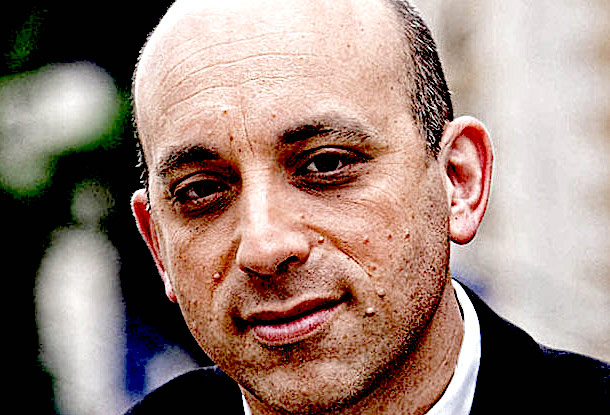
Why is his face so sinister? I don’t know, because the face-decoding modules in my brain operate below the level of consciousness. It doesn’t matter: those modules are supplying accurate information about Garland. He looks sinister because he is sinister. And it’s very bad for America that he holds such a powerful and important position in government. Lots of right-wingers would agree with me when I say that Garland is bad for America, but most of them would recoil with horror if they heard me link Garland’s sinister face and psychology with his ethnicity. The truth is toxic: Garland is a classic example of a creepy Jew. So are Richard Perle (born 1941), the Jewish neo-con who was nicknamed “the Prince of Darkness” in America, ADL head Jonathan Greenblatt (born 1970), and Michael Howard (né Hecht 1941), the Jewish politician who was nicknamed “Dracula” in Britain.

Jonathan Greenblatt

A wider racial pattern

Howard’s gentile colleague Ann Widdecombe famously said that “there is something of the night about him.” She would vehemently deny that she was being anti-Semitic when she made that judgement. And yes, in one way she would be perfectly correct. I’m sure that she wasn’t consciously thinking of Howard as a sinister Jew, but as a sinister individual who “just happens” to be Jewish. Nonetheless, Howard’s sinister nature fits into a wider racial pattern: like Garland, Perle, and many others, he is sinister in a specifically Jewish way. Although she would never admit it, Widdicombe was reacting as a gentile to the alien and predatory nature of a Jew. So are those who will readily agree that Garland and other Jews are sinister, but won’t admit that Jewishness is relevant.

I think they’re wrong. Jewishness is highly relevant: it isn’t just faces that are built on genetics, but also mannerisms and movements and voices, all of which are contributing to the sinister aura that surrounds Jews like Garland and Howard. I have to admit, though, that few Jews have voices as sinister and ugly as that of the shiksa Hilary Clinton. Her evil nature is obvious when she speaks, but again it’s subconscious modules in the brain that process her voice and supply us with this important information. I’m fascinated by voices too. Like faces, they’re another rich source of information for an ignoramus who can’t say how he knows but can say what he knows. For example, I can’t say exactly how I know that the Jewish politicians Chuck Schumer and Jerry Nadler are  sinister and crooked. But I just have to look at their faces or listen to their voices to be flooded with revulsion and aversion.

Two more sinister Jews: American politicians Chuck Schumer and Jerry Nadler

Does that make me a facial fascist and a vocal villain? It certainly does in the mainstream of modern culture and politics, but I don’t care. I want to understand the world, not be rewarded by it. That’s why I break the core commandment of the modern West: “Thou shalt not recognize patterns — except when they’re not there.” For example, to belong to respectable society you have to recognize and loudly condemn a huge but non-existent pattern of “systemic racism” against Blacks and other non-Whites. But you can’t, on pain of immediate expulsion from respectable society, recognize genuine patterns of Black criminality and intellectual inferiority. Intelligence, or the lack of it, is something else that can be read in faces. In America, the loudly acclaimed Black activist Ibram X. Kendi is obviously stupid, at least compared to other much-acclaimed, non-POC academics outside of ethnic and gender studies. So is the Black academic Kehinde Andrews in Britain. You can see it in their faces, just as you can see intelligence in the sinister faces of Jews like Merrick Garland and Chuck Schumer.

Acclaimed thinkers Ibram X. Kendi and Kehinde Andrews

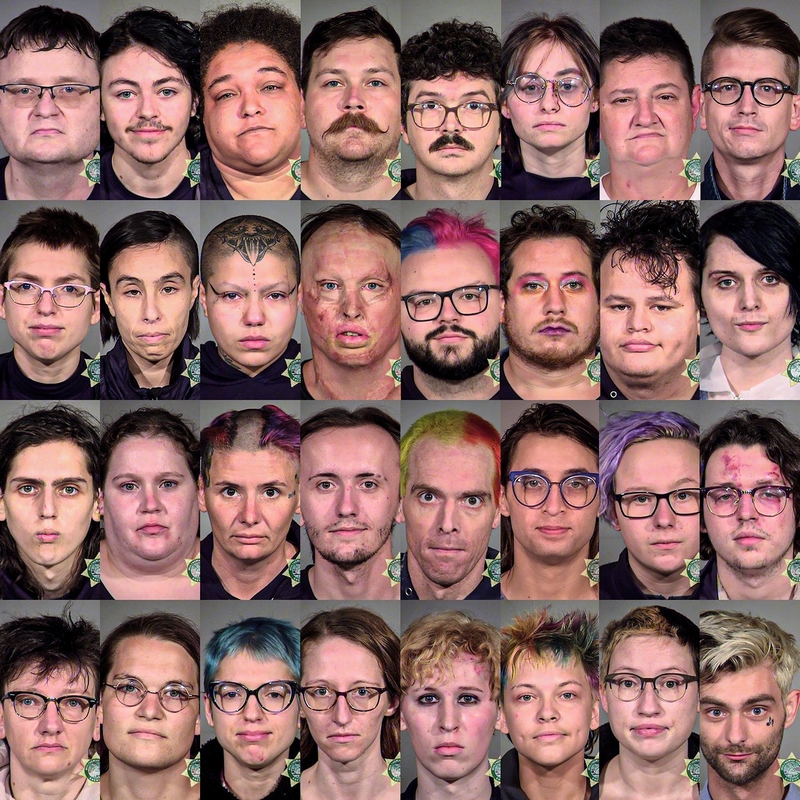
Physiognomy is real, as the great Chateau Heartiste often reminded his readers. That doesn’t mean that it’s infallible, because faces and voices are biological phenomena and biology is full of exceptions and anomalies. But physiognomy is a reliable guide to highly important social phenomena like the sinister and predatory nature of Jews and the stupid and anti-civic nature of Blacks. Physiognomy is also an excellent way to bypass the social conditioning or intellectual resistance of normies. For example, you can argue long and loud to a normie that antifa is an evil, corrupt, and psychotic ideology. Or you can make the same point much more efficiently and effectively by showing that normie the faces of some typical antifa:

Evil, corrupt and psychotic: the pernicious punims of some American antifa

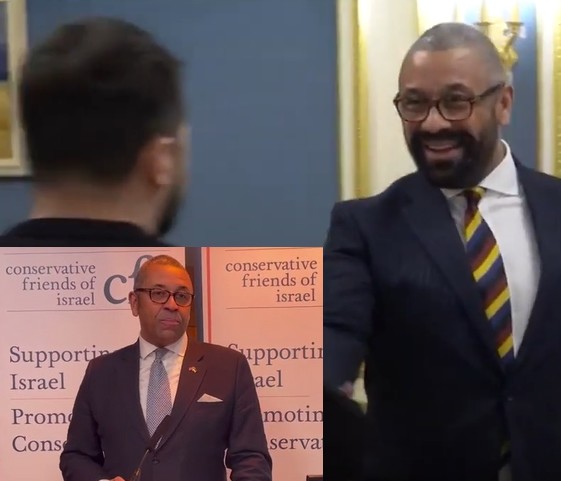
Physiognomy is real. The ugliness of the ideology is reflected (and reified) in the ugliness of its adherents. Now suppose that you wanted to convince a normie that the Ukraine war is a heavily Jewish project that doesn’t serve the interests of American and British Whites. Again, you can argue long and loud with words. Or you can quickly and efficiently appeal to intuition with photos of faces. Let’s have a look at some faces from a video of a British diplomatic delegation visiting Ukraine’s Jewish president Volodymyr Zelensky in June 2023 shortly before the beginning of Ukraine’s counter-offensive against Russia. As you can easily see, it’s not really a British delegation at all:

Zelensky meets James Cleverly, the half-Black “British” foreign minister and staunch Friend of Israel

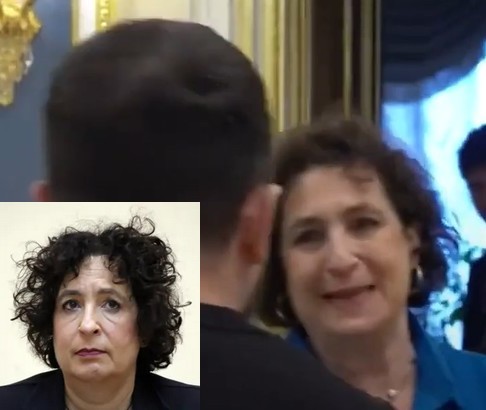
Anatoly’s Anglo again: Zelensky meets Jew Melinda Simmons, “British” ambassador to Ukraine

A Jewish-looking official who accompanied Cleverly and Simmons

It’s very easy to read racial information in the face of James Cleverly, the current British foreign minister. He isn’t White, so it should be no surprise that he isn’t serving the interests of the White British. Instead, he’s serving the interests of Jews, as is shown by the faces of two officials who accompanied him. Racial information is also obvious in their faces. But Melinda Simmons was misidentified as an “Anglo” by Anatoly Karlin at the Unz Review. I think Karlin was being dishonest rather than ignorant, because Simmons is obviously Jewish.

She’s ugly-Jewish too, which is why I felt foreboding for the White natives of Ukraine when I first saw a photo of her taking up her appointment there. Soon after her arrival, war broke out. Like it or not, ugliness and evil are strongly linked. Not inevitably and absolutely, because there are people who are ugly and good, just as there are people who are attractive and evil. But ugliness goes naturally with evil all the same. That’s why Clown World wages war on beauty and why it’s so appropriate that Jew-controlled Britain sent an ugly Jewish ambassador to Ukraine shortly before war broke out there.

Warring on the West

But I have to admit that Melinda Simmons is not as ugly as the other Jewish official in the “Anglo” delegation. I would say he’s Jewish, at least. I haven’t been able to identify him, but my subconscious face-reading modules spoke up loud and clear when I first saw him greeting and grinning at Volodymyr Zelensky. “That’s a creepy Jew!” they said (I’m sorry, but they did). If your face-reading modules don’t agree with mine, I strongly recommend that you take your J-dar in for servicing. The Ukraine war is a Jewish project just like the wider war on the West.

I’ve spent a lot of time writing and reasoning about that wider war, but I think that the faces of Merrick Garland and Melinda Simmons are worth far more than a thousand words in making my case. Physiognomy is real. Jewish physiognomy is often repulsive. You can call me a facial fascist for saying that, but I’ll simply repeat what I said above: I want to understand the world, not be rewarded by it. And faces are an excellent and intuitive route to understanding the world.

Myth or the Great Hoax: The Origins of Modern Demonology

We all use mythical language, although we seldom admit it. In contrast to concepts which are the hallmarks of modern discourse, myths are based on images and symbolic forms of speech. In the mythmaking narrative images change and vary over historical time and place although their driving force remains constant in the identity building process of peoples, tribes, nations, including political movements. Many Christians, along with many atheists and agnostics, who deride as surreal ancient Greek myths, resort to their own self-made myths, adorning them with their own pack of metaphors and imagery. In a sharp contrast to the historically recorded end-of-time, single-God revelation religions, such as Judaism, Islam and Christianity, European myths surfacing in epics, folk tales, legends or sagas have the advantage of overstepping the historical timeframe. They fuse the past present and future in one whole, offering the hope of gods’ return and announcing the rebirth of a vanished or destroyed political order.

The man of the myth discovers his freedom not in the possibility of building up his own history, but in the fact of being free vis-à-vis history.  It is in the abolition, relativization and reinterpretation of history that he finds his freedom.[i]

Ancient Europeans who believed in myths had a profound historical consciousness. Yet—unlike Christians, Jews or Muslims, let alone unlike modern political true believers—they could neither grasp nor embrace a linear historical and “unique” narrative announcing the beginning of time and the end of time. To a traditional man, of the myth, history, with its incessant flow of time, is always open. The belief in a plurality of gods means also the ability of accepting the plurality of ideas, the plurality of different truths and consequently rejecting a single religious or political dogma.

The tragic side of life is a cornerstone of ancient myths, as depicted in ancient Greek epics and dramas. However, one never spots in ancient mythical prose or poems signs of religious and political nihilism. The man of the myth is essentially a historical optimist: he believes in the return of historical cycles that will also bring about the return of the hero and witness the rebirth of gods, even if the sky is doomed to fall with the entire cosmos swept in chaos. One of the sharpest American scholars of the twentieth century, Joseph Campbell, understood well the subconscious human desire for the world of the myth, myths being “like dreams, revelations of the deepest hopes, desires and fears, potentialities and conflicts, of the human will.” [ii]  The mythical world is anchored in all of us, as can be witnessed by an ever-growing interest in the mythical characters inhabiting J. R. R. Tolkien’s novels or George Lucas’ movie Star Wars, as well as in the proliferation of hundreds of science fiction movies.

Despite his insight into various faces of mythmaking Campbell was not spared from demonization by new mythmakers who labeled him with their own mythicist vocabulary an “antisemite and racist.” [iii]

Vice, or better yet, virtue signaling squads of the modern morality police, such as the SPLC or the ADL, were quick to shove Campbell into the realm of underground demons.

Resorting to a mythical language is also a prime goal of modern political demagoguery. The word ‘myth’ is often used incorrectly in defaming a political adversary. This word, when used in political discourse carries a derogatory meaning, bearing no resemblance to the ancient belief in mythos. Today its verbal derivatives are widely used to delegitimize the beliefs of a political opponent, often having the goal of ruining his reputation in the public eye by painting him as some kind of a conspiracy theorist. The problem with conspiracy theorists, regardless whether they come from the Left or the rightwing political spectrum is that they can never be refuted with any empirical, forensic and contradictory argument.

To a very extent that conspiracy theories claim to “explain” everything, rejecting out of hand any contradiction and any argument put forward against them is seen either as a proof of their opponents’ “naivete”, or a simple plot by conspiracy theorists aiming to prevent them from being exposed. Any contradiction any denial only becomes an additional proof of the existence of conspiracy.”[iv]

Many conservative and nationalist authors in their own description of leftwing opponents have popularized expressions such as the “myth of progress,” the “myth of Marxism,” “the myth of multiculturism.” On their part, left-leaning authors accuse nationalists and conservatives of believing in the myth of race and the myth of Jewish world conspiracy. Many Jewish and liberal authors, however, seldom tire from resurrecting their own conspiracy-laden language depicting and evoking the mythical and ever lurking “white supremacist,” anti-Semite, or Neo-Nazi bent on destroying the liberal democratic order. Even if White anti-Semites and Neo-Nazis were to disappear, the Liberal System would need to reinvent them over and over again – similar to the ex-Soviet Union and its former client states who, in order to justify their repressive nature, constantly kept resurrecting the myth of the Fascist Evil.

Without using over and over again the modern myth of the Absolute Cosmic Evil, allegedly incorporated today in the eternal Neo-Nazi and White Supremacist, the Liberal System would fall part.

To the word of the myth, one could substitute more hyperbolic verbal constructs such as the “big lie,” the “grand hoax,” or “political theology,” or even “fake news,”—expressions which are quite trendy among conservative and nationalist authors. While the Left likes to denounce the “myth of the White race” as a sign of pseudoscientific and retarded mindset, the Right, by contrast, denounces the liberal and communist myth of egalitarianism as a belief contrary to the laws of evolutionary biology.

Credo quia absurdum, or the belief in the Big Lie.

The line between a belief in the big lie and a belief in some kind of a myth is often blurred. It is wrong to assume that only a few bad people impose their political lies on a credulous or stupid populace. Very often it is savants and allegedly great minds who are believers and instigators of surreal political myths, strange beliefs, bizarre victimhood stories which they usually discard after some time and replace them with new trendy myths or hoaxes. Often masses deliberately accept new political myths because it is all too human to take wishful thinking for granted. In the study of crowd hysteria, Gustave Le Bon observes how masses accept political myths without ever reflecting upon their disastrous consequences:

Crowds being only capable of thinking in images are only to be impressed by images. It is only images that terrify or attract them and become motives of action.[v]

It can be the mythic imagery of the shining communist future, or the myth of the end of the world caused by the Covid pandemic that can whip up masses into political frenzy or justify the most severe forms of political repression.  Religions, as well as modern beliefs and ideologies are also heavily interwoven with mythical scenes. Often those who ridicule beliefs in the mythical nature of the scenes from the Bible or from Homer’s Iliad are receptive to modern myths of a Marxist classless paradise on earth or the nature of permanent economic growth in Liberalism. One may recall intellectual enchantment with the Freudian-Marxist mystique by hundreds of thousands of US and European college professors in the first half of the twentieth century and extending even after psychoanalysis had lost all scientific credibility and communism had resulted only in political repression and economic stagnation. By the end of the century, these professors had no qualms in replacing their former ideologies with new myths of the free market and the myth of the invisible hand.  The capitalist myth aptly called “monotheism of the market” by the French philosopher Roger Garaudy, suggests the belief in permanent economic growth as the only salutary objective of human existence.[vi]

But one must be careful when reading Garaudy’s texts, as well as those of hundreds of other popular academics and authors preaching formulas of religious or political salvation. Garaudy was a reputable World War II antifascist resistant fighter, later a high-ranking French communist party member and a renowned intellectual—before he turned into a devout Muslim toward the end of his life. For his revisionist and anti-Israeli writings, he was also charged and convicted by the French courts with anti-Semitism and Holocaust denial, claiming it to be a “Jewish myth.”[vii] Regardless of what one may think of Garaudy’s  many astute observations about Israel, Jews, and American decadence, recanting his once upon-a-time mythical persona and accepting the other mythical opposite is not a sign of integrity of character.

Many revisionist scholars critical of Jews and their social status depict the Jewish World War II victimhood as a new secular religion containing its own legions of saints, sacraments, salvagers and survivors. What strikes one is the following: while one may openly downplay, deride and minimize the number of victims of communist killing fields during the Ukrainian Holodomor, the Croat Bleiburg, the Gulag sewage system in the ex-Soviet Union, or the millions of killed German civilians, during and after World War II without facing legal troubles, critical debates on the Jewish Holocaust story must stay off limits—an excellent marker of the power of the Jewish community.

But even authors complaining about legal duplicity regarding the narrative of Jewish victimhood are seldom consistent. Many of them believe in good faith in the immaculate conception of Virgin Mary and various surreal miracles performed by Jesus and his early Jewish disciples. They would never consider their faith in Jesus a myth, let alone, a hoax, a fraud, or a conspiracy theory.  They reject the claims by anti-Christian authors “that Jesus was a deliberately constructed myth, by a specific group of people with a specific end in mind,”[viii] as David Skrbina wrote recently.

Neither do the faithful ones who believe in the Jesus story want to hear the arguments purporting that the history of Christianity is replete with serial killings of infidels as well as lengthy inter-Christian religious wars. It remains difficult for them to admit that Christianity emerged in Judaism and that until the end of the Second Temple and the destruction of Jerusalem in 70 AD, all the way till the end of the second century, Christianity was just one of the several infighting Jewish sects in the Roman empire.

Christianity remained Jewish Christianity. As we move into the second century not only certain Christian sects can be described as ‘Jewish-Christian’, but Christianity as a whole can still properly be described as ‘Jewish Christianity’ in a justifiable sense.[ix]

The prominent Christian theologian Adolf Harnack also traces the roots of Christianity to Judaism, claiming that “it was the destruction of Jerusalem and the Temple which seems to have provoked the final crisis, and led to complete breach between the two parties.”[x]

The debate on mythical Jewish-inspired origins of Christianity is largely avoided by modern White Christian conservatives and White Christian nationalists. It must be noted though that the most critical analyses of Christianity over the last century and half have not come from the Left, but primarily from conservative and nationalist authors, especially in Germany and France. Particularly in Germany during the National-Socialist regime, from 1933 to 1945, there was a flurry of well-researched books and scholarly pieces by hundreds of academics dealing with the interrelationship between race and religion. Most of those authors contend that there is a causal link between Judaism-Christianity and their modern secular offshoots in the modern myth of Communism and Liberalism

We cannot expect that Christian religion, which originated from Jewish racial heritage, and which today still feels constrained by a baptism commandment issued 2000 years ago in the Jewish land, will atone for the guilt of the German soul.[xi]

It is a great setback that the works by German religious scholars, regardless of the demonic, or rather demonized nature of the National-Socialist epoch when their works were published, have not yet received a proper scholarly evaluation. Nor are the books on the racial makeup of a man, tribe or a people and how it affects the choice of his religion easily accessible. This raises the question of genetic and racial proclivity of any racial ingroup toward accepting or rejecting a foreign religious or political myth. Wilhelm Hauer a prominent religious scholar in National-Socialist Germany, noted:

For one thing, there is no longer any doubt today that race means not only body forms, but also forms of the soul and the spirit. And secondly, religion is not just a matter of the absolute truth, but also of various forms of truth by the bearers of religion.[xii]

Each racial group has its own vision of afterlife including its own notion of truth, or for that matter its acceptance of the big lie. Accordingly, to a large extent it is racial heritage of each man that shapes his world view. Between the German notion of “reality (Wirklichkeit) and “truth” (Wahrheit) there is a sharp distinction that needs to be made.

In addition, it is with great modesty of which Indo-European man is aware: we possess reality while being also possessed by it, but we are eternally on the way to truth, if by this we mean the knowledge of finitude. The absolute truth in the sense of final possession of the deepest mysteries is nonexistent. Such possession would mean the death of the living spirit. [xiii]

Why did early Europeans in the ancient Roman Empire out of hundreds of different cults and sects, each with its own myth, metaphor or allegory, embrace a small Middle Eastern Judaic cult will remain a riddle. Starting with the second century, many Oriental cults had already spread like wildfire in the Roman Empire, cults such as the Persian Mithra cult among Roman soldiers and the Egyptian Isis and Serapis cult, very popular in the high echelons of the Roman imperial court.[xiv] But they did not last long.

Wilhelm Nestle, a German philologist and expert on the mindset of early Greeks and Romans, writes in one of his essays published in the quarterly Archiv für Religionswissenschaft that late Greco-Roman pagan thinkers were hostile to the idea of the messiah insofar as they recognized in messianic prophesies a presumptuous claim by the Jews to future world domination.”[xv]

Nestle, along with many other German scholars in the first half of the twentieth century  voices amazement at how prominent and large European tribes and peoples had fallen prey to a strange Oriental cult preached by a small and insignificant tribe in Judea.

It seems incomprehensible that God did not send the messenger of his revelation to a large and famous people, but to the Jews in a small corner of the Earth, and that despite being omniscient he left his “son” to be shamefully punished by bad people. [xvi]

It does not make much sense to criticize inordinate Jewish political, social, and intellectual influence and popularity, which among other things can still be observed in the writings of a Jewish-born Karl Marx and his modern followers, or modern Jewish neocons dominating the U.S. foreign policy establishment, while at the same time accepting Christian scripts and screeds  which were originally written by Jewish prophets. This is a clearcut case of spiritual and political neurosis that the entire West has been victim of over the last 2000 years.

Seen from the secular perspective, the strong and unwavering support of Israel today by the United States is part of the predictable political theology based on the myth of self-chosenness borrowed from the Jewish Old Testament.[xvii]  It has served over the last one hundred years as a legal justification for its messianic do-good diplomatic efforts, but also its military engagements all over the world. The mythical “city on the hill,” the “manifest destiny” and the recent launching of “diversity” programs are essentially mythical derivatives from the Bible cloaked in modern languages.

It would be false to ascribe the mythical mindset or the religious mindset to one race or to one group of people only.  The myths of the nation and nationalism have  plunged European peoples into incessant and bloody civil wars, from Troy to the Thirty Years War, from the American Civil War to World War II and likely to the upcoming Third World War.

Myth, be it bad or good, is not a privilege of any people or race. Some of the sharpest Western minds who detected best the myth of the communist and liberal   myths were devout Catholics. We owe much to the early Catholic author Joseph de Maistre who criticized the French Revolution of 1789 and who was among the first to debunk the abstract globalist myth of “human rights.” Also, there are legions of Catholic writers who are critical of liberal modernity, such as J.R.R. Tolkien, G.K. Chesterton, Thomas Molnar and many, many others.

One must also mention a Catholic conservative expert in the international law and a noted political scientist Carl Schmitt, who was very popular in Weimar Germany, National-Socialist Germany and post-World War Germany, and who is now a household name of the New Right and the Alt-Right both in the U.S. and E.U. To him we owe the statement that “all significant concepts of the modern theory of the state are secularized theological concepts.”[xviii]


NOTES:

[i] Alain de Benoist, „Mythe“, Krisis, (Paris, numéro 6, Octobre, 1990), p.8.

[ii] Joseph Campbell, The Inner Reaches of Outer Space; Metaphor as Myth and as Religion (Novato: New World Library), p.27.

[iii]  „ After Death the Writer is accused of Anti-Semitism “, The New York Times (Nov 6, 1989).

https://www.nytimes.com/1989/11/06/arts/after-death-a-writer-is-accused-of-anti-semitism.html

[iv] Alain de Benoist, „Psychologie du Conspirationnisme“, in Critiques-Théoriques (Lausanne: L’Age d’Homme), p. 96.

[v] Gustave Le Bon, The Crowd; A Study of the Popular Mind (London: T. Fisher Unwin,1920), p.76.

[vi] Roger Garaudy, Avons-nous besoin de Dieu ? (Paris: Ed. Desclée de Brouwer 1993), p. 205.

[vii] Roger Garaudy, Les Mythes fondateurs de la politique israélienne  (Paris: Samizdat, 1996).

[viii] David Skrbina, The Jesus Hoax: How St. Paul’s Cabal Fooled the World for Two Thousand Years (Detroit: Creative Free Press, 2019), p. 23.

[ix] James D. G. Dunn, The Partings of the Ways (London: SCM Press, 2006), p. 307.

[x] Adolf Harnack, The Mission and Expansion of Christianity in the First Three Centuries, Vol. I (NY: G.P. Putnam’s Sons, 1908), p. 63.

[xi] Robert Luft, Die Verchristung der Deutschen (1937 Archiv-Edition, Verlag  Dietrich Bohlinger 1992), p. 74.

[xii] Wilhelm Hauer, Religion und Rasse (Tübingen:  JCB Mohr (Paul Siebeck, 1941), p. 6.

[xiii] Ibid., Hauer, p.48.

[xiv] Franz Cumont, Oriental Religions in Roman Paganism (1909 Eugene, OR:Wipfs and Stock Publishers, 2003).

[xv] Wilhelm Nestle, „Die Haupteinwände des antiken Denkens gegen das Christentum“, in Archiv für Religionswissenschaft, Vol. XXXVII, Book 1 (Leipzig: BG Teubner, 1941), p.61

[xvi] Ibid., p.87.

[xvii] T Sunic, Homo americanus; Child of the Postmodern Age, with preface by K. MacDonald and postface by A. de Benoist  (Arktos, 2017).

[xviii] Carl Schmitt, Political Theology (1934 Cambridge, Mass: MIT Press 1985), p.36.

Transgenderism and word magic

Introduction

A previous article ended with the statement that the path to transgenderism was laid by feminism. Transgenderism also owes much to postmodernism and especially to the postmodern belief in word magic. This article looks at how this belief affected history, journalism and politics before being picked up by transgenderism.


Word magic

Word magic is the means whereby saying something makes it true, and it is real. When a chairman says that a meeting is adjourned, it is adjourned, and this is just because he said those words. If an employer says “You’re fired!”, his employee is thereby fired. If, to lose one’s job in another way, one says “I resign”, one resigns. These are examples of a special class of speech act known as declarations.[1]

But word magic doesn’t work for ordinary statements. If I say that I am a millionaire, it doesn’t make me a millionaire. If you say that you are in the Seychelles when you are in New York, it doesn’t move you to the Seychelles. Yet many people believe that word magic does work for ordinary statements. They think that an ordinary statement can come true just by being made.

Word magic and postmodernism

Today’s belief in word magic originated with postmodernism, a school of thought which says that language, instead of letting us understand the world, stops us doing so and stops us so completely that external reality might as well not be there. There can therefore be no such things as truth or falsehood, for how can a statement be true or false of a world with which it cannot connect or that might not even exist?[2]

Postmodernism replaces the notion of a statement as something true or false by that of a “narrative”, saying that what we take to be true are only the narratives of groups, such as white people and men, who have the power to impose them on others, thus creating the illusion of objectivity. All that these groups’ narratives really do, say postmodernists, is express their prejudices and seek to advance their interests. Thus a postmodernist feminist described objectivity as nothing but male subjectivity.[3]

Postmodernists arrive at word magic via the idea that narratives “construct” social reality, which is as good as saying that they create it. This alleged creative power of ordinary statements was asserted by a social psychologist when he explained the persistence of national stereotypes such as of Italians as passionate.[4] This stereotype continued to exist because, he maintained, stereotypes are self-fulfilling. In other words, Italians really are passionate, but only because that is the way they are described. Reality didn’t come first; it was created by the description. This brings the concept of truth back into postmodernism, for if a narrative is self-fulfilling, it comes true automatically.

The appeal of postmodernism

Postmodernists find their theory appealing both as critics and as writers. As critics they find that it gives them a choice between two ways of rejecting an account of the world that they do not like. Either they can say that it only expresses its author’s prejudices and seeks to advance his sectional interests,[5] or they can undercut it completely by saying that it has no subject matter since there is no external reality for it to refer to.

As writers, their theory gives them carte blanche to fill their work with their own prejudices and use it pursue their own sectional interests, for it tells them that this is all that a narrative can do. How can they aspire to truth and objectivity when according to their theory there are no such things?[6] How can they be expected to establish facts when their theory says that establishing facts is impossible? They can therefore say what they like, and moreover, word magic will make it true. Should it so happen that their readers are not postmodernists but harbour a naive belief in reality and truth and assume that those they are reading are the same, so much the better.

Word magic and history

According to Richard Evans in a 1997 book defending the discipline of history, postmodernism was all-pervasive in academic discourse by 1993.[7] He cited What is History? by the Marxist E.H. Carr, published in 1961, as a precursor of postmodernism, where Carr wrote that historical facts were constituted by theory. Thus Carr suggested that the facts of history were the work of historians rather than of the people they were writing about.[8] Evans mentioned a 1981 book about the Weimar Republic by David Abraham, which misquoted a letter by omitting the word “not” and invented evidence.[9] There would have been little to complain about here for a postmodernist like Diane Purkiss, who said that historians should “just tell stories without bothering whether or not they are true”.[10] Other postmodernists denied that history could be impartial. Keith Jenkins described it as naked ideology.[11] Yet others suggested that there were no past events for historians to investigate. Hans Kellner stated that historians should stop behaving as though they were researching things that had actually happened.[12] Patrick Joyce seemed to admit that events really had occurred in the past but said that they could not be distinguished from the “historical discourses” that “constructed” them, raising the question of what the status of these events could have been before they were constructed by historians.[13] Evans noted that historians themselves, under the influence of postmodernism, were becoming less and less interested in the search for truth.[14]

Word magic and journalism

Journalism was just as affected by postmodernism as was academic discourse. Many journalists found its fuzzification or abolition of the concept of truth attractive. Some taught it to other journalists. In a 2001 book called The Elements of Journalism, two journalists described truth as a “confusing principle”.[15] Ignoring the fact that it is not too confusing to be taught to any child, they gave as an example the fact that when U.S. Secretary of Defence Robert McNamara was on his way back from Vietnam, he said that the war was going well, yet then told the president that it was a disaster. The only confusing thing about this supposed example is the idea that it shows that the concept of truth is confusing. It applies straightforwardly: if one of McNamara’s statements was true, the other was not. Bill Kovach and Tom Rosenthal went on to say that we use the words “truth” and “lie” as though they convey something meaningful, but they offered no reason to doubt it. They had nothing useful to say but were only exploiting postmodern scepticism to suggest that the concept of truth might be too much for journalists, who could therefore not be blamed for disregarding it.

Word magic and politics

Postmodernism aids any political movement, such as anti-racism or feminism, in its bid for power. In 1985 the British police responded to pressure from the Home Office by adopting a postmodern definition of a racial incident, according to which such an incident needed no racial element. All that was needed was for someone, whoever they were and on however flimsy a basis, to say that it had one.[16] This enabled the police to create the racial-incident statistics the Home Office was demanding, appearing to show that White people were bent on attacking non-Whites. Feminism copied anti-racism by saying that for a case of sexual harassment to have occurred, no sexual harassment needed to have occurred. It was enough for a woman to say that it had or to say that she felt as if it had.

Such a reference to feelings indicates the presence of “feel magic”, which in the 1990s joined word magic to assist such ideologies. Less and less did an allegation need to refer to external reality; a member of a favoured group only needed to say that they had felt victimised for it to be taken that they had been victimised. When in 1999 Sir William Macpherson stated that a Black couple “feel deeply that they were patronised and sidelined”, it was inferred that they had been patronised and sidelined.[17] They felt it so it was true, especially since they felt it deeply. When the wife stated on another occasion that her family felt betrayed by British justice, this was taken to mean that her family had been betrayed by British justice.[18] The #MeToo movement depended largely on women’s claims to have felt unsafe or threatened. The question of whether they had actually been unsafe or threatened was less interesting than the fact that this was what, according to them, they had felt.

Politically advantageous claims made by non-Whites and women are further supported by the postmodern idea that to correct the dominance of the narratives of White men, those of the “oppressed” must be “privileged”.

Word magic and transgenderism

And so we see that in making use of the idea of word magic, transgender ideology had many predecessors, and its use of the idea is par excellence. It does not just promote “gender self-identification”, according to which one can simply call oneself a member of the opposite “gender” — meaning the opposite sex[19] — and be entitled to be treated as such. Its belief in word magic extends to saying that if one identifies as a member of the opposite sex, this makes one a member of that sex. According to transgender ideology, unaided words can defeat the most basic and evident reality.

Thus in 2015 a man wrote on a transgender message board: “I am a woman because I say I am, nothing else is needed”.[20] Like God, he spoke, and lo! It was the case. He went on to say: “Caitlyn is a woman not because of surgery or make-up but because that is what she says she is”. Being a woman had nothing to do with anatomy or appearance, he insisted, but everything to do with how you “identified”. His words were echoed in a headline: “I Am a Woman Because I Say I Am”.[21] An advisor to the Democratic National Committee told an interviewer: “Your gender identity determines your gender, period”.[22] In other words, what you say your sex is, it is. A social-science professor defined a woman as a person who identifies as a woman.[23] Call yourself a woman and you are one. How can this be? Word magic.

To give two more examples, an article on the Everyday Feminism website stated: “Transgender people’s genders are valid from the moment they identify as a new gender”. In other words, at the very moment they say that their sex has changed, it changes.[24] If the act of identifying is an act of speech, the words do it; if it is a feeling, reality responds to the feeling. In 2014, official guidance from East Sussex County Council’s Children’s Services department defined “gender” as “how a person feels in regards to male / female / neither / both”.[25] I feel X, therefore X, is the reasoning.

The magic extends from words and feelings to desires. If you want it to be true, it is. When a young woman who said she believed that there were more than two genders was asked how many there were, she said: “I don’t know how many genders there are, but I just know everybody is who they want to be”.[26] You want to be X, therefore you are X.

It is only because the media have pressed the postmodern idea of word magic on the public so insistently for 35 years that people say such things, which in previous ages would have called their sanity into question. But people are selective in their insanity. If they want some milk and find that there is none in the fridge, they do not believe that they can put some there by saying that there is some there. The media have no interest in persuading them that they can.

Postmodernism feels free to switch at will from its scepticism about whether any statement can be true or is just an arbitrary “narrative” to its contrary idea that the speaker is the sole and supreme authority, whose words are true automatically. For postmodernism it all depends on who is speaking.

The reason transgender activists use the phrase “assigned at birth” is to suggest that when a doctor says “It’s a boy” or “It’s a girl”, it is not that a baby’s sex has been observed but merely that a fairly trivial administrative process has occurred, conferring on the neonate a status that it might very well not have. At this point the activist is not a postmodernist but a realist, who believes that there is an objective fact of the matter, independent of language, which the incompetent doctor might have missed. “He does not say, as he could have done”, that the doctor’s statement brings the corresponding reality into being by word magic, because then he would have to accept that a baby declared to be a boy is indeed a boy. Rather, he wants to keep open the option that the truth might emerge years or decades later when the boy or man announces that he is really a girl or woman.

But when this happens, how will we know that it is the truth? This is where the activist becomes a postmodernist. We will know it because the boy or man, now a girl or woman, says so. Words make it true, but only coming from the person himself. What the doctor said counted for nothing, as we now see. In this way the activist puts himself at two removes from reality. Not only does he ignore that fact that a person’s sex has nothing to do with what they say about it at any point in their life; he also ignores the fact that it has nothing to do with what a doctor said about it when they were born. It was decided nine months before that when a sperm fertilised an egg.

It is easy to see the appeal to transgender activists of their belief in word magic. It makes them omnipotent. Their words govern nature. But it is even better than that. Having made a statement that comes true by word magic, they only need to add a dash of common sense to reach an intriguing conclusion such as that men can give birth and women can have penises. If Riki Wilchins, who according to Wikipedia is an American activist whose work has focused on the impact of gender norms, is anything to go by, a transgender activist finds this kind of thing amusing. Wilchins describes gender as the new frontier: “the place to … drive parents and sundry other authority figures crazy”.[27]

The media dutifully follow the activists, finding it equally amusing to mess with people’s minds. Already by 2014 the Daily Mail could cite “new statistics” revealing that pregnancy — “traditionally only applicable to women” — appeared to be “becoming more prevalent among males”.[28] The article stated: “In the 2013–2014 financial year 22 men in Western Australia gave birth”, before hardly reducing readers’ confusion by referring to a man who had “kept his female reproductive organs”. His female reproductive organs? And whereas at that date the media, when reporting on cases of transgender men exposing themselves to women or girls in changing rooms, did not use the expression “her penis” without quotation marks, now they regularly do.[29] They take themselves sufficiently to have accustomed us to the idea that a woman can have the male sexual organ.

All this is quite apart from the sheer coarsening of public discourse that transgenderism has brought us, as in signs carried by protestors saying “Lesbians don’t have penises”. Not that most of us would be aware of such things if the media did not tell us all about them.[30] But then, why should we not wish to have people’s sexual proclivities and private parts thrust upon us?

Conclusion

It is the media that must be blamed for all this. Who cares if a few idiots want to think that they can command reality with their words? Problems only come when the media mount a concerted campaign to get the rest of us to believe it. But such a campaign was well underway by the time transgender ideology came along.


[1] Declarations, whereby “one brings a state of affairs into existence by declaring it to exist”, were given this name by the philosopher John Searle (see John R. Searle, 1979, Expression and Meaning, Cambridge: Cambridge University Press, p.16), developing an idea of J.L. Austin’s.

[2] Postmodernism started gaining influence in the 1970s after the publication of such books as The Order of Things by Michel Foucault (1966) and Writing and Difference and Of Grammatology by Jacques Derrida (both 1967).

[3] Adrienne Rich (1979) was quoted by Dale Spender, who was quoted by Roger Scruton in “Ideologically Speaking” in Leonard Michaels and Christopher Ricks (eds.), 1990, The State of the Language, Berkeley: University of California Press, pp. 118-129.

[4] Mark Snyder, 1988, “Self-fulfilling stereotypes”, in Paula Rothenberg (ed.), Racism and Sexism: An Integrated Study, New York: St. Martin’s Press.

[5] This is basically Marx’s theory of ideology except that Marx thought that a true and scientific account of events was possible.

[6] Richard J. Evans, 1997, In Defence of History, London: Granta. Evans writes on p. 3 that according to postmodernism there are no such things as historical truth or objectivity.

[7] Ibid., p. 6.

[8] Ibid., p. 76.

[9] Ibid., p. 120.

[10] Ibid., p. 253.

[11] Ibid., p. 253.

[12] Ibid., p. 253.

[13] Ibid., p. 109.

[14] Ibid.. p. 4.

[15] Bill Kovach and Tom Rosenthal, 2003 (2001), The Elements of Journalism. London: Atlantic Books. The book has a chapter called “Truth: The First and Most Confusing Principle”.

[16] According to the President of the Association of Chief Police Officers, the definition stated that a racial incident was “any incident in which it appears to the reporting or investigating officer that the complaint involves an element of racial motivation, or any incident which includes an allegation of racial motivation made by any person”. (John Newing, Dec. 8th 1998, “Race Equality in the UK Today: Developing Good Practice and Looking for Reform: The Police”, handed out at “QMW Public Policy Seminars: Developing New Legislation and Strategies on Race Equality”, Royal Over-Seas League, London SW1.)

[17] Sir William Macpherson, Stephen Lawrence Inquiry: Report of an Inquiry by Sir William Macpherson of Cluny. CM 4262-I, The Stationery Office, 1999, Paragraph 4.9.

[18] Doreen Lawrence quoted by the Guardian, April 27th 1996, “Lost dreams of an unspent life”.

[19] See also “Gender, ‘identifying as’ and identity”, https://www.theoccidentalobserver.net/2023/06/01/gender-identifying-as-and-identity/.

[20] Post by “SaraKama” to The Transgender Boards, Jan. 5th 2015, http://www.tgboards.com/forums/viewtopic.php?f=19&t=21501&p=333012&hilit=+identify+as+identify+as+#p333012.

[21] Lia Hodson, “I Am a Woman Because I Say I Am”, June 30th 2015, PBS Frontline, https://www.pbs.org/wgbh/frontline/article/i-am-a-woman-because-i-say-i-am/.

[22] Fox News, Feb. 25th 2017, “Transgender Argument Obliterated”, https://www.youtube.com/watch?v=a1aKWoHVyMw.

[23] Martin DeCoder, Oct. 21st 2022, “Heated Confrontation in “What Is a Woman?” | Matt Walsh and College Professor Breakdown”, https://www.youtube.com/watch?v=U_nVZRVkrY0.

[24] Everyday Feminism, May 3rd 2016, “What is gender, anyway?” by West Anderson, https://everydayfeminism.com/2016/05/guide-to-gender-identity/.

[25] East Sussex County Council Children’s Services, Oct. 2014, “Trans* Inclusion Schools Toolkit”, https://czone.eastsussex.gov.uk/media/2480/trans-toolkit.pdf (file no longer there).

[26] https://www.youtube.com/watch?v=DGgnaJvFbGw (video now unavailable).

[27] Riki Wilchins’s book GenderQueer (2002) is quoted by Dale O’Leary in National Catholic Register, Aug. 22nd 2013, “Gender Identity Debate: When Reality Causes Distress”, http://www.ncregister.com/site/article/gender-identity-debate-when-reality-causes-distress.

[28] MailOnline, Nov. 16th 2014, “‘Male pregnancy’ figures reveal how 54 MEN gave birth in Australia in the past 12 months”, http://www.dailymail.co.uk/news/article-2836374/Male-pregnancy-figures-reveal-54-MEN-gave-birth-Australia-past-12-months.html#ixzz59wBc4G8v.

[29] See for example MailOnline (1) Oct. 22nd 2022, “Moment transgender singer strips NAKED live on Channel 4 and plays the keyboard with her PENIS”, https://www.dailymail.co.uk/news/article-11343947/Moment-transgender-singer-strips-NAKED-live-Channel-4-plays-keyboard-PENIS.html, and (2) May 6th 2023, “Trans woman is cleared of flashing her penis at three women using Ohio YMCA after judge ruled she’s too FAT for her genitals to be visible”, https://www.dailymail.co.uk/news/article-12054769/Trans-woman-cleared-flashing-penis-YMCA-shes-FAT-genitals-visible.html.

[30] Telegraph, Dec. 25th 2020, “Lesbians facing ‘extinction’ as transgenderism becomes pervasive, campaigners warn”, reproduced at Peak Trans!, https://www.peaktrans.org/lesbians-facing-extinction-as-transgenderism-becomes-pervasive-campaigners-warn-telegraph-25-12-20/.

Review of “Passovers of Blood” by Ariel Toaff

12,965 words.

During the Passover ceremony of the Seder, a few drops of the child’s blood, the symbol of Edom (Christianity) and of Egypt, dissolved in the wine, had the power to transform the wine into blood, intended to be drunk and sprinkled onto the table as a sign of vengeance and a symbol of the curses directed at the enemies of Israel as well as a pressing call to Redemption. Again, in connection with the Pesach, vengeance on the children of Edom—Christianity—representing the Edom renewed, at Rome, the city of impurity.

Passovers of Blood by Ariel Toaff

Very infrequently, a book about history becomes history—never was that circumstance more apt than Ariel Toaff’s publication of Passovers of Blood (the “Toaff Affair”).  Not only does the book itself have something important to say about the era it covered, but the Toaff Affair also has something important to say about our era.

*           *           *           *

On February 7, 2007, a relatively unknown Israeli professor of medieval history, Professor Ariel Toaff, published a book that immediately caused a sensation, at least in the Jewish and Israeli press, and he came under a withering assault from all quarters. From the sleepy environs of medieval history, Professor Toaff, the son of the then Chief Rabbi of Rome, became an instant Jewish pariah. From a then contemporary article:

[Bar-Ilan University] said Sunday it had “severe reservations” about a book published by one of its professors that reportedly suggested some ritual murders might have really taken place in the Middle Ages, committed by Ashkenazi Jews seeking revenge for massacres, forced conversions and persecutions suffered by German Jews from the First Crusade of 1096 onwards. … Stressing that the university had not yet seen Toaff’s book, the statement said that the university’s “senior officials and researchers condemned in the past and condemn today any attempt to justify the awful blood libels against the Jewish people.” The university said it had not been in contact with Toaff since the book’s publication in Italy on Thursday and that on his return to Israel, the professor would be summoned to a meeting with the university’s president, Professor Moshe Kaveh, to explain his research. Until then, the statement continued, the university would not comment on the book. Toaff’s work, “Pasque di Sangue”—Bloody Passovers—just released in Italy, shocked the country’s small Jewish community—in part because he is the son of Elio Toaff, the chief rabbi who welcomed the late pope John Paul II to Rome’s synagogue two decades ago in an historic visit that helped ease Roman Catholic-Jewish relations after centuries of tension. The author, who teaches medieval and Renaissance history at Bar-Ilan University delves into the charge Jews added the blood of Christian children to wine and unleavened bread for Passover—allegations that resulted in torture, show trials and executions, periodically devastating Europe’s Jewish communities over the years. Historians have long disputed the medieval allegations, dismissing them as racism. But “blood libel” stories remain popular in anti-Jewish literature today. In his book Toaff cites confessions from Jews accused of ritual murder to expose what he claims was a body of anti-Christian literature, prayers and rites among Jewish communities of central Europe. Jewish and Roman Catholic scholars have denounced Toaff’s work, saying he simply reinterpreted known documents—and has given credence to confessions that were extracted under torture.

Initially, Professor Toaff maintained a defiant posture with regard to critics who had condemned him without even reading the book, which had been the product of years of research. On February 12, 2007, Professor Toaff responded, ironically enough, in an interview with Haaretz that: “‘I will not give up my devotion to the truth and academic freedom even if the world crucifies me.’” Within days of searing criticism and threats made to his professional career, Professor Toaff was ostracized and shunned by virtually the entire Jewish world.  On February 13, 2007, according to the Jerusalem Post:

Toaff has already paid a heavy personal price for his book and said that he feels as if he has been excommunicated. None of his old friends have called him at his Rome hotel during his entire week’s stay here, he said. He has been dismissed as editor of the Zohar historical review and is concerned he might lose his university position in Israel as well, although the university has said it will withhold judgement on the book until Toaff returns to Israel. He has even been prevented from seeing his father, Rabbi Elio Toaff, Rome’s former chief rabbi who led the community during both the terror attack on the main synagogue in 1982 and the pope’s visit in 1986. A rabbinical press release was issued against the contents of the book even before anyone had read it, based on the review. Riccardo Pacifici, vice president of the [Roman Jewish] community and its spokesperson … rejected what he said were Toaff’s claims of verbal threats from Italian Jews and said the reason he refused to come to the synagogue was out of shame, not fear. Comparing Toaff to a Jewish lawyer who wanted to defend two Nazis at a post-Holocaust trial in Lithuania, Pacifici noted the lawyer “broke down, cried and did teshuva (repented). I think Ariel Toaff’s case is similar. He has created enormous damage to our image in the Christian world but even more so in Islam. I hope he will do teshuva.”

Under incredible pressure, on February 14, 2007, Professor Toaff did teshuva and beat a hasty retreat, ordering that the publication of his work be halted:

The author of a new book that suggested there was factual basis to blood libels that led to the murder of millions of innocent Jews announced on Wednesday that he was suspending the book’s distribution. Ariel Toaff … said in a statement that he ordered the Italian publisher of his book to freeze distribution of his book so that he can “re-edit the passages which comprised the basis of the distortions and falsehoods that have been published in the media.”

(NB: “millions of innocent Jews”—really?)

In February 2008, Professor Toaff republished Passovers of Blood following extensive revisions, and it was received without much fanfare. The Toaff Affair, sordid as it is, is something that we should learn from. Even if Professor Toaff showed considerable cowardice in his pathetic retraction and later mutilation of his work to satisfy intense intra-Jewish criticism, his willingness to explore this issue honestly and deeply—the issue of the “Blood Libel”—is something for which he should be commended. If it is true that Professor Toaff’s critics condemned Passovers of Blood without even reading it, they were, at least in this instance, more than justified in doing so if their aim were avoid bringing shame and ignominy upon Jewish history—this work is by far the most devastating work on any part of Jewish history I have ever read, and, it is incredible that someone could have written it without understanding its toxicity. That said, his critics have succeeded in marginalizing him—and his work—to a stunning degree. A simple Google search of Ariel Toaff demonstrates that he has been reduced to an incompetent academic and Passovers of Blood, a recent and critical study of the history and circumstances of the “Blood Libel” phenomenon, is dismissed as a shoddy and unimportant work.

Notably, this review is based upon the first edition of Passovers of Blood, which is still available as of this date.

*           *           *

Before we even touch upon the Passovers of Blood in either edition, the Toaff Affair raises important and pertinent issues that are relevant today. Indeed, the Toaff Affair is an example of “Cancel Culture” years before that idiom became popular. Moreover, we must remember the context of the humanities and social sciences today when we evaluate Professor Toaff’s work and the Toaff Affair itself—as an historian in the traditional Western sense, Professor Toaff was undoubtedly taught to challenge historical maxims and conventional understandings as a matter of course. The critical spirit of academia thrives on this type of challenge. Indeed, one cuts his teeth—and obtains tenure and a name—by challenging long-held and conventional assumptions of historical studies by adopting, as it were, its opposite conclusion. Even if it is ultimately wrong, the historian gets “credit” for his originality in the challenge. As a result, there is a dialectical nature to the study of history within the academy—“position A” becomes the mainstream accepted position; its antithesis, “position B,” becomes a popular critical mode by which some historians make a name for themselves; and still yet other historians construct “position C,” the synthesis, as a “new” way of understanding past events. What then emerges is thesis, antithesis and synthesis in historiography. But, since most contemporary historians are functional Marxists, the dialectical degree of movement takes place within a Marxist spectrum. In other words, academic historical study and analysis is actually very circumscribed and anything but critical. It may be viciously critical of private property, traditional morality, Western sensibilities, and religious authenticity and sincerity (especially Christian), but its criticisms end there. And it certainly is not critical of collective Jewish hagiography and essential victimology.

What Professor Toaff evidently did not know is that that there are certain types of “position A” that cannot be challenged by their antithesis, and, in particular, one “position A” that is beyond historical criticism is the axiom that medieval Jews were always and everywhere falsely accused of killing Christian children for their blood, and the Christian outrage that followed such false charges were thinly veiled spates of anti-Semitic violence. This “Blood Libel” then feeds an historical narrative that Jews were always victims and Christians were always aggressors and bigots. More to the point, the “Blood Libel” is a core tenant and narrative in the belief of universal Jewish victimology and universal European Christian culpability. Because of its foundational support for the claims of later Jewish victimhood, weakening or destroying the idea of the “Blood Libel”—or worse, actually assigning blame to Jews for the despicable actions of which they were accused—then threatens the entire thread of Jewish victimhood, which is the only contemporarily acceptable cultural narrative.

To challenge the so-called “Blood Libel,” i.e., that medieval Jews actually killed Christian children is to touch, evidently, a third rail of historical criticism and critique, much like critical discussions of Holocaust dogma. Professor Toaff found this out the hard way. Obviously, at a minimum, the Toaff Affair says something significant about academic freedom and its limitations as applied to Jewish sacred cows and the Jewish historical narrative—and the perverse reality that outside pressure can bring to bear upon it. Clearly, Professor Toaff’s initial work (i.e., his 2007 first edition) represented years of laborious work reconstructing the world of Ashkenazi-Christian interactions during the later medieval period. With an erudite grasp of the medieval Arabic, Latin, Italian, Yiddish, German and Hebrew, Toaff sought to reexamine the entire question of the “Blood Libel” to understand how that phenomenon came to pass—and he discovered, honestly, that the commonly held axiom of the “Blood Libel’s” patent falsity may, in fact, have overstated reality. Indeed, he had the temerity to conclude that certain “Blood Libels” may have been—and likely were—true.

Obviously, as a Jew, Professor Toaff did not set out to discredit Jews in researching and writing his book—he was, however, an initially truthful historian who drew conclusions from what he believed the existing historical data told him. In a sense, Professor Toaff did not understand that the ideas of academic freedom and academic inquiry were chimeras if they were turned upon the prevailing Jewish understanding of the history of the Jewish people. And he further did not understand that his Jewishness—and, indeed, sympathy for the Jews—did not operate to insulate him from violating this unstated maxim and eleventh commandment of Jewish life: Thou shalt never bring disrepute upon the Jewish people. That he was crushed for honest research is, of course, obscene, and illiberal—and the irony of his crushing is that it demonstrates that the Jewish world at large is not interested in applying their legendary intelligence and critical skills to their own history. Other people’s histories are fair game—but, what the Toaff Affair showed, is that anything that disturbs the axiomatic nature of collective Jewish hagiography is definitively and categorically off-limits.

It is not as if Jews do not understand that the efforts to whitewash history—the history of others—is pernicious. An example of Jewish outrage at something similar is evidenced by the Polish government’s recent adoption of a law criminalizing the association of the Polish people with the Nazi concentration camps built and maintained on Polish soil during the Second World War. Consider the following coverage of a Polish trial in which two Holocaust researchers were charged under the law—and note the themes at work:

The trial was also criticized by Israel’s Holocaust memorial museum, Yad Vashem, who labeled it an attack on free speech and academic and public discourse. “Any effort to set the bounds of academic and public discourse through political or judicial pressure is unacceptable,” said Yad Vashem in a statement to the press at the time. “It constitutes a serious attack on free and open research. Legal proceedings against Holocaust scholars because of their research are incompatible with accepted academic research norms and amount to an attack on the effort to achieve a full and balanced picture of the history of the Holocaust and on the veracity and, reliability of its underlying historical sources.” Overall, many have criticized Poland for its perceived tendency to whitewash the role of its own people during the Holocaust.

Setting aside the wisdom of legislating the scope of historical research, as adopted by Poland, there is something rich in all of this considering the overwhelming Jewish response to silence and destroy Professor Toaff. If “any effort to set the bounds of academic and public discourse through political or judicial pressure is unacceptable,” why was it acceptable to pressure Toaff through threats to his career and even threats of prosecution in Israel?  If legal proceedings against Holocaust scholars constitute “a serious attack on free and open research [and] attack on the effort to achieve a full and balanced picture of the history of the Holocaust and on the veracity and, reliability of its underlying historical sources,” why was the Toaff Affair not a serious attack on free and open research in order to achieve a full and balanced picture of the history of the “Blood Libel”? Finally, the claim, that “many have criticized Poland for its perceived tendency to whitewash the role of its own people during the Holocaust,” is especially duplicitous when the Jews themselves have more than just a tendency to whitewash their own history—they have a tenacity in whitewashing it and a willful blindness to any interpretation that conflicts with their own historical narratives.

Unwittingly, the Jewish critics and censors of Professor Toaff did more to validate his work questioning whether the “Blood Libel” was, in fact, a libel at all than any anti-Semite could—if they, including many Jewish professors themselves, are collectively and uniformly willing to silence someone for saying something uncharitable to Jews (even if true) about Jewish history, what else are they silencing? And, more to the point, how is authentically free academic research possible under such circumstances? When we consider that Professor Toaff touched upon actions and accounts hundreds upon hundreds of years ago, how much more vicious would an attack be today if a genuine sacred cow (like the extent and meaning of the Jewish persecution during the Second World War (i.e., the Holocaust)) was questioned or examined? Indeed, it is a crime in some countries to question that axiom. Again, I am not questioning it here—I am merely observing that it, like any historical narrative, must be grist for critical and thoughtful examination. The Toaff Affair suggests that we are many centuries away—if ever—from having a society that engages in that type of honest examination. More to the point, the Jews today have done more than they realize to validate every anti-Semitic notion that non-Jews sense by their deliberate destruction of honest and self-evaluative academic work.

*           *           *

I had always considered the “Blood Libel” charge of the medieval ritual murder of Christian children by Jews as something far-fetched and, in all likelihood, to have been the product of a superstitious and ignorant Christian community in fear of the “other” (namely, the Jew) during a hyper-religious time. That opinion has been nurtured subconsciously in me from a very early age—to the extent I had ever heard of the “Blood Libel,” it was always prefaced or concluded by the sheer preposterousness of the accusation. Add to that a form of ubiquitous conditioning that Jews are uniquely and divinely opposed to any form of eating “blood” (see, e.g., Kosher dietary laws), the idea that they “ate” Christian children always struck me as something more appropriate for Grimm’s fairy tales than it was to authentic history. In fairness, as with many things, the “Blood Libel” controversy was never something that occupied much of my conscious time—in other words, I never considered it enough to come to a thoughtful conclusion, it was just an historical piece of data that I encountered from time to time.

In retrospect, my programmed response to the assumed falsity of the “Blood Libel” should not have been accepted so blithely for a few reasons that I knew even before undertaking any research of the question. First, I knew, in the ether, as it were, that there were various trials undertaken by the Church and local officials at that time that found Jews guilty of the very charges now conventionally deemed as ludicrous. And because I know enough now to know that the Church, especially in the medieval period, was an institution that valued due process and punctilious observation of form (even if it availed itself to certain methods we now reject), I should have never rejected, out of hand, that those medieval tribunals were something akin to hopeless kangaroo courts. Second, I also know now that the Church, despite the modern gloss, has always been indulgent and circumspect with respect to the treatment of the Jews. Far from the anti-Jewish monster that she is so frequently represented as, the medieval Church habitually protected the Jews from lowbrow anti-Jewishness and pogroms more than any other force in Europe. If the Church found some Jews guilty of these charges, she undoubtedly did all that she could to exonerate them if exoneration were possible. Indeed, the Church has always been, to a large extent, a diplomatic institution that sought to maintain whatever the given social and political dynamics were in an historical and geographic setting—trials of large groups of prominent Jews for killing Christian children undoubtedly threatened the delicate balance of social peace and economic wellbeing of the territories in which both Jews and Christians lived.

In other words, the Church had every reason to want these charges to be false. But as an institution with far more integrity than her critics give her credit, she also had to follow a process that ultimately led to the truth of the matter. In the end, she not only declared the guilt of the charged, the individual child at Trent, slain because he was a Christian, was canonized, and is Saint Simon of Trent. That alone should have been a giant blinking light to me that the charge of ritual murder had more to it that the modern dismissals that we are fed ad nauseum.

Perhaps the conventional dismissal of the “Blood Libel” is easier—even for observant Catholics. The very idea that medieval Jews conspired to murder Christian children—to crucify them in mockery of Christ—and then use their blood in a macabre religious ritual is too much to stomach. If true, the “Blood Libel” is a terrible case in which the malefactor successfully branded the victim as the criminal. What is one to do with that knowledge? And more to the point, if Jews abducted and crucified Christian children five- and six-hundred years ago, what does that say about how Jews, even today, feel about us? And what does it say about the historic coverup that redirected the guilt of these murders onto the victims as an alleged spasm of irrational anti-Jewish activity? In other words, does the truth of the allegations of the “Blood Libel” in fact threaten the idea, modern as it is, that there can be an effective and enduring rapprochement between Jews and Catholics? In other words, if Jews cannot come to terms with their historic anti-Christian bias while demanding that Christians come to terms with their historic anti-Jewish bias, what congress can we have with them?

*           *           *

With at least some of these ideas in mind, I undertook to read Professor Toaff’s work and found that Passovers of Blood is an incredible book—an impressive feat of detailed and well-sourced scholarship. Unwittingly, Professor Toaff has done more to unravel the mystery of the medieval “Blood Libel” more than any author, living or dead. What undoubtedly began as attempt to understand the nature, context, and milieu for the accusation of medieval Jewish ritual killing of Christian children turned—almost palpably as the book progressed—into a stinging indictment and acceptance of the reality of the practice. In other words, the book reads as if written by a mind slowly and definitively being convinced of the veracity of the charge—namely, that certain Ashkenazi Jews abducted Christian children to crucify them and use their dried and desiccated blood in the Passover ritual. By the end, there appears little doubt that Professor Toaff believes that the “libel” of Jewish ritual murder and blood use was, in fact, true for many Ashkenazi Jews.

Passovers of Blood is so fascinating because it introduces us to a world that has been shrouded in so much secrecy. While the medieval Christian world, at least to the relatively knowledgeable reader, is known to some extent; the medieval Ashkenazi Jewish world is brought into stark relief by Professor Toaff. Admittedly, the context for that introduction is necessarily a negative one—i.e., ritual slaughter of Christian children—but the world of medieval Jewry is nonetheless brought out. Before delving into some of the specifics, what emerges is a Jewish world that was paradoxical—calculating but fanatical, frightened but emboldened, united but disjointed, influential but powerless, and pious but irreverent. Upon reflection, it looks a lot like the Jewish world today. What hangs over the entire episode of the “Blood Libel” question is the phenomenon of the Crusades—both in terms of what it meant for the Jews who crossed path with the hyper-religious armies of Crusaders on their way to the Holy Land, and what it meant for the Jews when those same armies conquered the Holy Land and established a kingdom in Jerusalem. While the Crusades were a distant memory when the “Blood Libel” became a reality all over Europe, the success and folly of the Crusades strongly impacted the Jewish mind. That Christianity was triumphant over Judaism—and Jerusalem—caused a rash of voluntary conversions during the eleventh century all over Europe. But those who remained defiantly Jewish in the wake of the Crusades harbored an animosity towards Christianity that is hard for us to fathom today. The Crusades, more that perhaps anything, solidified the Jewish hatred of Christianity and, in a sense, institutionalized it as a dominant feature of Ashkenazi Judaism. To be a Jew then was to have an unutterable antipathy for Christianity, and that hatred revived and enhanced even the prior animosity that had always existed among Jews and Christians given their rival claims towards God and man.

Passovers of Blood is fifteen chapters—some of which are thematic of historical and religious Jewish ideas and some of which are descriptive of the real historical persons who played roles in Jewish ritual killings. In that sense it is two books in one—one is the history of the trial of the ritual killing of Saint Simon and the other is an explanation, broadly speaking, of the social and religious predicates for why ritual child murder and the consumption of blood was not as outlandish as it sounds. Indeed, as mentioned above, Toaff seems progressively convinced of the veracity of the “Blood Libel” as the book itself continues. Initially, Toaff introduces the reader to Ashkenazi community’s relocation from the German-speaking area above the Alps to what is now Northern Italy during the fourteenth and fifteenth centuries. Almost all the families that migrated were involved, in one or another, with moneylending and banking and the Ashkenazi newcomers managed to muscle out the existing Italian Jews. In a theme that runs throughout the work, Professor Toaff is antagonistic towards the German Ashkenazi Jews: as an Italian Jew himself, there is a distinct hostility towards German Jews that is not unlike, ironically enough, the hostility that Italians have towards Germans. Toaff says that the Ashkenazi Jews were overbearing, aggressive and boastful in their collective demeanor, and that they looked down on other types of Jews as inferior. In other words, the Ashkenazi Jews viewed themselves as the best and most pure form of Judaism. While numerically inferior to the other Jews existing at that time, the sheer will of the German Jews was enough for them to define themselves as the gold standard by which other Jews ought to live.

Toaff makes the point that the Ashkenazi Jews were more severe in their practice of Judaism than their Sephardic and Italian cousins. Indeed, he makes clear that Ashkenazi and Sephardic Judaism diverged after centuries of separation with distinctive liturgical practices and beliefs. Indeed, to some extent, Toaff blames this Ashkenazi distinctiveness for the “Blood Libel” itself. The German Jews were also involved with illegal practices that complimented their moneylending business—notably, counterfeiting. The picture that Toaff paints regarding the German Jewish entry into the world of Northern Italy is not an attractive one—a hostile and aggressive version of Jewry entered and appeared to have conflict after conflict with the Jewish and Christian locals year after year. They also appeared to become successful notwithstanding the failure of some banks and the trouble that some unscrupulous German Jews caused.

After this introduction of some of the characteristics and themes of Ashkenazi Judaism during this period, Toaff moves the reader to a specific date and time: March 23, 1475 and the murder of a two-year-old Christian child, Simonino, who was found on a riverbank close in proximity to the home of one of Trent’s leading Jews. The ensuing trial, the voluminous records, and depositions of which have been meticulously handed down to us from posterity, constitute the most important and detailed record of the ritual murder accusation, and a description, as it were, of the incredible and singular world of medieval Jewry. Professor Toaff notes:

These texts are a glimpse into a different world: the world of the Ashkenazi Judaism of the German territories and northern Italy, in all its sociological, historical and religious particularity. This was a Jewish world, enclosed upon itself, fearful and hostile towards outsiders, often incapable of accepting its own painful experiences and overcoming its own ideological contradictions. It was this world, which, moving from the negative and often tragic reality in which they lived, sought an improbable anchorage in the sacred text, which might illuminate a hope of redemption, which for the moment appeared beyond credibility: a Hebraic world discharging its energies in religious rights and antique myths, now re-enlivened with the renewed and different meanings and translated it into an alienating, harsh and rigorous confessional language, in which internal tensions and unresolved frustrations they had  hidden at all times. A world in which, having survived the massacres and forced conversions of men, women, and children, Jews continued to experience those traumatic events in a sterile effort to reverse the meaning of that world, rebalancing it and correcting history. It was a profoundly religious world in which redemption could not possibly be far off; in which God was to be involved, despite himself, and compelled to keep his promises, sometimes by force. It was a world drenched with magical rites and exorcism, within whose mental horizons, popular medicine and alchemy, occultism and necromancy were often mixed, finding a position of their own, influencing and reversing the meaning of ordinary religious standards.

In a sense, this passage reflects both Professor Toaff’s indictment and seeming exculpation of the Ashkenazi Jews for their ritual crucifixion of Christian children. Parenthetically, if he thought this type of sympathetic contextualizing of the reality of this Jewish practice of ritual sacrifice would suffice to satisfy today’s Jews as an ameliorative to the concession that ritual child sacrifice was indeed practiced among Jews, he was sorely and naively mistaken. As if to demonstrate the widespread mania surrounding Jewish ritual murder, Professor Toaff details over two chapters the known cases and trials of Jews for ritual murder. What makes them more believable, in part, for Toaff anyway, is that they almost universally involved Ashkenazi Jews—there were few cases involving Sephardic or Italian Jews. Sometimes, the mere disappearance of a child would lead to accusations against the Jews but would terminate, embarrassingly enough for the accusers, when the child was found unharmed. Clearly, even if the “Blood Libel” was true in part, Professor Toaff admits that the hysteria surrounding it led to seemingly many other accusations that were either palpably or likely false.

That said, Professor Toaff shows that there were a rash of these deaths over the course of two hundred years that almost always involved Ashkenazi Jews and almost always occurred during the spring (corresponding with Holy Week and Passover). The assorted records from these other ritual murder trials range from none to scant—but there is a theme that runs throughout: Jews were interested in Christian children and their blood, and there appears to be something of a network of Jews whose business was to procure such children (often, most easily, from beggars or orphans). There is also a suggestion that the Ashkenazi community closed ranks when someone or some group was accused of such a charge—and either bribed, attempted to bribe, or purchased the freedom of whomever they could. Professor Toaff also details how these same Ashkenazi Jews were often accused of, or witnessed, blaspheming Christianity, doing violence to Christian symbols and, even in some cases, profaning the Blessed Sacrament. In sum, a picture is presented of a very hostile and contemptuous Jewish minority living among the Christians during this time. Implied in the text, although not stated overtly, is that the resident Italian Jews enjoyed a more harmonious relationship with their gentile neighbors than did their Ashkenazi co-religionists.

If the first five chapters of Passovers of Blood set the table, pardon the pun, for the predicate and reality of ritual child sacrifice and consumption of their blood by Ashkenazi Jews, the next five chapters go into detail of the why and how this tradition came into existence. While Professor Toaff is certainly hazy, as are the records, on its beginning—he nonetheless does yeoman work in describing why the practice—both the ritual crucifixion and the consumption of blood—fit within a unique episode of a deformed Ashkenazi religious practice. In other words, Professor Toaff details how the ritual murder and blood consumption charge was not only plausible—it fit neatly within the weltanschauung of certain fundamentalist Ashkenazi Jews.

*           *           *

Professor Toaff’s first predicate for understanding ritual murder is the role and belief of the special powers of blood that medieval people (both Jews and Christians) believed it possessed. In a world in which alchemy was widely practiced and scientific medicine was in its infancy, the medicinal and magical powers of blood were seen in a way that is hard for us to recognize. These powers was seen both as curative and restorative—a potion and a powerful spell. In addition to moneylending, the other profession that attracted Jews at this time (and in ours) was that of medicine. Jewish doctors were common enough and they accepted the coagulant (hemostatic) powers of blood. Dried and powered blood was deemed to help staunch the bleeding that came from the practice of circumcision. And, in many cases, the Jewish murderers or accomplices thereof of Christian children admitted that they used the blood as a circumcision hemostatic. Moreover, this was not merely a contrived confession: the practical Kabbalah contained recipes and advice for using “young blood” expressly for this purpose—so the idea that blood, dried and powdered by pestle, was used by the Jewish communities is not only not far-fetched—it is attested to by the then-contemporary sources of Jewish medicine.

The use of blood in connection with circumcision is connected to two other facets of then-prevailing Ashkenazi practices—practices that defy imagination. First, Professor Toaff details how young men would wash themselves in a concoction made of perfumed water and the blood flowing from the infant Jewish males that would act as an aphrodisiac and help them in their procreative powers. Similarly, and more disgustingly, the foreskin itself would be eaten by young Jewish women in what Professor Toaff calls “ritualistic cannibalism” in a ceremony that looks something like the tossing of a bride’s bouquet in a contemporary wedding. If we dispense with our revulsion at such practices, which are, after all, not the point, we find that blood itself—as a medicinal and magical property—had a surprising and wide currency among Ashkenazi Jews at this time.

Professor Toaff addresses the objection of the religious strictures that Jews—especially religious Jews—impose against the consumption of human blood. First, he notes that Jewish recipes in a compendium of Ashkenazi remedies at the time provided for many recommendations for consuming human and animal blood for curing an assortment of ailments. When, during various trials, the accused Jews were confronted by the seemingly ironclad prohibition against the consumption of blood—several rationales by the accused were interposed. Some said that only animal blood was deemed prohibited by the Torah. Others were more candid—the prohibition, as applied to human beings, only pertained to Jews and not gentiles—so what was prohibited among Jews was not necessarily prohibited among gentiles. This latter argument, whether it was popular or not, would explain why Christians, among other reasons, were specifically targeted for their blood. Professor Toaff also cites a later Rabbinic opinion, in response to a query regarding the propriety of the practice and custom of ingesting dried blood among the Ashkenazim, that deemed it as acceptable because the blood was dried and, at least in a sense, was no longer what we consider “blood.” Thus, the common prohibition does not appear to be binding against dried and desiccated human blood provided it did not come from a Jew, and this practice was confirmed to be longstanding until recent times. Moreover, the practice of procuring the blood of Christian children was subject to a type of documentation requirement to ensure that the dried blood was what it was claimed to be—thus a type of testimonial certification of authenticity (not unlike a Kosher certification) was often required. Evidently the Jews were leery of being conned by a “dishonest” seller hawking dried animal blood in place of the blood of Christian children.

The predicate therefore is established first for what we could call “motive” as to why Jews at this time would have been interested in obtaining—and consuming—blood from Christian children—for its perceived value and properties. Already then, the idea of the “Blood Libel,” without anything further, becomes exponentially more plausible.

*           *           *

Along with the unsavory business of counterfeiting and usury, medieval Jews were known and feared for their role in the Muslim slave trade, which included the abduction of children inside Europe for sale in Muslim controlled territories and slave markets. And the fear of Jewish abduction for slaving appears to predate the hysteria and concern associated with Jewish ritual murder. Professor Toaff readily admits that the Jews of this period were preponderant in the medieval slave trade—noting that both then-contemporary Arab and Christian sources testify to the abduction, castration, and sale of Christian boys for use as eunuchs were undertaken by Jewish merchants. And this fear of child abduction and sale into Muslim lands had a profound effect on the Christian populations of Europe. His aside, as it were, on Jewish slaving appears to be introduced briefly as if to demonstrate a sort of reciprocity of hatred and loathing between the two communities. Indeed, at one point, he seems to suggest that the entire “Blood Libel” was one based upon harsh and mutual recriminations and fear of one another.

Professor Toaff’s observation regarding slavery is short, and perhaps that is fair because the book is not centered on the medieval slave trade. I do note that we live in an era in which European Christians—and European Christians alone—are being made to bear the guilt of the African slave trade as if they alone were the only peoples to engage in slaving. Now, African chattel slavery was a terrible and ignoble demerit on Western Civilization—one that needs no condemnation. But the reality is that slavery has been a constant of human civilization—and, indeed, continues in one form or another even today. Others, the Muslims, for example, practiced and sanctioned slavery on a scale that is beyond comprehension. But it is only Europeans, or their descendants, who are excoriated as history’s unique slaving villains. What is fascinating to me is that the slave trade to the Americas during the seventeenth and eighteenth centuries also featured Jewish merchants and slave traders prominently—but the mere suggestion of a corresponding Jewish guilt for the American slave trade is verboten as if it is tantamount to anti-Semitism. That said, I never considered, one way or the other, the role medieval Jewish involvement in the Muslim slave trade. For Toaff to call them predominant players in that vile way of life is a greater indictment of medieval Jewry that Professor Toaff himself understood. In that sense, I wonder if he realized just how horrendous a description he was crafting, even incidentally, of medieval Jewry.

*           *           *

If the Jewish interest in, and restrictions around, human blood could be classed as something indicative of something relatively benign, the Jewish interest in ritual murder was anything but. According to Professor Toaff, Jewish converts and various accused murderers admitted that Jews murdered Christian children “to bring redemption closer.” In some of these cases then, the interest in acquiring human blood appears to be secondary. Professor Toaff addresses the antecedents of ritual murder in some early sources, including Talmudic sources, dating from the first few centuries after Christ but dismisses their value because later Christian polemicists did little to use them against the Jews. That said, he seems to make the connection because, in his words, the idea that ritual murder is alien to Judaism is simply not true. That said, the sources are relatively thin in this regard.

More pointedly, however, according to Professor Toaff, is the outsized role that the festival of Purim played in stoking and animating Jewish hatred of Christ and Christians. In particular, Haman, the infamous Persian leader, who persecuted the Jews and eventually lost his life on a gibbet of sorts, is remembered and cursed during the festival. Purim is, to this day, a raucous Jewish holiday in which drunkenness and carnival-like activities are observed. Part of the celebration of Purim among medieval Jews (and before) involved the hanging of Haman in effigy. The hanging of Haman—and the death of Christ on the Cross—gave way to a certain license among Jews to merge the two into one enemy of the Jews—the old enemy and the new enemy in Christianity. He notes that Purim gave vent to a strong anti-Christian sentiment in which it was observed that medieval Jews, at least in Venice, greeted each other during the festival that, “May the King of the Christians go down to ruin immediately, the way Haman went down to ruin.” And Toaff notes that occasionally the figure hung was no mere effigy—but sometimes a live Christian child. Other instances of killing Christians during the Purim festival are noted as well. Later, well into the modern era, Purim lost its distinctly violent connotations, but Toaff notes that the clearly anti-Christian meaning “was never renounced.”

The festival of Purim comes typically soon before Passover. Professor Toaff’s point, although never made so bluntly, is that the observance of Purim and the legitimizing of rage against Christians during Purim created a moment of vengeance that came together uniquely at the time of Passover. Purim whetted the appetite of indignation, as it were, of a population who resented and scorned the people with whom they shared a territory and lived under their laws and dominion. As such, the Jewish anger was intense on the eve of Passover, and Professor Toaff directly connects that wrath with the ritual slaughter of Christian children all over Europe.

If Purim was an emotional precursor to anti-Christian violence, then Passover, at least for some Ashkenazi Jews of the medieval period, was the realization of that violence and vengeance. And for these same Jews, Passover was intimately related to two types of blood—the blood of the lamb and the blood of circumcision, both of which were seen in sacrificial terms and as salvific. Circumcision began to take on exorcistic properties among medieval Ashkenazi Jews. The two types of blood signified two different divine realities: the blood of circumcision represented God’s mercy to the children of Israel; the blood of the lamb represented God’s justice to the enemies of the children of Israel. How this morphed into instrumentalizing the blood of Christians in the Passover Seder is fascinating and harrowing; Professor Toaff theorizes that:

The link between the blood of the circumcision and that of the Passover lamb came to assume additional meanings during the Middle Ages, particularly in the German-speaking territories, and no longer alluded merely to the blood by virtue of which sin is expiated. The latter blood came to be added to the bloodshed by Jewish martyrs, who offered their lives and those of their dear ones, “to sanctify the name of God”, rejecting the waters of baptism. Thus, the blood of circumcision, that is of the Passover lamb, and that of those killed in defense of their own faith, became mixed together and confounded, hastening the final redemption of Israel and persuading God to wreak his atrocious vengeance on the children of Edom, the Christians, responsible for the tragedy suffered by the Jewish people. The Jews in Germany who, during the First Crusade, sacrificed their own children, ‘as Abraham sacrificed Isaac his son’, were perfectly convinced that their own blood, together with that of the two other sacrifices—circumcision and the Passover lamb—all offered to God in abnegation, would not be lost, but would constitute the powerful fluid from which the well-deserved and predicted revenge and the much-desired Redemption would ferment. Thus, in a distorted logic borne of suffering and distorted by passion, one might even arrive at aberrant analogies which nevertheless appear justifiable from the point of view of the persons concerned. In the ceremony of the milah, a few drops of blood from the circumcised child, poured into wine, possessed the power to transform the wine into blood; therefore the wine was drunk by the child, his mother and the mohel himself, with propitiatory, well-auguring and counter magical meanings. By the same logic, during the Passover ceremony of the Seder, a few drops of the child’s blood, the symbol of Edom (Christianity) and of Egypt, dissolved in the wine, had the power to transform the wine into blood, intended to be drunk and sprinkled onto the table as a sign of vengeance and as a symbol of the cures directed at the enemies of Israel as well as a pressing call for redemption.

As if to leave no doubt regarding the abhorrence of this brand of Ashkenazi Judaism, in addition to the drops of blood from the child of Edom, Toaff goes further and recounts how stories of actual body parts were kneaded together into the charoset, which is the otherwise tasty admixture of fruit, nuts and wine, that I have had a chance to eat. The elements—the use of blood and outright cannibalism—were thought, at least according to Toaff’s speculations, to hasten the redemption of Israel and punish its enemies.

While this is admittedly vile, it is the closest that Professor Toaff comes to providing a theological justification, or, perhaps more fairly, a theological rationale for the practice. It is, and this goes without saying, so foreign to Christian ears. Even if one sums our collective foibles and sins—and they are gargantuan, Christianity is not capable of blessing and solemnizing this type of putrid and contumely behavior. Such a practice, even in the most warped interpretation of Christianity, could never have materialized: it is simply too remote from its Founder’s teaching and mission. For example, while forced conversions or attempted forced conversions for political, social, or even religious reasons are, unfortunately, a part of Christian history, they represent something deeply at variance to what Christianity is and what it requires, i.e., that man’s relationship with Christ must be essentially voluntary. As a creedal religion, it must be voluntary for it to be salvific. Even as an aggressively missionary religion, the phenomenon of attempted forced conversions has always been at variance with Christianity’s core teachings and principles. Nonetheless, we “own” it, as it were, and must not shirk from the responsibility of studying and considering it as a black mark on Christian history. In a sense, forced conversions were always fundamentally anomalous with Christianity.

By contrast, the practice and theology of ritual murder among the medieval Ashkenazi Jews, even if “deformed,” comes up from the wellspring of Judaism itself—it is taking something normative within mainstream Judaism, that is, the hatred and cursing of the non-Jew, and elevating that sentiment to a plane of action. It is not a deforming variant that is fundamentally at odds with the underlying ethos of the religion; it is something in concert with it even it is an extreme manifestation of it. And therefore, as such, it is itself an indictment of Judaism writ large as a deformation of the residual religion of those Jewish deniers of Christ and their progeny. Judaism after Christ is thus a religion predicated upon a faulty and chauvinistic aloofness that amounts to an unholy and unsanctioned rage against the “other.” Ritual murder of the “other” is simply an extension of that rage. There is at the heart of Talmudic Judaism something that is essentially vengeful and angry—something that is soaked in curses and hatred. While ritual murder itself was anomalous within mainstream Judaism, it is not fundamentally anomalous with the underlying and animating spirit of hatred of the “other.”

If child sacrifice, as alleged in every “Blood Libel,” seems almost too absurd to believe, yet another antecedent—or seeming justification—of it is in the Passover story itself. The Talmud contains the story that Pharaoh was stricken with leprosy in punishment for his persecution of Israel, and, in turn, Pharaoh soothed his diseased skin by bathing in the blood of Jewish boys. While this Talmudic legend was largely ignored by most Jewish groups, the Ashkenazi Jews incorporated it prominently into their Passover traditions. Woodcuts of the Haggadah amply show young Jewish boys as victims of this form of infanticide. According to Professor Toaff, “these images were intended to provide a response of irrefutable historical, obviousness and vivid suggestiveness, to the ritual murder accusation linked with the celebration of the rituals of the Pesach. The accusation was therefore turned on its head, or generally subordinated to the crime of child murder for ritual or curative purposes, which was then demoted in the scale of seriousness, as an aberration of which the enemies of the Jews (including the Christians) were also guilty.”  

*           *           *

As a coda to the milieu of Ashkenazi Jewry and its rabid hatred of Christianity, Professor Toaff goes into some detail regarding the incredible events that were said to correspond to the Christian religious fervor that accompanied the Crusades, which, in chronology, took place a few hundred years before the events at Trent in 1475. As the Crusading armies passed through Germany and Italy en route to the East, attempted forced conversion of the Jews evidently were common. What happened in response was not:

[T]he phenomenon of martyrdom among German Jews at the time of the First Crusade, had no significant precedence in Judaism capable of explaining or justifying the phenomenon. Jewish Chronicles, written subsequently to those events, intended to describe the behavior of the Jews of their communities of the Valley of the Rhine. In these situations, they offered no excuse at all, nor did they appear to feel the need for justification of any kind. Under such tragic and exceptional circumstances, the choice to act contrary to the innate instinct to survive, and to love and care for one’s children, was a rational, spontaneous, and unpremeditated. The rational dictates of Jewish law could have no influence in such a situation.

In other words, in a circumstance without precedent, German Jews sacrificed their lives and those of their children to avoid baptism against their will. Thus, “German Jews were terrorized by the possibility of forceful conversion to Christianity.” Implied by Professor’s Toaff’s inclusion of this event, the mass self-sacrifice of Jews that accompanied the First Crusade heightened the already lively Jewish thirst for vengeance. The victims of past Christian attempts at forced conversions—huddled as they were in their synagogues and deliberating as to whom among them should perform the act of collective slaughter—were avenged according to Professor Toaff in the same place—the anteroom of the synagogue, and the sacrificed Christian child became part of a macabre ritual in which the congregants all took part. This vengeance was only partially vindictive for past crimes—it was also a pledge and offering for the final redemption of Israel and the destruction of its enemies.

What one takes from all of this is that German Jewry possessed a singular fanaticism that surpassed other Jewish groups. In a sense, Ashkenazi Jewry was right regarding its own commitments to its faith: it was willing to endure and inflict horrible things in its name. Obviously, Professor Toaff’s analysis of this type of historical gloss is designed to elicit an understanding of the Ashkenazi mentality—an almost absolution of the crime of Christian ritual murder given the context and memory of the suffering inflicted upon them. The hatred, the curses, the malignance of these Jews towards the Christians in their midst was overwhelming.

This point is something that deserves special consideration. If we take Newton’s third law, i.e., formally stated, for every action, there is an equal and opposite reaction, and apply it to human behavior and memory, and, further, if we take seriously the idea that the experience of the Ashkenazi Jews during the First Crusade was what has been passed down to us, then the violent and unhinged actions of later Ashkenazi Jews is not excused but understood, at least in a sense. It doesn’t even matter whether Crusader armies and the surrounding populace actually attempted to force conversion on masses of Jews, who, in turn, committed suicide to avoid the baptismal font. What matters is that later Jews believed that they had. For my own part, if my Christian ancestors in faith violated the first principal of conversion in threatening the Jews, i.e., its essentially voluntary nature, then they deserve condemnation for that gross violation of Christian values. And if it is believable that forced conversions happened, then it is believable that the anger that drove Christian men to take up arms against the Muslims who occupied and defiled Christian holy places—the same places where the Jews had conspired to slaughter our Lord—likely motivated these same Christian men to have little patience for the Jews who continued to resist the Lord. And if Professor Toaff is right to connect this experience with the later practice of ritual murder, perhaps, in a sense, we share culpability for what they did.

*           *           *

If the first chapters of Passovers of Blood are illustrative of both the atmosphere of Ashkenazi Jewry in Northern Italy and its hatred and contempt for Christianity and Christians alongside the circumstantial evidence of how this hatred could have—and indeed did—manifest itself in the murder and crucifixion of Christian children and the consumption of their blood, the final chapters are an in-depth analysis of the Trent trial records. In that, Professor Toaff reconstructs the testimony of the defendants with an eye to comparing their testimony to the nuances of Ashkenazi Judaism.

Critics, i.e., every seeming living historian, of Ariel Toaff’s position have always maintained that the “confessions” of the Trent defendants are functionally useless because they were procured utilizing interrogation techniques that we would, at least today, deem to be coerced. As someone familiar with, at least in part, the traditional English common law rights afforded to the accused in examinations, including the right against self-incrimination, I too am totally opposed to techniques based on coercion. What is interesting though is that the U.S. military—secretly—and the Israeli Defense Force use “enhanced interrogation” (i.e., torture by another name) techniques regularly in ferreting out the truth. This indicates that professional interrogators who are interrogating people in life-and-death situations believe that torture is legitimate. That is no defense of “torture” as an investigative tool but the uncritical dismissal, per se, of confessions obtained using these types of techniques appears to be too broad. The condemnation of “torture” in judicial proceedings can be maintained while simultaneously evaluating those statements procured as such for internal and external consistency and marks of corroboration. In other words, a categorical dismissal of the “confessions” is too punitive if the search for the truth is what is at stake; indeed, it’s just as suspect as taking the confessions at face value.

What one ought to do—and what Professor Toaff did—is take apart the confessions to determine if they had elements of truth. He found, almost completely, that they did. And the suggestion, carelessly made, that the defendants merely confessed—or signed off on—the words that the interrogators wished them to adopt is not consistent with the nature and content of what the confessions, at least at Trent, stated. The “torture” objection then to the Trent defendants appears to be a strawman—something designed to deflect from what the Trent defendants confessed. Thus, part of that reconstruction appears designed to rebut the charge that the confessions—and the use of torture—merely elicited testimony from the accused in the form that the presiding officials wished to hear. Whether Professor Toaff intended that result or whether it was a byproduct of honestly examining the testimony and coming to that conclusion, the net result is that he communicates that he does not think the testimony was a regurgitation of what the Christian judges wanted to hear because it is too steeped in the esoterica of the Jewish rituals and language that was often lost on the tribunal. The testimony, in terms of the confessions of how and why, fits too neatly within the milieu and sources of medieval Ashkenazi Judaism. In other words, it was far too accurate to be a contrivance of the tribunal.

The testimony and reconstruction are terrible—what it recounts is infernal. The ghastly liturgy that accompanied the medieval Ashkenazi Passover is reconstructed by Professor Toaff in three parts—the Seder, the Memorial of the Passion and “Doing the Fig.”

  1. The Seder

The Seder for the Trent defendants began traditionally enough—and is described as such—but then it diverged: “according to the custom of the Ashkenazi Jews, the curses against the Egyptians were transformed into an invective against all the nations and enemies hated by Israel, with explicit reference to the Christians.” Notably, this custom to curse the Christians preceded, according to Professor Toaff, even the First Crusade. As an aside, the curses pronounced, even as against the Egyptians, were only offered by the Ashkenazi Jews during their Seders and unknown by the Sephardic and Italian Jews. Toaff writes, “the Seder thus became a scandalous display of anti-Christian sentiment, exalted by symbolic acts and significances and burning imprecations, which was now using the stupendous events of the exodus of the Jews from Egypt, simply as a pretext.”

Following the dinner and related benediction, another Ashkenazi innovation was a new “violent invective” against the Christians: “Vomit your anger onto the nations which refused to recognize you, and their kingdoms, which do not invoke your name, which have devoured Jacob and destroyed his seat. Turn your anger, upon them, reach them with your scorn; persecute them with fury, cause them to perish from beneath the divine heaven.” In the words of Professor Toaff, this curse was designed to call fury down upon the Christians and hasten the redemption of Israel; he writes:

The meaning was obvious. Messianic Redemption could only be built upon the ruins of the hated Gentile World. In reciting the curses, the door of the room in which the Seder was held was kept half ajar, so that the Prophet Elias would be enabled to intervene and announce the promised rescue. The anti-Christian invective was intended to prepare and facilitate Elias’ entry. … [T]he magical cult of the outrage and anti-Christian evil omen was one of the principal elements characterizing the religious fundamentalism typical of the Franco-German environment of the Middle Ages, and its so-called passive messianism, which was aggressive and ritualized.

Compare the medieval Ashkenazi Seder with the contemporary description of the Passover Seder as written by the anonymous authors of the same in a Wikipedia article: “the Seder is an occasion for praise and thanksgiving and for re-dedication to the idea of liberation. Furthermore, the words and rituals of the Seder are a primary vehicle for the transmission of the Jewish faith from grandparent to child, and from one generation to the next.” The vitriol of the Ashkenazi medieval Seder is one almost entirely predicated on rage and vengeance—the ideas of liberation and punishment are forward-looking and punitive. For medieval Ashkenazi Jews then, the Seder was directed primarily as a vehicle for revenge against the Christians in particular—which, as Trent confessions make abundantly clear, was soon to be acted out in real time. In sum, beyond the malevolence of the Seder as it was practiced by these Ashkenazi Jews, the testimony corroborated closely to reality as it was. According to Professor Toaff, “in substance, the so-called ‘confessions’ of the defendants during the Trent trials relating to the rituals of the Seder and the Passover Haggadah are seen to be precise and truthful.”

  1. The Memorial of the Passion

Professor Toaff details two aspects of the medieval liturgical Seder rite performed by Ashkenazi Jews—the use of the Christian child’s blood in the wine during the Seder itself and its procurement by the ritual crucifixion of that same child. The thrust of the ceremony was recounted as follows:

The rite of the wine, or blood, and curses, had a dual significance. On the one hand, it was intended to recall the miraculous salvation of Israel brought about through the sign of the blood of the lamb placed on the doorposts of Jewish houses to protect them from the Angel of Death when they were about to be liberated from slavery in Egypt. It was also intended to bring closer final redemption, prepared by means of God’s vengeance on the gentiles who failed to recognize him and had persecuted the Jewish people. The memorial of the Passion of Christ, relived and celebrated in the form of an anti-ritual, miraculously exemplified the fate destined for Israel’s enemies. The blood of the Christian child, a new Agnus Dei, and the eating of his blood were premonitory signs of the proximate ruin of Israel’s indomitable and implacable persecutors, the followers of a false and mendacious faith.

The Trent defendants noted that they “use[d] the blood as a sad memorial of Jesus in outrage and contempt of Jesus, God of the Christians, and every year we do the memorial of that passion … every year by mixing the blood of the Christian boy into their unleavened bread.” Further, “the Christian boy who was to be crucified during the rite in commemoration of Christ’s shameful Passion had to be less than seven years old and of the male sex.” Toaff notes the testimony that, “all those present placed their hands, now one and now the other, as if to suffocate the child, because the Jews believe that they render themselves meritorious before God by demonstrating their participation in the sacrifice of a Christian child.”

The history and provenance of this sacrifice undertaken to mock Christ was attested to by the most learned and senior of the Trent defendants—Toaff recounts:

[The defendant] vaguely attributed these traditions to the rabbis of the Talmud who were said to have introduced the ritual in a very remote epoch, “before Christianity attained its power.” These scholars, united at a learned congress, were said to have concluded that the blood of a Christian child was highly beneficial to the salvation of souls, if it was extracted during the course of the memorial ritual of the Passion of Jesus, as a sign of contempt and scorn for the Christian religion. Over the course of this counter-ritual, the innocent boy who was to be less than seven years old and had to be a boy, like Jesus, was crucified among tournaments and expressions of execration, as had happened to Christ.

The connection that Professor Toaff earlier made regarding the Ashkenazi understanding the blood of the lamb and its vengeful quality—and the need to somehow replicate it in the Passover Seder is brought into full relief in this passage and testimony of one of the defendants:

According to the laws of Moses, it is the custom of the Jews that, in the days of the Passover, every head of family should take the blood of a perfect male lamb and place it (as a sign) on the doorposts of the dwellings. Nevertheless, since the custom of taking the blood of the perfect male lamb was being lost, and, in its place, [the Jews] now use the blood of a Christian boy … and they do this and consider it necessary as a negative memorial [of the passion] of Jesus, God of the Christians, who was a male, rather than a female, and was hanged and died on the cross in torment, in a shameful and vile manner.

Professor Toaff references that the corroboration of this testimony is related to the then-prevailing funeral customs of the Ashkenazi Jews who touched the casket and tomb in a collective act that amounted to a joint exorcism. In addition, the reference to the rabbis who were claimed by the defendants to have taught the defendant the intricacies of this rite corresponded to real and notable Ashkenazi rabbis.

The blood was added to the kneaded dough of the unleavened bread, and it was also added to the wine at the dinner. The addition of the blood to the bread appears expressly, according to the defendants, to “consume” it as both a sign of outrage towards Christ, and as expressing a type of overlordship over Christ by Israel’s consumption of Him, i.e., “eating unleavened bread with Christian blood in it means Christians, went down to perdition with His death, Thus, the Christian blood contained in the unleavened bread shall be ingested and completely consumed.” Interestingly, Professor Toaff finds some corroboration for the ritual in one of the details provided by the defendants that would have presumably been beyond the knowledge of the Christian interrogators. In particular, the curse that accompanied the final preparation of the blood-infused unleavened bread recalled an invective that accompanied the curses of Rosh Ha-Shanah. In other words, this testimonial detail could not have been the product of torture.

The Seder itself incorporated the use of the Christian child’s blood immediately prior to the recitation of the ten curses against Egypt. The blood inserted into the wine was part of a ritual of cursing the Egyptians and the gentiles, and in particular, the Christians. The head of the household would dip his finger into the wine and sprinkle it on the table while reciting “this is the blood of the Christian child.” In describing this aspect of the ritual, Professor Toaff indicates that the description of gestures and order are not something that an outsider would have understood or appreciated. In other words, the very details provided by the confessions signify a veracity that was beyond the ability of the interrogators to control.

If all of this wine and bread used as a ceremonial remembrance has a Eucharistic, or, more aptly, an anti-Eucharistic feel to it, then we see something that is a Jewish ritual that acknowledges His importance and centrality but converts into something horrid and uniquely blasphemous. In a strange way, the description of this ceremony will be particularly understandable for Catholics who understand the importance of bread and wine in sacrifice. This anti-Eucharist of medieval Jewish making is so detestable and despicable precisely because it is a ceremony offered by the right people, i.e., the Jews, but for the wrong reasons. It is then dangerously close to a “Black Mass,” which also acknowledges the power and efficacy of Christ if only to mock and deride Him. In a sense, the Jews, no matter what they do, cannot avoid the Nazarene, and they are compelled, as it were, to continue paying attention to Him even if that attention is ghastly.

This strident hatred and cursing fit within a type of generational teaching to loathe and detest the Christians. Toaff notes the charge of a Jewish convert who admonished his fellow Jews as follows:

You are accustomed to instilling in those little children, along with their mother’s milk, the observance and concept of the Law and the holy language, with Hebrew names for many things. … This is so that they may easily and soon understand the Law and Bible. But at the same time, you inculcate hatred against the Goyim, that is the gentiles, by which name you refer to the Christians, never missing a chance to curse them, and make your children curse them. Thus, the name most frequently used against [Christian] children is Sciekatizim, that is Abominations, which is also the word you use in reference to the ‘Idols’, as you are accustomed to call them.

The defendants admitted that this custom was unknown among the Italian Jews—and not even totally accepted within the Ashkenazi community. He also writes that some Jews testified that they had been fearful that some within the Ashkenazi community would report them to certain Jewish elders who, in turn, would report them to authorities.

  1. Doing the “Fig”

For Anglo-Americans, the “fig” is something foreign. But if we liken it to the display of the middle finger, most commonly seen on American roadways, we catch a glimpse of what the “fig” is—but it is even more obscene in the cultures in which it is used. The “fig” then, in all of its obscenity, was perhaps a fitting way to end this gruesome and wrathful rite. Indeed, as if to offer a coda to the entirely dreadful scene of the medieval Ashkenazi Seder, Professor Toaff recounts the ceremony that took place with the Christian child’s body following his murder and extraction of blood. A sabbath service commenced with the body of the dead Christian child placed on the almemor, which was the center table and pulpit of sorts. According to the testimony, a fiery sermon denouncing Christianity in which Jesus and His mother were horribly blasphemed occurred over the body. Our Lord’s mother’s purity was ruthlessly mocked, and his parentage also calumniated. The content of the sermon, per Professor Toaff, fit within the later Hebraic Counter-Gospels written by members of the German Jewish community. And even though the leader’s sermon at the sabbath service in connection with Simon’s murder predated these polemical anti-Christian writings, they were, “doubtlessly characteristic of the intolerant climate of a certain section of late medieval Ashkenazi Judaism.” To that end, Professor Toaff references several other instances in which similar calumnies against our Lord and against our Lady were known and prosecuted during this time period in Northern Italy.

Following the sermon, Professor Toaff notes what the defendants described what happened next:

On the Sabbath, right after Little Simon’s murder, when the child’s body was placed on the almemor [center pulpit], the Jews of Trent, gathered in the synagogue, abandoned themselves to excessive gestures, absolutely without inhibition or restraint. According to the deposition of [one of the defendants], after concluding his fiery anti-Christian sermon against Jesus and His mother, [the leader] rushed up to the almemor, and, after “doing the fig,” slapped the boy in the face and spat on him. Not to be outdone, [another one] imitated these outrageous gestures, spitting and slapping the corpse, while [another] “did the fig,” mockingly showing his teeth, while [another] allowed himself to be carried away in the performance of other acts of violence with no shortage of slapping and spitting. … [Another] added that he had bitten the child’s ear in an attempt to imitate or outdo [the leader].

What Professor Toaff makes clear is that this ritual was clearly directed at Christ—the child, Simon, was merely incidental—he notes:

In fact, in their eyes [the Jews], the boy lying on the almemor and the crucified Christ were one in the same person. Simon did not exist—if he had ever existed—and, in his place, they saw the Talui, Jesus the hanged, and Talui, the hanged or crucified woman, as Mary was called in an extemporaneous Hebraic neologism. To them, he was Christ, and whoever had engendered Him—the detestable embodiments of Christianity, was responsible for their miserable Diaspora, their bloody persecutions, and forced conversions. Almost trance-like, they cursed and swore, performed contemptuous and obscene gestures, each one, recalling tragic family memories and the many sufferings of those who, in their eyes, had embraced the cross as an offensive weapon.

In this horrible spectacle, Professor Toaff noted some similarity between the longstanding practice of kapparot, in which Orthodox Jews to this day swing a young free-range rooster above their head in order to transfer their sins onto the chicken, which is then ritually slaughtered and eaten. This symbolic imputation of Christ—and sin—onto another has a distant analogue, Professor Toaff writes:

Similarly, as with the kapparot, in the case of the Christian child, his crucifixion transformed the child into Jesus and into Christianity, symbolically allowing the community to savor that vengeance against the enemies of Israel which is a necessary, although insufficient, preamble to their final redemption. The crescendo, insults and contemptuous gestures in front of the almemor of the synagogue was not, paradoxically, directed at the innocent Boy, but rather, against Jesus, “the hanged one,” whom the boy personified. Whether by ‘doing the fig,’ spitting on the ground, grinding their teeth or stamping their feet, all the participants in this spectacular representation, alive and charged with tension, repeated the Hebrew wish, ken ikkaretu kol oyevecha, which means, “thus may our enemies be consumed.”

Taken in sum, the anti-ritual as confessed to by the Trent defendants as a mock memorial of the Passion of Christ is like the Good Friday liturgy in reverse. Whereas we Catholics, in reverence and compassion for our crucified Lord, love Him and pray for the world, including the Jews; these Jews mocked Him anew with the blood of an innocent child and cursed Him and His followers. One bespeaks a heavenly service of atonement and supplication; the other, an infernal call of vengeance actuated by yet still more shedding of innocent blood. If it is true, which it certainly appears to be, it was one of the most diabolic things I have ever read.

*           *           *

Passovers of Blood is a dumbfounding and revealing book. Whether Professor Toaff realized it at the time, he wrote one of the ugliest and vilest accounts of Jewish history. What he describes, from almost beginning to end, is a blood-thirsty (literally) nation who are the worst of people, who scheme and curse their neighbors, who steal and rob, who murder and enslave—and all with the distorted sanction of God. I see now, when I take the whole of it in, why an anti-Semite would want to see this reach a wider audience: the only conclusion that one can draw from it is that the Jews are a uniquely loathsome and detestable people. Considering that the book itself is well-written and well-reasoned, it is beyond credulity that someone as capable and intelligent as Professor Toaff could have missed the import of what he was publishing. It is like he validated the “Protocols of the Elders of Zion,” and then said, “oops.”

And therein lies the question, did Professor Toaff convince his readers of the veracity of at least some of the “Blood Libel” narratives? His proof, which ranges from the textual to the circumstantial to the testimonial, is riveting and compelling. At a minimum, Professor Toaff has established an aura of credibility that makes the “Blood Libel” plausible and even likely. In doing so, a whole new view of the medieval world was opened up—one that is pregnant with magic, potions, evil eyes, and curses. And if it is true, it is a terrible and damaging mark in Jewish history—a shameful and horrible practice that almost defies belief. The indicia of corroboration that Professor Toaff musters to validate the confessions are powerful as well, even if, at times, I felt that the corroboration at certain points was thin.

For my own part, after reading and re-reading this book to write this review, after thinking and mulling it over, I come out basically where Professor Toaff comes out—that it is more likely than not that some of the “Blood Libel” defendants did what they were accused of doing and did it for the reasons that they confessed to doing it. An inevitable inference and one that I think Professor Toaff missed from his conclusion, is that if he is right that some Ashkenazi Jews crucified Christian children and used their blood as part of a ritualized Passover malediction that was common enough to be taught and practiced among leading medieval Ashkenazi rabbis, we should probably assume that it took place more frequently during this era than Professor Toaff is willing to concede, and maybe more commonly than the number of reported cases that have come down to us from the historical records. And if that is true, it bespeaks something truly rotten at the core of Ashkenazi Judaism.

Part of me does not want to believe this—it is so difficult to internalize this type of charge and accusation. It is so disturbing, that it undoubtedly flavors my subconscious reaction to the Jews in a way that I wish could be avoided.

At least for the present, the antagonism between Jews and Christians in the West has operated in a non-violent way—in the guise of a civilizational conflict of ideology and religion. However, conflict in the West is being waged in the absence of Jewish ability to influence the political process in the way that, e.g., they did in communist Soviet Union with an authoritarian government and an ideology that mass murder was legitimate in order to create a classless Marxist utopia; or in Israel as a Jewish state increasingly dominated by the same types of religiously fanatic and ethnonationalist Jews who engaged in ritual murder of Christian boys centuries ago; or among the dominant neo-conservative U.S. foreign policy establishment that has fomented wars against Israel’s enemies and now against Christian Russia seen, as an Bolshevik times, as an historic enemy of the Jewish people. That is, one must consider the very prominent role of Jews in the Bolshevik slaughter of Russian Christians in the last century, the contemporary Jewish violence and dispossession being waged against Palestinians in Israel, and the recent neoconservative wars throughout the Middle East and in Ukraine (see here and here). And it’s obvious that anti-White and anti-Christian ideologies are becoming increasingly common as the West devolves into societies dominated by non-Whites (including a Jewish elite hostile to the traditional European-descended people and Christian culture of the West and has been instrumental in creating the multi-ethnic, multi-cultural West) and non-Christians, so it is not at all unlikely that the millennia-long conflict between Jews and Christians will turn violent.

To the extent that the historic animosity of Jews towards Christians has some contemporary meaning, i.e., if that hatred has continues to infect the attitudes of Jews towards Christians and their world, then Professor Toaff has revealed an historic wellspring of Jewish hatred that—even in the absence of ritual Christian child sacrifice—is astounding and frightening.

Saint Simon, Pray for us.

Léo Taxil: Is Anti-Semitism worse than pornography and Talmudic blasphemy?

The Villain, the Dummy, the Good, the Suss, from left to right, Léo Taxil (1854–1907) whose real name is Gabriel Jogand-Pagès , Luigi Rotelli (1833 – 1891) the archbishop of Pharsale and apostolic nuncio, Édouard Drumont, author of La France juive (1844–1917), Georges Bernanos (1888–1948)

In 1931, Georges Bernanos published a pamphlet entitled La Grande Peur des Bien-Pensants (The Great Fear of the Righteous), which retraced the life, work and times of Édouard Drumont (see here for a list of TOO articles that deal with Drumont). In it, he painted an apocalyptic picture of the conquest of France by the Jews and the concomitant eviction of the Christians, with, on the one hand, the Crémieux decree, which in 1870 automatically granted French citizenship to the “indigenous Israelites” of Algeria (Adolphe Crémieux was himself Jewish), the Dreyfus affair, which began in 1894, and the subsequent creation in 1898 of the LDH (Ligue des Droits de l’Homme — Human Rights League), these human rights being opposed to the rights –of the French — and even to God, and with, on the other hand, the anti-Catholic Expulsion of the Congregations in 1880, the law of 7 July 1904, relating to the suppression of congregational teaching, known as the “Combes law“, and in the middle of all this, a poor little journalist, Édouard Drumont, who rowed against the tide by publishing in 1886 a monumental La France Juive (Jewish France), 1,200 pages in two volumes, which sought to awaken Catholic France, but which was caught out by the betrayal of the Ralliement (the rallying of the Church in favor of  the nascent republican regime in France), pronounced in 1892 by Pope Leo XIII.

It was in this context that the Léo Taxil episode became emblematic of the Roman clergy fool’s game with the Jews and the Republic in France. The Ralliement as a whole was a downright suicide for the Church, and the Count of Chambord replied to Leo XIII’s policy, “I thought the Church forbade suicide”, but with Léo Taxil, we’ll see just how far this Church will compromise itself.

Drumont was to force a clarification of positions, and the publication of La France Juive was a resounding success, a blow that reverberated deep into the heart of French society and provoked an immediate reaction from the chief rabbi of the Consistoire central des Israélites de France, Zadoc-Kahn, who sent his famous letter to Le Temps, whose deceptively moderate tone oozed anguish:

It is already too much that, a hundred years after the Revolution of 89, there can occur in our public meetings such excitements against a whole category of citizens who are as good Frenchmen as anyone else.” — “As a Jew, I grieve, as a Frenchman, I blush.” —  “France would no longer be France, that is to say the country of liberal traditions…” [American readers can of course replace «France» by «United States» and «Frenchman» by «American» if that helps them understand the sentence]. And immediately afterwards, the perfidious conclusion, the trap set, where cowards are already longing to fall: “It is my absolute conviction that not one member of the Catholic or Protestant clergy, whose virtues I admire, whose elevation of heart and mind, whose enlightened patriotism, would want to subscribe to language that is neither French, nor Christian, nor human”.

One wonders how a clergyman who inherited the tradition of Saint Thomas Aquinas could be taken in by such a display of Oriental displays of politeness, but at least this Zadoc-Kahn is a kind of high priest, whereas Léo Taxil is not. He was a pornographer, a blasphemer and a hoaxer who, in 1887, “in the name of the high clergy”, gave a lecture denouncing the “war of religion” waged by the nationalists (and in particular Édouard Drumont) against the Jewish financiers of the time. And it was to this unscrupulous adventurer that the Apostolic Nuncio, Monsignor Rotelli, gave his visiting card at the end of the conference, without giving it a second thought, and arranged for him to have a private meeting with Pope Leo XIII.

Pope Léon XIII 1810 – 1903

In broad outline, when everything is said and done and we understand the question posed in the title, we understand the Church’s response: anti-Semitism is worse than pornography and Talmudic blasphemy, Catholics must rally round and submit, not only to the Republic, but to the Jewish Republic.

Forgiving readers could get a glimpse of the thought of Bernanos and Drumont in these translated extracts from La Grande Peur des Bien-Pensant, the chapter devoted to Léo Taxil, an anti-clerical Frenchman who concocted a hoax in which he claimed to have returned to Catholicism in an effort to expose the Church’s opposition to Freemasonry. Bear in mind that what we are aiming for here is not so much a good translation into English as making two essential authors known on the other side of the Atlantic: Édouard Drumont and Georges Bernanos, who can be very useful to Americans in understanding what happened in their own country at the same time.

Why so? Because the point of Bernanos and Drumont is beyond the classic war between an anticlerical French Republic and the Church. The context has evolved between 1789 and 1871: the Jews are now in the game, within the Republic and within the Church, just as neoconservatives have managed to dominate both sides of the political divide in the U.S. (see  “Neoconservatism as a Jewish Movement).” It could be said that  Drumont and Bernanos saw the “Ralliement as a Jewish Movement” and Pope Léon XIII as the first Neoconservative who will choose to meet with Léo Taxil, despite his being a pornographer and a blasphemer, rather than Édouard Drumont, Catholic but anti-Semite (and it should be noted that the “but” is completely new, before, it would have rather been a “and therefore”).

§§§

Georges Bernanos, translated from The Great Fear of the Righteous (1931), inner quotes from Drumont

At this time they [the clergy] hurled at the disrespectful Catholic [Drumont], with unheard-of naivety, the most hideous of penmen, rejected by all, a sort of black mass sacristan, claiming to be converted, and whose stench only bigots were probably still able to bear: Léo Taxil.

A magnificent story! A certain number of good people who never tire of anything, so terribly well-intentioned that, like Juvenal’s courtesan — and to rewrite this savage phrase — no cheese will ever make them vomit, still take seriously, after forty years, one or two episodes of an imposture that is as simple, as a summary as any famous swindle. A former seminarian, half pornographer, half blackmailer, supplier to specialty bookshops, then a bookseller himself, founder of an ‘Anticlerical Bookshop’ where he published so-called popular pamphlets, the delight of obsessives and maniacs, he had suddenly announced his return to God, promising at the same time, thanks to imminent revelations about the secrets of the Freemasonry to which he had belonged, a plentiful ration of muddy water to devout frogs. Thousands of simpletons were eager to learn the famous secret rites from the mouth of the prodigal son, no doubt sniffing out details of a wondrous obscenity, the terror and torment of their anxious chastity. Overnight, the anti-clerical Librairie became the anti-Masonic Librairie, tripling or quadrupling its clientele. What’s more, this bizarre forty-something altar boy had secured, it was said, the even more bizarre collaboration of a mysterious Masonic sister [Diana Vaughn] who had once reached the last degree of initiation, was familiar with the demonic cult, and was responsible for an incalculable number of political assassinations, executor of the pitiless decrees of the sect, and who, having miraculously escaped the possession of her master Satan and the vengeance of his accomplices, was condemned to death, wandered under a false name from monastery to monastery, watched over by the daggers of assassins. Using the pseudonym Diana Vaughan, she made revelations even more sensational than those of Taxil, avidly commented on by the most serious Catholic journals, and which filled all the presbyteries of France with visions and nightmares.

This prodigious detective story ended as abruptly as it had begun: with a pirouette. To the terror of the good canons, threatened with apoplexy, the neophyte [Taxil] flooded with blessings [neophyte in the literal sense = newly baptized], stuffed with pious sweets like the parrot of the ladies of Nevers, quietly stuck his tongue out at his new audience, and declared that he had paid off the mitered heads; moreover, more a Freemason than ever, having only revealed Polichinelle’s secrets to right-thinking curiosity. Diana Vaughan had never existed except in his soap opera imagination: the supposed revelations, the confessions, the pages that had shed so many tears, were the crude imposture of this vicious pimp, written on the marble of a café table, greasy with gum syrup and absinthe. What’s more, even at the height of his fervor — an unheard-of trait! — the favourite of the pious public had not even renounced the profits of the Librairie anticléricale. To the bewilderment of his dupes, he had left the management of the bookshop to Mme Léo Taxil, who faithfully brought in, each month, the countless free-thinking pennies, fraternally mixed with the clerical pennies from elsewhere. However disgusting this story may be, it is worth courageously swallowing its ignominy and humiliation: it gives the measure of a certain baseness of heart that explains, without justifying, alas! the corruptions of intelligence.

But at the same time as the author of La France juive [Drumont] was modestly standing for election to the town council, Léo Taxil was still the parish favourite, publishing articles every day in Le Petit Catholique and La France Chrétienne. Although he had already given a few tokens to the nascent anti-Semitism, he suddenly changed his front and in a resounding lecture stigmatized for the first time, in the “name of the high clergy”, what he impudently called the new religious war, declaring moreover that “the names of the Rothschilds, the Pereires, the Cahens of Anvers, the Hirsches, the Ephrussi and the Commondos were universally esteemed”.

The “high clergy” did not let the adventurer’s brutal formal notice go unanswered for long: at the very end of the conference — incredibly — the apostolic nuncio [Cardinal Rotelli] had his card deposited with Mr Léo Taxil. A token of even greater favors! A little later, he was received in private audience by Leo XIII, and in addition to the customary blessings, he brought back a more or less faithful but skillfully balanced interview.

It will be said that the episode is thin. However, it is worth repeating. In its comedy, alas! a little trivial — of such low quality, as it stands at last — it uncovers a whole part of Drumont’s life, gives the measure of the heroic bitterness that twenty years later was to sink into a kind of despair, otherwise incomprehensible.

At this moment at least, in full strength, the incomparable fighter stood his ground. It obviously did not depend on him to destroy in a single day the mediocrity — the incurable mediocrity of the clerical party, a mediocrity whose causes are profound, probably beyond the judgement of the moralist or the historian, and require a supernatural explanation. Let us at least take, after so many years, from this old fraternal voice, an admirable lesson in contempt! The over-scholastic portraits of [anti-Semites, monarchists, and/or pro-Catholics like] Veuillot, the heart-rending cries of Léon Bloy, the lyrical fury of Léon Daudet, the ancient eloquence, the sacred anger of Maurras, cannot give the idea of this good-natured and familiar ferocity, in its somewhat monotonous unfolding, where suddenly a tragic shudder passes, the whole breath of the powerful chest, like a lion’s snort.

All this, he writes, is of secondary interest. What confounds the mind is to see the archbishop of Paris suffer such an individual to dare to speak in the name of the high clergy, to hear the author of Les Amours secrètes de Pie IX [i.e., Taxill] assert that he has a mandate from the Church to attack a writer [Drumont] whose past is clean and who, even when he was not a Christian, never wrote, against what Christians respect, a line of which he would be ashamed of today.

There is more surprise than anger in these lines; you think you see the tired look behind the glasses, the resigned gesture of the hand closing a book. … But he is already marching on his adversary, with his heavy step:

I was curious to go through the filthy work of this man who is so dear to the ecclesiastical authorities today. It is understandable that the first publishers of these books were Jewish: Strauss in Paris, Milhaud in Marseille. It is truly a descent into Jewish hell, into the excremental hell described by Swendenborg in this “tainted Jerusalem which exhales the stench of rats, and through which Jews scabbed to the back run in the mud after a few gold coins”. This is not a mockery of Voltaire, nor the eloquent blasphemy of Proudhon, nor the disturbing protests of so many great rebels: this is pure abjection, the literature of La Lanterne that launched these publications and made them a success; this is the Talmud that announces that it is a good omen to dream of fecal matter.

Taxil’s protective nuncio begins to blush and asks for mercy. The vigilante continues, impassive:

You can’t imagine what it’s like to go through (even in haste, even if you avoid touching them for a long time) these books of stercorals [an omitted passage, a list of books with  gravelly-sounding titles that are difficult to translate]

Another minute’s silence, another step forward.

A few months ago, when M. Quentin-Bauchard’s curious volume La Caricature pendant le siège et la Commune [Caricature during the siege and the Commune] appeared, I was curious enough to look at my collection: it is not complete, and contains barely five hundred items. For a whole day, I saw Paris of the siege pass before me, that strange Paris, which, dying of hunger and still under arms, still found the means to hang nearly a thousand charges, caricatures and drawings on the nails of every shop. … Nothing is spared. … No, I am wrong, and it is an observation that has been made before me: a figure never appears in the midst of these saturnalia which begin on the Fourth of September and end in the days of May. During this time of absolute freedom, in the midst of all the outbursts of anger, no Frenchman was vile enough to insult the white cornette of the Sisters of Charity….

It was as if the Paris that had risen up resembled the Forum of Rome… Sedition was rumbling under the fiery voice of the Gracches, the henchmen of Clodius were at loggerheads with the friends of Milon; people were shouting, threatening and slitting each other’s throats. Suddenly the clamor died down and the daggers were lowered. At the entrance to the square, which resounded with the cries of civil war, the lictors had just appeared, preceding the white procession of the Vestals…

The implacable writer takes his time, swaying his slingshot for a moment:

The first person to insult the daughters of Saint-Vincent-de-Paul, the first to shamelessly lift the sacred gown, was the current favorite of the archbishopric and the nunciature.

He shrugs:

It’s a date, a degree in the sewer. If we had a hydrometer to indicate the low-water mark of the muddy river that has flowed over France, we would find this, indicated with a name.

Here she is, the sister of charity, in the Album anticlérical [comic drawings by Pépin based on text by Léo Taxil] she has her real name: la petite sœur qui quête… [the little sister who’s questing = pun on words, «qui quête» stand for «quéquette» i.e. «wee willy winkle» – sorry]

It was Lent, and the convent chaplain preached a very pathetic sermon on the tears shed by Christ for human sins.

The tears of Christ weeping over the faults of men, you can imagine how this lends itself to villainous comments… Sister Mary of the Angels drinks lacryma christi, she’s drunk as a skunk, she’s hung up by a rapin [apprentice painter] and after nine months we find her in the final drawing with a huge belly that she’s spreading.

He grabbed the drowsy nonce with his strong hand and put him on his feet, limp and pale, facing the burst sewer:

We still have to go on, overcoming a disgust that expresses itself in a very physical way. As you walk through this path that reeks of piss [French word = sentine], you think you’ve reached the last hiccups, but you’re wrong. There is yet another mound of excrement, another puddle of faeces.

Courage, Excellency!

The life of Jesus Christ messing about [along the Seine banks] is perhaps the most ignoble thing imaginable in this work, where ignominy is everywhere.

The Virgin is covered in filth. In fact, everything about her is a development of an abject slander in the Talmud that I have already debunked, which shows the Virgin mating women and being impregnated by a soldier called Panther.

“While Joseph was talking, Marion had regained her composure: she tried to coax her fiancé, made a cuddly pout to make him swallow the pill..

  • Joseph, my big bunny…
  • Ta ta ta, don’t try to fool me… Who, if not a man, put you in this bloody position?
  • It’s the pigeon, Joseph…”

The pen trembles in my hand, but this filth must be transcribed, so that it will be known that the wretch who spewed out this filth was able to rise up against me and say that he was blaming me in the name of the high clergy without an authorised voice being heard to protest.

But Léo Taxil perhaps had another claim to the indulgence of the high clergy, to the favours of the Nuncio Rotelli…. A former student at the seminary, he was introduced to certain special treatises, veritable clinical manuals for the use of future confessors, and one day became a voluntary publisher, translating them from Latin into French and launching the famous Livres secrets des confesseurs dévoilés aux pères de famille (Secret Books of Confessors Revealed to Fathers of Families), thanks to the publicity of La Lanterne. — “the only complete edition published by Léo Taxil and containing Mgr Bouvier’s Diaconales, the Compendium and the Mœchialogie or Treatise on sins against the sixth and ninth commandments of the decalogue and on all matrimonial matters by reverend father Deybryne,Trappist monk”.

In this work of villainy, Taxil was truly infernal. At five francs, the volume still seemed too expensive: to reach the little ones and reveal to them all the secrets of debauchery, he published a volume for one and a half francs, and flooded France with it: “Les Pornographes sacrés: La Confession et les Confesseurs, by Léo Taxil, on sale from the author and all booksellers”.

But here the great voice of the old master is going to swell, to pass imperceptibly from a tone of quiet contempt to that kind of accent which is the very quiver of genius, ingenium, the immortal vibration that nothing stops, neither space nor time — the word of justice where even anger has fallen silent. Words like these do not come out of a man’s heart without tearing it apart: woe betide anyone who receives in the face, to be marked forever, the jet of ruddy blood!

Do you want to know what the Pope’s representative, the Apostolic Nuncio, Archbishop Rotelli of Pharsalus, thinks of the man who has corrupted so many? Read La France chrétienne of 12 June 1890, which reports on the conference against anti-Semitism at the Salle des Capucines.

“The day after the conference, His Excellency the Apostolic Nuncio had his card delivered to Mr Léo Taxil!”

It’s a very fin de siècle trait, and confirms what we’ve said about the frivolous, extravagant, caricatured and buffoonish allure of dying societies.

When we think of the countless little girls in the workshop or in the countryside soiled by this filthy reading, and we see Rotelli fraternising with the author of all this filth, we must not despair of anything. Some day we can expect to see the Apostolic Nuncio, in his fine lace and purple camail, walking arm in arm with the imitators of Ménesclou [infamous murderer, kind of Jack the ripper].

But the comparison is only half fair. The unfortunates who commit these crimes that frighten Paris belong, for the most part, more to the doctor than to the executioner; they are irresponsible brutes; their brains are mush; they bear the burden of all fatal heredities. Here, it’s the intellectual crime — the seminary pupil who coldly says to himself: “I’m going to make money by defiling the souls of little girls and boys”.

So the Nuncio sent him his card.

At this point, what was left of the smile in the tangled beard disappears, the gaze fixes itself without hardening; attentive, as the gaze of the adversary has met it so many times, on pale mornings, and the long, admirably articulated sentences, powerful and supple, follow one another, in the same cadence, as at the end of a duel to the death:

If he sees these pages, Rotelli will not even understand why his conduct is shameful: he has a complete obscuring of the moral sense. For him, virtue consisted in faithfully paying his rent to Calmann-Lévy, with whom he had taken up residence while waiting for the Marquise de Plessis-Bellière to disinherit his parents and leave him a hotel. Such is the morality of this nonce.

He is not a politiian, this Frenchman,” he may murmur as he reads me; “he has not understood the combinazione. Léo Taxil has a good relationship with His Excellency Baron de Rothschild, and Baron de Rothschild is a good man; he got me to do a little business.”

They’re all like that in this country, and the Archbishop of Pharsalus has no more scruples about courting Jews than Nigra had about making the Empress’s rizotto in a silver pan.

Rotelli would even have been a cardinal a year ago had it not been for a trial that took place at the Perugia assize court in March 1890. It concerned a pharmacist, well known to Rotelli, who had murdered his brother with a knife; the brother was a canon, also well known to Rotelli.

It was feared that, in the modern Sacred College, the representative of a race of fratricides might seem a little too 16th-century; it was also feared that the new Eminence might feel some embarrassment in preaching to the godless the virtues of the family.

You know, Excellency, that I’m not like your friend Taxil, and that when I assert a fact, it’s because it’s absolutely true.

§§§

A final word on Bernanos: in the caption to his photo above, we described him as dubious, for two reasons:

1 – The Drumont portrayed by Bernanos bears a striking resemblance to his Curée de Campagne, which can be found in the pages of his next, most famous novel, so it is not clear whether La Grande Peur is sincere or is a kind of rehearsal for his masterpiece.

2 – He was uncompromisingly opposed to National Socialism from the outset, even though NS posed exactly the same problems as concerned Drumont.

So, did Bernanos consider antisemitism to be one of those old Christian virtues that have gone off mad?

That in no way detracts from his talent, of course.