Featured Articles

The Egomaniacs’ Ball: Chutzpah, Ethnocentrism and the Separation Solution

“You can never be too rich or too thin.” That’s a memorable line from Wallis Simpson, the American divorcée who turned Edward VIII into an ex-king. It’s a self-aware joke about female psychology, but its humour also comes from the incongruity of the adjectives it uses. Wealth and weight are different kinds of variable. It’s easy for one human being to be thousands or even millions of times wealthier than another. And wealth can be negative in the form of debt.

The qualitative cliff

That doesn’t happen with weight, which varies in a much narrower range and never becomes negative. The fattest adult can’t be thousands of times heavier than the average adult and being too thin will prove fatal. If you look at the other ways in which we human beings vary, you can divide them into the wealth-like and the weight-like. Intelligence is like weight; political power is like wealth. When it comes to political power, Kim Jong-un of North Korea is a kind of power millionaire: he has supreme power over millions of people who possess almost no power at all. But the IQs of geniuses like Newton and Shakespeare probably weren’t even twice the average IQ of the populations they lived among, even though their influence has been millions of times greater than the average person’s.

It seems very difficult to raise intelligence substantially, whether we’re talking about groups or individuals. My own version of Wallis Simpson’s motto would be this: “You can never be too intelligent or too knowledgeable.” But knowledge is much easier to acquire than intelligence, unless the knowledge depends on intelligence. I’d like to be able to understand higher mathematics, for example, but I can’t: there’s a qualitative cliff and I stand at the foot of it gazing upward in frustrated wonder. There’s no pill I can take or brain-operation I can undergo that would enable me to climb that cliff. Intelligence isn’t yet pharmacologically or neurologically malleable.

“The process began with Jews…”

That isn’t true of other psychological variables. Brain injuries can alter personality, turning the law-abiding into criminals. There are drugs that will increase alertness or sweep reality away altogether in a flood of vivid hallucinations. There is no drug for IQ, but there are drugs for ego, like cocaine and alcohol. There are also ideologies for ego, like anti-racism, feminism, LGBTQ+ activism and other branches of liberalism in its corrupt modern form. But egotrophic1 ideologies weren’t discovered by chance in the way that cocaine and alcohol were: they were deliberately invented. They also reflect the innate egomania of a particular race, if this story is any guide: Read more
Putting Shylock to Shame: The Moneylender Portrayed as Hero

There is a certain threshold beyond which the sociopathy of a Jewish intellectual like Yaron Brook achieves an almost alien quality. It is one thing to be a sociopath; quite another to extoll the total untethering of the individual from any kind of higher morality as the greatest cause to which one can devote their life. Hearing Brook talk about how the Allied bombing campaign against Germany should serve as a guidepost for American foreign policy gives readers the feeling they’re in the presence of something not made of flesh, as in a recent meme that presents Mark Zuckerberg as Star Trek’s Data intent on collecting the personal information of users of Facebook in order to learn what it means to be human.

Brook outdoes himself in a piece entitled “The Morality of Moneylending: A Short History.” The title is misleading, since its author does not dispassionately present a history, but rather presents a historiography with Jews (from Shakespeare’s Shylock to California’s Michael Milken) depicted as misunderstood and falsely persecuted heroes who are unfairly punished for their enterprise, industry, and value creation (all contrary to economic, philosophical, and theological arguments that lambast “barren metal” and extol those things which hold an intrinsic value).

“It seems,” Brook starts his article, “that every generation has its Shylock—a despised financier blamed for the economic problems of his day. A couple of decades ago it was Michael Milken and his ‘junk’ bonds” (Brook). And just as Shylock and the other Venetian Jews were forced to live in ghettos, wear red caps, and endure myriad other slanders from ungrateful goyim (Al Pacino gets spit on quite a bit in Michael Radford’s 2004 adaptation of The Merchant of Venice), our modern-day persecuted bankers must endure similar slings and arrows such as “investigations, criminal prosecutions, and heavier regulations.”

The ethnic fear and loathing — Shylock’s “ancient grudge” (Shakespeare 362) which he “feeds fat” in the famous play’s aside — is front and center in Brook’s article, as he bemoans the fact that moneylenders have served as “the primary scapegoats for practically every economic problem.” His laundry list of slights includes having “their property confiscated to compensate their ‘victims’” [the scare quotes are Brook’s] as well as “pogroms and the vilification of the House of Rothschild” and the jailing of American financiers.

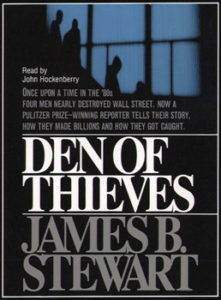
Brook would presumably have us glorify the Rothschilds, as did former inside trader Ivan Boesky, the son of Jewish immigrants who claimed he aspired to be a “latter-day Rothschild” (as noted in James B Stewart’s Den of Thieves, 226) and proceeded to do his best to make good on his ambition. Before the law eventually caught up with him, Ivan Boesky would engage in a series of insider trades that made him and a small cadre of fellow conspirators rich beyond dreams of avarice. In the aftermath of the era of merger mania and hostile takeovers he helped initiate, individual lives and companies were ruined, and trust in markets was eroded, if not shattered. Boesky of course has enjoyed a rather large pop culture footprint thanks to a speech given to a graduating class at the University of California in 1985, in which he assured the young audience that “Greed is all right.” That would eventually morph into the famous credo “Greed is good,” uttered by Michael Douglas in his Oscar-winning turn as Gordon Gekko in Oliver Stone’s Wall Street. Read more

The Jewish War on White Australia: The Anti-Defamation Commission and “Click Against Hate,” Part 4 of 4

Go to Part 1
Go to Part 2
Go to Part 3

EXCERPT 6: “Six million Jewish people”  

Brett Kaye: Right, who’s this guy I googled over here? This one.

Child: Is that supposed to be Osama bin Laden?

Brett Kaye: That’s a Jew. I typed in Jew and that’s what came up first. Now that was taken from, just to let you know, this was taken from a newspaper from Germany in the 1930s called Der Stürmer, that was the name of the newspaper, the voice, and what was happening in Germany in the 1930s? My history buffs in the room. Yes?

Child: Um they were killing Jews?

Brett Kaye: Not yet. They were almost killing Jews. Like who was rising to power? What was their name?

Children: Hitler

Brett Kaye: Between 1933 and 1939 Hitler rose to power …; in 1933 he became the Chancellor, in 1939 World War Two started [claps hands]. So during that time Hitler went on a campaign against Jews, against gypsies, against gay people, against black people, against people who didn’t believe in what Hitler said. And from 1939 to 1945 there was this huge war, as we know, World War Two, and during that time a lot of those people were killed. Six million Jewish people. My family for example. Most of them were killed. My great grandparents, my uncles, my aunts. My grandparents survived, and I’ll tell you something interesting. You talked about bystanders. My grandmother, who lived in Paris, she was saved during the war by a non-Jewish family who didn’t even know her. They hid her in their farm. She lived with the chickens actually. They hid her in the farm and she managed to survive there for three years, from the age of twelve until fifteen, until the war ended, and she came out and she lived. Just because a non-Jewish family chose to save the life of a little Jewish girl they didn’t even know. They weren’t bystanders. Even though they could have got absolutely and utterly in danger, their family and their parents, everybody would have been killed and punished, if they would have been discovered, hiding a Jewish family. Yet they chose to save my grandmother. And because of that here I am and my family’s here. Because of the goodness of somebody who chose to do the right thing. Read more

The Jewish War on White Australia: The Anti-Defamation Commission and “Click Against Hate,” Part 3 of 4

Go to Part 1
Go to Part 2

EXCERPT 3: “I was brought up in a racist country”

Brett Kaye: So somebody asked the question of whether I was brought up in a racist household. The answer is no. But I was brought up in a racist country.

Child: What country’s that?

Brett Kaye: I grew up in South Africa, and let me tell you how it is racist. When I was your age …, I grew up in a political system that was called this…

Child: Apartheid? …


Brett Kaye: You remember me from last year. So, apartheid, made up of two words in a language called Afrikaans which is kinda like Dutch, means separate-ness. And what apartheid meant, realistically, was because I’m a white fella, life for me was good. A-OK. It meant I would live in the best areas of the city, it meant I could go to the beach (other people couldn’t), it meant people who were white went to white schools, Indians went to Indian schools, blacks went to black schools. Whites lived in black… in white neighborhoods, Indians in Indian neighborhoods, blacks in black neighborhoods. When I was at the park there was a park bench that said [banging the table] “White People Only.” Public transport? There was a bus just for white people, a bus just for Indian people, and a bus just for black people.

Child: Isn’t Indian black?

Brett Kaye: Nup. They were considered to be three separate classifications, Hospitals for white people, hospitals just for Indian people, hospitals just for black people. Black people and White people were not allowed to get married, were not allowed to live in the same house. … What it meant was that white kids and black kids and Indian ones would never ever spend time together because they weren’t allowed to be in the same areas. How do you think a White kid your age, a black kid your age would have felt about white people. Think about it. How do you think black kids who lived two hours out, who lived in houses with no electricity, no running water, no power, made their houses out of whatever materials they could find around? How would that black kid feel about white kids?

Child: Spoilt or jealous?

Brett Kaye: That they were spoilt, that they were jealous, and what does jealousy lead to?

Child: Hate?

Brett Kaye: Hate. There was a lot of hate. What do you think a white kid might have felt about a black kid? Yeah…

Child: Maybe they thought that it was unfair and feel sorry.

Brett Kaye: Maybe. Sorry for them. What do you think maybe if I said to my parents “I want to go hang out two hours away in this neighborhood?” What do you think my parents might have said to me?

Child: No

Brett Kaye: Why?

Child: Because they’re a black person?

Brett Kaye: So they wouldn’t have wanted me to hang out with a black kid because it wasn’t the right thing to do. Hang out with black kids. So there was a lot of racial hatred happening.

Kaye gives the misleading impression that White South Africans simply stole all of the housing, electricity, running water and other infrastructure that existed in South Africa and selfishly hoarded it for themselves, rather than being responsible for the creation of these things which never previously existed in southern Africa. For Kaye, apartheid South Africa was “racist” because “Black and White people were not allowed to get married.” Somehow, the prohibition of marriage between Jews and non-Jews in Israel (which is subject to a two-year prison term), the walls of separation between Palestinians and Israelis on the West Bank, and the different legal treatment forPalestinians and Israelis don’t render that state “racist,” but is an indispensable part of the Jewish people’s right to “self-determination.” Read more

The Jewish War on White Australia: The Anti-Defamation Commission and “Click Against Hate,” Part 2 of 4

As discussed in Part 1 of this article, “Click Against Hate” was devised by the Anti-Defamation Commission (ADC) as an “early-intervention” program for Australian schoolchildren. I was recently forwarded a recording of a “Click Against Hate” session conducted by a Jewish activist named Brett Kaye (featured in the above photograph). At no point during the session does Kaye acknowledge that he represents the ADC, a Jewish activist organization. Instead he presents himself as a deeply moral and caring person who is involved in the program for purely humanitarian and altruistic reasons. In concealing his organizational affiliation, the children remain oblivious that “Click Against Hate” is not a politically neutral cyber-safety and anti-bullying program, but a carefully designed propaganda tool designed to serve Jewish ethnic interests in promoting “diversity,” “multiculturalism,” and the suppression of “hate” speech (i.e., speech professional Jews don’t like).

Kaye asks the children why they hate someone and they volunteer a variety of answers, such as jealousy and doing something bad to you. So he gives them a hint at what he is really after:

EXCERPT 1: “Psychologist time”

Brett Kaye: I’m gonna ask you a question that’s gonna help you: “Why would I hate somebody because of the color of their skin or because of their religion? Why would I hate somebody because the color of their skin or because of their religion? Why would I?

Child: Because of racism?

Brett Kaye: Yes. Why would I be racist?

Child: Because you were brought up not to like these people

Brett Kaye: AH! So my parents teach me how to be a racist. In other words, if I’m brought up in a racist household and therefore that could be my view too. Excellent answer.

Child: Wait, are you saying you were?

Brett Kaye: I’m not saying I was, but I’m saying based on what he said, what’s your name?

Child: James

Brett Kaye: Based on what James said, if somebody is brought up in racist household might they themselves become racist?

Child: Um maybe difference?

Brett Kaye: Difference. That’s an excellent answer too. Someone who is different to who I am: I don’t like people who are different, I don’t like their food, I don’t like the way they dress, I don’t like the way that they talk a funny language, they talk in an accent, and all of a sudden that difference can translate into hate. I don’t know about that. I’m ignorant about that. Nobody’s taught me about that. I’ve never learnt about that. Why are they doing all these funny things? Why are singing in this funny way? Why do they talk in this funny way? Why do they dress in this funny way? All that sort of stuff can lead to hatred. Have a look at my answers boys and girls and I think they’re close to yours: someone hurts you or someone you love (we got it), jealousy (Bam! Smacked it on the head), ignorance or lack of education, and what we learn at home.

Read more

The Jewish War on White Australia: The Anti-Defamation Commission and “Click Against Hate,” Part 1 of 4


The Australian Anti-Defamation Commission (ADC) is the Australian equivalent of America’s Anti-Defamation League (ADL). Both organizations fall under the umbrella of B’nai B’rith International which holds NGO status at the United Nations. The stated mission of the ADC is to make Australia “a better place” by fighting “anti-Semitism and all forms of racism” and combatting “the defamation of the Jewish people and Israel.” Describing itself as a “harm prevention charity,” the ADC claims to be dedicated to “promoting tolerance, justice and multiculturalism.” But despite its pious pretentions to universal benevolence, the ADC, like countless other Jewish activist organizations around the world, exists to promote the ethnic interests of Jews. The “harm” this organization is determined to prevent is any harm to these perceived interests.

Regarding the plethora of Jewish activist organizations in the United States, the Jewish academic and journalist Adam Garfinkle has observed:

The main mass-membership advocacy organizations of American Jewry — B’nai B’rith and its Anti-Defamation League (ADL), the American Jewish Congress, the American Jewish Committee, the Council of Jewish Federations and Welfare Funds, the National Conference of Jewish Federations, and the Conference of Presidents of Major Jewish Organizations (a kind of steering group for the major organizations), to mention only a few — are not religious organizations but ethnic ones. It is not necessary to have any Jewish religious affiliation to be a member in good standing in these organizations, and their leaderships are composed mainly of people who are not religious or Jewishly learned Jews.

We need not go into foundational texts and statements of purpose on the question of origins, for the answer is simple enough: organizations like B’nai B’rith and the American Jewish Committee were created to lobby for particular Jewish interests. … In time, these and most other Jewish organizations became explicitly or implicitly Zionist, and thereafter existed to one degree or another to support, first, a Jewish home in Palestine, and then, after 1948, the security and prosperity of the State of Israel. In other words, all these organizations have depended, and still depend, on the validity of their serving parochial Jewish ethnic interests that are simultaneously distinct from the broader American interest but not related directly to religion. [Emphasis added][1]

Contrary to the propaganda put out by the ADC for non-Jewish consumption, the interests of Jews are not the same as those of the broader Australian community, particularly the White Australian community. While the ADC — whose motto is “Promoting Diversity” — pretends that all conflicting group interests can be reconciled through “education” and “mutual understanding,” the interests of different racial and religious groups are often fundamentally opposed and irreconcilable. The group evolutionary interests of White Australians are absolutely harmed by the mass importation of non-Whites into the country — compounded by ideological commitments by state and federal governments to “diversity” and “multiculturalism.” Read more

Review: How the Jews Defeated Hitler: Exploding the Myth of Passivity in the Face of Nazism, Part 2 of 2

Go to Part 1.

After the outbreak of war, Jews were instrumental in restructuring the American economy in order to finance the cost of fighting it — ushering in what has been called ‘the military-industrial complex” and the massive expansion of government power. One of the key features of the Jewish historical profile has been the involvement of Jews in systems of taxation. In keeping with this trend, during the early 1940s Jews were conspicuous in transforming the American economy to one based on mass taxation. The Treasury Department was of course headed by Henry Morgenthau, but what is less remarked upon is the fact that Morgenthau staffed his department very heavily with fellow Jews including Jacob Viner, Walter Salant, Herbert Stein and Milton Friedman. Ginsberg states that these Jews “fundamentally changed America’s tax system.”[1] It is not without irony that while Roosevelt was effectively pardoning high-ranking media Jews such as Joseph Schenk for large-scale income tax evasion, the Jews in his administration were championing the introduction of payroll withholding or “collection at the source” taxation for the common working man.

Although the Constitution’s Sixteenth Amendment, ratified in 1913, allowed the levying of an income tax, exemptions and thresholds meant that prior to the New Deal only 3 percent of Americans were subject to it. By 1940, Morgenthau’s Jewish team had added more than 5 million Americans to the income tax machine. The same team’s 1942 Revenue Act brought the number of Americans paying income tax to 40 million — a move Ginsberg describes as a “turning point in the history of American income taxation.” Since closely administering such a huge transition would be difficult, Jews employed much the same style of propaganda as their counterparts in the Soviet Union did to ensure popular compliance in the war effort — blanket efforts of persuasion and coercion.

In the area of persuasion, Jewish treasury officials “presented tax payment as a patriotic duty and launched an extensive propaganda campaign to convince Americans that paying taxes was a form of sacrifice required to win the war.”[2] Ginsberg adds that “Jewish films studios and radio networks, as well as Jewish composers and media personalities, played an active role.” At Mogenthau’s request his co-ethnic Irving Berlin wrote a song, “played incessantly on the radio,” titled “I Paid My Income Tax Today,” aimed at lower-income Americans who had never previously been asked to pay income taxes. Suspicious that this wouldn’t be enough, Morgenthau, along with Milton Friedman and Elisha Friedman, pushed for a permanent coercive system of payroll withholding. Ginsberg comments that:

The result of the gradual increase in tax rates mandated every year between 1940 and the end of the war, accompanied by payroll withholding, was conversion of the income tax from a minor tax levied on wealthy Americans into a major tax levied on all Americans — from a class tax to a mass tax…According to Elisha Friedman, one key, in addition to collection at the source, was gradualism. Raising taxes gradually, Friedman told the Congress, “got the people’s minds accustomed to things” and lessened the chance of tax resistance and political opposition.[3]

Gradualism has of course also been applied with devastating effect in European societies in relation to immigration and the slow erosion of rights and freedoms. Read more