Featured Articles

European or Ethnic Identity?
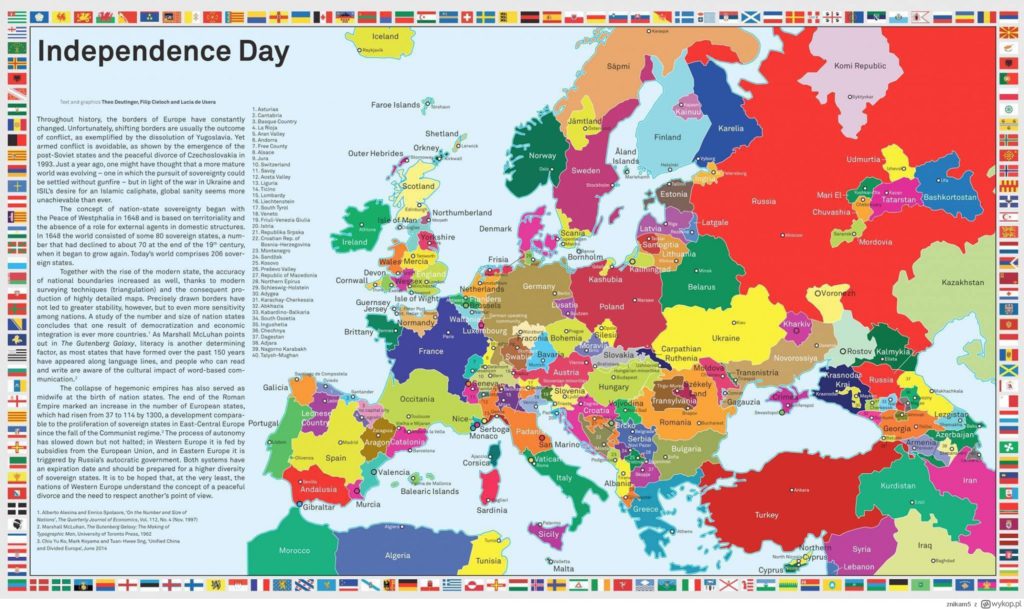
Ethnic Nations of Europe. Click here for an enlarged version.

In light of the mass migrations of non-Europeans to Europe we must redefine the notion of the political. The notion of the political is eternal, although its wording, alongside its political conceptualization, takes on different names in different time periods. We must also clarify the meaning of political concepts, such as the concept of “multicuturalism”, “identity”, “nationality”, as well as the meaning of the more atavistic communal concepts of “race” Or “ethnicity”. My main point is that various European national identities should from now on play a secondary role. I argue that our first priority should be to what is sometimes conveniently referred to as our common biocultural identity, or to put it in different words, the salvaging of our common and collective heredity as represented by the broader family of interrelated European peoples.

A Few Starting Points…

In our so-called “multicultural system”, where millions of people from hundreds of different nationalities live side by side, we should clearly draw the line between individual or particular national identity and this broader “familial” identity as described above, or better yet, between our national awareness and our European awareness. These two concepts are not always synonymous, although they often overlap. For example a Flemish national cannot be a Walloon national – just as a South Tyrolean nationalist must not be denied freedom to show his German roots to his Italian nationalist colleague.

In America, during the period of the state building process, the role of a generalized ethno-religious identity (often referred to by the abbreviated term: WASP) played a much stronger role than in Europe. By way of contrast, still very popular among the American fringe right is the expression “White Nationalist”, although the term “nationalist” has a different meaning in America than in Europe. The genesis of White American nationalism has had little in common with traditional ethnic and culture-bound nationalism of diverse European peoples living in Europe. In the English language there is also no corresponding word for the German word “Volk” or “völkisch” or the word “narod” in Slavic languages — words which are awkwardly translated with the noun “nation” or by the adjective “national” or “ethnic” into the standard modern English language. This national consciousness, or better yet national awareness in the traditional European sense, has played a minor role in America. Until recently national consciousness in Europe was built primarily on the basis of a common language, a common sense of history and a common destiny, i.e. preconditions that had taken a different turn among early European descended Americans of the early eighteenth century. Read more

Sully, the Movie

Think about the last time you walked through an American airport, particularly one that is heavily domestic. Who were the pilots in uniform you saw strolling down the corridors pulling their leather flight bags?

I’ll wager the vast majority were White males. That would make sense, since unlike most other professions today, piloting airplanes in America has remained in

A Nice White Flight Crew; Airport (1970)

the vicinity of 95% White male. This must gall liberals, social engineers, and other SJW’s, for these groups dream of a world of equality, that is, one in which White males are purged, eliminated, or at least relegated to humiliating positions of impotence.

And last year, comes the one hundred percent traditional film Sully (also called Sully: Miracle on the Hudson in some markets; see here for the official trailer). This movie flies in the face of endless promotion of non-White diversity and “vibrancy,” it goes against all that Hillary and her vast entourage represented, and it supports the reality that it is White males who built the public manifestations of Western civilization and to a large degree keep it going.

Directed by Clint Eastwood, who is in his mid-eighties, this film is a story of White America through and through. Sully is played by “Everyman” actor Tom Hanks, the first officer is played by Aaron Eckhart, and most of the supporting cast is White as well. Best of all, this is a story of uninterrupted heroism, as the two White pilots make split-second decisions that result in the survival of all 155 people aboard the plane that cold January day. Read more

The Wisdom of the Ancients, Part 3: Nature and Nurture; Socrates as Moral Exemplar for the Alt Right

Go to Part 1
Go to Part 2

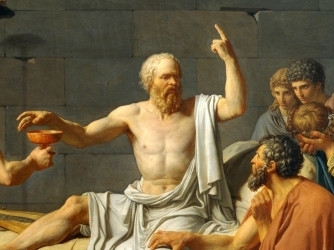
The Death of Socrates

  1. Self-Improvement: Nature and Nurture

Contrary to the currently fashionable egalitarian blank-slatist hysteria, the Greeks universally believed that an individual’s qualities were the fruits of nature and nurture. Even the sophist Protagoras, a thinker of democratic leanings and an educator of the people, argued: “Teaching requires natural endowments and training; one should begin to learn when one is young.”[1] The recognition of inborn human inequality in no way implied that the well-endowed should rest on their laurels. On the contrary, all humans should constantly work to maximize their potential through training and education.

The Greeks developed techniques for individuals to cope with and live well in the harsh world they inhabited. They were remarkably cognizant of the means available: good education, constant training, healthy habits, and socialization with good individuals. Through self-discipline and piety, reason could rule over emotions, pleasures and pains. The Greeks considered a life of belly-chasing, death-fearing, and comfort-clinging to be an evil, subhuman one, no better than that of the lower beasts. Politically, moral education of the citizens was considered practically the first duty of the state, to be achieved through training, culture, public religion, and laws.

None went further than the divine Plato in imagining what superhuman perfection might resemble. His ideal republic is a state effectively led by an enlightened and pious order of warrior-monks as a cognitive and moral elite drawn from the best of the whole people. This elite then systematically educates and trains itself, and to the extent possible the people, towards the good. But Plato goes further than most philosophers and follows the Spartan lawgiver Lycurgus in making genetic improvement of the population through good breeding a sacred moral imperative. This principle, while it follows quite naturally from humanity’s many successes in plant and animal breeding, is nonetheless remarkable given that Plato wrote long before the scientific facts about Darwinian evolution and genetic heredity were known. (Incidentally, I dare say that most of what science has since taught us on heredity reflects very favorably on Plato’s observations, concerns, and ideal.) Read more

The Wisdom of the Ancients, Part 2: Piety, Aristocratic Values and Necessary Inequality

Go to Part 1

  1.  Nature & the Gods: Sacred Laws

Greek thinkers often debated the nature of the gods and the universe itself — or nature — and their relationship with the laws. Many Greeks denounced their traditional stories about passionate and violent gods as impious. Some denounced their city’s laws as contrary to nature. The Greeks were typically Western in their willingness to question convention.

The Greeks almost universally believed that anyone who violated the will of the gods or nature, whether out of ignorance or contempt, would inevitably be ruined and destroyed as a result. In a quite literal sense then, to be impious or to do the unnatural meant for the Greeks to be engaging in maladaptive behavior. Homer’s capricious gods and the suffering of his heroes, who may have unknowingly offended a god, reflect the anxiousness of men, facing death and danger at every turn, to respect the inscrutable higher powers that hold sway over their lives.

This point is perhaps made most explicitly in one of Xenophon’s dialogues on the subject of incest:

Socrates: Those who transgress the laws laid down by the gods pay a penalty which no man can escape in the way that some transgressors of man-made laws escape paying the penalty, either by escaping detection or by the use of force.

Hippias: What penalty, Socrates, cannot be escaped by parents who copulate with their children or children who copulate with their parents?

Socrates: The greatest of all, I can tell you, what greater misfortune could happen to human beings in the procreation of their children than to procreate badly?[1]

The prohibition on incest is therefore a divine or natural law. This interdiction is a perfectly adaptive principle, even though the Ancients could know nothing about the genetic reasons for consanguineous diseases or inbreeding depression. In Xenophon’s dialogue, Hippias and Socrates observe two further customs besides incest which, being shared by (virtually) all human societies, likely reflect natural law: “among all peoples the first established custom is to worship gods” and “to honor parents.” I would argue both are fundamental adaptive principles. To honor one’s parents means to know one’s kin, to be in solidarity with them, and, to a certain extent, to inscribe ourselves in their wider plan. Elsewhere, Xenophon observes that a mother’s love for her own children is also a “natural law,”[2] which is self-evidently adaptive. Read more

The Wisdom of the Ancients, Part 1: Greek City-States as Ethnostates

Lycurgus bas relief from the chamber of the U.S. House of Representatives

Like too many of our generation, I was raised and “educated” without acquiring any real knowledge of European identity or our Western tradition. The Classics lay unopened. Though I may have tried once or twice to read them, they always left me baffled. I was too ignorant to even attempt to lessen my ignorance through them. I then did not know where we, our great civilization and family of nations, came from, and I took them for granted. “The West” meant little more to me than a set of very recent and highly questionable values largely imposed in the last century or so.

Having become conscious of my ignorance, I sought to rectify this, and I began reading some of the Classics — especially those of the Ancient Greeks — and, to my joy, I found that this time I could read them and that they often had very relevant insights for our times. I believe the difference is that I am a bit older, a bit wiser, and that I have been able to emancipate myself from the very impoverished view that postwar consumer democracy represents the highest possible form of human life. Having removed my liberal blinders, I could finally appreciate these works.

For the most part, I have not reviewed these works, for they are too subtle and my lights are too feeble to do them full justice. (I have, however, because the relevance and insight were too great, written for The Occidental Observer on the ethnocentric and eugenic themes in Plato’s Republic.) I fear my inferior paraphrases are not much use and I instead encourage the curious to read the Classics themselves.[1]

Nonetheless, I do wish here to highlight a few major insights and themes which I have drawn from my (by no means comprehensive) readings. In so doing, I hope to provide a useful introduction and whet the appetite of my readers to discover our peerless Western tradition. This should not be done in an antiquarian spirit. The Greeks, a brilliant people living in the harsh world of the ancient Mediterranean, discovered truths and techniques of timeless value, things to not memorize, but to live by. If one has understood anything, one begins to see life in a different way, and one begins, however modestly, to change one’s life, day by day. Read more

Alexander Dugin on the Heartland versus the Heartless: The Neocon and Neoliberal Plan for Russia (and America)

There is a marked difference between freedom and liberty, a distinction which highlights the greatest defect of liberalism (especially as it has come to be understood in postmodern discourse).

“Liberty” implies liberation from something, which marks freedom as a negative category. Because of the connotations of liberty commonly understood in the West before the rise of left-wing concepts like liberation theology (i.e. Patrick Henry’s “Give me liberty or give me death” speech), the negative functions of liberty aren’t always obvious to people in the Anglosphere, even or perhaps especially those who consider themselves conservative.

The Eurasians don’t struggle with this bind. Alexander Dugin, the Russian political scientist maligned as a fascist in the West, gets to the heart of the matter in his book, Putin vs Putin: Putin viewed from the Right:

Today, in realizing the ‘liberty from’, we understand ever better that this nihilistic agenda is leading us to an abyss.… A declaration of individual freedom in effect means total dependence of the common man on the oligarchy. Individual freedom abolishes all forms of collective identity. One is not allowed to be a supporter of a national state or a religious institution, because this is not politically correct (Dugin 59).

It is not hard to understand why a Russian political scientist is suspicious of liberty as it has been sold by the Atlanticist powers (Western Europe and the U.S.) when too often neoconservative concepts of liberty involve liberating people from their lives, or neoliberal projects result in liberating nations from their resources. This asset-stripping facet of ostensible liberation is also not lost on Dugin: “In a former socialist country, where a capitalist coup was implemented on short notice, state and public property ended up in private hands and social guarantees…were done away with” (Dugin 59-60).

When people are convinced that the responsibilities that bind them to one-another (faith, community, ethnicity) are merely burdens to be shed, when they are sold individualism as a fetishized commodity that atomizes them, they are ripe for plunder and exploitation. Many on the Right cite Saul Alinksy’s Rules for Radicals as a foundational blueprint for how the Left operates (and it is), but no book encapsulates this nihilistic isolation as a desired state of affairs like Karl Popper’s The Open Society and its Enemies, which holds that “liberals should fight against any ideology or political philosophy (ranging from Plato and Aristotle to Marx and Hegel) that suggests human society should have some common goal, common value, or common meaning” (Dugin 297). Billionaire Jewish business magnate George Soros was so apparently taken with the book, which he considers his “personal bible,” that he saw fit to borrow the title for his grant-making network, the Open Society Foundation. Read more

Dealing with Dysfunction: A Review of “What It Is Like to Teach in Failing Schools,” Part 2

Part 1 of “Dealing with Dysfunction”

Another of Mr. Teacher’s idiosyncrasies is his view on race. Although he does not explicitly identify his ethnicity, apparently he is a White man. And despite having plenty of real-world experience dealing with Blacks and Browns he does not address race as a biological concept. When discussing the Program in International Student Assessment (PISA) that compares student academic achievement across national borders the author notes that “American educators produce similar outcomes as Finland and Korea when looking only at White and Asian students” (99). Okay, that is to be expected. But then he goes on to state that the PISA “results help to show that biology is not the leading or most significant cause for assessment differences between subgroups (eduspeak for races) because largely non-white United States Hispanics significantly outscore biologically ‘White’ Uruguayans” (101).

The above is pretty slim evidence to base a conclusion regarding the role of race in educational achievement. A closer look shows that AT’s comparison is not apt. While Uruguay is 88 percent White, that is within a Latin American context. In addition, Uruguay has a far smaller per capita income than the US, and spends a significant smaller percent of its GDP on education.[1] As a result the South American country has a shorter school day, larger class sizes, and more basic educational facilities.

Strangely, later in the book the author gives evidence that race is a significant factor in educational outcomes.

Black Canadians are just 2.5 percent of the Canadian population. Black Canadian students in Toronto — the largest concentration of Blacks in any Canadian location — have a dropout rate of 40 percent — a much higher dropout rate than their Canadian peers. There is also a large scholastic achievement gap between Black Canadians and other Canadians (212).

In addition, AT notes that Black Canadian students have disproportionately high rates of absenteeism, suspension, and expulsion. So here you have two different countries with two different educational systems with the same racial disparities. This seem to be more convincing than the author’s Uruguay example. Mr. Teacher describes himself as an Orthodox Christian, and he affirms “God’s sovereign Will in human affairs” (213). He might not believe in biological evolution, which could explain his ambivalence on race. Read more