
Featured Articles

The Southern Point: Remember the Alamo!? Part 1
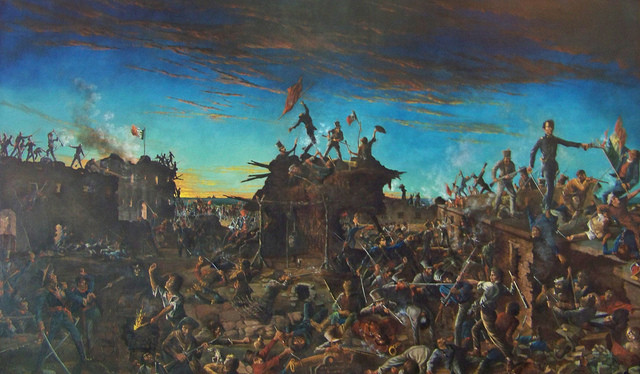
Dawn at the Alamo, Henry Arthur McArdle (1905)

The corn-shuckings and square dances, the fiddles,
The barrels of gin and whiskey, the jerked venison,
Juicy bear meat, hot corn pone, molasses,
And the girls giggling in corners — those are the things
That make life merry. But there came a time
When I neglected them all, and we made merry
(My Betsey and I) at a different kind of party,
Playing with powder and ball at the Alamo
I regret nothing, not even the lies and jokes
I told in Congress. But what is this I hear?
Tennesseans, have you forgotten the songs
Of Old Zip Coon and Turkey in the Straw?

from The Tall Men, Donald Davidson

It never occurred to me that the phrase “go ahead” actually had a history in the lexicon of authentic Americanisms. It was just a thing one said, especially if someone nearby was expressing hesitation or anxiety about an imminent course of action and was in need of a little encouragement. “Go ahead and jump!” or “Go ahead and do it! I dare ya…” etc.  The phrase has a tale behind it.

“Go ahead” was actually coined in the 1830s by none other than David Crockett. Over time, it became his personal motto and even turned into a national sensation, as Crockett was a well-known celebrity—a famous frontiersman turned charismatic populist. The phrase was synonymous with a rough yet laid back, direct, transparent, active, open and moral approach to life, for which Crockett was the ultimate symbol. The way he finally framed it was “Be always sure you’re right — THEN GO AHEAD.” But usually it was reduced to just “go ahead.” Read more

The Liberal Rule of Law and the National Socialist Rule of Law

Introduction

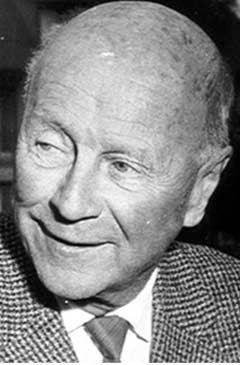
What follows below is my translation of a short chapter (Ch. 40) from Otto Koellreutter’s book Der nationalsozialistische Rechtsstaat (1938) (The Rule of Law in National Socialist State). Koellreutter was professor and dean of law at the University of Munich from 1933–1945. Along with Carl Schmitt, he was one of the prominent legal scholars in National Socialist Germany. He was also a NS party member (see Peter Caldwell’s article, “National Socialism and Constitutional Law : Carl Schmitt, Otto Koellreutter, and the debate over the nature of the Nazi state, 1933–1937”).

The translated chapter from his book is interesting in so far as it sheds a different light on the semantic and legal manipulations of words such as “the rule of law,” “totality,” “total state,” “absolutism” — words and concepts which have obtained a radically different meaning in the Liberal System of today. The author, however, writes favorably about the liberal experiment in 19th-century Europe and suggests that Liberalism, during that epoch, helped create the modern nation-state, including modern Germany. The author points, however, to the dated nature of Liberalism in comparison to National Socialism, which is seen by him as the best answer to the 20th-century crisis of modernity. Read more

Review of Roger Schlafly’s “How Einstein Ruined Physics”

How Einstein Ruined Physics
Roger Schlafly
Dark Buzz, 2011

Was Albert Einstein the smartest man and the greatest scientist who ever lived? Millions believe so.

But Roger Schlafly takes a different view, downgrading the rank of the 20th– century’s most revered scientist. Why? Schlafly presents compelling evidence that other leading physicists and mathematicians before and concurrent with Einstein made equally important breakthroughs in relativity theory and related fields. Further, Schlafly suggests that Einstein may have purloined some of his most famous insights.

What made Einstein so great? The official story goes this way: Albert Einstein, a young clerk in a Swiss patent office, single-handedly transformed physics from a static, three-dimensional science to a four-dimensional, mind-blowing, time-space universe via brilliant and solitary “thought experiments” involving gravity, motion, space and time. Einstein also made unprecedented inroads into understanding the nature of light and energy and was the first to comprehend the equivalence between energy and mass. Einstein’s discoveries not only transformed modern physics but the way we view the universe.

Schlafly disagrees. “It is all a myth.  Einstein did not invent relativity or most of the other things for which he is credited.”  Schlafly makes a very bold and persuasive case. Read more

A Winning Mindset for Effective Advocacy

James Edwards at AmRen

The following is the original text of the speech delivered by James Edwards to the American Renaissance Conference last weekend in Nashville, Tennessee.

Thank you, Jared, for that generous introduction, and thank you for inviting me to speak at American Renaissance 2012. The bi-annual AmRen Conference is the premier event in the cause of European-American advocacy. I’m honored to be here among my colleagues and my friends.

Let me first give you fair warning. I don’t have a silver bullet to offer you. If you came here today in hopes that any of the speakers will be giving you a previously unknown prescription that will cure what ails America, you will leave disappointed. The best I can do for you is to remind you that the political winds are fickle and can quickly change direction. Our job is to keep the pilot light burning until an opportunity presents itself to stoke the embers into an eternal flame.

Beyond that, I will talk to you about what I’ve been able to do that works and offer you practical advice that everyone can apply.

When Jared approached me about speaking here, he suggested that I talk about appealing to the mainstream, and about how I stay positive and professional, while at the same time, coming off as a “normal” guy.

Normalcy shouldn’t be overlooked. Obviously, I’m not talking about anyone here, but let’s face it, sometimes race realists can come across as either over intellectual and socially awkward, or downright angry and bitter. I’m neither. I’m not overly intellectual and one can usually find me in a good mood.

I’m often called “positive” by many folks who talk with me and email me, and I take that for the high compliment they intend it to be. God knows I’ve been called a lot worse. Read more

On the Path to Practical Politics

I was asked by Dr. MacDonald to write an introduction to a body of knowledge which he felt important to bring to the attention of TOO readers.  I struggled with this, first writing a long essay discussing and describing this knowledge, then I realized that the whole point of introducing it wasn’t to paraphrase or describe it, but to encourage you to follow a path toward this knowledge, and hopefully walk that path:  The Path to Practical Politics.

Most if not all readers come to TOO and similar sites because they’ve woken up to the feeling that something is going very wrong everywhere White people dwell.  They discuss the problem, who caused the problem, and present possible solutions.

This is all fine, but something is still missing:  A pathway for each and every reader to actually do something every day.   Most of us aren’t capable of authoring the fine articles that appear here and on associated sites, articles that discuss the problem eloquently.  But we are completely capable of acting effectively,  if only we have the right tools and a guide to using them.

A general summary of why things have “gone wrong” for the diverse White European peoples is contained in the phrase:  “We’ve Lost Control of the Message.” Read more

The Limerick “pogrom”: Creating Jewish victimhood

A very curious article has appeared in the March 14th edition of the UK Daily Mail (“Goldman Sachs’ touch of darkness“), a comment on Greg Smith’s recent indictment of the Goldman Sachs’ culture of greed and client exploitation. The article in question was written by one Alex Brummer, a journalist who writes for both the Daily Mail and the London-based Jewish Chronicle. Brummer’s specialty, it seems, is economic matters and he has a number of strange points to make in relation to the recent revelations that Goldman Sachs has been referring to its clients as “muppets” for some time.  The article begins by stating that the bank has been “sapped of its confidence” following a series of scandals “during and after the great financial panic,” under the chairmanship of Lloyd Blankfein.

If that doesn’t pull at your heartstrings, Brummer goes on to state that “the most enduring image of Blankfein era is that of the great, vampire squid drawn in an excoriating article in Rolling Stone magazine in 2010. What Rolling Stone does not seem to have realised is that this was a rerun of a notoriously anti-Semitic campaign by the late 19th-century polemicist ‘Coin’ Harvey against the Rothschild family. Whatever mistakes Blankfein and Goldman may have made, it does not deserve that.” (Matt Taibbi’s actual words, from his article “The Great American Bubble Machine: From tech stocks to high gas prices, Goldman Sachs has engineered every major market manipulation since the Great Depression“:  “The first thing you need to know about Goldman Sachs is that it’s everywhere. The world’s most powerful investment bank is a great vampire squid wrapped around the face of humanity, relentlessly jamming its blood funnel into anything that smells like money.” Read more

Falling down the memory hole: Reflections on the 1980s Soviet counterculture, Part 5

During my pre-hospital days, when I still hung out with a lot of ‘the system people’, I had been if not an ‘honorary Jew’ then certainly a sympathizer. Therefore it often happened that my Jewish friends and acquaintances did not mind my presence when they felt like saying an honest thing or two about the ‘damned natives.’ I never argued with them but listened with interest. Here are a few examples.

‘The system’ Jews seldom used the word ‘Russians’ but preferred euphemisms such as ‘common oafs’, ‘proles,’ ‘peasants,’ ‘ignoramuses,’ ‘dull wits,’ or ‘straights.’ Once, a guy was telling me about the book Slaughterhouse-Five by Kurt Vonnegut that he had just read. I remembered how he described in his own words an episode where US POWs arrive at a German concentration camp. The main character of the novel mentions Soviet POWs standing against a barbed wire that divided the British and the Russian areas, begging for food. His offhand comment ran something like: ‘If you can imagine! All these oafs could think of only one thing — the grub! Imagine what a dull bunch of bastards! Especially compared to the Brits — always clean and orderly Brits!’

He failed to notice what Vonnegut was driving at — that the Soviet POWs, unlike the British ones, were barred from the Red Cross food, so they were slowly dying from starvation. Yet, for him it was a proof of their ‘oafishness.’ Read more



