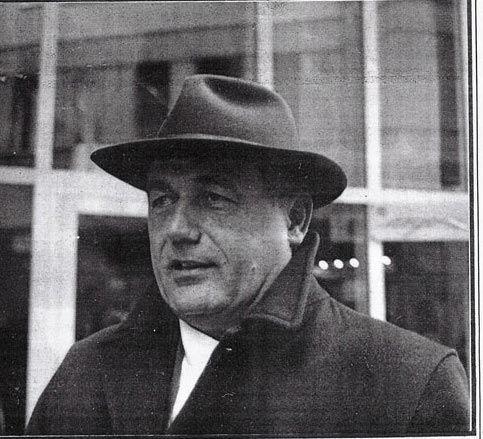
The elevationof Mrs Doreen Lawrence to Britain’s highest parliamentary chamber, the House of Lords, should come as no surprise to seasoned observers of the British political elite.
For as the mother of arguably the most important murder victim in modern British history, she occupies a special place in the political firmament somewhere beside Bob Geldof and the late Princess Diana — perhaps equivalent to Rosa Parks or the parents of the sainted Trayvon Martin.
While no-one can put a name to any of the dozens of teenage Blacks murdered every year in London since then, Doreen’s son Stephen Lawrence was different — he was killed by Whites and his death was an opportunity to create the most potent weapon that has ever been aimed at the British people: mass demonization.
In an earlier age, tactical area bombing was used to deliver a relentless, sustained and never-ending barrage to cow a civilian population. But instead of the RAF this time the propaganda barrage was delivered by the media and Doreen Lawrence played a vital role as a living symbol of the evils of White racism.
So in a sense, her ennoblement is for services to the political elite, the human-rights industrial complex, the bureaucratic class, the media and for everyone else who has benefited from the murder which took place twenty years ago this year. Read more
https://www.theoccidentalobserver.net/wp-content/uploads/2018/06/TOO-Full-Logo-660x156-1.png00Francis Carr Begbiehttps://www.theoccidentalobserver.net/wp-content/uploads/2018/06/TOO-Full-Logo-660x156-1.pngFrancis Carr Begbie2013-08-16 00:50:212013-08-16 13:36:31Doreen and Karen – a tale of two mothers
This newly-published collection of stories is based upon a scenario described on the volume’s back cover:
20–50 years from now when America has fallen apart economically, socially and racially. The Federal Government loses control as revenue dwindles and poverty spreads. To survive, States begin forming autonomous regions amidst the disintegration. Emerging from the disorder, Northern Mountain States of the west gradually form a new American Republic, de facto at first, finally in law, as it becomes a bastion of prosperity and a crucible of liberty. A religious and martial people arise with a will to reclaim ruined western States lost to invaders, oligarchs and degradation.
This process is nowhere described in the narrative itself, which begins in medias res with a vignette about a border patrol post located at the present boundary of Nevada and Idaho. A white couple with a three-year old child are attempting to enter New America under assumed identities. A young New American border guard notices their nervousness and sends them in for questioning, while a team of mechanics disassembles their car. New America has a great deal of cutting edge technology at its disposal, which the author takes pleasure in describing. A retina scanner and thumbprint reader quickly reveal the interlopers’ true identities.
https://www.theoccidentalobserver.net/wp-content/uploads/2018/06/TOO-Full-Logo-660x156-1.png00Brian Hesshttps://www.theoccidentalobserver.net/wp-content/uploads/2018/06/TOO-Full-Logo-660x156-1.pngBrian Hess2013-08-14 12:47:142013-08-15 14:04:01Review of “Tales of New America”
The following is an English translation of an article that was first published in French on the influentialPolemia.com site.
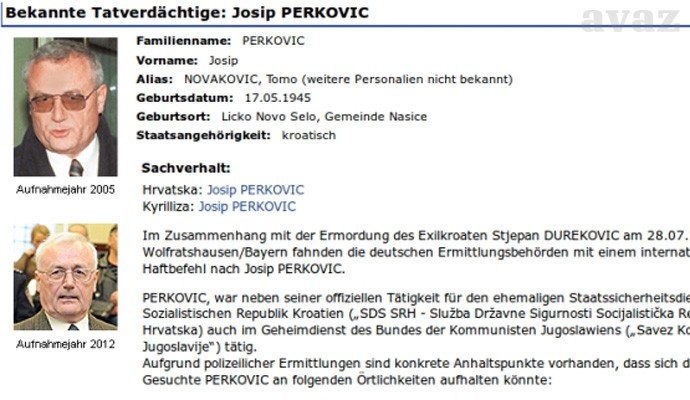
The German BKA arrest warrant for Josip Perkovic (former head of the Communist Secret Police in ex-Yugoslavia)
The recent diplomatic dispute between Berlin and Zagreb, as well as the conspicuous absence of German Chancellor Angela Merkel during the festivities on July 1, 2013, which marked Croatia’s entry into the European Union, brought into the limelight the unresolved question of crimes committed by the UDBA (1), the former Yugoslav communist secret police. The dispute between the two capitals about the extradition of Josip Perkovic — which official Croatia is strongly opposed to – even resulted in the adoption of special law on his behalf. This individual, who still savours his retirement days in Croatia, had very likely masterminded, sponsored and planned (among other crimes) the murder of Stjepan Durekovic, a political émigré who had savagely been killed by a bunch of Yugoslavian henchmen on July 28th, 1983 in the suburbs of Munich.
Josip Perkovic
Seen as an absolute nightmare for 45 years by Croatian émigrés and nationalists, the baleful UDBA managed to sneak through the recent war of Croatia’s secession (1991 – 1995) and survived the regime change. It rallied behind the first president of Croatia Franjo Tudjman, in order to avoid “lustration” (purges), with most of its senior executives now becoming cogs in the new machinery of the new Croatian state. Ministries, the Parliament, media, big business, administrations, diplomacy — rare are public fields where these former “suradnici” (aka “snitches”) don’t hold major positions. For example, in a recent article (June 10th, 2013), the Daily Mailwritesabout the surprising appointment of Croatian politician Neven Mimica, as a European Commissioner. Mimica is described as a former member of the Yugoslavian secret police. With a monthly salary of 20.000 Euros, Mr. Mimica is the best paid civil servant in Croatian history. This explains why the present government (run by non-repentant old communists and their younger “liberal” offspring), is reticent to hand over their old buddy to the German authorities. Read more
https://www.theoccidentalobserver.net/wp-content/uploads/2018/06/TOO-Full-Logo-660x156-1.png00Christophe Dolbeauhttps://www.theoccidentalobserver.net/wp-content/uploads/2018/06/TOO-Full-Logo-660x156-1.pngChristophe Dolbeau2013-08-12 14:52:492013-08-12 15:55:48Croatia and the Malodorous UDBA Ghosts
At TOO we have had several articles on the culture of corruption that pervades many traditional Jewish communities. Edmund Connelly’s “The Culture of Deceit” presents examples going back to the 18th century, citing Wilhelm von Dohm, a Prussian official that Jewish communities were engaged in “the breaking of the laws of the state restricting trade, the import and export of prohibited wares, the forgery of money and precious metals.”
In short, von Dohm describes traditional Jewish communities as far more resembling a mafia-like group engaged in organized crime than what we think of as a religion. Alexander Solzhenitsyn describes how Jews invented elaborate ways to get around laws on selling liquor and to avoid the military draft; they also sold shoddy goods to the Russian military with all that that implies (see “The Mesira Mentality: Laws are Made to be Broken“). Read more
https://www.theoccidentalobserver.net/wp-content/uploads/2018/06/TOO-Full-Logo-660x156-1.png00Kevin MacDonaldhttps://www.theoccidentalobserver.net/wp-content/uploads/2018/06/TOO-Full-Logo-660x156-1.pngKevin MacDonald2013-08-10 11:45:472015-09-09 20:12:22Ultra-Orthodox Jewish Ethics: Gaming the System
When reporting about the problem of political prisoners in Russia, mass media in Russia and abroad almost exclusively focus on Mikhail Khodorkovsky, the late Sergei Magnitsky and the “prisoners of May 6, 2012”. This creates an impression that the list of victims of political persecutions in Russia is limited by these people. However, in truth this is only the tip of the iceberg. Many, many others have been imprisoned during last several years for the sole ‘crime’ of being publically active Russian Nationalists. Here I briefly describe the history of the latest unlawful persecution of Russian Nationalists and Russian Nationalist organizations in the Russian Federation. The names and events described in this article are by no means comprehensive; they include only the most publicized instances of political persecution, in which — importantly — the accused did not confess and refused to collaborate with the prosecution.
An approximate number of Russian Nationalists imprisoned during the last decade is around two thousand. Most of them are young Russians, convicted under the notorious Article 282 of the Penal Code (“incitement to racial hatred,” also colloquially known as the ‘Russian Article’ or ‘hatespeech’), usually in aftermath of conflicts with Central Asians or Caucasians. Read more
https://www.theoccidentalobserver.net/wp-content/uploads/2018/06/TOO-Full-Logo-660x156-1.png00Pyotr Antonovhttps://www.theoccidentalobserver.net/wp-content/uploads/2018/06/TOO-Full-Logo-660x156-1.pngPyotr Antonov2013-08-06 14:11:512013-08-06 14:11:51Russian political prisoners in the Russian Federation
The Jewish antagonism has been manifested in a continuous—even if underhanded—manner in the two thousand year course of the Judeo-Christian clash. “The Jew—James Darmesteter tells us—was the champion of reason against the mythical mind; in the intellectual night of the Middle Ages, only in it did he think that he could find asylum. Provoked by the Church which wants to persuade him, after having tried in vain to convert him by force, he undermines with irony and perspicacity some of her controversies, and, like no one else, knows how to find the vulnerabilities of her doctrine. The understanding of the Sacred Books, and even more the terrible sagacity of the oppressed, are his means to discover those points. He is the doctor of the incredulous; all the revolts of the mind are presented to him in the shade or under an open sky. He worked in the immense forge of curses of the great Emperor Frederick and of the princes of Swabia or Aragon; he fashions together this deadly arsenal of reasoning and irony that he offered then to the skeptical of the Renaissance and the libertines of the Seventeenth Century. And the sarcasm of Voltaire is none other than the heavy echo of a word murmured six centuries earlier, in the shade of the ghetto, or, even earlier, (in the Counter-Gospel of the I and II Century) at the time of Celsus and Origen, and at the very origins of the religion of Christ.”[2]
For his part, Elie Faure (1873-1937), whose works were recently reprinted and highly publicized, talks about “this sarcastic snickering (Heine, Offenbach) towards all that is not Jewish […]. His ruthless analysis and his irresistible sarcasm acted as vitriol.” Following the course of our history, “it is easy to follow the trail, and although it is not possible to quantify the dissemination of Jewish thought, after its passage we can take note of its destructive power. Sigmund Freud, Albert Einstein, Marcel Proust, Charlie Chaplin opened up to us, in all senses, the prodigious streets which demolish the narrow lanes of the Classic Greco-Latin and Catholic edifice in which for five or six centuries the burning doubt of the Jewish soul was waiting for opportunities to destroy it. For it is necessary to note that its [sc. that of the Jewish soul] own skeptical pole appears to emerge for the first time from the complete silence that surrounds the action of the Jewish mind in the Middle Ages, silence in the middle of which, from the Renaissance onwards, some voices burst forth, and which [sc. silence] today is annihilated by a great din.”
Yes, “is it possible to consider the Jew as anything other than a demolisher armed with corrosive doubts who, since the time of the Greeks, has always opposed Israel to the sentimental idealism of Europe? […] His historic mission is clearly defined, and perhaps forever. It will be the main factor of each apocalyptic period, as it was at the end of the ancient world, and as it will be at the end of the Christian world in which we live.”[3] Read more
https://www.theoccidentalobserver.net/wp-content/uploads/2018/06/TOO-Full-Logo-660x156-1.png00George F. Heldhttps://www.theoccidentalobserver.net/wp-content/uploads/2018/06/TOO-Full-Logo-660x156-1.pngGeorge F. Held2013-08-05 00:08:362013-08-05 00:14:50Léon de Poncins: The Problem with the Jews at the Council, Part IV
VII: JUDAISM’S STRUGGLE AGAINST THE CATHOLIC TRADITION
In fact, behind the appearance of an ecumenical search for a reconciliation between religions and other equally seductive words, it was a matter of demolishing the bulwark of Catholic Tradition, defined by Josué Jéhouda as “the ancient fortress of Christian obscurantism.” According to Jéhouda, there were three attempts at the “straightening out of Christianity,” which “sought to cleanse the Christian conscience of the miasmata of hatred”; three attempts at the straightening out of Christian theology which had become suffocating and paralyzing; “three open breaches in the old fortress of Christian obscurantism.” In fact, three important stages in the destruction of traditional Christianity:
– The Renaissance – The Protestant Reformation
– The French Revolution
In these three major movements, Jéhouda perceives the wonderful work of dechristianization to which each of them, in various forms, has powerfully contributed. He does not tell us this so brutally, since he is very skillful at handling the artifices of language, but that bursts forth clearly from his writings, as we will show with some quotes extracted from his works:
“The Renaissance, the Protestant Reformation, and the French Revolution represent the three attempts at straightening out the Christian mentality to put it in tunewith the progressive development of reason and science, and while dogmatic Christianity continued to make itself obscure, the Jews were gradually emancipating themselves.”
Speaking of the Renaissance, he maintains:
“We can affirm that if the Renaissance had not deviated from its original course in favor of the dualized Greek world, we would have had without a doubt a world unified by the creative thought and doctrine of the Kabbalah.”[1] Read more
https://www.theoccidentalobserver.net/wp-content/uploads/2018/06/TOO-Full-Logo-660x156-1.png00George F. Heldhttps://www.theoccidentalobserver.net/wp-content/uploads/2018/06/TOO-Full-Logo-660x156-1.pngGeorge F. Held2013-08-04 02:15:572013-08-05 00:15:41Léon de Poncins: The Problem with the Jews at the Council, Part III
We may request cookies to be set on your device. We use cookies to let us know when you visit our websites, how you interact with us, to enrich your user experience, and to customize your relationship with our website.
Click on the different category headings to find out more. You can also change some of your preferences. Note that blocking some types of cookies may impact your experience on our websites and the services we are able to offer.
Essential Website Cookies
These cookies are strictly necessary to provide you with services available through our website and to use some of its features.
Because these cookies are strictly necessary to deliver the website, refusing them will have impact how our site functions. You always can block or delete cookies by changing your browser settings and force blocking all cookies on this website. But this will always prompt you to accept/refuse cookies when revisiting our site.
We fully respect if you want to refuse cookies but to avoid asking you again and again kindly allow us to store a cookie for that. You are free to opt out any time or opt in for other cookies to get a better experience. If you refuse cookies we will remove all set cookies in our domain.
We provide you with a list of stored cookies on your computer in our domain so you can check what we stored. Due to security reasons we are not able to show or modify cookies from other domains. You can check these in your browser security settings.
Other external services
We also use different external services like Google Webfonts, Google Maps, and external Video providers. Since these providers may collect personal data like your IP address we allow you to block them here. Please be aware that this might heavily reduce the functionality and appearance of our site. Changes will take effect once you reload the page.
Google Webfont Settings:
Google Map Settings:
Google reCaptcha Settings:
Vimeo and Youtube video embeds:
Privacy Policy
You can read about our cookies and privacy settings in detail on our Privacy Policy Page.

 The
The