• MISSION STATEMENT
  • TERMS
  • PRIVACY
The Occidental Observer
  • HOME
  • BLOG
  • SUBSCRIBE TOQ
  • CONTACT USPlease send all letters to the editor, manuscripts, promotional materials, and subscription questions to Editors@TheOccidentalObserver.net.
  • DONATE
  • Click to open the search input field Click to open the search input field Search
  • Menu Menu

General

The Disappearing Aid Check: The Future of US–Israel Defense Support

May 31, 2026/2 Comments/in General/by Kevin MacDonald

The Disappearing Aid Check: The Future of US–Israel Defense Support

Steven Simon; Quincy Institute for Responsible Statecraft
Posted onMay 26, 2026

Executive Summary

The United States and Israel are now approaching the renegotiation of their 10-year defense Memorandum of Understanding, or MOU. Israeli officials have said they want to phase out US military grant aid — a position that sounds like a step toward ending US military assistance to Israel. It is not.

What top Israeli officials — including Prime Minister Benjamin Netanyahu — are quietly backing is not a reduction in American support, but a reorganization of it: shifting billions in resources from State Department–administered foreign aid grants into general Pentagon procurement accounts, industrial partnerships, and sustainment pipelines. The shift will strip away the political and diplomatic oversight mechanisms that make the relationship publicly accountable, moving it from a visible annual aid vote into the opaque machinery of defense acquisition, where oversight is limited and political accountability is minimal. The result would be a defense relationship that is simultaneously deeper and less transparent.

Since fiscal year 2019, the United States has provided $3.3 billion per year in Foreign Military Financing, or FMF, grants to Israel, plus an additional $500 million per year for missile defense cooperation. About 25 percent of this FMF grant money has gone toward offshore procurement, or OSP, funds allocated to Israel to spend domestically on its own defense industry and military equipment. Effectively, it is a US subsidy for Israel’s military industrial complex.

This OSP precedent is slated to end with the expiration of the current MOU. This has fueled Israeli proposals to phase out FMF grants altogether, replacing them with a relationship centered on US–Israeli defense integration. This would embed Israeli firms and Israeli–origin intellectual property inside larger Pentagon programs and production. Unlike the foreign assistance process, the military procurement framework would not be subject to the political scrutiny of Congress and the State Department, but would be evaluated on bureaucratic criteria such as cost, readiness, and capability. This shift would likely be justified by reframing US support not as a handout to Israel, but as an investment in American military readiness, industrial capacity, and jobs.

At a time when the US–Israel relationship should be scrutinized in light of Israeli actions that run counter to US interests, such a structural shift would be counterproductive. To avoid this outcome, any procurement-centered relationship should meet these three basic requirements:

  • Clear metrics to assess whether Israeli participation in Pentagon programs serves US defense requirements.
  • Program-level transparency regarding the existence, scale, cost, and rationale of each procurement program.
  • Cross-committee coordination in Congress to ensure visibility and accountability to non-military congressional oversight committees.

The complete document …

https://www.theoccidentalobserver.net/wp-content/uploads/2018/06/TOO-Full-Logo-660x156-1.png 0 0 Kevin MacDonald https://www.theoccidentalobserver.net/wp-content/uploads/2018/06/TOO-Full-Logo-660x156-1.png Kevin MacDonald2026-05-31 10:40:062026-05-31 10:40:06The Disappearing Aid Check: The Future of US–Israel Defense Support

1975 – The Mosley Remigration Interview on Thames TV

May 31, 2026/16 Comments/in Fascism, Featured Articles, General/by Francis Goumain

Back in 1975, they didn’t say “Remigration,” but “Repatriation.” For today’s viewer, this is perhaps the only interesting point that saves an otherwise rather lackluster video: even fifty years ago, people were talking about remigration, about return, and about encouraging return. And the exact opposite happened; migration flows to Western countries increased, as did miscegenation.
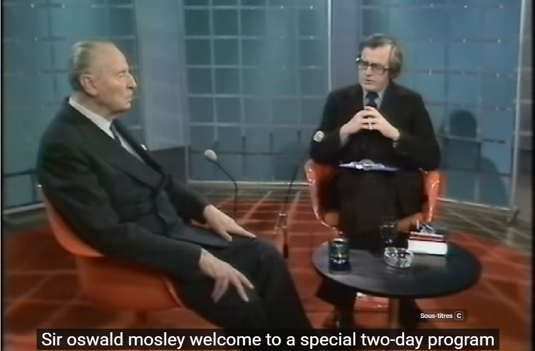
Sir Oswald Mosley, guest on Thames TV for a special program in 1975. https://www.youtube.com/watch?v=HNhF28fzN9I

Even back then, in 1975, Oswald Mosley explained that this “repatriation” had become a monumental task, given the sheer size of the immigrant population in Britain. It had reached such a point that, in his view, action was needed at the European level, leveraging the power and solidarity of the continent’s nations, for which —incredible as it may seem coming from a nationalist—he advocated a transnational government.

At almost 80 years old, Oswald Mosley still saw himself as a providential man who would be called upon by the country to face the imminent racial crisis. He acknowledged that, while he had withdrawn from English political life, this was to better prepare his mission at the European and international level: he spoke, he said, four languages and met more foreigners than any other English politician.

Today, we wonder how Mosley could have agreed to engage in such a charade. He was forced to say that he was not anti-Semitic—not on his life—that he was not so racist, that he abhorred force, that he was not a Hitler’s admirer, that he did not consider himself a hero. All this to fit into a pure marketing product of British entertainment television which aimed only to give viewers the thrill of history on the cheap.

A thrill from English history, of which we are the custodians in France.

Imagine that Mosley, who had married Diana Mitford in Germany at Goebbels’s place, lived after the war and until his death in France, in Orsay (91400), rue du Bocage, in a beautiful property called “Temple of Glory”, erected by general Jean Victor Marie Moreau, following his victory at Hohenlinden, on December 3, 1800.

The “Temple of Glory” in Orsay became the Moslay family’s home after the war. He and his wife discovered it in December 1950.

Imagine, too, that the Mosleys thus lived just seven or eight kilometers from another prominent British exile, the deposed King Edward VIII of England, who, like Mosley, was a notorious Nazi sympathizer. The property, called Moulin de la Tuilerie, is located in Gif-sur-Yvette (91190), on Impasse de la Tuilerie.

A visit to the Moulin de la Tuilerie, the property of Edward VIII in 1952, on the banks of the Mértaise. A tour around Le Moulin de la Tuilerie – YouTube

And imagine, finally, that the author of these lines lives 17 km from the Temple of Glory and 13 km from the Tuilerie Mill. The walk to the Tuilerie is very pleasant. The Temple of Glory, on the other hand, is not easy to reach coming from the west because there’s a motorway to cross: even though Mosley’s property seems peaceful and secluded, in reality, the motorway access is only a few hundred meters away… the modern world.

For this reason, and to re-establish some sort of mental contact, both with Edward VIII and with Oswald Mosley, we provide below the transcript of Mosley’s video (thank you to readers for pointing out errors and filling in missing parts, we know there are some).

We counted 20 “against” statements, roughly one per minute of Mosley’s speaking time. But to make history, one must not be “against,” one must be “in favor of”: this is how the poor man waited his whole life for a call from history that would never come.

(By the way, in 1955, he was also « against » the repatriation scheme, he preferred to stop new arrivals. In 1975, of course, he changed his mind: the population of the new incomer has considerably inflated since 1955).

Francis Goumain

Video transcript.

§§§§§§§


Sir Oswald Moslley, welcome to a special Today programme.

When I say welcome, you know and I know, that throughout London a great many Jewish viewers will not welcome your presence on this programme.

Why should any Jewish person now watch you and listen to you?

Well, if they were, some of them have abused me so much. They might be interested to see why.

But in fact, there are many great misunderstandings in politics. Now, let us be absolutely clear about this question.

I was never anti-semitic and I’ll define anti-semitic. By that I mean someone who attacks Jews on account of race or on account of religion.

I had a quarrel, not with all Jews, but with some Jews, about one subject: whether there should be a Second World War or not.

Now coming back from the First World War, after that time in the air and in the trenches and in the loss of all my friends, I was very strongly against another war. And it seemed to me rightly or wrongly, that’s a question we could debate, that certain Jews were trying to provoke a second world war because their compatriots or co-religionists were, admittedly, having a very bad time in Germany. Now, I do not think that a minority in this country should pursue a policy contrary to the national interest, which can end, in fact which did, in the loss of 50 million lives.

That gave rise to a very bitter quarrel of the period in which harsh things were said and harsh things done, that they attacked our meetings.

But I was not before that, and I have not been since, or even at the time, anti-semitic. Because not all Jews were involved but only some.

Sir Oswald, your answer, as you well know, begs so many questions that I have to put to you…

Well, which ones?

I’ll come to those in a moment. But let me stay with « not anti-semitic », not anti-semitic to refer to Hitler as the sweepings of the ghetto?

Well, the people who just came in, it is very rough these meetings, then shouting every insult, every abuse at the speaker. And he sees that they have just come in from Central Europe, and from totally different conditions to break up another meeting gives them a rough answer. I might have said that to any foreigners who came in to try and break up an English meeting.

Of course, it was rough. People don’t understand now in those great mass meetings in which some people were trying to break up and the speaker had to hold his own, and if you saw that they’d come from another country to break up an English meeting you gave them a rough answer.

Now you say that your argument with them was that you wish to prevent a second world war.

Certainly.

Would not your argument have been better addressed to Hitler?

The argument that there was not a second world war?

Yes, to prevent a second world war. If you wanted to have an argument with someone, would not the argument be better addressed to Hitler rather than the Jews?

Well, Hitler was driving east. I, my policy and my party, that’s a totally different thing. Fascism in every country was a strongly national movement. Therefore ours was totally different in its form, policy, and method.

I had wanted to conduct further and better a great Commonwealth of Nations, had to have a multiracial policy. He wanted to unite the Germans in Eastern Europe, and I did not want to intervene in a world war to stop him from doing it. I thought a war between Germany and Russia was better than a war between Germany and Britain. That gave rise to the quarrel.

Sir Oswald, do you now, looking back with the hindsight and knowledge of history, blame the Jews or Hitler for the Second World War?

I blame both. I blame both in that Hitler was impatient; he wanted to drive East, unite his own people, and when we signed the guarantee with Poland…

So rather like blaming the victim of a rapist for the rape, isn’t it?

Well, no, wait a minute, let us look at it clearly. While Hitler was driving east to unite his own people, we gave a guarantee to Poland which we could only implement by a world war. In fact, we couldn’t save Poland. We didn’t. It’s like signing a bouncing cheque.

Well now the agitation to make us do those ridiculous things like guaranteeing Poland and the other side of Europe was largely due to the influence of some Jews. Therefore, I say that both were responsible. Hitler for driving East before he had gotten a diplomatic arrangement with us, Jews for gradually persuading us, or the British people or government to do absurd things which were bound to result in war. All those people made tremendous mistakes. I was against both mistakes. I’m against the persecution of Jews or any other minority; I’m also against giving guarantees which [that] you cannot honor. That’s what caused the world war.

When did your conversion to be against the persecution of Jews begin?

Well, I never wanted to persecute Jews myself. I simply defended my meetings from Jewish attacks. Take the Olympia meeting. They marched two miles from East London. Afterwards, East London swung over to me. But at that time it was against.

What was it like?

I tell you exactly what it was like. I went along to make a speech to an enormous audience, a record audience opening the great Olympia hall. People who had marched from East London entered the hall in order to break it up. I had 1500 stewards in the black shirt, so they could recognize each other; that’s why, in order to stop them from doing it.The fighting was then very protracted, inside my meeting, I wasn’t going to break up my own meeting. They were doing that. Then the cinema lights, which were there in great force, were swung off the platform onto the audience, where the fights were occurring, and some people, very foolishly, said that I wanted that to happen.

Well, I’ve never known yet a speaker who wanted the searchlight turned off himself and on to other people. And that was done by the cinema lights naturally.

If I then had intervened by force, to ask my people to swivel the lights back on to me, what an outrage it would be. Supposing lights were then turned off me now onto something else and I had people around me who went and turned them back on to me, you’d rightly think it an outrage. And that was done by the cinema companies who wanted a story. It wasn’t done by me.

Quite and you’ve described what was happening in there. But what I’m actually asking you is how you felt addressing what was by any standards a huge rally. Did you then feel that the millennium had come and that power was yours for taking?

Oh good heavens, no. It took me, I’ve spoken all over the country for seven years. I spoke at enormous meetings, far the greatest ever held in this country, and three years later after that I addressed an audience twice as big, no four or five years later, in 1939, twice as big exhibition hall at Earls Court, never been filled for a meeting on any other occasion and that meeting was absolutely orderly, immensely enthusiastic, because the attempt to break up our meeting had been defeated. Force was used against us and we used force in return. I hate force. I had more than enough, of course, for the fighting in air and trench in the first war. Then when my meetings were attacked, I either had to close down or defend them, and I organized their defense and we won. We had orderly meetings and that was our whole offense.

Do you really hate force, Sir Oswald? Or do you not in fact have a hankering, as a man of action, for the quick result that force can achieve.

Oh no, no, no. All that nonsense was knocked out of my generation in the First World War. I was flying against the Germans in 1914 to 1915 when the average life was three months. All my friends were killed. I was later in the trench of my own regiment. With my whole generation, well practically my whole generation was wiped out. A man who’s been through the first war had a real hatred of war and of violence.

But then, if you found a political movement and come out of politics with a certain praise of what you thought about and what you’ve done and you try to go on, talking to the same audience as you have before, and people with armed force come to break it up, what do you do? Blow them a kiss and say “Goodnight, I’m retiring from politics”, or say “you are not going to do this, I’m going to defend my meetings.” I stood firm and defended them.

But does not violence attract violence?

Precisely, they used violence against us and we had to use violence in return. But I don’t like it. I hate it.

Do you have in you, however, Sir Oswald, a concept of the hero?

Of the hero?

Yes

Well, I think that an element of the heroic is necessary to all great nations. Britain was founded, the British Empire and everything else that we have, was founded by heroism. Men who went out to the far corners of the world and did heroic things. But it should be constructive heroism in the service of great people, in the service of humanity.

People who have done marvels in medicine and in science and that sort of thing are equally heroic. It’s not simply a military virtue. That I think an element of heroism is what is perhaps lacking today, but I’m convinced the British people are still capable of it and in a great crisis can show heroic qualities, which should be evoked.

Who are your heroes?

In History? In our history, the great Chatham. They kept him out of politics, out of power all his life. They gave him four years toward the end of it, and he gave them in return everything they’ve got. Immediately performed that service, they got rid of him again and any man of action who does anything for our people or any people for that matter, he’s well-advised when he’s done, he stops, he’s performed his great service to go into retirement when he’s done it.

Chatham was one example but there are many others. In British history I also give a great part to Marlborough, the original Churchill, who was a great, two great men, Marlborough and his descendant Winston. Extreme opposite of character in every respect, and Marlborough and Chatham, I would put with the two great Latins: Julius Caesar and Napoleon, and with the two great, two great Teutons, the Hohenstaufen and the Hohenzollern Frederick’s, and I should give those six men as the examples of supreme men of action in history.

And when sometimes I’m accused of having modeled myself on this man or that and all sorts of stuff, my simple reply is when I, going in for action, study the great models, if you are going to play tennis, then study the champions at Wimbledon, study their strokes. See how they do it and I did study all those, that kind of person, and it’s very essential to do it. That doesn’t mean you identify yourself with them. It merely means that you learn from great performers how to do certain things.

I did interest of course that you can choose Chatham who, as you say, was kept out of political life nearly all his life and then drawn back. In a shorter interview that we did recently, you gave me the impression that you still believe the call might come for you. Do you really believe that?

Oh yes, I’m much better now than I’ve ever been in my life; I’ve still got…

Better at what Sir?

Better at politics. That is I’ve got health and vigour, every capacity I ever had, and added to it, a vast experience and, I hope, more wisdom than when I was young. At least that seems to be the impression of a good many people. Therefore, while you have the health and strength, you go on improving. Experience, and wisdom which comes with age, is a splendid thing. Of course when you get past it all, and the physical is feeble and the rest of it, then it is over, and any man of any sense recognizes it.

Happily history abounds in cases of men who went on ten or fifteen years older than I am now and did extraordinary things. Therefore, I found that I feel that my whole life has been a training for what can now come. And if I was wanted to perform any part – I don’t care what – I would gladly do anything I could for this country.

But who on earth would ask you?

Well, they only ask people when it’s necessary. When that man alone has the experience and the proved capacity and willpower to meet a difficult and desperate situation. Anyhow, my life has proved a certain willpower, and a certain capacity to endure and come through supreme difficulties. Which are exactly what this nation will be faced with very shortly.

The Poet Yeats said «Why should not old men be mad?». Isn’t it a form of madness to believe at 78 that the country will call you?

No, because countries have called back men much older than me with great advantage, and things have been done in other spheres of literature, of art, of philosophy as well by very old men. The only one of two questions are: does the situation require such a man? Is he still capable of doing something effective? Those are the two questions which our audience and the British people are perfectly capable of judging for themselves. That I have not yet seen anybody else in the present situation who can meet the crisis which is coming.

So what would your nation be like then? What would your Britain be like?

I’ll tell you exactly what I should propose. I think in a crisis, you should have a government drawn from the whole country. I don’t mean just a coalition of parties which have failed – that will probably happen like it did with Baldwin and McDonald before.

Would it include Jews?

If they are any good, yes. I know there’s certainly one or two of them who are absolutely first-rate, particularly in science and so on. Now what I propose is a government drawn from the whole country at a certain point, from politics the best, certainly from business, from some of the younger trade unionists who certainly would be available I think, from the universities. From the fighting services I should certainly include as well, because in a very dangerous situation you want a few members of my original profession, the professional army, because men that are trained to danger, in that situation, are very valuable.

And such a government, elected by the people at a general election entirely democratically informed, subject to dismissal any day by the consequent Parliament if they abuse power, but given the power to act while they are there, just as the Board of Directors is given the power to act by the shareholders and sacked if they don’t do the job properly. I think that it is the modern form of government entirely democratic, combining the two essential things: the power to act with individual liberty, which must be scrupulously preserved.

No suspending of the Habeas Corpus Act. With all those outrages from which I suffered myself. Habeas Corpus Act. Personal liberty, always there in this country till it’s needed. The moment of crisis they scrap it and put people in jail, without trial. Absolutely wrong. Give a government power to act, certainly, dismiss it if it doesn’t do the job and preserve with cost…

How do we dismiss it out there; there would still be elections?

Oh certainly, exactly as today that any party might enter the election and that the people should choose. But if they give a party, or a newly constituted government, or a proposed government, if they give it power, that there is a parliamentary majority, that majority should give it the power to act and should sack them if they don’t act properly. We have little until the people vote for them, the question doesn’t arrive.

We have a substantial black, brown, and colored population in this country now. Would they be represented in your government?

They’d have a vote in every constituency

They’d be in your government?

If any of them was a first-rate man, he certainly would be, yes.

What’s a first-rate man, Sir?

First-rate man: approved capacity in any sphere. Scientists and people like that who had nothing whatever to do with politics would certainly be included in the kind of government I suggest. The politicians would be a minority. And if some black, or some Asian had proved himself in some sphere as an outstanding man, he’d obviously be a most welcomed member of any government that was formed

If he hadn’t been sent home under your repatriation scheme.

Well, repatriation, now. That is, I was against, of course, and that was quite often discussed at the time, against another coming here. That is I took a stand way back in 55. I fought an election on the subject in 59, the very strange and dubious election, and I stood for that policy, I think several years before Mr Powell ever thought of such a thing while he is Minister of Health and introducing colored nurses into the hospital service. Then I was strongly against the scheme from the start when it was perfectly easy to stop it.

But now that we’ve got anything, well figures are very much disputed, but we have a very large number here, it’s a much bigger operation to secure any repatriation. And it can only be done in a humane and a decent way. And I think that means the whole of Europe facing the problem together and enabling conditions in their homelands to which they will wish to return. I think it’s possible to solve that problem in a decent and humane way, but it is miserably more difficult than it was in 1955 when I first stated publicly that immigration of that kind should be stopped.

This seems to me the thing that has bedeviled you all your life

Yeah

That you put forward in advance ideas, obviously in the 1930s, major economic ideas that might have – probably should have been taken up. But all this shall be deviled by this desire to find a scapegoat which will rally people around you in the thirties, the Jews, in the 50s and the 60s and the 70s, the blacks, who next?

No well, the answer is, I think, very plain and simple. I was against certain Jews, not all Jews, because they were agitating for war. I was against the import of a completely different alien population which would bedevil all our civilization and has done it, but that is the only form of prejudice of that kind which can ever be charged against me. For instance, as the Times reported recently in a long article, a study of that period, I stood against the persecution of the Irish, having had to fight them as a professional soldier at the end of the first war. I strongly opposed the treatment of them by the Blacks and Tans, and I was appraised in my early life for my humane treatment of such people. I stand against atrocity and bullying and I still feel the same today. I am passionately against any ill treatment of prisoners or the underdog.

But in those two cases, it was necessary to take action against a minority who was agitating for war or against the import of another population, in an overcrowded island, which has done us immeasurable harm. But we cannot deal with it brutally and inhumanly; we’ve got to deal with it – if we deal – on a great scale with the whole of Europe, making arrangements for a fair return of people to their native lands, and that means an enormous enterprise because there’s got to be conditions to which they wish to return.

When you say, and when you think about this call, that will come, why should the call come? What is wrong with the political leaders now?

Well, I tell you exactly what is wrong. They’re running into a supreme crisis because they failed to solve all the main problems. But now what is the main problem? The main problem is the failure to adjust consumption to production. That is in plain language, to give the mass of the people the power to consume the goods the mass of the people produce.

Not an insoluble problem, it’s a matter of creating conditions in which it can be done. Now before the war, in my early days in politics, we had deflation, which was a disaster, and some people are proposing it again. They’re dressing it up in another new jargon. It’s exactly the same policy we saw applied before. All this Keith Joseph policy of deflating and the rest of it, means doing what we did in the forties, the creation of enormous unemployment.

Now in an effort to escape from that, they’ve had the countrary: inflation. What you want is a perfectly stable price level with production matched by consumption, and that means two things: a viable area, and within that area, a government given the power to act.

I know days in my youth in politics, we had the British Commonwealth, that is a viable area and if government had had the will ready to act, we could have solved the problem there. That was thrown away in the Second War. I’m greatly denounced for opposing the Second War, but it lost us everything.

And after the war, I said we must go right into Europe. There’s another valuable area, and if you have the whole of Europe, and a government capable of running the whole of Europe, central government for the main subjects, national governments of the next level, exactly like we got today, and regional governments, Scotland, Wales, possibly even Yorkshire and Lancashire, with a great devolution; you can solve the problem.

If you are insulated from the chaos of world markets and world finance, a viable area and the power to act, those are the two things which are necessary in this. Endless details could be added but in broad outline, that is what has to be done, and you need a government with the will to act within an area where action is possible.

Don’t you understand, Sir Oswald, that what is tied to this will to act is that people can see and accept the will to act, but what they are also afraid of are the consequences of the man of action, and they look at Europe and they look at other countries which have chosen men of action, some of the left, some of the right, and they see where that ends, and maybe they say our nice little model is rather better than what men of action give us.

You are absolutely right, you’ll put your finger on the whole complex and a number of intellectuals say are making these points very fairly the other day, I said well what you’re saying that any man who’s any damn good is always dangerous, you see.

Well now that is the question, is it possible they have men who are capable of great action who are not madmen, who are sane and who are constructive. That is you have a load of manure which has to be shifted, and you have a strong elephant capable of doing the job for you. Can you be assured that instead of doing the job, he doesn’t run amok and run berserk. Now that the people have got to make up their mind about it, sooner or later. In ordinary times, and I quite see why, they say no. They’re strong people and strong action is not necessary, and it is dangerous. But when things go wrong, it’s a bigger risk to let the muddle go to a disaster, then they have a man of action, and in those days, I think they will turn to action. I never blame the people, as some of my friends do, for not being ready to take action when the crisis is becoming perfectly obvious, when everybody in the know is aware that there is a crisis, and the people are still perfectly content.

Now I say an answer to that: if I read the journals and newspapers in four languages, try to read books in four languages as well, if I travel continuously over Europe, America and everywhere else, seeing every sort of person, far more than any other English politician has ever seen or done, of that so, I can just, working the whole time, keep abreast of events. How on earth can a chap coming out of a factory, or coming out of an office, having a drink at the local on the way home, keep abreast with events. And when they say never had it so good, and when wages are going up faster than prices, how can they know what is happening? The question is, when things go wrong, when they wake up, when we see England awake instead of asleep, will they or will they not then want men of action. Well, they do want men of action that have certain proposals to make to them.

Who would you have around you now? If you had to, if you walked into power and you were asked to form this government of men of action of a met of talents. Who would you have around you?

I deliberately now have no one around me at all in that area. To be precise, in 1966, I finally severed myself from all parties, from all connections, so I could speak in this country.

Who would be your cabinet?

Well, the first step is to see why I separated myself, which was that I didn’t want to avoid the charge, or wanting through an organized party to impose myself, or through a clique or through intrigue or anything else, what I do is…

Another reason might be that only two thousand dot people voted for you in Nothing Hill gates, of course.

Well, 8% of the electorate voted for me, which is more than the difference between the parties. It was a very curious election, a long story could be told,

It was hardly a famous victory; what I’m saying, what I’m suggesting to you, is that you have been rejected by the people when it came to polls. But what you are now saying is that you would form this government or talents; what I’m trying to find out, is who would you actually have in that government among our contemporary politicians and contemporary talents?

Yeah, and let’s deal with the two points, low votes, I’ve had not more than eight percent since the war, perfectly true, but I could give you many examples from recent history of people polling far, far less than that, who were in power very few years later. Because great country people, quite rightly, it’s sensible, don’t want drastic things to be done before it’s necessary.

Now coming to your second point, which is easy.This is very sound; who would you put into a government of that sort? Well, now you would look around you, if you were what anyone who was charged with tasks, for the man who has most succeeded in their particular line of business. Particularly men like scientists of all kinds, particularly men who have succeeded in business there, and reasonable trade union leaders particularly among the younger man, and in fact in every sphere there are outstanding people who never fail in public…

Sorry, can you think of the reasonable trade union leader whom we might include?

But I can think of that; I expect that they will promptly be turned out of the trade union if I mention their name. I know among the younger men quite a lot who I will call highly reasonable and ready for action. And in fact I’ve seen trade union leaders on television with you, who I don’t think would be unreasonable in a situation of great crisis. They know when everything is easy and going relatively smoothly, they want, and it’s their job, to get as much as they can for their members. But the moment things go wrong, those men will be looking for some way out. If the house is on fire, as a trade unionist, a young man…

Sorry we are in the last two minutes, believe it or not. Isn’t it in fact a reflection on a political figure, a man who is devoted to politics, that the only way he can conceive of coming to power or achieving his aims and ends is through a crisis, is through a breakdown in the system as it stands

Well, no if he’s always foreseen that a crisis was inevitable. After all, it has been admitted, very generously, by opponents that I could have been Prime Minister in either of the two main parties. But I could not do what the country wanted done with their policies and with their personnel; therefore, it was inevitable to act in view of the approaching crisis in a different way, which I have done, and my whole life has been a training for that crisis, which I am certain will arrive, but other people think will not.

Has your whole life not also been a failure?

Well, the whole of my life has been a failure if the premise on which I based it, our crisis, does not occur; even then, I have had some thoughts to offer to my country in the world, some of which have been accepted. But I agree with you that I’ve never been given a great part in action; then being a man of action, my life would have been a failure.

So you don’t get it; you failed,

If I don’t get that in my terms, as a man of action, I should have failed

Sir Oswald, thank you very much indeed.

https://www.theoccidentalobserver.net/wp-content/uploads/2018/06/TOO-Full-Logo-660x156-1.png 0 0 Francis Goumain https://www.theoccidentalobserver.net/wp-content/uploads/2018/06/TOO-Full-Logo-660x156-1.png Francis Goumain2026-05-31 08:10:262026-05-31 08:10:261975 – The Mosley Remigration Interview on Thames TV

Mark Wauck: Congress Seeking To Subordinate US MIC To Jewish Nationalism

May 30, 2026/2 Comments/in General/by Kevin MacDonald

Congress Seeking To Subordinate US MIC To Jewish Nationalism

Does that sound extreme? Consider that what we’re talking about is a first step. This is what happens when the US government is owned by foreigners and those whose first loyalty is not to America.

Daniel Davis Deep Dive @DanielLDavis1

This is outrageous and stripping back the façade: President Trump and Congress are trying to make the United States armed forces an auxiliary for use by the Israeli Prime Minister to fight his wars.

We should be distancing ourselves dramatically from Israel, because their wars are a direct drain on American lives and resources, and a significant harm to our country.

They are also a moral stain on America, which can ill afford additional such stains.

But that the alleged “United States”Congress (they are acting more like the Israeli Parliament) is trying to codify an even closer relationship, exposes that there is no America-first element in Washington DC, there is only a surrender to Israel.

Well, no, they’re not acting like the Israeli parliament, they’re acting like fully owned agents. Which is what they are.

This is a shame and stain on the genuine American patriots who serve our country.

Ben Freeman @BenFreemanDC

May 29

“At a time when the American public is expressing unprecedented levels of distrust in the Israeli government, Congress just proposed tying the U.S. to the Israeli military more than ever before.”

Here’s the story:

Image

Excerpts from the full story:

Buried in the House’s version of the 2027 National Defense Authorization Act (NDAA) released on Tuesday, is section 224, entitled “United States-Israel Defense Technology Cooperation Initiative.” …

Section 224 lays the groundwork for bilateral research and development, co-production of weapons, joint ventures, licensing agreements, and seemingly every manner of U.S.-Israeli military-industrial complex cooperation. The U.S. and Israel already work together heavily on missile defense, but this provision would greatly expand coordination to seemingly every area of defense tech, including AI, quantum, autonomous systems, directed energy, cyber, biotech, and many more. It also proposes “network integration” and “data fusion.” In other words, the U.S. military’s data could soon be the Israeli military’s data.

If fully enacted, this proposal would provide a higher level of military-industrial integration than the U.S. has with any other country in the world. …

That’s serious enough, but the further implications are actually far more serious. It would, in effect, lead to a legal foundation for the takeover of America for the cause of Jewish Nationalism and Supremacy.

Section 224 would … fuse the U.S. and Israeli defense sectors in multiple areas vital to the battlefields of the future, like autonomous systems and cyber. It would also bring extraordinary Israeli influence to the U.S. beyond what it already has through the Israel lobby and its robust network of social media influencers. It would give the Israeli government the opportunity to greatly expand one of the most powerful levers of influence in U.S. politics: jobs in the U.S. By expanding or starting new co-production facilities like it already has in Mississippi and Arkansas, the Israeli government could boast of providing jobs on U.S. soil, thereby securing allies among members of Congress who represent the districts where those jobs lie.

The result could well be a U.S. political system even more susceptible to the whims of an Israeli government that seemingly has no qualms about drawing the U.S. into military conflicts in the Middle East.

… As laid out in a recent Quincy Institute brief, authored by Steven Simon, this shift from an aid model to a military integration model has troubling implications, namely:

The shift will strip away the political and diplomatic oversight mechanisms that make the relationship publicly accountable, moving it from a visible annual aid vote into the opaque machinery of defense acquisition, where oversight is limited and political accountability is minimal. The result would be a defense relationship that is simultaneously deeper and less transparent.

Think about what this integration of the US military-industrial complex into the movement for Jewish Nationalism and Supremacy says about our “representatives,” who are subordinating America to a movement that shrinks from nothing—up to and including genocide.

The enormous gulf between what most Americans want and what the president is doing when it comes to Israel and what Congress is proposing here should not be ignored. Just 30% of respondents to a New York Times/Sienna poll from mid-May believe Trump made “the right decision” to go to war with Iran, with 64% saying it was wrong. An Institute for Global Affairs poll released earlier this week dove even deeper into the American psyche when it comes to arming Israel, finding that “Just 16 percent say the United States should keep supplying Israel with weapons without new restrictions. Thirty-eight percent want to stop supplying weapons entirely, and another 24 percent want weapons conditioned on how they’re used.”

…

All this reflects the sad reality that Trump won an election and took office, including taking an oath of office to defend the American constitutional order, under false pretenses. He is clearly owned by a movement that is not loyal to that order.

One thing we know about Jewish Nationalists in their drive for power is that they never say, ‘This far and no further.’ There is never any concept that, ‘OK, this is enough power.’ Section 224 would be an additional step beyond what is already beyond anything that should be allowed under the American constitutional order, but it would not be the last step. We see that in the Trumpian efforts to criminalize criticism of Israel.

Hopefully this measure will be stripped out of the final bill, but even if that happens, the fact that such a measure could even be preliminarily included is a real shot across the bow of the USS Freedom. It signals a clear and present danger to American sovereignty.

https://www.theoccidentalobserver.net/wp-content/uploads/2018/06/TOO-Full-Logo-660x156-1.png 0 0 Kevin MacDonald https://www.theoccidentalobserver.net/wp-content/uploads/2018/06/TOO-Full-Logo-660x156-1.png Kevin MacDonald2026-05-30 12:59:362026-05-30 12:59:36Mark Wauck: Congress Seeking To Subordinate US MIC To Jewish Nationalism

Both Sides Agree Iran Deal ‘Close’ But Not Finalized, As Trump Promises ‘Final Determination’ Soon

May 30, 2026/6 Comments/in General/by Kevin MacDonald

I’ll believe it when it’s done.

Both Sides Agree Iran Deal ‘Close’ But Not Finalized, As Trump Promises ‘Final Determination’ Soon

Summary

  • NYT: President Trump’s meeting in the Situation Room lasted about two hours, but the president did not reach a decision on any new deal with Iran.
  • Trump repeats conditions on Iran for lifting US naval blockade, oil pushed lower. Fars responds: “Mix of truth & lies.”
  • Trump vows to ‘unearth’ and gain control of nuclear dust in ‘cooperation’ with Iran and/or China, says no money will be exchanged with Iran, and that it ‘must agree’ to never have a nuclear weapon (Truth Social).
  • NY Times reports surprising element of the Iran peace draft deal: a proposed investment fund for Iran – reportedly $300 billion.
  • Tehran confirms MOU stalled, but is being reviewed, amid lack of trust in negotiating with Washington.
  • The Revolutionary Guards said any renewed conflict would spread “far beyond the region,” threatening “crushing blows” and “utter ruin” in places opponents “cannot even imagine.”
US x Iran permanent peace deal by June 30, 2026?
Yes 38% · No 63%
View full market & trade on Polymarket

*  *  *

Trump After 2-Hour Situation Room Meeting: No Deal Yet

By close to day’s end on Friday, both sides appear in agreement that no deal has been reached. First, fresh reporting after a two-hour White House situation room meeting from the NY Times:

President Trump’s meeting in the Situation Room lasted about two hours, but the president did not reach a decision on any new deal with Iran, according to a senior administration official who spoke on condition of anonymity to speak about internal deliberations.

The administration believes it is close to an agreement but there are still certain matters being debated including the unfreezing of funds for the Iranians, the official said.

And from the Iranian side, the last afternoon official message was as follows (Reuters, state sources):

A senior Iranian source tells Reuters that a political understanding has been reached between Iran and the US, though it has not yet been finalized.

More from NYT:

Trump Promises ‘Final Determination’ on Iran Proposal

Trump: Iran’s Uranium will be unearthed by the United States; Fars: Trump’s claims “mix of truth and lies”

These Truth Social messages are starting to appear uncannily similar to ones already issued weeks ago. But this seems more confirmation that there is no MOU which has been ‘finalized’ – but that some key things have been agreed to.

  • Trump is again saying the US will get the ‘nuclear dust’
  • Iran “must agree” to never have a nuclear weapon
  • No toll system for Hormuz
  • Removal of all sea mines
  • “No money will be exchanges until further notice.”


Oil pushed lower on the headlines via Trump’s post…

But amid the return to some ‘optimism’ in headlines, there are the usual caveats and counternarratives (likely accurate):

Iran Clarifies Deal ‘Not Finalized’ Amid Lack Of Trust

Iran’s Tasnim reports Friday that the US-Iran Memorandum of Understanding (MOU) is not yet finalized, and that Thursday’s flurry of Western media headlines about an agreement finally being reached were inaccurate.

“The text is not finalized yet and the account in Western media is not precise,” a fresh statement indicates. Official confirmation will be announced if it does get to the point of being finalized, Tasnim notes. The report cited an Iranian official to say that “the text of the possible memorandum of understanding has had changes over the past few days.”

The warring sides are attempting to lock in a 60-day extended ceasefire, during which time they will get back to the table – and that’s when finer details like how to address Iran’s stockpile of highly enriched uranium will be dealt with. It is now day 91, and according to the latest Friday:

Iranian Parliament Speaker and top negotiator Ghalibaf says: “We have no trust in guarantees or words.”

Late Thursday, US Vice President J.D. Vance indicated that President Trump has not approved, at a moment Washington is insisting the nuclear issue be more front and center as part of the MOU.

However, the Iranians have consistently said their nuclear program is not up for negotiation toward ending the war – but that it is something that can be talked about once the conflict closes.

According to a summary of the latest on the stalled MOU from an Al Jazeera correspondent:

Diplomatic efforts to preserve the ceasefire between the United States and Iran have continued behind the scenes, with officials signaling progress towards a framework that could open the door to formal negotiations after weeks of conflict and disruption across the Gulf and beyond.

Despite the optimism, questions remain over the timing and scope of any agreement.

Iranian media reports suggested discussions are continuing and that key details have yet to be finalized, while both sides continue to navigate sensitive issues, including Iran’s nuclear program and security in the Gulf.

Ghalibaf: We Achieved Concessions Through Missiles, Not Dialogue

More from Iran’s chief negotiator in a Friday update:

What has become clear is that US and international media reports have consistently proven premature, too out front, thinly sourced, and ultimately inaccurate in their generally optimistic claims of a deal being ‘finalized’ or else ‘imminent’.

Iran Threatens ‘Utter Ruin’ on US-Gulf-Israel if War Resumes

In the meantime, Iran’s ongoing threats of an escalated, protracted war happen to be very clear:

The Revolutionary Guards said any renewed conflict would spread “far beyond the region,” threatening “crushing blows” and “utter ruin” in places opponents “cannot even imagine.”

The warnings come after a war that saw Iran target US bases, Israeli cities and critical infrastructure in Gulf Arab states, while effectively shutting shipping through the Strait of Hormuz and triggering a global energy shock.

The Islamic Republic has also been touting new “tools” to use against its enemies, per CNN:

Last week, Iranian Foreign Minister Abbas Araghchi warned that any future retaliation would “feature many more surprises,” while Iran’s military threatened to open “new fronts” using “new tools.” Mohammad Bagher Ghalibaf, Iran’s top negotiator, said the armed forces had used the ceasefire period to rebuild their capabilities “at the highest level.”

Some pundits fear that such references to “new fronts” could mean either the closure of the Bab al-Mandeb Strait in the Red Sea, or even the possibility of missiles reaching Europe.

Umud Shokri, an energy strategist at George Mason University, has explained in a statement, “A simultaneous crisis in Bab al-Mandeb and the Strait of Hormuz would be far more serious, potentially affecting both Red Sea trade and Persian Gulf energy flows, which would raise oil prices, freight rates, and inflationary pressure worldwide.”

Still, the Trump administration is pressing for a deal which would make its Iran gambit look like ‘victory’ – something which finally reopens energy transit points and sees the removal of highly enriched uranium from Iran. Tehran leaders, however, don’t appear in the mood to allow Washington to have its cake and eat it too.

More Latest Headlines

More latest Iran developments via Newsquawk:

  • Many points regarding the Iranian nuclear file have been resolved; Iran has agreed to international oversight of its nuclear facilities to prevent their dismantling, Al Arabiya reported citing sources. Iran wants to transfer the enriched uranium to China with a commitment not to deliver it to America.
  • Chairman of the Iranian National Security Committee of the Iranian Parliament said there are no plans to transfer enriched uranium out of the country, Asharq reported.
  • Iran Deputy for Foreign Policy and International Security Ali Baqeri held separate meetings in Moscow with the Foreign Policy Advisor to Brazil’s President and the Secretary General of Egypt’s National Security Council.
  • IRGC Commander said Iran forces are ready to act on Supreme Leader’s order and enemies should not make mistakes as they will get themselves and others into trouble.
  • Iran military source said US drone was intercepted near Bushehr in southern Iran, according to Al Jazeera.
  • US Vice President Vance said that US President Trump is not yet ready to endorse the Iran agreement, while Vance noted that US and Iran made a lot of progress towards a ceasefire deal, according to AFP. Vance said US and Iran are at odds on uranium enrichment and stockpiles, according to SNN.
  • White House Deputy Chief of Staff for Policy Stephen Miller stating in an interview with Fox News that US President Trump is directly involved in negotiations with Iran.
  • US President Trump said we completely sank the Iranian Navy and destroyed their air force, did not target all of Iran’s military leadership so that what happened in Iraq would not be repeated.
  • US military said Iran’s state TV claim that Iranian forces downed a US aircraft near Bushehr is false and no US aircraft was shot down by Iran, with all US air assets are accounted for.
  • US VP Vance said US and Iran are exchanging proposals regarding some drafting points including issue of enrichment, adds time is still early to know when an agreement with Iran will be reached and if it will happen at all.
  • US Treasury imposes fresh sanctions targeting Iran’s military oil sales, according to Reuters. IRNA reported US sanctions 25 individuals, firms and vessels over Iran oil.
  • US President Trump said that US has all the cards, Iran has been defeated militarily, according to a Fox interview.
  • Al Hadath posted Iranian television reported “the downing of an American fighter jet” in the vicinity of Bushehr, with no American confirmations.
  • US official denies what Iranian TV announced about downing any American plane near Bushehr, according to Al Hadath.
  • Israel’s Channel 12, citing military sources, said “The army recommends to the political leadership intensifying the air and ground strikes in Lebanon”.
https://www.theoccidentalobserver.net/wp-content/uploads/2018/06/TOO-Full-Logo-660x156-1.png 0 0 Kevin MacDonald https://www.theoccidentalobserver.net/wp-content/uploads/2018/06/TOO-Full-Logo-660x156-1.png Kevin MacDonald2026-05-30 10:57:502026-05-30 10:57:50Both Sides Agree Iran Deal ‘Close’ But Not Finalized, As Trump Promises ‘Final Determination’ Soon

Horus on Brenton Sanderson’s review of Philip Mendes “Jews and the Left”

May 29, 2026/3 Comments/in General/by Kevin MacDonald

https://substack.com/@eternalhorus/note/c-264411475?utm_source=notes-share-action&utm_medium=web

https://www.theoccidentalobserver.net/wp-content/uploads/2018/06/TOO-Full-Logo-660x156-1.png 0 0 Kevin MacDonald https://www.theoccidentalobserver.net/wp-content/uploads/2018/06/TOO-Full-Logo-660x156-1.png Kevin MacDonald2026-05-29 13:12:232026-05-29 13:12:23Horus on Brenton Sanderson’s review of Philip Mendes “Jews and the Left”

JFK’s conflict with Israel: The central role of James Angleton, destruction of files, etc.

May 27, 2026/12 Comments/in General/by Kevin MacDonald

https://www.theoccidentalobserver.net/wp-content/uploads/2018/06/TOO-Full-Logo-660x156-1.png 0 0 Kevin MacDonald https://www.theoccidentalobserver.net/wp-content/uploads/2018/06/TOO-Full-Logo-660x156-1.png Kevin MacDonald2026-05-27 11:17:302026-05-27 11:19:35JFK’s conflict with Israel: The central role of James Angleton, destruction of files, etc.

Anti-Semitism, Jewish Interpersonal Aggressiveness, and Newton’s Third Law

May 27, 2026/23 Comments/in Featured Articles, General/by Patrick ODay

Such a long history.  It began with the Egyptian and Babylonian captivities of the 15th and 6th centuries B.C., respectively.  It continued through the conquest in 720 B.C. of Galilee and Samaria (the northern and central parts of today’s Israel) by Assyrian gentiles.  As a result, the southernmost Jews, who remained safe in Judea, began to develop and systematically maintain a deep-seated reluctance to assimilate with the rest of the world.

To more fully understand this phenomenon, it is important to bear in mind that the Assyrian invasion led to the permanent scattering of ten of Israel’s twelve tribes.  Because of this, the consequent resolve on the part of the remaining Jews to dwell alone became all encompassing, and not just theologically.  It also became deeply embedded in their culture.  This, in turn, led to an enduring focus on ethnocentrism, of which their persistent endogamy is just one feature

Since the Roman Catholic Church is frequently blamed for having developed early on a skewed body of theology holding Jews responsible for the crucifixion of Jesus, it is tempting to lay the blame for the West’s anti-Semitism at the feet of the Church.  Although there is clearly some truth in this charge against the Church,1 the problem with this perspective is that the anti-gentiles would have to wait a thousand years for the Church to fully develop and thus for any such theologically based anti-Semitism to extend itself throughout Europe.

For this reason, a more fundamental and timeless social-psychological explanation for this widespread cult of persecution is needed, perhaps one that at least partially does indeed “blame the victim.”  Although not referring to the Jewish/gentile dynamic at all, Jordan Peterson raises this point to a more general theoretical level with the following words:  “Over the millennia, animals who must cohabit with others in the same territory, have…learned many tricks to establish dominance while risking the least amount of possible damage.”2   [[Emphasis added].

In this regard, the people of the diaspora undoubtedly found themselves starting out at the bottom of whatever society they landed in.  Partly as a result, according to Benzion Netanyahu (the father of Israeli Prime Minister Benjamin Netanyahu), by the time of the Spanish Inquisition there had already been about one thousand “pogroms” of the marginalized Ashkenazic Jews by the established populations of Europe.3  It will be the purpose of this paper to demonstrate that a corresponding  Jewish thirst for dominance and (in their view) the security that comes with it, continues to the present day.

An abrupt and stunning example of how this timeless behavioral norm can apply to confessionalist (inter-religious) struggles in general and to early Christian populations in particular is the 614 A.D. massacre, of as many as 60,000 Palestinian Christians by Palestinian Jews who allied themselves with the Sassanid Persians in their seizure of Jerusalem and the rest of Judea from the Byzantine Empire.4 Although estimates of the number of Christians who were massacred vary somewhat, the current massacre of the Palestinian Muslims in Gaza is probably no worse than the 614 A.D. massacre of Palestinian Christians 1,412 years ago..

This pre-European anti-gentilic brutality is a largely unknown precursor of what became a habit-forming response of Ashkenazi Jews to the almost reflexive anti-Semitism they encountered throughout European society and elsewhere. This pattern of security through dominance is documented not only by Douglas Reed in his classic  Controversy of Zion,  but also by Marshall Yeats in the first chapter of his highly auspicious developing work on Jewish history.  For example, Yeats explains why this behavioral modality was able to work so well for Ashkenazi Jews by pointing out that their unique geographical, ethnic and religious profile made them the natural providers of the wealth of Asia to their European neighbors.

The supply chain was at times direct, as with the ancient Silk Road which was actually a web of trails to Henan Province in China, where the mulberry tree grows in abundance.  Usually, however, the supply chain, which involved obtaining whatever goods (both material and cultural) the Levant and the rest of Asia had to offer, was more indirect.   It is well known, for instance, that the state of Kerala on India’s southwest coast, has had a Jewish presence since the time of Solomon.  Their original purpose was apparently to supply locally grown sandalwood for the 100th room of the Jewish temple, the inner sanctum.

Later, however, they would take advantage of the semi-annual monsoons to ship a wide variety of spices and other from Kerala’s Malabar Coast across the Arabian Sea and then up the Red Sea to Sinai.  Still other Jewish traders could obtain a steady supply of goods from their fellow Semites, the eventually Muslim populations of Baghdad and Damascus.

This strategic position of Jews was further enhanced by the fact that Christianity, like Islam, is built on Judaism.  Thus, it was only natural and even logical that Jewish merchants would morph into becoming the bankers of their known world.  This process was augmented by the fact that Christians, both Catholics and early Protestants, were until relatively recently, prohibited from charging interest on loans, (as are Muslims to the present day).   In the case of Catholicism, opinions as to the propriety of charging interest actually went back and forth within the Church, with the Vatican itself at one point agreeing to pay interest…to the Rothchilds, of course!  It was not until the 1917 Pio-Benedictine Code of Canon Law that the routine charging of interest was finally and officially allowed and Jews were no longer considered to be beyond the pale, for that reason at least.

It is the purpose of this paper to demonstrate that this seldom acknowledged but pervasive animus against the gentile world on the part of the children of Israel is roughly equal to the (largely historic) anti-Semitism of the West.  Newton’s Third Law of Motion, after all, posits that for every action there is an equal and opposite reaction.  I will now seek to merge my own experiences and observations with the insights of MacDonald, Peterson, Yeats, Kant, Beck and others to explore the Jewish question while at the same time respectfully taking exception to the Yeatsian thesis that the children of the diaspora, at least Ashkenazic Jews, will always be an alien presence in their country of residence, with Israel itself being the only possible exception..

Humans are not inanimate particles, of course, with one result being that the anger, and resentment of the victimized, if not promptly expressed in the form of countervailing behavior, can turn into clinical depression.  I will argue that in the more secular West “push back” (to put it politely) on the part of Ashkenazic Jews has not only been routine, but almost canonized.  In the traditionally more authoritarian worlds of Italy, Spain. Portugal and Latin America, on the other hand, the Sephardim were forced by their respective authoritarian regimes to lead a cryptic and much less confrontational existence.

In time however,  they emerged from the shadows and found that they could make themselves useful to the elites with their business contacts and in their financial acumen.  In addition, in the world of academics. and more recently in politics, many individuals have been able to make notable advances.  Claudia Scheinbaum, the current President of Mexico, for instance, is Jewish; and the “Mexico Siglo XX” documentary television film series was created by Enrique Krauze with such great sensitivity to historical detail that it was even critical of Jews when necessary.

If the quest for individual recognition failed, however, little recourse remained except depression, which became a common response to the historically pervasive anti-Jewish sentiment and policies of their entorno.  For example, after living in Mexico for only a couple of years I began to notice that there was something different about people who carried the last name Sánchez.  They tended to be small shopkeepers and generally seemed to be morose. It was not until Cary Herz came out with his book, New Mexico’s Crypto-Jews,6 however, that I was able to discover the reason for this personality feature.

It goes back to the Jewish population of Spain being able prosper so much under the 700 hundred year rule of the Muslim Moors.  Both jealousy and a widespread suspicion of their (putative) collaboration with the Muslims led to the 1492 royal edict to either convert to Christianity or face expulsion from Spain.  Although Poland gave free land, a guarantee of employment and no taxes until the seventh generation to those expelled, many just wandered around France until a new dynasty would eventually allow them to return.   Although the standard French word for house is mansion, in southern France the term chez is commonly used.  This term was then frequently applied to the Jews without a stable home as les sans chez.  Finally, when allowed to return to Spain, many bore the name Sánchez with defiant pride.3

On a happier note, it is interesting to examine those who through guile or resourcefulness were able to remain in the (Semitic) Middle East, either in Palestine or elsewhere in the Muslim world. They are known as the Mizrahim, and historically they never experienced the degree of anti-Jewish sentiment and behavior that would oblige them to undergo the profound personality transformations of their co-religionists elsewhere.  As a result, their ethnic personality has largely remained indistinguishable from that of their surrounding population.  They were the happy Jews, and up until the Arabic outrage and Zionist jingoism surrounding the recreation of the State of Israel took them in its grip, the inoffensive ones, too.

For me, the most interesting question here is why the Ashkenazic Jews, especially, those from most parts of New York City, display such a heightened degree of interpersonal aggressive behavior that at first blush it appears to be part of their very nature.  It seems that this phenomenon arises when Ashkenazic Jews, having been raised with the carefully curated  belief that gentiles are out to get them, are also imbued with the Leninist dictum that the best defense is a good offense.  The notion is generally credited as having originated with the Chinee philosopher, Sun Tsu, who wrote that “Attack is the secret of defense.”7 Regardless, this response to the (perceived) antipathy of the world of gentiles appears to be both efficacious and even therapeutic.

In my particular case, I still suffer considerably from post-traumatic stress because more than half a century ago I went away to college and had as a roommate for one semester, a New York Jew who was admitted on an athletic scholarship and who felt so uncomfortable having a non-Jewish roommate (even one whose parents were decidedly pro-Jewish), that he used terror to maintain complete control over me.  For instance, he once lifted me off the floor by my neck when I turned the overhead light on when I entered the room while he was already in bed screaming that he would kill me if I ever did it again.  Another time he destroyed almost my entire record collection and bragged about it to me.  I felt that if I complained in a formal manner, I would simply not survive the semester.

Yet, most of the leadership in the dorm (which was almost entirely gentile) was well aware of what I was going through, with the result that on one occasion I was forced to dress as Jane and my roommate as Tarzan, and we had to walk around campus holding hands!  To this day I still suffer from post-traumatic stress, which was caused by the danger and humiliation I endured.  I think that this story of one person can give the reader a more complete understanding of the need for control on the part of Jews who have been inculcated with the long history of anti-Semitism.  More to the point, it may help to make clear the devastating impact that this insatiable thirst for dominance can have on the affected gentile population right up to the present day.

In reflecting on what I went through, the one thing that consistently amazes me is the reflexive, almost innate, nature of Askenazic inter-personal aggressiveness.  Even though it can have its benefits for the aggressor, as I have mentioned, the total energy expenditure seems to be so enormous as to render it impracticable on a daily basis.  Perhaps a partial explanation can be found in the Jewish expression, “Rush toward the problem; don’t rush from it.”  Interestingly, this cultural response to perceived aggression has now been transcended at a very high intellectual level by the renowned (and very Jewish) University of Pennsylvania professor of psychiatry, Aaron Beck.  He died a few years ago at age 100, but during his lifetime, he completely changed the field of psychotherapy.

Freudianism has now been largely discredited and Beck’s cognitive-behavioral model has become the therapeutic standard.  Basically, it involves identifying a problem, and once it is shorn of its understandable (e.g., monster-under-the-bed) enhancements, the victim of trauma is encouraged to “rush toward the problem” by addressing it as it actually exists and not as it once was.  Current reality then provides the positive reinforcement that helps to extinguish the inflammation of the amygdalae that keeps the sufferer in PTSD’s grip.

Currently, I am a retired professor of sociology and am therefore acutely aware that my sample size, a grand total of one (1), is of course statistically meaningless.  Given the degree of the Jewish control of the media in the U.S. and elsewhere,8 however, I am sure that there are many stories like mine.  Further, the fact that this heightened interpersonal aggressiveness, so emblematic of New York Jews. can affect assimilated co-religionists as well as gentiles is attested to even by Jews who are from other places.

Once, for example, in a university cafeteria all of the tables were taken, so I asked a well dressed fellow student who was wearing a Star of David, if I could sit his table.  He graciously assented and not being able to ignore the fact that he identified so strongly with being Jewish, I recounted to him much of what I have written here.  “Look,” he exclaimed, “I’m from Los Angeles.  There are lots of New York Jews in my synagogue…and we can’t stand them!”  Then he sighed and said, “But what can we do, they’re Jewish.”

He and I then proceeded to have one of the most interesting conversations of my entire life.  Since we both, Jew and gentile, agreed fully on the obnoxious and intimidating aggressiveness so characteristic of so very many New York Jews, we could focus on analyzing why this is so.  What we concluded is that they came from the same place (northern Europe), to the same place (the recently constructed massive housing projects of the Bronx) and largely for the same reason (fleeing persecution, not just in Germany, but throughout war -torn Europe).

The 63 public housing projects of the Bronx constitute a community onto themselves.  Now occupied almost exclusively by blacks and some Puerto Ricans, in the 1930 and 1940s they were occupied almost entirely by displaced European Jews.  Thus, the critical mass (in the sense of what is required for an atomic explosion) was similarly present for an explosion of outrage and hatred for the world of gentiles.  Not even America was spared because the Jews who could escape to the U.S. had to come in under the regular quota of their country of origin. The liberals in Congress wanted to establish a special refugee category just for the victims of Nazi persecution, but the Southern Democrats prevented the measure from passing.

Now, of course, it is socially acceptable for non-New Yorkers to look suspiciously on all people from New York.  After all, consider Donald Trump: regardless of his politics, he is certainly as ego-centric and almost as overbearing as the one time denizens of the Bronx I have described.  This process is called  cultural diffusion and is well known to anthropologists   Basically, New York gentiles, once cast into the wrong circles, out of self-preservation had little choice but to develop the same armor and tentacles as their adversaries.

The Los Angeles student’s sensitivity to this issue, however, is understandable especially in light of the fact that in reaction to D.W. Griffith’s 1915 “Birth of Nation,” New York Jews immediately began to take over Hollywood.  As the Jewish writer, Michael Medved (1992) has pointed out, their presence in Hollywood is still very extensive.9  Related to this question, is The Library Book,  a study of the Los Angeles library system by the rather liberal writer, Susan Orlean.

She tells the incredible story of why the central Los Angeles library has anti-burglary bars on its second story windows   It turns out that when a studio sends its people to find whatever books are written about a screen play under consideration, rather than simply check them out, one person will go upstairs, find the relevant books and then force open a window in order to throw them out to his accomplice who is waiting outside.10  The books could so easily be checked out and presumably returned, of course, but there is no chutzpah in that.

This says it all, yet, it is important not to stereotype while otherwise making perfectly reasonable and empirically sound generalizations.  For instance, not only is the arrogant, obnoxious New York City archtype not representative of all, or possibly even most, New Yorkers, many acute observers of New York life will attest that there is one New York City borough that is most un-New Yorkish.  It is Brooklyn.   And the key to this transformation is integration.

Because of its relatively cheap rent, beginning in the early 1800s Brooklyn became known as “Manhatten’s Bedroom” and over the next two centuries it became a mozaic of races, religions and ethnicities.  This pattern has continued to the present day, especially with the ongoing arrival of so many penniless but idealistic college graduates.  Over time, shoulders rub shoulders, rough edges tend to gradually get rubbed off and something ressembling a common culture emerges.

It is for this reason that I would like to conclude by elaborating on my difference with the Yates perspective that Jews will never consider themselves to be true citizens of their “host” countries and will always consider themselves to be first and foremost Children of Israel.  Not only are there striking differences between Ashkenazic, Sephardic and Mizraic Jews, but even within these subgroups there are significant differences such as the differences between New York and non-New York Jews..  With this on mind, I would like to bring up an old saying, “Young man, do not remain too long on the Eastern Seaboard, for it will make you too hard; young man, do not linger too long on the West Coast; for it will make you too soft.”

I am bringing this up in part because of my experience back in the 1990s when I flew out (yes, to the West Coast) to confront my nemesis with what he had done to me.  Although I did find him to be largely in denial and still unapologetic, he was really in many ways a changed and even gracious individual and not at all the arrogant monster I had so painfully remembered.   A very prominent example of the West Coast’s potential softening effect is Andrew Breitbart.  Although his biological father was an Irish-American folk singer, he was adopted by a Jewish family when he was just a few weeks old and remained quite openly Jewish throughout his life.

Tragically, he died suddenly in 2012 of heart failure, but his news service is well known and is still widely respected by many conservatives.  Of particular note is his memorable evisceration of the Frankfort School for its shameless and specious attacks on the United States, the country that had saved them from a vastly different fate in Nazi Germany.  A similar figure is Ron Unz, also a California Jew, he is a force of nature and renowned conservative activist who has authored many California referenda.  Among his many other “firsts,” he has accused Jewish admissions officers at Harvard with “unconsciously” favoring Jewish applicants, and recently he had a major article published in the Fall 2025 issue of the Occidental Quarterly.

The main theoretical point here is that although Jewish ethnocentrism may indeed be theological and therefore political, it is mainly cultural.  So, what does this mean in practical terms?  Basically, what it means is that there is one weapon which potentially all gentiles possess against which Jews are utterly defenseless.  It is acceptance.  Yes, their ethnocentrism, aggressiveness, overweaning control of the media, fixation on sex and occasional bouts of dishonesty must be rigorously exposed, as for the most part I have tried to do here.  But this tactic is defensive; it merely involves repairing damage.  They remain the actors and with agency.

Acceptance, on the other hand, renders them (like anyone else) inert.  That is it in a nut shell.  Yes, they do indeed have many rough edges, which will unavoidably get rubbed smooth by abrading our sensibilities.  That however, is the price that we have to pay for our own confessionalism.  (Remember, just as with Jews, history will not hold us gentiles blameless either)!   Newton’s third law works in both directions, after all.  These reflections may induce many to see this article as sadly ending with a whimper rather than a bang and wide from the mark to boot, but I think further examination of my cultural hypothesis will bear me out.  Cultures are like glaciers; they most commonly change very slowly, but they do change.

To conclude, I would like to put my point on solid philosophical ground by mentioning Roger Devlin’s practical summation of Kant’s categorical imperative: “We should be willing to practice reciprocity with all who are willing to practice it with us [i.e., by treating everyone equally]….but when we encounter outsiders committed to the supposedly unique claims [of favoritism] to their in-group, we must counter with an unapologetic commitment to our own.”14  In other words, we should treat others (blacks, Jews, Muslims, Mexicans, Canadians and everyone else) the same way that we treat ourselves unless they claim special treatment for their own group.  In that case, with absolutely no guilt and with no apologies whatsoever, we should show the same preference to our own group.  We may need to do this for defensive reasons if for no other.  The pain of recovery and reconciliation will continue for quite some time, but when as a unified people we can finally reach the stars, we will do so as one planet at peace with itself.


Footnotes

1After more than a millennium of thunderous silence, the Vatican in its 1965 Nostra Aetate declaration absolved the Jewish people of any guilt for the crucifixion of Jesus.  Then, in 1998 it apologized for not having anything to help the Jewish population of Europe during World War II.  Finally, in 2000 Pope John Paul II asked God to forgive those Christians who have persecuted Jews.

2Jordan Peterson. Twelve Rules for Life: An Antidote to Chaos.  Random House; p. 4.

3 Benzion Netanyahu.  Los Orígenes de la Inquisición en España del Siglo XV.  Nagrela Editores, 2015.

4 MacDonald, Kevin.  Cultural Insurrections: Essays on Western Civilization, Jewish Influence and Anti-Semitism.  Atlanta: Occidental Press, 2007).

5Douglas Reed. The Controversy of Zion T.  GSG , 2013

6Marshall Yeats.  “The Jewish Question.”  Pre-Print in the Occidental Quarterly, Vol 24, No. 1 (Spring 2024); pp. 3-29.

7Carey Hertz.  New Mexico’s Crypto-Jews.  UNM, 2009

8Kevin MacDonald. ”On the Possibility of a New Elite.” Electronic Posting. February 9, 2025),

9V.I. Lenin, who was one-quarter Jewish, was very studious and being from Kazan, a heavily Oriental part of Russia, he was undoubtedly well aware of Sun’s military writings and was most likely predisposed to them as well.  See Sun Tsu.  The Art of War.  512 B.C.

10 Medved, Michael.   Hollywood vs. America: Popular Culture and the War on Traditional Values.   New York: Harper Collins. 1992.

11Susan Orlean. The Library Book.  Simon and Schuster, 2018;  pp.  86-87. .

12 Breitbart, Andrew.  2011.  Righteous Indignation: Excuse me While I Save the World.  Grand Central Publishing


13 Ron Unz.  “The True History of World War II.”  Occidental Quarterly, Vol. 25, No. 3. (Fall 2025), pp. 41-79.

14Roger Devlin.  . “Two Styles of Moral Reasoning: Reciprocity vs. the Unique Rightness of the In-Group.  Occidental Quarterly, Vol. 25, No..4. (Winter, 2025-2026); pp. 73-81.

Bibliography

Breitbart, Andrew.  2011.  Righteous Indignation: Excuse me While I Save the World.  Grand Central Publishing.

Devlin, F. Roger. “Two Styles of Moral Reasoning: Reciprocity vs. the Unique Rightness of the In-Group.  Occidental Quarterly, 25. (Winter, 2025-2026); pp. 73-81.

Herz, Carey.  2009.  New Mexico’s Crypto-Jews: Image and Memory.  Albuquerque: University of New Mexico Press.

MacDonald, Kevin.  A People That Shall Dwell Alone  New York: Praeger, 2002.

MacDonald, Kevin.  Cultural Insurrections: Essays on Western Civilization, Jewish Influence and Anti-Semitism.  Atlanta: Occidental Press, 2007).

Medved, Michael.  1992.  Hollywood vs. America: Popular Culture and the War on Traditional Values.   New York: Harper Collins.

Netanyahu, Benzion.  2015.  Los Orígenes de la Inquisición en Espana del Siglo XV.  Madrid: Nagrela Editores

Orlean, Susan.  2018.  The Library Book.  New York: Simon and Schuster; pp. 86-87.

Peterson, Jordan B.  2018.  Twelve Rules for Life: An Antidote to Chaos.  Toronto:  Random House; p. 4.

Reed, Douglas: The Controversy of Zion.  San Pedro, California:  GSG, 2013.

Unz, Ron.  “The True History of World War II.”  Occidental Quarterly, (Fall, 2025); pp. 41-79.

Yeats, Marshall.  “The Jewish Question.”  Pre-Print in The Occidental Quarterly, Vol 24, No. 1.

https://www.theoccidentalobserver.net/wp-content/uploads/2018/06/TOO-Full-Logo-660x156-1.png 0 0 Patrick ODay https://www.theoccidentalobserver.net/wp-content/uploads/2018/06/TOO-Full-Logo-660x156-1.png Patrick ODay2026-05-27 07:30:352026-05-27 07:30:35Anti-Semitism, Jewish Interpersonal Aggressiveness, and Newton’s Third Law
Page 27 of 255«‹2526272829›»
RSS Feed Logo RSS Feed Logo Subscribeto RSS Feed

Kevin MacDonald on Mark Collett’s show reviewing Culture of Critique

James Edwards at the Counter-Currents Conference, Atlanta, 2022

Watch TOO Video Picks

video archives

DONATE

DONATE TO TOO

Follow us on Facebook

Keep Up To Date By Email

Subscribe to get our latest posts in your inbox twice a week.

Name

Email


Topics

Authors

Monthly Archives

RECENT TRANSLATIONS

All | Czech | Finnish | French | German | Greek | Italian | Polish | Portuguese | Russian | Spanish | Swedish

Blogroll

  • American Free Press
  • American Freedom Party
  • American Mercury
  • American Renaissance
  • Arktos Publishing
  • Candour Magazine
  • Center for Immigration Studies
  • Chronicles Magazine
  • Council of European Canadians
  • Counter-Currents
  • Curiales—Dutch nationalist-conservative website
  • Denmark's Freedom Council
  • Diversity Chronicle
  • Folktrove: Digital Library of the Third Way
  • Human Biodiversity Bibliography
  • Institute for Historical Review
  • Mondoweiss
  • Pat Buchanan
  • Paul Craig Roberts
  • Project Nova Europea
  • Red Ice
  • Richard Lynn
  • Rivers of Blood
  • Sobran's
  • The Occidental Quarterly Online
  • The Political Cesspool
  • The Raven's Call: A Reactionary Perspective
  • The Right Stuff
  • The Unz Review
  • VDare
  • XYZ: Australian Nationalist Site
NEW: Individualism and the Western Liberal Tradition

Also available at Barnes & Noble

Culture of Critique

Also available at Barnes & Noble

Separation and Its Discontents
A People That Shall Dwell Alone
© 2025 The Occidental Observer - powered by Enfold WordPress Theme
  • Link to X
  • Link to Dribbble
Scroll to top Scroll to top Scroll to top

By continuing to browse the site, you are legally agreeing to our use of cookies and general site statistics plugins.

CloseLearn more

Cookie and Privacy Settings


How we use cookies

We may request cookies to be set on your device. We use cookies to let us know when you visit our websites, how you interact with us, to enrich your user experience, and to customize your relationship with our website.

Click on the different category headings to find out more. You can also change some of your preferences. Note that blocking some types of cookies may impact your experience on our websites and the services we are able to offer.

Essential Website Cookies

These cookies are strictly necessary to provide you with services available through our website and to use some of its features.

Because these cookies are strictly necessary to deliver the website, refusing them will have impact how our site functions. You always can block or delete cookies by changing your browser settings and force blocking all cookies on this website. But this will always prompt you to accept/refuse cookies when revisiting our site.

We fully respect if you want to refuse cookies but to avoid asking you again and again kindly allow us to store a cookie for that. You are free to opt out any time or opt in for other cookies to get a better experience. If you refuse cookies we will remove all set cookies in our domain.

We provide you with a list of stored cookies on your computer in our domain so you can check what we stored. Due to security reasons we are not able to show or modify cookies from other domains. You can check these in your browser security settings.

Other external services

We also use different external services like Google Webfonts, Google Maps, and external Video providers. Since these providers may collect personal data like your IP address we allow you to block them here. Please be aware that this might heavily reduce the functionality and appearance of our site. Changes will take effect once you reload the page.

Google Webfont Settings:

Google Map Settings:

Google reCaptcha Settings:

Vimeo and Youtube video embeds:

Privacy Policy

You can read about our cookies and privacy settings in detail on our Privacy Policy Page.

Privacy Policy
Accept settingsHide notification only



