Labour’s Fictitious Anti-Semitism Problem

A supposed problem

According to much of the British media, Labour has had an ‘anti-Semitism problem’ since Jeremy Corbyn became leader in 2015. The more impartial headlines call it a controversy or a set of claims. Corbyn critics speak of a crisis while his supporters complain of a witch-hunt.

As with any claim of anti-Semitism, the accusers refer to one or both of two things: that the party is racist towards some or all Jews, or that it is critical of Israel, the world’s only Jewish state, in ways that it would not be of any other country.

Why use that term?

For Labour to be racist toward Jews would be strange. One would think that such a tendency would alienate the Jews deeply embedded and strongly over-represented within Corbyn’s Labour. Three of the four founders of the Corbyn-backing Momentum organisation — John Lansmann (no stranger to denouncing people for racism), Adam Klug and James Schneider — are Jewish, as are prominent Corbynist activists like Max Shanly. Several organisations supporting Labour, especially since Corbyn became leader, are Jewish, such as Jewish Voice for Labour and Jewdas. None of these, nor any of the many signatories to public letters supporting Corbyn against his critics, seem to have found any troubling signs that they are in fact supporting a party that quietly despises them and all their kind, whether defined by faith, ancestry or anything else. Several Jewish leftists, not unconcerned with racism against their own group, have examined the claims in good faith and at great length and found no particular problem in Labour [1]. Soon after the controversy first ‘erupted’ (though we can fairly doubt its spontaneity) following a re-tweet by Labour MP Naz Shah in 2016, Jamie Stern-Weiner wrote an article exhaustively demonstrating the alacrity with which the party excluded those who showed actual racial antipathy [2].

Nor is Labour’s opposition to Israel based on the country’s Jewishness. In a book claiming to explain ‘The Left’s Jewish Problem’ but actually almost entirely concerned with leftist opposition to the Israeli state, Dave Rich of the Community Security Trust showed clearly enough why leftists like Corbyn oppose Israel — because they see it as an outpost of Western imperialism and capitalism which oppresses, displaces and kills Palestinian Arabs who, until the last century, had dominated the region for centuries. The leftist position is consistent with their worldview, and that worldview is not founded on racial hatred.

If they were only referring to racism against Jews, opponents of anti-Semitism would use a more rational term like Judeophobia or anti-Jewishness. But those who defend Israel know that they are defending actions which they would reject if carried out by other, genuinely Western states and thus find it politically useful to use one term, ‘anti-Semitism’, which enables them to conflate criticism of the state with attacks on the people it claims to represent. [3] Read more

Featured Video Play Icon

TOQLive: Thursday, Sept. 12, 2:00 Eastern with Guillaume Durocher

We called it off for this week/last week because of technical issue. We’ll do/did it again on Thursday, Sept. 12, at 2:00 PM Eastern. Sorry for the inconvenience.
Here it is today, when you have the correct file showing from Youtube, it will be the full 1:25:30 in length.
youtube.com/watch?v=iUsDA_Io-JI&feature=youtu.be

Human Pre-History and the Making of the Races, Part 2: Genetic Distances

Confirmation by modern genetic studies of the traditional racial classification categories

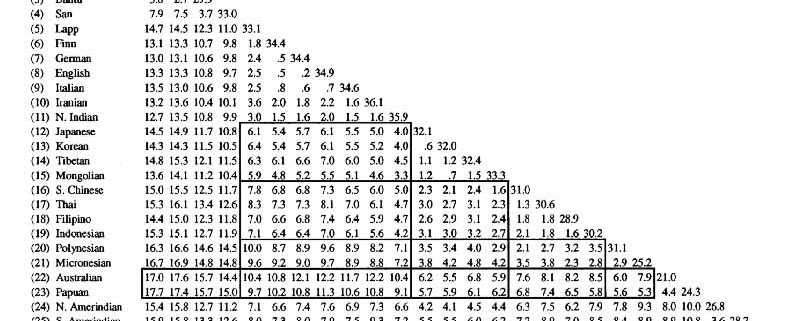
What are the percentages of genetic differences between the human races, indicating their relationships? Perhaps the best global scale study to date on this subject is still that of Masatoshi Nei and Arun K. Roychoudhury from Evolutionary Relationships of Human Populations on a Global Scale (1993). Subsequent studies, which have included increasing numbers of alleles but have usually been regional rather than global in scale, have been consistent with Nei and Roychoudhury’s results. The following table (Fig. 1 below) of estimates of genetic differences between human populations is from their study.

Read more

Human Pre-History and the Making of the Races, Part 1

Since the 1950 UNESCO Statement on Race there has been an increasing tendency to claim, based on Boasian anthropology and in promotion of a multiracialist agenda, that the human races are “socially constructed” and their existence is not supported by science, meaning not biologically and genetically real. This essay is an account, consistent with current scientific knowledge, of how the human races we know historically and today were really constructed.

The human species is blessed with great variety and diversity. Its rich diversity resulted from its global distribution, which caused the different populations of humanity to be geographically separated and thus reproductively isolated. Reproductive isolation enabled divergence — the process of divergent evolution — to occur, causing the isolated populations to evolve in different directions, developing their own distinct ensembles of genetic traits and characteristics.

Divergent evolution is the process by which new life forms are created by the division and separation of life into different branches. Human evolution has seen its share of divergent branching. The generic name commonly used to refer to the genetically different populations—that share a common biological ancestry that distinguishes them from other populations — is race. But in the human species, as in any species enjoying a great degree of variety, the constant branching and dividing that characterize the process of divergent evolution have created many different divisions, each of which possesses a genetic signature which distinguishes it from other divisions at the same level. For purposes of taxonomic accuracy each of these levels should have its own specific name and definition. The first or highest level is the species, and it is simply and objectively defined as including all those populations which are capable of interbreeding with each other and producing fully fertile offspring. The term race is commonly used to refer to a branch or division of the species possessing genetically transmitted physical traits (e.g., skin color) which distinguish it from other branches or divisions of the same level. Adding to this definition, it will here also be defined as including only those persons who are capable of reproduction with each other without alteration of the racially-distinctive genetic traits of either parent stock; that is, the genetically transmitted traits which distinguish a race from other divisions at the same level (i.e., other races) should not be diminished or lost by reproduction within the race. If racially-distinctive traits are lost or diminished by within-group reproduction then the population group is at a level of division too broad and inclusive to be accurately defined as a race. If it is too narrow to be defined as a species, as it does not include all those populations capable of interbreeding, then it is at a level between race and species, which will here be referred to as a subspecies. Read more