Chile’s Immigration Crossroads, Part 1
The most defining trend of our era is the movement of non-Whites, jealous of the prosperous and stable societies created by Whites that they are incapable of building for themselves, flooding and fundamentally transforming White societies—it is the century of Camp of the Saints. The small Latin American nation of Chile, a very White place by Latin American standards, is in no way immune from this trend. In the last 20 years, and especially the last five, non-White immigration to Chile has increased dramatically. “Dramatically” is perhaps an understatement. As of 2017, 1,119,267 people living in Chile were foreign-born. Chile is not a big nation, and this number represents 6.1 percent of the total population. The most common countries of origin are: Peru (23.8 percent), Colombia (13 percent), Venezuela (12 percent), Bolivia (11 percent), Haiti (10 percent), Argentina (7.9 percent), and Ecuador (3.5 percent). Just as with the United States, only in the 1970s did non-European immigration eclipse European immigration in Chile:
| Year | Total Population | Immigrant Population | ||||
| Total | Percent of Total Population | Percent from Europe | Percent from the Western Hemisphere | Percent from Elsewhere | ||
| 1865 | 1,819,223 | 21,982 | 1.21 | 53.7 | 41.4 | 4.9 |
| 1875 | 2,075,971 | 25,199 | 1.21 | 62.3 | 33.0 | 4.7 |
| 1885 | 2,057,005 | 87,077 | 4.23 | 30.1 | 67.2 | 2.7 |
| 1907 | 3,249,279 | 134,524 | 4.50 | 53.3 | 42.7 | 4.0 |
| 1920 | 3,731,593 | 114,114 | 3.06 | 60.0 | 31.2 | 8.9 |
| 1930 | 4,287,445 | 105,463 | 2.46 | 60.0 | 24.6 | 15.4 |
| 1940 | 5,023,539 | 107,273 | 2.14 | 67.2 | 21.7 | 11.1 |
| 1952 | 5,932,995 | 103,878 | 1.75 | 55.9 | 23.4 | 20.7 |
| 1960 | 7,374,115 | 104,853 | 1.42 | 60.9 | 26.1 | 13.0 |
| 1970 | 8,884,768 | 90,441 | 1.02 | 53.3 | 34.4 | 12.3 |
| 1982 | 11,275,440 | 84,345 | 0.75 | 31.8 | 54.5 | 13.7 |
| 1992 | 13,348,401 | 114,597 | 0.86 | 20.1 | 65.1 | 14.8 |
| 2002 | 15,116,435 | 184,464 | 1.22 | 17.2 | 71.8 | 11.0 |
| 2012 | 16,634,603 | 339,536 | 2.04 | 10.5 | 85.6 | 3.8 |
| 2017 | 17,574,003 | 1,119,267 | 6.1 | 12.4 | 83.8 | 3.8 |
As the above chart shows, in addition to immigrants becoming less White in the last few decades, the sheer number of them has increased enormously. In 2012, the immigrant population relative to 2002 increased by a factor of 1.84. In 2017, the immigrant population relative to 2012 increased by a factor of 3.29—and in just half the time. On top of these official figures, there are an estimated 300,000 “irregular” (i.e. illegal) immigrants in Chile today—mostly Peruvians and Bolivians who successfully crossed across the border illegally, and Haitians who have overstayed their visas. Government statistics and tallies are not as precise in Chile as they are in the United States, so everything should be taken with a grain of salt. Regardless, the general trend is obvious.
From the data available across a wide array of sources, I have put together the below table showing the number of foreign-born Chileans by country over the years.
| 1960 | 1982 | 1990 | 1992 | 2002 | 2012 | 2013 | 2015 | 2016 | 2017 | |
| Peruvians | 3,583 | 4,308 | ~ | 7,649 | 37,860 | 103,624 | 117,925 | 130,361 | 266,244 | |
| Bolivians | ~ | ~ | 7,277 | ~ | 10,919 | 25,121 | 33,623 | 37,554 | 122,773 | |
| Colombians | 645 | 1,069 | ~ | 1,666 | 4,095 | 27,411 | 48,894 | 63,481 | 145,139 | |
| Haitians | ~ | ~ | ~ | ~ | 50 | 2,428 | ~ | 48,783 | 112,414 | |
| Argentines | 11,876 | 19,733 | 34,415 | 48,176 | 57,019 | 53,192 | 55,185 | 87,926 | ||
| Ecuadorians | 9,393 | 16,357 | 39,556 |
Other smaller, but not insignificant foreign national populations, as of 2017, include: Spanish (26,177), Brazilian (20,707), American (19,900), Chinese (17,021), and Dominican (9,270). The total number of foreign nationals for 2017 not listed in this paragraph or the chart above was a whopping 117,750.
The biggest blind spot in seriously determining the racial makeup of Chile is that while the foreign/immigrant population is monitored by the government, aside from Amerindians, the same cannot be said of race in and of itself. The broad and imprecise nature of Whiteness in Chile has led to the government, when collecting population statistics, not distinguishing between the historically typical Chilean castizo and the notably darker mestizos of its northern neighbors. Up until recently, this has not been a very big issue because mestizo immigration was minimal. But with the widening streams of Peruvians, Bolivians, etc., coming into the country, it is time for Chile to adopt more particular racial categories. Until then, the demographic data will remain quite incomplete. We know how many people born in Peru are now in Chile, but we do not have good numbers on their specific birth rates, their rates of intermarriage with castizo Chileans, and so on and so forth.
What is certain, however, is that Chile is darkening. With the enormous increases in non-White immigration, as shown in the above tables, it could not be any other way. To make matters worse, Chile’s national birth rate is nearly as bad as the notoriously infertile West: about 13 per 1,000 citizens. By comparison: Belgium, Denmark, and Norway are 11; Germany, Spain, and Greece are 9; Peru and Bangladesh are 19; Bolivia and Cambodia are 23; Nigeria and Mozambique are 39. There has been considerable discussion at American Renaissance, and other dissident websites, about the “world’s most important graph,” that shows the UN’s demographic projections for the globe over the course of the next century.
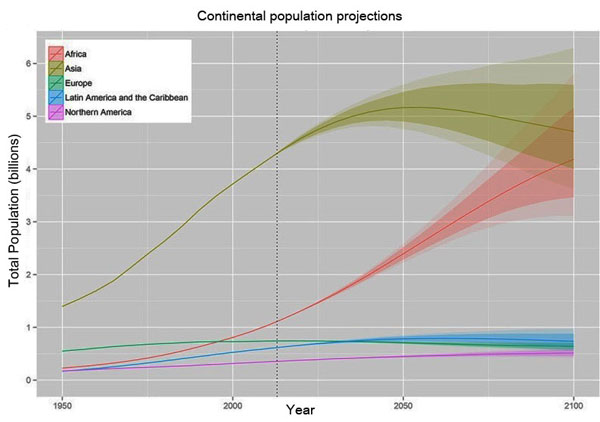
What is not appreciated, however, is that these projections will be just as devastating to the “off White” parts of the world as the White ones. The Arab and Turkic nations of north Africa and Asia may be overwhelmed by sub-Saharan Blacks. Meanwhile, Latin America’s whitish “Southern Cone,” consisting of Chile, Argentina, and Uruguay, will be flooded with mestizos, Amerindians, and not-insignificant numbers of Blacks and Asians as well, if nothing is done. The limited data on group birthrates that is available suggests, as with nearly every country in the West, that immigrants are producing offspring at a much higher rate than the natives, particularly Colombians, Chinese, and Venezuelans; while this could obviously be better (Spaniards, Argentines), we should also be grateful it is not worse (Haitians, Bolivians).
Troublesome Trends
So far, the worst result of this trend is that for the first time in its history Chile has a large Black minority, composed mostly of Haitians, but of Black Colombians and a few Black Peruvians and Bolivians as well. According to Richard Lynn and Tatu Vanhanen’s book, IQ and the Wealth of Nations, Chile has an average IQ of 90. To put that in context, consider these data points:
- Latin America’s two other Whitish nations (which are, admittedly, Whiter than Chile), Uruguay and Argentina, are 96 and 93, respectively.
- The average IQs of Spain and Portugal are 98 and 95, respectively.
- Two other countries with an average IQ of 90 are also what might be considered “off White”—albeit of a very different variety—Turkey and Kyrgyzstan.
- Remember too that Chile’s upper class is very White, composed of descendants from European nations with very high IQs. Some of the most common ancestral nations for the elite include: the United Kingdom, the Basque nation, Germany, and Italy—with average IQs of 99, 99, 100, and 102, respectively.
Haiti, meanwhile, has an average IQ of 67. This gap is even larger than the gap between American Whites, who average a score of 100, and American Blacks, who average a score of 85. (The difference in intelligence between Haitian Blacks and American Blacks is largely accounted for by the aforementioned considerable White admixture American Blacks have and the superior nutrition of the diet of Americans, relative to Haitians.) Moreover, somebody with an IQ of 85 is capable of carrying out basic jobs competently, such as running a cash register. Somebody with an IQ of 67 cannot do much of anything aside from pushing a broom or swinging an axe. This does not bode well for the prospects of Haitians, who speak a version of French, have of learning Spanish.
Along with Uruguay and Costa Rica, Chile regularly earns the distinction of the most peaceful country in all of Latin America—and it is always among the top five most peaceful. Haiti, meanwhile, is such a shithole that good numbers on crime are unavailable. Bolivia is the same way, while Colombia has a murder rate of 27 per 100,000 inhabitants per year—the eighth highest recorded in the world. Chile’s murder rate, in stark contrast, is 3 per 100,000 inhabitants per year. America’s, at 5, is technically higher, but if one were to exclude “certain” neighborhoods in all the major cities, it would be lower than Chile’s.
The Blacks from Haiti and Colombia now in Chile behave just like all Blacks do everywhere—that is to say, criminally. For the reasons already explained, there are no explicit numbers on race and crime in Chile. We can infer, however, the impact made by these new arrivals by comparing absolute crime numbers before and after the immigrant population explosion. The American State Department’s Bureau of Diplomatic Security regularly puts out “crime and safety reports” for foreign nations to advise American tourists and expatriates. In 2014, their report on Chile opened with:
The security environment is generally safe, and there is comparatively less serious violent crime experienced in Chile than in other Latin American countries. Pickpocketing, telephonic scams, vehicular theft, and residential burglaries are far more common than violent crimes like express kidnappings, kidnapping for ransom, and random shootings, which rarely occur. Residents and tourists in Santiago are frequently victims of non-violent pickpocketing. Purse snatching and pickpocketing are most prevalent in crowded, tourist locations and pedestrian shopping areas in Santiago and in subway stations, bus terminals, and on crowded buses and metros.
The same report in 2016 opened with:
The security environment in Chile is moderately safe, with comparatively less violent crime than in other Latin American countries. Pickpocketing, telephonic scams, vehicle thefts, and residential break-ins are the most common crimes against tourists and resident Americans. Violent crime also occurs, most often in the form of carjackings, home invasions, and muggings; express and traditional kidnappings and random shootings are almost non-existent.
Petty crime and residential burglaries (home invasions) dramatically increased in the metropolitan Santiago area in 2015. The largest increases occurred in the eastern sector of the city. According to Carabinero (local police) statistics reported in a January 2016 news story, the affluent community of Lo Barnechea, where many expatriates live due to the proximity to the international schools, “robbery with violence” (assaults) rose 52 percent. Home invasions rose 10.5 percent. Two other communities where many expatriates live and tourists stay are Vitacura and Las Condes. These communities saw a rise in “robbery with intimidation” of 38 percent and 32.5 percent, respectively. The use of violence in residential break-ins also increased in 2015. When residents are home, bats, homemade knives, and increasingly firearms are being used by burglars to intimidate. One tactic involves binding the feet and hands of residents and placing them in a closet while the burglars take valuables.
The difference between 2014 and 2016 is one of a few hundred thousand mestizos and Blacks—there was no policy change or economic crash to explain it away.
As with so many other things, in Chile just as in the United States, mestizos, while not equivalent to the historic stock, are still vastly preferable to Blacks. Bolivia and Peru both have national average IQs on par with American Blacks, 87 and 85, respectively. There is, however, still historical resentment of Chileans over their victory in the War of the Pacific (1879-1884), in which Chile annexed what is today the northern third of its territory from those two nations. Just as many Hispanics in the United States dream of regaining the territory they lost in the Mexican-American War, so do Peruvians and Bolivians covet their long-lost borders. The social and political problems caused by this are exactly what you would expect.
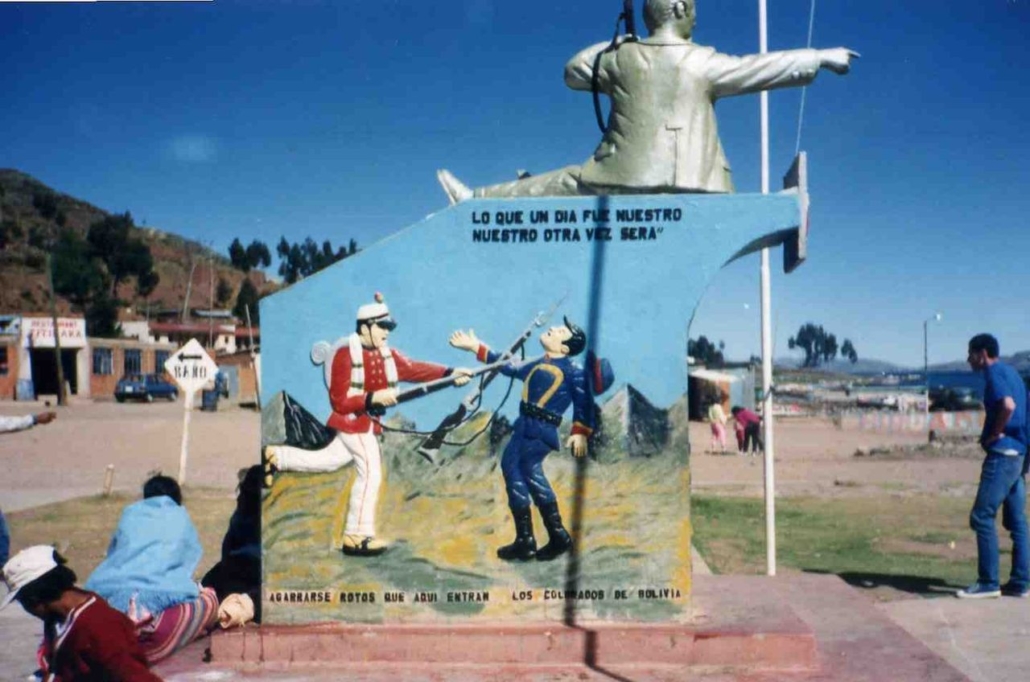
A memorial to the War of the Pacific in Bolivia. The text above the soldiers reads, “What was once ours, will be once again.”
Beneath the soldiers it reads, “Hold on Chileans, here come the redcoats of Bolivia.”
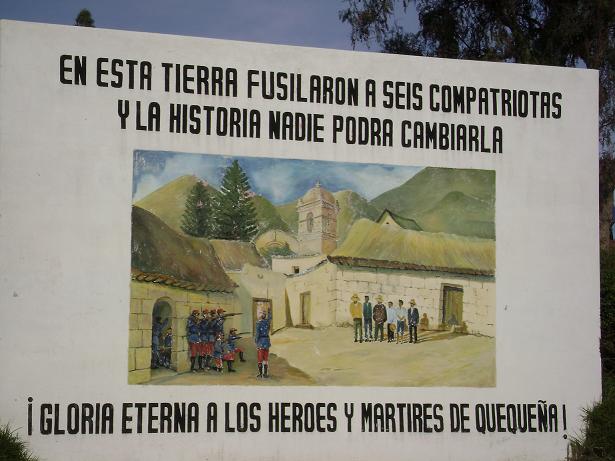
A memorial to the War of the Pacific in Peru. The text reads: “It was here that six comrades were executed—and history cannot be changed.
Eternal glory to the heroes and martyrs of Quequeña.”
These new waves of immigrants are also bringing diseases with them. By and large, Chile avoided the “AIDS crisis” of the 1980s and has always had very low rates of infection. That is starting to change now, as some estimate that the number of new HIV cases has doubled in the last the decade. More conservative estimates put the increase at 79 percent since 2010. Gonorrhea rates are soaring too. From 2010 to 2015, confirmed cases went up by 208 percent. Cases of syphilis, after years of holding steading, and the various kinds of hepatitis are all going up as well.
The fashionable explanation for this sudden jump is that because Chile is such a conservative society, its citizens lack proper education about condom use, and are too embarrassed to seek treatment for any kind of sexually transmitted infections. But if that is the reason for it, why haven’t STI rates always been high? As with crime, the sudden spike correlates chronologically with the sudden arrival of high numbers of Blacks and mestizos. And as with crime, the sudden spike of infections is most apparent in regions with high numbers of immigrants: Santiago, Santiago-adjacent areas, and the northernmost third of the country, especially the city of Antofagasta.
Latin America is no exception to the global trend of Blacks having enormously higher rates of sexually transmitted infections of all kinds than any other race. The Latin American nations with the highest rates of AIDS are Haiti and the Bahamas, both of which are over 90 percent Black. About two percent of adults in Haiti have AIDS—that’s one in 50 Haitians. After two centuries of having no Haitians, Chile now has at least 100,000 of them. Statistically speaking, that translates to about 2,000 new AIDS carriers. I suspect, however, that many of the new infections are coming from Black Colombians. Haitian immigrants are overwhelmingly male—the most reliable statistic putting it at 68 percent. While I cannot find a similar breakdown for Colombian immigrants, I am confident it is much more balanced. And while Colombian men specialize in drug dealing, the women specialize in prostitution. I cannot find hard numbers on this either, but in walking around Santiago, it is quite apparent that Colombian women—especially Black ones—are over represented in the city’s “red light” areas. (The different Black populations in Chile, while not always easily distinguishable at first glance, are easily distinguishable by their accents—the same is true, though less pronouncedly, with the mestizos.) In the northern mining city of Antofagasta, second only to Santiago in number of recent immigrants received, a local politician made headlines in 2014 for commenting that the city’s recent rise in gonorrhea, syphilis, and AIDS was obviously caused by Colombian prostitutes (no race specified), “who, by the way, are very beautiful maidens.” (Spanish language video here.)
Racial Consciousness in Chile
These are all troubling trends, to be sure. But Chile is not without points of light either. Chileans have a strong sense of race lurking just beneath the surface. The connection between race and class, with Whites dominating the upper classes and mestizos dominating the lower classes, is understood and largely accepted by nearly every Chilean. The best evidence of this comes from egalitarian whining about the situation. One blogger has a neat summary of the typical conversation Americans and Chileans have when race comes up:
Chilean person: There are real race issues in the [United] [S]tates.
Me: Yes, there are huge problems. But I think race is a problem here.
Chilean: No, we don’t have race issues here. We do have issues with class.
Me: What do you mean?
Chilean: Well, people of lower class are really looked down upon.
Me: How can you tell who these people are?
Chilean: You just can.
Me: (finding a darker skinned Chilean in the crowd) What about that person… over there… what class are they?
Chilean: They are lower class.
The Whiter the Chilean, the prouder and more protective they are of their Whiteness. Marriages between different economic classes are very uncommon, and this protects the European blood of the upper classes from being diluted. Demonstrating this empirically with objective facts and statistics is difficult, but the signs are all there for anyone who cares to look. Another leftist blogger noted in 2015 that:
A few years ago, there was a study in Chile that consisted on [sic] presenting ten images of people with different skin colors and asking people to identify the subjects as Chileans or not. There was a tendency on [sic] identifying light skinned subjects as Chileans and darker skinned ones as Mapuches (a Chilean indigenous group), Peruvians, or “foreigners”.
In Chile’s domestic media, stories and studies about the terrible discrimination Peruvians in Chile face make the rounds every few years. While these sort of “human interest” pieces are always presented in an obnoxious breathless liberal tone, they are, by and large, true. Chileans are now, and always have been, very aware of race—even if not explicitly so. The recent arrival of Haitians has intensified this consciousness. While they have served as an excuse for academics and journalists to decry racism, the not-quite-silent majority is less than impressed. Just as elsewhere in the West, the comments threads of online articles do a lot to show the common sense of most readers. One article from 2016 I came across, titled, “The Arrival of Haitian Immigrants in Chile has Lit Racism’s Fuse,” shows this perfectly. One commenter wrote, “Haitians first invade and then want to be accepted. Deport them all. The world doesn’t want them.” Another comment reads, in part, “they’re rejected because they are culturally different; as we all know, not every rejection of Blacks is because of racism. If they were White and had the same customs, culture, religion, and manner of invading and devastating places, they would be rejected. Give them time and they will eat every animal and bird, and deforest entire areas.” Another commenter concludes that “the natural idea of the basis of a country and society is to accept immigration that steadily adopts the values of the country, not immigration that in one fell swoop upsets the national identity… Are not visas inherently discriminatory? Some get them, some don’t. Do you not have a right to decide what visitors you receive in your own home?”
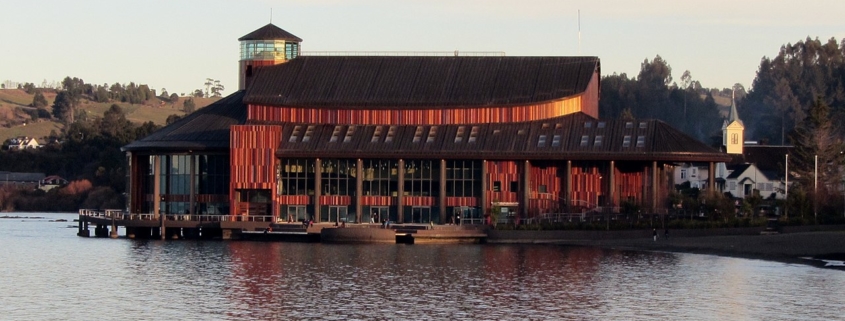
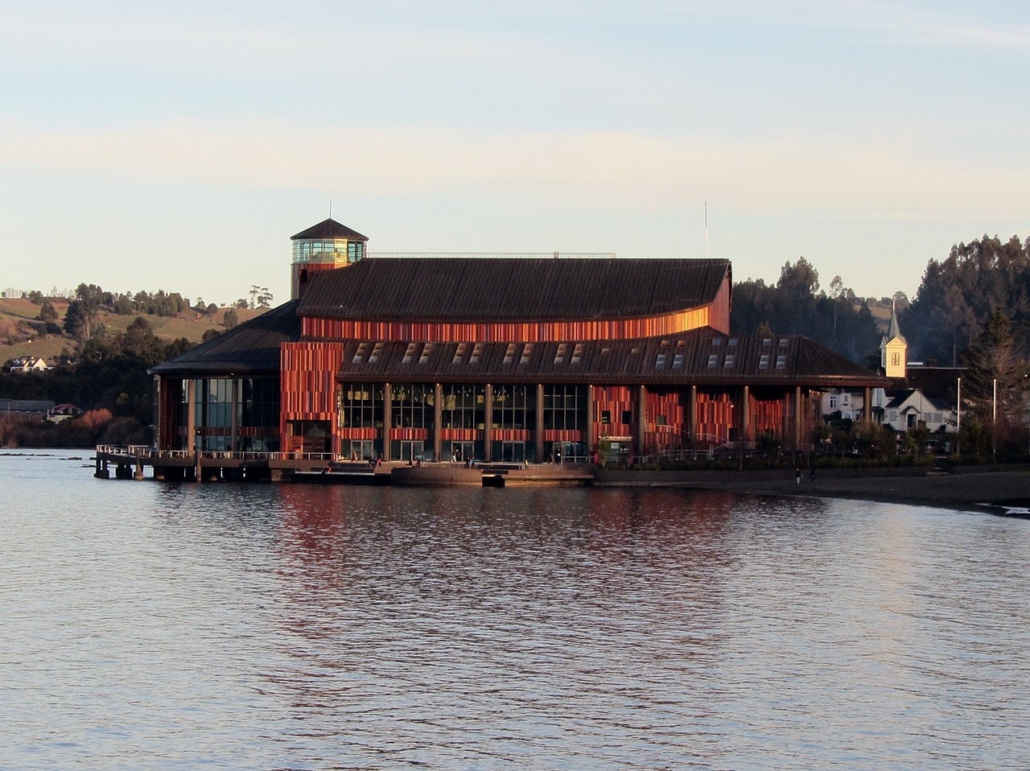
Chileans are also very proud of their country’s many European cultural touches and historical figures. Chile’s two foremost Founding Fathers were very White, Bernardo O’Higgins (Irish) and José Miguel Carrera (Basque). As were all of the major political figures of the twentieth century, whether of the Left or Right,: the Alessandri family (Italian), Carlos Ibáñez del Campo (Irish and Spanish) Pedro Aguirre Cerda (Basque), Salvador Allende (Belgian and Basque), Patricio Aylwin (Irish and Basque), and Augusto Pinochet (French and Basque). The post-independence immigrant group to have the greatest impact in Chile are far and away the Germans. Throughout Chile (and especially in the mid-south), one sees very obviously German architecture and civic groups. The below photo of a German-style opera house and Lutheran church in the city of Frutillar is a beautiful example of this:
Chile also has more citizens of British ancestry than any other Latin American nation, estimated to be around 420,000 today, or about 2.25 percent of the population. As such, typical Anglo surnames are more common than one might think, some examples would be Andrés Chadwick, the right-wing politician; Jorge Edwards, the esteemed novelist; and Juan Williams Rebolledo, the commander of the Chilean Navy during the War of the Pacific.
When polled, at least a third of Chileans have openly race realist views, and all polls about racial matters under-represent how many people hold “racist” opinions because of many people’s unwillingness to admit as much, even to a pollster—commonly called the “Bradley effect” in America. Here are some results from a 2003 poll of Chileans about Peruvians, the largest and most historically contiguous non-White immigration group:
- Chile is more developed than its neighboring countries because it has less indigenous population. (agree 34.1 percent, disagree 65.9 percent)
- The problem of opening up to Latin American immigration is that many Latin American immigrants are indigenous. (agree 35.8 percent, disagree 64.2 percent)
- Some races are better than others” (agree 32.9 percent disagree 67.1 percent)
- It is true that Peruvians need employment but Chilean entrepreneurs should always prefer Chileans (agree 69.4 percent, disagree 30.6 percent)
- If Peruvians get too mixed with Chileans the quality of our people will worsen (agree 33.4 percent, disagree 66.6 percent)
- Peruvian immigrants that come to our country are more likely to commit crimes (agree 43.8 percent, disagree 56.2 percent)
Chile now has its own identitarian movement, called Identitarian Action Chile, clearly modeled after those in Western Europe and the United States. Their symbol is El Torreón, is an eighteenth-century fort built to defend the southern city of Valdivia (named for Pedro de Valdivia, the conquistador) against the Araucanos. Though still small, they appear to be growing, and have regular marches, actions, and pamphletting campaigns against immigration, and for a Chile-first economy. Just as America’s Identity Evorpa seeks to raise awareness about the murders of women such as Kate Steinle and Justine Damond, Identitarian Action Chile raises awareness of murders committed by immigrants in their own country, such as Margarita Ancacoy, who was beaten to death by a gang of Ecuadorians.
Antofagasta is rapidly developing the politics of a nativist backlash as well. In late 2013, when Colombia defeated Chile in a soccer match for the World Cup, Colombians in the city celebrated in the streets, and several fights between them and native Chileans broke out. Since then, the group Antofa Seguro (“Secure Antofagasta”) was founded to pressure politicians to do something about the rising crime rates, drug trafficking, and flooded public schools caused by immigrants. Much like the “Remembrance Project” in the United States, they lead marches and demonstrations highlighting the deaths of citizens caused by immigrants. Antofagasta has long been a bastion of Chile’s Leftist labor movement, but because of immigration, this is starting to change. Consider that in 2012, Karen Rojo, a leftist, won the mayoral election with 47.9 percent of the vote. Marcela Hernando came in second with a distant 29.1 percent of the vote—and she was a leftist as well, and had been the prior mayor of the city. In 2016, Mayor Rojo narrowly won reelection with just 28.1 percent of the vote. In second place, with 22.2 percent of the vote, was Manuel Rojas, an immigration restrictionist and member of Chile’s rightmost mainstream party, the pinochetista Independent Democratic Union. The change was entirely caused by the wedge issue of immigration, which Mayor Rojo refuses to deal with seriously, simply issuing platitudes such as, “The city of Antofagasta was formed by immigrants and nobody can deny that. There is work that Chileans no longer want to do.”
Jobs Chileans in Antofagasta won’t do, but immigrants are all too happy to do, include setting up Brazilian favela-like shanty towns, dealing drugs, prostitution, and expressing hatred for the city’s historic population. Illustrative photos can be found here]
More than one Chilean has advised me to stay away from Antofagasta, saying that the city has been transformed into a den of criminals, and that the only difference between it and Africa is the lack of elephants. In the last several years Antofagasta has become a key layover for drug smugglers bringing cocaine and marijuana in from Chile’s northern neighbors. Though a lot of these drugs are destined for the rest of Chile, plenty are simply headed for Chilean ports where they will embark on a lengthy Pacific journey to America’s west coast. Whenever Mexico and the United States intensify their largely jointed drug war, this drug passage picks up the slack. Drug busts in this part of the country are constant and large.