Featured Articles

Beware of the Anti-Qatar Narrative on the Right

If you criticize Israel on the American right today, expect to be labeled a Qatari shill by a network of pro-Israel commentators who have turned accusations of Gulf Arab money into a political weapon while ignoring the elephant in the room of Jewish influence in American foreign policy. This campaign has intensified dramatically since October 7, 2023, as criticism of Israel’s conduct in Gaza mounted and figures like Tucker Carlson broke with hawkish foreign policy orthodoxy.

The accusations function as a convenient diversion. Anyone arguing that Qatar possesses influence comparable to the Zionist lobby in American politics is simply living on a different planet. The overwhelming Jewish overrepresentation in think tanks, media, business, and other institutions makes the assertion of dominant Qatari influence in U.S. politics risible at best.

The history between Qatar and Israel is far more nuanced and complex than the pro-Israel influencers who accuse Qatar of causing all sorts of trouble would have people believe. Qatar’s relationship with Israel has oscillated between quiet engagement and open antagonism for nearly three decades. Qatar became the first Gulf Cooperation Council state to grant Israel de facto recognition when Israel opened a trade office in Doha in 1996 following a visit by Prime Minister Shimon Peres. That office was closed following the outbreak of the Second Intifada in 2000, briefly re-opened after Israel’s 2005 disengagement from Gaza, and then permanently shuttered again in 2009 in the wake of Operation Cast Lead.

Despite these ruptures, Qatar and Israel have regularly found areas of practical alignment. After Operation Protective Edge in 2014, Israel actively embraced Qatar’s role as Gaza’s financier and mediator with Hamas. Between 2012 and 2021, Qatar transferred $1.49 billion to Gaza—including up to $1 billion in cash—with the approval of successive Israeli governments, according to the Database of Israeli Military and Security Export. Israel itself facilitated these monthly transfers of Qatari funds to keep the electricity grid running and civil servant salaries paid, per the Israel Policy Forum. Curiously, Qatar and Israel were strange bedfellows in the dirty war against Bashar al-Assad’s government in Syria, both working to undermine and eventually topple his regime by late 2024.

Further, Qatar is fully integrated in the United States’s—which is Israel’s de facto bodyguard—security architecture. Qatar hosts the largest U.S. Air Force installation outside the United States at Al Udeid Air Base, paying a significant portion of its operating costs and contributing over $8 billion since 2003. President Joe Biden designated Qatar a Major Non-NATO Ally in 2022, and both Israel and the United States have relied on Qatar as the primary mediator in all hostage release and ceasefire talks with Hamas following October 7.

At the same time, genuine tensions between Qatar and Israel do exist. Qatar has housed Hamas’s political bureau in Doha since 2012, when the group’s leadership departed Damascus following the Syrian Civil War, and has provided an estimated $1.8 billion to Gaza’s Hamas-run government over the years. Qatar’s state-owned Al Jazeera network has consistently given Hamas leaders a platform, which Israeli officials have long viewed as hostile to Israel’s interests, prompting Israel to pass legislation in April 2024 banning the network from operating in the country. Unlike the UAE, Bahrain, and other Gulf states, Qatar explicitly did not join the 2020 Abraham Accords normalization process.

The tensions reached an unprecedented level on September 9, 2025, when Israel conducted airstrikes on residential buildings in Doha’s Katara district housing Hamas’s political bureau. Hamas confirmed the strike killed five of its members, while Qatar confirmed that one member of its Internal Security Force was also killed. It was Israel’s first direct strike on a Gulf Cooperation Council member state, drawing condemnation from Qatar, Saudi Arabia, and the UAE.

This complicated history, however, is precisely what pro-Israel commentators, who are largely of Jewish extraction, prefer to ignore. Josh Hammer, Newsweek Senior Editor at Large, author of Israel and Civilization, and host of The Josh Hammer Show, has been among the most vocal critics. In a December 2025 Newsweek piece titled “Foreign Forces Are Sowing Discord on the Home Front,” Hammer explicitly accused Tucker Carlson, Nick Fuentes, and others of being corrupted by Qatar’s soft power offensive, arguing that “many on the American Right spent the better part of two decades warning about the corrosive influence of Qatar’s soft-power ventures.” In a separate piece titled “Operation Divide MAGA,” Hammer wrote that Carlson had “evinced an unhealthy obsession with the Jewish people and the state of Israel,” accusing him of entertaining “Hitler/Nazi apologia” and arguing that Carlson and Candace Owens have embarked “down this dark, well-trodden path” of promoting anti-Israel narratives on the right.

Laura Loomer launched some of the most aggressive personal attacks, publicly accusing Tucker Carlson of being “controlled by Muslims” and dubbing him “Tucker Qatarlson” in a series of posts beginning in mid-2025. Her accusations were rooted in a Washington Examiner investigation revealing that Lumen8 Advisors LLC—paid $180,000 per month by the Embassy of Qatar for “media and communication coaching and consulting services” per FARA records—helped facilitate Carlson’s March 2025 interview with Qatari Prime Minister Mohammed bin Abdulrahman Al Thani, which garnered nearly 6,000,000 views. Loomer claimed Qatar had paid over $200,000 for the interview, though the actual FARA filing showed no disbursement to Carlson or his company, and TCN CEO Neil Patel denied any payment.

Fox News host Mark Levin coined the nickname “Chatsworth Qatarlson” for Tucker Carlson and repeatedly accused him of being paid by the Qatari government in connection with the Israel-Iran conflict. Levin also questioned whether Tucker Carlson Network CEO Neil Patel should “register as foreign agents under FARA” following Patel’s appearance at the Doha Forum.

David Reaboi, a Jewish national security consultant, author of Qatar’s Shadow War, founder of Late Republic Nonsense, and a Claremont Institute fellow, has spent years building the analytical infrastructure for critiques of Qatari influence. In a 2019 speech, Reaboi stated that “Today there is no more important bankroller of the Muslim Brotherhood and Hamas than Qatar,” and argued that Qatar is “savvy when it comes to information warfare” as well as lobbying for favorable policies in Washington. Even Israel’s Diaspora Minister Amichai Chikli joined the chorus in early 2026, publicly stating that “Currently in America, the greatest threat is Tucker Carlson, who is most likely paid by Qatar.”

The Qatar accusations flooding conservative media represent an attempt to deflect attention from the far more extensive and documented influence of pro-Israel forces in American politics. While Qatar certainly engages in lobbying and public relations, the scale pales in comparison to organizations like AIPAC, JINSA, ZOA, WINEP and the broader infrastructure of Zionist political power that operates through campaign contributions, think tank funding, media ownership, and dense networks of organizational influence across every sector of American elite life. Those invoking the Qatar specter to discredit critics of Israel are engaged in misdirection, hoping Americans will not notice who shapes their country’s Middle East policy and silences dissent through accusations and eventual censorship campaigns rather than arguments.

To blame Qatar for America’s foreign policy misadventures is a calculated misdirection designed to insulate the real center of influence from scrutiny. The relentless focus on Gulf states is a tactical smoke screen maintained by Jewish media agents to keep the American Right from identifying the genuine sovereign in foreign policy decision-making. Until we have the courage to acknowledge that our Middle East policy is dictated by organized Jewry—not Qatar—we will remain a hoodwinked and occupied nation.

When Jews ran the Gulag

INTRODUCTION

Few people realize how very Jewish the government of the Soviet Union was in its first two decades. Given the realities of publishing in today’s world, those who wish to learn more could read numerous books, encounter a blizzard of unfamiliar Russian names, and never realize that many of the crucial figures were actually Jews. Anne Applebaum’s Gulag: A History is a great example of this phenomenon. Applebaum, a Jew, wrote almost six hundred pages about the Gulag, but mentioned the three Jews who headed it in the 1930s (Kogan, Berman, and Pliner) less than a dozen times, and never let the reader know that they were Jews. She did not discuss the administration of the Gulag, nor the men who staffed it. There is no “Jew” in her index, only “Jewish prisoners.” Thus, the only Jews in her “history” are victims; the fact that Jews ran the entire Gulag system and were responsible for the death of hundreds of thousands of people (and the terrible suffering of millions more) is whitewashed from the record. This is nothing less than a willful and severe distortion of the historical record, and it is replicated in so much of what was published on the Soviet Union.

This article aims to provide a modest correction. We will look at the three Jews who headed the Gulag in the 1930s, and their boss, the head of the NKVD, Genrikh Yagoda.[1] These four men—full-blooded Jews all—ruled over millions of prisoners who were treated essentially as slaves with no rights, and worked them, by the hundred thousand, literally to death. They ruthlessly sent millions of Soviet citizens into some of the harshest climates on earth to create cities and industrial complexes with little more than their bare hands. The goal was to develop the country’s natural resources and carry out a breakneck industrialization, to prepare for the next world war, the aim of which was to communize the entire world. The mortality and suffering were horrifying, but these malevolent figures evidently believed it was a worthy exchange for that perfect communist future. (Or, rather, they never cared enough to even make that calculation.)

The term “Gulag” is shorthand for Glavnoye Upravleniye Ispravitelno-Trudovykh Lagerey, or “Main Administration of Corrective Labor Camps.” This agency dates from 1930, well after the Bolsheviks erected the first camps in 1918. At this time all the camps were finally brought under a central organization, within the purview of the secret police. Historians estimate that eighteen million people were sent to the camps and that 1.6 million of them died, although some admit the true number of deaths could be far higher.[2] In the history of the Gulag there existed almost 500 major groups of camps, with the total number of individual camps rising toward 30,000.[3] The Gulag administration was finally abolished only in 1960, although some camps continued in existence. The structure and method of the Gulag in these three decades were largely established by the following four men:

GENRIKH YAGODA  

Genrikh Grigorievich Yagoda was the highest-ranking Jewish secret police official in the history of Soviet Russia.[4] He headed the NKVD from 1934–1936 but was effectively in control for years before that. During his time in power, his policies and actions resulted in the murder (not “death”) of almost ten million people, with millions more enslaved in concentration camps. It is true that the real driver of policy was Stalin, but Yagoda freely chose to cooperate—participating in high-level policy-making—and implement the program. The Jewish people have never issued an apology for his actions, nor for any other Jewish Bolshevik mass murderer. (Rather, Communist criminals such as Salomon Morel and others find refuge from prosecution in Israel.)

Born in 1891 as Genokh Gershevich Yagoda, he grew up in Nizhni-Novgorod, his family closely associated with the Sverdlovs, with whom they were related.[5] Yagoda entered the revolutionary movement before the age of sixteen, participated in the October Revolution in Petrograd, and joined the Cheka. By 1920 he was a member of the ruling panel of the Cheka, the Collegium. Three years later he was second deputy chairman of the OGPU[6] and by 1926 first deputy chairman under Vyacheslav Menzhinsky, whose chronic illness placed Yagoda essentially in charge by 1929. During most of the 1920s Yagoda was deputy head or head of the important Special Department, which handled counterintelligence and surveillance of the entire country and all its institutions; it was a post that afforded him great power in the murky world of a secret police dictatorship.[7]

Yagoda as a dandified young revolutionary, age twenty, in a mug-shot from 1912. Yagoda was arrested in connection with a revolutionary bank-robbery, for which he had purportedly provided material for explosives. The senescent Tsarist government soon amnestied him, and he moved to St. Petersburg and married Yakov Sverdlov’s niece.

Yagoda and his wife Ida Averbakh in 1922. Yagoda was already a Chekist of very high rank. Two eastern European Jews—among hundreds of thousands—enjoying the trajectory from shtetl to power on a world stage. Ida became a state prosecutor in Moscow.

Since 1918 the concentration camp system had grown apace, and in April 1930 it was brought under a unified administration, the Gulag (within the main structure of the secret police).[8] Stalin had made the decision to utilize forced labor to develop the vast natural wealth of the country and spur industrialization, influenced by his secret police officers, who had been using prisoners to harvest timber in the north and touting their success. (The Jew Naftali Frenkel was instrumental in this development.)[9] Under Stalin, Yagoda worked closely with the heads of the Gulag—his subordinates—to form the economic goals of the massively expanded system of camps. One of the earliest major projects was the ill-fated White Sea-Baltic Canal, built in 1931–1933 at the cost of at least 25,000 lives. An even bigger undertaking, the Moscow-Volga Canal, followed. Both these enterprises were headed by a swarm of secret police Jews, under the overall command of Yagoda.

Another massive and lethal program he supervised was the collectivization of the farmers (1929–1933).[10] This involved skimming off the class of “kulaks,” supposedly wealthier farmers, and sending them to the Gulag or into internal exile—about two million people, of whom an estimated half a million died. Then the other farmers were forced off their lands and onto state-run farms, in order to regularize output and fuel industrialization. It was the destruction of the way of life of 120 million people. It culminated in the “Harvest of Sorrow” (1932–1933) in which the state—the NKVD—used famine to break the pervasive resistance to collectivization. Six to eight million died in Ukraine and other areas.[11]

In 1934 Menzhinsky died and Stalin made Yagoda General Commissar of the restructured security administration, the NKVD. His power was immense: the secret police, the Gulag, the border troops, special NKVD troops, the regular police, all-embracing surveillance. He accumulated great wealth at his three lavishly-decorated residences: foreign wine, clothing, guns, pornographic films, and cash.

However, Stalin wanted to get rid of Yagoda, who did not wholeheartedly support collectivization or the show trial of the Old Bolsheviks Zinoviev and Kamenev (August 1936), a crucial step in Stalin’s consolidation of total power.[12] Stalin was grooming Yagoda’s successor, Nikolai Yezhov, and wanted to break up the old leadership of the secret police. Thus, on 25 September 1936, Stalin demoted him to Commissar of Communications. For months Yagoda twisted in the wind, barely showing up to work, making paper airplanes when he did. Yezhov arrested ninety percent of Yagoda’s top men and brought in his own group, many of whom were Jews.

Yagoda at his desk in the early 1930s, apparently cultivating an aura. He was lauded in the Soviet press for his “success” in finishing the White Sea-Baltic Canal on schedule.


Yagoda as imperious chief of the NKVD, 1936. Despite the lofty decorations, his face clearly shows insecurity. The mustache has been trimmed into the then-popular “toothbrush” style, à la Charlie Chaplin. The uniform greatcoat is ugly and unimaginative, like virtually the entire Soviet aesthetic.

Finally, in late March 1937, NKVD officers took him into custody. Among the men who interrogated (and beat) him were numerous Jews.[13] Stalin ordered his investigators to concoct a vast fictional conspiracy and place Yagoda in the center of it: he was accused of spying for foreign nations, including Germany, plotting to assassinate Stalin, and poisoning several prominent people, including his predecessor Menzhinsky and the writer Maxim Gorky. NKVD interrogation teams put  him through lengthy and exhausting rehearsals of his “guilt.” In his cell he “wept constantly [and] fought . . . for breath.”[14] He also made a highly revealing comment to one of his interrogators: “You can put down in your report . . . that I said there must be a God after all. From Stalin I deserved nothing but gratitude for my faithful service; from God, I deserved the most severe punishment for having violated his commandments thousands of times. Now look where I am and judge for yourself: is there a God or not?”[15] Yagoda was officially an atheistic materialist, but, like Stalin, the old religion seemed to be lurking in the unconscious spaces of his mind.

The third and final show trial, featuring Yagoda and Nikolai Bukharin, took place in March 1938.[16] Yagoda admitted guilt in general while disputing details;[17] no matter, he was shot anyway, despite a final plea for clemency—to be allowed to work as a laborer on one of his canals. Stalin exterminated practically his whole family: parents, wife Ida, siblings. His son, Genrikh, grew up in an NKVD orphanage, did five years in the camps, and later emigrated to Israel.[18] A fitting coda to the family story: in three generations they went from a (probably) observant Jew in a shtetl to a (nominally) atheistic, all-powerful Bolshevik commissar, to a deracinated elderly Jew in Israel, where the fourth generation might well become militant Jewish nationalists.[19] What a trajectory!

LAZAR KOGAN

The cheerful reformer of mankind through (slave) labor.

Lazar Iosifovich Kogan was the head of the Gulag for two years (June 1930 – June 1932), the first of three Jews who consecutively held that post, and personally directed the construction of both the White Sea-Baltic and Moscow-Volga canals, at least up to August 1936.[20] Possibly a hundred thousand people under his control—in the camps and on huge forced-labor projects—died of malnutrition, overwork, and execution. He was a ruthless exploiter of forced labor who claimed he was doing it for their own good, and for a glorious future for all mankind.

Kogan was born in or near Krasnoyarsk, Siberia, in the family of a wealthy fur trader, in 1889. By 1905 he was a revolutionary (or a violent criminal—often the two overlapped) and in 1908 he was sentenced to death by a military court in Kiev for armed robbery and murder carried out in the company of purported anarchists.[21] The sentence was changed to life at hard labor because of his young age. He then served his sentence until the Provisional Government amnestied political prisoners after the fall of the Tsar, in early 1917. No lasting ill effects are recorded as a result of his sentence, unlike what befell his own later victims.

During the Russian Civil War he joined the Bolsheviks and served in the Red Army and the Cheka. He was head of the Special Department (Cheka) of the Ninth Army, handling counterintelligence and suppression of counterrevolution, which meant he ordered the execution of anyone viewed as a threat to Communist power. He held the same office for the Terek region in the north Caucasus, killing Cossacks and others en masse. Then he moved to Dagestan on the Caspian Sea and crushed all opposition there. In 1926 he became the assistant to the head of the OGPU troops and border guards, a considerable force. Then in June 1930 he became the head of the Gulag and his career as slave master began.

In 1930 the campaign of collectivization was filling the Gulag with new prisoners, and the NKVD was gearing up to align the camps with the economic goals of the regime on a more ambitious scale. The number of prisoners in the camps doubled in Kogan’s tenure, to over 370,000 in mid-1932.[22] The two aforementioned canals were initiated, and in November 1931 he took on the management of the construction of the White Sea-Baltic Canal. The following May he simultaneously took over the same position at the Moscow-Volga Canal. The next month, June 1932, he stepped down from leading the Gulag (Matvei Berman took over) but remained deputy head. He concentrated on building the canals that were viewed by the regime as so emblematic of the developing socialist society.

The White Sea-Baltic canal required digging 140 miles through a landscape “largely composed of sheer granite,” with very little machinery, which was expensive and relatively rare.[23] The workers did the vast bulk of the digging and building by hand, with shovels and wheelbarrows. Soviet publicists made much fanfare of the value of manual labor in redeeming criminals and making them fit citizens of the socialist state, and Kogan at least paid lip service to the idea. However, food supply and living and working conditions were usually awful, because of official embezzlement, negligence, and callousness, and workers died in droves. Rations were tied to work performance, with a drastic reduction to starvation level for workers who did not meet the overly ambitious production goals (Kogan and the other directors of the canal were desperate to finish on time to impress Stalin and expand their role in the economy). At least 25,000 and perhaps as many as 50,000 people died. They were often thrown in unmarked mass graves; many died in accidents, being buried in dams or falling into huge concrete pourings. The canal was finished on schedule (August 1933) and the top organizers were fawned over in the press and given awards.[24] Six administrators, all Jews—Yagoda, Matvei Berman, Kogan, Naftali Frenkel, Semyon Firin, and Yakov Rapoport—were given the highest state award, the Order of Lenin (along with two Russian engineers.)[25] Many of the prisoners and staff were then transferred to the Moscow canal.

Kogan with a delegation visiting the building site of the Moscow-Volga Canal, circa 19351936. The diminutive Kogan sports a leather trench coat, center.

The Moscow Canal—linking the Moskva River in Moscow with the Volga river to the north—was even more ambitious, with an estimated 600,000 prisoners cycling through in the nearly five years of construction, although the maximum at one time was 195,000. The death-toll here was another 25,000–50,000 (anonymous mass graves are still periodically found along the line of the canal)[26] and 2,500 more prisoners were dispatched to the Butovo shooting ground and executed after the project was finished in July 1937.[27] By that time, however, Stalin had relieved the pint-sized Chekist of his NKVD posts and shunted him off to the Timber Commissariat (August 1936).

An inspection of the Moscow-Volga Canal. Yagoda is front-center, Semyon Firin is on the left, and tiny Lazar Kogan is far right. Nikita Krushchev, an official in the regional Moscow Communist Party, appears behind Yagoda in a belted white tunic.  

Kogan was arrested in January 1938, accused of “having been, since 1930, a participant in an anti-Soviet terrorist organization operating within the NKVD system,” and sabotaging the timber harvest.[28] The Supreme Court of the USSR passed a sentence of death, and on March 3, 1939, NKVD executioners shot and buried him at one of Moscow’s secret execution sites, the Kommunarka shooting ground, reserved for high-ranking officials.

 MATVEI BERMAN

Matvei Davidovich Berman, a short, stocky, red-haired Chekist, was chief of the Gulag from June 1932 to August 1937, with a million slaves under his absolute control, working on gigantic building projects all over Russia, in conditions so horrific they beggar description. At least 200,000 people died in the camps during his tenure. His name recognition is infinitesimal compared to the notoriety he deserves.

Berman was born in 1898 in the Chita district, east of Lake Baikal. His father owned a brick factory; his two brothers, Boris and Yuri, would also serve in the secret police. He joined the Bolshevik Party even before they seized power, then served in the Red Army. He entered the Cheka in August 1918 and became head of the Glazov City Cheka. After only a month, the twenty-year-old was expelled from the Party for drunkenness, but was soon reinstated, and went on to hold leading posts all over the Urals, the Far East, and Central Asia. He proved himself a very effective operator, exterminating anti-Soviet elements, suppressing rebellions, sending his agents into China to conduct sabotage and kidnap expatriate White Russians. In 1927 he became chairman of the secret police (then called the OGPU) over the entire Soviet Republic of Uzbekistan. His superiors obviously trusted him, and in July 1930 they named him deputy head of the Gulag. He was only thirty-two.

Berman as a young, rather severe Cheka commissar. The gaze is weirdly intense for a formal portrait.

Berman immediately took an active role in organizing the large economic projects assigned to the Gulag, beginning with the White Sea-Baltic Canal. He showed himself a ruthless exploiter of forced labor. He fired off memoranda demanding thousands of new slaves, carried out whirlwind inspections, and presided over the full transition of the Gulag to a major economic role in “building Socialism.” After the “success” of the White Sea-Baltic Canal, a number of huge initiatives were launched or expanded: the Moscow-Volga Canal, the Baikal-Amur Railroad, coal mining in Uzbekistan, the construction of the city Magnitogorsk as a center of steel production, gold mining in Kolyma, nickel mines at Norilsk north of the Arctic circle, and even the construction of the massive factories famous from the siege of Stalingrad: Red October and the Barrikady. There were hundreds of other enterprises, in every corner of the country, and in June 1932 Berman assumed total control over them, being named head of the Gulag, succeeding Kogan. In connection with these economic projects and the collectivization campaign, Berman supervised a vast expansion in the number of prisoners. By 1937 there were many groups of camps, all of them encompassing dozens or hundreds of smaller satellite camps. These groups had separate local administrations, so there were a large number of officials ruling over the prisoners, and Jews were well-represented among their number.

Berman visiting the White Sea-Baltic Canal construction site in 1932. He is inthe center, hands behind his back. Naftaly Frenkel is on the far right. Berman radiates self-confidence and menace. On the left is another Jewish chief of construction of a sector of the canal, Grigory Afanasyev who is mentioned below as the head of military construction sites and labor camps all over western Russia until 1952.

A particularly egregious exploitation of human life was the effort to extract gold from the far northeastern region of Russia, in the Kolyma River basin. Soviet leaders coveted the gold because it could finance the import of modern industrial technology, but extreme climatic conditions meant that free labor would never move there. They would have to use forced labor, and the basic infrastructure would have to be built first: roads, a port, settlements, etc. The effort began in 1931 with the founding of Dalstroy, the Far Northern Construction Trust, under OGPU control, to direct the venture. The following summer—just after Berman became head of the Gulag—Dalstroy began sending out steamers each packed with ten thousand carefully guarded people. When they arrived at present-day Magadan on the north shore of the Sea of Okhotsk, the bosses informed them that their living quarters—cheap barracks—would have to wait; they had to build the port and the town first:

With bare hands they constructed piers for ocean steamers, setting up caissons weighing many tons under the steep cliffs where the sea was 12 to 15 feet deep at the water’s edge. They cut broad roads through the stone, leading down to the piers. They built . . . a sawmill, a brickyard, a fish-salting factory, ship repair yards, a power station. They began draining the swamp and clearing the parts of the taiga adjacent to the spot selected for the future town, felling and rooting up trees. . . . They built houses for the administrative staff . . . for the GPU troops they built “cold-resistant barracks” with double walls filled in with sawdust . . . [yet] through the summer and late into the autumn the workers lived in huts made of branches.[29]

That autumn groups of workers were sent north to begin preparatory work for the construction of a road leading to the gold deposits (the road became known as “the road of bones”). That winter the death toll was great, but Gulag administrators were supplied with plenty of ships and people. They began sending ships through the Bering Strait to deliver workers to the mouth of the Kolyma River, which empties into the Arctic Ocean (one such ship, the Dzhurma, got stuck in the ice and arrived after a year’s delay without a single one of its 12,000 prisoners still alive).[30] These parties began building a road south to meet the workers moving north. That summer they managed to begin mining the placer deposits of gold. By 1939 there were 140,000 prisoners in the area and they extracted 53 tons of gold, thirty-five percent of total Soviet production.[31] The mining of the gold was eventually mechanized and 88 tons were produced in 1941. Needless to say, the conditions of work and life were even worse than elsewhere in the Gulag. The cost in human suffering, despair, and death is incalculable. Estimates of deaths range from 140,000 to a million. (The horror of Kolyma was so great that Robert Conquest, a very judicious researcher, in his 1978 book Kolyma put the death toll at three million people.) Berman is not on record as expressing regret or sorrow over the human lives lost.

In August 1936 Berman became head of the construction of the Moscow-Volga Canal; in September he became deputy head of the NKVD, under the new man Yezhov, who replaced Yagoda. In 1938 he was a deputy of the first meeting of the Supreme Soviet of the USSR. He was reaching dizzying heights, often the prelude to a fall under Stalin. On April 22, 1937 he escorted Stalin on a tour of the Moscow Canal, not long before its official opening. That August, however, Stalin removed him from his NKVD posts and made him Commissar of Communications, a radical demotion. Stalin, you recall, made the same move with Yagoda just a year before.

Berman (on left) escorting Stalin on a visit to the Moscow-Volga Canal, April 1937. Semyon Firin is on the right; within days Firin was arrested.

Stalin had Berman arrested in December 1938. Stalin had just called a halt to the sixteen-month crescendo of executions called the “Great Terror,” and Lavrenti Beria had replaced Nikolai Yezhov as secret police chief. Yet another purge swept through the NKVD, and Berman was caught in the trap. He was accused of leading a counterrevolutionary terrorist group in the NKVD, sabotaging the major projects carried out by the Gulag, and spying for Germany. Presumably he was tortured, but by March 7, 1939, it was over. He also was taken to Kommunarka and shot. Lazar Kogan had been shot there just four days earlier, and Berman’s brother Boris two weeks before.[32] The camp system and its projects continued on, however, growing ever bigger until the death of Stalin in 1953, largely on the lines laid down by Matvei Berman, one of the greatest slave-drivers in recorded history.

Berman in the hands of NKVD interrogators, his eyes moist, clearly struggling to process what is happening to him. The self-confidence is utterly gone, replaced by unconcealed anguish.

IZRAIL PLINER

Izrail Izrailevich Pliner was head of the Gulag from August 1937 to November 1938. This was the exact period of Stalin’s Great Terror with its 1.5 million arrests and 700,000 executions. Hundreds of thousands of unfortunates flooded into the camps. Immense economic endeavors utilizing Gulag labor continued apace, and more were initiated. Pliner did not last long in this post, but he perpetuated and expanded the inhumane regimen that his Jewish predecessors had established.

The clean-cut high-ranking Chekist.

Pliner was born in 1896 in what is now northern Belarus, in the Pale of Settlement. He worked in various occupations as a young man: brewer’s assistant, wagon driver, conductor on the railway, even fishing in Astrakhan. His family was religious and wished him to become a rabbi, but when the Revolution came, he plunged into the maelstrom. After the Bolsheviks took power and the Civil War began, he entered the Red Army, serving until 1926 in the supply services as quartermaster. In 1922 he entered the Communist Party. He transferred to supply roles for OGPU special purpose troops in 1926. He worked in the Moscow region and came to the attention of high officials; as a result, they tapped him as assistant head of the Gulag in February 1933, where he remained until he ascended to the head position in August 1937.

Pliner’s responsibilities as deputy head of the Gulag included supervising logistics and prisoner allocation to the various enterprises based on need. The camp population soared over the one million mark around 1936, and neared two million by the end of 1937. Pliner took measures to improve the function of the camps by ordering the release of sick and disabled prisoners, but the pressure to increase productivity prevented him from introducing a more humane regime. He, like his predecessors, urged camp bosses to drive the workers harder. In the circumstances—chaotic food supply, crowded camps, inadequate infrastructure—this meant that people were worked to death. 108,000 deaths were recorded in the camps in the year 1938; the real number must have been at least fifteen percent higher than that.[33] In 1937–38 there were also mass executions in the camps, part of the program of the Great Terror.[34]

In a group photo alongside a somewhat chubby Matvei Berman, with an enigmatic expression. He is reminiscent of Jeffrey Epstein here.  

From July 1936 to November 1938 he was also deputy head, then head of the NKVD Resettlement Department. Almost immediately he took charge of the operation to deport 175,000 Koreans from the Far Eastern border (adjacent to Korea and China) to the interior of Russia, to Central Asia. Stalin suspected the Koreans of disloyalty. Little was provided to help the Koreans resettle in the new areas, and mortality was significant.[35] Pliner was awarded the Order of Lenin for managing this great crime.

It was during Pliner’s tenure that the propaganda about redeeming criminals through labor was dropped. “As the political rhetoric grew more radical, as the hunt for political criminals intensified, the status of the camps, where these dangerous [counterrevolutionaries] resided, changed as well.”[36] Now the camps were full of deadly enemies of the state, who needed to be destroyed, not redeemed. The harder attitude was reflected in harsher conditions in the camps, and this became systematic, not merely informal. Rations were reduced, security was tightened. Correspondence was restricted and controlled. Prisoners, who had been called by their names or occupations, now became strictly a “zek,” short for the word prisoner: zaklyuchennyi. A group of prisoners became a “contingent.” Guards stopped calling prisoners “comrade,” which had a surprisingly baleful effect on the morale of the prisoners.

In the camps, “enemy of the people” now became an official term. . . . Women were arrested as “wives of enemies of the people” after an NKVD decree of 1937 made such arrests possible, and the same applied to children. Officially, they were sentenced as . . . “Member of the Family of an Enemy of the Revolution.” Many of the “wives” were incarcerated together in the Temnikovsky camp.[37]

The dislocations produced by the Great Terror damaged the efficiency and productivity of the camps. Prisoners with skills (who ran the camps to a large extent) were no longer trusted, or were killed off. The huge influx of prisoners produced chaos; 700,000 people poured into the system in 1937 alone.[38] That year and the next over 140,000 people died in the camps.[39] The economic output of the camps fell by about thirteen percent. In such conditions it was easy to get rid of Pliner.

Pliner after his arrest. He still looks defiant, nostrils flared and lips pursed, but he knows what is coming.

Pliner was arrested on November 14, 1938, as part of the transition from Yezhov’s rule to Beria in the NKVD (Beria replaced Yezhov on November 25). He was accused of spying for Germany and participation in an anti-Soviet conspiracy in the secret police. On February 22, 1939, he was sentenced to death by the Supreme Court of the USSR, and the next day he was shot. It was a dangerous occupation, this Gulag business.

Pliner was the last Jewish head of the Gulag, but his ouster was not the end of highly-placed Jews in the central administration of the Gulag, nor in the huge number of camps and construction projects that continued through World War Two and into the 1950s. A few examples: Zinovy Aleshinsky was deputy head of the Gulag administration in 1939.[40] Yakov Rapoport headed a number of camps and construction sites up until his retirement in the mid-1950s.[41] Naftaly Frenkel was deputy head of the Gulag in 1941 and up until 1947 was head of the Main Directorate of Railway Construction Camps.[42] Grigory Afanasyev (pictured above) headed military construction sites and labor camps all over western Russia until 1952.[43] Alexander Usievich was deputy head of the Gulag in the 1940s and headed camps and construction projects until he retired in 1954.[44]

SUMMARY

If the faces and deeds of these men—and other Jewish Bolsheviks—sink deeply into the popular consciousness, a dramatic change in attitude toward the Jewish Question will become irresistible, much as the recent Gaza slaughter catalyzed a powerful reaction against the Jewish state and a growing appreciation of its genocidal imperative. Hopefully this article can help raise these four representatives of the Jewish nation to the profile they deserve, in the front rank of the greatest mass murderers of history.

These men were not simply mass murderers, however; their plan was global genocide. Communism from the beginning had worldwide ambitions, and these men strove to make that a reality. Had they gained such power, they would have exterminated everyone who stood out from the common mass of humanity. It would have been (and was, in Russia, for decades) a particularly monstrous program: kill everyone of worth so the rest could be enslaved. In this sense, the agenda of communism seems identical to that of Talmudic Jewry. Thankfully, Stalin eventually handed the state over to ethnic Russians, displacing the Jews, and Communist Russia lost much of its dynamism and lethal ferocity. Yet another form of secular Jewish messianism had run its course, leaving a husk of a host nation behind, profoundly scarred and traumatized.

These examples of Jewish mass murderers are not of merely historical interest. Realize that if ever an anti-White government came to  power with unlimited power as was the case in the USSR, there would be no shortage of Jewish executioners ready and willing to engage in mass murder of the traditional American White majority. The hatred is already there—the holocaust perpetrated by a White, Christian society, the 1924 and 1952 immigration laws, the exclusion of Jews from Ivy League schools and Wall St. financial firms in the early decades of the twentieth century, etc.

From Kevin MacDonald’s review of Yuri Slezkine’s The Jewish Century:

Jewish involvement in the Communist elite of the USSR can be seen as a variation on an ancient theme in Jewish culture rather than a new one sprung from the special circumstances of the Bolshevik Revolution. Rather than being the willing agents of exploitative non-Jewish elites who were clearly separated from both the Jews and the people they ruled, Jews became an entrenched part of an exploitative and oppressive elite in which group boundaries were blurred. This blurring of boundaries was aided by four processes, all covered by Slezkine: shedding overt Jewish identities in favor of a veneer of international socialism in which Jewish identity and ethnic networking were relatively invisible; seeking lower-profile positions in order to de-emphasize Jewish preeminence (e.g., Trotsky); adopting Slavic names; and engaging in a limited amount of intermarriage with non-Jewish elites. …

Although the replacement of Germans by Jews was well under way by the time of the Bolshevik Revolution, a key consequence of the Revolution was the substitution of one Mercurian group, the Germans, by another, the Jews. The difference between the Jews and the Germans was that the Jews had a longstanding visceral antipathy, out of past historical grievances, both real and imagined, toward the people and culture they came to administer. Indeed, Russians on the nationalist right admired the Germans, at least up to World War I. For example, a statute of one nationalist organization, Michael the Archangel Russian People’s Union, expressed “particular trust in the German population of the Empire,”16 while its leader, Vladimir Purishkevich, accused the Jews of “irreconcilable hatred of Russia and everything Russian.”17

Jews disliked the Christian religion of the vast majority of Russians because of the antagonistic relationship between Judaism and Christianity over the
ages; Jews distrusted the peasants, who “fell from grace” (p. 140) with the intelligentsia after the numerous anti-Jewish pogroms, especially after 1880;
and Jews blamed the tsar for not doing enough to keep the peasants in check and for imposing the various quotas on Jewish advancement that went into
place, also beginning in the 1880s—quotas that slowed down but by no means halted Jewish overrepresentation in the universities and the professions. …

The establishment of the Explicitly Therapeutic State was much aided by yet another Jewish intellectual movement, the Frankfurt School, which combined psychoanalysis and Marxism. The result was a culture of critique which fundamentally aimed not only at de-legitimizing the older American culture, but even attempted to alter or obliterate human nature itself: “The statistical connection between ‘the Jewish question’ and the hope for a new species of mankind seems fairly strong” (p. 90).

And when people don’t cooperate in becoming a new species, there’s always murder. Slezkine describes Walter Benjamin, an icon of the Frankfurt School and darling of the current crop of postmodern intellectuals, “with glasses on his nose, autumn in his soul and vicarious murder in his heart” (p. 216), a comment that illustrates the fine line between murder and cultural criticism, especially when engaged in by ethnic outsiders. Indeed, on another occasion, Benjamin stated, “Hatred and [the] spirit of sacrifice…are nourished by the image of enslaved ancestors rather than that of liberated grandchildren.”29 Although Slezkine downplays this aspect of Jewish motivation, Jews’ lachrymose perceptions of their history—their images of enslaved ancestors—were potent motivators of the hatred unleashed by the upheavals of the twentieth century.

As for the four men described above, providence ensured that they were made to suffer and die by at least some agency, if not directly in the name of eternal justice. All of them suffered arrest, the loss of position, family, and prestige. All of them suffered intense periods of torture, agony, fear, and the quandary of making humiliating confessions to preposterous conspiracies and crimes. Then, hoping till the end for clemency or the announcement that their arrest was all a big mistake, they heard the sentence of death, were hustled to the edge of a pit, forced to kneel, and felt the bullet exploding in the back of the head. No men were more justly executed, ironically by the very power that authorized their crimes.


NOTES

[1] The NKVD was set up in July 1934 as a new security structure, replacing the Cheka/OGPU: Narodnyy komissariat vnutrennikh del (People’s Commissariat of Internal Affairs). It didn’t cover internal affairs in the way that the U.S. Department of the Interior does; it was strictly a security body, overseeing in its various departments the secret police (GUGB or Main Directorate of State Security), the Gulag (Main Directorate of Correctional Labor Camps), the border guard and other troops, regular police and prisons, and the militia. The previous head of the secret police, Vyacheslav Menzhinsky, who had been ailing for years, died in May and Stalin promoted (after some hesitation) Yagoda to General Commissar of the NKVD.

[2] Wikipedia, “Gulag,” https://en.wikipedia.org/wiki/Gulag#Death_toll

[3] “The History of the Gulag” at https://gulag.online/articles/historie-gulagu?locale=en

[4] The basic information on these men has been taken from two works: 1) Евреи в НКВД СССР 1936-1938 (Jews in the NKVD of the USSR, 1936-1938) by M. Tumshis and V. Zolotaryov. 2nd edition, revised and expanded. Moscow: Dmitry Pozharsky University, 2017. 2) Евреи в КГБ: палачи и жертвы (Jews in the KGB: Executioners and Victims) by Vadim Abramov. Moscow: Izdatel Bystrov, 2006.

[5] The Sverdlovs and Yagodas ran a printing/engraving shop which they put at the disposal of the revolutionary movement. Movsha Sverdlov’s son Yakov was a dynamic Bolshevik and played a crucial, albeit short-lived, role in Lenin’s early government. Until his death in March 1919 he was arguably the third most important Bolshevik. Yagoda married the niece of Yakov, Ida Averbakh.

[6] The secret police in the Soviet Union was named successively Cheka, GPU, OGPU, NKVD, MGB, KGB.

[7] The Special Department later evolved into the famous SMERSH organization in World War Two.

[8] The Gulag was headed for a few months by the Latvian Teodors Eihmans, then Jews took over. From June 1930 to November 1938, Lazar Kogan, Matvei Berman, and Izrail Pliner successively headed the massive system of slave labor camps.

[9] The man who pioneered using camp prisoners as slave labor in the northern camps, the Jew Naftali Frenkel, also introduced the infamous method of feeding people according to the work they performed. He became one of the heads of construction of the White Sea-Baltic Canal. See Applebaum, Gulag: A History, 31-37 and 53-54. Applebaum does not identify Frenkel clearly as a Jew, claiming his origins were mysterious. They were not so mysterious as to obscure his Jewish identity. Frenkel went on to head other major projects, including the Baikal-Amur Railroad with its attendant group of Gulag camps. Frenkel was noteworthy in that he was never purged.

[10] Donald Rayfield called collectivization “an act of unprecedented monstrosity.” Stalin and His Hangmen (New York, 2004), 180.

[11] Yakov Yakovlev (real name Epstein) was the Commissar of Agriculture at this time. Solzhenitsyn called him, in reference to his role in collectivization, “the murderer of the peasantry.” The Jew Boris Bak was the head of the secret police in the Middle Volga region and collectivized that region. The Jew Filipp Goloshchekin was in charge of Kazakhstan and exterminated about forty percent of the population during this time. I could go on …

[12] When Yagoda dragged his feet in producing “confessions” that would prove a far-reaching conspiracy involving Kamenev and Zinoviev, Stalin phoned him and threatened, “Look out, or we’ll smash your face in.” Donald Rayfield, 251.

[13] Among their number were N. M. Lerner, V. M. Kursky, G. N. Lulov, M. M. Gerzon, M. I. Litvin, and Ya. A. Aronson. Tumshis and Zolotaryov, 67.

[14] Donald Rayfield, 287

[15] Simon Sebag Montefiore, Stalin: The Court of the Red Tsar (Alfred Knopf, 2004), 220-21.

[16] The “Case of the Anti-Soviet Bloc of Rightists and Trotskyites.”

[17] He quipped that had he been a spy, “dozens of countries could have closed down their intelligence services.” Donald Rayfield, 285.

[18] https://www.geni.com/people/Henrih-Averbakh/6000000064495308846

[19] Yagoda’s son Genrikh, who took his mother’s name Averbakh, seems to have had three children in the 1950s-1960s. The line of Yagoda perdures.

[20] The White Sea-Baltic Canal was in built between September 1931 and August 1933, and the Moscow-Volga Canal was built between September 1932 and July 1937.

[21] https://protivpytok.org/?page_id=1507  note 1.

[22] Estimates vary. I chose one I regard as likely.

[23] Applebaum, Gulag: A History, 62-64.

[24] Despite the canal being a failure. “In 1940 it was used at 44 percent of its capacity, and in 1950, only 20 percent.” Oleg Khlevniuk, The History of the Gulag: From Collectivization to the Great Terror (Yale University Press, 2004), 335

[25] Semyon Firin was a Communist since 1918 and worked in Red Army military intelligence in Western Europe in the 1920s. In 1930 he transferred to the OGPU, becoming deputy head of the Gulag and head of the labor camp whose prisoners built the White Sea-Baltic canal, and then the camp for Moscow-Volga canal. He was arrested just before the latter canal was finished, and shot in August 1937. Yakov Rapoport joined the Cheka in 1918 and headed labor camps and major NKVD construction projects, including the White Sea-Baltic canal, all over the Soviet Union from 1930 to his retirement in 1956.

[26] Cynthia Ruder. Building Stalinism: The Moscow Canal and the Creation of Soviet Space (I. B. Taurus, 2018), 72-73.

[27] Karl Schlögel, Moscow 1937 (Polity Press, 2013), 487.

[28] Tumshis and Zolotaryov, 357 note 38

[29] David Dallin and Boris Nikolaevsky, Forced Labor in Soviet Russia (Yale University Press, 1947), 119-20.

[30] Dallin and Nikolaevsky, Forced Labor, 128.

[31] Stephane Courtois, Nicolas Werth, et. al., The Black Book of Communism (1999), 205.

[32] Among the 6600 bodies buried at that site were those of Bela Kun and Yakov Yakovlev (Epstein), the Commissar of Agriculture during collectivization.

[33] Not all deaths were recorded; some camp commanders minimized deaths; and camp commanders often released sick prisoners at the point of death, to make their mortality statistics look better.

[34] Some examples: 1200 were shot in the Solovki camps in the north; 2000 in Vorkuta in the far north; 230 in one day in Belbaltlag, the camp that serviced the White Sea-Baltic Canal. The total number was obviously very great. Applebaum, 105-07

[35] The Koreans “had been highly regarded immigrants: some were Orthodox converts who had moved to Russian territory at the turn of the century after being threatened with beheading by the Korean emperor. Later waves were fleeing the Japanese, who colonized Korea in 1910. The Koreans had supported the Bolsheviks in 1917 . . .” Donald Rayfield, Stalin and His Hangmen, 371.

[36] Applebaum, 100.

[37] Applebaum, 102.

[38] Stephane Courtois, Black Book of Communism, 205

[39] Wikipedia, “Gulag,” https://en.wikipedia.org/wiki/Gulag#Death_tol

[40] https://nkvd.memo.ru/index.php/Алешинский,_Зиновий_Ильич

[41] Vadim Abramov, Jews in the KGB, 273-74.

[42] Tumshis and Zolotaryov, 640-41.

[43] Tumshis and Zolotaryov, 106-07.

[44] Tumshis and Zolotaryov, 627.

 The Hidden Messages in Schindler’s List

Amon Göeth, Psychopathic Counterpart of the Gaza Snipers

To document the importance of subliminal messages in movies, let’s turn to one of the most memorable movies ever: Schindler’s List, a fiction by Jewish director Steven Spielberg. Our intention is to show how Jewish owned Hollywood hides and falsifies facts to sully White culture. [1] As noted by Mark Weber of the Institute for Historical Review:

Even many of those who readily acknowledge the tremendous influence of American film and television seem not to fully comprehend the formidable scope of the power behind Hollywood, or the outlook and agenda of those who wield that power… Hollywood, together with the rest of the Jewish-Zionist dominated US media, sensationalizes and distorts current events, systematically falsifies history, promotes debased “entertainment” and perverse cultural standards, and makes possible the Jewish-Zionist hold on American political life.[2]

As explained below in more detail, invariably, this movie and many others such as Sophie’s Choice, The Zone of Interest, and Nuremberg are basically deterrents to racial consciousness and national sovereignty, by showing how they can lead to genocide and unimaginable sadism and cruelty, when combined with ideologies of superiority, dehumanization, and state power. This is vividly illustrated by psychopath Amon Göeth, one of the main characters of Schindler’s List, who, paradoxically,  shot Jews the same way Gaza snipers are documented to routinely and deliberately shoot Palestinians.[3]

What happens in this fiction pales in comparison to the reality of the inhumane, unflinching, and stark violence of the IDF soldiers and settlers of the West Bank: The scorched-earth Palantir-AI-guided pulverisation of hospitals, schools, bridges, business, and residential buildings; the deliberate assassination of doctors and journalists; the starvation of Palestinians, who are dehumanized by labelling them as “animals”; the sex parties of the IDF soldiers, the mocking of Palestinians, the looting of their homes, and the blocking and stealing of international aid; the public humiliation of the aid flotilla activists by the minister of National security, Itamar Ben-Gvir; the rape and torture of adults and minors of both sexes; the mass graves of people buried alive; the lust for blood by God’s “chosen people,” who have convinced themselves of their superiority over their brothers, the Arab Semites; and their lust for revenge on Amalek, the archetypical enemy of the Jewish race, turns into farce the main Talmudic message of Schindler’s List: “Whoever saves one life, saves the world entire.”

Never Again”: The Magic Wand of Democracy.

Before examining the truth of the most gruesome scene of Schindler’s List, the balcony scene, let’s first examine the hidden messages of the movie:

Deterrent to Racial Consciousness

By portraying Germans, and by association Whites, as the embodiment of absolute evil, this systematic stigmatization serves to neutralize with guilt the racial consciousness of the whole White race, and by extension, its instinct for self-preservation. Left defenceless, Whites are then incapable of defending themselves against their own replacement by extra-Europeans, and ultimately, Jewish-global governance and a world with no borders.

DeepSeek on the Great Replacement

What Jews fear most of all,” writes author F. Britton in his book Behind Communism, “is a resurgence of racial consciousness among the vast white majority of the Western world. They remember that the very moment the German people regained their racial consciousness, they turned with deadly fury against the Jews.[4]

The Jewish Interest in Multiethnic Immigration and Multiculturalism

Indeed, Jews know by experience that racial consciousness is the best survival strategy. Their position in our societies is a testament to that. Israel and the Jewish diaspora are in fact emboldened by a powerful sense of destiny and identity based on racial consciousness. As such, Jews see themselves as a collective group that thrives on its racial homogeneity, unity, solidarity, and “what’s good for the Jews,” something they expressly forbid Whites from doing precisely because they don’t want their main racial competitor to snap out of its torpor and resist its replacement and disappearance.

Moses, the First “Führer” in History: Jewish Racial Consciousness and Supremacism

Deterrent to National Sovereignty

Racial consciousness leads to patriotism and cultural, social, economic, and financial sovereignty. This was the sin that led to Hitler’s demise. According to Churchill’s “appalling admission,” writes Jean-Jacques Stormay in his book Reflections on Nationalism, “The unforgivable crime of Germany before the Second World War was her attempt to detach her economic power from the world trading system and to become financially sovereign.”[5]

The Jewish-led Anglo-American bankers of the City, Wall Street, and their central bank satellites[6] —those who started the First and Second World Wars, [7] and most wars since [8]—could not tolerate that Germany, which was previously in their thrall, had become a powerful sovereign nation, racially conscious and patriotic, with an autarkic vocation, and an independent trading system.

To paraphrase J. J. Stormay: “those whom official history and the conventions of language oblige us to call the ‘Allies’ did not intervene to ‘liberate’ Europe from Hitler’s ‘barbarism.’” They intervened, for the benefit of the Jewish-led bankers, “to cut up traditional Europe which had become all the more dangerous for them because it was in the process of becoming itself again—thanks to the nationalism adopted by its traditional nations, which had finally become sovereign, complementary, and no longer conflicting”; akin to the BRIC countries such as Russia, China, and Iran, which are trying to free themselves from the Jewish-led Western banking hegemony.[9]

Hitler’s goal was a “Europe of sovereign Nations” based on race and similar to the Roman Empire at its peak of power during the Pax Romana (27 BCE—180 CE). According to Belgian politician Léon Degrelle, one of Hitler’s most brilliant soldiers,[10] the Führer wanted a pan-European union with freedom of movement within it, but restricted to the people who are part of the European gene pool.

To paraphrase American evolutionary psychologist, Dr. Kevin MacDonald, such a race realist point of view would have stressed the genetic interests of Europeans first. It would have constituted a group evolutionary strategy to the extent that it had the political will to keep other races out. It would have turned Europe into a superpower as powerful if not more than any of its competitors.[11]

The problem, of course, comes from the fact that such a national-raced-based-policy was completely contrary to the interests of the Jewish-led Big Money class, as is the case today, more than ever. So, of course, it had to be stopped just like all present sovereign countries, which are not subservient to the Epstein class.

Many countries since have been destroyed by this “money machine” and many more, such as Russia, China, and Iran, are threatened with destruction if they cannot find a way out of the banker’s crosshairs.

The Balcony Scene

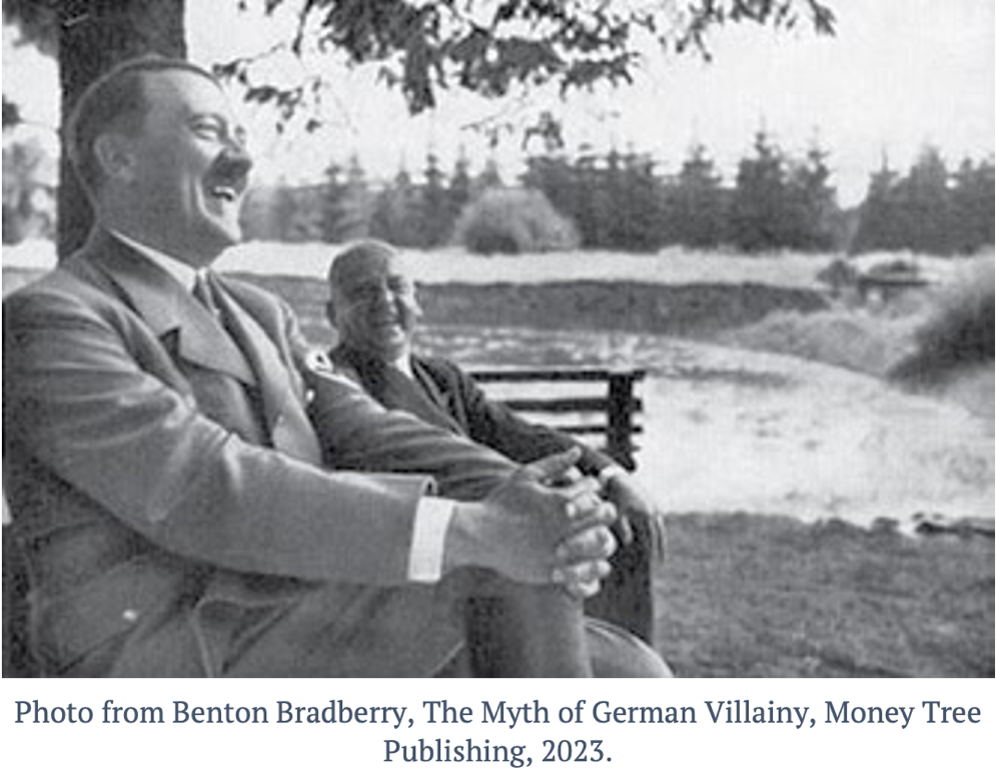
After this brief review of the hidden messages of Schindler’s List, let’s take a look at one of its most emblematic scenes: the balcony scene. In this striking portrait of alleged German cruelty, writes former US Navy pilot Benton Bradberry in his book, The Myth of German Villainy,

The Nazi commandant of the concentration camp (supposedly the Plaszow camp outside of Krakow, not far from Auschwitz) is standing shirtless on the balcony of his house with a hunting rifle over his bare shoulders. The rifle is equipped with a telescopic sight. In the movie, the house is located on a hill above the camp so that he can look down on the throngs of prisoners milling around in the compound below. He lifts the rifle to his shoulder and through the telescope begins casually scanning from one prisoner to another. The image through the telescope now fills the movie screen. The crosshairs of the scope stop on a randomly selected prisoner. He pulls the trigger and the prisoner drops to the ground, dead. The screen then cuts back to the Nazi commandant to show bored insouciance as he actuates the bolt of his rifle and casually raises it back to his shoulder. He fires again, and again a prisoner drops to the ground, dead. Bored with his “target practice,” he turns his attention to the beautiful, sexy, naked woman lying on a bed just inside the house from the balcony. The woman is purportedly one of his Jewish housemaids selected from the camp who also apparently serves as his sex slave. His face expresses disdainful, though lackadaisical, cynicism.[12]

As Benton Bradberry points out, the purpose of this gruesome scene, as well as the presence of the naked Jewish maid, is to make the officer look like a totally depraved psychopath.

What is false: This scene is entirely fictional. The real camp in Płaszów was completely out of sight from the commander’s balcony. Thus, even if he had wanted to, he could not shoot into the camp from the top of his balcony in order to amplify the cruelty of the character. Moreover, the commander Amon Göeth did have two Jewish maids chosen from among the prisoners in the camp, but they were not beautiful and sexy like the ones in the film, and there is no indication that he had improper relations with them. This sex story was added to the film only to spice it up.[13]

What is true: Major Göeth was indeed a godless, cruel, and bloodthirsty psychopath of the kind that’s found everywhere, especially in times of war, in an environment handmade for such monsters.[14]

What is false: What the millions of viewers who saw Schindler’s List do not know is that this was not a generalized behavior, typical of all National Socialists and all Germans, as the film implies. Jews, moreover, were not the only victims.[15]

What is true: While the IDF rarely punishes soldiers for war crimes against Palestinians, with data indicating near-total impunity,[16] the SS had an internal security police force whose mission was to prosecute German camp personnel involved in corruption or brutality. Hundreds of delinquents were arrested, tried, and punished by the Germans with sentences ranging from prison to execution. In September 1944, Göeth, for example, was arrested and imprisoned for bribery and murder of prisoners by the SS HaupAmt Gericht, the central office of SS justice. Göeth’s arrest (he was executed after the war in 1946) came after an investigation by German military judge Georg Konrad Morgen and officers of the Reich Security Office. [17], [18]

Ultimately, the existence of this internal security police is just another one of those oddities surrounding the Holocaust—and the image of the Holocaust presented to us by Hollywood and the media—that makes us wonder what really happened during that tragic period.

Jews and other minorities were indeed persecuted and locked up in concentration camps and many were expelled from the country when the war started in 1939. No one denies that atrocities were committed during this period of intense turmoil; families were separated, the elderly and the sick died in troves unable to resist the hardships of war.

The major claims made by historical revisionists are:

  • There was no genocide of the Jews; the final solution was a territorial solution;
  • Gas chambers were not used to kill Jews, but to kill lice and to save lives as the deadly typhus disease, which caused most of the deaths in the camps, is transmitted by lice; Zyklon B is in fact an insecticidal gas;
  • 6 million Jews did not die during the war;
  • The official narrative of the Second World War is false; the Germans were the good guys.

The examination of these matters is beyond the scope of this article, but curious minds, concerned by the present state of the world, should look into the matter for the sake of justice and progress as one of the main obstacles to the death of the Jewish globalist utopia and the birth of a peaceful multipolar world is the official narrative of the Holocaust and WW2.

I invite my readers to look into the many convincing contradictory articles, books, and movies on the matter. Here are a few references:

Arthur R. Butz, The Hoax of the Twentieth Century: The Case Against the Presumed Extermination of European Jewry, London: Armreg Ltd, 2024 (5th edition).

Nicholas Kollerstrom, Breaking the Spell. The Holocaust, Myth & Reality, London: Armreg Ltd, 2024.

Holocaust Encyclopedia, Uncensored and Unrestrained, 2025. Sponsored by the Committee for Open Debate on the Holocaust (www.CODOH.com).

For a contradictory version of WW2:

Adolf Hitler, The Greatest Story Never Told, 2026.

Benton Bradberry, The Myth of German Villainy, 2nd revised and updated edition, Money Tree Publishing, 2023.

Articles of Interest from Pierre Simon:

A Racial War That Dares Not Say Its Name

The Saddest Story Never Told. The Real Cause of WW2

Was Fascism the Height of Abomination?

Why Were Hitler and the Germans Antisemites?

“Never Again”: The Magic Wand of Democracy

Those Who Reign Supreme: The Holocaust as Linchpin of a Jewish-Ruled World


[1] Lisa Klug, “Who Said Jews Run Hollywood?” The Times of Israel, 2016.

[2] Mark Weber, Hollywood’s Agenda, and the Power Behind It, Institute for Historical Review, Feb. 6, 2013.

[3] Caitlin Johnstone, “Israeli Snipers Routinely, Deliberately Shoot Palestinian Kids in the Head,” Global Research, October 10, 2024; Hoda Osman and Emma Graham-Harrison, ‘The Gaza family torn apart by IDF snipers from Chicago and Munich,” The Guardian, Tuesday 9, Sep 2025.

[4] Frank L. Britton, Behind Communism, River Crest Publishing, 2021 (first published in 1952), pp 116-118.

[5] Churchill’s quote is from Écrits de Paris, no 613, September, 1999, p. 40.

[6] Alex Krainer, “The Banks Are Driving Forever Wars,” YouTube, May 15, 2026.

[7] Thomas Dalton, PhD, The Jewish hands in the World Wars, Castle Hill Publishers, 2019.

[8] For a good explanation on how bankers start all wars see this interview of German economist Richard Werner on the YouTube Tucker Carlson channel: “Every Major War Begins Under False Pretenses & the Central Banks Are Behind It. Economist Explains,” May 22, 2026.

[9] Jean-Jacques Stormay, Réflections sur le Nationalisme : En relisant ‘Doctrines du nationalisme’ de Jacques Ploncard d’Assac, Reconquista Press, 2019, pp. 76-77.

[10] Léon Degrelle, Hitler pour mille ans, La Table Ronde, 1969.

[11] Kevin MacDonald, PhD, Individualism and Western Liberal Tradition. Evolutionary Origins, History and Prospects for the Future, Kindle Direct Publishing Edition, 2019, pp. 88-89.

[12] Benton Bradberry, The Myth of German Villainy, 2nd revised and updated edition, Money Tree Publishing, 2023, p. 2.

[13] Ibid.

[14] Amon Göeth—Pure Evil, May 24, 2025.

[15] Categories of Prisoners, Memorial and Museum Auschwitz-Birkenau.

[16] Dan Sabbagh, “Israel closes down or leaves unresolved 88% of cases of alleged war crimes or abuse – report,” The Guardian, Aug 2, 2025.

[17] K. Prenger, A Judge in Auschwitz – Konrad Morgen’s Crusade Against SS Corruption & ‘Illegal’ Murder, Pen & Sword Books, 2021.

[18] Konrad Morgen, Wikipedia, The Free Encyclopedia.

1975 – The Mosley Remigration Interview on Thames TV

Back in 1975, they didn’t say “Remigration,” but “Repatriation.” For today’s viewer, this is perhaps the only interesting point that saves an otherwise rather lackluster video: even fifty years ago, people were talking about remigration, about return, and about encouraging return. And the exact opposite happened; migration flows to Western countries increased, as did miscegenation.

Sir Oswald Mosley, guest on Thames TV for a special program in 1975. https://www.youtube.com/watch?v=HNhF28fzN9I

Even back then, in 1975, Oswald Mosley explained that this “repatriation” had become a monumental task, given the sheer size of the immigrant population in Britain. It had reached such a point that, in his view, action was needed at the European level, leveraging the power and solidarity of the continent’s nations, for which —incredible as it may seem coming from a nationalist—he advocated a transnational government.

At almost 80 years old, Oswald Mosley still saw himself as a providential man who would be called upon by the country to face the imminent racial crisis. He acknowledged that, while he had withdrawn from English political life, this was to better prepare his mission at the European and international level: he spoke, he said, four languages and met more foreigners than any other English politician.

Today, we wonder how Mosley could have agreed to engage in such a charade. He was forced to say that he was not anti-Semitic—not on his life—that he was not so racist, that he abhorred force, that he was not a Hitler’s admirer, that he did not consider himself a hero. All this to fit into a pure marketing product of British entertainment television which aimed only to give viewers the thrill of history on the cheap.

A thrill from English history, of which we are the custodians in France.

Imagine that Mosley, who had married Diana Mitford in Germany at Goebbels’s place, lived after the war and until his death in France, in Orsay (91400), rue du Bocage, in a beautiful property called “Temple of Glory”, erected by general Jean Victor Marie Moreau, following his victory at Hohenlinden, on December 3, 1800.

The “Temple of Glory” in Orsay became the Moslay family’s home after the war. He and his wife discovered it in December 1950.

Imagine, too, that the Mosleys thus lived just seven or eight kilometers from another prominent British exile, the deposed King Edward VIII of England, who, like Mosley, was a notorious Nazi sympathizer. The property, called Moulin de la Tuilerie, is located in Gif-sur-Yvette (91190), on Impasse de la Tuilerie.

A visit to the Moulin de la Tuilerie, the property of Edward VIII in 1952, on the banks of the Mértaise. A tour around Le Moulin de la Tuilerie – YouTube

And imagine, finally, that the author of these lines lives 17 km from the Temple of Glory and 13 km from the Tuilerie Mill. The walk to the Tuilerie is very pleasant. The Temple of Glory, on the other hand, is not easy to reach coming from the west because there’s a motorway to cross: even though Mosley’s property seems peaceful and secluded, in reality, the motorway access is only a few hundred meters away… the modern world.

For this reason, and to re-establish some sort of mental contact, both with Edward VIII and with Oswald Mosley, we provide below the transcript of Mosley’s video (thank you to readers for pointing out errors and filling in missing parts, we know there are some).

We counted 20 “against” statements, roughly one per minute of Mosley’s speaking time. But to make history, one must not be “against,” one must be “in favor of”: this is how the poor man waited his whole life for a call from history that would never come.

(By the way, in 1955, he was also « against » the repatriation scheme, he preferred to stop new arrivals. In 1975, of course, he changed his mind: the population of the new incomer has considerably inflated since 1955).

Francis Goumain

Video transcript.

§§§§§§§


Sir Oswald Moslley, welcome to a special Today programme.

When I say welcome, you know and I know, that throughout London a great many Jewish viewers will not welcome your presence on this programme.

Why should any Jewish person now watch you and listen to you?

Well, if they were, some of them have abused me so much. They might be interested to see why.

But in fact, there are many great misunderstandings in politics. Now, let us be absolutely clear about this question.

I was never anti-semitic and I’ll define anti-semitic. By that I mean someone who attacks Jews on account of race or on account of religion.

I had a quarrel, not with all Jews, but with some Jews, about one subject: whether there should be a Second World War or not.

Now coming back from the First World War, after that time in the air and in the trenches and in the loss of all my friends, I was very strongly against another war. And it seemed to me rightly or wrongly, that’s a question we could debate, that certain Jews were trying to provoke a second world war because their compatriots or co-religionists were, admittedly, having a very bad time in Germany. Now, I do not think that a minority in this country should pursue a policy contrary to the national interest, which can end, in fact which did, in the loss of 50 million lives.

That gave rise to a very bitter quarrel of the period in which harsh things were said and harsh things done, that they attacked our meetings.

But I was not before that, and I have not been since, or even at the time, anti-semitic. Because not all Jews were involved but only some.

Sir Oswald, your answer, as you well know, begs so many questions that I have to put to you…

Well, which ones?

I’ll come to those in a moment. But let me stay with « not anti-semitic », not anti-semitic to refer to Hitler as the sweepings of the ghetto?

Well, the people who just came in, it is very rough these meetings, then shouting every insult, every abuse at the speaker. And he sees that they have just come in from Central Europe, and from totally different conditions to break up another meeting gives them a rough answer. I might have said that to any foreigners who came in to try and break up an English meeting.

Of course, it was rough. People don’t understand now in those great mass meetings in which some people were trying to break up and the speaker had to hold his own, and if you saw that they’d come from another country to break up an English meeting you gave them a rough answer.

Now you say that your argument with them was that you wish to prevent a second world war.

Certainly.

Would not your argument have been better addressed to Hitler?

The argument that there was not a second world war?

Yes, to prevent a second world war. If you wanted to have an argument with someone, would not the argument be better addressed to Hitler rather than the Jews?

Well, Hitler was driving east. I, my policy and my party, that’s a totally different thing. Fascism in every country was a strongly national movement. Therefore ours was totally different in its form, policy, and method.

I had wanted to conduct further and better a great Commonwealth of Nations, had to have a multiracial policy. He wanted to unite the Germans in Eastern Europe, and I did not want to intervene in a world war to stop him from doing it. I thought a war between Germany and Russia was better than a war between Germany and Britain. That gave rise to the quarrel.

Sir Oswald, do you now, looking back with the hindsight and knowledge of history, blame the Jews or Hitler for the Second World War?

I blame both. I blame both in that Hitler was impatient; he wanted to drive East, unite his own people, and when we signed the guarantee with Poland…

So rather like blaming the victim of a rapist for the rape, isn’t it?

Well, no, wait a minute, let us look at it clearly. While Hitler was driving east to unite his own people, we gave a guarantee to Poland which we could only implement by a world war. In fact, we couldn’t save Poland. We didn’t. It’s like signing a bouncing cheque.

Well now the agitation to make us do those ridiculous things like guaranteeing Poland and the other side of Europe was largely due to the influence of some Jews. Therefore, I say that both were responsible. Hitler for driving East before he had gotten a diplomatic arrangement with us, Jews for gradually persuading us, or the British people or government to do absurd things which were bound to result in war. All those people made tremendous mistakes. I was against both mistakes. I’m against the persecution of Jews or any other minority; I’m also against giving guarantees which [that] you cannot honor. That’s what caused the world war.

When did your conversion to be against the persecution of Jews begin?

Well, I never wanted to persecute Jews myself. I simply defended my meetings from Jewish attacks. Take the Olympia meeting. They marched two miles from East London. Afterwards, East London swung over to me. But at that time it was against.

What was it like?

I tell you exactly what it was like. I went along to make a speech to an enormous audience, a record audience opening the great Olympia hall. People who had marched from East London entered the hall in order to break it up. I had 1500 stewards in the black shirt, so they could recognize each other; that’s why, in order to stop them from doing it.The fighting was then very protracted, inside my meeting, I wasn’t going to break up my own meeting. They were doing that. Then the cinema lights, which were there in great force, were swung off the platform onto the audience, where the fights were occurring, and some people, very foolishly, said that I wanted that to happen.

Well, I’ve never known yet a speaker who wanted the searchlight turned off himself and on to other people. And that was done by the cinema lights naturally.

If I then had intervened by force, to ask my people to swivel the lights back on to me, what an outrage it would be. Supposing lights were then turned off me now onto something else and I had people around me who went and turned them back on to me, you’d rightly think it an outrage. And that was done by the cinema companies who wanted a story. It wasn’t done by me.

Quite and you’ve described what was happening in there. But what I’m actually asking you is how you felt addressing what was by any standards a huge rally. Did you then feel that the millennium had come and that power was yours for taking?

Oh good heavens, no. It took me, I’ve spoken all over the country for seven years. I spoke at enormous meetings, far the greatest ever held in this country, and three years later after that I addressed an audience twice as big, no four or five years later, in 1939, twice as big exhibition hall at Earls Court, never been filled for a meeting on any other occasion and that meeting was absolutely orderly, immensely enthusiastic, because the attempt to break up our meeting had been defeated. Force was used against us and we used force in return. I hate force. I had more than enough, of course, for the fighting in air and trench in the first war. Then when my meetings were attacked, I either had to close down or defend them, and I organized their defense and we won. We had orderly meetings and that was our whole offense.

Do you really hate force, Sir Oswald? Or do you not in fact have a hankering, as a man of action, for the quick result that force can achieve.

Oh no, no, no. All that nonsense was knocked out of my generation in the First World War. I was flying against the Germans in 1914 to 1915 when the average life was three months. All my friends were killed. I was later in the trench of my own regiment. With my whole generation, well practically my whole generation was wiped out. A man who’s been through the first war had a real hatred of war and of violence.

But then, if you found a political movement and come out of politics with a certain praise of what you thought about and what you’ve done and you try to go on, talking to the same audience as you have before, and people with armed force come to break it up, what do you do? Blow them a kiss and say “Goodnight, I’m retiring from politics”, or say “you are not going to do this, I’m going to defend my meetings.” I stood firm and defended them.

But does not violence attract violence?

Precisely, they used violence against us and we had to use violence in return. But I don’t like it. I hate it.

Do you have in you, however, Sir Oswald, a concept of the hero?

Of the hero?

Yes

Well, I think that an element of the heroic is necessary to all great nations. Britain was founded, the British Empire and everything else that we have, was founded by heroism. Men who went out to the far corners of the world and did heroic things. But it should be constructive heroism in the service of great people, in the service of humanity.

People who have done marvels in medicine and in science and that sort of thing are equally heroic. It’s not simply a military virtue. That I think an element of heroism is what is perhaps lacking today, but I’m convinced the British people are still capable of it and in a great crisis can show heroic qualities, which should be evoked.

Who are your heroes?

In History? In our history, the great Chatham. They kept him out of politics, out of power all his life. They gave him four years toward the end of it, and he gave them in return everything they’ve got. Immediately performed that service, they got rid of him again and any man of action who does anything for our people or any people for that matter, he’s well-advised when he’s done, he stops, he’s performed his great service to go into retirement when he’s done it.

Chatham was one example but there are many others. In British history I also give a great part to Marlborough, the original Churchill, who was a great, two great men, Marlborough and his descendant Winston. Extreme opposite of character in every respect, and Marlborough and Chatham, I would put with the two great Latins: Julius Caesar and Napoleon, and with the two great, two great Teutons, the Hohenstaufen and the Hohenzollern Frederick’s, and I should give those six men as the examples of supreme men of action in history.

And when sometimes I’m accused of having modeled myself on this man or that and all sorts of stuff, my simple reply is when I, going in for action, study the great models, if you are going to play tennis, then study the champions at Wimbledon, study their strokes. See how they do it and I did study all those, that kind of person, and it’s very essential to do it. That doesn’t mean you identify yourself with them. It merely means that you learn from great performers how to do certain things.

I did interest of course that you can choose Chatham who, as you say, was kept out of political life nearly all his life and then drawn back. In a shorter interview that we did recently, you gave me the impression that you still believe the call might come for you. Do you really believe that?

Oh yes, I’m much better now than I’ve ever been in my life; I’ve still got…

Better at what Sir?

Better at politics. That is I’ve got health and vigour, every capacity I ever had, and added to it, a vast experience and, I hope, more wisdom than when I was young. At least that seems to be the impression of a good many people. Therefore, while you have the health and strength, you go on improving. Experience, and wisdom which comes with age, is a splendid thing. Of course when you get past it all, and the physical is feeble and the rest of it, then it is over, and any man of any sense recognizes it.

Happily history abounds in cases of men who went on ten or fifteen years older than I am now and did extraordinary things. Therefore, I found that I feel that my whole life has been a training for what can now come. And if I was wanted to perform any part – I don’t care what – I would gladly do anything I could for this country.

But who on earth would ask you?

Well, they only ask people when it’s necessary. When that man alone has the experience and the proved capacity and willpower to meet a difficult and desperate situation. Anyhow, my life has proved a certain willpower, and a certain capacity to endure and come through supreme difficulties. Which are exactly what this nation will be faced with very shortly.

The Poet Yeats said «Why should not old men be mad?». Isn’t it a form of madness to believe at 78 that the country will call you?

No, because countries have called back men much older than me with great advantage, and things have been done in other spheres of literature, of art, of philosophy as well by very old men. The only one of two questions are: does the situation require such a man? Is he still capable of doing something effective? Those are the two questions which our audience and the British people are perfectly capable of judging for themselves. That I have not yet seen anybody else in the present situation who can meet the crisis which is coming.

So what would your nation be like then? What would your Britain be like?

I’ll tell you exactly what I should propose. I think in a crisis, you should have a government drawn from the whole country. I don’t mean just a coalition of parties which have failed – that will probably happen like it did with Baldwin and McDonald before.

Would it include Jews?

If they are any good, yes. I know there’s certainly one or two of them who are absolutely first-rate, particularly in science and so on. Now what I propose is a government drawn from the whole country at a certain point, from politics the best, certainly from business, from some of the younger trade unionists who certainly would be available I think, from the universities. From the fighting services I should certainly include as well, because in a very dangerous situation you want a few members of my original profession, the professional army, because men that are trained to danger, in that situation, are very valuable.

And such a government, elected by the people at a general election entirely democratically informed, subject to dismissal any day by the consequent Parliament if they abuse power, but given the power to act while they are there, just as the Board of Directors is given the power to act by the shareholders and sacked if they don’t do the job properly. I think that it is the modern form of government entirely democratic, combining the two essential things: the power to act with individual liberty, which must be scrupulously preserved.

No suspending of the Habeas Corpus Act. With all those outrages from which I suffered myself. Habeas Corpus Act. Personal liberty, always there in this country till it’s needed. The moment of crisis they scrap it and put people in jail, without trial. Absolutely wrong. Give a government power to act, certainly, dismiss it if it doesn’t do the job and preserve with cost…

How do we dismiss it out there; there would still be elections?

Oh certainly, exactly as today that any party might enter the election and that the people should choose. But if they give a party, or a newly constituted government, or a proposed government, if they give it power, that there is a parliamentary majority, that majority should give it the power to act and should sack them if they don’t act properly. We have little until the people vote for them, the question doesn’t arrive.

We have a substantial black, brown, and colored population in this country now. Would they be represented in your government?

They’d have a vote in every constituency

They’d be in your government?

If any of them was a first-rate man, he certainly would be, yes.

What’s a first-rate man, Sir?

First-rate man: approved capacity in any sphere. Scientists and people like that who had nothing whatever to do with politics would certainly be included in the kind of government I suggest. The politicians would be a minority. And if some black, or some Asian had proved himself in some sphere as an outstanding man, he’d obviously be a most welcomed member of any government that was formed

If he hadn’t been sent home under your repatriation scheme.

Well, repatriation, now. That is, I was against, of course, and that was quite often discussed at the time, against another coming here. That is I took a stand way back in 55. I fought an election on the subject in 59, the very strange and dubious election, and I stood for that policy, I think several years before Mr Powell ever thought of such a thing while he is Minister of Health and introducing colored nurses into the hospital service. Then I was strongly against the scheme from the start when it was perfectly easy to stop it.

But now that we’ve got anything, well figures are very much disputed, but we have a very large number here, it’s a much bigger operation to secure any repatriation. And it can only be done in a humane and a decent way. And I think that means the whole of Europe facing the problem together and enabling conditions in their homelands to which they will wish to return. I think it’s possible to solve that problem in a decent and humane way, but it is miserably more difficult than it was in 1955 when I first stated publicly that immigration of that kind should be stopped.

This seems to me the thing that has bedeviled you all your life

Yeah

That you put forward in advance ideas, obviously in the 1930s, major economic ideas that might have – probably should have been taken up. But all this shall be deviled by this desire to find a scapegoat which will rally people around you in the thirties, the Jews, in the 50s and the 60s and the 70s, the blacks, who next?

No well, the answer is, I think, very plain and simple. I was against certain Jews, not all Jews, because they were agitating for war. I was against the import of a completely different alien population which would bedevil all our civilization and has done it, but that is the only form of prejudice of that kind which can ever be charged against me. For instance, as the Times reported recently in a long article, a study of that period, I stood against the persecution of the Irish, having had to fight them as a professional soldier at the end of the first war. I strongly opposed the treatment of them by the Blacks and Tans, and I was appraised in my early life for my humane treatment of such people. I stand against atrocity and bullying and I still feel the same today. I am passionately against any ill treatment of prisoners or the underdog.

But in those two cases, it was necessary to take action against a minority who was agitating for war or against the import of another population, in an overcrowded island, which has done us immeasurable harm. But we cannot deal with it brutally and inhumanly; we’ve got to deal with it – if we deal – on a great scale with the whole of Europe, making arrangements for a fair return of people to their native lands, and that means an enormous enterprise because there’s got to be conditions to which they wish to return.

When you say, and when you think about this call, that will come, why should the call come? What is wrong with the political leaders now?

Well, I tell you exactly what is wrong. They’re running into a supreme crisis because they failed to solve all the main problems. But now what is the main problem? The main problem is the failure to adjust consumption to production. That is in plain language, to give the mass of the people the power to consume the goods the mass of the people produce.

Not an insoluble problem, it’s a matter of creating conditions in which it can be done. Now before the war, in my early days in politics, we had deflation, which was a disaster, and some people are proposing it again. They’re dressing it up in another new jargon. It’s exactly the same policy we saw applied before. All this Keith Joseph policy of deflating and the rest of it, means doing what we did in the forties, the creation of enormous unemployment.

Now in an effort to escape from that, they’ve had the countrary: inflation. What you want is a perfectly stable price level with production matched by consumption, and that means two things: a viable area, and within that area, a government given the power to act.

I know days in my youth in politics, we had the British Commonwealth, that is a viable area and if government had had the will ready to act, we could have solved the problem there. That was thrown away in the Second War. I’m greatly denounced for opposing the Second War, but it lost us everything.

And after the war, I said we must go right into Europe. There’s another valuable area, and if you have the whole of Europe, and a government capable of running the whole of Europe, central government for the main subjects, national governments of the next level, exactly like we got today, and regional governments, Scotland, Wales, possibly even Yorkshire and Lancashire, with a great devolution; you can solve the problem.

If you are insulated from the chaos of world markets and world finance, a viable area and the power to act, those are the two things which are necessary in this. Endless details could be added but in broad outline, that is what has to be done, and you need a government with the will to act within an area where action is possible.

Don’t you understand, Sir Oswald, that what is tied to this will to act is that people can see and accept the will to act, but what they are also afraid of are the consequences of the man of action, and they look at Europe and they look at other countries which have chosen men of action, some of the left, some of the right, and they see where that ends, and maybe they say our nice little model is rather better than what men of action give us.

You are absolutely right, you’ll put your finger on the whole complex and a number of intellectuals say are making these points very fairly the other day, I said well what you’re saying that any man who’s any damn good is always dangerous, you see.

Well now that is the question, is it possible they have men who are capable of great action who are not madmen, who are sane and who are constructive. That is you have a load of manure which has to be shifted, and you have a strong elephant capable of doing the job for you. Can you be assured that instead of doing the job, he doesn’t run amok and run berserk. Now that the people have got to make up their mind about it, sooner or later. In ordinary times, and I quite see why, they say no. They’re strong people and strong action is not necessary, and it is dangerous. But when things go wrong, it’s a bigger risk to let the muddle go to a disaster, then they have a man of action, and in those days, I think they will turn to action. I never blame the people, as some of my friends do, for not being ready to take action when the crisis is becoming perfectly obvious, when everybody in the know is aware that there is a crisis, and the people are still perfectly content.

Now I say an answer to that: if I read the journals and newspapers in four languages, try to read books in four languages as well, if I travel continuously over Europe, America and everywhere else, seeing every sort of person, far more than any other English politician has ever seen or done, of that so, I can just, working the whole time, keep abreast of events. How on earth can a chap coming out of a factory, or coming out of an office, having a drink at the local on the way home, keep abreast with events. And when they say never had it so good, and when wages are going up faster than prices, how can they know what is happening? The question is, when things go wrong, when they wake up, when we see England awake instead of asleep, will they or will they not then want men of action. Well, they do want men of action that have certain proposals to make to them.

Who would you have around you now? If you had to, if you walked into power and you were asked to form this government of men of action of a met of talents. Who would you have around you?

I deliberately now have no one around me at all in that area. To be precise, in 1966, I finally severed myself from all parties, from all connections, so I could speak in this country.

Who would be your cabinet?

Well, the first step is to see why I separated myself, which was that I didn’t want to avoid the charge, or wanting through an organized party to impose myself, or through a clique or through intrigue or anything else, what I do is…

Another reason might be that only two thousand dot people voted for you in Nothing Hill gates, of course.

Well, 8% of the electorate voted for me, which is more than the difference between the parties. It was a very curious election, a long story could be told,

It was hardly a famous victory; what I’m saying, what I’m suggesting to you, is that you have been rejected by the people when it came to polls. But what you are now saying is that you would form this government or talents; what I’m trying to find out, is who would you actually have in that government among our contemporary politicians and contemporary talents?

Yeah, and let’s deal with the two points, low votes, I’ve had not more than eight percent since the war, perfectly true, but I could give you many examples from recent history of people polling far, far less than that, who were in power very few years later. Because great country people, quite rightly, it’s sensible, don’t want drastic things to be done before it’s necessary.

Now coming to your second point, which is easy.This is very sound; who would you put into a government of that sort? Well, now you would look around you, if you were what anyone who was charged with tasks, for the man who has most succeeded in their particular line of business. Particularly men like scientists of all kinds, particularly men who have succeeded in business there, and reasonable trade union leaders particularly among the younger man, and in fact in every sphere there are outstanding people who never fail in public…

Sorry, can you think of the reasonable trade union leader whom we might include?

But I can think of that; I expect that they will promptly be turned out of the trade union if I mention their name. I know among the younger men quite a lot who I will call highly reasonable and ready for action. And in fact I’ve seen trade union leaders on television with you, who I don’t think would be unreasonable in a situation of great crisis. They know when everything is easy and going relatively smoothly, they want, and it’s their job, to get as much as they can for their members. But the moment things go wrong, those men will be looking for some way out. If the house is on fire, as a trade unionist, a young man…

Sorry we are in the last two minutes, believe it or not. Isn’t it in fact a reflection on a political figure, a man who is devoted to politics, that the only way he can conceive of coming to power or achieving his aims and ends is through a crisis, is through a breakdown in the system as it stands

Well, no if he’s always foreseen that a crisis was inevitable. After all, it has been admitted, very generously, by opponents that I could have been Prime Minister in either of the two main parties. But I could not do what the country wanted done with their policies and with their personnel; therefore, it was inevitable to act in view of the approaching crisis in a different way, which I have done, and my whole life has been a training for that crisis, which I am certain will arrive, but other people think will not.

Has your whole life not also been a failure?

Well, the whole of my life has been a failure if the premise on which I based it, our crisis, does not occur; even then, I have had some thoughts to offer to my country in the world, some of which have been accepted. But I agree with you that I’ve never been given a great part in action; then being a man of action, my life would have been a failure.

So you don’t get it; you failed,

If I don’t get that in my terms, as a man of action, I should have failed

Sir Oswald, thank you very much indeed.

Ezra Klein Warns Israel’s Role in Iran War Will Fuel Antisemitism

For decades, prominent Jewish voices have wrestled privately with an uncomfortable question. Does aggressive Israeli government conduct expose diaspora Jewish communities to backlash they did not invite? In early March, Ezra Klein brought that question back into public view. Speaking with former Obama senior adviser Ben Rhodes on a podcast episode titled “The Great Lie of War”, the New York Times columnist warned that Israel’s central role in the joint U.S. assault on Iran could fuel a new wave of antisemitism.

The two men spent most of the interview discussing the strategic recklessness of the Iran operation where the United States and Israel launched an assault that killed Supreme Leader Ali Khamenei and much of his senior command. They examined the lack of congressional authorization, the absence of an endgame, the risk of a massive refugee crisis, and what they described as Israeli Prime Minister Netanyahu’s long-sought goal of drawing the United States into direct military confronttion with Iran.

The antisemitism remark came near the end of that segment, specifically as a follow-on to a discussion about Saudi ambivalence toward the war and the question of what Israel actually wants from the conflict. Klein’s exact words in the transcript were, “I’m not saying this is the biggest issue at this moment, but the centrality of Israel in the operation has raised some concerns for me about what this is going to mean for anti-Semitism. You see the amount of talk on the MAGA right, but elsewhere as well that, you know, Israel’s leverage over Donald Trump or that, you know, this is all just some kind of Israeli plot.”

Klein then noted that Netanyahu appeared to be gambling with Israel’s long term political standing in America and in the world at a time of “very, very sharply rising anti-Semitism,” expressing uncertainty about how it would all pan out. The New York Times columnist’s concern, stated plainly, was that Israel’s highly visible, central role in what many perceived as an unjustified war of aggression would fuel conspiracy theories rather than defuse them. His worry was that Netanyahu’s short-term tactical success, finally getting a U.S. president to strike Iran, risked long-term consequences for Jews, especially in the United States.

This dilemma is not new. Jewish billionaire George Soros articulated a similar concern over two decades ago. Soros has largely steered clear of public association with Jewish communal life and seldom appears at exclusively Jewish functions. That changed in 2003, when he took the stage at a New York City meeting hosted by the Jewish Funders Network. Questioned about the spread of antisemitism across Europe, Soros offered an unexpected diagnosis, laying blame at the feet of U.S. and Israeli policy. “There is a resurgence of anti-Semitism in Europe. The policies of the Bush administration and the Sharon administration contribute to that,” he stated. “If we change that direction, then anti-Semitism also will diminish. I can’t see how one could confront it directly.”

At the time, the reaction from Jewish leadership was furious. Elan Steinberg, who served as senior adviser to the World Jewish Congress after a stint as its executive director, fired back. “Let’s understand things clearly: Anti-Semitism is not caused by Jews; it’s caused by anti-Semites.” Abraham Foxman dismissed Soros’s words as “absolutely obscene.” The head of the ADL elaborated. “He buys into the stereotype. It’s a simplistic, counterproductive, biased and bigoted perception of what’s out there. It’s blaming the victim for all of Israel’s and the Jewish people’s ills.”

The Foxman and Steinberg responses reflected an orthodox position within Jewish communal leadership. Antisemitism, in this view, is a pathology of antisemites, and any attempt to link it to Israeli behavior constitutes victim blaming. Yet this position has always co-existed uneasily with a practical awareness that Israeli actions, particularly those perceived as disproportionate or aggressive, create public relations challenges for diaspora Jewish communities.

Klein’s 2026 remarks fall squarely within this tension. He was warning that Netanyahu’s gamble, making Israel so visibly central to an unpopular war, would hand ammunition to those who already believed such theories. Polling data suggests that Klein’s concerns about Israel’s political standing are well-founded. Gallup’s 2025 Annual World Affairs Survey documented a broader collapse in American sentiment toward Israel. Only 46% of Americans sympathized with Israelis, the lowest figure in 25 years of Gallup tracking. Among Democrats, 59% sympathized more with Palestinians—with only 21% sympathizing with Israelis—creating a nearly 3-to-1 ratio, the first time Palestinians had held such a commanding lead among members of a major U.S. party. A majority of Americans, and a record-high 76% of Democrats, supported an independent Palestinian state.

These trends predate the Iran strike and reflect cumulative damage from Israel’s conduct in Gaza. The joint United States and Israel operation against Iran, with Israel’s role so prominently featured, is unlikely to reverse this trajectory and will more than likely heighten Western populations’ hostility toward Israel. The polling numbers bear this out.

The Jewish People Policy Institute found that only 28% of strong liberal Jews support the war while 62% oppose it. Support climbs to 100% among strong conservative Jews. The partisan split is even more dramatic. Trump voters among American Jews back the war at 99%, while Harris voters divide 47% to 42%.

The picture among Americans generally looks very different. Pew Research found that 59% of Americans said the United States made the wrong decision in using military force and 61% disapprove of Trump’s handling of the conflict. An AP-NORC poll found that 59% of Americans believe U.S. military action has gone “too far,” while a Quinnipiac survey reported 74% oppose sending U.S. ground troops into Iran. The immediate unpopularity of the Iran war combined with Israel’s sullied image as a result of the Gaza genocide may explain why elements of American Jewry are embracing certain forms of controlled opposition to the Netanyahu regime, while stopping short of criticizing the entire Zionist project and its thoroughly Jewish nature.

It should be said that rational anti-Semitism is never about all Jews.  Klein’s worry that “Jewish communities globally could be stained with guilt by association in the eyes of those who conflate the Israeli government with all Jews” should be seen as relying on the idea that anti-Semitism refers to complaints about “all Jews.” Most commonly complaints about Jews rely on understanding where the power of the Jewish community is directed, and in this case it’s obvious that the mainstream Jewish community in the U.S. and its powerful lobbying organizations (here and here) are entirely on board with the war. This is especially true in the Trump administration where the more conservative elements of the Jewish community, including Chabad Lubavitch, have increased their influence greatly.

It is simply that their vision [of conservative Jewish groups] for Jewish flourishing in America is radically at odds with the basic assumptions that have grounded American Jewish politics for much of the last century: chiefly, that Jewish interests are best served by the separation of religion and state; that American Jews are best protected through multiethnic, pluralistic coalitions rather than an alliance with the Christian majority; and that the invisibility of Jewish group interests is preferable to visible Jewish particularity.

Ezra Klein’s warnings about the centrality of Israel in the Iran war are a tacit admission that the Jewish establishment has lost its ability to operate from behind a veil. By leveraging control over U.S. administrations to initiate wars of choice, this power structure has forced a public reckoning that no amount of image-polishing can reverse. History has repeatedly shown that Jewish overreach eventually triggers an immune response from the host population.

We are currently in the midst of that reaction, and the path forward lies in the unapologetic identification and systematic dismantling of the Jewish influence networks that have compromised the highest levels of our government and financial institutions.

Stolen Weapons Grade Uranium: Remembering The Apollo Affair

In May 2026, Rep. Joaquin Castro (D-TX) led a group of 30 House Democrats in sending a formal letter to Secretary of State Marco Rubio demanding the United States end its decades-long policy of nuclear ambiguity regarding Israel. Castro explicitly cited the ongoing U.S. and Israel military conflict with Iran, noting that “fighting this war side by side with a country whose potential nuclear weapons program the United States government officially refuses to acknowledge risks miscalculation” and potential nuclear escalation. The signatories cited the classified 1974 Special National Intelligence Estimate confirming Israel had nuclear weapons and asked eleven specific questions, including whether Israel had communicated nuclear red lines to U.S. officials.

Castro’s letter represents the most significant congressional challenge to American silence on Israel’s nuclear program in decades. Yet buried beneath that silence lies a scandal that stretches back to the early Cold War—one involving a small Pennsylvania town, a team of Israeli spies, and the largest loss of weapons-grade uranium in American history.

The trail begins in the small borough of Apollo, Pennsylvania, roughly 30 miles northeast of Pittsburgh, where the Nuclear Materials and Equipment Corporation (NUMEC) processed approximately 17 metric tons of weapons-grade highly enriched uranium (HEU) for the United States government between 1957 and 1978. By the time investigators finished their work, more than 337 kilograms of that material had vanished—enough fissile material to construct multiple nuclear weapons. The CIA concluded that the missing uranium ended up in Israel’s nuclear arsenal. Yet no one was ever prosecuted, and the story has been systematically suppressed for over half a century.

In 1957, chemist Zalman Mordecai Shapiro co-founded NUMEC to process government-owned enriched uranium into naval reactor fuel and commercial nuclear fuel. Shapiro was a respected scientist who had assisted in the design of the world’s first nuclear-powered submarine, the USS Nautilus. He was also a committed Zionist with extensive contacts in the Israeli government, including a separate contract to build nuclear-powered generators for Israel.

In 1965, after the Atomic Energy Commission (AEC) ordered a physical inventory of the plant, investigators discovered that approximately 93 kilograms—about 205 pounds—of highly enriched uranium could not be accounted for. By the time NUMEC was fully decommissioned in 1978, the total cumulative “material unaccounted for” had grown to 337 kilograms—roughly 741 pounds—confirmed by the Energy Department in a 2001 historical report as the largest HEU inventory loss at any commercial site in U.S. history. Shapiro and his co-founders claimed the losses were normal industrial attrition. The AEC’s own materials accountability system at the time was remarkably lax, providing no mechanism for physically checking shipments abroad, requiring no security clearances for employees handling nuclear materials, and mandating no physical protection of special nuclear material either inside or in transit from private plants.

The men at the center of this affair were not ordinary businessmen. Beyond running NUMEC, Shapiro was a member of the Zionist Organization of America’s Pittsburgh chapter, traveled frequently to Israel, had NUMEC serve as a procurement and sales agent for the Israeli Ministry of Defense, and was involved in a joint venture called ISORAD with Israel’s nuclear organization. FBI surveillance revealed unusual meetings between Shapiro and known Israeli intelligence operatives that were never satisfactorily explained.

Rafael “Rafi” Eitan is the most explosive figure in the affair. On September 10, 1968, four Israeli nationals arrived at the NUMEC plant. They listed their purpose as discussing the purchase of small plutonium-238 power sources, identifying themselves as a “chemist” and “electronics specialists.” In reality, Eitan was not a chemist. He was one of Israel’s most accomplished intelligence operatives, famous for serving as the operational ground commander of the 1960 Mossad team that seized Nazi veteran Adolf Eichmann in Buenos Aires. He later became head of LAKAM, Israel’s scientific intelligence service, and in the 1980s he directed the operation that recruited Jonathan Pollard to spy against the United States.

The other three visitors in the 1968 delegation were equally remarkable. Avraham Bendor—whose real name was Avraham Shalom—was a long-time Shin Bet agent who served as deputy commander of the Eichmann capture in 1960 and later became head of the Israeli internal security service (Shin Bet) from 1980 to 1986. Avraham Hermoni was listed as the Israeli Embassy’s scientific counselor but was in fact the technical director of Israel’s nuclear bomb project at RAFAEL, Israel’s armament development authority, with a direct role in the Dimona project. That this group of four—collectively representing the operational cream of Israeli intelligence and nuclear weapons development—would visit a Pennsylvania fuel processing plant to discuss commercial plutonium power sources strained any plausible cover story. As former Pentagon official Anthony Cordesman put it: “There is no conceivable reason for Eitan to have gone to the Apollo plant but for the nuclear material.” David Lowenthal, NUMEC’s venture capitalist and financier, also had close ties to Israeli intelligence and had previously facilitated the transport of refugees between the U.S., Europe, and Israel before organizing NUMEC’s financing. Ephraim Biegun appeared on the visitor list as “Department of Electronics, Israel,” a bland title that concealed his command of the Mossad’s Technical Department.

Several independent threads of evidence coalesced to make the diversion case compelling. Before April 1968, the CIA had conducted clandestine environmental sampling around Israel’s Dimona nuclear complex and detected traces of highly enriched uranium there. Critically, the uranium bore the isotopic signature of the Portsmouth, Ohio enrichment facility—enriched to 97.7 percent, a level produced exclusively at Portsmouth, which had only one commercial customer: NUMEC.

Testimony from the ground backed up the data. In March 1980, FBI agents interviewed a former NUMEC employee who stated that in early 1965 he had encountered armed strangers on the NUMEC loading dock loading what appeared to be canisters of Highly Enriched Uranium (HEU) onto a truck—with a shipping manifest indicating the material was bound for a Zim-Israel shipping line vessel headed to Israel. A gun-toting guard ordered him to leave, and a NUMEC manager later threatened him to keep his mouth shut about what he had seen. Former CIA Tel Aviv station chief John Hadden, who served from 1963 to 1967, later described NUMEC as “an Israeli operation from the beginning” and told investigators that Israel’s removal of the material was relatively straightforward compared to the Eichmann kidnapping.

In April 1968, CIA Director Richard Helms wrote to Attorney General Ramsey Clark—in a memo that remains classified—reporting that HEU processed at Apollo had likely ended up at Dimona and requested the FBI resume its investigation. Despite this, in 1969 J. Edgar Hoover halted the FBI investigation that Helms had requested after the Atomic Energy Commission declined to revoke Shapiro’s security clearance, citing insufficient grounds for prosecution. The CIA recorded that FBI investigators “indicated that even if they came up with a case, it was extremely unlikely that Justice and State would allow it to come to trial.” The Nixon administration simultaneously adopted Israel’s preferred policy of nuclear ambiguity, agreeing in a secret 1969 meeting between Nixon and Israeli Prime Minister Golda Meir not to press Israel on its nuclear program. Henry Kissinger’s July 16,1969 memo to Nixon had already outlined the philosophy: “What we really want at a minimum may be just to keep Israeli possession from becoming an established international fact.”

During the Ford Administration, in February 1976, Nuclear Regulatory Commission (NRC) Chairman William Anders invited CIA Deputy Director for Science and Technology Carl Duckett to brief senior NRC officials. Instead of dismissing the rumors, Duckett stunned the audience by confirming the CIA’s belief that Israel had illegally obtained highly enriched uranium from NUMEC and used it to develop its first nuclear weapons. President Ford’s aide James Connor summarized it plainly to Ford: “The good news is that Israel definitely has the Bomb and can take care of itself. The bad news is that the stuff came from Pennsylvania.” Attorney General Edward Levi then wrote a remarkable memo to President Ford listing multiple federal statutes that may have been violated, stating his belief not only that uranium had been unlawfully removed from Apollo, but that federal officials themselves may have committed felonies by concealing the events after the fact.

During the Carter Administration, Carter was briefed during the presidential transition, and his National Security Advisor’s staff concluded, “The CIA case is persuasive, though not conclusive.” Yet despite Carter’s public identity as a champion of nuclear nonproliferation, newly declassified documents show his administration worked to keep the NUMEC story under wraps out of concern for relations with Israel. As Ford’s close adviser James Connor later told journalist John Fialka, the investigative trail had grown cold: “You could look at all the documents and ask yourself whether something had happened here. The answer was probably yes. Then the question was whether you could do anything about it, and the answer was no.” When confronted decades later about why the Carter administration covered up the evidence, National Security Advisor Zbigniew Brzezinski was dismissive: “What are we going to say to the Israelis, ‘Give it back?'”

Congress conducted its own inquiries but reached no resolution. The House Interior Committee, chaired by Rep. Morris Udall, conducted oversight hearings from 1977 to 1980. Udall personally interviewed Shapiro. When a BBC interviewer asked him in 1979 whether he thought the Israelis had taken HEU from Apollo, Udall replied: “If someone had me write in an envelope whether a diversion occurred or did not occur and that I would be put to death if I answered wrong, I suspect I would have to put in the envelope that I believe there was a diversion.” A General Accounting Office report on the matter—titled Nuclear Diversion in the U.S.? 13 Years of Contradiction and Confusion and classified for decades—found that the CIA and FBI had refused to cooperate with the investigation, noting: “We believe a timely, concerted effort on the part of these three agencies would have greatly aided and possibly solved the NUMEC diversion questions, if they desired to do so.”

Israeli officials have never acknowledged the NUMEC diversion. The most high-profile response came in a 1977 CBS 60 Minutes interview when Mike Wallace asked Prime Minister Menachem Begin directly whether Israel had stolen bomb-grade uranium from the United States. Begin neither denied it plainly nor engaged with the substance, instead ridiculing the premise: “From time to time I read in the press the most fantastic stories—how everywhere Israel snatches away uranium from America and from Europe. It belongs to the James Bond stories.” When Wallace pressed, “Not so?” Begin replied, “I don’t pay any attention to them.”

When Rafi Eitan died in March 2019, the Mossad’s official statement said his “operations cannot be publicized but they contributed greatly to the security of the State of Israel.” The New York Times initially included a reference to the uranium disappearance in Eitan’s obituary but removed it after pressure from the media watchdog CAMERA, replacing it with a correction noting only that “it was never shown conclusively that he had had an important role in it.”

Victor Gilinsky, former NRC commissioner, and Roger Mattson, a former NRC physicist who investigated NUMEC, published a landmark reassessment in the Bulletin of the Atomic Scientists in 2010 titled “Revisiting the NUMEC Affair,” which stated plainly: “When the known facts are put together, it is difficult to escape the conclusion that Israel probably did steal highly enriched uranium from the United States.” Mattson went on to publish a full book, Stealing the Atom Bomb, through the National Security Archive in 2016. Grant F. Smith, director of the Institute for Research on Middle Eastern Policy, also published Divert! NUMEC, Zalman Shapiro and the Diversion of US Weapons Grade Uranium into the Israeli Nuclear Weapons Program in 2012, based on exhaustive FOIA requests.

To this day, the NUMEC affair remains unresolved. Key CIA and FBI files are still classified or heavily redacted. No criminal charges were ever filed against anyone, and Zalman Shapiro died in 2016 at age 96. Roger Mattson, who spent decades investigating the affair, put it simply in a public lecture: “My conclusion is the material went there [Israel].”

The Apollo Affair stands as a cautionary tale of how American foreign policy can be corrupted from within, how institutional silence becomes its own form of complicity, and how the most documented case of nuclear diversion in American history was buried by the very officials charged with preventing it. It is yet another indication that the first loyalty of many American Jews is to Israel, not America. Rep. Castro’s May 2026 letter represents a rare attempt to pierce the silence that has surrounded these events, but the precedents established over six decades of official denial remain formidable obstacles to the transparency he seeks.

NUMEC was never an accounting error, but rather a clear-cut act of espionage that our leaders chose to ignore. This pattern of complicity continues because our political establishment is trapped beneath the weight of an unshakeable Jewish supremacist power structure.

Seriously Narcissistic People: From Harts of Darkness in America to a Posturing Poison-Dwarf in Alba

One was a tragedy, the other is a farce. One happened in America, the other has happened in Scotland. But both of them say a lot about the psychology of leftism. Let’s look at the tragedy first. And it truly was a tragedy, a horrible story from California of a psychotic “white savior” slaughtering six Black children in narcissistic rage. Do you remember it from 2018? Probably not, because the left didn’t want to commemorate the Black children and their White murderer, who was called Jennifer Hart. You see, she was both leftist and lesbian, one half of a thoroughly progressive couple who adopted six Black children, then postured in public as kind and compassionate anti-racists whilst abusing and starving the children in private.

Promoting lies, advancing leftism

But the family’s façade slowly began to crack and by 2018 the “same-sex white couple” knew that the authorities were finally closing in. Narcissistic rage explains what happened next: rather than endure public exposure and the collapse of her lies, Jennifer Hart drove her “wife” and “family” in an SUV over a cliff on the California coast, plunging them 100 feet into the sea. Unsurprisingly, no-one survived and the body of one of the children has never been recovered. He was called Devonte, but did Black Lives Matter (BLM) and other leftists ever demand that the world “Say His Name”? Nope. Jennifer Hart’s death-drive was what I call a meteor murder, something that flashes through the headlines of the mainstream media, then disappears for ever. Why so? Because leftists don’t want to commemorate some crimes. Unlike the self-inflicted deaths of Black Trayvon Martin in 2012 and Black George Floyd in 2020, leftists couldn’t exploit the Hart Massacre to promote lies and advance leftism. On the contrary: the Hart Massacre was very bad publicity for leftism. From the lesbianism of the Harts to their oh-so-ironic surname, it was a spectacularly horrible symbol of how leftists posture about helping Blacks whilst in reality doing great harm to Blacks.

Note the nose: Sarah (left) and Jennifer Hart and three of the Black children they abused and murdered (Devonte is on the right) (see image here)

And I think you can see the abuse in the posturing photos that came before the massacre. There’s something forced and desperate in the children’s smiles. And the children look disturbingly small, particularly by comparison with the hulking figure of Jennifer Hart. In the photo above she’s wearing a T-shirt that reads “LOVE IS THE ANSWER TO [?EVERYTHING]” as she’s kissed by her lesbian partner Sarah Hart (née Gengler). As you can see from her vulturine profile, Sarah Hart was Jewish. I suspect Jennifer Hart was Jewish too. The involvement of at least one Jew in the tragedy is another reason for the Hart Massacre not to be infamous in the way it deserves to be. Possibly Jewish Jennifer Hart and definitely Jewish Sarah Hart did not display love towards those Black children, who were literally stunted in their growth by the starvation and cruelty they endured. Here are some of the horrible details that the leftist media long ago dropped down the memory-hole: “At 11, Hannah weighed 50 pounds and stood less than 4 feet tall, a stature typical of a 6-year-old girl. Devonte, also 11, stood about 4-feet-2 and weighed 57 pounds — the size of a typical 8-year-old boy.”

Jennifer Hart and her starved Black abuse-victims (image from CNN)

But while Jennifer Hart didn’t display any love, she did display things that contradict what “one welfare worker put […] in a report[:] ‘these women look normal.’ ” No, the Harts didn’t “look normal.” Lesbians are not normal and don’t behave like straight women. For one thing, they’re more aggressive, that is, more masculine in their behavior. Jennifer Hart committed mass murder in an aggressive, quasi-male way, driving a powerful vehicle over the edge of a cliff. And whether or not she was Jewish, she certainly had Jewish traits of authoritarianism and self-righteousness:

Jennifer Hart and her Jewish “wife” Sarah Hart (née Gengler) (image from Pink News)

A relative of Jennifer’s, who spoke on the condition of anonymity to discuss private matters, said Jennifer often erupted at the children.

“The kids couldn’t do anything without getting into trouble,” the relative said. “If the kids did anything she thought was wrong, she would snap her fingers and say, ‘Get in the corner. No food for you.’ ”

Family members and others who questioned her child-rearing were “pretty much cut out,” said the relative. “Jen wouldn’t have anything to do with you if you disagreed with her.” (“Abuse, neglect and a system that failed: The tragic lives of the Hart children,” The Washington Post, 12th July 2018)

Narcissists hate contradiction and criticism, but narcissism on its own doesn’t fully explain why leftists punish heresy and dissent so aggressively. If you’re interested in finding truth, you will support free speech and free enquiry. If you’re interested in winning and retaining power, you will support censorship and bans on free enquiry. That’s why the left suppress discussion of, and research into, the differences between the races and the sexes. And differences between the sexualities too: the role of lesbian aggression in the Hart Massacre is something leftists would never discuss or allow to be discussed in the mainstream. Nevertheless, it’s obvious in the story, which is why the Hart Massacre was also a meteor massacre. What isn’t talked about doesn’t undermine your ideology.

Seriously narcissistic and seriously nasty: the glowering Giftzwerg Nicola Sturgeon (see Youtube video)

That principle has been at work in the tragedy in America as it has been in the farce in Scotland (or Alba as it’s known in Scots Gaelic). We’ve looked at the tragedy, so now let’s look at the farce. It’s also a story of public posturing and seriously narcissistic people. And maybe it’s a story of lesbianism too. That’s because rumors of secret lesbianism have long circulated about Nicola Sturgeon, the former leader of the Scottish National Party (SNP). I discussed the authoritarian and anti-White ways of Sturgeon and the SNP in “A Tartan Tyranny.” Well, the Tartan Tyrant lost her job as First Minister of Scotland in 2023, but now she’s back big-time in the headlines. Her former husband, Peter Murrell, has just admitted embezzling more than £400,000 ($540,000) from the SNP while he served as the party’s chief executive.

Loving Scotland, looting Scots

The story is both farcical and damning: farcical for how Murrell spent the money and damning of how the SNP’s leadership both failed to spot his crimes and tried to prevent scrutiny of party finances. Among much else, Murrell stole the donations of ordinary SNP members to spend “£3,232 on a Jura Giga 5 Cromo coffee machine, £2,618 on two Feuilles pepper and salt grinders, £1,990 on eight umbrellas, £1,475 on a Beatles special-edition fountain pen and rollerball, [and] £550 on a 1:30-scale model of an Airbus helicopter.” That raises three obvious questions in my mind, but only one of them seems obvious to the mainstream media in Britain. They’re asking how Nicola Sturgeon could have failed to be suspicious about her husband’s extravagance. I ask that too. But I also ask: How did Murrell think he could get away with stealing so much and spending so extravagantly? And how did he reconcile looting Scots with his loudly professed love of Scotland?

Machiavellian Murrell: the Scotland-loving, Scots-looting embezzler Peter Murrell (image from Wikipedia)

By all accounts, Murrell is a highly competent White male of the kind leftist parties across the West no longer favor. But his political success included Machiavellianism and didn’t preclude mental illness. He was central to the rise of the SNP in Scotland and will probably now be central to its fall. His Machiavellianism explains the rise and his mental illness will explain the fall. I ask again: how did he think he could get away with the embezzlement? If he really thought he could, he was mentally ill and detached from reality. If he didn’t care whether he could, he was mentally ill in another way. Narcissism was part of his mental illness, but I don’t find that surprising. I’ve long thought that leftism is better described as a mental illness than as an ideology. And narcissism is central to leftism. You can see that in the tragedy of the Hart Massacre just as you can in the farce of the SNP embezzler. A “pro-independence blogger” called Stuart Campbell raised concerns about the party’s finances as far back as 2020 and the SNP’s leadership reacted by concealing the party’s accounts from audit. Campbell was impugning their virtue! How dare he! And when SNP figures like Joanna Cherry raised their concerns too, Nicola Sturgeon “treated [them] as traitors to the party,” according to Cherry.

SNP = Seriously Nasty People

Sturgeon often behaved aggressively and moralistically like that. She postured as a virtuous woman in a world of villainy. In fact, she’s a virago, not a virtuous woman. As I described in “The Trouble with Trans-Westernism,” her small physique and malignant personality make her what Germans call a Giftzwerg, a “poison-dwarf.” As SNP leader, she was interested only in power, not in truth or what was good for Scottish Whites. Like the equally narcissistic and malignant “nationalists” of Celtic Wales and Ireland, the Scottish National Party want to destroy their supposedly beloved homeland by flooding it with non-Whites from the Third World.

So are you surprised to hear that, as SNP leader, Nicola Sturgeon “regularly met the Jewish community and […] always [spoke] supportively of it”? You shouldn’t be. Jews want to destroy White Scotland just as much as they want to destroy White America. That’s why Jews have supported leftism in both Scotland and America, because leftism is the ideal ideology for narcissists who posture as virtuous in public while practising villainy in private. You can see the toxic truth just as much in that tragedy of child-murder in America as in the farce of embezzlement in Scotland. Seriously Narcissistic People are also Seriously Nasty People.

Afterword

For more evidence that the child-murderer Jennifer Hart was Jewish, compare her face with that of the definitely Jewish Michelle Walker, who’s currently waging lawfare against a White private-membership group called Return to the Land (RTTL). For more details of the lawfare and how to donate towards the fight-back, please see RTTL’s fund-raising page and this video at Twitter.

A possible Jew and a definite Jew: Jennifer Hart and Michelle Walker (second image from Twitter)