
Featured Articles

The Genocidal Mark Levin as Exemplar of Traditional Jewish Hatred toward Non-Jews

From a monologue by Carlson introducing a long video titled “Tucker Carlson on the Israel First Meltdown and the Future of the America First Movement.”

Short version whose main message is that we should not become like Mark Levin: https://tuckercarlson.com/live-show-november-12-highlights-2

Tucker does his usual schtick against collective identities, in favor of Christian ethics, and proclaiming he is not an anti-Semite, just a critic of Israel’s hold over U.S. policy. As always, it completely eludes Tucker that Jews like Mark Levin are never going to give up their Jewish identity and attachment to Israel, and that advocating that Whites eschew White identity politics is obviously a losing strategy in a world increasingly dominated by non-White identity politics. The overriding issue is that we must win this battle.

But the point is that Levin is really losing it on Tucker and showing his true genocidal character against the Palestinians. The intense hatred shown here by Levin is the real story and we should all realize how utterly common such hatred is among Jews. Such people are running the Israeli government and are the backbone of the West Bank settler movement. They dominate the pro-Israel Lobby throughout the West.

The fact is that whenever Jews have had power over non-Jews we see this genocidal hatred emerge. We recently posted Karl Nemmersdorf’s “Jewish Bolsheviks and Mass Murder: Rozalia Zemliachka and the Jews Responsible for the Bloodbath in Crimea, 1920″ which detailed Jewish involvement in mass murder in Crimea in 1920, a part of the much larger mass murder of Russians in the 1920s and 1930s perpetrated by the USSR and typically carried out by Jewish operatives. From my “Stalin’s Willing Executioners: Jews as a Hostile Elite in the USSR,” a review of Yuri Slezkine’s The Jewish Century.

For example, a statute of one nationalist organization, Michaelthe Archangel Russian People’s Union, expressed “particular trust in the German population of the Empire,”16 while its leader, Vladimir Purishkevich,accused the Jews of “irreconcilable hatred of Russia and everything Russian.”17 Jews disliked the Christian religion of the vast majority of Russians becauseof the antagonistic relationship between Judaism and Christianity over theages; Jews distrusted the peasants, who “fell from grace” (p. 140) with theintelligentsia after the numerous anti-Jewish pogroms, especially after 1880;and Jews blamed the tsar for not doing enough to keep the peasants in checkand for imposing the various quotas on Jewish advancement that went intoplace, also beginning in the 1880s—quotas that slowed down but by no meanshalted Jewish overrepresentation in the universities and the professions. In this respect, the Germans were far more like the Overseas Chinese, in that they became an elite without having an aggressively hostile attitude toward the people and culture they administered and dominated economically. Thus when Jews achieved power in Russia, it was as a hostile elite with a deep sense of historic grievance. As a result, they became willing executioners of both the people and cultures they came to rule, including the Germans. …

And when people don’t cooperate in becoming a new species, there’s always murder. Slezkine describes Walter Benjamin, an icon of the Frankfurt School and darling of the current crop of postmodern intellectuals, “with glasses on his nose, autumn in his soul and vicarious murder in his heart” (p. 216), a comment that illustrates the fine line between murder and cultural criticism, especially when engaged in by ethnic outsiders. Indeed, on another occasion, Benjamin stated, “Hatred and [the] spirit of sacrifice…are nourished by the image of enslaved ancestors rather than that of liberated grandchildren.”29 Although Slezkine downplays this aspect of Jewish motivation, Jews’ lachrymose perceptions of their history—their images of enslaved ancestors—were potent motivators of the hatred unleashed by the upheavals of the twentieth century. …

But [Georg] Lukács also expresses his hatred for “the whole of official Hungary”—how he extended his unhappiness with his father to “cover the whole of Magyar life, Magyar history, and Magyar literature indiscriminately (save for Petőfi)” (p. 97). Ah, yes. Save for Petőfi. All else—the people and the culture—would have to go, by mass murder if necessary. (Lazar Kaganovich, the most prolific Jewish mass murderer of the Stalinist era, is pictured at the end of his life reading Pushkin, Tolstoy, and Turgenev [pp. 97–98].) But rather than see this as an aspect of traditional Jewish hatred for non-Jews and their culture, souped up and rationalized with a veneer of Marxism, Slezkine explains these radicals as enlightened Mercurians who wished to destroy the old culture except for a few classics of modern literature. We may give thanks to know that Shakespeare would have survived the revolution. …

What united the Jews and philosemites was their hatred for what Lenin (who had a Jewish grandfather) called “the thick-skulled, boorish, inert, and bearishly savage Russian or Ukrainian peasant”—the same peasant Gorky described as “savage, somnolent, and glued to his pile of manure” (p. 163). It was attitudes like these that created the climate that justified the slaughter of many millions of peasants under the new regime. Philosemites continued to be common among the non-Jewish elite in the USSR, even in the 1950s, when Jews began to be targeted as Jews. One such philosemite was Pavel Sudoplatov, a Slav married to a Jew and with many Jewish friends, who was a high-ranking secret police official with a great deal of blood on his hands. The only murder he unequivocally condemned in his memoirs was that of Paul Mikhoels, a Jewish ethnic activist associated with the Jewish Anti-Fascist Committee. …

The migration of the Jews to the urban centers of the USSR is a critical aspect of Slezkine’s presentation, but it strains credulity to suppose that these migrants threw off, completely and immediately, all remnants of the Eastern European shtetl culture which, Slezkine acknowledges, had a deep sense of estrangement from non-Jewish culture, and in particular a fear and hatred of peasants resulting from the traditional economic relations between Jews and peasants and exacerbated by the long and recent history of anti-Jewish pogroms carried out by peasants. Traditional Jewish shtetl culture also had a very negative attitude toward Christianity, not only as the central cultural icon of the outgroup but as associated in their minds with a long history of anti-Jewish persecution. The same situation doubtless occurred in Poland, where the efforts of even the most “de-ethnicized” Jewish Communists to recruit Poles were inhibited by traditional Jewish attitudes of superiority toward and estrangement from traditional Polish culture. …

Slezkine’s argument that Jews were critically involved in destroying traditional Russian institutions, liquidating Russian nationalists, murdering the tsar and his family, dispossessing and murdering the kulaks, and destroying the Orthodox Church has been made by many other writers over the years, including Igor Shafarevich, a mathematician and member of the prestigious U. S. National Academy of Sciences (NAS). Shafarevich’s review of Jewish literary works during the Soviet and post-Soviet period agrees with Slezkine in showing Jewish hatred mixed with a powerful desire for revenge toward pre-revolutionary Russia and its culture.65 But Shafarevich also suggests that the Jewish “Russophobia” that prompted the mass murder is not a unique phenomenon, but results from traditional Jewish hostility toward the non-Jewish world, considered tref (unclean), and toward non-Jews themselves, considered sub-human and as worthy of destruction. Both Shafarevich and Slezkine review the traditional animosity of Jews toward Russia, but Slezkine attempts to get his readers to believe that shtetl Jews were magically transformed in the instant of Revolution; although they did carry out the destruction of traditional Russia and approximately twenty million of its people, they did so only out of the highest humanitarian motives and the dream of utopian socialism, only to return to an overt Jewish identity because of the pressures of World War II, the rise of Israel as a source of Jewish identity and pride, and anti-Jewish policies and attitudes in the USSR. This is simply not plausible. The situation prompts reflection on what might have happened in the United States had American Communists and their sympathizers assumed power. The “red diaper babies” came from Jewish families which “around the breakfast table, day after day, in Scarsdale, Newton, Great Neck, and Beverly Hills have discussed what an awful, corrupt, immoral, undemocratic, racist society the United States is.”66 Indeed, hatred toward the peoples and cultures of non-Jews and the image of enslaved ancestors as victims of anti-Semitism have been the Jewish norm throughout history—much commented on, from Tacitus to the present.67

It is easy to imagine which sectors of American society would have been deemed overly backward and religious and therefore worthy of mass murder by the American counterparts of the Jewish elite in the Soviet Union—the ones who journeyed to Ellis Island instead of Moscow. The descendants of these overly backward and religious people now loom large among the “red state” voters who have been so important in recent national elections. Jewish animosity toward the Christian culture that is so deeply ingrained in much of America is legendary….

[Maxim] Gorky himself remained a philosemite to the end, despite the prominent Jewish rolein the murder of approximately twenty million of his ethnic kin, 58 but afterthe Revolution he commented that “the reason for the current anti-Semitism in Russia is the tactlessness of the Jewish Bolsheviks. The Jewish Bolsheviks, not all of them but some irresponsible boys, are taking part in the defiling of the holy sites of the Russian people. They have turned churches into movie theaters and reading rooms without considering the feelings of the Russianpeople.” However, Gorky did not blame the Jews for this: “The fact that theBolsheviks sent the Jews, the helpless and irresponsible Jewish youths, to dothese things, does smack of provocation, of course. But the Jews should have refrained” (p. 186). …

[Neverftheless.] Gorky’s mild rebuke of Jewish anti-Christian zealotry was too much for Esther Frumkina, a leader of the Party’s Jewish section. Frumkina accused Gorky of attacking “Jewish Communists for their selfless struggle against darkness and fanaticism” (p. 187). In their self-perceptions, Jews are selflessly altruistic even when acting out ancient hatreds. …

Many of the commentators on Jewish Bolsheviks noted the “transformation” of Jews: In the words of another Jewish commentator, G. A. Landau, “cruelty, sadism, and violence had seemed alien to a nation so far removed from physical activity.” And another Jewish commentator, Ia. A Bromberg, noted that: the formerly oppressed lover of liberty had turned into a tyrant of “unheard-of-despotic arbitrariness”…. The convinced and unconditional opponent of the death penalty not just for political crimes but for the most heinous offenses, who could not, as it were, watch a chicken being killed, has been transformed outwardly into a leather-clad person with a revolver and, in fact, lost all human likeness (pp. 183–184).

This reminds me of being bored listening to Levin’s FoxNews show where he was all about his love for the Constitution, etc. A true American patriot. Suddenly, when the Israel Lobby is on the defensive, we see the transformation into his real persona of genocidal hater.

The point is that the current Jewish animosity toward Russia and support for Ukraine doubtless reflect these traditional Jewish hatreds. And we see that same intense hatred and genocidal attitude in Mark Levin and the Israelis (not all, but the great majority who support the Netanyahu government) toward the Palestinians. Americans should ponder that fact that if Jewish power increases to the point that they can do what they want to White Christians whether in Russia or the West, it will be yet another horrifying bloodbath of mass murder.

*   *   *

Tucker: But we are absolutely moving toward violence and it should be really clear, that’s the other thing, is you don’t want to espouse violence because where does it go? It always begets more violence 100% of the time. September 11th? Led to millions of deaths in the Middle East. October 7th led to Gaza. Like this, all, once the violence begins, you can’t predict its course, but you can be fairly certain it will accelerate. And when that happens, all calculations change and people change. And the feud becomes irresolvable and more people die and that could happen in our country. So the only way to stop it is by controlling your own behavior so you yourself don’t become evil. So Mark Levin is already there and we know that because Mark Levin has repeatedly and he’s not the only one but he’s the most blunt has repeatedly called for just murdering civilians and children in Gaza because they’re Amalek or whatever they’re stained by blood guilt. Tbe Prime Minister of Israel said exactly the same thing: they are guilty by virtue of how they were born so that by definition which includes women and children. So Mark Levin is not clever enough to keep the implications of these views to himself and he said them repeatedly on television. Just to give you a sense about how Mark Levin feels about human life and the human soul:

Mark Levin SOT [00:22:26] And I’m supposed to, what, shed crocodile tears for what’s going to happen to these people? I’m not. Maybe I’m the only one who will voice it, but I’m NOT. Israel has every right. To throw every damn thing it has at barbarians and if they’re innocent people quote-unquote civilians who are killed that maybe they ought to organize to take out the government they elected. Tapper and the others are saying, there’s two million Palestinians in Gaza. They’re not all terrorists. They don’t all believe in Hamas. They really have no choice. Let me ask you a question. Is that how we treated the German people when we were fighting the Third Reich? Well, they’re not All Nazis. You gotta fight to win and survive. You can’t sit there and figure all that stuff out. Oh, but don’t hurt the civilians! We have to defend ourselves, the Israelis have to defend ourselves. The free world has to defend itself. And if there’s collateral damage…

[In other words, it would have been fine with Levin to have murdered every last German. The Morgenthau Plan on steroids.]

Tucker Carlson [00:23:45] 25 years ago in this country, people didn’t talk that way. They didn’t. It was a different landscape, different expectations. The idea of blood guilt, because that’s what he’s describing there. You should be killed by virtue of who your parents are, who your grandparents were, by virtue how you were born. You should killed. You don’t have a right to live. You’re guilty because you were born, which of course leads to collective punishment and genocide. That’s the basis of genocide, right there. That attitude. That was considered totally un-Christian and un-American because it is. And if someone said something like that on television, I mean, he’d be probably pulled off the air for that. You should kill kids because you don’t like their parents. That is their attitude. That’s the Israeli government’s attitude, well-documented attitude. We’re paying for that, and you could say, well, you know, you don’t have to hate Israel, but that behavior is not better than Hamas at all. In fact, it’s kind of the same. Killed civilians. They came in and killed people at a music festival. Bibi turns out let them in, we found out today in the Knesset.

[In  other words, Israel knew damn well that Hamas would attack and let them do so they could genocide the Palestinians.]

But whatever you think of what happened on October 7th, you know, Israeli civilians were killed. That’s terrible. We’re against that. We have to be against that and we’re no better than the people we’re fighting, of course. What is the difference between us and them? We’re in different groups? That’s not a meaningful difference. The difference is we’re committed to a set of Western principles. And those principles begin with we reject And because we do, we reject collective punishment and genocide. A lot of us thought that was a consensus after World War II. That was the lesson of the Nazi regime. Should have been the lesson the Soviet regime, which of course practiced collective punishment and committed genocide against Christians. Most people don’t even know that. They did, more efficiently than the Nazis did. But all of it is terrible. All of it awful. And a lot of thought that that was the main lesson. That we’re supposed to take away from the war. And by the way, that’s a great lesson. That’s an excellent lesson. We should take that lesson from the Second World War. And then you wake up and there’s Mark Levin, not just Mark Leven, but our policymakers, our members of Congress. Most of them are not Jewish, by the way. This is like infected everybody. That’s okay. It’s not okay. It’ll never be okay. It’s a shame. It’s shameful behavior. It’s the stain on this country. You can’t fight people unless you think you’re morally superior to them. Shouldn’t be. And how can you say you’re morally superior if you’re operating from the same assumption, which is that every one on the other side should be killed because of how they were born?

But that is absolutely Mark Levin’s assumption. And he said it out loud. Look at this Twitter exchange. Watch this. She’s basically saying, I don’t understand why we’re getting involved in all this stuff. And Mark LeVine is saying, well, you’re a Nazi. And someone writes in and says, Mark, I’m not even… You know, I may be on your side or not, but what you’re saying is actually creating antisemitism. And he’s saying, and I’m quoting, antisemitism is quote, in your family’s DNA.

[Criticizing the Jewish community makes you a Nazi and it’s in your DNA. Which means that if they had enough  power, they would murder every last critic of Israel and the Jewish community.]

Who thinks that? Who would say something like that? Guilt or virtue are not in your DNA. We don’t believe in a chosen people and we don’t believe in a damned people, period. We don’t believe that in the West. We don believe that some peoples are inherently better or worse than other peoples. We believe in individuals in the capacity of every person to make individual choices and change for the better or the worse. And on that basis, they are judged. But not on how they were born. And if we don’t believe that, if we think that some people are just inherently bad because of their DNA, as Mark has said, and a lot of other people like Mark have said, then what’s the point of all of this? At that point, it’s just like, well, my group has more guns than your group and we’re in charge. That attitude gets people killed and it rots your soul. That’s why we say anti-Semitism is bad in the first place, isn’t it? You can’t judge a whole group of people by how they were born, by their genetics, by the DNA. But there’s Marc Levin doing it. So it shouldn’t surprise you that, of course, if you have those attitudes and you think they’re Americans, and he clearly does, whose DNA makes them less than human, unsalvageable, inherently evil, Well, it shouldn’t surprise you that he’d be calling for violence against them, and he is. And this isn’t like your kind of classic, like, oh, everyone’s out to kill me, I’m so important. I despise that. But it’s a fact, and we know that from what he says. So here’s Mark Levin about two weeks, in fact, I think exactly two weeks after Charlie Kirk was assassinated, and he was trying to explain how this happened. How did Charlie get killed? Here’s what he said.

Mark Levin SOT [00:28:45] A call to violence! That’s what it is. You’re calling people Hitler, it’s a mass murder. You’re treating ICE like it’s the Gestapo or the SS. You’re free to shoot them!

Tucker Carlson [00:29:01] You call people Hitler, they get killed, right? You torque up the rhetoric to, we’ve all decided Hitler is the worst, okay, great. Hitler’s bad, for sure. So once you call people that, you liken them to the person we collectively agree is the worse person ever, person we collectively agree, if you had a chance to kill baby Hitler, you would. Then why wouldn’t you kill the people who are Hitler in your own society? You probably would, and you’d feel justified in doing it, and that was the point he was making. Yeah, fair point. You know, you hope it’s not used to censor people. You’re allowed to have ugly thoughts. By the way, they’re constitutionally protected. But you should be discouraged from it, for sure. And as Mark Levin just said, they lead to violence. Calling people Hitler leads to violence.” Well, since that’s his description and his terms, consider this clip about a month later.

Mark Levin SOT [00:29:53] Some of these people who say, look, I’m going to stand by Tucker. You know, he’s just inquisitive. He likes to have these people on and ask them questions. Really? But I’m not gonna platform them now. So Tucker is a racist, is that okay? First of all, how many of you have friends who are racists? Isn’t that a fair question, Mr. Producer? How many of you have friends who are racist and are proud of it and talk about it on a national platform? This is what I get now. Will you debate him? Will you talk about Tucker Carlson? I don’t debate the Klan. I don’t debate Nazis!

Tucker Carlson [00:30:32] I don’t debate Nazis. He texted me that. Almost didn’t want to address this because you never want to make anything about yourself. It’s another way in which you can very easily become Mark Levin, start talking about yourself all the time. Your family, your people, no. If you’re interested in improving the country, you should be talking about all people in the country. It’s not just about you or your people. Whoever they are. It should be about everybody. That’s the universalist spirit without which this country can’t continue. Just to be clear, it’ll break apart, of course. Into warring groups. The basis of racism and anti-Semitism and all forms of bias that we abhor, forms of biased that treat people as members of groups rather than individuals, all emanate from the same idea, which is you’re born a certain way and you can’t be fixed. You have blood guilt. And that’s why it’s bad to call people Nazis. And here is Mark Levin calling people Nazis, well, in this case, me. So what is that? Well, that’s of course a call to violence and it’s not just me. We compiled a list of all of some of the people on Twitter, Mark Levin has referred to, These are all recent, Nazi, Nazi Nazi Bastard! F off Nazi, NAZI, NAZI, NAZI!

Finally, somebody writes in on Twitter and says, and we’re quoting, this is Mark Levin’s 12th post today that’s related to Israel or its critics. I know he’s Jewish and sympathy for Israel is understandable, but this now borders on obsession, to which Mark Levin responds, Nazi! You should pause before you call people names like that. And I should just say, because righteousness is a goal, self-righteousness is a sin, I don’t want to be self- righteous. I’ve certainly called people things they didn’t deserve. I’ve leveled ad hominem attacks on people. I did against Liz Cheney. I apologize for what I meant. But we shouldn’t let ourselves go in this area. We should force ourselves to treat other people like human beings with sincere disagreements or insincere disagreements, but still agreements that we can debate. Because once you start calling people Nazis, we really have no choice but to start shooting them. To be Dietrich Bonhoeffer and sort of reach the end of reason or even Christianity, Bonhoaffer decided Christianity’s not even, he was a Lutheran pastor. Christianity’s is not enough, we have to kill the guy. Not judging Bonhoffer, he was a great man in some ways, but that’s inevitable once we decide that people are Nazis. You kinda… Have to wonder why they’re doing this. And of course, it’s because when you call someone a Nazi, and maybe in Marc Levin’s case he believes it, you immediately freeze them in the headlights of your slur. Nazi, Nazi. You deter people from arguing with you because no one wants to be called a Nazi. But you also, for the bystanders who aren’t even directly part of the debate, you draw their attention away from what the debate is actually about. In other words, for every moment, we’re arguing about who is and who is not a Nazi. Answer really, nobody. The Nazi’s been gone for 80 years, sorry. But for every moment where they’re having that debate, we’re not debating the things we ought to be debating. In this case, should we use military force on behalf of a small country, a totally irrelevant country? That’s a fair debate. We’re not having that. We’re screaming about who’s a Nazi, who’s not a Nazi. So I guess the thing that we can learn from Mark Levin in this case If you have a position, argue that position.

Levin doesn’t want to argue his position. It’s very hard to defend, so he won’t defend it. He’ll just attack. But the rest of us who have a sincere position about America’s relationship with Israel and the damage it has done to the Trump coalition, which we’re watching it be destroyed, very unfortunately, those people should argue what they believe and not get caught in this trap. Of identity politics, whose a Nazi was a right to speak buzz off. Is a foreign lobby, it should register as one. Our country should come first in the thinking of every person who represents our country. Those are the debates that we ought to be having.
Kant, Dühring and Nietzsche on Christianity and Judaism

Immanuel Kant (1724–1804) is known today mainly for his three disquisitions on the limits of reason as an instrument of epistemology, ethics and aesthetics (Critique of Reason, 1781/1787, Critique of Practical Reason, 1788, and Critique of the Faculty of Judgement, 1790) and for his strengthening of metaphysics in an age that had come to be dominated by Cartesian Rationalism. In politics, Kant favoured a republican, constitutional government which was based on moral foundations rather than on the majority rule of direct democracy. He believed that international relations too should be directed by the ideal of a universal federation of free states. The universal religion he envisaged for this federation would be a form of Christianity, since he believed that only Christianity was a truly moral religion and contained ‘the seed and the principles of the objective unity of the true and universal religious faith.’ His principal work on religion, Religion within the Limits of Reason, was published in 1793, that is, after his three critiques, and was followed by his essay on international politics, On Perpetual Peace (1795).

It is in his Religion within the Limits of Reason that Kant feels obliged to evaluate Judaism as the historical basis of Christianity. The first two books of this work are devoted to a discussion of the conflict of good and evil in human nature. The Third Book deals with the need to defeat the evil principle and to establish a ‘kingdom of God on earth’. Already in the ‘General Observations’ on Book I of this work Kant distinguishes two types of religions:

All religions, however, can be divided into those which are endeavors to win favor (mere worship) and moral religions, i.e., religions of good life-conduct. In the first, man flatters himself by believing either that God can make him eternally happy (through remission of his sins) without his having to become a better man, or else, if this seems to him impossible, that God can certainly make him a better man without his having to do anything more than to ask for it.[1]

Of the prevalent major religions Kant considers Christianity alone as being a moral religion:

In the moral religion (and of all the public religions which have ever existed, the Christian alone is moral) it is a basic principle that each must do as much as lies in his power to become a better man, and that only when he has not buried his inborn talent (Luke 19: 12-16) but has made use of his original predisposition to good in order to become a better man, can he hope that what is not within his power will be supplied through cooperation from above.

The major distinction of Christianity is thus its focus on the self-improvement of man as a religious principle. The instrument of this moral self-improvement is conscience. In Book IV, where he delineates the faults of clericalism and stresses the virtue of conscience as a director of religious faith, he defines conscience thus (Sec.II, 4):

Conscience might also be defined as follows: it is the moral faculty of judgment, passing judgment upon itself; only this definition would stand in great need of a prior elucidation of the concepts contained in it. Conscience does not pass judgment upon actions as cases which fall under the law; for this is what reason does so far as it is subjectively practical (hence the casus conscientiae and casuistry, as a kind of dialectic of conscience). Rather, reason here judges itself, as to whether it has really undertaken that appraisal of actions (as to whether they are right or wrong) with all diligence, and it calls the man himself to witness for or against himself whether this diligent appraisal did or did not take place.

The aim of civilization is the formation of an ethical commonwealth. As he states in Bk. III, Sec. I (‘Philosophical Account of the Victory of the Good Principle in the Founding of a Kingdom of God on Earth’):

 A union of men under merely moral laws, patterned on the above idea, may be called an ethical, and so far as these laws are public, an ethico-civil (in contrast to a juridico-civil) society or an ethical commonwealth. It can exist in the midst of a political commonwealth and may even be made up of all its members; (indeed, unless it is based upon such a commonwealth it can never be brought into existence by man). It has, however, a special and unique principle of union (virtue), and hence a form and constitution, which fundamentally distinguish it from the political commonwealth.

Further, the ethical commonwealth is necessarily universal:

Because the duties of virtue apply to the entire human race, the concept of an ethical commonwealth is extended ideally to the whole of mankind, and thereby distinguishes itself from the concept of a political commonwealth.

An ethical commonwealth under the direction of Divine Law may be called a ‘church’, ideal as well as actual:

An ethical commonwealth under divine moral legislation is a church which, so far as it is not an object of possible experience, is called the church invisible (a mere idea of the union of all the righteous under direct and moral divine world-government, an idea serving all as the archetype of what is to be established by men). The visible church is the actual union of men into a whole which harmonizes with that ideal.

In Section II of the Book III (‘Historical Account of the gradual Establishment of the Sovereignty of the Good Principle on Earth’), Kant again affirms that only Christianity is qualified to be a universal religion:

We can deal, under this heading, only with the history of that church which contained within itself, from its first beginning, the seed and the principles of the objective unity of the true and universal religious faith, to which it is gradually brought nearer.

The universality of Christianity is based essentially on the fact that the teachings of the Christ are moral instructions and not legalistic:

Christianity possesses the great advantage over Judaism of being represented as coming from the mouth of the first Teacher not as a statutory but as a moral religion, and as thus entering into the closest relation with reason so that, through reason, it was able of itself, without historical learning, to be spread at all times and among all peoples with the greatest trustworthiness. (Bk. IV, Sec. I, ii)

The first important fact to be noted about historical Christianity is its fundamental distinction from Judaism even though the latter provided the ambience in which Christianity grew. Judaism is, indeed, not a religion at all but a political organisation:

The Jewish faith was, in its original form, a collection of mere statutory laws upon which was established a political organization; for whatever moral additions were then or later appended to it in no way whatever belong to Judaism as such. Judaism is really not a religion at all but merely a union of a number of people who, since they belonged to a particular stock, formed themselves into a commonwealth under purely political laws, and not into a church; nay, it was intended to be merely an earthly state so that, were it possibly to be dismembered through adverse circumstances, there would still remain to it (as part of its very essence) the political faith in its eventual re-establishment (with the advent of the Messiah). That this political organization has a theocracy as its basis (visibly, an aristocracy of priests or leaders, who boast of instructions imparted directly by God), and that therefore the name of God, who after all is here merely an earthly regent making absolutely no claims upon, and no appeals to, conscience, is respected — this does not make it a religious organization.

Kant then gives three reasons why Judaism does not develop from a political into a religious organization. The first is its limited social perspective that does not include any truly ethical views based on the crucial human faculty of conscience:

First, all its commands are of the kind which a political organization can insist upon and lay down as coercive laws, since they relate merely to external acts; and although the Ten Commandments are, to the eye of reason, valid as ethical commands even had they not been given publicly, yet in that legislation they are not so prescribed as to induce obedience by laying requirements upon the moral disposition (Christianity later placed its main emphasis here); they are directed to absolutely nothing but outer observance. From this it is also clear that, second, all the consequences of fulfilling or transgressing these laws, all rewards or punishments, are limited to those alone which can be allotted to all men in this world, and not even these [are distributed] according to ethical concepts, since both rewards and punishments were to reach a posterity which has taken no practical part in these deeds or misdeeds. In a political organization this may indeed be a prudent device for creating docility, but in an ethical organization it would be contrary to all right.

Secondly, it has no belief in a future life such as informs all religions:

Since no religion can be conceived of which involves no belief in a future life, Judaism, which, when taken in its purity is seen to lack this belief, is not a religious faith at all. This can be further supported by the following remark. We can hardly question that the Jews, like other peoples, even the most savage, ought [normally] to have had a belief in a future life, and therefore in a heaven and a hell; for this belief automatically obtrudes itself upon everyone by virtue of the universal moral predisposition in human nature. Hence it certainly came about intentionally that the law-giver of this people, even though he is represented as God Himself, wished to pay not the slightest regard to the future life. This shows that he must have wanted to found merely a political, not an ethical commonwealth; and to talk, in a political state, of rewards and punishments which cannot become apparent here in this life-would have been, on that premise, a wholly inconsequential and unsuitable procedure. And though, indeed, it cannot be doubted that the Jews may, subsequently, and each for himself, have framed some sort of religious faith which was mingled with the articles of their statutory belief, such religious faith has never been part and parcel of the legislation of Judaism.

Thirdly, the ‘monotheism’ affected by the Jews is only a sign of their hostility to the rest of the world and of their innate lack of a moral disposition:

Judaism fell so far short of constituting an era suited to the requirements of the church universal, or of setting up this universal church itself during its time, as actually to exclude from its communion the entire human race, on the ground that it was a special people chosen by God for Himself — [an exclusiveness] which showed enmity toward all other peoples and which, therefore, evoked the enmity of all.

In comparison, polytheism is more suited to a universal religion based on morality:

In this connection, we should not rate too highly the fact that this people set up, as universal Ruler of the world, a one and only God who could be represented through no visible image. For we find that the religious doctrines of most other peoples tended in the same direction and that these made themselves suspected of polytheism only by the veneration of certain mighty undergods subordinated to Him. For a God who desires merely obedience to commands for which absolutely no improved moral disposition is requisite is, after all, not really the moral Being the concept of whom we need for a religion. Religion would be more likely to arise from a belief in many mighty invisible beings of this order, provided a people conceived of these as all agreeing, amid their “departmental” differences, to bestow their good pleasure only upon the man who cherishes virtue with all his heart — more likely, I say, than when faith is bestowed upon but one Being, who, however, attaches prime importance to mechanical worship.

Thus Kant concludes that

the Jewish faith stands in no essential connection whatever, i.e., in no unity of concepts, with this ecclesiastical faith whose history we wish to consider, though the Jewish immediately preceded this (the Christian) church and provided the physical occasion for its establishment.

Moreover, any study of historical Christianity must necessarily consider it as a religious revolution:

We cannot, therefore, do otherwise than begin general church history, if it is to constitute a system, with the origin of Christianity, which, completely forsaking the Judaism from which it sprang, and grounded upon a wholly new principle, effected a thoroughgoing revolution in doctrines of faith.


*   *   *

Kant’s conception of the moralistic uniqueness of Christianity is repeated almost a century after Kant by the Berlin philosopher Eugen Dühring (1833–1921) in his comprehensive study of the Jewish Question, Die Judenfrage (1881), which presents the same emphasis on morality and conscience that we have noted in Kant. Indeed, Dühring’s entire critique of Jewry is essentially a moral one. The source of the Jewish corrupt nature is located by Dühring in their basic lack of conscience, and their self-interest and cruelty vis-à-vis the other nations. As he states in Chapter II, ‘Character-reflection in religion and morality’:

The chosen self-interest is the leading principle. From it are explained religious and moral matters in full unity. A morality of self-interest is indeed really the opposite of morality, but only when we understand morality in the better sense and in a way in which it has no home among the Jews. Where there are found among the ancient writers occasional judgements about the Jews, there they are full of contempt against this racial tribe and grope for the strongest expressions to characterize their procedures and customs as depraved.[2]

Exactly like Kant, Dühring prefers the polytheism of the pagans to the Jewish monotheism:

The creation of many gods, of whom one was the most respected and powerful, and over whom in turn stood the all-encompassing Fate — this Greek conception was something which agreed incomparably better with the true nature of things and with freedom than the shrivelling unity of abstract Israelism which twines round all independent life.

The particular virtue of Christianity is the doctrine of Love that informs it:

That esteemed prophet and martyr whom the world is familiar with founded his religion of love of one’s neighbour and self-sacrifice where the disposition of his people indeed bore in itself the most marked tendency in the world to the opposite.

Thus Christianity can only be construed as an attempt at a reform of Jewry:

Historical Christianity considered in its naturalness and in its true spirit was, as already mentioned, a reaction within the Jewry against the latter themselves. It wanted to soften the “hardheartedness” of the Jews through an extreme paradox, that is, through the commandment of the all-sided love which should rise to the point of love of one’s enemy. It has taught the most unconditional love of one’s neighbour and meekness as the only way to salvation where the self-interest and cruelty of the chosen ruled. It has in this way reversed, as it were, the extremes of the Jewish nature and turned against its own characteristics, which form the counterpart of the attributes of a better humanity conceived by it. For this reason however it is also only fully understandable if one considers it as the final self-correction of the Jewry.

However, the reform that Christ aimed at was clearly not successful. Exploitation of other nations has always been the major aim of the Jews and a genuine sense of human rights is utterly lacking in their commercial, essentially usurious, dealings. This belief that non-Jews have no moral worth makes true politics impossible among them:

A society united in self-interest against others must also turn outwards and seek material there for its greed. The Roman conquered the world; but the Jew sought to bring its wealth to himself through devious means. From this is explained the predilection for all commercial activities in which, not so much work, but astute acquisition and sly cheating have a scope.

And the Jewish involvement in all sorts of so-called Socialist movements is only conditioned by their desire to extract advantages for themselves from disturbed social and economic conditions. Even as Kant had characterized Judaism as a political organization rather than a true religion, Dühring reinforces this distinction by pointing out the real aim of this political organization masquerading as a religion:

[In the Old Testament] it has been shown now that their political worship of the Lord is of the same mould as their religious worship of the Lord. Both have the same goal; both create for the Jews in all ways power over another people and over other peoples. Even the entire specific Jewish idea of the Messiah has no other meaning. According to it, a person will arise among them who brings about mastery for them over the whole world and raises them externally over all peoples.

*   *   *

Contrary to these moralistic German views of Judaism and Christianity are those of  Friedrich Nietzsche (1844–1900), who was indeed not only anti-Christian but also anti-Germanic. In his autobiographical work, Ecce Homo (1888), for instance, Nietzsche remarks:

My ancestors were Polish noblemen: it is owing to them that I have so much race instinct in my blood—who knows? perhaps even the liberum veto.[3] When I think of the number of times in my travels that I have been accosted as a Pole, even by Poles themselves, and how seldom I have been taken for a German, it seems to me as if I belonged to those only who have a sprinkling of German in them.[4]

And in the Twilight of the Idols (1889) he presents various reasons for his contempt for modern Germans in the seventh section entitled ‘What the Germans lack’. His aversion to morality is detailed in the fourth section, ‘Morality as the enemy of Nature’, where he makes a childish contrast between the — presumably ‘Dionysiac’ — indulgence of natural appetites and what he considers to be the denial of life exemplified by Christian asceticism. Furthermore, diametrically opposed to Kant’s elevation of morality in his system, Nietzsche proclaims in On the Genealogy of Morality (1887) that ‘Morality is the best of all devices for leading mankind by the nose!’

More remarkable, however, in Nietzsche’s oeuvre, is the increasing blatancy of his preference of Judaism to Christianity. In this context, one may indeed wonder about Nietzsche’s racial constitution. We have noted his enthusiastic adoption of a distant Polish ancestry. However, the latter has not been established by any genealogical records and it is not clear if such a Polish background included Jewish blood. Yet it is certain that his works from 1878 onwards reveal a steadfast glorification of the Jewish spirit and that this glorification was also reciprocated by the efforts of Jewish intellectuals — like the Danish Jew Georg Brandes (1842–1927), for instance[5] — to promote the amoralistic thought of Nietzsche.

Nietzsche’s denunciations of Christian morality are bound to his firm conviction that the Hebrews represent a superior race. In Beyond good and evil (1886), for instance, he declares:

In the Jewish “Old Testament,” the book of divine justice, there are men, things, and sayings on such an immense scale, that Greek and Indian literature has nothing to compare with it. … To have bound up this New Testament (a kind of Rococo of taste in every respect) along with the Old Testament into one book, as the “Bible,” as “The Book in Itself,” is perhaps the greatest audacity and “sin against the Spirit” which literary Europe has upon its conscience. (Ch.III)[6]

This is in stark contrast to what Dühring had made clear in his work;

The Old Testament is a thoroughly alien book and must become increasingly more alien if we do not wish to alter our character in the long run. In dark times the error could creep in that this piece of Judaism belongs to Christianity. In more enlightened times, on the contrary, the consciousness arises that Christianity was only a reaction against Judaism which, however, was not able to accomplish itself in the Jewish sphere itself. Accordingly, the other peoples will have to see in that chief prophet who arose among the Jews only a spiritual force which sought to redeem the Jews from themselves.

Indeed, according to Dühring:

The morality of the Jews, I mean that which is attached to the race and which, from its commercial activity, has the well-known popular reputation of general harmfulness, is in its core something so naturally grown and in essence so unchangeable that one can point to its spirit even in the oldest religious documents.

Further, in The Anti-Christian (1888), Nietzsche maintains that the priestly section of the Hebrews deliberately and cunningly utilised Christianity — especially through the evangelist Paul — to subvert the aristocratic Roman ethos of Europe:

Psychologically, the Jews are a people gifted with the very strongest vitality, so much so that when they found themselves facing impossible conditions of life they chose voluntarily, and with a profound talent for self-preservation, the side of all those instincts which make for décadencenot as if mastered by them, but as if detecting in them a power by which “the world” could be defied. The Jews are the very opposite of décadents: they have simply been forced into appearing in that guise, and with a degree of skill approaching the non plus ultra of histrionic genius they have managed to put themselves at the head of all décadent movements (for example, the Christianity of Paul), and so make of them something stronger than any party frankly saying Yes to  life. To the sort of men who reach out for power under Judaism and Christianity — that is to say, to the priestly class — décadence is no more than a means to an end. Men of this sort have a vital interest in making mankind sick, and in confusing the values of “good” and “bad,” “true” and “false” in a manner that is not only dangerous to life, but also slanders it.[7]

Whereas Kant and Dühring considered Christianity as an attempt at a reform of Judaism, Nietzsche presents Christianity not as a reform of Jewish, that is Pharisaic, clericalism but rather as a finally absurd intensification of it that results in the destruction of Jewry itself:

The “holy people,” who had adopted priestly values and priestly names for all things, and who, with a terrible logical consistency, had rejected everything of the earth as “unholy,” “worldly,” “sinful” — this people put its instinct into a final formula that was logical to the point of self-annihilation: as Christianity it actually denied even the last form of reality, the “holy people,” the “chosen people,” Jewish reality itself.

What Nietzsche is lamenting here is the loss of the original spirit of Judaism that he believes was represented by its prophets:

It was an insurrection against the “good and just,” against the “prophets of Israel,” against the whole hierarchy of society — not against corruption, but against caste, privilege, order, formalism.

But Dühring, on the other hand, had considered the prophets too as agents of political subversion and conquest:

Even the history of one of the greater prophets, namely Daniel, shows how the Jews, already in the most ancient times, were experienced in the ways of creating influence for themselves among the power-holders. From modern life, however, we do not need any special example of their hereditary customs. How often have the Jews, already from the later Middle Ages and indeed already early precisely in bigoted Spain, apart from many other countries indeed, been the financial artists of the power-holders of the government, whether it be directly or indirectly!

Dühring reminds us that the frequent chastisements expressed by the prophets were mostly directed at the deviation of the Hebrews from their obligatory adherence to Yahweh. But, according to Dühring, the very innovation of monotheism is an indication of the principle of self-interest among the Jews:

Only where self-interest was the chosen predominant one did even religion and the idea of God have to correspond to this character-trait. This has now been the case, in the highest measure, among the Jewish tribe, from its origin onwards. The Jewish idea of Unity [i.e. of a single God] is nothing else but the despotism of self-interest.

Christ, on the other hand, sought in his attacks on the Pharisees to reform the Jewish nature itself:

That esteemed prophet and martyr whom the world is familiar with founded his religion of love of one’s neighbour and self-sacrifice where the disposition of his people indeed bore in itself the most marked tendency in the world to the opposite. This is the solution to the riddle of how Christianity could arise precisely among the Jewish people.

In On the Genealogy of Morality Nietzsche portrays Christianity also as an instrument of the Jewish revenge against the aristocratic Romans who ruled them since the priests

eventually realised that the one method of effecting satisfaction on its enemies and tyrants was by means of a radical transvaluation of values, which was at the same time an act of the cleverest revenge. Yet the method was only appropriate to a nation of priests, to a nation of the most jealously nursed priestly revengefulness.[8]

Nietzsche rightly explains this revengefulness as being due to the native Jewish resentment of superior ‘Roman’ values’:

The Romans were strong and aristocratic; a nation stronger and more aristocratic has never existed in the world, has never even been dreamed of; every relic of them, every inscription enraptures, granted that one can divine what it is that writes the inscription. The Jews, conversely, were that priestly nation of resentment par excellence, possessed by a unique genius for popular morals.

However, Dühring had pointed out that Christianity cannot be considered a revenge against all aristocratic thought — such as that of the Europeans among whom it developed — since its doctrines were indeed better understood by the Europeans than by the Jews who brutally rejected it:

What the new, and indeed the Germanic, peoples have made of Christianity through their own ways of perceiving and feeling is something better than that Jewish-coloured original form of the same. The high founder of the new doctrine has been better understood and evaluated only among the modern peoples; by his own people he was only betrayed and crucified.

Dühring concludes therefrom that the remedy to the ethical enervation of the Europeans must necessarily involve a clear dissociation of Christianity from Judaism:

But neither have the Jews been redeemed from themselves and their inherited nature nor the world from the nuisance which the mixture with Judaism has imposed on it. On the contrary, Christianity has drawn the Jews into world-history behind itself, as it were, and secured everywhere at least a role of second rank among the modern cultured peoples. This protection which Christianity let the Jews participate in — at least in an existence of second rank — is today silenced by the Jews themselves as a rule. Indeed, Christianity is referred to by the Jews, that is, by the Jewish writers, in a manner which must insult not merely a Christian but, in general, every noble-thinking person. The highest martyrdom for mankind, which deserves consideration under all circumstances, has been exposed to the Jewish sneering, and often precisely to the vile Jewish wit, because, in the enlightened public, the better human feelings were too far undermined by the Jewish and half-Jewish press and literature to be able to attain any longer to any powerful counteraction and to ban writings of such a Jewish tone. But this would have been the only means of establishing the damaged human morality in its rights once again, against the Jews.

We see therefore that a careful comparison of the firm anti-Judaism of moralistic philosophers like Kant and Dühring with Nietzsche’s denunciations of Christianity and admiration of the Old Testament of the prophets reveals that Nietzsche — though highly celebrated by European nationalists in recent times — was indeed one of the most subversive pro-Judaic, anti-Christian and anti-Germanic philosophers of the nineteenth century.


[1] All quotations from this work are from Religion within the Limits of Reason alone, tr. T.M. Greene and H.H. Hudson, 1934.

[2] All quotations are from Eugen Dühring, The Jewish Question as a Racial, Moral and Cultural Question — with a World-historical Answer, translated with an Introduction, Ostara Publications, 2019.

[3] A legislative veto of the nobles in the Polish-Lituanian Commonwealth.

[4] Tr. A.M. Ludovici.

[5] Brandes gave a series of lectures in the late eighteen eighties on Nietzsche’s ‘aristocratic radicalism’ (See Christoph Steding’s remark in The Reich and the Disease of European Culture, Part II [tr. Alexander Jacob, Uthwita Press, 2023]: ‘Nietzsche was not only not accidentally first understood by Jews but he himself repeatedly held up the Jews to the Germans as a model.’)

[6] Tr. H. Zimmern.

[7] Tr. H.L. Mencken.

[8] Tr. H.B. Samuel.

Friend or Foe: Is This the Behavior of Our Greatest Ally?

America’s alliances should serve the American people, not bleed us dry while stabbing us in the back. For decades, we have been sold the myth that Israel is our greatest ally in the Middle East, a beacon of democracy amid chaos, deserving of billions in aid, unwavering military support, and blind loyalty from our politicians. But peel back the layers of propaganda, and what do you find? A nation that spies on us relentlessly, steals our technology, infiltrates our institutions, and manipulates our government through unchecked foreign influence. This is not alliance; it is exploitation. As former CIA counterterrorism officer and whistleblower John Kiriakou stated on the October 2, 2025, Truth Hurts Show, “The Israelis are not our friends, period.” If this is friendship, who needs enemies?

A Spy’s Game, Not an Ally’s Handshake

Kiriakou revealed a systematic intelligence operation. The Israeli embassy in Washington maintains just two declared intelligence officers, one from Mossad and one from Shin Bet, known to the CIA. But in the late 1980s, during Kiriakou’s CIA orientation, the FBI had identified 187 undeclared Mossad agents operating across the United States, embedded in our defense contractors to pilfer classified secrets. “We give the Israelis 99% of the technology that we have,” Kiriakou explained. “They’re trying to steal that last 1%.” Stolen designs, like advanced radar or missile systems, are repackaged for export, undercutting U.S. firms in markets from Asia to Europe. This hidden trade war costs billions in contracts and thousands of American jobs, turning our generosity into a weapon that hollows out our industrial heartland.

Take the F-35 fighter jet, America’s crown jewel of aerial dominance. The U.S. offered Israel a slightly downgraded version, the F-35I, to prevent sensitive avionics from falling into enemy hands if shot down. Israel resisted, pushing for the complete technology. When refused, Mossad agents infiltrated contractors like Northrop Grumman, Lockheed Martin, and Boeing to steal the upgrades. Meanwhile, allies like the United Arab Emirates accepted a similar downgraded F-35E without complaint. Recent accusations from U.S. defense firm Conflict Kinetics claim an Israeli Ministry of Defense employee stole confidential data in 2024, a fresh assault on our technological edge. This is a strategic erosion, where U.S.-funded tech fuels a rival’s rise, weakening the industrial backbone that secures our global power.

Bugs in Gifts, Eyes on Our Secrets

The betrayal extends to surveillance. Israelis are outright banned from CIA headquarters for liaison briefings. Why? Because every visit came with gifts, plaques, seals, trinkets, all laced with listening devices and batteries to eavesdrop on CIA officers. “We’re like, ‘You guys have to stop doing this,'” Kiriakou recounted. But they did not, forcing the CIA to rent safe houses for meetings. This mirrors a 2019 scandal where mysterious spy devices surfaced near the White House, suspected to target President Trump and his aides, with fingers pointing at Israeli intelligence. This is a digital ambush, exploiting our trust to monitor our leaders. It is a silent takeover, where an ally acts like a rival, scanning our secrets to gain leverage over our decisions.

Recruiting Americans, Owning Narratives

Kiriakou shared a personal encounter that exposes Mossad’s audacity. During his first liaison briefing as a junior Iraq analyst, in one of those rented safe houses, a Mossad representative zeroed in on him mid-introduction. Assuming his name sounded Jewish, the agent said, “You’re Jewish.” Kiriakou shot back, “I am not recruitable. Don’t even think about it.” His colleagues laughed it off afterward: “They do that to every one of us. They are so crude and so heavy-handed.” He filed a security report, but the pattern persists, Mossad targets Americans in positions of authority, confident in their political leverage.

The Jonathan Pollard case proves the stakes: convicted in 1987, he handed over thousands of classified documents on U.S. intelligence methods, satellite imagery, and weapon systems, material so sensitive that officials suspect Israel repackaged it for the Soviet Union in exchange for Jewish emigres. Pollard compromised U.S. agents worldwide, leading to executions in some cases, yet Israel never returned the stolen files despite promises. He was paroled in 2015 and fled to Israel, where he is hailed as a hero. This recruitment strategy now extends to media control. Bari Weiss, a vocal pro-Israel advocate, was installed as Editor-in-Chief of CBS News after Paramount Global, under Skydance Media led by David Ellison, acquired her Free Press for $150 million in October 2025 (far more that it was worth). David’s father, Larry Ellison, a staunch Israel supporter who has donated millions to pro-Israel causes like Friends of the Israel Defense Forces, controls a slice of U.S. media. Leaked emails reveal Ellison vetting politicians like Marco Rubio for Israel loyalty, weaving a web that shapes what Americans see and think.

The AIPAC Stranglehold

These actions are enabled by the American Israel Public Affairs Committee (AIPAC), which pours millions into campaigns, ousting critics like Rep. Jamaal Bowman while propping up Netanyahu loyalists. In 2024, AIPAC spent $100 million, including $2.5 million against Bowman alone. Yet AIPAC dodges registration under the Foreign Agents Registration Act (FARA), which requires foreign lobbyists to disclose activities and bans campaign donations. Kiriakou urged: Force AIPAC to register under FARA, and watch the house of cards crumble. They would have to report every meeting with Israeli officials, face felonies for hiding dealings, and stop bankrolling our elections. This chokehold fuels the $3.8 billion we funnel annually, a blank check for betrayal that binds our leaders to foreign interests.

A Call to Reclaim Sovereignty

America First means putting our sovereignty, security, and citizens above any foreign entanglements. Israel is not an ally; it is a leech, siphoning $3.8 billion yearly while undermining our interests. This is a velvet conquest, where espionage, recruitment, and lobbying weave a net that traps U.S. policy in foreign hands. The real cost is a democracy on its knees, its voice drowned by external agendas. Patriots, sound the alarm: enforce FARA on AIPAC, audit the aid, probe the spies. No more blank checks for betrayal. Break this stranglehold, or watch our republic suffocate under foreign weight.


Sources

“Exposing Epstein, Mossad, CIA Torture & the Blackmail Playbook.” Truth Hurts Show, YouTube, 2 Oct. 2025, www.youtube.com/watch?v=0kiHYQC6SXM

“Joe Rogan guest makes explosive claims on Israeli spying.” Israel Hayom, 12 Oct. 2025, www.israelhayom.com/2025/10/12/joe-rogan-guest-makes-explosive-claims-on-israeli-spying/

“Israel accused of planting mysterious spy devices near the White House.” Politico, 12 Sep. 2019, www.politico.com/story/2019/09/12/israel-white-house-spying-devices-1491351

“United States • US defence company accuses Israel of industrial espionage.” Intelligence Online, 12 Sep. 2024, www.intelligenceonline.com/international-dealmaking/2024/09/12/us-defence-company-accuses-israel-of-industrial-espionage%2C110285155-eve

“Paramount Buys Bari Weiss’s The Free Press for $150 Million.” The Wall Street Journal, 6 Oct. 2025, www.wsj.com/business/media/paramount-buys-bari-weisss-the-free-press-for-150-million-737a94eb

“Who is Bari Weiss, the new editor-in-chief of CBS News?” The Guardian, 6 Oct. 2025, www.theguardian.com/media/2025/oct/06/who-is-bari-weiss-cbs-news

“Two Views: The Release of Spy for Israel Jonathan Pollard.” Washington Report on Middle East Affairs, 10 Aug. 2015, www.wrmea.org/2015-september/two-views-the-release-of-spy-for-israel-jonathan-pollard.html

“Why isn’t a pro-Israel lobbying group considered a foreign agent?” Forward, 19 Jun. 2025, forward.com/news/730423/tucker-carlson-ted-cruz-aipac-foreign-agent/

“Why AIPAC Must Register Under FARA: Exposing Israel’s Influence.” Track AIPAC, 12 Apr. 2025, www.trackaipac.com/blog/aipac-fara

“U.S. Foreign Aid to Israel.” Congressional Research Service, 7 Jun. 2024, crsreports.congress.gov/product/pdf/RL/RL33222

Freud as Charlatan and Politician

‘I’ve never done a mean thing.’ —Freud

I’ve spent my whole life battling guilt and all those words that psychoanalysis has drilled into our heads. —David Cooper [1]

Readers may have noticed that I have sometimes used the terms psychiatrist and psychoanalyst interchangeably. Before reading Jeffrey Masson, I believed they were essentially different things. It’s true that I had experience with Giuseppe Amara, who appears in the Mexican media as a psychoanalyst but acts as a psychiatrist when faced with family problems. But even so, I believed they were fundamentally different.

I was wrong. Now I know that from its origins, psychoanalysis has been linked to psychiatry, and that in North America many analysts, like Amara, were both physicians and psychiatrists. Sigmund Freud himself, who began his career as an electrotherapist, flourished thanks to an amalgamation of his system with psychiatric approaches.

Eugen Bleuler, the psychiatrist who coined the term schizophrenia, published the first psychoanalytic journal with Freud. Psychiatrists were among Freud’s earliest followers. Ludwig Binswanger and Jung, from Bleuler’s group and representatives of mainstream psychiatry in Europe, began associating with Freud in 1907. Karl Abraham, a psychiatrist from Zurich, founded the most structured psychoanalytic society in Berlin. At the first psychoanalytic congress, Abraham and Jung presented papers on dementia praecox, now known as schizophrenia, which Freud listened to favourably. Max Eitingon, also a young psychiatrist, was Freud’s first translator into English. Across the Atlantic, the American psychiatrist Stanley Hall invited Freud to the United States, where Clark University awarded him an honorary doctorate in 1909. This marked the beginning of the dissemination of Freud’s ideas in North America.

Freudian ideas are part of our cultural matrix: repressed memories, sexual sublimation, phallic symbols, castration anxiety, etc. I cannot delve into an examination of psychoanalytic theory. I will focus on those aspects of Freud’s biography in which his personality is compromised with the ideological system he created.

*   *   *

Freud wrote: ‘I consider ethics to be a given. In truth, I’ve never done a mean thing.’[2] To verify such extraordinary claim, it is more illuminating to read his correspondence with close friends than the official version of his life found in the hagiographies of his disciples. In his correspondence with Eduard Silberstein, his childhood friend, the young Freud wrote: ‘…whom nature has also inclined to be vain, a combination often found in girls.’[3] As can be seen in the insightful essays of F. Roger Devlin, or the internet texts by incels, this proved to be true. Where I believe Freud terribly erred was in believing that women literally envied men’s penises.

Freud’s career as a therapist began horribly. When Pauline, Silberstein’s wife, became depressed in 1891, Silberstein sent her to Freud. For unknown reasons, Pauline jumped from the fourth floor, where Freud had his office. Although some try to defend Freud by arguing that Pauline jumped without having met him yet, it should be noted that Freud never spoke about the case.[4] But I have my conjectures. Did Freud re-traumatize Pauline because of her marital problems with his old buddy? Did the young woman suffer a suicidal panic during the consultation due to re-traumatization? (I remember what Amara did to me when I was a teenager and how I left his office in a panic walking through Parque Hundido.)

It is well known that, as far as family politics were concerned, Freud sided with husbands in conflict with their wives. Similarly, like Kraepelin and Bleuler, Freud found it difficult to side with the children and easy to side with the parents. For example, the psychiatrist Richard von Krafft-Ebing was displeased by a letter he received from a nineteen-year-old girl, Nina R., stating that she had erotic dreams. He wrote to Freud accusing her of suffering from ‘psychic masturbation.’ In 1891, the year Pauline threw herself from Freud’s apartment, Freud wrote:  ‘Nina R. has always been overexcited, full of romantic ideas, thinks her parents do not like her. Has the occasional fantasy that her father does not love her. The patient does nothing but read and write’ (this somewhat echoes Amara’s diagnosis). Two years later, Freud wrote to Dr Binswanger about this same young woman: ‘The inborn crookedness of her character manifested itself in her forgetting her immediate duties, her adjustment to her milieu, while she strove to gain interests on a more idealistic level and absorb more exalted intellectual stimuli.’[5] Freud went so far as to send some women to the Bellevue psychiatric hospital in the 1890s.[6]

In his first book, Studies on Hysteria, which he published with Josef Breuer, Freud wrote about other women. Breuer, who had obtained these patients for Freud, had been a paternal figure. In the 1880s, when Freud was still an unknown and relatively poor doctor, Breuer paid him monthly sums of money. Although he didn’t always agree with Freud’s interpretations of women in the book they published together, he expressed his differences very cautiously and respectfully toward his protégé. That was enough for the disciple to repudiate his teacher and never speak to him again for the rest of his life. Josef Breuer was deeply hurt by Freud’s disproportionate reaction. Hanna, Breuer’s daughter-in-law, recounts something that happened many years later: ‘How profoundly this break must have affected my father-in-law can be guessed from a small but significant incident that occurred when he was already an old man. He was walking down the street in Vienna when he suddenly saw Freud coming toward him. Intuitively, he opened his arms. Freud walked past him pretending not to have seen him.’[7]

This is how Freud repaid the most protective person in his life. Later, Adler, Stekel, Jung, Rank and Ferenczi, like Breuer, fell out of Freud’s favour for the same reason: they didn’t adhere to each and every Freudian doctrine. If Freud behaved this way with his protector and disciples, how must he have behaved with his defenceless patients? Besides the suicide of Pauline Silberstein, it is known for certain that Freud endangered the life of another of his patients: Emma Eckstein.

In 1895, when Freud saw that Emma wasn’t recovering from her hysteria, he summoned Wilhelm Fliess. Psychoanalysts often omit mentioning, when speaking of their mentor, that Fliess, Freud’s best friend, was ‘one of the giants of German crackpottery.’[8] Fliess was convinced that neuroses were related to the nose, so he would remove a piece of a nasal bone from his ‘severe’ patients. During the ten years of Fliess’s friendship with Freud, the latter accepted his friend’s crackpottery as genuine science. In fact, Freud even called his friend ‘the new Kepler’ for his discoveries in the field of otolaryngology. So Fliess, the new Kepler, operated on Emma.

After the operation Fliess returned to Berlin, but the young woman began to bleed uncontrollably. Alarmed, Freud took her to a real surgeon who reopened her nose and found a piece of iodized gauze that Fliess had left behind during the operation. The gauze had prevented the wound from healing properly. Although she healed after the surgeon treated her, Emma was left with a permanent disfigurement, a cavity in her cheek. However—and this is the important point—Freud interpreted what happened to Emma Eckstein in such a way that he exonerated the irresponsible quack. In one of his letters, Freud wrote to Fliess:

You were right that her episodes of bleeding were hysterical, were occasioned by longing, and probably occurred at the sexually relevant times (the woman, out of resistance, has not yet supplied me with the dates).[9]

Freud concluded: ‘As far as the blood is concerned, you are completely without blame!’[10] That business about dates was part of Fliess’s quackery, who, like an astrologer, made associations between dates and menstrual periods to predict women’s destinies. But what interests us is Freud’s interpretation. I can’t think of a better example to show how, despite the more than obvious evidence of Fliess’s guilt, in a conflict between people, the psychoanalyst exonerates his buddy, and the way to do so is by blaming the victim. I call this revictimization.

The analytical interpretation Freud applied to Emma, ​​‘hysterical haemorrhage,’ wasn’t a slip of the tongue in his correspondence with Fliess. In his most important work, The Interpretation of Dreams, he dedicates sixteen pages to the Emma case, using the pseudonym ‘Irma’: the longest analytical topic in The Interpretation. Freud confesses there that he had a dream about Irma (that is, Emma Eckstein). It is not relevant to transcribe it here. What is important is that, according to Freud, the dream was his own unconscious’s declaration of innocence regarding the accusation of medical error and, as Freud’s self-analysis continues, the dream blamed several people: Emma/Irma for not accepting his interpretation, Breuer, and another doctor who appeared in his dream. It is an exquisite irony that a work many consider seminal for unearthing the truth of the human mind—incidentally, The Interpretation of Dreams is Amara’s favourite book—begins by misrepresenting what Freud and Fliess did to Emma. To add insult to injury, in the year of the operation that disfigured Emma, ​​Freud wrote a letter to Fliess asking if the house where he had the dream about Emma would one day bear a marble plaque with a lapidary inscription, in Freud’s own words:

Here, on July 24, 1895,
the secret of the dream was revealed
to Dr Sigmund Freud. [11]

Ten years later, in 1905, Freud wrote to Emma and brought up the subject of Fliess’s botched operation again. One might assume that after so many years, the great connoisseur of the human soul would have examined his conscience and regretted what he and his buddy had done to her. This was not the case. In the letter, Freud continued to accuse her of believing that her problem was physical and that another doctor had cured her. Incredibly, Freud reiterated that Emma’s ‘resistance’ to his interpretation was responsible for his ‘psychoanalysis’ not having been successful. [12]

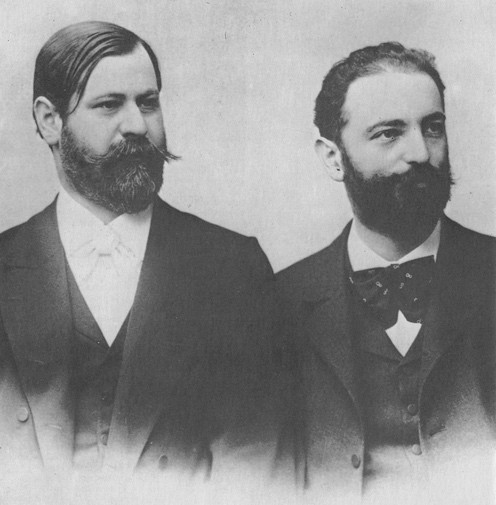
Sigmund Freud and Wilhelm Fliess in 1890.

The most serious blunder in Freud’s career, one that would wreak havoc not on a couple of women but on how his followers treated their clients throughout the 20th century, was his repudiation of one of his discoveries.

At the end of the 19th century, Freud had noticed that some women who consulted him suffered from memories of having been raped by their fathers: something that went down in history as ‘the seduction theory.’ In 1896 Freud wrote an article on the subject, ‘The Aetiology of Hysteria.’ Jeffrey Masson suggests that, seeing that these revelations only alienated him from his colleagues in a Vienna incapable of putting the respected fathers on the dock, Freud, much like the psychiatrists, reversed his ideology and decided to blame the victims. Freud labelled them ‘hysterical’ and defined hysteria as a hidden desire to be seduced. It is now known that incest has occurred more frequently than was accepted in 19th-century Europe, but this reversal of blame was to be the cornerstone upon which Freud would build his edifice. For psychoanalysis, the year 1897 marks both the abandonment of Freud’s seduction theory (if you say your father molested you…) and the ‘discovery’ of the Oedipus complex (…it means you were actually fantasizing about it).

In 1900 Freud saw Ida Bauer for the first time, whom he called ‘Dora’. Mr. K., an industrialist and friend of Dora’s dad, tried to seduce her twice: the first time when she was just thirteen-year-old and the second time when she was fifteen. Mr. K. forcibly kissed her on the mouth and Dora responded ‘with a vivid sense of disgust.’[13] When the girl reported the situation her father wanted to take her to a doctor. Dora refused: all she wanted was to be vindicated against Lolita’s harasser. But eventually, she relented.

In a session with Freud, the seventeen years old Dora told him her story. Since her father hadn’t supported her, perhaps Dr Freud would. Freud listened to her for several sessions and, unlike her father, believed her story. But he did something more. The following is a quote from an article in which Freud confesses what he told Dora in their consultation:

You will agree that nothing makes you so angry as having it thought that you merely fancied the scene by the lake [the place of the seduction]. I know now—and this is what you do not want to be reminded of—that you did fancy that Mr K.’s proposals were serious, and that he would not leave off until you had married him.[14]

This is one of the sins that analysts commit daily. Right now, one of them is ‘interpreting’ the mind of one of their unsuspecting clients in a manner as capricious as this. Another example is how Amara interpreted my running away to my grandmother’s house as a result of feeling insecure before my siblings. When Freud interpreted her as being in love with a man three times her age, and as having felt disgusted when Mr. K. tried to kiss her being ‘hysterical’—Freud assumed that if Dora were normal, she would have responded with pleasure—, the girl didn’t challenge him. She said goodbye to the Vienna quack and never set foot in his office again.

Freud took his revenge by devising the theory that if someone disagreed with the analyst’s interpretation, it was simply due to a lack of insight, a refusal to confront her own psychological reality. This overinterpretation, elevated to a doctrine in psychoanalysis, he christened ‘resistance’: a concept he had already used in the case of Emma Eckstein. For Freud and psychoanalysts, this word means that, once the analyst has made an interpretation, the case is closed: everything else is ‘resistance.’ Let us listen once more to Freud:

We must not be led astray by initial denials. If we keep firmly to what we have inferred, we shall in the end conquer every resistance by emphasizing the unshakable nature of our convictions.[15]

Then Freud adds that ‘this conviction has become so absolute in me…’

This is the language of the dogmatist, not of the student of the mind, much less of the mind of another person. What Freud really wanted was for Dora to fall into a state of folie à deux with him (as I fell into it with Amara when he prevented me from stopping my appointments). Freud not only failed to apologize to Dora for the stupid thing he had said about Mr. K., but he elevated his foolish interpretation to the level of science, employing all the literary resources of his intellect. Freud’s essay on Dora, Fragment of an Analysis of a Case of Hysteria, is the most extensive clinical history in Freud’s legacy and the most cited work on female ‘hysteria.’ In Fragment of an Analysis Freud dared to interpret Dora’s cough as an expression of her desire to perform fellatio on Mr. K., and he also interpreted two of her dreams along those same sexual lines. Obviously, the teenager’s disagreement with such interpretations constituted ‘resistance.’ Not content with that, Freud also used the Dora case to develop the famous doctrine of ‘transference.’ Let us read Freud once more:

…those indications that make a transference onto me plausible. … I conclude that in one of the treatment sessions, the patient [Dora] decided she wanted me to kiss her. [16]

Freud deluded himself into believing that a young woman in her prime wanted to be kissed not only by Mr. K. but by him as well. In one of the few good biographies written about Freud, the analyst Louis Breger states that it was clear that the therapy Freud applied to Dora was quite harmful, and that it was painful to read the case today.[17] The harmful therapy appears in the excellent Mexican play Feliz Nuevo Siglo Doktor Freud (Happy New Century, Dr. Freud ) by Sabina Berman. Berman’s comedy, which I thoroughly enjoyed and which was even performed in Spain, deals precisely with what has been said here about Freud and Dora.

I wonder how someone like Freud ended up in history as an astute observer of the mind. Because analysts continue to follow Freudian doctrines, they have tarnished Dora’s image for a century without ever having met her. Masson tells us that famous analysts like Ernest Jones, Félix Deutch, Jacques Lacan and even feminists like Toril Moi have spoken of Dora with contempt. Jenny Pavisic, a Lacanian analyst, told me personally: ‘Dora was a hysteric who—.’ In other words, the folie à deux of the true believers of Freud’s ideas continues. In reality, Dr Freud blamed Dora to absolve the industrialist and blamed Emma to absolve his buddy: antecedents of what, three-quarters of a century later, Amara would do to me: blame me to absolve my parents. Throughout the 20th and early 21st centuries Freud’s followers have blamed countless Doras, Emmas, and Césares.

At the end of the 19th century, in a letter to Wilhelm Fliess, Freud confessed that, due to his essay on seduction, in which he discussed incest among the middle and upper classes, ‘the word has been given out to abandon me and I am isolated.’[18] Masson believes that Dora’s case vindicated him. His new theory of hysteria represented a complete reversal of his previous position. Now Freud no longer targeted powerful industrialists like Mr. K., but a defenceless young woman. Freud’s behaviour was in line with psychiatry: siding with parents and the wealthy classes against their victims. From this perspective, it is no exaggeration to say that psychoanalysis was founded on the betrayal of women and adolescents in early 20th-century Vienna.

The Dora case and the abandonment of his seduction theory are not venial sins of the founder of psychoanalysis. They invalidate two pillars of the Freudian edifice: the notion of hysteria and the famous Oedipus complex. But Freud also used his prestige to side with parents in conflicts with adolescent boys. This is evident in his own writings. In The Psychopathology of Everyday Life Freud recounts that a mother asked him to examine her son. Freud noticed a stain on his trousers, and the adolescent told him he had dropped an egg. Freud didn’t believe the story and spoke with the mother privately: ‘I… took as the basis of our discussion his confession that he was suffering from the troubles arising from masturbation.’[19] The point of the anecdote, and I owe this to Thomas Szasz, is that the boy wasn’t suffering from anything at all: it was an ignorant mother who was worried about her son’s emerging sexuality. Freud saw something as normal as adolescent ejaculation as ‘psychopathological.’ Whether it was due to masturbation or not, much like Catholics taking their children to confession, the boy’s emission warranted a whole medical ceremony culminating in a formal diagnosis.

This was not another hypothetical isolated slip of Freud’s. Throughout his life he shared the Victorian hysteria surrounding masturbation: real hysteria, not the ‘hysteria’ of Emma and Dora that harmed no one. Freud believed that masturbation was a very serious matter. He wrote to Fliess that masturbation was the ‘primary addiction’ from which all others arose, including addiction to morphine and homosexuality.[20] We are so accustomed to seeing Freud as the pioneer in the courageous revelation of human sexuality that it is difficult for us to see him for what he was: an exponent of the morality of his time. In fact, he didn’t tell his own children how babies came into the world but sent them to the family doctor to have it explained. The most fascinating anecdote I know on this subject is something told by Oliver Freud, one of Freud’s sons.

When Oliver was sixteen, he asked his father for advice about masturbation. The boy hoped the renowned physician of the human soul would free him from guilt. Freud did the opposite: he warned him against masturbating. In Oliver’s own words, he was ‘quite upset for some time.’[21] Louis Breger comments that Oliver had the feeling that his father’s censure had erected a barrier that prevented communication between them.[22] Years later, Oliver would be the Freud child who distanced himself most from the family. What better example to portray the real Freud, the creator of an all-encompassing theory that revolved around human eroticism? The man who founded the profession of listening to those who needed to talk about their sexuality didn’t listen to his own son!

*   *   *

Now I will address Freud’s stance on the political realities of his time.

The First World War was the greatest catastrophe Europe experienced at the beginning of the century. It violently awakened people from the optimistic dream of unstoppable 19th-century progress. Never before had millions died in a single war. The war not only killed and disabled many soldiers during combat, but the emotional aftermath was also felt by their wives and families.

Freud was at the height of his intellectual powers when the conflict erupted. Initially, he embraced the nationalism of the time and even told a disciple, ‘All my libido is for Austria-Hungary.’[23] Freud’s euphoria cooled, as did that of his compatriots, when the stark realities of the war and the death toll began to emerge. I cannot elaborate on the details, but I will mention Freud’s stance toward the thousands of traumatized soldiers who survived the fighting. Stanley Kubrick’s Paths of Glory was the first movie to portray the hell of trench warfare in the First World War, including the psychological trauma of some soldiers, which in Freud’s time was termed ‘war neurosis.’ For some English and French doctors—and this is not a movie but true history—it was obvious that these traumas were caused by their experiences in the war. Currently, the term PTSD is used in some cases of veterans of the Vietnam War and the Gulf Wars.

Freud, on the other hand, was blind to the obvious. In his contribution to the monograph Psychoanalysis and the War Neurosis he wrote that the soldiers’ mental disorders had a purely sexual origin, and his close disciples seconded him. Josef Breuer, despite his advanced age during the war, helped to medically treat some of the survivors. His philanthropic attitude contrasts sharply with that of Freud, who never treated a single soldier. Freud was content to draw his conclusions directly from his theories. For Freud, these theories were laws of nature, and from them it was possible to deduce everything related to human behaviour. If Freudian theory was based on the axiom of human sexuality, then all neuroses, including ‘war neurosis,’ must necessarily have a sexual aetiology. A single case will suffice to illustrate Freud’s position. In 1919, Lou Andreas-Salomé, one of Freud’s most famous disciples, wrote to Freud about the case of a soldier whose twin brother had died in the war. Neither Andreas-Salomé nor Freud paid any attention to the loss. Under Freud’s guidance, Andreas-Salomé conducted the ‘analysis’ of the surviving twin around classic Freudian doctrines such as latent homosexuality, the Oedipus complex, and fixation on the paternal figure. [24]

The Freudian interpretation is as capricious as the interpretations of Emma and Dora or Amara’s interpretation of my running away to my grandmother’s house. But Freud was guilty of more than just a theoretical stance. The founder of psychoanalysis not only sided with powerful individuals in conflict with young women, but also with the State in conflict with soldiers.

The German psychiatrist Julius Wagner-Jauregg administered painful electric shocks during World War I to young men who wanted to leave the military. After the war, some of those treated in the psychiatric division of Vienna General Hospital, run by Wagner-Jauregg, complained, and in 1920 a commission was appointed to investigate the charges. The commission asked Freud for his opinion. Freud defended Wagner-Jauregg. And not only that: He insisted on calling the soldiers who accused the renowned doctor ‘patients’ and on referring to their fear as an ‘illness.’ The commission ruled in favour of Wagner-Jauregg. Because Freud was a man convinced of his own righteousness and believed he had never done anything mean, he never regretted what he had done to the young soldiers.[25]

I emphasize that these weren’t isolated sins in the biographies of Freud and Jung. In the entire vast body of work of these psychologists, there is not a single critical line regarding involuntary psychiatric hospitalization. Since Jung learned his trade at the Burghölzli Hospital in Zurich under Bleuler’s supervision, he was familiar with the neologism his boss coined: schizophrenia. On one occasion, Freud played the accomplice in Bleuler and Jung’s prison-like psychiatry. On May 16, 1908, Freud wrote to Jung:

Enclosed the certificate for Otto Gross. Once you have him, don’t let him out before October, when I shall be able to take charge of him.[26]

This smells like the mafia. Gross himself was a doctor who, ironically, that same year published a letter to an editor objecting to a girl’s involuntary commitment by her father. On June 17, Gross escaped from the Burghölzli. Jung retaliated by labelling him ‘schizophrenic.’ Freud enthusiastically accepted the diagnosis.[27]

In 1975, the Mexican Social Security Institute convened an international conference on psychiatry and psychoanalysis in Mexico City, in which Tom Szasz participated along with other European and Latin American psychiatrists and analysts. At a roundtable discussion, Szasz confronted his colleagues. He told them what he thought about lobotomist doctors and psychiatrists:

The other conclusion is that they are gangsters, butchers, criminals, and delinquents. That is my conclusion. And I would add that people like Freud are also sympathetic to these butchers, since for forty years he never pointed out that this was wrong. And this was happening right next door. He behaved like one of those Germans who, when the Jews were in the gas chambers, claimed not to smell anything. And finally, my conclusion is that Freud and Jung, especially Freud—who had many good ideas and was very intelligent—was basically a gangster, because he wasn’t interested in studying anything scientifically. He was only interested in building what he called the psychoanalytic movement.

Words are very important. Galileo didn’t have a movement. Darwin didn’t have a movement. Mendel didn’t have a movement. Einstein didn’t have a movement. Freud claimed to be a scientist, but since he needed a movement, this makes him a politician. The only question left is: do you like Freud as a politician or not? I find him detestable.[28]

The analysts who shared the roundtable with Szasz didn’t respond to these criticisms: that throughout his career Freud remained silent about the psychiatric crimes in the house next door. Igor Caruso and Marie Langer offended him, and Szasz had to leave the discussion.[29] But the important thing to emphasize is that these learned figures in psychoanalysis didn’t respond at all regarding Freud’s indifference to the crime. They had nothing to say.

Not only did Freud lack compassion for the victims of world war and psychiatric confinement but, like his mentor Charcot, when referring to the women persecuted by the Inquisition, he spoke of them as ‘hysterics.’ This is one of the facts that most horrified me when reading Szasz’s classic, The Manufacture of Madness: Freud and his mentor didn’t speak of perpetrators but rather diagnosed the victims of the inquisitors. In his obituary for Charcot, Freud wrote:

By pronouncing possession by a demon to be the cause of hysterical phenomena, the Middle Ages in fact chose this solution; it would only have been a matter of exchanging the religious terminology of that dark and superstitious age for the scientific language of today.[30]

As Szasz pointed out, this is an extraordinary statement. Freud acknowledges that the psychoanalytic description of hysteria is merely a semantic revision of the demonological one! Freud wrote his note in 1893. In more recent times, there are psychiatrists and historians sympathetic to psychiatry who continue to spout the exact same nonsense. For example, in Nouvelle histoire de la psychiatrie, published in France in 1983, the editors Jacques Poster and Claude Quétel wrote a biographical note on Johann Christian Heinroth and the words he used. This 19th-century psychiatrist identified mental illness with sin. Poster and Quétel commented that Heinroth’s Lutheran vocabulary had been much criticized and had fallen into disuse in our time. But they immediately added: ‘However, if we substitute the notion of “sin” with that of “guilt,” many of his ideas acquire a curiously modern dimension.’[31] Another contributor, the Mexican psychiatrist Héctor Pérez Rincón, wrote: ‘One cannot speak of the history of psychiatry in New Spain without taking into consideration … the activity of the Inquisition in some behaviours that today would be classified as psychiatric.’[32] So, in a book published a century after Freud’s pronouncement, there are psychiatrists who continue to maintain that his Newspeak is merely a semantic revision of the Inquisition’s ideology.

In the 4th century, the stigmatizing labels were pagan and heretic. A thousand years later, there were no longer any Greco-Roman pagans—they had been exterminated by the Church—only heretics, but a new group emerged to be stigmatized: witches. In 1486, the Dominican theologians Jacob Sprenger and Heinrich Krämer published the Malleus Maleficarum, literally the hammer of witches: the medieval manual that would become the ideological source of terror for countless women: an inhumane hunt that would last for centuries. The exact number of women murdered is unknown, but some estimates range from one hundred thousand to half a million. The last execution for ‘witchcraft’ took place in Poland in 1793. Incredibly, these victims of deranged Christians are not considered as such in the writings of psychiatrists. Following Charcot and Freud, psychiatrists speak of neuro-pathologies referring not to the inquisitors, but to their victims. Szasz observes that, for the historians of psychiatry Franz Alexander and Sheldon Selesnick, the fact that these women were tortured and burned was enough to make them, not their murderers, objects of medical interest. And what do psychiatrists say about the authors of the Malleus Maleficarum? Gregory Zilboorg, another historian of psychiatry, called them ‘two honest Dominicans.’ Similar words of admiration can be found in the writings of Jules Masserman, another psychiatrist.[33] Evidently these doctors, as arrogant as those medieval theologians, diagnose ‘psychopathologies’ centuries later, without having medically examined any of the women. I call this Wonderland Logic, alluding to Lewis Carroll’s story: the surrealism of punishing the victim and not the perpetrator.

The most relevant point in psychiatric Wonderland is that many psychiatrists today believe these official psychiatric narratives. Even students in the new century accept such narratives. For example, in his thesis for his undergraduate degree in psychology from the National Autonomous University of Mexico in 2001, Guillermo Gaytan wrote: ‘Sprenger and Kramer’s Malleus Maleficarum, a book that can be considered a true treatise on psychopathology, also contained a good number of corrective measures.’ [34]

Corrective measures! Does the author approve of burning women at the stake? Fortunately, for historians who are not psychiatrists or psychologists, such as Hugh Trevor-Roper, the witch hunts were clearly a paranoid enterprise of the Church. After the Enlightenment there is no excuse for viewing this chapter of history any other way. It doesn’t surprise me that an individual who labels the victim of fanatics as hysterical—Freud—treated some of his patients the way he did.


[1] David Cooper, quoted in Francisco Gomezjara (ed.): “La otra psicología” in Alternativas a la psiquiatría y a la psicología social (México: Fontamara, 1989), p. 76. This dossier of articles published in various Mexican journals and newspapers was originally published in 1982. The edition I am referring to is the expanded 1989 edition.

[2] Freud to James Putnam, quoted by Ernest Jones. On page 153 of The Myth of Mental Illness (Harper & Row, 1974), Thomas Szasz quotes it in German (“Ich betrachte das Moralische als etwas Selbstverständliches… Ich habe eigentlich nie etwas Gemeines getan.‘‘).

[3] Quoted in Louis Breger: Freud: el genio y sus sombras (Javier Vergara, 2001), p. 71. The original title is Freud: Darkness in the Midst of Vision (John Wiley & Sons, 2000).

[4] Ibid., (Spanish edition) p. 72.

[5] Cited in Masson: Against Therapy, p. 82.

[6] Ibidem.

[7] Hanna Breuer, cited in Breger: Freud, p. 174 (Spanish edition). The relationship between Josef Breuer and Freud is explained in three chapters of Breger’s book.

[8] Martin Gardner: ‘Freud and Fliess: The Sad Sage of Emma Eckstein’s Nose’ in Skeptical Inquirer (Summer 1984), p. 302.

[9] Ibid, p. 304.

[10] Ibid.

[11] Freud to Wilhelm Fliess, cited in Breger: Freud (Spanish edition) p. 196.

[12] I read this in ibidem, p. 511.

[13] Ibidem, p. 212.

[14] Masson: Against Therapy, p. 95.

[15] Quoted in Paul Gray, ‘The Assault on Freud’, Time (29 November 1993), p. 33.

[16] Breger: Freud (Spanish edition), p. 162.

[17] Ibid.

[18] Masson: Against Therapy, p. 104.

[19] Freud, cited in Szasz: The Manufacture of Madness, p. 195.

[20] I read several quotations of Freud to Fliess on masturbation in Szasz: Pharmacracy, pp. 102ff. See also The Manufacture of Madness, pp. 189-194.

[21] Oliver Freud, cited in Breger: Freud (Spanish edition), p. 375.

[22] Ibid. On pages 244ff, Breger writes about a different case in which Freud was open minded and didn’t condemn the masturbation of Albert Hirst, one of his patients. But Freud never mentioned the case in his writings: what is known is due to what Hirst himself recounted.

[23] Freud, cited in ibid., p. 305.

[24] Ibid., p. 339.

[25] Thomas Szasz’s The Myth of Psychotherapy contains a chapter on Freud and electrotherapy.

[26] Szasz: Anti-Freud, pp. 135ff.

[27] These observations are taken from ibid., p. 136. A more detailed account of these events and the erratic story of Otto Gross appears in Richard Noll’s The Aryan Christ: The Secret Life of Carl Jung (Random House, 1997).

[28] Basaglia et al.: Razón, locura y sociedad, pp. 178ff (my translation).

[29] Ibid., pp. 179-184.

[30] Freud, cited in Szasz: The Manufacture of Madness, p. 73.

[31] Jacques Poster and Claude Quétel (eds.): “Diccionario biográfico” in Nueva historia de la psiquiatría (Fondo de Cultura Económica, 2000), p. 652, my translation.

[32] Héctor Pérez-Rincón: “México” in ibid., p. 525, my translation.

[33] In the chapter ‘The Witch as Mental Patient’ from The Manufacture of Madness, Szasz presents the positions of Charcot, Freud, Zilborg and other physicians regarding the Inquisition.

[34] Guillermo Gaytan-Bonfil: El diagnóstico de la locura en el Manicomio General de La Castañeda (undergraduate thesis, Faculty of Psychology, UNAM, 2001), p. 3, my translation.


Absurdities and Atrocities: How the Arms Races of Animals Can Illuminate the Bullshit of Humans

A specter is haunting America — the specter of a vanished predator.[1] More precisely, it’s haunting the prairies west of the Mississippi, the home of a remarkable antelope called the pronghorn, Antilocapra americana. What’s remarkable about the pronghorn is that it runs far faster than it needs to. No living predator in America gets close to its top speed of 55 mph (88 kph), so some biologists have suggested that the pronghorn is, in effect, running from a dead predator, the long-extinct American cheetah, Miracinonyx spp.

Speeding from a specter: a pronghorn displays its remarkable speed (image from Wikipedia)
If those biologists are right, the pronghorn is the surviving half of an evolutionary arms-race, a competition between predator and prey in which each side had to respond when the other side evolved to be faster. A similar arms-race took place across the Atlantic between African antelopes and the African cheetah, which isn’t in fact closely related to its American namesake.[2] But both groups of cheetahs evolved ever-greater speed to catch ever-fleeter prey. By now, after millions of years of evolution, cheetahs and antelopes must be at the limits of biological possibility. They couldn’t get much faster. Nor could biology ever catch up with one of H.G. Wells’ most memorable short-stories. In “The New Accelerator” (1901), Wells describes the invention of a stimulant drug that makes the body work “several thousand times faster,” “heart, lungs, muscles, brain — everything.”

Power-hungry priests

When the narrator and the inventor take the stimulant and go for what seems to them a stroll, they find that the world of people, animals and objects has, from their point of view, almost frozen to immobility, because they’re moving and perceiving so fast. And when they run, air-friction almost sets their clothes on fire. It’s a highly inventive and entertaining story, but also physiologically absurd (as Wells must have been well aware). After the narrator takes the stimulant, he says: “My heart, for example, was beating a thousand times a second.” But in that case, his heart would have burst. And if his heart and blood-vessels hadn’t burst, his joints and muscles would have disintegrated when he began to move. And so on. Biology can’t be indefinitely accelerated. That’s why biological arms-races between predators and prey haven’t resulted in cheetahs and antelopes that break the sound-barrier.

But if biology can’t be indefinitely accelerated, theology can. Indeed, theology can be infinitely accelerated. I think the concept of an evolutionary arms-race can be applied to the human mind too. For example, some arms-races in theology have gone to infinity — and to absurdity. So have some arms-races in politics and culture.[3] What am I talking about? Well, in theology I’m talking about the concepts of Hell and infallibility. Both of these are big and so-far insurmountable barriers to my becoming a traditionalist Catholic, because I find them absurd and literally unbelievable. But I also find them fascinating as psychological phenomena. And I think I can explain them sociologically and epistemologically. More precisely, I think I can explain them memetically — as conceptual products of a cognitive arms-race, as memes in a Kulturkampf. The concept of Hell, of everlasting punishment in the afterlife, is the product of an arms-race between competing religions or between power-hungry priests and pleasure-hungry layfolk. The point of Hell is to frighten and manipulate. But any religion that used the threat of finite punishment in the afterlife, no matter how prolonged and agonizing, would be out-competed by a religion that used the threat of infinite punishment.

Obey the Church or be eternally tortured: Jan van Eyck’s 15th-century depiction of Hell (image from Wikipedia)
However, threatening infinitely intense pain would be no good, because we can’t imagine that. But we can imagine infinitely prolonged pain. That’s why even atheists and unbelievers can be disturbed by one section of James Joyce’s autobiographical novel A Portrait of the Artist as a Young Man (1916). Joyce describes a preacher trying to frighten his audience with an utterly absurd but also deeply disturbing vision of Hell. And I think that vision represents the culmination of a conceptual arms-race between priests seeking to frighten and layfolk seeking to resist being frightened:

The preacher’s voice sank. He paused, joined his palms for an instant, parted them. Then he resumed:

—Now let us try for a moment to realise, as far as we can, the nature of that abode of the damned which the justice of an offended God has called into existence for the eternal punishment of sinners. Hell is a strait and dark and foulsmelling prison, an abode of demons and lost souls, filled with fire and smoke. The straitness of this prison house is expressly designed by God to punish those who refused to be bound by His laws. In earthly prisons the poor captive has at least some liberty of movement, were it only within the four walls of his cell or in the gloomy yard of his prison. Not so in hell. There, by reason of the great number of the damned, the prisoners are heaped together in their awful prison, the walls of which are said to be four thousand miles thick: and the damned are so utterly bound and helpless that, as a blessed saint, saint Anselm, writes in his book on similitudes, they are not even able to remove from the eye a worm that gnaws it.

—They lie in exterior darkness. For, remember, the fire of hell gives forth no light. As, at the command of God, the fire of the Babylonian furnace lost its heat but not its light so, at the command of God, the fire of hell, while retaining the intensity of its heat, burns eternally in darkness. It is a neverending storm of darkness, dark flames and dark smoke of burning brimstone, amid which the bodies are heaped one upon another without even a glimpse of air. Of all the plagues with which the land of the Pharaohs were smitten one plague alone, that of darkness, was called horrible. What name, then, shall we give to the darkness of hell which is to last not for three days alone but for all eternity?

—The horror of this strait and dark prison is increased by its awful stench. All the filth of the world, all the offal and scum of the world, we are told, shall run there as to a vast reeking sewer when the terrible conflagration of the last day has purged the world. The brimstone, too, which burns there in such prodigious quantity fills all hell with its intolerable stench; and the bodies of the damned themselves exhale such a pestilential odour that, as saint Bonaventure says, one of them alone would suffice to infect the whole world. The very air of this world, that pure element, becomes foul and unbreathable when it has been long enclosed. Consider then what must be the foulness of the air of hell. Imagine some foul and putrid corpse that has lain rotting and decomposing in the grave, a jellylike mass of liquid corruption. Imagine such a corpse a prey to flames, devoured by the fire of burning brimstone and giving off dense choking fumes of nauseous loathsome decomposition. And then imagine this sickening stench, multiplied a millionfold and a millionfold again from the millions upon millions of fetid carcasses massed together in the reeking darkness, a huge and rotting human fungus. Imagine all this, and you will have some idea of the horror of the stench of hell.

—But this stench is not, horrible though it is, the greatest physical torment to which the damned are subjected. The torment of fire is the greatest torment to which the tyrant has ever subjected his fellow creatures. Place your finger for a moment in the flame of a candle and you will feel the pain of fire. But our earthly fire was created by God for the benefit of man, to maintain in him the spark of life and to help him in the useful arts whereas the fire of hell is of another quality and was created by God to torture and punish the unrepentant sinner. Our earthly fire also consumes more or less rapidly according as the object which it attacks is more or less combustible so that human ingenuity has even succeeded in inventing chemical preparations to check or frustrate its action. But the sulphurous brimstone which burns in hell is a substance which is specially designed to burn for ever and for ever with unspeakable fury. Moreover, our earthly fire destroys at the same time as it burns so that the more intense it is the shorter is its duration; but the fire of hell has this property that it preserves that which it burns and though it rages with incredible intensity it rages for ever. […] And this terrible fire will not afflict the bodies of the damned only from without, but each lost soul will be a hell unto itself, the boundless fire raging in its very vitals. O, how terrible is the lot of those wretched beings! The blood seethes and boils in the veins, the brains are boiling in the skull, the heart in the breast glowing and bursting, the bowels a redhot mass of burning pulp, the tender eyes flaming like molten balls. […]

—O, my dear little brothers in Christ, may it never be our lot to [enter Hell]! May it never be our lot, I say! In the last day of terrible reckoning I pray fervently to God that not a single soul of those who are in this chapel today may be found among those miserable beings whom the Great Judge shall command to depart for ever from His sight, that not one of us may ever hear ringing in his ears the awful sentence of rejection: Depart from me, ye cursed, into everlasting fire which was prepared for the devil and his angels! (James Joyce, Portrait of the Artist as a Young Man, chapter III, 1916)

I’m an unbeliever, but I find that description of Hell disturbing. I also find it both absurd and atrocious.[4] How could any rational person believe in a perfect god and just God who inflicts such a punishment on weak and fallible humans for their finite sins?[5] Well, the simple answer is that Hell isn’t a matter of rationality but of cratology.[6] That’s a useful word meaning “study of power” or “system of power.” The preacher, as proxy for the Church, wants to exercise power over the minds of his audience. And he succeeds very well in one case. Joyce’s alter ego, Stephen Dedalus, is badly frightened by the sermon and after it has a psychosomatic illusion that his “brain [is] simmering and bubbling within the cracking tenement of the skull.” That’s the point of Hell: to frighten. But anything short of an infinitely prolonged Hell isn’t frightening enough or can be out-competed by an infinite Hell. And so, for most of Christian history, the atrocity outweighed the absurdity and the threat of eternal punishment was a potent means of psychological manipulation by the priesthood.[7]

An arms-race with science

There’s no atrocity in another theological concept created by an ideological arms-race. But there is plenty of absurdity. It’s the concept of infallibility, that is, the claim that a religion can offer certain knowledge without any tincture of doubt or uncertainty. I’ve pointed out before that mathematics doesn’t claim infallibility because it doesn’t need to. Math is obviously as close to certain knowledge as fallible and intellectually limited humans can get. Theology, by contrast, is about as far as humans can get from certain knowledge. Our opinions about God and the supernatural are obviously both subjective and arbitrary, in that they’re highly dependant on the time, place and circumstances of our birth. And on our own, unchosen psychology (atheism goes with autism, for example). But one can hardly expect competing religions to admit their own contingency. Instead, competing religions — or ideologies — will enter an epistemological arms-race. The logical culmination of that arms-race is infallibility: the claim that a religion offers complete certainty about all-important matters.

And it’s no coincidence, I’d suggest, that Papal infallibility was proclaimed as dogma in the century that saw the full rise of modern science. In the nineteenth century, Catholicism entered an arms-race with science, which had proved very successful in a physical sense but remained epistemologically modest. Mother Church could not compete materially with science but could compete metaphysically. And so Pius IX proclaimed the absurd concept of Papal infallibility.[8] Protestantism struck back with the even more absurd concept of Biblical inerrancy.[9] And these concepts then influenced secular politics: Leszek Kołokowski, the great Polish philosopher and intellectual historian, said this in his magisterial Main Currents of Marxism (1978): “When the party is identified with the state and the apparatus of power, and when it achieves perfect unity in the shape of a one-man tyranny, doctrine becomes a matter of state and the tyrant is proclaimed infallible. […] Lenin had always been right [and] the Bolshevik party was and had always been infallible.” (Op. cit., Vol 3, p 5) And Italian fascism, which was strongly influenced by Marxism, had the slogan Il Duce ha sempre ragione — “The Duce is always right.”

From pronghorns to perverts

The political concept of infallibility is again the product of an arms-race between competing ideologies. Part of the reason that communism won the arms-race in Russia and fascism won in Italy is that communists and fascists went to infinity. They believed that their leaders and their ideologies weren’t probably or overwhelmingly right, but infinitely right — infallibly right. I think such political and cultural arms-races have continued to this day. But they can be intra-ideological as well as inter-ideological. For example, I think the demand for open borders or defunding of the police is the culmination of an arms-race within the left, not just between the left and the right. Any leftists who support even minimal border-controls leave themselves vulnerable to charges of racism and xenophobia. And so, just as the theological arms-races resulted in the absurd but potent concepts of Hell and infallibility, the intra-leftist arms-race results in the absurd but potent concept of open borders. That is, it’s psychologically potent, because it maximally feeds leftist narcissism and self-regard.

A leftist absurdity: All races have the same brain and cognitive potential

So do two even more absurd leftist concepts: “Race does not exist” and “Transwomen Are Women.” There have been two more arms-races powered by the fact that accusations of racism or transphobia will shower down on any leftist who questions the Psychic Unity of Mankind or who doesn’t fully accept translunacy. And translunacy itself can be seen as the product of an arms-race between feminists and autogynephiles, that is, men who fetishize themselves as female. Translunacy can also be seen as the product of an arms-race inside the heads of those male fetishists. Before the 1960s and ’70s, men who derived sexual pleasure from dressing and play-acting as women could be dismissed by feminists as exactly what they were: perverted men with an absurd and embarrassing fetish. That’s why those men began to claim that they were real women, not perverted and play-acting men. They were seeking to defeat the feminist critique but also to heighten their own pleasure. An autogynephile who knows he’s play-acting as a woman gets less pleasure than one who manages to convince himself that he really is a woman.

Hacking the hierarchy

Like Hell or infallibility, transgenderism is an absurd concept whose absurdity hasn’t hindered its success. Again, it’s cratology that applies, not rationality. And translunatics have been very successful in pursuing power and winning their arms-race with feminists. Indeed, they’ve been astonishingly successful. As I pointed out in “Power to the Perverts,” some stale pale males in Britain have managed to hack the hierarchy and claim to be victims of hate-crime by a Black lesbian called Linda Bellos. How on Earth did they do that? Under normal circumstances, Bellos would be right at the top of the hierarchy of racial and sexual privilege in leftism. And stale pale males would be right at the bottom. But these stale pale males are “transwomen” and Bellos is a TERF, or Trans-Exclusionary Radical Feminist. Therefore the White men can claim that they are victims of “hate” by the Black lesbian. But since the besting of Bellos, translunacy has suffered setbacks, as I’ve described in “Trashing Traumatized Trannies” and “Moobs on the Move.” The British Supreme Court has ruled that women are defined by biology, not by bullshit.

The absurdity of autogynephilia: some bearded and balding male perverts invade female territory on a lesbian dating-site
But the translunatics haven’t gone away and haven’t dropped their absurd claim to be women. They never will drop it, because it’s the product of an arm-race inside their own heads: between sanity and sexual perversion. As you might expect, perversion has prevailed, because sanity and rationality aren’t essential elements of either psychology or cratology. Indeed, they often hinder the pursuit of power, which is why they’re often so conspicuously absent in human affairs. Concepts like Hell and transgenderism are absurd, but their absurdity has mattered much less than their potency. The seemingly disparate concepts of Hell and transgenderism are also united in the way they illustrate a famous principle: “Those who believe in absurdities will commit atrocities.” Those who believed in Hell used it to justify unlimited torture and tyranny. And those who believe in transgenderism have used to justify the mutilation and sterilization of children. As antelopes and cheetahs reveal, a biological arms-race often ends in celerity. As Hell and transgenderism reveal, a cultural arms-race often ends in atrocity.[10]


[1] This is a reference to Marx’s opening line in the Communist Manifesto (1848): “A specter is haunting Europe — the specter of communism.”

[2]American cheetahs seem to have been more closely related to pumas than to African cheetahs.

[3]  See also Nassim Taleb’s very interesting essay “The Most Intolerant Wins: The Dictatorship of the Small Minority.”

[4]  I also find Hell an immoral or extra-moral concept. If you refrain from bad behavior because you think bad behavior will send you to Hell, you’re not behaving morally. That is, you’re motivated not by abhorrence of sin but by fear of damnation. And if you cease to believe in Hell, you’ll presumably cease to refrain from bad behavior.

[5] I’ve seen the argument that infinite punishment is justified because sin is an offence against an infinite God. This seems to me like arguing that five-year-olds or animals should be punished as adults or humans if they commit an offence against an adult or a human. After all, children and animals can do real harm to their superiors. But how can a human harm God or, in any lasting sense, God’s creation?

[6] Traditional portrayals of Hell and the Crucifixion also owe something to sadism and sexual pathology. The S&M in traditional Catholicism is another thing that keeps me out of Mother Church. It might be easier if I were homosexual: Gerard Manley Hopkins “was horrified to find himself aroused by images of Christ on the cross, and he would scourge himself after erotic dreams.”

[7] Under secular criticism, Hell became embarrassing for the mainstream churches and was increasingly left to the vulgar fringe. You’ve seen above from Joyce how a devout Catholic described Hell at the beginning of the twentieth century. At the beginning of the twenty-first century, another devout Catholic says merely that unrepentant sinners will suffer “the isolation and emptiness of hell forever.” So it’s isolation, not incineration. And “hell” doesn’t even merit a capital letter. C.S. Lewis, the most popular Christian apologist of the twentieth century, presented a psychological Hell of self-willed egocentrism in The Great Divorce (1945). It’s an interesting book, but it owes much more to existentialism than to the unequivocal portrayal of Hell in the Gospels as a place of fiery torment.

[8] I’d also say that those traditionalists who claim in believe in Hell and infallibility don’t behave as though they do. If you possess passive infallibility (active infallibility is reserved to the Pope as God’s proxy), why do you not make your proof of infallibility central to your arguments in favor of your beliefs? Once infallibility is granted, all else follows, including the Virgin Birth, Resurrection and Hell. But traditionalist devote much more time and effort to arguing for those secondary concepts than they do to arguing for the primary concept of infallibility. And if they genuinely believe in Hell, why do they not talk about Hell much more?

[9] Traditional Catholicism also claims that the Bible is inerrant, but layfolk cannot interpret its inerrancy for themselves. Fundamentalist Protestantism claims that layfolk do not need a church or Pope to be infallible on matters of faith, because they can be guided by an inerrant Bible.

[10] Or in tinnitus. Bands like Swans or Sunn O))) are the products of an arms-race in volume. Cultural arms-races can also end in unlistenability or incomprehensibility. Try listening to Schoenberg or reading Finnegans Wake.

A Dissident Perspective on Veterans Day: An Indictment of So-Called American Exceptionalism

Most all Americans will be celebrating Veterans Day, the purpose of which is self-evident in its name. That purpose is to honor veterans who served in this nation’s military and who fought in the many wars this country has needlessly involved itself with. This is seemingly something quite noble. However, far too few are cognizant that the date was chosen to coincide with Armistice Day, November 11, 1918, which ended hostilities in the First World War. Nor are most aware that this country’s role in the Great War is hardly a cause of celebration or testament to “American exceptionalism,” but an utter indictment of this country, this government, and pretty much everything it stands for and has stood for over the past 125 years. The formal peace treaty, the Treaty of Versailles—better described as the Versailles Diktat—was not signed until seven months later on June 28, 1919: a moral outrage and a significant causal factor underlying The Second World War. As Darryl Cooper, aka Martyr Made, has noted, the blockade that was starving Germany was still in effect, with nearly a million German civilians perishing needlessly.

The United States had no legitimate reason to enter that war, just as it has had no legitimate reason for entering or instigating the number of conflicts it has been involved with, before or since. As most should already know, the purported casus belli, the sinking of the Lusitania, occurred after the German government implored neutral powers that areas of The Atlantic Ocean surrounding the British Isles was a war zone, and that while German submarines will make every reasonable effort not to sink neutral shipping, the ability to ascertain a ship’s nationality is most limited peering through a periscope. Most readers are doubtlessly well aware that forensics have proven the Lusitania was smuggling war contraband. This was in the broader context of arming Britain, supporting Britain, even though Germany never posed any threat to the United States or her interests. Woodrow Wilson’s this and that talk about “making the world safe for democracy” was an abject lie, although given the myriad evils inherent to democracy, one wonders if a threat to what may be the very death of Mother Europe would be a bad thing at all. Regardless, Germany neither had the intention nor the capacity to pose a threat beyond the Atlantic in either world war. 1

The moral outrage of the United States role in entering the Great War is further compounded by the Benjamin Freedman theory of the Balfour Declaration, which credibly posits that the British government enticed Jewish financial interests to nudge the United States into the war in exchange for granting land in Palestine to realize the Zionist dream of forming the Jewish state of Israel. Finally, those deluded by these lies of American exceptionalism should consider that Germany would likely have won The Great War but for American intervention, while further considering all the ramifications of this. The seemingly unending litany of existential threats facing the Occident would simply not exist had this not occurred.

In the aftermath of World War II, the Germans have adopted a war guilt complex into their very national character. One hopes this is temporary, but marinating in over 80 years of allied occupation and the post-war cultural milieu that occupation has infused into the German national consciousness does not instill a sense of optimism; this pathology is very likely to become a permanent, defining characteristic of the German national character. It is highly doubtful the German people will ever be able to throw off this national guilt complex, at least not until the nationale and völkische Abschaffung des deutches Volkes has been fully and utterly consummated in earnest. In particular relation to the absurd proposition that today is a day for honoring this country’s war mongering, the United States is responsible for this pathology first and foremost, as it is also responsible for the number of maladies that emanate from this complex, including the mad delusion of open borders and Angela Merkel letting in millions of racial imposters into sacred Germany and the European continent more broadly.

If one concedes that the Third Reich was the unmitigated, unequivocal evil in that conflict, a proposition that is dubious at best, consider further if any nation is to assume blame for the rise of Hitler, it should be first and foremost Great Britain as well as the United States. The Great Blockade, which claimed nearly a million Germans, has already been mentioned. The Treaty of Versailles assigned all liability of the Great War on Germany and Germany alone, despite the Austro-Hungarian Empire, Russia, and even France being far more bellicose in both actions and statements preceding the outbreak of war, catalyzing the sudden plunge into war across the continent. The German people suffered unspeakable hardships as a result, paying for a loaf of bread not with a wallet but a wheelbarrow. They were paying not just a million marks but a billion marks for a loaf of bread. One must also consider the legitimate territorial claims that further inform the rise of national socialism, from the demilitarization of the Rhineland to the German port city of Danzig. These and other grievances help explain, without the advantage of hindsight, why everyday Germans turned to the swastika. These considerations in turn reveal that the United States is not the force for good that American exceptionalism and high school civics class curricula insist. Great Britain and more particularly the United States are just as responsible for the rise of Hitler as any collective group (namely “The Germans”), if not more so. Remarkably, as Darryl Cooper points out in his podcast on American involvement in the Russian-Ukraine war, crimes and offenses against the German people by the American government are hardly unique. This government committed similar outrages against the Russian people, all for bringing the world a velvet revolution and a peaceful end to The Cold War, as American foreign policy has brought the world to the brink of nuclear Armageddon through its intermeddling with Ukraine.

These and other reflections should not evoke a sense of patriotism, but national shame. Few will be so insightful. Most Americans, and particularly those opposed to the Democrat party, will be flying the American flag with unquestioning pride, and will be doing so with more purpose and vehemence than any other day except for perhaps July the Fourth. Many will have Lee Greenwood’s acoustic abomination “Proud to be an American” on particularly heavy rotation. Just as with any other day but even more so, today is not a day to be proud to be an American. Today, like each and every day, is a reason to be ashamed of this country, to be ashamed to call one’s self American. Ich bin nicht stolz darauf, Amerikaner zu sein. Ich schäme mich, Amerikaner zu sein.

Cernay German Military Cemetery, located South of the town on the Rue-d’Aspach. Here lie the remains of some 7,085 German soldiers from World War One and 1,479 soldiers from World War Two.

Other articles and essays by Richard Parker are available at his publication, The Raven’s Call: A Reactionary Perspective, found at theravenscall.substack.com. Please consider subscribing on a free or paid basis, and to like and share as warranted. Readers can also find him on twitter, under the handle @astheravencalls.

1

For starters, see Patrick Buachanan’s Churchill, Hitler, and the Unnecessary War generally. There are of course any number of sources confirming this.

When Black Power Turned Against Israel

Few alliances in American history seemed more unshakable than that between Jews and Blacks during the civil rights era. Yet, by the late 1960s, the same moral conviction that had once united them began driving them apart.

The 1967 Arab-Israeli War awakened a deep sense of solidarity among Black Power activists in the United States, compelling many to align themselves with the Palestinian cause. Operating under the illusion that Black activism could be harnessed as a weapon against White gentile power, American Jewry soon discovered that the blade they had forged could just as easily turn in their direction.

Even prior to 1967, the foundations of Black support for the Palestinian cause had been laid, most notably through Malcolm X’s early advocacy of Black-Palestinian solidarity. On September 5, 1964, he visited Gaza, touring the Khan Younis refugee camp and meeting Palestinian poet Harun Hashim Rashid.

His essay “Zionist Logic” pulled no punches: “The Israeli Zionists are convinced they have successfully camouflaged their new kind of colonialism. Their colonialism appears to be more ‘benevolent,’ more ‘philanthropic,’ a system with which they rule simply by getting their potential victims to accept their friendly offers of economic ‘aid,’ and other tempting gifts.” During a 1965 speech in Detroit, Malcolm X made his vision for Palestine clear: “We need a free Palestine… We don’t need a divided Palestine. We need a whole Palestine.”

The real earthquake came in June-July 1967 when the Student Nonviolent Coordinating Committee (SNCC)—a pillar of the civil rights movement—published “The Palestine Problem: Test Your Knowledge” in its newsletter. The article accused Israel of being established “through terror, force, and massacres” and claimed “Zionist terror gangs… deliberately slaughtered and mutilated women, children and men.” It asserted: “ISRAEL WAS PLANTED AT THE CROSSROADS OF ASIA AND AFRICA WITHOUT THE FREE APPROVAL OF ANY MIDDLE-EASTERN, ASIAN OR AFRICAN COUNTRY!” Stokely Carmichael, the SNCC chairman from 1966-1967 who would later become a pan-African activist, promoted a “tricontinental” vision uniting peoples of color in the Global South against imperialism, and capitalism—with Palestinians playing a critical role in this revolutionary project.

Acclaimed writer James Baldwin, initially optimistic about Israel, shifted dramatically to the pro-Palestinian side of the aisle by the late 1960s. Palestinian scholar Nadia Alahmed noted that “once Baldwin changed his mind about Israel, he never stopped criticizing it. Baldwin was one of the very first prolific black American voices to recognize Israel for what it really is.” In a 1979 essay for The Nation, Baldwin wrote: “But the state of Israel was not created for the salvation of the Jews; it was created for the salvation of the Western interests… The Palestinians have been paying for the British colonial policy of ‘divide and rule’ and for Europe’s guilty Christian conscience for more than thirty years.” Baldwin’s change in opinion was particularly influenced by his conversations with Black Panther Party members Stokely Carmichael, Huey P. Newton, and Bobby Seale.

For many within the Black Power movement, Palestinians represented a kindred people resisting colonial domination. The United States’ close alignment with Israel merely confirmed this sense of shared struggle. By contrast, for Jewish liberals who had marched for civil rights, supported Black causes, and long identified with the progressive coalition, this shift came as a profound disappointment.
The once-vaunted Jewish-Black alliance, born in the crucible of America’s civil rights struggle, ultimately broke apart against the hard realities of global south nationalism and mounting anti-Zionist sentiment among certain sectors of the Black political community.

Such tensions would continue in ensuing decades. In August 1991, the Brooklyn neighborhood of Crown Heights—home to a large Caribbean-American population and the Lubavitch Hasidic Jewish community—erupted into three days of violent unrest after a Hasidic driver accidentally struck and killed a Black child. What began as a tragic traffic accident quickly spiraled into a wave of anti-Jewish rioting that left one man dead, hundreds injured, and continued Black-Jewish tensions.

The 1991 Crown Heights riots marked a decisive rupture in Black–Jewish relations. As historian Edward Shapiro bluntly put it, this was “the only riot in American history in which the violence was directed at Jews,” with mobs chanting “Kill the Jew.” The killing of Yankel Rosenbaum and the initial acquittal of his attacker produced “immediate and angered disbelief” in the Jewish community, according to a report by then-Director of Criminal Justice and Commissioner of the Division of Criminal Justice Services Richard H. Girgentini.

Leadership failures deepened the break. The state’s Girgenti Report called Crown Heights “the most extensive racial unrest in New York City in over 20 years.” and faulted City Hall for not acting “in a timely and decisive manner.”

Black Lives Matter’s 2020 revival re-opened deep fissures in the uneasy alliance between Blacks and Jews. Following the death of George Floyd, BLM declared solidarity with Palestinians and called for an end to “settler colonialism in all forms,” signaling a turn toward anti-Israel rhetoric that unnerved many Jewish groups who had once embraced the movement.

The rupture widened after the October 7, 2023 Hamas attacks. BLM Chicago posted—and then deleted—an image of a paraglider carrying a Palestinian flag, widely interpreted as a show of support for Hamas. BLM Grassroots soon followed with a statement condemning Israel’s “apartheid system” and defending the Palestinians’ “right to resist.”

The reaction from organized Jewry was swift. The ADL publicly condemned BLM’s national chapters for spreading “sick, twisted, and dehumanizing” messages. CEO Jonathan Greenblatt warned that glorifying Hamas would not be tolerated—a message unmistakably aimed at reminding Black activists of their place in the anti-White totem pole.

Even prominent Jewish entertainers joined in. In a November 2023 interview on The Back Room with Andy Ostroy, actress Julianna Margulies, of Ashkenazi Jewish background and best known for her roles in The Good Wife and ER, alleged that Black Americans had been “brainwashed to hate Jews.”

For all the talk of “shared oppression,” history shows that moral alliances rarely survive political realities. From Malcolm X to Black Lives Matter, the story remains the same: every time the Palestinian cause rises to prominence, it reopens the rift between Black radicals and Jewish power brokers—reminding American Jewry that even the most reliable golems will eventually turn against their Hebraic masters.



