Featured Articles

Alan Dershowitz Wants to Use Tariffs to Teach Canada a Lesson

Harvard Law School professor emeritus Alan Dershowitz recently ignited a firestorm by declaring that “our enemy now is Canada” over Ottawa’s recognition of the State of Palestine and its pledge to enforce an International Criminal Court warrant against Israeli Prime Minister Benjamin Netanyahu.

Speaking at the Rage Against Hate conference on Oct. 27, 2025, at Manhattan’s Museum of Jewish Heritage, Dershowitz urged President Donald Trump to take punitive action—including tariffs and potential sanctions—against America’s northern neighbor.

The event, organized by the Shurat HaDin–Israel Law Center, featured high-profile figures such as former Mossad chief Yossi Cohen, Australian broadcaster Erin Molan, Arab-Israeli influencer Yoseph Haddad, and Anne Bayefsky of Human Rights Voices. During his remarks, Dershowitz dismissed pro-Palestinian activism as “pro-hate” and claimed that “every element within the Palestinian movement has encouraged terrorism.”

“We have to understand who our enemies are,” Dershowitz told Canada’s National Post. “And our enemy now is Canada.” He added that he was “in favor of Trump putting tariffs on Canada for its statements regarding Israel and Netanyahu, and even sanctions perhaps.” 

Canada’s Recognition of Palestine

The remarks came in response to Prime Minister Mark Carney’s decision to officially recognize the State of Palestine during the 80th session of the United Nations General Assembly on Sept. 21, 2025—making Canada the first G7 country to do so. The move was coordinated with similar recognitions by the United Kingdom, Australia, Portugal, and several other European countries.

Carney justified the recognition by stating that Israel’s government “has pursued an unrelenting policy of settlement expansion in the West Bank, which is illegal under international law,” and that “its sustained assault in Gaza has killed tens of thousands of civilians, displaced well over one million people, and caused a devastating and preventable famine.” He concluded that Canada recognized Palestine to preserve the two-state solution and to offer “our partnership in building the promise of a peaceful future.”

Dershowitz, however, dismissed the move as “recognition of a nonexistent entity.” He also condemned Canada’s pledge to enforce the ICC arrest warrant for Netanyahu, declaring, “I will come up to Canada. I will defend Netanyahu, and I will go after everybody who has tried to arrest him.”

Fallout Between Ottawa and Washington

Following Carney’s announcement, Israel’s embassy in Canada condemned the decision, claiming it “only rewards Hamas and its sympathizers.” The fallout also drew attention in Washington, where Trump quickly weaponized the issue.

In the early hours of July 31, Trump posted on Truth Social: “Wow! Canada has just announced that it is backing statehood for Palestine. That will make it very hard for us to make a Trade Deal with them. Oh’ Canada!!!”

At the time, U.S. and Canadian negotiators were racing to meet an August 1 deadline for a new trade agreement. Trump threatened to impose a 35 percent tariff on Canadian goods outside the United States–Mexico–Canada Agreement if no deal was reached.

U.S. Secretary of State Marco Rubio joined the criticism, calling Western recognitions of Palestine “counterproductive.” “None of these countries have the ability to create a Palestinian state,” Rubio said. “There can be no Palestinian state unless Israel agrees to it.”

Dershowitz’s Pattern of Provocative Rhetoric

Dershowitz’s denunciation of Canada fits a long-established pattern of inflammatory defenses of Israel. A staunch Zionist and lifelong advocate for Jewish interests, he has repeatedly equated criticism of Israel with antisemitism and justified extreme military actions against Palestinians.

In May 2024, he compared anti-Israel college protesters to Hitler Youth, claiming that “Nazi students blocked Jews from entering universities” in a manner similar to campus activism in the wake of Hamas’ October 7 attacks. Earlier, he defended Israel’s 2002 Operation Defensive Shield by asserting there was “no evidence that Israeli soldiers deliberately killed even a single civilian,” despite Human Rights Watch findings documenting 22 civilian deaths, some of which constituted war crimes.

In May 2025, Dershowitz told an audience at Harvard’s Institute of Politics that “killing innocent civilians in Gaza might be necessary as part of a cost-benefit analysis.” He later wrote an essay titled “The ‘Better’ Civilians of Gaza” arguing that many Palestinians were “complicit” and thus “legitimate targets.”

His version of a two-state solution further underscores his worldview: “The only two-state solution that’s possible is to have a state without an army, without an air force and with security controlled by Israel for maybe 50 years, maybe 100 years.”

A Broader Trend Toward Annexation?

Dershowitz’s attacks on Ottawa echo a broader shift in U.S. political culture, where even allies face coercion when they deviate from Washington’s—and by extension, Israel’s—foreign policy priorities. The rhetoric mirrors Donald Trump’s veiled threats to make Canada “the 51st state,” as well as growing speculation about a revived North American Union under U.S. dominance.

In a land where Zionists are in control, all foreign policy decisions—no matter how trivial they seem—will be carried out with Zionist interests in mind. Any government that dares stray even slightly will be taught, in short order, the price of defying the pan-Judah imperium.


The Forgotten Jewish Origins of the Anti-Woke Crusade

Long before “wokeness” became a culture war buzzword, a cohort of Jewish thinkers who had come of age as socialists, Trotskyists, and New Deal liberals began warning about identity politics, racial grievance, and threats to Israel. As the radicalism of the 1960s engulfed American politics, these figures became what we might now call the original anti-woke activists.

Norman Podhoretz, editor of Commentary from 1960 to 1995, embodied this transformation. Early on, he moved comfortably in liberal circles and even flirted with sympathy for the New Left. By the late 1960s, however, he underwent what he later described as a political “conversion experience,” emerging by 1970 as an unapologetic neoconservative. His critique of the radical Left was withering. He accused it of following “the route of personal grievance” instead of “the route of ideas” and of describing middle-class American values “in terms that are drenched in an arrogant contempt for the lives of millions and millions of people.”

Podhoretz’s shift was not purely ideological. It exposed deeper racial anxieties and a fraught relationship with America’s upheavals over race. Long before his full turn to neoconservatism, he wrote one of the most explosive essays of the decade, “My Negro Problem—And Ours,” which appeared in Commentary in 1963 and stunned readers with its brutal candor.

In that piece, Podhoretz admitted to “the hatred I still feel for Negroes,” yet proposed interracial marriage as the ultimate solution to racism. “I cannot see how [the dream of erasing color consciousness] will ever be realized unless color does in fact disappear,” he wrote. “And that means not integration, it means assimilation, it means—let the brutal word come out—miscegenation.” He pushed further, insisting that “the wholesale merging of the two races is the most desirable alternative for everyone concerned,” and that only the physical erasure of racial difference through intermarriage could resolve the “Negro problem.”

This episode foreshadowed his later disillusionment with the Left. As the civil rights movement gave way to Black Power and campus radicals who were increasingly hostile to Israel, Podhoretz came to view the New Left not as an ally but as an existential rival. Reflecting on that era in the Claremont Review of Books, he observed that “the enemy of the New Left was not the Right. The Right didn’t exist for the New Left. It wasn’t on the radar. It was so self-evidently bad. They didn’t have to waste any energy on it. No, the enemy was the liberal community.”

If Podhoretz supplied the tone and the cultural venom, Irving Kristol supplied the architecture. Often described by the New York Times as the godfather of neoconservatism, Kristol began, as he later recalled in a PBS interview, as a Trotskyist at City College of New York in the late 1930s, part of a famous milieu bound together less by devotion to socialism than by hatred for Stalin and the Soviet betrayal of the socialist ideal.

After World War II, he evolved into a Cold War liberal, co-founding the London-based journal Encounter in 1953 to promote an Atlanticist, anti-Communist vision; its rise and later scandal have been chronicled in obituaries such as The Guardian’s appraisal. By the mid-1960s, Kristol remained a Democrat but was increasingly skeptical of the Great Society and the utopian social engineering it promised. With Daniel Bell, he launched The Public Interest in 1965 as a journal for reform-minded liberals wary of technocratic hubris and unintended consequences.

The New Left’s surge, with its anti-Americanism, moral relativism, and emerging hostility to Israel, pushed Kristol further right. He saw in the counterculture a sign of cultural and civilizational decay. By the 1972 McGovern campaign, he had concluded that, as one left-wing critic later put it in Jacobin, the Democratic Party had been captured by its radical fringe. Kristol openly aligned with the conservative movement, praising Nixon’s law-and-order pragmatism.

Kristol’s thinking was also shaped by the German-Jewish political philosopher Leo Strauss, whose work on classical political philosophy and modern nihilism was popularized in venues like Cato’s overview of Straussian influence. For Kristol, politics became the art of the possible, grounded in moral tradition rather than abstract egalitarian ideals. His journey—from Trotskyist to liberal to conservative—came to be summed up in the famous line explored at VoegelinView: “a neoconservative is a liberal who has been mugged by reality.”

If Podhoretz and Kristol provided the intellectual spine, Sidney Hook represented the embattled academic conscience. Once a Marxist and Communist sympathizer in the 1930s, Hook became by the 1960s one of the New Left’s fiercest critics. As Jewish historian Edward Shapiro recalled in a piece for the National Association of Scholars, Hook was horrified when “groups of violent anti-Vietnam War radicals and racist demagogues, urged on by sympathetic faculty, occupied campus buildings, trashed faculty offices, and intimidated spineless administrators.” For anyone watching the campus pro-Palestine protests of 2023-2024, the echoes are unmistakable. The barricades, moral fervor, and denunciations echo the 1960s, when Jewish political actors first discovered how easily their own revolutions could turn against them.

Midge Decter, often described as the “godmother of neoconservatism,” followed a path akin to Podhoretz and Kristol. She began as a liberal Democrat deeply embedded in New York’s Jewish intellectual scene, but recoiled in the 1960s from what she later denounced, in a Jerusalem Post interview, as the Left’s “heedless and mindless politics and intellectual and artistic nihilism.”

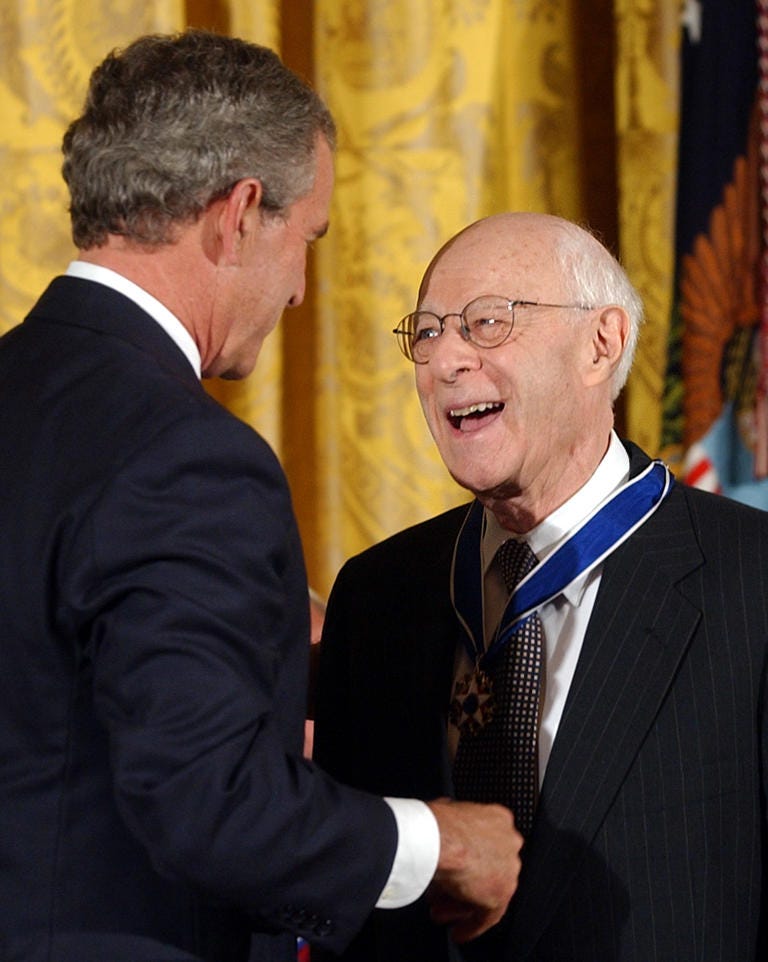
The New Left’s radicalism, sexual liberation, and what she saw as a national “seizure of self-hatred” convinced her, as summarized in a National Humanities Medal citation, that America was spiraling into moral decay. By the 1970s she had become a leading critic of feminism, the counterculture, and gay liberation. In one widely cited formulation, reported in an Associated Press obituary, Decter argued that feminism aimed to keep adult women “as unformed, as able to act without genuine consequence, as the little girl she imagines she once was and longs to continue to be.”

Taken together, these figures were reacting to the same combustible mix: the rise of the New Left and Black Power, the spread of the counterculture, and the eventual fallout from the Arab-Israeli wars, which helped nudge segments of Black America toward sympathy for the Palestinian cause. Their response was to abandon the Left and remake American conservatism in their Judaic image.

The consequences of the Jewish neoconservative ideological conquest still shape American politics today. From it emerged an “invade the world, invite the world” order in which American power is spent advancing Jewish interests abroad while immigration policy at home enriches plutocrats and erodes the country’s European demographic core.

The Rise of the Extreme Female Brain: Making Sense of the Defenestration of Prince

Research indicates that we can reasonably distinguish between the “Extreme Male Brain” and the “Extreme Female Brain.” The former is interested in logic and systematizing to the neglect of emotion and how people feel. The latter is focused on the emotions of others, on empathy, and on ensuring everyone is included but it is “system blind.” As women have become more influential in society, it seems fairly clear that we have moved from a focus on logic and consistency to an obsession with how others feel. This shift is epitomised in the treatment of Prince Andrew or, as we are suddenly supposed to call him, Andrew Mountbatten Windsor.

As I think I made clear in my review of the Prince Andrew biography Entitled, the younger brother of the King is, clearly, lacking in intelligence and is also an extremely unpleasant and Narcissistic individual. The word “entitled” perfectly encapsulates this thoroughly spoilt man who mistreats his staff, has tantrums when his full titles aren’t used and brazenly lies, particularly about the extent of his relationship with the late sex offender and tycoon Jeffrey Epstein. But, surely, even Prince Andrew deserves to be regarded as innocent until proven guilty, and this is not a right which the Royal Family have accorded him.

On 30th October, seemingly in response to the King being booed by members of the public and someone aggressively asking him how much he knew about his brother’s behaviour, Andrew was stripped of his titles of nobility, his knighthood, the prenominal “His Royal Highness” and even of the title “Prince,” humiliatingly reducing him to the status of a “commoner.” The press release directly stated that Andrew denied the allegations against him (of statutory rape of Virginia Roberts, by implication) and added, “Their majesties wish to make clear that their thoughts and utmost sympathies have been, and will remain with, the victims and survivors of any and all forms of abuse.”

In other words, without quite directly saying so, the Palace stated it was defenestrating Andrew because (at least in part) of Virginia Roberts’ allegations, even though he denies the allegations and he has not been proven guilty of them. This is in spite of the fact that Virginia Roberts is a fantasist or, at the very least, is extremely unreliable woman. She claimed that Alan Dershowitz raped her as a minor multiple times and was forced to withdraw this and admit she’d made a mistake. She made accusations against a French public figure and was compelled to admit under oath that she made mistakes about the people who assaulted her. She originally claimed to have first had sex with Prince Andrew in New Mexico, something that flight logs proved simply never happened. In 2025, she stated on Instragram that she had four days to live, which was a complete lie. Prosecutors even dropped a rape case she brought because no jury would consider her credible. In her posthumously published memoir, Nobody’s Girl, she was raped by a “Prime Minister” in one edition but a mere “Minister” in another, presumably because she inflated the title.

If Nobody’s Girl, is to be believed then there is no bigger victim in the world than Virginia Roberts. From a relatively young age Virginia was sexually abused by her father and his friends, allegations the father denies. “He used his fingers at first. Then, days later, his mouth. He called my private parts my “tee-tee” and his penis his “pee-pee.” It wasn’t long before he asked if I wanted to touch his genitals. I didn’t want to, but he wanted me to. He was my father, so I did.”

Virginia’s mother used to beat her on the bare bottom with thorn-covered sticks as a punishment for wetting herself, presumably drawing blood with every stroke. Virginia’s mother would even do this in front of the neighbours: “When she was really angry, she’d send me out to the yard to cut a thorny branch from one of her prized rosebushes. “Pick a switch,” she’d say. Then, she’d make me pull down my pants, in front of the neighbors and anyone else who was around, so she could whip me with it.” The parents sent her to a kind of reform school called “Growing Together” where she was also supposedly abused: “Not for nothing would Growing Together eventually be dubbed “Suffering Together” in an exposé in New Times . . .

Virginia’s behaviour patterns are consistent with having been abused in some way. Post-Traumatic Stress can lead to memory gaps which victims will fill in, extreme emotional dysregulation, warped perceptions, and Histrionic behaviour in order to feel better about yourself. This may result in their becoming addicted to attention, and sympathy, in such a way that confabulation is incentivised. Indeed, such women may become Vulnerable Narcissists, presenting themselves as the world’s biggest victim in order to get attention and turbo-charge bonding with people over whom they can then feel a sense of control. The unfortunate result is that even if Virginia was a victim of abuse it becomes difficult to believe anything she says.

This should extend to her allegations against Prince Andrew. Her brother “Sky Rocket” (that really is his name) asserted in an interview that this “ordinary American girl from an ordinary American family brought down a British Prince . . . ” But Virginia was not an “ordinary American girl.” She was probably an abuse victim and was certainly a fantasist. Appalling as Prince Andrew is, it, surely, unacceptable that he should be treated in this way due to allegations levelled by a woman whom no sensible person would regard as credible.

The King’s actions reflect a kind of hysteria. This hysteria is ultimately underpinned by the long-term shift from being system-focused to being system-blind and centred, to far too great a degree, on empathy and emotion.

Why Invading Venezuela Won’t Be a Walk in the Park

Why Invading Venezuela Won’t Be a Walk in the Park

Neoconservative strategists aren’t talking about the day after…

As American warships patrol Caribbean waters and F-35 fighters prowl Venezuelan airspace, hawkish voices in Washington paint an enticing picture: A swift military operation to topple Nicolás Maduro, similar to the easy interventions in Grenada (1983) and Panama (1989). It’s a dangerous fantasy that ignores three decades of failed Venezuelan policy and fundamentally misunderstands the catastrophic difference between those brief police actions and what a Venezuela invasion would entail.

The comparison is essentially that of a neighborhood skirmish to a regional war. Venezuela is roughly 2,650 times larger than Grenada and 12 times larger than Panama, with 243 times more people than Grenada and 12 times more than Panama. The appropriate historical parallels aren’t Grenada or Panama—they’re Iraq and Afghanistan, multi-trillion-dollar quagmires that killed thousands of Americans and hundreds of thousands of civilians while advancing no genuine U.S. interests.

What regime change boosters consistently ignore is what happens the day after Maduro falls. They focus obsessively on knocking out Venezuela’s conventional military—no walk in the park, but an attainable feat—while studiously avoiding the nightmare that follows: A multi-factional civil war among heavily armed irregular forces, refugee flows dwarfing the current crisis, and a protracted insurgency that could justify further U.S. intervention and spiral into a broader conflict that could attract irregular leftist forces from the region.

As far as historical analogues are concerned, Grenada was a tiny 344-square-kilometer volcanic island—smaller than many American cities. Despite hilly terrain, the entire country could be secured quickly because of its minuscule size. Panama at 75,420 square kilometers was larger but still a narrow isthmus focused around the Canal Zone, where U.S. forces already had extensive military presence and insider knowledge based on decades of American influence in Panama.

Venezuela covers 912,050 square kilometers—featuring the Andes mountains in the west, vast central plains (llanos), dense Amazon jungle in the south, and 2,800 kilometers of Caribbean coastline. This geographic complexity creates countless opportunities for asymmetric warfare, with mountainous terrain favoring defensive operations, urban centers ideal for guerrilla resistance, and jungle regions providing sanctuary for irregular forces.

Unlike Panama where U.S. forces had extensive familiarity from decades of base presence, or Grenada, where the entire operational theater was one small island, Venezuela’s diverse terrain would require controlling vast territories to prevent insurgent sanctuaries. U.S. military planners have no established presence, no intimate geographic knowledge, and would face the same challenges that gave American forces fits in Afghanistan’s mountains, Iraq’s urban centers, and Vietnam’s jungles.

Venezuela hosts one of the most complex networks of armed non-state actors in the Western Hemisphere. Start with the colectivos—far-left paramilitary groups numbering 8,000 individuals operating in 16 states and controlling approximately 10 percent of Venezuelan cities. These aren’t poorly armed street gangs; they possess AK-47s, submachine guns, fragmentation grenades, and tear gas—much of it supplied directly by the Venezuelan government.

Colombian guerrilla organizations have also established a significant presence on Venezuelan territory. The National Liberation Army (ELN) maintains operations in 13 Venezuelan states. According to a report by Colombian media outlet Connectas, the ELN has armed cells in roughly 10 percent of Venezuela’s more than 300 municipalities. The group controls territory in the Venezuelan states of Zulia, Táchira, Apure, and Amazonas—the four states bordering Colombia—and also operates in Barinas, Bolívar, and Delta Amacuro, with a presence of roughly 1,000 fighters in Venezuela and 6,000 members in total.

Segunda Marquetalia, dissidents of the Revolutionary Armed Forces (FARC) who rejected Colombia’s peace accords, operates with an estimated 1,000 members. Other FARC dissident factions add approximately 2,000 more fighters. These groups maintain Marxist-Leninist, anti-imperialist ideologies and view the United States as the primary threat to revolutionary movements. Combined, these irregular forces are in the tens of thousands with substantial weapons, territorial control, and operational experience.

It should be stressed that Venezuela’s official military doctrine has been explicitly designed around asymmetric warfare against a hypothetical U.S. invasion since the Chávez era. The strategy assumes initial conventional defeat followed by sustained guerrilla resistance—making occupation costly and politically unsustainable.

Nevertheless, Venezuela won’t just roll over without a conventional fight. Venezuela is the number one purchaser of Russian weaponry in Latin America. It boasts mobile Russian S-300VM and Buk-M2E air defense systems (described as “by far the most formidable in Latin America” by Military Watch Magazine) and KH-31 anti-ship missiles. Additionally, Venezuela boasts 24 Su-30MK2V Flanker fighters (approximately 21 operational) capable of carrying anti-ship missiles and critically, components of Russia’s C4ISR system—integrated digital warfare networks previously shared only with Belarus.

Most significantly, Russia signed a comprehensive 10-year strategic partnership with Venezuela in May 2025, ratified in October 2025, covering more than 350 bilateral agreements on security, defense, and technology. Russian cargo aircraft have recently been landing in Caracas with additional military supplies. In October 2025, Maduro requested Russian assistance enhancing air defenses, restoring Su-30 aircraft, and acquiring missiles. The Iranians have also cooperated with Venezuela on the development of drone technology and sanctions evasion assistance.

This great power backing has no parallel in Grenada (where Soviet/Cuban support was minimal during the invasion) or Panama (where Manuel Noriega’s late attempts to seek Cuban/Nicaraguan support proved futile against American forces.

The ultimate challenge for the United States comes the day after when Venezuelan forces, colectivos, militias, and allied guerrilla groups retreat to mountainous regions, jungles, and southern plains. From there, armed groups would be able to conduct asymmetric attacks on U.S. forces and any post-Maduro government, creating multiple overlapping resistance movements.

A 2019 U.S. Army analysis concluded Venezuela presents a “Black Swan” hot spot significantly more complex than the 1989 Panama operation, noting Venezuela has “115,000 troops, in addition to tanks and fighter jets” and “thirty million people, about 20 percent of whom still support the Maduro government,” with leaders having “been preparing for asymmetrical warfare for more than a decade.” In contrast, the study noted that “[Manuel] Noriega’s Panama had only fifteen thousand troops—of which, only 3,500 were soldiers.” The study highlighted that “there is no chance that countries in the region would participate in an effort to topple Maduro.”

It’s also worth noting that Cuba has deep penetration of Venezuela’s security apparatus through secret agreements signed in May 2008 that “gave Cuba vast access to the Venezuelan military and wide freedom to spy on and reform it,” according to the Havana Times. Approximately 5,600 Cuban personnel work in Venezuelan security sectors, including 500 active Cuban military advisors. Venezuela’s Bolivarian National Intelligence Service (SEBIN) has been described as “almost a branch of the G2—the Cuban secret service—in Venezuela.”

This integration helps explain Venezuelan military loyalty despite economic collapse and has proved key in protecting the South American nation from U.S. covert operations. The Cuban intelligence network provides early warning of dissent and mechanisms for neutralizing opposition forces and other fifth columnists. For U.S. planners, any intervention would effectively fight not just Venezuela’s military but Cuba’s sophisticated intelligence apparatus with decades of experience countering U.S. operations.

Before contemplating another Latin American adventure, Washington should review its track record. Historian John H. Coatsworth documented that from 1898-1994, the United States intervened to change Latin American governments at least 41 times across 100 years, averaging once every 28 months.

The results? The 1961 Bay of Pigs invasion failed catastrophically, strengthening Fidel Castro. The 1980s Contra War in Nicaragua killed approximately 30,000 Nicaraguans, yet Nicaraguan President Daniel Ortega, who lost the presidency in 1990, eventually returned to power in 2007. Ortega has currently ruled as an authoritarian president, exactly what the United States tried to prevent through the proxy war it facilitated during the Reagan era.

Beyond Latin America, the United States’ second invasion of Iraq cost over $2 trillion and killed 4,500 U.S. troops while creating conditions for the rise of ISIS and rival Shiite militias across the nation. The United States’ nation-building experiment in Afghanistan cost $2.3 trillion and killed 2,461 U.S. troops, only to see the Taliban return to power after 20 years.

Perhaps most striking is how overwhelmingly Venezuelans themselves reject foreign military intervention. September 2025 polling found 93 percent of Venezuelans oppose foreign military intervention, with only 5 percent supporting it. October 2025 polling showed this increased to 94 percent opposition.

This creates a paradox: Polling demonstrates 64 percent to 90 percent of Venezuelans wanting some form of democratic transition yet 93 percent to 94 percent reject foreign military intervention. When presented with peaceful alternatives, 63 percent have supported a negotiated settlement to remove Maduro, making negotiation by far the most popular option.

The Venezuelan opposition itself is deeply divided, with prominent figures like two-time presidential candidate Henrique Capriles—who remains in Venezuela—explicitly rejecting intervention. “Most people who want a military solution and a US invasion do not live in Venezuela. They don’t even understand the consequences of it,” Capriles said in an interview with the BBC. In an interview with The New York Times, he posed a pointed question: “Name one successful case in the last few years of a successful U.S. military intervention.”

As far as stateside is concerned, 62 percent of Americans also oppose invading Venezuela, with only 16 percent supporting such action, per YouGov polling.

Here’s what neoconservatives don’t discuss: Knocking out Venezuela’s conventional military is attainable. U.S. technological superiority would likely produce a relatively swift conventional victory. But then what?

A decapitation strike removing Maduro wouldn’t stabilize Venezuela—it would detonate it. Consider the armed actors positioned to fill the vacuum such as the colectivos with heavy weapons controlling urban neighborhoods; ELN fighters with decades of guerrilla experience; Segunda Marquetalia combatants; thousands of other FARC dissidents; and remnants of defeated military units retreating to mountains and jungles.

The result will likely be a multi-factional civil war. Various armed groups would compete over oil, gold, and minerals. Colectivos would defend urban territory. ELN and FARC dissidents would establish rural sanctuaries. Criminal organizations would exploit the ensuing chaos. The 20 percent of Venezuelans supporting Maduro ideologically would provide a substantial resistance base.

Such a conflict would trigger a massive refugee crisis. Venezuela has already had nearly 8 million people flee since 2015. Military intervention triggering civil war could produce millions more refugees, destabilizing Colombia, Brazil, Trinidad, Guyana, and the entire Caribbean basin. Moreover, many of these refugees would wash up on American shores—a prospect Secretary of State Marco Rubio and his cheap labor-addicted Republican cohorts in Florida would embrace with open arms.

Any U.S.-backed government would face prolonged insurgency, requiring sustained American military occupation, not the swift operation regime change boosters promise, but years or decades of counterinsurgency. Ironically, this could be dangerous even for María Corina Machado or whatever U.S. puppet is installed, as pro-regime forces remain heavily armed and motivated, while countless other militants will start carving out their own statelets nationwide. Not exactly an ideal climate for a prospective U.S. client regime to operate in.

Perhaps most underestimated would be backlash among Latin America’s radical Left. Since the end of the Cold War, leftist movements have been relatively pacified because the United States hasn’t taken direct, kinetic action in the regime. But when Marines enter the mix, this will galvanize nationalist sentiment throughout the region.

The ELN maintains strong ideological affinity with Venezuela’s state ideology of Chavismo and sees itself leading the struggle against American imperialism. Colombian guerrillas already recruit Venezuelans. U.S. intervention would dramatically accelerate recruitment. One could see foreign fighters form international brigades to fight American forces and the puppet government they try to prop up.

Colombia’s President Gustavo Petro already condemned U.S. strikes as “acts of tyranny.” Full-scale invasion would trigger denunciations across the region, breathe new life into dormant anti-American movements, and create a generation of Latin American leftists radicalized by direct confrontation with U.S. military power. External actors like Iran, Russia, and China—who all have their own set of grievances with the United States—would pounce on this chaotic environment to further inflame tensions and poke Uncle Sam in the eye.

Comparing Venezuela to Grenada or Panama is fundamentally misleading propaganda. Those were brief police actions against micro-states in political chaos with minimal armed opposition, limited territory, no great power backing, and some regional support.

After 30 years of escalating intervention—coups, sanctions, economic warfare—Maduro remains in power while Venezuela has deepened ties with Russia, China, and Iran. The humanitarian crisis has worsened. Multiple coup attempts strengthened authoritarian control.

The historical record is unambiguous: U.S. military interventions consistently fail to achieve stated objectives. Initial conventional victories give way to protracted insurgencies, state collapse, refugee crises, and strategic disasters costing trillions. Venezuela would be worse because of its size, geography, complex array of armed actors, ideological polarization, and strategic importance to U.S. adversaries such as Russia, China, and Iran, who are all itching to get back at the United States.

Neoconservative strategists are engaging in dangerous wishful thinking. They promise swift operation followed by grateful Venezuelans welcoming democracy. Reality would be years of counterinsurgency, multi-factional civil war, massive refugee flows, regional destabilization, and a strategic quagmire.

Invading Venezuela won’t be a walk in the park. It would be a quagmire defining American foreign policy for a generation. After 30 years of failure, perhaps it’s time to try something radically different: Diplomacy, engagement, and respect for sovereignty. The alternative is catastrophe, something Donald Trump’s “America First” movement never voted for.

Judge McFadden’s Ruling: How Israeli Interests Threaten American Free Speech

Power is revealed by those you cannot criticize without consequence. American liberty rests on free speech, ensuring no government, corporation, or foreign entity evades scrutiny. Yet, in August 2025, U.S. District Judge Trevor McFadden’s ruling in Sumrall v. Ali delivered a brazen betrayal, declaring an alleged assault involving an Israeli flag’s desecration as racial discrimination against Jews under Section 1981, linking the Star of David to Jewish identity. Although framed as a response to violence, this ruling undermines constitutional protections. The Supreme Court’s decision in Texas v. Johnson upheld burning the American flag as protected political expression, but Judge McFadden’s logic suggests that actions targeting the Israeli flag could incur civil penalties for “antisemitism.” Elevating a foreign symbol over our own, driven by pro-Israel advocacy and the American Israel Public Affairs Committee’s (AIPAC) financial dominance, this decision strangles dissent, imperiling sacred liberties every patriot cherishes.

The American people must rise against this five-alarm fire. With the U.S. funneling $3.8 billion annually to Israel, more than any nation, why does its flag command protections our Stars and Stripes lacks? McFadden’s ruling, lauded by pro-Israel groups, exposes a system where money and advocacy silence opposition to foreign entanglements, demanding we confront who commands power.

Ruling: A Foreign Symbol Over American Liberty

In Sumrall v. Ali (2024, Washington, D.C.), a protest clash amid Israel-Palestine tensions sparked a lawsuit. Kimmara Sumrall, a Jewish activist wearing an Israeli flag as a cape, alleged Janine Ali yanked it, briefly choking her in a targeted attack. Sumrall sued under Section 1981, a law against racial discrimination, extended to assembly. McFadden denied Ali’s motion to dismiss in August 2025, ruling the assault “targeted Jewish identity through the flag’s Star of David,” citing Shaare Tefila Congregation v. Cobb. He declared, “Purposefully yanking an Israeli flag tied around a Jewish person’s neck to choke them is direct evidence of racial discrimination.”

Contrast this with Texas v. Johnson, where the Supreme Court upheld burning the U.S. flag, stating, “The government cannot ban offensive ideas.” United States v. Eichman reaffirmed this. Yet McFadden’s logic creates a double standard, suggesting burning Israel’s flag could invite penalties, unlike our own flag. Rep. Marjorie Taylor Greene warned on The Megyn Kelly Show, “McFadden’s ruling means you can burn any flag here, even ours, but not Israel’s without facing consequences.” No other nation’s flag, China’s or Russia’s, holds such privilege.

This chills protests, especially amid Gaza’s crisis, where over 67,000 Palestinians, mostly civilians, have died by October 2025. UN reports cite war crimes, including school attacks. Human Rights Watch documented aid-site killings. Amnesty International urged arms embargoes, citing genocide risks. With U.S. aid fueling this, symbolic protest is essential, yet McFadden’s ruling endangers it.

McFadden’s Advocacy Alignment

McFadden, a Trump-appointed judge, oversees national security cases in D.C.’s federal court. While no AIPAC donations are documented, his ruling aligns with pro-Israel groups like the Louis D. Brandeis Center, which hailed it as a “breakthrough.” Its judicial trainings, shaping over 500 judges, frame Israel criticism as hate speech. The National Jewish Advocacy Center, representing Sumrall, reinforced this, with attorney Matthew Mainen declaring the ruling a precedent. McFadden’s embrace of this logic favors a foreign nation over Americans’ rights.

AIPAC’s Financial Dominance

AIPAC’s $100 million in 2024 election spending targeted critics like Rep. Thomas Massie, a conservative skeptic of Israel aid, with $2.5 million. This secures loyalty to $3.8 billion in annual U.S. aid. Its Foreign Agents Registration Act exemption enables unchecked lobbying. Anti-BDS laws in 38 states, upheld in Arkansas Times LP v. Waldrip, curb protest, affecting 250 million Americans. AIPAC’s influence shaped McFadden’s Senate confirmation, tying it to judicial outcomes.

Free Speech Under Siege

McFadden’s ruling risks branding protests against Israel’s flag as civil rights violations, while U.S. flag burning remains protected. The Institute for Justice condemned it for conflating dissent with hostility. Amid Gaza’s crisis, symbolic protest is vital. Yet AIPAC-backed laws and rulings like McFadden’s crush expression.

Reclaim Liberty

McFadden’s ruling, shaped by AIPAC, betrays our sacred Constitution. Demand FARA enforcement, transparency in judicial trainings, and audits of $3.8 billion in aid amid UN-documented crimes. America First patriots, defend our liberties: no foreign flag above ours. Break Israel’s taboo, restore free speech.

Sources

“Sumrall v. Ali (1:25-Cv-02277), District of Columbia District Court.” (1:25-Cv-02277), District Of Columbia District Court, www.pacermonitor.com/public/case/59042308/SUMRALL_v_ALI

42 U.S.C. Section 1981, Legal Information Institute, Cornell Law School, www.law.cornell.edu/uscode/text/42/1981

“Rep. Marjorie Taylor Greene on Secrets of DC, the Israel Lobby, Jasmine Crockett, and the Future of Maga.” Apple Podcasts, 19 Aug. 2025, https://podcasts.apple.com/us/podcast/rep-marjorie-taylor-greene-on-secrets-of-dc-the/id1532976305?i=1000722686959

“Trevor McFadden.” https://ballotpedia.org/Trevor_McFadden

American Israel Public Affairs CMTE Profile: Summary • Opensecrets, www.opensecrets.org/orgs/american-israel-public-affairs-cmte/summary?id=D000046963

Impelli, Matthew. “Map Shows States Where Boycotting Israel Is Illegal.” Newsweek, Newsweek, 29 Apr. 2024, www.newsweek.com/pro-palestinian-protest-states-colleges-illegal-bds-1895292

Arkansas Times LP v. Waldrip, 988 F.3d 453 (8th Cir. 2021), www.ca8.uscourts.gov/opinions/988F3d453.pdf

“Foreign Influence and Democratic Governance.” Council on Foreign Relations, Council on Foreign Relations, www.cfr.org/report/foreign-influence-and-democratic-governance

Israel Has Committed Genocide in the Gaza Strip, UN Commission Finds | Ohchr, www.ohchr.org/en/press-releases/2025/09/israel-has-committed-genocide-gaza-strip-un-commission-finds

“Global Day of Action to Demand States #stopsendingarms Fuelling Violations of International Law in Gaza.” Amnesty International, 3 May 2024, www.amnesty.org/en/latest/news/2024/05/israel-opt-global-day-of-action-to-demand-states-stopsendingarms-fuelling-violations-of-international-law/

Texas v. Johnson, 491 U.S. 397 (1989), www.oyez.org/cases/1988/88-155

United States v. Eichman, 496 U.S. 310 (1990), www.oyez.org/cases/1989/89-1433

Shaare Tefila Congregation v. Cobb, 481 U.S. 615 (1987), www.oyez.org/cases/1986/85-2156

28, Jake JohnsonAug, et al. “‘Very Bad Sign for Democracy’: AIPAC Has Spent over $100 Million on 2024 Elections.” Common Dreams, 6 Sept. 2024, www.commondreams.org/news/aipac-100-million

Bent Melchior 1929–2021

Bent Melchior 1929–2021

This article was originally published in Danish on July 30, 2021.


Bent Melchior. (Photo: Cropped, the uncropped picture here: Embassy of Poland, CopenhagenCC BY 3.0 PL)

As is well known, Denmark has just been relieved of its former chief rabbi and chief Jew, Bent Melchior. Judging by the press coverage, one would immediately think that a member of the royal family had passed away. Thus, the entire mainstream press has come up with a chorus of lamentations and tributes worthy of the Wailing Wall.

A common feature of this completely uncritical and distasteful tribute is the emphasis on Melchior’s “great commitment to refugees and immigrants.” We agree with this observation, except that it shows Melchior’s harmful and socially destructive character. Over the past 60 years, few others have so thoroughly mocked and degraded Danish culture and contributed to transforming our once homogeneous and harmonious country into a multi-ethnic and multicultural cesspool. It is astonishing that it is even possible for one person to cause so much damage. Melchior had his fingers deep in the multi-ethnic dough, and his achievements include membership of the board of the “Documentation and Advisory Center on Racial Discrimination,” the “Danish Refugee Council’s Representative Committee,” the “Refugee Council’s Executive Committee,” chairmanship of the “Asylum Committee,” board member of the “Center for Holocaust and Genocide Studies,” and chairmanship of the “Bridge Builders Association – Center for Dialogue Coffee.” For a number of years, Melchior was also a member of the leadership of the influential Jewish lobby organization B’nai B’rith, which has worked for a steady restriction of freedom of speech and launched countless anti-national initiatives, the significance of which cannot be overestimated when it comes to the current destruction of the West. Added to this is an endless stream of interviews, columns, letters to the editor, and television appearances in which the multicultural tone was set. Yes, Melchior was at the forefront when it came to paving the way for the foreign invading forces, and as early as 1998, he assured us mockingly that “the foreigners among us will soon prove that they have something to contribute to their new homeland. Their diligence is indisputable, and many high schools report that the highest exam scores are achieved by immigrant children. In ten years, they will help shape research and art, just as they are already helping to raise the bar in the field of sports. Then there will no longer be any reason to discuss what the new citizens cost, compared to what they contribute.” In reality, the only thing they have contributed to can be seen in the crime statistics.

In this context, Melchior has often emphasized that, apart from a little disagreement over a barren piece of desert land in the Middle East, Jews and Muslims in practice have everything in common and share an interest in fighting their White, Christian hosts, who for Melchior were always enemy No. 1. It could not be more fitting, then, that the most vocal mourner was Muslim Özlem Cekic, who for many years has formed a united front with Melchior to secure common Muslim and Jewish interests in this country. Mrs. Cekic was by no means Melchior’s first Muslim ally. In 2008, Melchior was busy “building bridges between Jews and Muslims” together with Bashy Quraishy. An article in Politiken on March 17, 2008, states quite tellingly “A toxic climate of Islamophobia and anti-Semitism makes it necessary for Jews and Muslims to cooperate in Europe… With rising anti-Semitism and Islamophobia in Europe, it is obvious and necessary to join forces, not in opposition to anyone, but to help each other… That is why November 27 was a day of joy and pride for many European Jewish and Muslim organizations and enthusiasts who have worked tirelessly and loyally to establish a Jewish-Muslim cooperation platform in Europe as a bulwark against the mistreatment of both Jews and Muslims and to lend each other a helping hand…. A quick glance at any European community today should be enough to convince all enlightened Jewish or Muslim communities or individuals that cooperation is in their own interest. A quick glance at any European community today should be enough to convince any enlightened Jewish or Muslim community or individual that cooperation is in their own interest. Muslim groups have many members but limited influence, while Jewish communities are small in number but well-organized and willing to share their experience and knowledge.” It couldn’t be said any better: Muslims have the numbers, while Jews have the organization and influence, which they gladly make available to the most recent immigrants. Another telling example is the joint campaign against racism in 2009 by the Muslim Council and the Jewish Community, in which the two immigrant groups once again joined forces to combat their host people’s natural defense mechanism. So much for Jews’ integration into and loyalty to Danish society!

Melchior’s love for Muslims seems to be somewhat selective, however, as when the good rabbi allegedly spat on some Muslim girls on Auschwitz Day in 2003, and his love obviously did not extend to Muslims in their home countries. Melchior liked to play the role of the tolerant, peace-loving “Danish” Jew, advocate of human rights, openness, understanding, and charity, but who was it who really hid behind Melchior’s often insidious grin? Immediately after World War II, Mr. Melchior was in Palestine as a member of the notorious Haganah terrorist organization, which, together with Shamir’s notorious “Stern Gang” and Menachim Begin’s “Irgun,” was responsible for, among other things, the massacre of the village of Deir Yassin in 1948, where at least 107 men, women, and children were murdered in cold blood, and the Arabs were told that this was only the beginning. In this way, the Jewish terrorists drove no less than 750,000 Arabs from their original homeland, only to persecute them in refugee camps, where they lived a miserable existence for many years before Melchior and his ilk began agitating for their importation into Denmark and Europe.

Many of the Muslims who today ravage our streets and alleys are direct descendants of the refugees that Mr. Melchior helped to create, and it has naturally been in his interest to ease the pressure on Israel by bringing them to our shores. It was not without reason that Melchior often laughed. His life experience must have reinforced his belief that, as is well known, only Jews are human beings, while the rest of us are merely animals. The fact that he did not encounter more and better opposition shows, if anything, the miserable state of the Danes.

Yes, it is not without reason that his passing is being reported as if it were the Queen herself who had passed away. Melchior had far greater power than the queen. Denmark is not really ruled from either Amalienborg or Christiansborg, but from the synagogue in Copenhagen – just look at the whole discussion about circumcision, which almost everyone finds abhorrent, but which is nevertheless never banned.

With Melchior’s departure to Lucifer’s lap, Denmark has lost one of its most dangerous and cunning enemies. We can only regret that his departure did not take place earlier and under different circumstances.

Translated with the help of AI

Israel’s Desperate Ground: Fueling Global Outrage to Build Lasting Unity

In the history of warfare and human strategy, few ideas capture the raw drive for survival as vividly as the “Desperate Ground.” Picture an army on a narrow field, its back to a raging river, with no way to retreat. The soldiers face a stark choice: drown in the turbulent waters or charge into battle, fighting with the intensity of those with nothing to lose. This tactic, famously described by Sun Tzu in The Art of War, turns fear into unyielding determination. “Place them where escape is impossible,” Sun Tzu writes in Chapter 11, “The Nine Situations,” “and they will fight with fearless courage.” On such ground, ordinary people become fierce, united not by hope but by the primal need to survive.

This ancient strategy finds a striking modern parallel in the work of Professor Jiang Xueqin, a Beijing-based educator whose Secret History lecture series explores the mechanics of power and evil. In “Secret History #4: How Evil Triumphs,” delivered to his high school students on August 28, 2025, Jiang uses history to show how harmful forces gain strength by creating their own peril. He describes the river-backed army as a symbol of how leaders, from ancient warlords to modern regimes, deliberately put themselves in extreme danger to rally their followers. By cutting off escape routes and risking destruction, they spark a fierce unity that drives them to victory. Jiang argues that evil thrives not in safety but in engineered crises, where survival depends on total loyalty, often at the cost of innocent lives. “The river isn’t just a barrier,” Jiang tells his audience in the viral lecture, which has over 1.4 million views. “It’s a forge, turning fear into fanaticism.”

Today, Israel stands on this Desperate Ground, not by chance, but by choice. The ongoing genocide in Gaza, now in its second year as of October 3, 2025, is not just a military action. It is a deliberate provocation, a calculated escalation of horrors designed to unite the world in anger against Israel. By committing acts so egregious that they spark global outrage, over 67,000 Palestinians killed and more than 170,000 wounded, with an entire population starved, Israel positions itself as a fortress under siege, its back to the river of history. This strategy, blending tactical desperation with religious prophecy, aims to fulfill ancient predictions of divine salvation. The river of global isolation grows with every airstrike, every blocked aid shipment, every civilian death. Like Sun Tzu’s soldiers, Israel fights with desperate resolve, knowing retreat means extinction.

The evidence is clear, written in the headlines of global anger. Recent events, especially the bold interception of the Global Sumud Flotilla on October 2-3, 2025, reveal this intent. Israel’s leaders, from Prime Minister Benjamin Netanyahu to others, are not unaware of the backlash; they seek it. In doing so, they reflect Jiang’s idea: evil succeeds by creating its own danger, turning hatred into the glue that binds a divided people. This is not exaggeration. It is the logic of Desperate Ground applied to a 21st-century genocide.

The Flotilla: A Dramatic Provocation in Open Waters

No event better shows Israel’s embrace of Desperate Ground than the October 2-3, 2025, interception of the Global Sumud Flotilla. This 44-vessel fleet, organized by the Freedom Flotilla Coalition, carried humanitarian aid such as food, medicine, and water to Gaza’s two million trapped residents. Prominent passengers, including former Barcelona mayor Ada Colau and Nelson Mandela’s grandson, drew global attention. The mission: break Israel’s blockade, a tool the UN calls “deliberate starvation.”

Militarily, the flotilla was no threat. It carried no weapons, no military supplies, just bandages and rice, not enough to shift the balance in a war dominated by Israeli airstrikes and troop surges. Even if every crate reached Khan Yunis field hospitals, it would not change Palestinians’ struggle or Israel’s control. Humanitarily, its impact was small: one convoy, or even ten, could not meet Gaza’s desperate needs amid a crisis affecting millions.

So why intercept? Why risk breaking international law by storming ships in open seas? Reuters reported the raid: Israeli forces boarded the flotilla with naval vessels, detaining activists, who called it an “abduction.” Only the lone vessel Marinette slipped through, delivering its cargo under threat of attack. Amnesty International called it an “unlawful assault,” sparking protests from Sydney to Washington and diplomatic outrage.

The reasoning was clear: allowing the flotilla would soften Israel’s image, countering starvation claims and humanizing its blockade. Instead, interception ensured headlines, BBC front-pages, AP legal reports, outrage calling it a “theater of cruelty.” On Desperate Ground, provocation beats practicality. The raid deepened the river, uniting the world in disgust while rallying Israel’s supporters: “They hate us; we fight harder.”

Propaganda’s Desperate Tools: Buying Voices, Silencing Critics

To maintain this isolation, Israel uses a propaganda machine as fierce as its airstrikes. In a recorded September 2025 meeting at Israel’s New York consulate, Netanyahu met with U.S. influencers, many paid by Israel, to plan “winning hearts and minds” among American youth. The session, reported by The New York Times, included Netanyahu’s son Yair, and paid promoters like Lizzy Savetsky, who earned up to $7,000 per post to downplay Gaza’s horrors. “Social media is our weapon,” Netanyahu admitted, openly planning to sway the American youth and counter TikTok’s anti-Israel wave.

This is not a side effort; it is state policy. A Guardian investigation revealed Israel’s multimillion-dollar Google deal to flood feeds with denials of Gaza’s famine, while the Foreign Ministry paid thousands to influencers via Israel365. At Gaza’s border, staged visits let these promoters spread lies: “No famine here!” despite UN-confirmed starvation.

The attack on free speech is even bolder. Israel’s influence taints the U.S. TikTok takeover, forced in September 2025 under Executive Order 14166, with pro-Israel investors like Oracle ready to censor anti-Israel content. Theories suggest Israeli involvement, as Newsweek reported, to silence American youth amid Gaza’s viral horrors. DHS’s social media checks, screening for “antisemitic activity,” reinforce this as legal non-citizens are deported for protests, despite a federal judge ruling it unconstitutional, yet the fear remains. Netanyahu’s meeting? A clear admission: atrocities exposed, so silence the exposers.

This war on truth deepens the river, making every suppressed post a stone in Israel’s desperate wall.

The Religious Forge: Prophecies of Power Through Ruin

At the heart of Desperate Ground lies faith, a divine plan for provocation. Traditional Jewish teachings envision the end of days as nations uniting against Israel, only for God to step in, ushering a Messianic era of Jewish triumph. Midrash Tehillim, a rabbinic commentary on Psalms from the 3rd to 11th centuries CE, captures this in its explanation of Psalm 2:8: “Ask of Me, and I will give You the nations for Your inheritance, and the ends of the earth for Your possession.”

The Midrash sees this as God’s promise to the righteous (Israel or the Messiah): after defeating hostile nations, eternal rule over the world. “I have made the nations the inheritance for the righteous man and his descendants forever,” it states, linking Psalm 2 to apocalyptic wars like Gog and Magog. This is not obscure mysticism; it is part of Talmudic thought, where global opposition signals redemption. Some voices in Israel today, seen in social media posts tying flotilla outrage to “prophetic fulfillment,” view the genocide in Gaza as speeding this: provoke the nations, inherit the earth.

Netanyahu’s circle, rooted in this tradition, acts accordingly. The flotilla raid, influencer payments, TikTok moves, all align with Midrashic goals, where isolation leads to glory. As Jiang warns, evil succeeds by making desperation holy, turning genocide into a sacred mission.

Forging Victory from the River’s Depths

Israel’s Desperate Ground strategy is working. Global unity against it grows: UN reports stack up, protests surge. The river rises, but so does Israel’s resolve, its narrative unshaken in its echo chamber.

Yet without U.S. support, this plan collapses. Middle Eastern powers would step in to stop the genocide. Why the support? Deep influence, via groups like AIPAC, which my next piece will explore: how money and loyalties turn American power into Israel’s shield.

In Sun Tzu’s shadow, Jiang’s warning echoes: on Desperate Ground, desperation breeds not just courage, but conquest. Gaza’s suffering is the cost. The world must see the river for what it is, not a barrier, but a trap. 

Sources

Al Mughrabi, Nidal, et al. Israel Opens New Route out of Gaza City, Death Toll Passes 65,000 | Reuters, www.reuters.com/world/middle-east/israel-opens-new-route-out-gaza-city-death-toll-passes-65000-2025-09-17/.

Press, The Associated. “These Numbers Show How 2 Years of War Have Devastated Palestinian Lives in Gaza.” NPR, NPR, 7 Oct. 2025, www.npr.org/2025/10/07/g-s1-92367/october-7-two-years-gaza-war-israel-hamas-palestinians

“Israeli Naval Ships Intercept Gaza-Bound Flotilla.” BBC News, 1 Oct. 2025, www.bbc.com/news/articles/c0lk292jww4o

“Israeli Navy Storms Gaza Aid Flotilla in International Waters.” Al Jazeera, 3 Oct. 2025, www.aljazeera.com/news/2025/10/03/israeli-navy-storms-gaza-aid-flotilla-in-international-waters

“How Social Media Is Changing the Narrative of the Israel-Gaza War.” The New York Times, 1 Oct. 2025, www.nytimes.com/2025/10/01/business/israel-gaza-war-social-media.html

Mahdawi, Arwa. “US Marketing Companies Are Helping to Rebrand the Genocide in Gaza.” The Guardian, 26 Sept. 2025, www.theguardian.com/commentisfree/2025/sep/26/gaza-us-marketing-companies

YouTube: Prof. Jiang Xueqin – Secret History #4: How Evil Triumphs, https://www.youtube.com/watch?v=BtlWoqWLm9Q