Featured Articles

THE FAKE RESIDENTIAL SCHOOL GENOCIDE

Time to Abolish the White Race

Those who are capable of tyranny are capable of perjury to sustain it.
Lysander Spooner

Did you know that the children of the nomadic Siberian Nenet tribe are sent to boarding school for nine months of the year to learn the basics of civilization? Many of them don’t tolerate it and literally freeze to death trying to return to the tundra to rejoin their tribe. It’s hard to change worlds, to go from freedom to confinement from one day to the next. We sure know something about that, don’t we?

Does this mean they are coerced? Of course not. It’s not the evil civilized “superior” White people forcing them. Like all responsible parents, Nenet parents who want the best for their children, know very well that their kids need to learn how to live in the modern world.

After their education which lasts several years, most of these kids, in fact, do not want to return to the tundra. The most gifted become lawyers, doctors, or researchers, the others find a job of some kind and integrate themselves into the society that raised them. Nobody forces them. They themselves choose where they want to live and how. And that’s a good thing.

Russians have great respect for the hundreds of ethnic groups that have lived on their territory since time immemorial. Contrary to woke liberals such as Canadian prime minister Justin Trudeau who are constantly trying to inflame minorities against their own race, they want things to go well and everyone to be happy.

And so did the missionaries who taught the Amerindians in residential schools. By vocation, they were also sincerely concerned about their students who just like the Nenets were to be civilized for their own good. The same goes for Canadian aboriginal parents, who were as concerned about their children’s welfare as the Nenets and the missionaries. None of these children were forced at gunpoint to do so like all main stream media claimed. [1] To pretend otherwise is a form of racism.

Since their families lived in the wilderness, sometimes far from the boarding schools, some of those students could not be sent back to their families on weekends as they would today. There were no roads or buses. In order to adapt them as well as possible, it made more sense to keep these children in boarding schools for several months. That being said 2/3 of the kids who attended residential schools were day students that went home every day to those parents who lived on the reserve at a walking distance from the schools. Moreover, half of all Amerindian children never went to school.[2]

Yet, in spite of this long period far from their parents, a majority of students such as the prominent Aboriginal playwright Tomson Highway and the late band chief Cece Hodgson-McCauley greatly enjoyed their time at their schools. “Nine of the happiest years of my life were spent at that school… some people have been bad-mouthing residential schools for money,” the chief told The Huffington Post and CBC.[3]

Fortunately, the thesis of systematic, large-scale abuse and mistreatment has finally fallen by the wayside.[4] The mass grave of 215 bodies allegedly discovered near a residential school in Kamloops, British Columbia, with laser imaging and telemetry techniques, is just one more lie to be added to the false reality that the controlled globalist media such as the New York Times is constantly imposing on us by repetition.[5] “Only soil anomalies — not ‘remains, bodies, or graves’ — had been detected by the inexperienced radar operator” writes journalist Brian Giesbrecht. “Only excavation can conclusively prove that graves exist. However, the Tk’emlups Indian band that made the claim refused to excavate and to release the radar operator’s report.”[6]

In fact, “after two years of horror stories about alleged mass graves of aboriginal children in Canada’s residential schools,” writes journalist Dana Kennedy, “a series of recent digs at suspected sites have revealed no human remains.”[7] Jacques Rouillard, professor emeritus in the history department at the Université de Montréal, told the New York Post: “I don’t like to use the word hoax because it’s too strong, but there are too many falsehoods circulating on this issue without any proof.”[8]

Graves where children who died of natural causes were indeed found around residential schools, but there was no Native American genocide. At the time of the alleged mass graves, the infant mortality rate was close to 40%. Some boarding schools were overcrowded and hygiene was sometimes poor. As Amerindians were less resistant to disease than Europeans, many succumbed to malnutrition, tuberculosis, typhus, influenza (Spanish Flew) and several other infectious diseases. There were no antibiotics to treat them. As some of the parents lived far away in the woods, there was no easy way to warn them, and the bodies had to be properly buried to avoid epidemics. Things eventually improved once the nutrition and living conditions of the Aboriginals changed for the better thanks to the care of the missionaries, the government, and the indigenous staff who worked in these residential schools.

There may have been isolated cases of mistreatment, as is the case in all institutions of this kind, but there is no trace of forcible transfer of a population, persecution against an identifiable group, enforced disappearance of persons, apartheid, and general inhumane acts of cruelty, torture, hangings, medical experimentation, or systematic rape and sexual slavery.[9] In the end, there was no reason to burn churches all across Canada, as some Aboriginals and the social justice left have done in revenge.

This is not only a story about indigenous people telling lies to obtain reparations and social benefits, but a story about people of all denominations losing their minds because of a false consensus effect.[10] A prominent group of lawyers, who called for an International Criminal Court investigation of anyone involved in Residential Schools, the Vatican, incompetent government officials, the social justice left, politized RCMP, subsidized government media, “missionary” scholars who use their research to serve a cause, and the public always ready to believe the first wolf disguised as sheep readily jumped on the bandwagon of lies in a frenzy tantamount to hysteria as if they had been prepared or groomed beforehand by decades of anti-Christian and anti-White propaganda.

Anti-Catholic and Anti-White Propaganda

It is very much Hollywood that prepared the ground for what happened in Canada. In films on television and in the movies, Christians, especially Catholics, are most often portrayed as bigoted, narrow-minded, and intolerant, even as rapists or murderers. As for the Catholic clergy, they are most often portrayed as a bunch of sadists and pedophiles.[11]

Whites by association are also systematically targeted. As a matter of fact, anti-White propaganda has been a fixture of Hollywood movies as far back as the early 50’s. As noted by Frank L. Brittons in his 1952 booklet Behind communism, “Hollywood has now committed itself to producing at least four race pictures annually. Most of these pictures are destined beforehand to lose money, and are made purely for propaganda purposes. Some are so inflammatory they cannot be shown in certain sections of the United States. […] While minorities are systematically taught to think and act in terms of race, Whites are instilled with a sense of guilt for the ‘wrongs’ committed against minorities; they are taught that race consciousness is wrong and a manifestation of bigotry, and that all races being equal, they should discard the concept of race.”[12]

This massive ongoing propaganda machine has only one goal in mind: to sully Christians, demonize the White race and turn against it not only the minority groups, but also the majority White population and its leaders, who by dint of being told in schools and on theater, TV, and computer screens, almost 24/7, that their race is rotten, hate it more than the minorities themselves.[13]

As Mark Weber of the Institute for Historical Review says, “Even many of those who readily acknowledge the tremendous influence of American film and television seem not to fully comprehend the formidable scope of the power behind Hollywood, or the outlook and agenda of those who wield that power…”[14]

The Myth of the Noble Savage

You’ve probably seen the film, Dances with Wolves, with the handsome Kevin Costner, but did you know it’s pure fiction? Before their evangelization and education in boarding schools by missionaries, Native Americans were not noble, good, kind, or innocent as portrayed in the movie. The idea of the peaceful and noble savage is pure bunk.[15] They were savages of unprecedented cruelty[16]; primitives who practiced cannibalism, polygamy, and slavery; warriors who spent their time fighting over territory.[17] They knew nothing of writing, agriculture, the wheel, the sail, or the pulley – inventions that were centuries old. The term “First Nations’ is a misnomer as they had no idea of what a nation is. There was no unity between these tribes. Only conflict and abject cruelty. Hollywood glorifies them only to smear Christians and Whites.

According to prolific New Zealand author journalist Kerry Bolton, there are two fundamental objectives to this propaganda: 1. Disparage European colonial empires with a concomitant idealization of ex-colonial people, and 2. Glorify the national liberation struggles of indigenous people. This emotion-laden propaganda is given the scholarly name of post-modernism. As Kerry Bolton says, these ideological studies are “a broad front for the theoretical deconstruction of Western Civilization, and is part and parcel of a neo-Marxian movement in academia which includes gender studies […] These studies are intended to serve political agendas rather than the ‘truth’ per se.” [18] According to Bolton,

The tendency is for the European peoples, or rather governments in their name, to forever apologize for the alleged wrongdoings of the colonial era. This universal guilt complex is transposed to the present so that reparations can be demanded in perpetuity on the basis of collective hereditary guilt. Hence European peoples will be forever judged guilty for the alleged crimes of their colonial oppressor forebearers.[19]

In other words, claims of mass deaths, unmarked graves, and “disappearances” in Residential Schools are exaggerated or fabricated for political gain, financial compensation, or to advance the anti-colonial agendas that are used to guilt-trip Whites. Indigenous lawyer Kimberley Murray is often targeted in this discourse as a key figure “pushing” these claims due to her Truth and Reconciliation Commission Report (TRC) and Interlocutor roles.[20]

Grave Error

The former Globalist Pope Francis, after a visit to Canada in July 2022, apologized for what happened at Roman Catholic and other Christian Church mission schools. He did not use the word “genocide” but he did say it was a “Holocaust,”[21] although there is absolutely no proof of such a thing as shown conclusively by editors C.P. Champion and Tom Flanagan in their landmark book Grave Error forwarded by Conrad Black. [22] Was the Pope duped by the fake narratives promoted by subsidized media and the TRC report on the alleged Residential School genocide is an open question? This report is everything but a truthful document. It is filled with totally false assertions and gross exaggerations such as:

  • –Thousands of missing children went away to residential schools and were never heard of again.
  • –These missing children are buried in unmarked graves underneath or around mission churches and schools.
  • –Many of these missing children were murdered by school personnel after being subjected to physical and sexual abuse, even outright torture.
  • –The carnage is appropriately defined as genocide.
  • –Many human remains have already been located by ground-penetrating radar, and many more will be found as government-funded research progresses.
  • –Most Indian children attended residential schools.
  • –Those who attended residential schools did not go voluntarily but were compelled to attend by federal policy and enforcement.
  • –Attendance at residential school has traumatized Indigenous people, creating social pathologies that descend across generations.
  • –Residential schools destroyed Indigenous languages and culture.[23]

“It is striking that every single one of the 94 recommendations […] of the TRC is a demand for the federal government, or occasionally, some other organization such as the Catholic Church, to provide some benefits to First Nations,” note C.P. Chapman and Tom Flanagan, the editors of the above-mentioned book, Grave Error.[24]

No solutions are suggested for the many social pathologies such as violence against women, heavy consumption of tobacco, drugs, and alcohol and lack of family support for education, which affect First Nations. Instead of looking for biological causes to these problems such as the average low IQ of the population, the only factor responsible cannot possibly be anything other than the harm done by the Residential schools, what the TRC calls “cultural genocide.”

The Criminalization of Denial

Leah Gazan, the NDP Member of the Canadian Parliament for Winnipeg Centre, has been a leading figure in the recognition of the Canadian Indian Residential School system as an act of genocide. She has both Jewish and Indigenous ancestry; her advocacy for social justice is informed by the fact that her father was a holocaust survivor and her mother is a member of the Wood Mountain Lakota Nation. Mrs. Gazan has introduced legislation into the House of Commons to criminalize denial of the residential school genocide. Here is a quote from one of her interventions made in the House of Commons on October 31, 2025, during the reintroduction (first reading) of her private member’s bill aimed at amending the Criminal Code to address residential school denialism as a form of promoting hatred against Indigenous peoples:

Today, I will be reintroducing my bill to recognize Residential School denialism as a form of inciting hate. You know, it’s been over a decade since the release of the Truth and Reconciliation Report, and since that time we have seen since the discovery of unmarked graves an increase in denialism about what occurred in the Residential Schools. This is horrific particularly because all members of parliament unanimously supported my motion in 2022 to recognize what has happened in residential schools as an act of genocide, the first genocide that was recognized within Canadian borders at a time, where we are looking once again at building a nation on the backs of indigenous peoples around our lands, territories, and resources in the name of national interests in violation of constitutionally enshrined indigenous rights. If this government is serious about reconciling with indigenous people, it must ensure the protection of survivors. It was the story of survivors and our family that put us on a path towards reconciliation. So, I’m calling on the government to do the right thing. To take on this bill, to support this bill and truly honor the gift that residential school survivors provided to Canada.

The accusation of denialism is a powerful rhetorical weapon because of its association with the Holocaust. As C.P. Champion and Tom Flanagan state in their sequel book to Grave Error, Dead Wrong: How Canada Got the Residential School Story So Wrong, “Labelling a certain position on residential schools brings in the powerful emotions associated with anti-Semitism and the Holocaust without having to make a logical and factual case.”[25] In fact, this reflexive mantra is used to stamp out criticism of any argument that contradicts the gimmicks that are used to scare us such as the fake climate urgency and the planned Covid pandemic or to make us feel guilty such as slavery, colonialism, the Holocaust, etc.

Critical Theory
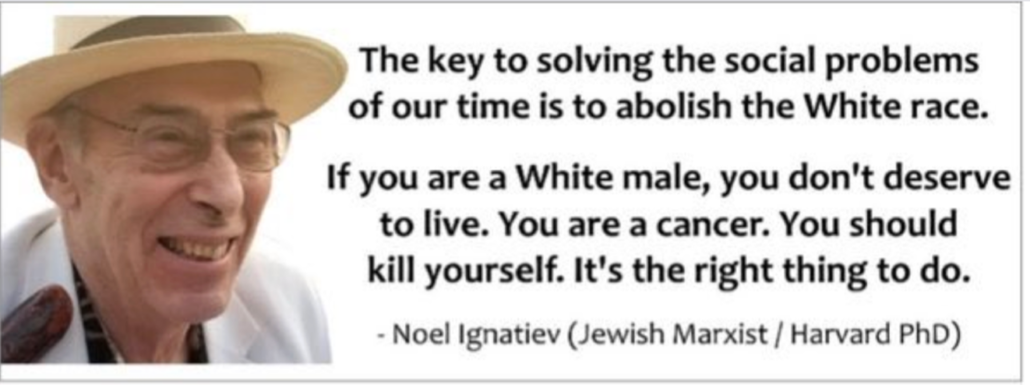
As a result of these lies, Canada has officially recognized that genocide did take place. This admission of guilt based on thin air is in effect another giant step on the way to demonizing and abolishing the White race and the nations and civilization it created. “Everything today,” writes James Pew, one of the authors of Grave Error, “is viewed through the cynical lens of radical critical theory. […] It asserts that the relatively peaceful and pluralistic first-world societies of the West are actually oppressive regimes upholding the white patriarchal power structure left over from colonialism, and serving the interests of public enemy number one: White men.”[26]

The Poison of Postmodernism

It is postmodernists like the Jewish philosopher Jacques Derrida and the homosexual child rapist Michel Foucault[27] who invented the idea, roundly denounced as an intellectual imposture by the physicists Alain Sokal and Jean Bricmont[28] that reality does not exist. Their philosophy is quite simple: it is enough to believe something for it to be true. Everything is subject to interpretation, everything is relative.[29], [30]

In their world, you can be whoever you want, a male, a female, half-and-half, whatever suits your fancy. Everyone has the same abilities. Equality in everything is the rule. So, women and men are interchangeable in all areas, including pregnancy. There is no such thing as race and all cultures are equal. For these deniers of reality, behaviours and abilities have no genetic basis.[31] It is so simply because you decide that it is so; so, there is no need to prove anything with objective arguments, objectivity does not exist anyway.[32]

And if it doesn’t fit with reality, they manage to make it fit by lowering the selection criteria, by favouring through positive discrimination (affirmative action) the less qualified over the more qualified. In this tyranny of “your opinion is as good as mine,” men who are women by choice become female weightlifting champions, a plant nutrient such as CO2 becomes a poison, soil anomalies become mass graves, the discovery of a potentially unmarked burial site becomes the discovery of an unmarked burial site containing 215 children secretly killed by priests who forced six-year-olds to dig the graves.

All you have to do is want it, et voilà, with a wave of a magic wand your wildest desires become a reality that no one can contest on pain of reprisals, as this kind of policy can only work at gunpoint. This is behaviour by culture vs. behaviour by nature, our real vocation enshrined in our DNA. That’s why all leftist utopias finish in bloodshed, they’re in conflict with human nature.

In short, as Pope Benedict XVI says: “Relativism appears to be the only admissible attitude in our present age, a dictatorship of relativism that recognizes nothing as definitive and that gives as its ultimate measure only its own ego and its desires.”[33] In this reign of subtle, perverse terror veiled by good intentions and noble sentiments, the very concepts of facts and knowledge are denounced as hate speech and racism. Truth no longer has any meaning. Minority opinion takes precedence over that of the majority. Freedom of expression is stifled. Democracy is nothing more than an empty word. Threats of dismissal, vandalism, intimidation, banking exclusion, and personal attacks are the rules of engagement in this war of subjectivity against common sense, logic, and objectivity.

The scourge of relativism, in other words, boils down to an excessive, dogmatic, or performative ideology that prioritizes identity politics, victimhood hierarchies, cancel culture, and enforced conformity over merit, free speech, and individual responsibility; it divides society into oppressors and oppressed based on group identities and leads to intolerance or reverse discrimination particularly towards Christians and White people, who are seen as the most important obstacles to progress that must be erased from the surface of the Earth.

Global Utopia

Don’t be fooled, though, progress has nothing to do with it. The decolonizing social justice left and the government puppets that are involved in this destruction of Christianity and the White race are the useful idiots of international capitalism that is leading the world down a path to planetary servitude.

The ultimate goal of the banker-merchants who call the shots in the background is to create a worldwide collectivist society of consumers easy to manipulate and control;[34] a society where the notion of belonging to a country will be obsolete; a society where no one will have any identity, other than that of consumer. This future is described as a “global utopia” for the ruling elite, a nightmare for the millions of rootless, acculturated post-national nomads.[35]

In this post-modern drama that’s unfolding in front of our very eyes, the “worker bees” will be able to move unhindered to wherever they are needed. Trade and all other transactions will be greatly facilitated by the elimination of all barriers, not only physical, but also psychological and social.

The fake residential school genocide is just one step in that direction.


[1] Editors C. P. Champion and Tom Flanagan, preface by Conrad Black, Grave Error: How the Media Misled Us (and the Truth about Residential Schools), True North and Dorchester Books, 2023.

[2] Lifesitenews staff, “Rescued from the memory hole: Some First Nations people loved their residential schools,” June 28, 2021.

[3] McRAE: Is the real truth not bad enough? Western Standard, December 15, 2022.

[4] C P Champion and Tom Flanagan, work cited.

[5] Gabrielle Fonrouge, Mass grave with 215 Indigenous kids found on former school grounds in Canada, New York Post, May 28, 2021.

[6] Brian Giesbrecht, ‘Lawyers Should Apologize for False Accusations,’ Editors C. P. Champion and Tom Flanagan, sequel to Grave Error,  Dead Wrong: How Canada Got the Residential School Story So Wrong, True North and Dorchester Books, 2025, p. 142.

[7] Dana Kennedy, “No Human Remains Found 2 Years After Claims of ‘Mass Graves’ in Canada,” New York Post, August 31, 2023.

[8] Ibid.

[9] Jared Taylor, Kamloops: Greatest Hate Hoax Ever?  YouTube, January 29, 2022.

[10] AI GROK definition on X: The false consensus effect is a cognitive bias in psychology where people tend to overestimate the extent to which others share their own opinions, beliefs, behaviors, or preferences. In brief: We assume our views are more common than they actually are. This phenomenon was first systematically studied by Lee Ross and colleagues in 1977, and it’s supported by extensive research showing it’s a pervasive egocentric bias in social perception.

[11] Hervé Ryssen, Satan in Hollywood, The Barnes Review, also on the Internet Archive, 2016.

[12] Frank L. Britton, Behind Communism, River Crest Publishing, 2021 (first published in 1952), pp 116-118.

[13] Arthur Kempt, The War Against Whites. The Psychology Behind the Anti-White Hatred Sweeping the West, Ostara Publications, 2020, p. 82.

[14] Mark Weber, Hollywood’s Agenda, and the Power Behind It, Institute for Historical Review, Feb. 6, 2013.

[15] Lawrence H. Keeley, War before Civilization, Oxford University Press, Nov. 1 1997.

[16] Adam Stueck, “A Place Under Heaven: Amerindian Torture and Cultural Violence in Colonial New France, 1609-1729″ (2012). Dissertations (2009 -). Paper 174. http://epublications.marquette.edu/dissertations_mu/174

[17] Thomas Goodrich, Scalp Dance. Indian Warfare on the High Plains, 1865-1879, Stackpole Books, 1996.

[18] Kerry Bolton, PhD, The Parihaka Cult, Black House Publishing, 2012.

[19] Ibid, p. 19.

[20] Michelle Stirling, “Open letter,” Dead Wrong: How Canada Got the Residential School Story So Wrong, True North, 2025, pp 218 to 230.

[21]Pope says genocide of Aboriginal children in Canadian mission schools,” epicnews, July 30, 2022.

[22] C.P. Champion and Tom Flanagan, Grave Error.[22] How the Media Misled us (and the Truth about Residential schools), Forward by Conrad Black, True North, 2023; there is a sequel to this book, Dead Wrong: How Canada Got the Residential School Story So Wrong, True North, 2025; see also a controversial documentary on the “worst lie in Canadian history,” Making a Killing: Reconciliation, Genocide, and Plunder in Canada, released December 2, 2025.

[23] C.P. Champion and Tom Flanagan, Grave Error, p. 330.

[24] Ibid., p. 329.

[25] Editors C.P. Champion and Tom Flanagan, Dead Wrong: How Canada Got the Residential School Story So Wrong, True North, 2025, chapter 7, p. 18.

[26] James Pew, “Canada’s descent into collective guilt,” Grave Error by Editors C.P. Champion and Tom Flanagan, p. 160.

[27] Matthew Campbell, “French Philosopher Michel Foucault ‘Abused Boys in Tunisia,’” The Sunday Times, March 28, 2021.

[28] Alain D. Sokal and Jean Bricmont, Impostures intellectuelles, Odile Jacob, 1997.

[29] Stephen R. C. Hicks, Explaining Postmodernism: Skepticism and Socialism from Rousseau to Foucault, Ockam’s Razor Publishing, 2018.

[30] Noretta Koertge, A House Built on Sand: Exposing Postmodernist Myths About Science, Oxford University Press, 1998.

[31] Robert Plomin, John Defries, Gerald Mcclearn, and Michael Rutter, Des gènes au comportement : Introduction à la génétique comportementale, Université de Boeck, 1999.

[32] David Ruse, Fake Science: Exposing the Left’s Skewed Statistics, Fuzzy Facts, and Doggy Data, Regnery Publishing, 2017

[33] Greg Kandra, « Benoît XVI : “Le relativisme est un poison” », Aleteia, January 31, 2017.

[34] Kerry Bolton, PhD, Revolution from Above, Arktos, 2011; see also by the same author, The Banking Swindle. Money Creation and the State, Black House Publishing, 2017. French jurist Valérie Bugault, PhD has also written extensively on this subject, Demain l’aube… le renouveau, Sigest, 2023; lastly but not least: Stephen Mitford Goodson, A History of Central Banking and the Enslavement of Humanity, Black House Publishing Ltd, 4th Edition, 2019.

[35] Gearóid Ó Colmáin, “Rothschild’s ‘Slaughter Ships.’ Coercive Engineered Migration: Zionism’s War on Europe (Part 4 of 11),” Dissident Voice, 2016. Cited by Scott Howard, The Open Society Playbook, Antelope Hill Publishing, p. 223.
The Isaac Accords: A New Diplomatic Front Opens in Latin America

Argentine President Javier Milei stood before Jerusalem’s Museum of Tolerance in June 2025 as the first non-Jewish head of state to receive the Genesis Prize. Israeli President Isaac Herzog and Genesis Prize Foundation Chairman Stan Polovets presented the award, with Milei declaring to the assembled crowd his embrace of Jewish history as his own.

“I am not Jewish, but that does not stop me from feeling the history of the Jewish people as my own,” Milei said. “You will always find in me an ally of Israel, a country that stands on the right side of history. In this difficult moment, I embrace you fraternally and say with sincerity, Am Israel Chai!”

Milei donated the entire million dollar prize to establish the American Friends of Isaac Accords, a New York based non-profit designed to institutionalize a pro-Israel bloc throughout Latin America. The organization opened its doors in August and is on a mission to make Latin America safe for Israeli interests.

The initiative takes its name from Isaac, the biblical patriarch and son of Abraham, positioning the framework as a successor to the 2020 Abraham Accords that normalized relations between Israel and several Arab nations such as Bahrain, Morocco, Sudan, and the United Arab Emirates. Where the Abraham Accords focused on the Middle East, the Isaac Accords are now targeting Latin America.

Argentina’s Ambassador to Israel, Rabbi Shimon Axel Wahnish, articulated the vision in June following the Genesis Prize ceremony. “If the Gulf can have the Abraham Accords, why can’t Latin America have the Isaac Accords?” Wahnish asked.

The framework pursues concrete diplomatic milestones rather than symbolic gestures. The initiative encourages Latin American nations to relocate embassies from Tel Aviv to Jerusalem, designate Hamas and Hezbollah as terrorist organizations, reverse anti-Israel voting patterns at the United Nations, and establish security cooperation channels to combat Iranian influence in the region. Economic integration centers on Israeli technology transfers in agritech, water management and cyber defense, sectors where Latin American nations face acute capacity gaps.

The November 27 meeting between Milei and Israeli Foreign Minister Gideon Sa’ar in Buenos Aires marked the formal diplomatic launch of the initiative. Sa’ar described Milei’s connection to Judaism and Israel as sincere, describing the president’s rise as a double miracle for Argentina and the Jewish people. Milei declared Argentina would serve as a key partner alongside the United States in promoting the framework, stating the free world must rise together against threats to liberty.

Israeli Prime Minister Benjamin Netanyahu praised Milei’s vision as signals of a new era of shared values between Israel and Latin America. “Together, and in tandem with U.S. leadership under President Trump, we will elevate our relations to new heights,” Netanyahu said. “I invite all our friends across the continent, those who believe in freedom, security and prosperity, to join the Isaac Accords.”

The organizational architecture operates through the American Friends of Isaac Accords rather than traditional diplomatic channels. The non-profit structure allows the initiative to bypass government bureaucracy, directly funding pro-Israel organizations, arranging delegation trips, and facilitating partnerships between Israeli technology firms and Latin American markets. This is the hidden strength of the sprawling NGO–think tank networks that steer much of foreign policy from behind the scenes. This consortium of NGOs advances Zionist objectives regardless of who occupies office, answering only to itself and shrugging off any of the consequences.

For Israeli officials, the rollout of the Isaac Accords is a sigh of relief, given Latin America’s growing hostility toward Israel since October 7.  Multiple governments across the region, most notably Colombia in recent years, have downgraded ties with Israel or recalled ambassadors as public outrage over Israel’s genocide in Gaza has grown, while Israel has faced deeper isolation across parts of the Global South.

Israeli Ambassador to the United Nations Danny Danon was effusive about this recent initiative. “Given the hostility toward the Jewish state from some nations in the region, support of Israel by Latin American countries which are now on the sidelines is very important,” Danon said.

Genesis Prize Foundation Chairman Stan Polovets articulated the initiative’s ambitions at the June ceremony in Jerusalem. “We must end Israel’s isolation on the world stage,” Polovets said. “Together with President Milei, we will start in Latin America and help make his dream of Isaac Accords a reality. Milei’s support is not only symbolic. His Isaac Accords vision is a geopolitical strategy that can bring tangible results in Latin America.”

Polovets described the creation of AFOIA as inspired by Milei’s steadfast support of Israel during one of the most challenging periods in its history. “AFOIA is a vehicle to promote Milei’s bold vision and encourage other Latin American leaders to stand with Israel, confront antisemitism, and reject the ideologies of terror that threaten our shared values and freedoms,” Polovets said.

The initiative operates on a phased approach. Argentina, Costa Rica, Panama and Uruguay form the initial partnership group, with focus on immediate trade deals and security agreements. Phase Two targets Brazil, Chile, Colombia and El Salvador for expansion in 2026 and beyond, aiming to pull these nations back toward Israel despite recent diplomatic tensions.

Milei addressed the Argentine Congress at the 90th anniversary of DAIA, the Delegation of Argentine Israelite Associations, in November, framing Argentina’s stance as moral courage amid international abandonment. “While the vast majority of the free world decided to turn its back on the Jewish state, we extended a hand to it,” Milei said. “While the vast majority turned a deaf ear to the growth of antisemitism in their lands, we denounced it with even greater fervor, because evil cannot be met with indifference.”

During his June address to the Knesset, Milei pledged to move Argentina’s embassy to Jerusalem in 2026 and outlined his administration’s position. “I said at the start of my term of office that I consider Israel and the United States as our two main strategic partners,” Milei told Israeli lawmakers. “We did not hesitate to declare Hamas as a terrorist organization. My brothers and sisters, Argentina stands by you in these difficult times.”

Milei framed Argentina’s alliance with Israel as a question of good vs. evil. “It is important to understand that we are in the midst of a battle between good and evil, and we started to lose this battle when we started to lose the distinction between the two,” Milei said. “The international community must reconnect urgently with its moral compass.”

Argentine Foreign Minister Pablo Quirno is scheduled to travel to Israel in February 2026 to finalize operational frameworks with Sa’ar and Netanyahu. Israeli Foreign Minister Sa’ar described 2026 as the year of Latin America for Israeli diplomatic efforts to rebuild ties across the region.

All things considered, Israel views Latin America as a strategically important region. With its bodyguard in the United States getting into confrontations with countries like Venezuela, Israel is taking advantage of these tensions to mend and expand relations with nations across Latin America.

As one of the key nodes of world Jewry, Israel sees not just the Middle East, but the rest of the world, as its sphere of influence. American Jewry is in strong agreement with this vision and is doing everything possible to make Latin America safe for Jewish supremacy. The United States’ $20 billion bailout to Argentina—the region’s launchpad for philosemitism—and its enthusiastic support for Venezuelan opposition leader Maria Corina Machado—the Likud party’s favorite shabbos goyess—demonstrates the lengths the United States will go to promote governments and political actors amenable to Jewish interests in the Western Hemisphere.

The Isaac Accords will be the next front in this concerted effort to subdue and Zionize Latin America. Thus unfolds the meticulously orchestrated campaign to bring an entire continent to heel. Will the peoples of Latin America rise to crush the head of this Hebraic serpent before its suffocating coils forever strangle their sovereignty, or are they destined to be its final, gasping prize?

The continent now stands at a precipice, its destiny hanging on a single, stark choice: to wield the sword against the serpent’s head or to be slowly asphyxiated by its ever-tightening grip.

Joyeux Noёl: The Beginnings of WWI and the Christmas Truce of 1914

MerryChristmasfilmPoster3

Editor’s note: Christmas is a special time of year, and over the years TOO has posted some classic articles that bear on the season. This article by F. Roger Devlin was originally posted in December, 2013. It is an important reminder of the disastrous intra-racial wars of the twentieth century—wars that may yet deal a death blow to our people and culture given the processes that they set in motion. 

With the hindsight offered by ninety-nine years, it is obvious that the outbreak of the World War I marked not merely the beginning of the most destructive war in history up to that time, but a fundamental civilizational watershed. While the fighting was going on, nearly all participants assumed they had been forced into the struggle by naked aggression from the other side. It took historians years to unravel what had actually happened.

At the beginning of the twentieth century, the German Army was the best in Europe, capable of defeating any individual rival. Yet Germany had no natural borders, and was vulnerable to a joint attack on two fronts: by France and Britain in the West and the Russian Empire in the East. A German defeat was considered virtually inevitable in such a scenario.

The Franco-Russian alliance of 1894, which became the Triple Entente when Britain joined in 1907, realized Germany’s worst fears.

However, there were important differences between Germany’s Western and Eastern rivals: France and Britain were modern, compact, efficiently-organized countries capable of rapid mobilization, while sprawling Russia with its thinly spread population and economic backwardness was expected to require up to 110 days for full mobilization. Taking advantage of this asymmetry, the German High Command developed the Schlieffen plan: upon the outbreak of hostilities, close to ninety percent of Germany’s effective troops would launch a lightning attack in the West; this campaign was to be completed within forty days, while lumbering Russia was still mobilizing. With the Western powers out of the way, massive troop transfers to the Eastern front were expected to arrive in time for Germany to face down Russia. Speed—of mobilization, of offensive operations, and of troop transfer—was critical to the success of this plan.

The assassination of the Austro-Hungarian Arch-Duke by a Serb nationalist in June, 1914, is the perfect example of an event which occasioned events which followed, but did not cause them; the men of Europe’s great powers did not slaughter one another for four years over a political assassination in the Balkans. Rather, the assassination occurred in the context of Russian guarantees to Serbia and German guarantees to Austria, which inevitably brought the Triple Entente into play. A diplomatic game of ‘chicken’ ensued, in which no side was willing to be the first to back down.

When Austria declared war on Serbia on July 28th, the Russian Tsar, conscious of his Empire’s military backwardness, ordered a partial mobilization. This action was intended merely as a precaution in case of a war that still seemed unlikely. But for the Germans, with their Schlieffen plan requiring utmost speed, the Tsar’s order had the effect of an electric shock. Germany felt it had to mobilize as well. Russia responded two days later by ordering full mobilization. Germany gave Russia an ultimatum; and the Tsar, unwilling to knuckle under, allowed the deadline to pass. Within hours, everyone was involved in a war that none of the parties had originally wanted or intended.

German historians call such a series of events a Betriebsunfall: a quasi-mechanical accident such as might occur in the machinery of a factory. Men were drawn into the gear work and crushed when no one was able to throw the emergency switch in time. It was a tragedy in the fullest sense of the word—a disaster brought on by well-intentioned but flawed men acting rationally under conditions of imperfect knowledge. The consequences are well-known: ten million dead, twenty-eight million more wounded or missing, Communism established in Russia, the Balfour Declaration setting the stage for today’s ongoing Middle East conflict, and the whole crowned by a shameful ‘peace’ treaty that all but guaranteed a future war of German revenge.

Yet, as we can see from newsreel footage of August 1st, the popular reaction to the outbreak was war fever on a scale not seen since the crusades. Europe had been enjoying forty-three years of peace and unprecedented material prosperity, and the young greeted the war as a romantic adventure.

The planned rapid German advance through the Low Countries into Northeast France was unexpectedly halted  in early September—the “Miracle of the Marne”—foiling the Schlieffen plan. On the 13th, the German Army responded by attempting a flanking action around the French lines; the French then rapidly extended their own defensive lines in what became known as the “race to the sea.” Since neither side could dislodge the other, and neither was willing to retreat, soldiers began digging themselves in to their positions—the beginning of trench warfare. By the time winter set in, the pattern of the next four years had been clearly established: a war of attrition involving trivial advances and retreats across a few acres of mud.

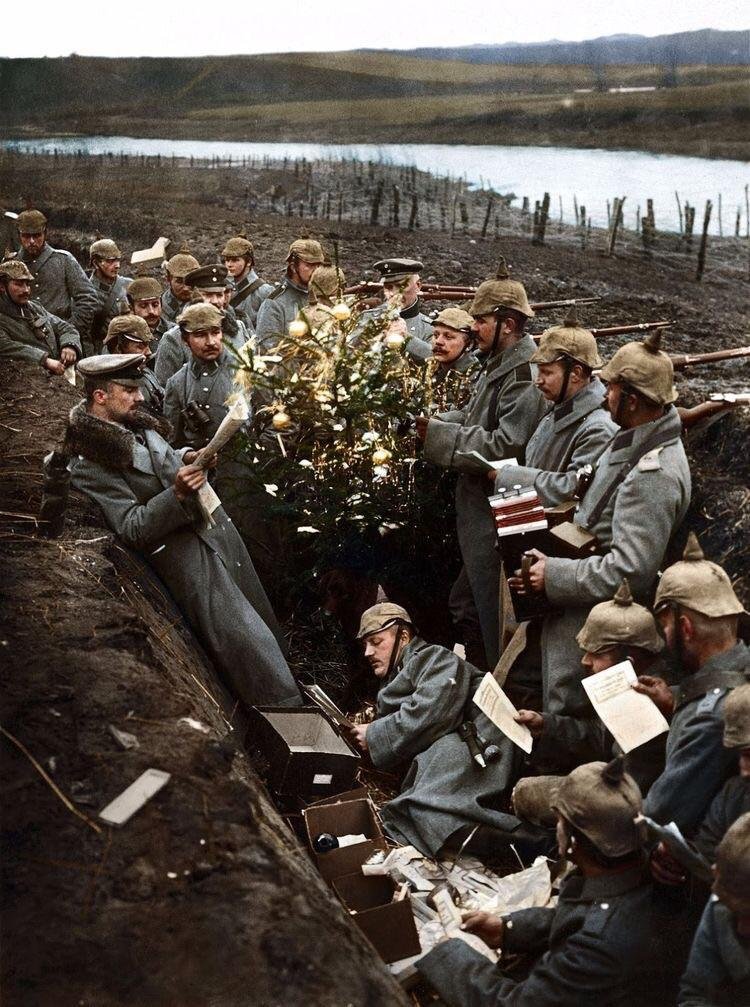
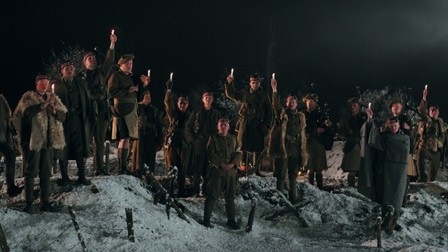
But as Christmas approached that year, something unexpected began unfolding. On the frontline sector south of Ypres, Belgium, German troops began decorating the area around their trenches for Christmas Eve. As Wikipedia describes it:

The Germans began by placing candles on their trenches and on Christmas trees, then continued the celebration by singing Christmas carols. The British responded by singing carols of their own. The two sides continued by shouting Christmas greetings to each other. Soon thereafter, there were excursions across No Man’s Land, where small gifts were exchanged, such as food, tobacco and alcohol, and souvenirs such as buttons and hats. The artillery in the region fell silent. The truce also allowed a breathing spell where recently killed soldiers could be brought back behind their lines by burial parties. Joint [religious] services were held.

The ceasefire spread to other sectors of the front, with as many as 100,000 men eventually participating. In some areas, soccer games between the belligerents replaced combat.

joyeux-noel

By December 26th, it was over. The authorities got word of the breakdown in discipline and intervened vigorously.

In 2005, an international consortium from France, Germany, the United Kingdom, Belgium, and Romania produced a film about the Christmas Truce: Joyeux Noёl. The film opens with scenes of children in French, British and German grade schools reciting rhymed curses they had been taught against the opposing side: the British child’s curse calls for the complete extermination of Germans.

The scene switches to Scotland, where an enthusiastic young man, William, rushes into his local Catholic church breathlessly to announce to his younger brother Jonathan that war has been declared; they are to begin basic training in two days. “At last, something’s happening in our lives,” he rejoices. The priest, Fr. Palmer, looks notably less enthusiastic.

At the Berlin Opera, a performance is interrupted by an officer walking on stage to announce that war has been declared. The lead tenor, Sprink, is quickly called up.

In a French trench, Lieutenant Audebert wistfully looks at a photograph of his pregnant wife moments before being called to lead an assault on the German lines. In the ensuing action, Scottish William is mortally wounded; his brother Jonathan is forced to leave him behind, a psychological trauma from which he never recovers. Audebert’s men pour into a German trench, but as they turn a corner, some one-third of them are mown down by a German machine gun.

Meanwhile, Sprink’s lover, the Danish soprano Anna, receives permission to sing before the Crown Prince of Prussia. Sprink is called back from the front to perform with her, and is impressed with the luxurious comfort in which the German commanders are living. When he returns to the front, Anna insists on accompanying him, determined to sing for the ordinary frontline soldiers as well as the officers at headquarters. (The presence of a woman at the front is poetic license on the filmmakers’ part.)

The German soldiers begin setting up Christmas trees along their trenches, to the bewildered suspicion of the French soldiery. After the singers conclude their first number, a cheer goes up from the Scottish trenches. Fr. Palmer plays the first few bars of another Christmas song on the bagpipes, and Sprink responds by performing the song, climbing out into No Man’s Land. Lieutenant Audebert motions to his men to hold fire. Soon, men are pouring out of the trenches on both sides, sharing food and drinks. Fr. Palmer holds a Christmas Eve Mass for all the men.

On Christmas morning, the officers renew the truce and arrange for exchanging their dead. Dozens of men are buried between the lines. A soccer match ensues. The officers realize the situation is untenable and attempt to restore discipline, but by this time the men are refusing to fire upon each other.

A bundle of soldiers’ letters is intercepted by the French authorities, alerting them to the situation. Fearful of having their war spoiled, they dissolve the division and repost its members to various unaffected sectors of the front. The Germans are transferred to the Eastern front to face the Russians. Fr. Palmer is replaced by a Bishop who preaches a sermon urging new recruits to exterminate German men, women and children.

A major theme of the film is music. Sprink’s superior officer begins by telling him that, being a singer, he is useless as a soldier. Then it is the incongruous presence of music that leads to the unplanned ceasefire. At the end, as the Crown Prince of Prussia informs his men of their punishment, he catches sight of a harmonica. He snatches it away and crushes it beneath his boot heel.

The Christmas Truce of 1914 did not change the course of the war very much. In future years, commanders were successful in suppressing similar occurrences. As the war progressed and especially after poison gas was introduced, soldiers gradually came to see their enemies as less than human, as was the intention of the higher officers on all sides. But it has continued to spark the popular imagination in the near-century since it took place. A Canadian historian has written:

It [was] the last expression of that 19th-century world of manners and morals, where the opponent was a gentleman. The ones who survived, who lived to see other Christmases in the war, themselves expressed amazement that this had occurred. The emotions had changed to such a degree that the sort of humanity seen in Christmas 1914 seemed inconceivable.

Joyeux Noёl lost money at the box office, and critics have complained of its “sentimentality.” I suggest seeing it for oneself this Christmas season.

Is it “anti-Semitic” to say there is war on Christmas?

Editor’s note: This article was originally posted on December 26, 2019.

Dan Rosenberg, writing in the Canadian Jewish News, claims that it’s “anti-Semitic” to say that there’s a war on Christmas. He also says that “terms such as ‘New York lawyers (and bankers),’ and ‘Hollywood culture’ refer to Jews. When people speak of the ‘secularists’ and ‘internationalists’ who are behind conspiracies like the War on Christmas, they are also referring to Jews.” And I suppose any mentions of globalists, George Soros’s influence, or the Israel Lobby are similarly off limits. In fact, for the likes of Rosenberg (and pretty much every Jew with a high position in the media), any mention that Jews are an elite or have any influence at all (or at least not any influence that is not utterly benign and good for everyone) is horrifying and utterly irrational.

Activists like Rosenberg are not limited by having to deal with actual data and facts. It’s simple. They can claim anything they want because any assertion that Jews have anything to do with changing Christian culture of America is automatically labeled as evil.

So what evidence does Rosenberg come up with?

The idea of the War on Christmas started with one of the founding fathers of American anti-Semitism: automaker Henry Ford. Back in the 1920s, he published a newsweekly called the International Jew. It frequently featured blatantly bigoted accusations such as, “Last Christmas, most people had a hard time finding Christmas cards that indicated in any way that Christmas commemorated someone’s birth.… People sometimes ask why three million Jews can control the affairs of 100 million Americans. In the same way that 10 Jewish students can abolish the mention of Christmas and Easter out of schools containing 3,000 Christian pupils.”

In modern times, Fox News has been airing segments such as Bill O’Reilly’s 2016 “Naughty or Nice” list, which praised businesses that use “Merry Christmas” and condemned others that say “Happy Holidays.”

That’s it. No heavy lifting required. Of course, it ignores Eli Plaut’s academic book A Kosher Christmas which proudly claims, in the words of a reviewer:

Jews have been the vanguard of an effort to “transform Christmastime into a holiday season belonging to all Americans,” without religious exclusivity.  The most important Jewish mechanisms of secularization are comedy and parody, for laughter undermines religious awe.  Take, for example, Hanukkah Harry from “Saturday Night Live”, who heroically steps in for a bedridden Santa by delivering presents from a cart pulled by donkeys named Moishe, Hershel, and Shlomo.  Remarkably, Hanukkah Harry has emerged as a real Santa-alternative for many American Jews.  Plaut sees such things not as attempts at assimilation but as an intentional subversion of Christmas traditions.  “Through these parodies,” he writes, “Jews could envision not having to be captivated by the allure of ubiquitous Christmas symbols.”  And it isn’t just Jews: for Americans in general, Jewish parody helps ensure that Christmas “not be taken too seriously” and that the celebrations of other traditions “be accorded equal respect and opportunity.”

As I note in my comment, “there seem to be two messages here. One is the message of subversion utilizing ridicule among other methods. The other is that Jews are seen as high-mindedly making Christmas  ‘into a holiday season belonging to all Americans.’ The end result is that Christmas is not ‘taken too seriously’ and the Christian religious aspect central to the traditional holiday is de-emphasized.”

So is it “blatantly bigoted” to make claims such as that Jews have been instrumental in getting Christianity removed from the public square? Of course not. In Chapter 7 of The Culture of Critique I noted: “One aspect of the Jewish interest in cultural pluralism in the United States has been that Jews have a perceived interest that the United States not be a homogeneous Christian culture. As Ivers (1995, 2) notes,

Jewish civil rights organizations have had an historic role in the postwar development of American church-state law and policy.” In this case the main Jewish effort began only after World War II, although Jews opposed linkages between the state and the Protestant religion much earlier. … The Jewish effort in this case was well funded and was the focus of well-organized, highly dedicated Jewish civil service organizations, including the AJCommittee, the AJCongress, and the ADL. It involved keen legal expertise both in the actual litigation but also in influencing legal opinion via articles in law journals and other forums of intellectual debate, including the popular media. It also involved a highly charismatic and effective leadership, particularly Leo Pfeffer of the AJCongress.

But, since Rosenberg focuses on Henry Ford, let’s take a look at what Ford’s The International Jew (TIJ)had to say (see my review). This was around 1920, well before the post-World War II era when Jewish influence crescendoed. The International Jew had a lot to say about Jewish efforts to eradicate the idea that America ought to be a Christian culture. Rosenberg writes that any mention of “Hollywood culture” is an unacceptable reference to Jews. Ford’s writers were well aware of this:

TIJ notes that to advocate censorship is construed as anti-Semitism: “Reader, beware! if you so much as resent the filth of the mass of the movies, you will fall under the judgment of anti-Semitism” (2/12/1921).

But, after noting that “90% of the production is in the hands of a few large companies, 85% of which “are in the hands of Jews” (2/12/1921), there was enough resentment about the movies that in fact attempts to control Hollywood were created shortly thereafter:

TIJ is careful to note that its concerns with the moral messages in movies are not idiosyncratic but part of a larger kulturkampf between the movie industry and large segments of the American public: “In almost every state there are movie censorship bills pending, with the old ‘wet’ and gambling elements against them, and the awakened part of the decent population in favor of them; always, the Jewish producing firms constituting the silent pressure behind the opposition” (2/12/1921). Indeed, the Motion Picture Producers and Distributors of America, headed by Will H. Hays, was created in 1922 in response to movements in over thirty state legislatures to enact strict censorship laws, and the Production Code Administration, headed by Joseph I. Breen, was launched in response to a campaign by the Catholic Legion of Decency (Gabler 1988). TIJ’s reservations about the moral content of movies was indeed widely shared among the American public.

The effectiveness of these organizations in influencing the content of Hollywood culture lasted until the 1960s’ counter-cultural revolution, a social transformation, that as argued in Chapter 3 of The Culture of Critique, was the product of a new Jewish-dominated elite that remains dominant today. Moreover, “the assertions of TIJ are congruent with recent studies indicating that Jews remain in control of the movie industry and that the movies often portray Christians and Christianity negatively and Jews and Judaism positively (e.g., Medved, 1992/1993; MacDonald, 2002a).” For recent examples, see Edmund Connelly’s updated War on Christmas series.

As also noted in the quote above from The Culture of Critique, TIJ was also well aware of Jewish influence in removing Christianity from the public square:

Besides the cultural influences described above, TIJ devotes a great deal of attention to the Jewish political campaigns against public expressions of Christianity and for official recognition of the Jewish religion (e.g., recognizing Jewish holidays). “The St. Louis Charity Fair in 1908 planned to remain open on Friday evening; a great outcry; did the managers of that fair mean to insult the Jews; didn’t they know that the Jewish Sabbath began on Friday night?” (6/04/1921). TIJ presents a history of Jewish activism against public expressions of Christianity based on Kehillah records [see TIJ‘s account of the Kehillah], beginning with an attempt in 1899–1900 to remove the word “Christian” from the Virginia Bill of Rights and culminating in 1919–1920: “In this year the Kehillah was so successful in its New York campaign that it was possible for a Jewish advertiser in New York to say that he wanted Jewish help, but it was not possible for a non-Jewish advertiser to state his non-Jewish preference. This is a sidelight both on Jewish reasonableness and Jewish power” (3/12/1920). “The Jews’ interference with the religion of the others, and the Jews’ determination to wipe out of public life every sign of the predominant Christian character of the United States is the only active form of religious intolerance in the country today” (3/21/1920).

Indeed, the focus of Jewish activism was that the United States was not a Christian civilization but an “unshapen mass of potentiality”:

Based on pronouncements of Jewish organizations and intellectuals, TIJ makes the important point that Jews promote “one of the dangerous doctrines being preached today” that “the United States is not any definite thing as yet, but that it is yet to be made, and it is still the prey of whatever power can seize it and mold it to its liking. It is a favorite Jewish view that the United States is a great unshapen mass of potentiality, of no particular character which is yet to be given its definite form. . . . We are not making Americans; we are permitting foreigners to be educated in the theory that America is a free-for-all, the prize of whatever fantastic foreign political theory may seize it” (3/05/1921). This comment on Jewish attitudes fits well with a great deal of evidence that Jews have consistently opposed the notion that the U.S. has any ethnic overtones or that it is a European or Christian civilization (see MacDonald, 1998/2002, Ch. 7). …

What strikes the reader of TIJ is its portrayal of Jewish intensity and aggressiveness in asserting its interests. Jews were unique as an American immigrant group in their hostility toward American Christian culture and in their energetic efforts to change that culture (see also MacDonald 1998b, 2002b). From the perspective of TIJ, the United States had imported around 3,500,000 mainly Yiddish speaking, intensely Jewish immigrants over the previous 40 years. In that very short period, Jews had had enormous effect on American society.

Fundamentally, TIJ was correct in all of its important assertions. I conclude:

Mainstream scholarship supports the following contentions of TIJ regarding Jewish influence on the U.S. as of the early 1920s:

  1. Jews had achieved a great deal of economic success, even to the point of dominating certain important U.S. industries.

  2. Jewish organizations had launched highly successful campaigns to remove references to Christianity from U.S. public culture and to legitimize Judaism as a religion on a par with Protestantism and Catholicism.

  3. Jewish organizations had been able to impose their ethnic interests on certain key areas of domestic policy. As TIJ noted, Jews were the main force behind maintaining the policy of unrestricted immigration; by 1920, unrestricted immigration policy had continued nearly 20 years after U.S. public opinion had turned against it (see MacDonald 1998b, Ch. 7). Jews had also shown the ability to have a great deal of influence in the executive branch of the U.S. government, as indicated by their influence in the Wilson administration.

  4. Jews had also been able to impose their ethnic interests in the area of foreign policy despite widespread feelings among the political establishment that the policies advocated by the Jewish community were often not in the best interests of the United States. The main examples highlighted by TIJ were the abrogation of the Russian trade agreement in 1911 and post-W.W.I policy toward Eastern Europe where Jewish attitudes were entirely dictated by their perceptions of the interests of foreign Jews rather than the economic or political interests of the U.S. Jews achieved their goals on these issues despite the views of the Taft Administration on the Russian Trade Agreement and the views of a wide range of military and diplomatic figures that the U.S. should support post-W.W.I Poland as a bulwark against Bolshevism and that Jewish complaints against Poland were exaggerated (see Bendersky 2000).

  5. Jews had been a major force behind the success of Bolshevism and its incredibly bloody reign of terror in the Soviet Union and in the abortive Communist revolutions in Hungary by Kun and Germany by Eisner.

  6. Jews were the main component and by far the most energetic component of the radical left in the United States, a movement that advocated a massive political, economic, and cultural transformation of the U.S.

  7. Jews had attained a substantial influence over the U.S. media via a virtual monopoly on the movie production business, domination of the theater and music businesses, their influence in journalism, ownership of some newspapers, and their ability to apply economic pressure on newspapers because of their importance as advertisers. In turn, the ability of Jews to pressure non-Jewish newspapers depended on Jewish ownership of department stores in major cities. Jews used this media influence to advance their domestic and foreign policy agendas, portray Jews and Judaism positively while portraying Christianity negatively, and promote a sexual morality at odds with the traditional culture of the United States.

In turn, these consequences stemmed from critical features of Judaism as a group evolutionary strategy

But for an activist like Rosenberg, all that is necessary is to scream “bigoted,” “anti-Semitic,” and the vast majority of people, unaware of the history of Jewish activism, acquiesce. This is unsurprising because the history of Jewish activism and influence can’t even be discussed in polite circles much less be disseminated in the mainstream media or the educational system.

Or they are well aware of  the Jewish role in transforming the culture of the United States, but they also aware of the Jewish power to ruin their lives.

In short the present situation is an excellent marker of Jewish power in contemporary America. And yes, Christianity remains in their crosshairs.

Star Baby and Straw Blasphemy: The Complex Simplicity of the First Christian Story

Varsk’vlavi. That’s a strange word from a strange language. At least, it’s a strange word if your mother-tongue is English and not Georgian, the mother-tongue of Joseph Stalin. As a boy, Stalin himself would have found the word right at the beginning of the New Testament in the Gospel of Matthew:

2:9 და აჰა, ვარსკვლავი, რომელიც მათ აღმოსავლეთში იხილეს, წინ უძღოდა მათ, ვიდრე მივიდოდა და დადგებოდა იმ ადგილზე, სადაც ყრმა იყო. 2:10 ვარსკვლავი რომ დაინახეს, მათ მეტისმეტი სიხარულით გაიხარეს.

2:9 da aha, varsk’vlavi, romelits mat aghmosavletsši ikhiles, ts’in udzghoda mat, vidre mividoda da dadgeboda im adgilze, sadats qrma iqo. 2:10 varsk’vlavi rom dainakhes, mat met’ismet’i sikharulit gaikhares.

2:9 And, lo, the star, which they saw in the east, went before them, till it came and stood over where the young child was. 2:10 When they saw the star, they rejoiced with exceeding great joy.

Yes, varsk’vlavi, ვარსკვლავი, means “star.” It’s a strange word for Anglophones because it’s so long and complex. Where English has one syllable and four letters, Georgian has three syllables and ten letters. But you could say that the word is appropriately complex in Georgian and appropriately simple in English. Stars are complex things after all, giant globes of glowing gas that evolve and explode and still challenge the best brains of the human race to explain and predict their behavior. But on the other hand, stars are simple things too, primal things, bright points of light to the naked eye. Stars are complex in physics and simple in stories, bearing messages that even the youngest children can grasp.

Fleeting but fertile

The Star of Bethlehem bore a simple but stupendous message: Here is the Son of God. Jesus was a star-baby, born humbly on Earth but heralded in the Heavens. His star brought Kings from the East, the Three Wise Men, the Magi whose fleeting appearance in a single Gospel has inspired millennia of Christian art, literature and legend. The star’s appearance is fleeting but fertile too. Only Matthew mentions it and only briefly, but Matthew’s is the first Gospel and the star is central to the first story he tells. Stalin must have read that story as a child, but Stalin would grow up to reject the star-baby of Jesus and follow the straw man of Marx.

The Star of Bethlehem (c. 1887) by Sir Edward Burne-Jones (image from Wikipedia)

Another able and intelligent atheist, the science-fiction writer Arthur C. Clarke (1917–2008), rejected the star-baby too. He replaced it with what you might call a straw star. When I first read Clarke’s short-story “The Star” (1955) as a teenager, I thought it was a clever and cutting swipe at Christianity, a swingeing blow delivered on behalf of science against superstition. When I re-read it today, I see it for what it really is: not a successful swipe against Christian irrationality, but a stroking of atheist vanity. And a soothing of atheist fears. The fears were first those of Arthur C. Clarke himself. He obviously didn’t want Christianity to be true, which is why he created a straw star to swallow the joy-star of Matthew’s Gospel.

Stellar spoiler

What I describe next will be a spoiler for anyone who hasn’t read his story, but that will be appropriate enough in its way. After all, Clarke intended “The Star” to be a spoiler for Christianity. It’s about a Jesuit priest three thousand light-years from home. The priest is the first-person narrator of “The Star,” an astrophysicist of the far future who’s part of an interstellar mission to the Phoenix Nebula. The Nebula is the remnants of a supernova, the cataclysmic explosion of a once stable star. It turns out that the star had planets and that one of the planets had an alien civilization on it, advanced enough to predict the supernova but not advanced enough to flee its fury.

The Crab Nebula, remnant of a supernova (image from Wikipedia)

But before the aliens and their home-planet were vaporized by the supernova, they left a memorial of their existence in hope of just such a later mission as the astrophysicist priest is describing. As the priest himself puts it: “A civilization that knew it was about to die had made its last bid for immortality.” The aliens created a vault of records on their star-system’s equivalent of Pluto, a far-out planet that they knew would be the only one to survive the coming cataclysm. Like the other scientists and crew on his star-ship, the priest is deeply moved by what the vault reveals:

If only they had had a little more time! They could travel freely enough between the planets of their own sun, but they had not yet learned to cross the interstellar gulfs, and the nearest solar system was a hundred light-years away. Yet even had they possessed the secret of the Transfinite Drive, no more than a few millions could have been saved. Perhaps it was better thus.

Even if they had not been so disturbingly human as their sculpture shows, we could not have helped admiring them and grieving for their fate. They left thousands of visual records and the machines for projecting them, together with elaborate pictorial instructions from which it will not be difficult to learn their written language. We have examined many of these records, and brought to life for the first time in six thousand years the warmth and beauty of a civilization that in many ways must have been superior to our own. Perhaps they only showed us the best, and one can hardly blame them. But their words were very lovely, and their cities were built with a grace that matches anything of man’s. We have watched them at work and play, and listened to their musical speech sounding across the centuries. One scene is still before my eyes — a group of children on a beach of strange blue sand, playing in the waves as children play on Earth. Curious whiplike trees line the shore, and some very large animal is wading in the shadows yet attracting no attention at all.

And sinking into the sea, still warm and friendly and life-giving, is the sun that will soon turn traitor and obliterate all this innocent happiness. (“The Star,” 1955)

It’s important that the aliens were “disturbingly human” and that they enjoyed “innocent happiness,” because Clarke is setting up the punch-line of the story. The astrophysicist priest studies the rocks of the planet where the vault was delved and is able to calculate the date of the supernova “very exactly.” That’s how he learns when its light must have blazed in the skies of distant Earth and that’s why, as he narrates the story,  he’s grappling with a fierce and probably fatal crisis of faith. He now knows the answer to an age-old enigma and the identity of a hallowed entity. Here are the closing lines of his narrative:

There can be no reasonable doubt: the ancient mystery is solved at last. Yet, oh God, there were so many stars you could have used. What was the need to give these people to the fire, that the symbol of their passing might shine above Bethlehem? (“The Star”)

“How clever!” I thought when I read that as a teenager. “How cringe!” I think when I read it now. The supernova of the story is a straw star, a fiction created to fill the mind with a message of disdain for Christianity. And created to mark the mind too: after you read “The Star,” its fiction will cloud the fact of The Star that blazed over Bethlehem. It’s fact for traditionalist Christians, at least, and traditionalist Christians will rightly say that Clarke’s story is blasphemous. I’d say it’s blasphemy on behalf of boy-buggery. Like a disproportionate number of people in science fiction, Arthur C. Clarke was a pedophile and I think the “children … playing in the waves” aren’t there in his blasphemous story just to set up the punch-line. Clarke settled on the tropical island of Sri Lanka in 1956, the year after he published “The Star.” Leftist Wikipedia says that he moved there “to pursue his interest in scuba diving.” I think that the move was also — and more importantly — to pursue his interest in undressed children playing in warm water.

Far, far at sea

Male children, to be specific. But what does Christianity say about pederasty, the “boy-love” that was beloved of the pagan Greeks and philhellene Romans? Christianity says pederasty is wicked and sinful, which is not a message that the pederast Arthur C. Clarke wanted to hear. That’s why, I’d suggest, he created the straw star of his blasphemous story. It’s also why the story won a Hugo Award in 1956. That was one of highest honors in science fiction, because the story was liked by other atheists, other Christophobes and other pedophiles. I liked that star-story myself when I was a teenager, but I don’t like it any more. It’s clever but cheap, designed to fill and fool the mind, not to truly feed it. The star-story in Matthew is different. It does feed the mind. And the imagination. It fed a civilization too, the civilization of Christendom whose star-story was told in Georgian long before it was told in English.

And even longer before it was subverted in English by the pederast atheist Arthur C. Clarke. Nowadays I prefer a Christian star-poem to Clarke’s atheist star-story. It’s a poem that mixes the primality of stars with the primality of an earthly entity that Georgian calls zghwa, ზღვა. That’s an aptly swishing and grumbling monosyllable for what English calls “the sea.” And here is the star-poem, a hymn by a Scottish writer called Jane Cross Simpson (1811-86), who never achieved a fraction of Arthur C. Clarke’s fame and influence but said far more than he did in far fewer words:

Star of peace to wanderers weary,
Bright the beams that smile on me;
Cheer the pilot’s vision dreary,
Far, far at sea.
Star of hope! gleam on the billow;
Bless the soul that sighs for Thee;
Bless the sailor’s lonely pillow,
Far, far at sea.
Star of faith! when winds are mocking
All his toil, he flies to Thee;
Save him on the billows rocking,
Far, far at sea.
Star Divine, O safely guide him;
Bring the wanderer home to Thee;
Sore temptations long have tried him,
Far, far at sea.
Star of Peace” at Youtube.Youtube.

Tucker Carlson Backpedals Once Again

Thoughts and Observations of the Spectacle That Is Turning Point USA

As most readers are doubtlessly well aware, the first day of the Turning Point Convention on December 18, 2025 was a notable event for the way that Erika Kirk and above all Ben Shapiro made spectacles of themselves. Vivek Ramaswamy also saw fit to tell Americans what their identity is and how it includes him and his kind. In that speecch he insisted that “There is no American who is more American than somebody else,” replete with more “magic dirt” nonsense. He even made the obligatory allusion to Martin Luther King, Jr” with talk about “content of your character.”

Watching Shapiro in particular was a most unenviable task. Concentrating on his speech is made all the more difficult because of the intrusive but utterly correct utterance from any sensible internal monologue: “how do you do, fellow whites?” That spectacle, replete with a devastating confrontation about the USS Liberty in the question and answer portion, was overshadowed by Tucker Carlson’s speech. Shapiro of course denounced Tucker Carlson for not in turn denouncing Candace Owens and more particularly for daring to have Darryl Cooper aka Martyrmade and above all Nick Fuentes on as guests. Shapiro’s speech seems part of a desperate bid to counteract the discrediting that has occurred over the past few weeks. Time will tell if it reverses that trend, but so far things seem to be turning against the Israeli shill. The very next evening, Steve Bannon skewered both Shapiro and America being beholden to Israeli and Jewish interests, culminating with the declaration that “Ben Shapiro is like a cancer that metastasizes.” Megyn Kelly then lambasted Shapiro in a sit-down with Jack Posobiec, even stating she no longer considers Shapiro a friend.

While Shapiro’s bold provocations and the reaction to it are certainly interesting, comments by Tucker Carlson are likely of far greater interest to this publication and its readers for various reasons, above all because this speech was part and parcel of Carlson’s propensity to hedge controversial comments with statements that negate, qualify, or “backpedal” from these statements, either in the same presentation or in the context of recent statements and presentations. Carlson’s speech is of course in the context of having the guests that Shapiro denounced, as well as the interview with Piers Morgan for which the foppish British twit has been rightly excoriated, including—among many other things—forsaking his nation and its posterity “for a good curry:” a particularly contemptible utterance for many different reasons, not least of which that curry of course originated from Britain and because, as Rowan Atkinson quipped in a famous skit, “now that we [have] the recipes, is there really any reason for them to stay?”

Carlson begins with a stern rebuke of Shapiro’s comments. His reproach of Shapiro’s denunciation of Carlson reads in pertinent part:

I watched [Shapiro’s speech]. I laughed. I laughed. that kind of bitter sardonic laugh that emerges from you and like upside down world arrives when your dog starts doing your taxes and you’re like, “Wait, it’s not supposed to work this way.” To hear calls for. . . DEPLATFORMING AND DENOUNCING PEOPLE AT A CHARLIE KIRK EVENT. . . “WHAT? This is hilarious.” [laughter] Yeah, this is hilarious.

That Carlson laughed at Shapiro (both as he delivered his comments and in the account of his immediate reaction) cannot be emphasized enough. Carlson commented further, urging that Shapiro’s rant was antithetical to what Charlie Kirk himself stood for:

I really thought that the impulse to deplatform people or even to use the word platform as a verb, which it’s not. It’s a noun. Don’t steal my nouns. Deplatform and denounce. Why haven’t you denounced somebody else? The whole. . .. red guard cultural revolution thing that we so hated and feared on the left that we did everything we could to usher in a new time where you could have an actual debate. I mean, this kind of was the whole point of Charlie Kirk’s public life. . . . I think that he died for it. I really believe that.

After this brief foray, Carlson focuses much of his attention mitigating or even disclaiming earlier sentiments in past presentations discussed above and doubtlessly others as well. These comments operate from the basic underlying “universal principle” against “hating” people for how they were born, that “it is immoral to hate people for how they were born.” These comments admonish against “hating everyone in a group.” He stressed that it is immoral to punish a people for crimes individuals in that group did not commit. He even asserts that this is a commandment under the Christian religion and morality: “[Y]ou are prohibited by. . . Christianity from hating people for how they were born because God created them with his spark in his image because they have souls.”

From these other assertions he condemned so-called “Islamophobia” and antisemitism. He did however use these admonitions as a vehicle to condemn prejudice and discrimination against white males, particularly in relation to college admissions practices and even hiring practices in recent years and even over the past several decades. As important as this message is, it is needlessly hampered, neutered even by talk about this supposed universal principle discussed above. Carlson unequivocally denounces (in this speech and elsewhere) in-group preferences for whites, a necessary ethos to protect white, European posterity for the evils he confronted Piers Morgan about as just one example. It is impossible, for example, to rectify and prevent The Great Replacement in Britain and Europe in any meaningful way without measures such as remigration which necessarily entails enacting policy based on group identity.

Carlson of course buttressed such rhetoric by absurd off-the-shelf appeals to civic nationalism. Such appeals include the ridiculous assertion that “Most Americans have more in common” than they do not, a demonstrably false assertion. He also asserted that racially conscious commentary should be denounced because “they are trying to divide the country,” a mindless slogan about as stupid as “The Democrats are the real racists.” None of this should be persuasive to anyone, but the crowd reaction suggests otherwise.

Many of these assertions and contentions require the firmest, most vehement repudiation, even as so much of this counterproductive rhetoric relies heavily on various norms and mores deeply embedded in the American tradition and traditional mainstream conservatism more particularly. To some limited extent, judging individuals as such is fine as far as it goes (not far at all, really). Such musings notwithstanding, to only judge individuals only as individuals without looking at the larger picture from the collective whole is to embrace willful ignorance at its worst. No society can function without making group judgment based on various criteria that define a group. Consider for example age requirements for things like driving, voting, and what not. There are doubtlessly youngsters under 16 who possess the maturity, skill, and even height necessary to drive responsibly and safely, and yet society nonetheless operates on a rule requiring an age of 16 because those youngsters who defy this general rule are outliers. Up until recently, society correctly precluded women from traditional male roles such as combat duty in the military, on-the-beat law enforcement and so on because humanity is a sexually dimorphic species and is so despite certain outliers such as women like Brigitte Nielsen being 6’1 that defy, to some limited extent, general differences between the sexes such as strength and height. There are black individuals who defy certain trends, such as an aggregate, collective IQ gap between one-to-two standard deviations, or who defy the collective racial resentment, even racial hatred that defines much of the black populace, or who are not part of “a racial commitment to crime” that characterizes and defines wild overrepresentation of blacks in crime statistics. The existence of such individuals—who are indeed outliers—does not negate the overall trend that defines a majority of the black population. Nor does it give cause to ignore these overall trends or to refrain from policy considerations based on these trends.

In very real, important ways, Carlson deludes himself and his audience by insisting that we are all just individuals. Innate characteristics that are inherent to any individual, most particularly race, matter a great deal. Differences in race are real—they are not just a social construct—just as race is a core, fundamental component of culture, identity, and any cohesive polity defined by common race, language, and history.

External factors such as cultural milieu, religious upbringing, and myriad others further dispel such naïve notions about individual autonomy. Even a cursory review of history and human nature demonstrates that individuals are profoundly determined and influenced by a variety of external factors, including the time and circumstance one is born into, just as they are influenced by what others do in a variety of ways that one can scarcely fathom. Consider as just one example that people often mimic what others do. This is reflected in various phenomena associated with social contagion, from suicide clusters, to transgender nuttery and bulimia rubbing off on a small group of individuals to others, to how a married couple is far more likely to divorce if other couples in the same social circle have divorced or are considering divorce. There are other phenomena, such as the “mere exposure effect,” which dictates that a critical mass of people will like music, cinema, and other expressions of culture merely due to exposure to these cultural expressions.

Carlson makes an even worse error, conflating in-group preference for hatred and asserting that whites advancing white, European interests on a collective basis—that is, having an in-group preference at all—is tantamount to hating individuals in a different group. Implicit in this statement is the absurd idea that such supposed hatred or what might be better described as animus in the context of very legitimate grievances is hatred for each and every individual in that group. Doubtlessly, more and more whites are harboring animus for other groups, and not without good reason. “Black fatigue” is real, and the phrase (as well as a more virulent variant with one racial epithet in particular) has become a familiar adage in Internet parlance for very good reasons: namely, that whites have legitimate grievances about the black collective, involving wildly disparate black involvement in violent and other forms of crime, the racial resentment if not ancient hatred that a critical mass of blacks harbor against whites, and a whole host of other grievances that render black people as a collective irredeemable and incompatible with white society. The same principle applies to Pakistanis, Indians, and other imposters and their role in the reverse colonization of the British Isles and the columns of black and brown hordes in Germany and Europe at large who have no right to even set foot on the sacred continent, let alone seek “refuge” there. A person can rightly hold very negative views about these and other groups collectively while still acknowledging there are outliers to these groups. That there are outliers to these trends, as there are for almost any phenomenon under the sun, does not negate the requirement for collective action, nor does it negate sensible observations and conclusions about the group as a whole. To save British and European posterity will require remigration and resettlement of all such imposters, or at least the vast majority of them. And this is true even if some of them are otherwise nice and decent people. The number of decent, upstanding black individuals does not negate the overall general trend at hand, easily observed and reinforced through centuries of experience and history, that the multiracial experiment has failed, is doomed to fail, and that there are irreconcilable differences between whites and blacks that cannot be solved except by divorce and separation, preferably on a mutually amicable basis.

These and other such utterances, including how Carlson stupidly deflated his confrontation with Piers Morgan about The Great Replacement with silly, pointless disclaimers that he likes Pakistanis and there are many nice individuals who are part of this or that group, demonstrates once again that figures like Carlson are of limited utility. Although some insist they serve no purpose, writings and presentations such as those by Tucker Carlson can be used to help persuade others on those matters they get right, leaving the work of others to explain how and why this sort of senseless pandering and equivocation is wrong. The principal utility of figures like Carlson is that they have helped normalize formerly scandalous topics like anti-white discrimination, The Great Replacement, and other topics that Carlson himself has emphasized but that were taboo even a couple short years ago. That utility must however be harnessed in a way that is separated and bifurcated from these sorts of cowardly, simplistic, and self-defeating qualifications and other sorts of “back-pedaling.”

This unfortunate propensity to backpedal—in comparison and contrast to more sensible utterances—again demonstrates how essential the vital faculties of reason, discernment and discrimination are. Ultimately, to what extent Tucker Carlson will be a net benefit by interviewing figures like Darryl Cooper or even the somewhat unsavory Nick Fuentes will depend on to what extent the larger audience possesses and utilizes these faculties, or more particularly how writers, streamers, and other thought leaders use these faculties and then apply them in any discussion or analysis about events like these. These faculties, used in concert, allow both the individual and a group to discern that Carlson’s denunciation of evils such as The Great Replacement anti-white discrimination, and even his repudiation of Ben Shapiro’s naked Zionism are laudable, but are of limited utility unless such pointless and counterproductive qualifications such as those discussed above are discarded and repudiated outright. The application of these essential faculties in turn allow both the individual and the white collective to discern that such comments against in-group preference, appeals that we are“all God’s children,” admonitions that people can only be judged as individuals are both preposterous and harmful. This underscores the vital role the new populist right has in highlighting when figures like Tucker Carlson “get it right,” while also undertaking the most vital task of arguing and persuading how and why this backpedaling could not be more erroneous or harmful.

Other articles and essays by Richard Parker are available at his publication, The Raven’s Call: A Reactionary Perspective, found at theravenscall.substack.com. Please consider subscribing on a free or paid basis, and to like and share as warranted. Readers can also find him on twitter, under the handle @astheravencalls.

End of an Era: Norman Podhoretz and the Much-to-be-Hoped-for-Decline of Neoconservative Power

The neoocns captured George W. Bush and his administration, resulting in U.S. involvement in wars throughout the Middle East.

Norman Podhoretz, the pugnacious Jewish intellectual who transformed Commentary magazine into the engine room of neoconservatism and spent half a century waging ideological warfare against enemies foreign and domestic, died December 16, 2025, at age 95. His passing from pneumonia complications closes a chapter in American political thought that increasingly appears headed for the history books rather than the future.

The combative editor who guided Commentary for 35 years represented something increasingly rare in contemporary politics: a complete ideological metamorphosis from liberal literary critic to a neoconservative warrior who constantly advocated for Judeo-American primacy on the world stage. His journey from the working class streets of Brooklyn to the commanding heights of American intellectual life mirrored the broader fracturing of the American Left during the Cold War, when former progressives found themselves “mugged by reality” and remade as champions of military interventionism and unflinching support for Israel.

Podhoretz entered the world on January 16, 1930, in Brownsville, a Brooklyn neighborhood teeming with Jewish immigrants and left-wing sympathies. His parents, Julius and Helen Podhoretz, had fled Galicia in what is now Ukraine, settling into the working-class milieu that would later provide fodder for his most controversial writings on race and class in America.

The young Podhoretz distinguished himself at Boys High School in Brooklyn through his academic prowess, which earned him a scholarship to Columbia University. At Columbia, he studied under the legendary literary Jewish critic Lionel Trilling and simultaneously pursued Hebrew literature at the Jewish Theological Seminary, a dual education that would later inform his fierce defense of Jewish particularism. A Fulbright Scholarship carried him to Cambridge University, where he studied under F.R. Leavis, completing an education that positioned him at the center of postwar intellectual life.

In 1956, he married Midge Decter, herself a formidable thinker and writer. They formed an intellectual power couple whose influence radiated through American conservatism until her death in 2022. Their son, John Podhoretz, would eventually succeed his father as editor of Commentary, cementing a dynastic hold on neoconservative thought.

Podhoretz began writing for Commentary in the early 1950s, but his ascension to editor-in-chief in 1960 marked the beginning of his true influence. Initially, he steered the magazine leftward, publishing countercultural figures like Paul Goodman and early critics of American conformity. The intellectual atmosphere of early 1960s liberalism still seemed congenial to a young editor eager to challenge the status quo.

But the emergence of the New Left, with its embrace of Third World revolutionaries and its hostility to American power and the state of Israel’s supremacist ambitions in the Middle East, alienated Podhoretz profoundly. The counterculture of the 1960s, with its sexual revolution and drug experimentation, struck him as decadent and nihilistic. Most critically, the New Left’s anti-Americanism and sympathy for enemies of the West convinced him that the liberal movement had lost its way.

By the late 1960s and early 1970s, Podhoretz had transformed Commentary into the primary intellectual arsenal of neoconservatism. The magazine became a bastion of anti-Communism, a fierce defender of Western values, and an unrelenting critic of affirmative action, multiculturalism, and what Podhoretz saw as the excesses of the sexual revolution. Under his leadership, the magazine gave voice to a generation of former liberals who felt the Democratic Party had abandoned them for the radical fringe.

Podhoretz’s political evolution traced the rightward migration of the neoconservative movement itself. In the early 1960s, he identified as a liberal Democrat, supporting civil rights legislation and the Great Society programs. But the 1972 nomination of George McGovern by the Democratic Party represented a breaking point. McGovern’s isolationism and perceived anti-Americanism convinced Podhoretz that the Democratic Party had been captured by forces hostile to American—and Israeli—interests.

By 1980, Podhoretz and his fellow neoconservatives threw their support behind Ronald Reagan, seeing in him a leader who would restore American confidence and confront Soviet expansionism. Reagan’s presidency validated the neoconservative worldview, as the Cold War wound down with the Soviet Union in retreat.

Neocons in the media—most notably David Frum, Max Boot, Lawrence F. Kaplan, Jonah Goldberg, and Alan Wald—have often labeled their opponents “anti-Semites.” An early example concerned a 1988 speech given by Russell Kirk at the Heritage Foundation in which he remarked that “not seldom it has seemed as if some eminent neoconservatives mistook Tel Aviv for the capital of United States”—what Sam Francis characterizes as “a wisecrack about the slavishly pro-Israel sympathies among neoconservatives.” Midge Decter, who, as noted, was a prominent neocon writer and wife of Commentary editor Norman Podhoretz, labeled the comment “a bloody outrage, a piece of anti-Semitism by Kirk that impugns the loyalty of neoconservatives.” If the shoe fits …

The September 11, 2001 attacks gave Podhoretz a new crusade. He argued that the Cold War had been World War III and that the War on Terror represented World War IV. He became one of the most vocal intellectual supporters of the Iraq War, defending the Bush Doctrine with the same fervor he had once directed against Soviet Communism. In 2004, President Bush awarded him the Presidential Medal of Freedom, the nation’s highest civilian honor.

His support for Barack Obama’s opponents in 2008 and 2012 reflected his view that Obama sympathized with America’s enemies and sought to diminish American power. He famously declared he would “rather be ruled by the Tea Party” than by Obama, a statement that captured his alarm at the direction of American liberalism.

The rise of Donald Trump presented Podhoretz with a dilemma. In the 2016 Republican primaries, he initially backed Marco Rubio. But faced with a choice between Trump and Hillary Clinton, Podhoretz endorsed Trump as the lesser evil. Despite private reservations about Trump’s character and temperament, he publicly defended Trump’s policies, particularly his hawkish stance toward Iran and his unwavering support for Israel. The Times of Israel would later describe him as “the last remaining ‘anti-anti-Trump’ neocon.”

No issue animated Podhoretz more than Israel. He viewed the Jewish state not merely as a refuge for persecuted Jews but claimed that Israel was a frontline defender of Western civilization. He served on the executive committee of Writers and Artists for Peace in the Middle East, using his platform to rally American support for Israeli military action.

Podhoretz harbored deep skepticism about the Oslo Accords in the 1990s, viewing Yitzhak Rabin’s negotiations with Yasser Arafat as dangerously naive. He long believed that Arab hostility toward Israel was existential and could not be appeased through land concessions. He argued that anti Zionism represented merely the latest manifestation of ancient anti-Semitism, prompting him to get into a public feud with conservative gatekeeper William F. Buckley Jr. over the conservative movement’s tolerance of anti-Israel rhetoric.

Podhoretz thrived on intellectual combat and described himself as a provocateur. His 1963 essay, “My Negro Problem—And Ours,” remains one of the most controversial pieces ever published in an American magazine. In brutally honest prose, he confessed to the fear and envy he felt toward black youths while growing up in Brooklyn, challenging the liberal pieties of the Civil Rights movement. He concluded with a radical suggestion that only complete racial amalgamation through intermarriage could solve America’s racial divide. It was never clear if that meant intermarriage with Jews.

On Iran, Podhoretz advocated military action with characteristic bluntness. “If we were to bomb the Iranians as I hope and pray we will,” he stated in a 2007 interview, “we’ll unleash a wave of anti-Americanism all over the world that will make the anti-Americanism we’ve experienced so far look like a love fest.”

Podhoretz’s death arrives at a moment when neoconservatism itself appears embattled. The American public has grown weary of the endless wars that Jewish neoconservatives championed. The Iraq War, which Podhoretz defended to the end, stands as a cautionary tale about the limits of American power and the dangers of ideological hubris. Even support for Israel, long a bipartisan consensus, has frayed, particularly among younger Americans disturbed by Israel’s recent genocidal campaign in Gaza.

Podhoretz’s passing follows the recent deaths of Michael Ledeen and David Horowitz, fellow travelers in the neoconservative movement. Together, these losses mark a generational transition. The intellectual architecture that Podhoretz and his Jewish contemporaries built over decades faces an uncertain future. Populist Republicans show little interest in the democracy promotion and nation-building projects that animated the neoconservative foreign policy consensus.

The movement that Podhoretz helped create now finds itself orphaned, embraced fully by neither political party. His death symbolizes not just the loss of a single thinker but the twilight of an entire worldview that dominated American foreign policy for a generation. Whether neoconservatism will find new champions or fade into historical memory remains an open question, but the era of Podhoretz’s influence has unmistakably ended.

He is survived by his son, John Podhoretz, and his daughters. His legacy endures in the pages of Commentary, in the foreign policy debates that continue to roil American politics, and within the corridors of American Jewish discourse.

Like Michael Ledeen and David Horowitz before him, Podhoretz exits the stage without eliciting mourning from those who bore the consequences of the wars and doctrines he championed. History will record his influence, but it will also reckon with the wreckage left in its wake.