Featured Articles

Conservative Dogma and the Student Loan Crisis

Musings on Student Loan and Education Reform and the Errors and Failings of Mainstream Conservatism

Author’s note: the Trump Administration announced it will begin garnishing defaulted student loans after the New Year, in January 2026. Mainstream conservatives are applauding, many of whom are doing so with a marked callousness and even Schadenfreude. This essay, originally published in May of 2025, argues that, among other things, mainstream conservatives get this wrong. With the left wrong in other ways, a third way would provide the solution, if only that were possible.

A Synopsis of the Student Loan Crisis and the Outrages of Conservative Dogma

There is perhaps no greater issue revealing critical, structural defects in mainstream conservatism than the typical response by many in the GOP, conservative establishment regarding the student loan crisis, a response which is quite often callous and even mean-spirited. These talking points have regrettably been adopted by large contingents of the natural constituency of the GOP and establishment conservatism. As many are well aware, sizeable numbers of the zoomer, millennial, and Gen X generations have been saddled with unconscionable student loan debt, a problem worsened by how higher education has become a fraud, not just in failing to offer—and require—demanding academic curricula, but in the poor job prospects many college graduates face. This problem hinders and even prevents many from owning a home, starting a family, as it is also a key component in the evisceration of the middle class in the United States.

The original meme is featured in the upper left corner. An edited meme is in the center with an asterisk. To the right, a list of other crushing factors contributing to reduced fertility, among them is the student loan debt crisis.n…

This is particularly egregious in the case of Gen X and even millenials because back then, unlike now, the sobering reality about the deteriorating worth of college education as an investment in time and resources was not well known. The Internet did not exist when Gen Xers were in their adolescence and was in its infancy for early millenials. Beyond that, both Gen X and millenials have faced three “once in a life-time” economic disasters, each worse than the last. These economic disasters are:

  • 2001 with 9/11, the dotcom bubble, and the Enron and Worldcom securities fraud matters;
  • the economic meltdown of 2008 which is better described as a depression rather than the “Great Recession;”
  • and the slow-burn economic meltdown that has been unfolding since 2020 with absurd covid policy, rampant inflationary spending, as well as the hundreds of billions of aid to Ukraine in what is almost certainly a scam allowing Ukrainian politicians and Biden family members and administration officials to skim off the top.

These and other considerations notwithstanding, a large contingent of conservative chatter on social media, forums, and so on is nothing less than “let them eat cake.” Many assert that persons saddled with unsustainable college debt “agreed to it,” and so must be made be to pay regardless of the cost.

An infamous normy-tier conservative cartoon (left), and some spot-on edits in rebuttal (center and rigth).

This rationale plays into naïveté about “free will” so pervasive in the Anglo-American world, failing to consider the profound, overwhelming influence that guidance from parents, teachers, and all of American society will have on the individual during the most formative years as a child and adolescent, as these generations of people were told—as children and adolescents—that going to college is the key to a middle-class, bourgeois life in this country. This creates a social contract that needs to be honored by this dystopic abomination that passes itself off as a society and civilization.1 That is no consequence to the simple-minded conservative—they signed the legal instruments agreeing to the debt, and nothing else matters.

Excerpts from a John Stossel presentation denouncing student loan relief. These excerpted portions pull most if not all the registers of conservative dogma, as summarized in this essay.

Other talking points characteristic of such chatter include objections that student loan relief would not be fair to those who either paid off their student loans or did not go to college—there is at least a partial solution to that problem, discussed below. Beyond that, such flippant disregard for the welfare of others exemplifies the deracinated state of the American mind. The welder or carpenter who did not go to college feels no concern for the plight of others because there is no community—no Volksgemeinschaft. This lack of community is created by the absence of any bond or connection by common race, blood, or soil. Together these form the very hallmark of a low-trust society, a somewhat cliched term but one that conveys a core, critical concept nonetheless.

Much of the opposition stems from outright hostility to higher education generally if not categorically. To a certain, limited extent, some of that hostility and disdain for higher education is a reaction to the present state of higher education, in which English departments for example are no longer teaching Shakespeare or Milton, but are instead teaching “diverse” authors in an insidious bid to “deconstruct” the canon of Western literature. A large portion of such hostility nonetheless reveals a piggish anti-intellectualism and the crass philistinism that defines a large contingent of mainstream conservatism. Such overt philistinism would characterize much of mainstream conservatism even if universities were the bastion of erudition and culture they are supposed to be. Such abject philistinism—outright contempt for and aversion to matters of culture and the arts—are a critical factor behind the state of society and the Unkultur that envelops us all. When only the left cares about culture, the culture, or lack thereof, that we all suffer from is the result. This in no way should be interpreted as an endorsement of leftist pretensions of cultural superiority to their ideological adversaries. Leftist swine, particularly millennials and younger, are as incessant as they are insufferable in their constant references to an unending stream of cultural sewage, from Star Wars, to Marvel “cape shit” fare, and everything in between. Many even allude to such garbage with reverence, as if they were quoting Shakespeare or Goethe. That caveat notwithstanding, the strident philistinism that has defined many facets of mainstream conservatism is a critical flaw that has doomed the supposed culture war from the start.

This trademark philistinism only partly explains conservative dogma concerning the student loan crisis. While there are of course detractors among the American conservative establishment, mainstream, “normie” conservatives insist that those afflicted by the student loan crisis pay off the debts they agreed to, no matter how destructive such an insurmountable burden might be to their futures or quality of life, and without regard to the fact that many simply cannot given the inflated cost of tuition and what is available on the job market to many college graduates, some of whom admittedly are probably not fit for a truly collegiate, academic environment. There is a vindictiveness, a mean-spiritedness in much of the rhetoric. This vindictive rhetoric seems to take delight in young adults and even people in their thirties and forties being relegated to a perpetual state of impoverishment, only just a notch above destitution, with no prospect for any quality of life, let alone the ability to own a home or start a family.

A version of this meme may be familiar to readers. It has been revised and expanded to reflect the student loan crisis and the poor economic prospects for far too many.

Moreover, the conservative outrage about the idea of helping others makes no distinction between those who can reasonably pay back student loans and those who simply cannot. There is a fundamental distinction between a person who takes a ten-thousand-dollar debt but has a hundred thousand dollars or even the ability to pay it back versus someone who was lied to since infancy and winds up working at Starbucks or a manager at Pottery Barn after “playing by the rules and getting a college education,” and borrows tens of thousands if not a hundred thousand dollars or more to do so. Even worse, almost no figure in conservative punditry even so much as countenances reforming bankruptcy law2 to allow those who truly cannot pay back loans (absent a lifetime of indentured servitude) some sort of relief. One might even think such persons regret the reform and abolition of debtor’s prison.

That mean-spiritedness is properly attributed, at least in part, to the lack of cohesiveness in American society—and multicultural societies categorically. With no common blood, ancestry, history, or language that binds a common people together, by living in the various antithesis of Volksgemeinschaft, Americans, utterly deracinated and alienated from one another, have little reason to show compassion or concern for one another.

The most appalling aspect of the “normie” conservative opposition to student loan relief is that it punishes millions who have been defrauded by the institutions of higher education, as well as led astray by parents, teachers, and elders at large. The student loan fiasco is aided and facilitated by the federal government which guarantees these loans, removing any incentive to control or curb the rising cost of tuition. One would think that a group of people who hate a particular institution would want to make that particular institution pay for the harm it has imposed on many tens of millions of ordinary Americans. As stated, one suspects many of these people would hate universities even if they were teaching the canon and applying rigorous academic standards. Conservative dogma rarely yearns for a time when the University adhered to exacting academic standards and was a beacon for high Western, European culture. Instead, it often denigrates the humanities as akin to the fabled and ridiculous “degree in under-water basket weaving,” while also conflating disciplines like history and English literature with gender and critical race theory. And they do so categorically, meaning many conservatives would be no less contemptuous of an English major if English departments were raising the banner for the dead white males, for what Matthew Arnold called the greatest that has been uttered and written.

But therein, nestled in that very hostility and resentment to higher education, either in the abstract or as it currently exists, lies an elegant and compassionate solution to the problem. Many universities have billion-dollar endowments, attributable at least in part to the student loan scam. Most estimates tally the total combined worth of all endowments at $873 billion.3 This is pitted against some $1.77 trillion in student loan debt. A tax or levy on these endowments could of course never come close to covering all of this debt, nor is there any reason to propose that. The Pew Research Center indicates 25 percent of those with student loan debt struggle financially. The actual figure of those in legitimate need of debt relief likely varies from this figure (it could be higher or lower), but that 25 percent offers a nice benchmark of relief that ought to be targeted: $425 billion.

Rather than consign many millions of people to what is in effect indentured servitude, much of the student loan crisis could be addressed by levying a tax on these endowments and other revenue streams. This sort of reform could also address the objection that it is somehow unfair to persons who “did the right thing” and paid off these unconscionable student loans. At the very least, bankruptcy laws could be reformed so that student loan debt could be written off through the process of bankruptcy, particularly in conjunction with a tax or levy on the universities. Many of the more unflattering, standard conservative sort would not allow even that.

These considerations are compounded by how petty and pointless these diatribes are. “Let them eat cake” rejoinders such as “they can pull themselves up by the bootstraps” and “they borrowed the money, they can pay it back regardless of the hardships” are trotted out time and again by conservative shills who are often nothing less than mouthpieces of the donor class. But to what end does any of this dogma serve? While “principled” conservatives, many of them of the boomer generation, drone on about “personal responsibility,” the federal government has only continued to squander many trillions of dollars, as the national debt has gone from about 19 trillion to over 34 trillion. This explosion in deficit spending is most readily attributable to the absurd, hysterical reaction Covid in 2020 and beyond, to the money laundering scheme that has propped up Ukraine in a war that is of no concern to any nation but Russia and Ukraine, as that war has brought the world closer to nuclear oblivion in very frightening ways, surpassed only by the Cuban Missile Crisis and perhaps a couple moments of heightened tension between the USSR and the United States during the Reagan administration. And let us not forget these same conservative shills have no problem whatsoever with hundreds of billions in aid the United States has given Israel, to say nothing of how this government and society has enriched and empowered nefarious Jewish interest groups. These and other considerations reveal most if not all conservative punditry is beholden to moneyed, corporate interests with insidious, subversive designs.

Any Sensible Student Loan Reform Would Require Drastic, Even Unthinkable Education Reforms

Ultimately, much of the student loan crisis touches on other problems with our education system, not just in regards to higher education, but primary education as well. One of the reasons why a college education means much less than it used to is because much of American society has adopted the absurd proposition that college is for everyone. If the average IQ for whites is 100, and substantially less for blacks, between one and two standard deviations below, college curriculum accessible to anyone would have to be accessible to persons with that 100 IQ, less if one is truly committed to the splendors of diversity and inclusion. That is squarely incompatible with a rigorous academic environment. Could a politician or a political movement in a democracy, replete with cultural baggage in America that eschews elitism and embraces hyper egalitarianism, be able to convince the electorate that this must be done? This consideration only further persuades this author and hopefully many readers of this publication that, eventually, somehow, some way, democracy has to go.

Another problem, facilitated by this strong aversion to matters of culture, is how thoroughly infiltrated higher education is with Cultural Marxism. The number of professors, especially in the humanities, who are far-left is beyond overwhelming. This is why English departments no longer teach the canon, (which in turn explains in part why bachelor degrees in English literature have less appeal) as it also accounts for the rise and dominance of the descriptivist menace. A march through the institutions by a new, populist right seems improbable, particularly given the strong aversion to disdain many opposed to the left have for higher education—again, one suspects this aversion would be present even if universities were not as tainted as they are. This of course has been a critical, devastating error, ceding the institutions of culture and education to Cultural Marxism, as it explains precisely why and how large swathes of white persons have been indoctrinated by the cultural milieu formed by these institutions.

Lest there be any confusion on the matter, nothing set forth in this essay suggests that Biden’s failed plan of carte blanche student loan forgiveness should be endorsed. Student loan forgiveness should however be available for those who need it. But—absent drastic reform at all levels of education—student loan forgiveness, particularly on a large scale or universal basis, would not address many of the underlying problems with education that have created those conditions which gave rise to this crisis with student loan debt. If unconscionable student loan debt were somehow erased or paid off overnight, irrespective of what that might do to national debt that has long since gone beyond the point of no return, issues of inflation, and other ancillary issues, the problem would just continue as it has, perhaps even worsened by the “positive reinforcement” of paying off over a trillion in student loan debt absent consequences or reforms. In order to prevent the crisis from continuing after, there must be additional reforms of some of the underlying cultural and institutional problems that are foundational to the student loan crisis. The clear solution is to provide some measure of student loan relief—even if just by reforming bankruptcy law to render student loan debt eligible for bankruptcy discharge—combined with wide-reaching reforms that are at the root of the problem. Unfortunately, it is doubtful our democratic system is capable of or willing to implement such drastic reforms.

Many mainstream conservatives rightly decry the federal guarantee of student loans, which simply encourages schools to rubber stamp these loans in a way that simply does not occur anywhere else in lending. This is an essential reform, but does not go nearly far enough to correct the number of deficiencies and flaws in our education system, not just at the collegiate level but at all levels. If there were a genie in a bottle or a wand to be waved, here follows a short list of reforms that would prevent the student loan crisis from reoccurring. Many of these would not be possible in our current democratic system, but would require the strong-arm of authoritarianism, backed by populist, anti-democratic mandate, and enforced with the swift-carriage of strong-arm and jackboot!

Complete overhaul of the university and admission and academic standards as conceptualized in modern American life. College and university are not for everyone, and cannot be for everyone. A smaller pool of those eligible for college would allow the United States to move closer to the European model, where admission to college better demonstrates actual merit. If free universal college tuition is not possible, free tuition would be much more expansive than it is, as it should be.

This means educators at the primary school level as well as society overall must no longer encourage everyone to go to college. This would be complemented in turn by an even greater revival of trade schools, which is already taking place, but not nearly to the degree necessary to solve this problem going forward. There are of course countervailing considerations, such as how to make allowances for deserving late-bloomers, bright intelligent youth who come from broken or chaotic familial backgrounds and the like.

Closure and consolidation of lower-tier schoolsLower supply of students would lead to closure and consolidation of a great number of nominal colleges and universities, some of which are barely accredited. A lower supply of college graduates, with much greater quality, would restore demand for academic credentials, making college education mean something again.

Complete overhaul and transformation of primary education. One critical defect of higher education is that many high school graduates, even those who are admitted to the most elite colleges and universities, are deficient in aptitude for what should be standard for any entering freshman. Were it possible, American high school should be transformed to something akin to the German gymnasium, jettisoning both varsity athletics and an overall environment that is hardly academic at all.

Many cultural and sociological phenomena associated with American high school as an institution would also need to be addressed. The truth about American high schools, particularly in affluent suburban areas, is well known, so much so it has become a cornerstone of teenage themed movies, particularly in the 80s. Many of these same problems continue on in college, with binge drinking, hyper promiscuity, and worshipping the football and basketball team par for the course.

This, like many negative characteristics of American college life discussed below, would be exceedingly difficult to reform. Such phenomena in high school are, very much for the worse, a hallmark of American life, and are deeply embedded in American “culture” and the American consciousness.

End the university’s role as a bacchanal orgy and minor league for sportsballBanish the American university’s role in what is in effect a quasi-professional farming system to “sportsball,” the NFL and NBA in particular. The degree to which American universities have prostituted themselves out, like shameless whores, to be the minor leagues to sportsball is a travesty. Moreover, this phenomenon perverts and taints college life, rendering it little more than an extension of suburban high schools, preoccupied with keggers, football, and hyper-promiscuity.4 The wanton debauchery that pervades the fraternity and sorority system warrants reforms in the Greek system5; alas, outright abolition of a system that has existed for a century or more would be nigh impossible.

Unfortunately, many of these aspects of college life are deeply embedded in what passes as American “culture,” better described and derided as American Unkultur. It would be exceedingly difficult to foster a political mandate sufficient to override these institutions so deeply embedded in the American consciousness.

Severe, drastic reforms of both teaching and academia. Make English Departments great again, make English teachers great again. The sheer numbers of subversive, ideologically corrupt teachers and professors would likely render this impossible, absent a sustained spending campaign by billionaires like Elon Musk in order to perfect a second “March Through the Institutions” as Cultural Marxists did after the United States imported the Frankfurt School upon rightful expulsion6 from Nazi Germany, seating Jewish “intellectuals” first at Columbia University, which then soon took over all of American academia. The alternative would be a purge of both higher education and the teaching profession at large, in way of large-scale firings, widespread revocation of teaching licenses, and other, far more drastic, but exciting measures. These and other ideas should be endorsed in theory, but presently have little realistic prospect of happening in the foreseeable future, at least for now. Beyond that, how would large contingents of the education profession, such as it is, be replaced and restaffed with persons not affiliated with leftist ideology?

Indeed, most if not all of these reforms would be impossible in our democratic system. If powerful lobbying interests would not prevent them, as lobbying is simply a euphemism for bribery, misguided American sentiment about equality and egalitarianism would make even the more modest reforms a tough sell in our current society and governmental system as they currently exist. One would hope that some sort of propaganda campaign could convince a critical mass of persons that, for a college education to have value, it cannot be for everyone and that something must be done about falling academic standards and the number of problems that pervade not just higher education but American education at large.

But while many of these reforms are just as fantastical as they are necessary, entrenched rhetoric about “personal responsibility” replete with chatter about “pulling one’s self up by his own bootstraps” under the pernicious shadow of Horatio Alger does nothing to solve these and many other problems that seem so intractable. Although some if not most of these proposals show no immediate prospect of success, at the very least the student loan crisis can be mitigated at least in part by these reforms that our current system and current form of government can reasonably implement:

  • Levying a tax on institutions of higher education to recoup ill-gotten gains and help fund relief that may be in excess of 425 billion;
  • Reform of bankruptcy law to allow for student loan forgiveness more readily;
  • End or substantially curtail federal guarantees of student loans;
  • Some modest measures that at least clean up academic standards in some measurable way, particularly in higher education but also in primary school. This means defunding and abolition of critical race and gender theory, doing something about college classes on comic books and other such things that conservative pundits enjoy harping on to impugn universities categorically. There would also need to be some sort of propaganda campaign dissuading society against the mad delirium that everyone should go to college.

Even these more modest reforms would require greater rejection of mainstream conservatism by those who oppose the left in a meaningful way. Ultimately, in the long-term, meaningful opposition to the left must supplant mainstream conservatism, as such opposition must come to embrace principles similar to those of Volksgemeinschaft and disabuse themselves of some of the more pernicious illusions stemming not just from misguided sentimentality about rugged individualism, but critical philosophical and intellectual errors about fundamental differences in abilities in individuals and groups in the collective. Stated more precisely, those opposed to the left must reject mainstream conservatism and many of its ineffectual trappings, embracing in its wake a far more potent movement in the guise of hard-right, reactionary populism.

Other articles and essays by Richard Parker are available at his publication, The Raven’s Call: A Reactionary Perspective, found at theravenscall.substack.com. Please consider subscribing on a free or paid basis, and to like and share as warranted. Readers can also find him on twitter, under the handle @astheravencalls.

1 Some might quibble that “social contract” only pertains to Rousseau’s concept of social contract, but this is an error. The concept is more expansive.
2 For those unaware, it is technically possible to have student loans discharged in bankruptcy, but it is next to impossible. Low paying jobs, perennial underemploymentm, and other hardships are not sufficient for discharge of such loans. Successful discharge of student loans typically involve things like disability or infirmity through old age. See 11 U.S. Code § 523 (a) (8) (i) and (ii) as well as Brunner v. New York State Higher Education Services Corp., 831 F.2d 395 (2d Cir. 1987). Proving that even a broken clock is right twice a day, The Biden administration did implement some measures to loosen the “undue harship” test, but this has been rescinded.
3 Based on a study 658 of institutions that participated in that study. Therte are over 3900 colleges, universities, and other institutions of higher learning in the United States.
4 The novel I Am Charlotte Simmons by Tom Wolfe is particularly illustrative of this. A comparison review of that book with the film Can’t Buy Me Love is recommendd. There are spoilers, but for those readers who will never read the 700 page novel, the review explores essential, vital themes. Consider also the Baylor University “hostess scandal,” in which the University’s efforts to recruit student athletes (mostly blacks) included a “hostess” program, in which athletic staff encouraged female students to have sexual relations with student athletes and student athlete prospects.
5 See “Incel: The Most Mindless, Unoriginal Insult of All,” which among other things, discusses the history of fraternities, including discussion of the role status plays in “the dating and rating game.” It also explores how the ridiculous requirement to be 21 to drink provides fraternities an unnatural monopoly in social gatherings serving alcohol. As stated in the previous note, the novel I Am Charlotte Simmons is particularly illuminating on this subject, as is the comparative review of that novel and Can’t Buy My Love.
6 It is a pity they were allowed to escape at all.

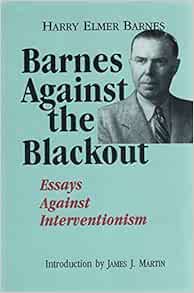
Barnes Against the Blackout, Part 2 of 2

2318 words

See Part 1 of my review of the essay collection Barnes Against the Blackout.

THE COLD WAR AND BEYOND

In his 1954 essay “The Chickens of the Interventionist Liberals Have Come Home to Roost,” Harry Elmer Barnes introduces the idea of the “totalitarian liberal.” Such men (as exemplified by Arthur Schlessinger Jr.) distinguished themselves from pre-World-War-II liberals in their lust for power and abandonment of principled anti-interventionism. Such men make up James Burnham’s managerial elite as described in his 1941 work The Managerial Revolution, which Barnes discusses. Such people reject “the coexistence of conflicting political and economic systems,” and in so doing promote a “we or they psychosis” which enables elites to wage war in the name of “collective security,” a notion which Barnes finds utterly spurious. This is how it was during World War II and it was no different during the Cold War, according to Barnes, except that both sides were mutually deterred by nuclear weapons.

Barnes further extends revisionism into the Cold War in his 1958 essay “Revisionism and the Promotion of Peace.” He remembers how despite standing against World-War-II intervention, patriotic political organizations like America First later fell in line with Cold War intervention “because of the business advantages in industry, trade and finance which an extravagant armament program provided.” President Eisenhower’s “military industrial complex,” in other words. In light of this, Barnes’ passionate belief in the critical importance of revisionism becomes crystal clear. If standing against intervention in 1939 could have spared tens of millions of lives, standing against it during the Cold War could spare humanity a nuclear Armageddon. Indeed, the specter of World War III haunts much of Barnes Against the Blackout.

The final essay in the collection, “How ‘Nineteen Eighty-Four’ Trends Threaten American Peace, Freedom, and Prosperity” takes the Cold War comparison even further. The “we or they psychosis” becomes the “war psychology,” which led to the absurdity of “perpetual war through perpetual peace.” This is straight out of Orwell’s 1984, which Barnes calls “the keenest and most penetrating work produced in this generation on the current trends in national policy and world affairs.” In the novel, Big Brother (whom Barnes considers a totalitarian liberal) manufactures phony outrages to prolong phony wars designed ultimately to consolidate very real power for himself and the elite classes. And the masses are either hypnotized enough by propaganda, intimidated enough by government, or distracted enough by entertainment to go along with it. Meanwhile, all reliable historical material is destroyed to disconnect the people from their past—just like what the Blackout Boys tried to do with revisionist accounts of World War II. Barnes sees 1984 as a direct mirror to reality.

And there is much truth to this, as shown by how Barnes uses his “Orwell Formula” to predict the Vietnam War as early as 1952:

The declining public interest in the Korean War has made President Truman and his associates the more willing to accept Churchill’s proposal to shift the main psychological impact of the cold war to Indochina, where it may both revive flagging American fear and excitement and also more directly protect adjacent British interests. The Orwell formula has been faithfully worked out in first directing fear and hatred against Nazi Germany, then against Soviet Russia, next shifting antagonism more toward Communist China, and then moving the chief center of interest in the struggle against the latter from Korea to Indochina.

Despite the clarity and prescience of this essay, Barnes makes a few questionable calls. In keeping with his aversion to the Orwellian doublethink of Cold War psychology and hysteria, he impugns the Truman Doctrine as a sham meant to “rehabilitate Mr. Truman’s fast-fading political prospects.” He also paints the USSR in a more benign light than it deserves—as if the United States were the aggressor during the Cold War and had no legitimate reason to employ deterrence or containment strategies against Communism. And in 1952, perhaps the Soviets did seem to some as unlikely to pose a real threat to American interests. But this was before they detonated their first hydrogen bomb in 1953. This was before their invasion of Hungary, and the Berlin Wall, and the Cuban Missile Crisis, and a host of other threatening actions. While Barnes makes excellent points about the injustice of blacking out revisionism, this was nothing compared to the psychological warfare the Soviets waged for decades against its own people which culminated in the terror famines, the Great Terror, and the gulags.

It seems that the Soviet Union during the Cold War made for a much more appropriate nemesis than did Nazi Germany. That Barnes seems to disagree, however, is not my bone of contention here. For all I know, Barnes is correct. However, the time he should have spent dispensing with counterarguments from seasoned cold warriors like George Kennan (who barely gets a mention in Barnes Against the Blackout) was instead spent admiring the life-imitating-art impact of 1984. Interesting and enlightening for sure, but hardly the final word on the subject.

THE JEWS

Direct treatment of the Jews in Barnes Against the Blackout rarely rises above incidental. Many of the “court historians” and “Blackout Boys” Barnes mentions do happen to be Jewish—Herbert Feis, Max Lerner, and Selig Adler are some obvious examples. However, just as many if not more are gentiles, such as William Langer, Samuel Eliot Morison, and Samuel Flagg Bemis. In his essays, Barnes never singles a person out as being Jewish. This certainly protects him from the charge of Jew-baiting, but it also prevents him from drawing conclusions from the fact that while a substantial proportion of anti-revisionists were Jews, none of the nine major revisionists mentioned in Part 1 were—clearly a meaningful data point.

When he does mention American Jews directly, it’s only to let them off the hook for pushing Roosevelt into war. In 1962’s “Blasting the Historical Blackout,” he states flatly that:

Roosevelt did not need any pressure from the Jews to create his interventionism and war policy. There is little evidence that he was deeply disturbed by Hitler’s anti-Jewish policy; he was much more annoyed by the fact that Hitler’s “New Deal” had succeeded in spectacular fashion while his own had failed to bring prosperity to the United States.

Maybe this is true, but it does not mean that influential Jews in media, finance, academia, and politics were not enthusiastic if not crucial facilitators of Roosevelt’s war policy. In his 2013 work How the Jews Defeated Hitler Benjamin Ginsburg describes how American Jews professed fierce loyalty to Roosevelt and did what they could to embroil the United States in a war with Germany. As I stated in my review:

Ginsburg describes how Jews in the private sector also war mongered during this time. The heavily Jewish Century Group called for a declaration of war against Germany following the surrender of France in 1940. The press also aided Jewish belligerence through its pro-Jewish bias. For example, when Lindbergh and the Century Group’s General John Pershing were giving speeches around the same time, the Jewish-owned New York Times gave Pershing front-page coverage and relegated Lindbergh to the back pages.

The Fight For Freedom Committee was more “all out” in its pro-war activities than the Century Group.

The FFF organized a nationwide effort –with the tacit support of the White House and the behind-the-scenes support of the British Embassy—to discredit isolationists and to mobilize public opinion against Germany and in support of American participation in the war.

And by “discredit,” of course, Ginsburg means ruthlessly slander and smear. The FFF thought nothing of labeling leading isolationists and America-Firsters like Lindbergh as Nazis, fascists, or dupes of the Axis. Ironically, they would often question the patriotism of such people as a form of intimidation which preceded the McCarthy era by over a decade. For example, because Senator Burton Wheeler wished to prevent the slaughter of American lives in an unnecessary war, the FFF declared that he was a “twentieth century Benedict Arnold.” The FFF also spied upon and collected compromising information on isolationists in Congress, such as Hamilton Fish. As it turned out, the FFF discovered that Fish’s people were distributing pro-German literature and were in contact with German agents. One of Fish’s secretaries went to prison for that. At the same time, however, Ginsburg informs us that the FFF was in constant contact with British agents. Just as insidiously, the FFF and other groups planted moles at isolationist rallies in order to disrupt them.

So perhaps President Roosevelt didn’t need Jews to change his mind, but he certainly needed them to change the minds of the millions of Americans he tried to deceive. Unfortunately, Barnes entirely avoids this point. His minimal treatment of the Jewish Holocaust in Barnes Versus the Black also deserves comment. He exerts almost no effort in placing it within his blackout vs. revisionists framework. Instead, he brushes it aside by saying that the Germans ultimately suffered more than the Jews did. He’s also skeptical that the Jewish Holocaust was the enormous atrocity it was purported to be:

There is little in the history of mankind more horrible than the sufferings of the Germans expelled from their eastern provinces, the Sudeten area, and other regions, some four to six millions perishing from butchery, starvation, exposure, and disease in the process. Their sufferings were obviously far more hideous and prolonged than those of the Jews said to have been exterminated in great numbers by the Nazis. The tragedy of Lidice was re-enacted by the Czechs hundreds of times at the expense of the Sudeten Germans during the expulsion. The Morgenthau Plan, which was inspired by Stalin and his associates and passed on to Henry Morgenthau by Harry Dexter White and other Soviet sympathizers, envisaged the starvation of between twenty and thirty million Germans in the process of turning Germany into a purely agricultural and pastoral nation.

Barnes never voices any support or approval of Adolf Hitler. He admits the man was at times cruel and erratic; then again so were Churchill and Roosevelt. As far as honest statesmanship goes, however, Hitler was actually on a higher plane than any of the Allied leaders. This is a demonstrable fact, one that is borne out by the diplomatic history of the 1930s as revealed by Hoggan. One does not have to love or even like Hitler to see that of all the major world leaders of the time, he was the least responsible for war. Barnes also refuses to demonize Hitler, and actually gives space for arguments claiming that Hitler had been too soft while conducting the war. To Hitler haters, this may sound like apologism, but it really isn’t. In “Blasting the Historical Blackout” Barnes dismisses Hitler’s Jewish policy as “folly” and correctly notes that it was this, rather than any foreign policy, which engendered anti-German hatred in Allied countries. He also recalls proudly how Rabbi Stephen Wise—the rabid, Hitler-hating Jew who led the worldwide Jewish boycott against Nazi Germany—once reprinted articles by him decrying Hitler’s anti-Semitism. Barnes even states that for a decade after 1945—which is smack dab in the middle of the Barnes Against the Blackout timeline—he had wished that Hitler had been assassinated in 1938 or early 1939, which would have avoided the catastrophe of a second world war.

In light of this, it cannot be said that within the pages of Barnes Against the Blackout Harry Elmer Barnes is anti-Semitic. He’s not philo-Semitic either. Instead, like any true historian, he’s anti-Falsehood and pro-Truth. Of course, he may be right or wrong, but never does he relinquish the discipline and objectivity required of great historians to keep civilization tethered to its past so it cannot go astray in its future.

CONCLUSION

There are many minor themes running through Barnes Against the Blackout which contribute to its value. Most notable is the topic of World War I revisionism, for which Barnes was an outright champion. His 1926 work Genesis of World War made him famous in this regard. Barnes often compares and contrasts revisionism from both World Wars and demonstrates how suppression and groupthink after the latter was much more insidious and comprehensive. He also offers examples of revisionism going back to antiquity.

Like Orwell, Barnes likes to invent neologisms and slogans. My favorites are “perpetual war for perpetual peace,” “globaloney,” the “Blackout Boys,” and the “Smearbund.” His 1962 essay “Revisionism and Brainwashing” is especially poignant in its descriptions of how modern Germans had been brainwashed into accepting their own culpability and shame. Some of the most ardent anti-revisionists of Barnes’ day were post-war Germans themselves, whom, Barnes suspects, feared the equivalent of a third Punic War. Barnes also drops historical Easter eggs everywhere. Did you know that the Roman theologian Paulus Orosius smeared the ancient pagans just as outrageously as court historian Herbert Feis smeared the Japanese? Or how about how Renaissance Scholar Lorenzo Valla proved that the 4th-century Donation of Constantine decree, which solidified the secular power of the Pope, was in fact an 8th-century forgery? It took Europe 350 years to come around to this fact. Barnes hopes it won’t take Europeans nearly as long to come around to the forged history of World War II.

If Harry Elmer Barnes has any personal bias in Barnes Against the Blackout it’s one that favors peace and an honest accounting of history. Because the so-called leaders of the free world gave us neither in the 1930s and 1940s, tens of millions needlessly perished. And with globalist liberalism still supreme today, being the root cause for mass third-world immigration into America and Europe, we continue to suffer from the effects of the catastrophe of World War II. Barnes himself said it best: “Revisionism is not only the major issue in the field of historical writing today but also the supreme moral and intellectual concern of our era.”

Barnes Against the Blackout, Part 1 of 2

2424 words 

“In short, there is no unique or special case against Nazi barbarism and horrors unless one assumes that it is far more wicked to exterminate Jews than to massacre Gentiles. While this latter value judgment appears to have become rather generally accepted in the Western world since 1945, I am personally still quaint enough to hold it to be reprehensible to exterminate either Jews or Gentiles.”

—Harry Elmer Barnes

INTRODUCTION

Anyone still questioning the relevance of World War II revisionism to politics today should realize how often our liberal, globalist elites not only invoke World War II, but also ignore, suppress, or besmirch revisionism. Whenever a mainstream personality invites a revisionist on his program, he gets swiftly rebuked and called a Nazi not only by the Left but also by people presumably on the Right. Recently, Jewish commentator Mark Levin invoked the massacre of German civilians during World War II to justify the ethnic cleansing of Gaza. Clearly, whenever someone questions the authority of our liberal elites, they fire back with World War II. Since Adolf Hitler and the Nazis represent the most extreme form of evil and since globalist liberalism is the ideological opposite of Nazism, any form of oppression and aggression by globalist liberals is justifiable—as long as it is aimed against so-called “Nazis.” And if you happen to be against liberalism or globalism these days, it’s only a matter of time before you get dubbed a “Nazi.”

Historian Harry Elmer Barnes understood this perfectly over seventy years ago and promoted revisionism in the face of eerily similar oppression and backlash. Nine of his most incisive essays on the topic—written between 1951 and 1962—are collected in Barnes Against the Blackout, which was published by the Institute for Historical Review in 1991. Several important themes run through these essays. First, Barnes wishes to proselytize revisionism, and does so by constantly referencing  and summarizing the great American works of revisionism of his day. These include:

Given the suffocating interventionist hysteria of the time, major publishers declined to publish these volumes despite how many of them had been written by prominent, well-respected historians. Either the publishers were ardent interventionists themselves, or they feared backlash from anti-revisionists who wielded great power in America, just as they do today. Except for the Neilson volumes, which were self-published, these works found only two small publishing houses brave enough to publish them: Regnery and Devin-Adair.
Two later volumes which Barnes discusses often are The Origins of the Second World War (1961) by AJP Taylor and The Forced War (1961) by David Hoggan. (See part one of my three-part review of Hoggan here.) These prove to be slight exceptions to Barnes’ America-centric approach since Taylor was British, and, although Hoggan was American, his work was only available in German at the time.

Another crucial theme running through Barnes Against the Blackout is the presentation of the evidence for revisionism. How do we know the official war narratives are less correct than what the revisionists offer? Barnes is never shy about sharing this information—and there is a lot of it. As with many essay collections from a single author about a single topic, there’s much overlap. And that’s okay. It’s never too much of a good thing revealing how President Franklin Delano Roosevelt “lied the United States into war.”

Describing exactly how the establishment suppressed revisionism in Barnes’ day emerges as another important theme. Barnes focuses on it most in his first two essays, both published in 1953: “Revisionism and the Historical Blackout” (which also serves as the first chapter in his collection Perpetual War for Perpetual Peace from the same year) and “The Court Historians Versus Revisionism.”

Barnes’ final theme is also his most speculative: extending revisionism into the Cold War and postulating how it might avert a nuclear Armageddon. Here is where we find Barnes at his most stunningly prescient but also were he winds up, in spots, to be somewhat dated. Through it all, he utilizes George Orwell’s 1984, which never fails to produce a parallel for whatever point Barnes wishes to make. He explores this novel’s uncanny mirroring of reality in the book’s final essay, 1952’s “How ‘Nineteen Eighty-Four’ Trends Threaten American Peace, Freedom, and Prosperity.”

Barnes Against the Blackout is also interesting for it seemingly negligible treatment of the Jews. Barnes says very little about them directly. However, this amounts to what I call an anti-theme because any reader familiar with Jewish power and supremacy can fill in the blanks where Barnes could have opined about the Jews, but didn’t—or at least didn’t seem to. This adds an extra layer of meaning to Barnes Against the Blackout.

THE EVIDENCE

The evidence for World War II revisionism which Barnes compiles appears in two distinct yet related branches of history: Pearl Harbor revisionism and Western European revisionism. For the former, he relies greatly on Tansill, Sanborn, and Morgenstern, and demonstrates how the U.S. not only goaded the Japanese into attacking as a “back door to war” against Japan’s ally Nazi Germany, but also knew where the attack would occur and approximately when, thereby outraging the American public into supporting military intervention. Barnes believes this “constituted one of the major public crimes of human history.”

The major facts line up as so:

  • Roosevelt floated war with the Japanese as early as 1933 during one of his first cabinet meetings.
  • The U.S. aided and encouraged Chiang Kai Shek to fight against the Japanese in China during the 1930s.
  • Days before the Pearl Harbor attack, Roosevelt ignored Japanese Prince Fumimaro Konoye’s peace overtures which proposed humiliating concessions for Japan in return for “a little time and a face-saving formula.”
  • In early 1941 Ambassador Joseph Grew had clearly warned that Pearl Harbor would be the likeliest point of attack. Despite agreements from Washington, US forces at Pearl Harbor remained unprepared for it.
  • Secretary of War Henry Stimson stated on November 25, 1941 that, “the question was how we should maneuver them [the Japanese] into the position of firing the first shot without too much danger to ourselves.”
  • The US had intercepted the “East Wind Rain” message three days before the attack, which clearly signaled Japanese intentions. Yet Admiral Husband Kimmel and Lieutenant General Walter Short, who were responsible for Pearl Harbor, were kept in the dark about it.

Barnes presents most of this information while piercing holes in the specious logic of pro-interventionist works written by what he calls “court historians.” The two most relevant to Pearl Harbor are Herbert Feis, who wrote The Road to Pearl Harbor (1950), and Basil Rouch, who wrote Roosevelt from Munich to Pearl Harbor (1950). Barnes demonstrates how these historians either ignored, distorted, or misconstrued the above evidence. His point is clear: if the notions of Pearl Harbor being a surprise attack and Roosevelt’s naïve innocence about it were lies, there’s no telling what other lies had been told. It turns out there were many.

As for Western Europe, the facts are equally damning, if perhaps more voluminous. All of them cannot be included a single review, but the points Barnes most often bangs home include:

  • The diplomatic history of the 1930s, as collected by Taylor and Hoggan, shows that Adolf Hitler did not want war and did what he could to avoid it.
  • The diplomatic history also reveals that Hitler had made reasonable requests to Poland regarding the “international” (yet very German) city of Danzig; yet Polish leaders refused to negotiate at the urging of Lord Halifax in England who had given Poland a “blank check” assurance of English military support against Germany.
  • In his last report as Chief of Staff in 1945, General George Marshall had claimed that Hitler “far from having any plan of world domination, did not even have any well-worked-out plan for collaborating with his Axis allies in limited wars, to say nothing of the gigantic task of conquering Russia.”
  • Hitler had allowed tens of thousands of British troops to escape at Dunkirk “to promote peace sentiments in Britain.”
  • Hitler had excellent reasons to invade the Soviet Union since the Soviets had “practiced sabotage, terrorism, and espionage against Germany, had resisted German attempts to establish a stable order in Europe, had conspired with Great Britain in the Balkans, and had menaced the Third Reich with troop concentrations.”
  • Documentary evidence, such as “The German White Paper” found by the Germans after their conquest of Poland, demonstrates the extent to which American ambassador William Bullitt had assured Poland of American military support in the event of war with Germany. This was corroborated by Czechoslovak president Eduard Benés who claimed in his autobiography that on May 29th, 1939 Roosevelt himself had assured him that if war broke out in Europe, America would join the fight against Germany.
  • The Lend-Lease program, the “Destroyer Deal” between Britain and the United States, the secret Tyler Kent documents, and Roosevelt’s 1941 meeting with Winston Churchill in Newfoundland offer circumstantial evidence that Roosevelt had clear belligerent intentions well before war was declared.

As with Pearl Harbor, Barnes often presents this evidence while reviewing books written by court historians. The most prominent of these is The Struggle Against Isolation, 1937–1940 (1952) by William Langer and SE Gleason. Despite never proclaiming Hitler’s innocence, Barnes repeatedly stresses that the man’s sole responsibility for starting the war is a complete falsehood—a falsehood which is the foundation of all post-1945 politics. In his 1962 essay “Revisionism and Brainwashing,” he states with characteristic flourish:

It is unlikely that there has been any vested interest in dogma, opinion, and politics since the birth, death, and resurrection of Jesus Christ equal in intensity to that built up around the allegation that Hitler was solely responsible for the outbreak of war in 1939.

One interesting side note: Barnes implies more than once that it was Hitler’s actions in East Asia rather than Europe which truly antagonized Roosevelt. This contradicts some of Barnes’ other claims about Roosevelt’s opposition to Hitler vis-à-vis Europe. Take, for example, this paragraph from the essay “Rauch on Roosevelt”:

Indeed, it was only in 1938, when Hitler recalled his military mission from China, where Nazi officers had been directing the forces of Chiang Kai-shek against the Japanese, that Roosevelt became actually hostile to Hitler in his policies, whatever the previous rhetoric. Right down through the Spanish Civil War, Mr. Roosevelt condoned when he did not favor, most of Hitler’s policies. Even as late as August, 1939, it appears from the Nazi Soviet Relations that Roosevelt was inclined to put nothing in the way of Hitler if he abandoned support of Japan, sent his military back to help Chiang, and delivered arms to the Chinese.

This is an interesting conundrum considering that Barnes brings up Benés’ recollection from May 1939 in the same essay.

THE BLACKOUT

Barnes spills a lot of ink outlining the ways in which revisionism was suppressed and marginalized after 1945. This often resulted from mainstream historians either having vested professional interests in perpetuating the “good war” myth of World War II—since they themselves promoted it while it was happening—or they sought the wealth, fame, and opportunity afforded to academics who adhered to the official narrative of the war.

In “Revisionism and the Historical Blackout” Barnes enumerates the following methods of suppression:

  1. Excluding revisionists from official documents, while allowing state-approved court historians free access to them

Barnes describes how revisionist historians had been barred from viewing many sensitive documents and in some case had had their own notes confiscated after viewing the ones they were allowed to see. Barnes concedes that Charles Tansill did ultimately view more documents than other revisionists, but Tansill did not enjoy the free reign of information afforded to court historians like Langer and Feis.

  1. Intimidating publishers into not publishing revisionism

Barnes describes how political pressure groups not only ensured that revisionist volumes would not sell, but made it clear that publishers releasing such material would face business-crippling backlash. Barnes recalls how a major publisher explained this to him despite his personal sympathies towards revisionism. Libraries, book clubs, and nationwide periodicals also contributed to this blackout. Barnes mordantly notes that the post-1945 “Blackout Boys” outdid the Nazis in suppressing honest intellectual inquiry.

  1. Ignoring revisionist works that do get published

Barnes demonstrates how the majority of revisionist works simply did not get reviewed in important mainstream publications—or when they did, as with the case of Charles Beard, they received either cursory attention or were maliciously panned. It almost goes without saying that this silent treatment was not afforded to court historians, whose works received ample praise everywhere. Barnes relays the following recollection from journalist Oswald Garrison Villard to illustrate his point:

I myself rang up a magazine which some months previously had asked me to review a book for them and asked if they would accept another review from me. The answer was, “Yes, of course. What book had you in mind?” I replied, “Morgenstern’s Pearl Harbor.

“Oh, that’s that new book attacking F.D.R. and the war, isn’t it?”

“Yes.”

“Well, how do you stand on it?”

“I believe, since his book is based on the records of the Pearl Harbor inquiry, he is right.”

“Oh, we don’t handle books of that type. It is against our policy.”

  1. Smearing revisionists personally

Barnes offers several examples of ad hominem attacks upon revisionist historians by the “Smearbund,” as he calls them. Often “isolationism” itself became a slur, as if labeling a person thusly were reason enough to dismiss him. More often, however, reviewers would attempt to ruin a revisionist’s reputation by imputing some evil or underhanded motive rather than argue the facts. Barnes notes how reviewers used phrases such as “bitterly partisan” or “blind anger” when describing Morgenstern while ignoring their own partisan anger. He also notes how one reviewer attempted to discredit Beard because he was hard of hearing and lived on a farm. One reviewer freely admitted to lambasting The Forced War without having read a word of it.

To be concluded in Part 2.

James Edwards interviews Jack Antonio

Below is an interview conducted by talk radio host James Edwards with Jack Antonio*, a professional actor who has appeared in film, television, and theater for over 50 years.

James Edwards: What is it like working with A-list celebrities while having traditional beliefs and not being ashamed of being a White man? Take us behind the scenes, so to speak.

Jack Antonio: On film, TV, and commercial sets, there is very little time to socialize. The producers want to get the A-listers finished and off set ASAP because they are so expensive. I’ve had friendly disagreements about politics with major stars a few times. I did have a very loud argument on set with an obnoxious star who was praising BLM and Antifa during the Summer of Floyd. The Assistant Director intervened and called for an early lunch break. The star and I avoided each other for the rest of the shoot. In theatre, you are around each other much more during rehearsal and then during what you hope will be a long run. I had a very loud disagreement with a star during the 2nd Iraq War. He supported Tony Blair. The rest of the company was with me, so I had back-up.

Edwards: How have you been able to work continuously for so long? And do more actors share your concerns than the media would let on?

Antonio: I’ve always hustled for work and sharpened and expanded my talents. I’m known to be versatile, pleasant, and professional. I can also learn lines and moves very quickly. I give directors what they want in one take. Many actors, alas, are stupid and lazy. I can’t say that there are legions of unabashed pro-White actors out there. But there is a significant minority who are at least Right-lite. I will often test the water in the dressing room or rehearsal hall with a politically incorrect quip and will catch knowing, approving looks from some of the cast. Many White actors’ eyes are being opened by the obvious hypocrisy of supposedly “color blind” casting. That is, blacks can play White roles but not vice versa. Black lesbians get to play King Lear, but I can’t play Harriet Tubman. How come?

Edwards: You have been an actor working for more than fifty years at the top level of international show business. What have been the biggest changes you have seen in that time?

Antonio: White actors have been marginalized and even erased from the very industry and culture we created. Since the end of WWII, there has been an organized strategy to replace us in plays, films, sitcoms, commercials, computer games, and even cartoons. At last, Whites are daring to protest the number of non-White faces they see on their screens and stages. In fact, in the UK, there was a recent unbiased study that showed how ridiculously disproportionate the number of non-Whites in commercials is to their actual number in the UK population.

Edwards: How did this happen?

Antonio: The Cultural Marxists targeted the arts in the 1930s. They infiltrated the performing and fine art schools and indoctrinated the White students to hasten and even accept their replacement. I saw productions of Romeo and Juliet in the early 1960s with a White Juliet and a black Romeo. The Marxists, who were overwhelmingly Jewish, slimed into publishing, advertising, and academia. I have consistently encountered this while working on productions around the world.

Edwards: How does it work in advertising?

Antonio: When liberals say it is a coincidence that there are so many non-Whites in the ads, they are just plain stupid. I have starred in commercials for top brands worldwide. I have seen clients, directors, and designers almost come to blows over the color of my necktie. Are you telling me that they don’t agonize over the color of the family in their ads? That they don’t deliberately place black men with White women? Nonsense. The word has come down from, I believe, even above corporate headquarters to push the anti-White race-mixing agenda. I can’t tell you exactly who tells General Mills or Ford to get in line, “or else,” but it is a powerful hidden hand.


Edwards: You lived in England for many years. Is it the same there?

Antonio: It’s worse. Many Americans think Britain is just like Downton Abbey. It ain’t. Many of the major cities in the UK are now governed by Muslim mayors. (We just lost New York.) In fact, the town of Rotherham, the epicenter of the Pakistani rape gangs who preyed upon vulnerable White girls, now has a female Muslim mayor who can barely speak English! The United Kingdom has been betrayed by the Royal Family, its government, and the BBC. King Charles kisses so much Muslim butt I’m amazed he can stand up straight. When not blatantly lying about Trump, the BBC churns out historical dramas in which Anne Boleyn is black, the Vikings look like The Jackson 5, and the British army on D-Day looks like the Harlem Globetrotters. Meanwhile, the Labour Party, under the war criminal Tony Blair, created an English version of our disastrous 1965 Immigration Reform Act. Blair flooded the UK with non-White immigrants. That outrage was managed by the Jewish minister Barbara Roche just as ours was managed by Javits and Celler in New York.

Edwards: What is another change you’ve seen in the performing arts?

Antonio: All of the arts in the US and UK have been feminized.  Just as I watched Brits become obese in my thirty years there (thanks to American fast food) I watched their culture become degenerate and deballed. Everything has become cute and girly. This is because on both sides of the Atlantic, girls rule the roost.  I was shocked when I returned to America to find a country ruled by humorless, censorious harridans. Many of them are embittered childless scolds determined to take their misery out on everyone, especially men. They are the Cat Ladies that J.D. Vance quite rightly ridiculed.

Edwards: Where did they come from?

Antonio: I trace them to the social reformers of the early 19th century who harangued men about marriage, money, and meat. Then came Harriet Beecher Stowe, whose preposterous, sentimental novel, Uncle Tom’s Cabin, was a major force leading to the War of Northern Aggression. Then came the suffragettes. (I hope we can agree that giving women the vote has been an unmitigated disaster.)  Then we had the singularly unpleasant Margaret Sanger of Planned Parenthood. Maggie managed to kill several of her children by neglect, which is a novel form of birth control, to say the least. Next came Eleanor Roosevelt, who was a loudmouth witch who practically ruled the country for ten years while the crippled FDR hid and convalesced. And, finally, the decidedly Jewish Second Stage Feminism of the Sixties gave birth to our current crop of miserable, blue-haired, pierced, tattooed, faux-females called Cat Ladies.

They run just about any cultural or civic organization you can name, from choirs and book clubs to police and fire departments. In fact, they run cities and states. We just had two more elected governor!  And their unfulfilled nurturing instincts have taken a perverted turn. With no children to care for, they adopt blacks, homosexuals, transexuals, pedophiles (I’m not kidding!), and, of course, cats. Lots and lots of cats. You can spot these psycho-sexual misfits running around with their pink hair on fire at any protest de jour.

Edwards: Where are the men?

Antonio: Well, you should ask. Many are so tired of being harangued and belittled that they have abandoned ship and become incels. Young men have been bombarded with anti-male propaganda and poisoned by chemicals since birth. Their t-count is tragically low. Many are saddled with mommies who have serious male issues and take those out on junior. Take note of how often it is mommy who pushes for Sonny Boy to be castrated. There has always been a Battle of the Sexes, but heretofore it has been a healthy jousting before bed. Now it is an ugly, hateful suicide pact.

Edwards: You paint a grim picture. Is there hope?

 Antonio: There is. Thanks to Mother Nature. Note that men have retreated to video games in which they can pretend to be warriors and superheroes. Note that women have made romance novels and rom-com movies the most popular genres. The natural desire for normal sexual relations can never be completely extinguished. If we can find a way to rekindle our generative spark, nature will take care of the rest. You may think I’ve been watching too many rom-coms myself. But the awful truth is that we either rediscover the Adam and Eve in our kind and heal this rift between men and women, or we perish.

 Edwards: Final thoughts?

Antonio: The America I left in 1990 was not full of autism. I know the diagnosis of autism has been broadened, but that is a separate issue. I tell you that when I returned to America thirty years later, I was shocked by how many people were “on the spectrum.” I’m not a doctor or scientist, but I sense that a combination of factors, such as arsenic added to vaccines to extend their shelf life and increase profits, combined with chemicals in the air, food, and water, has poisoned us. And this may be partly responsible for our current sexual malaise. Somehow, someway, someone has stolen our mojo. We gotta get it back!

*Jack Antonio is the pen name of a working actor who is currently starring in a stage production. He is the author of Boy Outa Brooklyn – a murder memoir. It is available on Amazon as a paperback and e-book, as well as from all major e-book distributors. Or visit Jack’s blog at https://boyoutabrooklyn.com/blog/

This article was originally published by American Free Press – America’s last real newspaper! Click here to subscribe today or call 1-888-699-NEWS.

The Mechanics of the Antisemitic Cycle: Pronatalism from Genesis to The Redemption

In Bullets

  • A family, tribe, or clan of pastoralists must adopt pronatalism to father enough sons to drive their rapidly reproducing flocks and herds before them.
  • When rapidly growing pronatal families, tribes, and clans are in proximity they soon begin to quarrel over available pasture. Persistent quarreling leads to armed conflict, so they must fission or fight. Abraham and Lot, and later Jacob and Esau, choose to fission rather than fight over pasture in two fission or fight events described in the book of Genesis.
  • Genesis 13:6-9 “The land could not support them both together; for their livestock were so numerous that they could not settle in the same district and there were quarrels between Abram’s herdsmen and Lot’s. Abram said, ‘Let there be no quarrel between us… let us part company.’”
  • Genesis 36:6-7 Esau took his wives and sons and daughters and everyone in his household, his herds, his cattle, and all the chattels he had acquired in Canaan and went to the district of Seir out of the way of his brother Jacob, because they had so much stock that they could not live together; the land where they were staying could not support them because of their herds.
  • The Biblical author culminates Genesis’ Darwinian threads regarding pronatalism (too many) and eugenics (too strong i.e., too smart) in the first few lines of the book of Exodus:

Exodus 1:7-10 “Now the Israelites were fruitful and prolific; they increased in numbers and became very powerful, so that the country was overrun by them. Then a new pharaoh ascended the throne of Egypt, one who knew nothing of Joseph. He said to his people, “These Israelites have become too many and too strong for us…”

The Pharaoh’s remark identifies the first significant instance of the “antisemitic” cycle:

  • the Abrahamic covenant that generates the cycle (too many) and
  • the Jacobian selection for intelligence that directs the cycle (too strong).
  • Consider the allegorical layers of the Genesis text in which shepherds and their flocks and herds (the surface layer) represent Orthodox Jewish communities in Diaspora (the concealed layer). “He [God] took Abram outside and said, ‘Look up into the sky, and count the stars if you can. So many,’ he said, ‘shall your descendants be.’”[1] In the wake of God’s promise, Abraham and his descendants will endeavor to have as many children as they can. An Orthodox Jewish community practicing Abrahamic pronatalism in Diaspora “sows over”[2] the educated classes of its colonized host with many, smart babies[3] who will compete directly with the host’s educated classes as they grow to maturity. In adulthood they will rise to the top of the socioeconomic hierarchies of the host’s indigenous populations and appropriate their broadest niches.[4] Ensconced in a host’s broadest niches, they will disperse the host’s homogenous population among diverse groups of foreigners until the host is incapable of preserving its group identity.[5] The genetically gifted Jewish colonizers effectively “become” the indigenous educated classes of the colonized host. Resistance to the niche seizure is often mislabeled “antisemitism.”
  • Orthodox Jewish communities fission rather than fight one another. They spread out over the earth in an ever-expanding matrix that will eventually cover the globe with its capitol in Jerusalem. The matrix is connected by intermarriage arranged by shadkhan (matchmakers) who ensure Orthodox Jewry’s far-flung communities forever remain a cohesive global network. The practice of pronatalism that generates the fission or fight cycle will necessarily culminate in an apocalypse and an eschatology once the competition has:
    • assumed global dimensions
    • surviving pronatalists have run out of niche space to seize and
    • the option of fissioning (i.e., parting amicably) is no longer available.
    • From Google: “While the root meaning of ‘apocalypse’ is about seeing and understanding something [revealed that was formerly hidden], its popular usage has evolved to encompass the concept of a final often destructive event that brings about the end of the world as we know it.”
    • From Wikipedia: “Eschatology concerns expectations of the end of the present age, human history, or the world itself. The end of the world, the end times, is predicted by several world religions, which teach that negative world events will reach a climax.”
  • Central to this paper is the understanding that pronatalism is driving the world toward the very real and violent end of apocalypse and eschatology. The three “Abrahamic” faiths: Judaism, Christianity, and Islam, are so-called because they are all pronatal. Wherever these religions co-exist, their populations will grow rapidly and eventually generate the fission or fight cycle. Forced to compete with one another for dwindling niche space pronatal communities in conflict will seek the demographic decline of competing pronatal communities. For example, LGBT sexual ideology, a non-reproductive, anti-pronatal ideological weapon designed to be deployed against a pronatal competitor, has so enchanted Christians they’ve chosen to attend to their sexual proclivities rather than reproduce while Orthodox Judaism and Islam steadfastly maintain their ancient pronatal traditions. Emerging Islamic caliphates and rapidly growing Orthodox Jewish communities in Diaspora will continue to generate the fission or fight cycle due to their prolific growth within a colonized host nation’s borders.
  • Pronatal forces are driving the large population transfers of pronatal peoples of North Africa into Europe facilitated by the E.U.’s legislated Schengen Agreement.
  • Similar population transfers comprised of millions of unvetted foreigners entered the U.S.A. due to the dropping of its southern border during Joseph Biden’s traitorous presidential administration which dishonestly declared the border “secure.”
  • Below is a prophetic rendering of apocalypse and eschatology generated by the fission or fight cycle of pronatalism. In Gershom Scholem’s[6] treatment of the messianic idea in Kabbalism he describes the Redemption. Scholem writes: “The Zohar follows Talmudic Aggadah”[7] in seeing Redemption as “the gradual illumination of the world by the light of the Messiah.”[8]

“At the time when the Holy One, blessed be He, shall set Israel upright and bring them up out of Galut He will open to them a small and scant window of light, and then he will open another that is larger, until he will open to them the portals on high to the four directions of the universe. So shall it be with all that the Holy One, blessed be He, does for Israel and for the righteous among them, so shall it be and not at a single instant, for neither does healing come to a sick man at a single instant, but gradually until he is made strong. The Gentiles (who are designated Esau or Edom), however, will suffer the opposite fate. They received their light in this world at a single stroke, but it will depart from them gradually until Israel shall grow strong and destroy them.”[9]

  • The mechanics of the antisemitic cycle began with the pastoralist Abraham’s rapidly reproducing flocks and herds and will end in apocalypse and one world government.


[1] Genesis 15:5

[2] Diaspora: Greek, from diaspeirein ‘disperse’, from dia‘across’ + speirein ‘scatter’. The term originated in

the Septuagint (Deuteronomy 28:25) in the phrase esē diaspora en pasais basileias tēs gēs ‘thou shalt be a

dispersion in all kingdoms of the earth’. (From Google)

[3] For “smart babies,” see Richard Faussette, The Biblical Significance of Adam and Eve and Jacob and

Esau to appreciate Jacob’s preference for cunning Rachel over dull-eyed Leah, www.academia.edu

[4] Due to Jacobian selection for intelligence, see Richard Faussette, The Biblical Significance of Adam

and Eve and Jacob and Esau, www.Academia.edu

[5] See Richard Faussette, The Biblical Significance of the Tower of Babel, www.academia.edu

[6]   Gershom Scholem (an ardent Zionist) was appointed the first professor of Jewish mysticism at the

Hebrew University of Jerusalem.

[7]   Gershom Scholem, The Messianic Idea in Judaism and Other Essays on Jewish Spirituality, Schocken

Books 1971 page 39

[8]   Ibid., page 39

[9]  Ibid., pages 39-40

Richard Faussette, copyright © All Rights Reserved, 9/29/25, 10/8/25, 12/29/25 Words: 1,303

The Bari Weiss Playbook: How a Zionist Operative Conquered American Media

Long before she ran a newsroom, Bari Weiss was already running a campaign. The target was anyone she perceived as a threat to Israel. In the mid-2000s, at Columbia University, she helped found a student effort that marketed itself as a defense of Jewish students and Zionist speech in an environment she portrayed as hostile.

The controversy reached its zenith with the release of Columbia Unbecoming, a documentary created in collaboration with The David Project, which leveled accusations against Middle East Studies faculty for their alleged intimidation of students who expressed pro-Israel views. The film circulated online as video testimony that Jewish students were allegedly under threat on campus.

The counterattack naturally came quickly. Civil liberties advocates warned that encouraging students to monitor faculty for ideological infractions would chill speech and collapse academic freedom into factional policing. An online critique from the Columbia ecosystem framed the campaign as overreach and a template for future pressure tactics. Such concerns proved to be prescient, as Jewish students would keep tabs on Columbia professors and report them for anti-Zionist and antisemitic conduct after October 7, 2023. ​

That early fight showcased Weiss’s primordial instinct to go to the mat for her tribe. This did not come out of the blue. Weiss grew up in a politically engaged Jewish household in Pittsburgh, where her father Lou Weiss served on the National Council for AIPAC and frequently organized missions to Israel, profoundly shaping her early Zionist identity.

With unwavering devotion to Zionist principles, Weiss navigated the political landscape with a singular focus, her commitment to advancing Jewish interests remaining unshaken by the petty squabbles and transient allegiances of partisan politics. By the time she rose inside legacy media, she carried a worldview that opportunistically fused free speech rhetoric with strong stances on Israel and antisemitism.

Weiss’s ascent mirrored the classic trajectory of the modern mandarin class, ascending the rungs of the opinion-making apparatus that manufactures public consent. Her journey began in the trenches of reporting, leading to an editorial position at The Wall Street Journal. In that capacity, she gained the skills of gatekeeping and narrative framing, which she would continue to employ as she climbed up the media ladder.

In 2017, she landed at the New York Times opinion section after she believed that the WSJ took too hard of a pro-Trump stance. She described herself “as center left on most issues”, but the issue of Israel was non-negotiable for her, when push came to shove. Ultimately, her position at the Times did not hold. In July 2020, she announced her exit with a resignation letter that accused the institution of enforcing ideological conformity, tolerating internal bullying, and letting social media pressure shape editorial decisions.

While the letter publicly signaled her break with legacy liberalism, it was fundamentally an act of strategic repositioning. A deeper, more calculating motive propelled this departure: the dawning realization that the very media establishments she inhabited were losing their effectiveness as guardians of Jewish interests. Her subsequent career trajectory into new media ventures confirms this was not an ideological conversion, but a pragmatic pivot to more reliable channels of influence.

In 2021 she took matters into her own hands by launching a Substack newsletter called Common Sense, then rebranded it into The Free Press, positioning it as a supposed bastion for free speech. The Free Press outwardly curated a portfolio of anti-woke commentary on issues like gender ideology and campus radicalism. However, these topics served as a popular façade for the publication’s central, animating purpose: the advancement of Zionism. Weiss meticulously assembled a stable of contributors—including prominent voices like Douglas Murray, Niall Ferguson, Konstantin Kisin, and Eli Lake—whose primary alignment was a staunch defense of Israeli policy, making the outlet’s broader ideological commitment unmistakable.

Israel was the unwavering constant, serving not as a footnote but as the central organizing principle of her moral worldview. She treated anti-Zionism as a mask for antisemitism and made that position central to her public identity, a framework reflected in discussion around her book and its reception. Her 2019 book How to Fight Anti Semitism became the manifesto version of the same argument.

The 2018 mass shooting at Pittsburgh’s Tree of Life synagogue, in which Robert Bowers murdered eleven Jewish congregants, threw Weiss’s propensity for targeting the hard Right into stark relief. The atrocity held profound personal significance for her, as the synagogue was the site of her Bat Mitzvah ceremony. Weiss pinpointed Bowers’ motive: his belief in organized Jewry’s outsized promotion of mass migration. She conceded this factual premise during an NPR interview, highlighting HIAS’s active role in facilitating refugee settlement, although it was much more than just HIAS—the entire organized Jewish community.

Weiss offered a trenchant analysis of the anti-Zionist left, warning that the climate of intolerance fostered by cancel culture posed a clear and present danger to American Jews—a concern that crystallized for her following the violence in Pittsburgh. She developed this argument while headlining a virtual event on June 6th dedicated to exploring the phenomenon of cancel culture through a specifically Jewish framework.

“I have felt more of a sense of alarm over the past few weeks now than I did in the aftermath of the attack on my synagogue,” said Weiss, referring to the 2021 Israel-Palestine confrontation. “Anti-Semitism,” she said, “has moved from the lunatic fringe firmly into the mainstream of American cultural life and into the halls of Congress.”

Weiss went mask off In October 2023, during the Israel-Hamas war, when her ethno-religious activism was on full display. Refaat Alareer, a professor and poet from Gaza, provoked outrage with a since-deleted tweet in which he jested about unverified claims that Hamas fighters had incinerated a Jewish baby in an oven, sarcastically asking, “with or without baking powder.” Weiss immediately pounced and quote-tweeted this post, highlighting it as an example of moral depravity. Alareer reported receiving death threats following Weiss’s post to her large following. He posted, “If I get killed by Israeli bombs or my family is harmed, I blame Bari Weiss and her likes,” arguing that her platforming of his tweet marked him as a target. The Israeli military would then kill Alareer, along with multiple members of his family, in a single, targeted airstrike on December 6. 2023.

The allegation from Alareer’s supporters was unequivocal: Weiss had committed stochastic terrorism. They argued she deliberately employed her massive reach to channel hostility and, by inevitable extension, the attention of military and intelligence agencies toward Alareer, a process that ended with his assassination.

Weiss’ fanatic commitment to her tribe was recognized by the likes of David Ellison—CEO of Skydance Media and the son of billionaire Oracle founder Larry Ellison. The younger Ellison had been considering how to revitalize CBS News even before the Paramount acquisition closed. Both David and Larry Ellison are described as “extremely fervent supporters of Israel,” with Larry being a “known Trump supporter” and David “at least suspected to be” pro-Trump as well.

Throughout summer 2025, as Skydance awaited regulatory approval for the Paramount merger, Ellison held discussions with Weiss about integrating The Free Press‘s editorial vision into CBS News. Democracy Now! reported that “Ellison has gotten very close with Bari Weiss”. CNN added that Ellison was “interested in infusing Weiss’s editorial perspective into CBS News.” The deal was eventually finalized in early October,  Paramount officially announced the acquisition of The Free Press in a deal valued at approximately $150 million in cash and Paramount shares, to be disbursed gradually and potentially varying based on Paramount’s stock performance.. Further,

Weiss was appointed editor-in-chief of CBS News—a newly created position.

In her position, Weiss reports directly to David Ellison, the CEO of Paramount Skydance, not through the normal CBS News chain of command. The Free Press maintains independent operations as a separate brand within Paramount. Weiss will collaborate with Tom Cibrowski, president of CBS News, though they occupy parallel rather than hierarchical positions.

A lifetime of dedicated advocacy for Zionist causes has yielded its intended dividends for Bari Weiss. Her trajectory demonstrates a remarkable consistency, guided unerringly by the twin lodestars of perceived Jewish safety and the legitimization of the Zionist endeavor. In the end, Bari Weiss’s career trajectory reveals a fundamental truth: she is not a journalist in any meaningful sense, but a zealous agent for Jewish tribal power, making her a conscious and effective enemy of the gentile civilization whose institutions she has so skillfully subverted.

Three Savage Jewish Communists

Introduction

In my last article (“Jewish Bolsheviks and Mass Murder: Rozalia Zemliachka and the Jews Responsible for the Bloodbath in Crimea, 1920”), I described a group of Communist Jews and the slaughter they perpetrated in the early years of Bolshevik rule in Russia. Over the thirty-five years that spanned the rule of Lenin and Stalin, there were hundreds of similar massacres, carried out by various delegations of Cheka-OGPU-NKVD officers (with significant Jewish representation or even outright leadership), operating in every region of the USSR. These massacres cry out for more attention, and I hope to write about more of them. In the meantime, however, I will describe three depraved Jewish executioners, each of them richly deserving infamy and execration: Mikhail Vikhman, Revekka Plastinina-Maizel, and Isai Berg. Vikhman was a leading Cheka commissar in Odessa and Crimea in 1919–1921, where he personally shot hundreds of victims, including some of the highest rank. (His later career features an exquisite irony.) Plastinina-Maizel was a Party official who barbarically murdered thousands in the Far North of Russia together with her consort, a mad Cheka official. She later enjoyed a career at the highest level of the Soviet judiciary, a fine commentary on the perversities of Soviet society. Berg, a leading NKVD official in Moscow and executioner in the Great Terror, already boasts some notoriety among anti-Communists because he pioneered the homicidal gas van, which was meant to help him in his regular job: organizing nearly twenty thousand executions at the Butovo killing grounds in 1937–1938. These three Jews alone are responsible for the death of over twenty thousand people, and their names should be at least as well-known as Eichmann or Mengele, and for better reasons.

MIKHAIL VIKHMAN

Mikhail Vikhman was born in 1888, in or near Astrakhan on the Caspian Sea. His father Moisey was a dealer in fish. Mikhail graduated from the Realschule in Astrakhan in 1907, then worked as an electrician until he was conscripted in 1912. He served in a sapper battalion,[1] fought in the World War, and won the St. George Cross (4th degree). When the Revolution came, he suddenly ascended to positions of power, initially chief of police in Tsaritsyn (Stalingrad).[2] By 1918 he had joined the Bolsheviks, become a Chekist, participated in suppressing a Cossack uprising, and, as commander of the 1st Red Partisan Regiment, fought in Ukraine against various anti-Bolshevik forces. In the spring of 1919, he became a leader of the Cheka in Odessa, the third-largest city in Ukraine. The erstwhile sapper corporal now had the power of life and death over nearly half a million people. (The city was heavily Jewish, and its Cheka was too.) Here he won fame, not as a wise administrator or promoter of the common good, but as a bloodthirsty mass murderer. Sergei Melgunov in The Red Terror in Russia tells us that Vikhman employed six executioners but “would go into the cells, and slaughter prisoners for his personal pleasure.”[3] In the summer of 1919 forty or fifty prisoners were shot every night, and former White officers were killed “by chaining them to planks and then pushing them very slowly into furnaces . . .”[4] One source states that Vikhman shot over 200 people during his time in Odessa, including the former police chief Baron Sergei Vasilyevich van der Hoeven (1865–1919) and the rector of the Novorossiysk University, Sergei Levashov.[5] Melgunov gives another story, sadly typical of the era:

. . . there is on record a case where, on the lid of a coffin slowly opening and emitting a cry of “My comrades, I am still alive!” a telephone message was sent to the Che-Ka, and elicited the reply, “Settle him with a brick,” whilst a further appeal to the head of the Che-Ka himself [Vikhman] called forth the jest: “We are to requisition the best surgeon in Odessa, I suppose?” and finally a Che-Ka employee had to be dispatched to the scene, to shoot the victim a second time with a revolver.[6]

Vikhman seems to have worked in Odessa through part of the year 1920, but in the spring of 1921 he became the chairman of the Crimean regional Cheka.[7] The Red Army had recently conquered Crimea, and Bolshevik forces under the leadership of two repulsive Jews, Bela Kun and Rozalia Zemliachka, had subjected the peninsula to a horrific scourging. Now Vikhman, another remorseless Jew, headed all Cheka forces in the peninsula, and the killing proceeded. Remnants of the White forces had taken to the hills to wage guerrilla warfare (as much to survive as to resist Communist rule) and Vikhman organized forces to wipe them out; captives were liquidated. The Communists judged many others deserving of death, and Vikhman lent his hand and his Mauser to the task. Among others, he shot the former Ukrainian ministers Alexander Ragoza and Komorny. Years later he stated that in Crimea he personally shot “many hundreds” of “enemies of Soviet power … the exact number of which is written on my combat Mauser and combat carbine.”[8]

But there was trouble: the Crimean Bolshevik Party Committee became upset with Vikhman’s haughty manner. They charged him with arresting Party members and defiance of Party authorities. He was removed from his position and sent to the Caucasus, where he worked in the Stavropol Provincial Cheka. By the end of 1921, however, the Party expelled him and cashiered him from the Cheka.[9] It was the end of the first phase of his career.

Vikhman returned to Odessa and worked in the administration of the city tram network, quite the fall for the menacing, all-powerful Cheka executioner. Before long, however, he gained readmittance to the Party and even the Cheka. After 1928 he worked in various mid-level capacities for the OGPU (successor organization of the Cheka), in Kharkov (Ukraine) and the Caucasus. He participated in suppressing peasant revolts, headed the Chernigov city department OGPU, and won the award “Honorary Worker of the Cheka-OGPU” (1932). By the year 1938 he was working in Vinnytsia as deputy head of the NKVD militia. Then there came a knock at the door. It was July 8, 1938, the height of the Great Terror, the absolute peak of the decades-long repression, and Stalin was beginning to liquidate the liquidators. Genrikh Yagoda, Jewish head of the NKVD, had been shot in March, and thousands more secret police perished in the next few years. Now it was Vikhman’s turn: the secret police searched his house, seized a cache of weapons, and took him to Lukyanivska prison in Kiev.

The Party was carrying out a major purge of the Ukrainian NKVD: Vikhman’s former boss, the Jewish head of the NKVD in Ukraine, Izrail Leplevsky, had been replaced in January, arrested in April, and shot in July. The new boss, the Russian Alexander Uspensky, had orders to clear out Leplevsky’s men, “who included large numbers of Jewish NKVD operatives.”[10] Hundreds were arrested, but not all: Leplevsky had been tortured during his interrogation by the Jewish NKVD men Lulov and Vizel,[11] and Vikhman now faced a similar experience: he was tortured by the Jews Kogan (Russian form of Cohen) and Ratner.[12] These men beat him mercilessly and forced him to stand continuously for up to four days. (How many people had Vikhman done this to?) By July 17 he gave in and admitted guilt. He was left badly damaged, even crippled, by this treatment.

Vikhman in the hands of Jewish interrogators
It was an astonishing scene: in twentieth-century Russia, a man named Cohen, descendant of the ancient Hebrew priestly line, interrogating and torturing another Jew, both avowed atheists and ruthless members of the same secret police force, serving a Georgian tyrant ruling over Russia in the name of Marxist socialism![13]

Vikhman, understandably, was outraged that he was subjected to such treatment and appealed to higher authorities. In a letter to a deputy of the Supreme Soviet, he cited his work for the socialist motherland, proudly boasted that he had shot hundreds of the enemies of Soviet rule and appealed to “justice” and “Bolshevik Stalinist truth.”[14] In his desperate straits he suddenly found verities to cling to. In the end he escaped the bullet in the neck: he was sentenced to five years (November 1939), and a few months later the State ordered him released, probably because of his physical deterioration. He spent the next year in a neurological hospital, but eventually resumed work, in the Soviet electric power industry and in a shipbuilding plant in his hometown of Astrakhan. Eventually he retired but had to sell mineral water to supplement his meager pension. He won political rehabilitation in 1956. This was a process in which the state proclaimed some of the people repressed under Stalin innocent and restored them to their rights, including pensions. The courts would look at the evidence and make a ruling, and Vikhman saw his name “cleared” before his death.[15]

One wonders what he thought about it all as he neared the end of his life, the dreams of a socialist paradise, the prestige and power he enjoyed, flashbacks of the deafening crack of his Mauser in the death-cellars, the bitterness of his own arrest and torture. And finally, penury and physical impairment. He wasn’t an intellectual; perhaps he spent little time in reflection, assuaging his grievances by cleaving to the old vision of socialism, the one thing that could make it all seem worthwhile. Like other old Stalinist apparatchiks (even Kaganovich and Molotov)[16] he lived out his life in a threadbare apartment, waiting for the monthly pension check, playing checkers and reading Pravda. He died in 1963.[17]

REVEKKA PLASTININA-MAIZEL

Our second subject is Revekka Plastinina-Maizel. Plastinina was her married name, Maizel her maiden name. She was born in 1886 in Grodno, a typical city of the Pale of Settlement, near the junction of Belarus, Lithuania, and Poland, with a mixed population to match, nearly half Jewish. Her parents were Kivel and Olga; her brothers Moisey and Yakov emigrated to America, and her sister Anna later lived with her children near Revekka in Moscow. In 1904 Revekka joined the underground Russian Social Democratic Labor Party (RSDLP), and a couple years later she helped her cousin Eva, imprisoned for revolutionary activity, escape from Grodno prison.[18] By the year 1909 she was married to Nikandr Plastinina, a Russian revolutionary, and they were living in Switzerland, where Nikandr helped Lenin print his newspaper Iskra. They had a son, Vladimir.[19] They were of that class of professional revolutionaries who spent their time reading, writing articles, “organizing” the workers, and dreaming of the future. Revekka’s father, a lawyer, presumably supported her lifestyle.

Nikandr Plastinina, Vladimir, and Revekka in Geneva 1916
When the Tsar fell from power, they hurried back to Russia, along with thousands of other exiles. Nikandr’s hometown was Shenkursk in north-western Russia, and that became their base. By January 1918 Revekka became secretary of the Shenkursk City Soviet and in June a member of the Archangelsk Provincial Executive Committee. Archangelsk, on the White Sea, was a much bigger city, the hub of Archangelsk Province. Revekka and Nikandr worked together to establish Bolshevik power, but quite soon an Allied intervention drove the Bolsheviks out of the area. In early August Archangelsk was taken by British and American troops, who drove south as far as Shenkursk. Russian uprisings against the Communists had aided the Allies in both cities; Revekka and other members of the Executive Committee had been seized by the rebels, but Revekka escaped.[20] Revekka and Nikandr then worked as political commissars in the Sixth (Red) Army, which was fighting in that area. In early 1920 Bolshevik forces retook the area and commenced a vengeful and murderous purge, in which Revekka played a leading role. It was a wave of terror very similar to that which took place in Crimea later that year.

Moscow sent a top Cheka official, Mikhail Kedrov, to Archangelsk to “pacify” the area. Revekka left Nikandr and took up with Kedrov, eventually marrying him. Some sort of quarrel had broken out between Nikandr’s family and Revekka, with the result that she ordered the death of his entire family, “whom she crucified in an act of savage revenge.”[21] Apparently, the family were disgruntled when Nikandr and Revekka executed the brother-in-law of Nikandr, and evinced insufficient revolutionary ardor for the liking of Revekka. Sergei Melgunov says that she “repaid petty insults once shown her by her first husband’s family by having that family crucified en masse . . .”[22] Petty insults and lack of revolutionary ardor repaid with mass crucifixion? She was clearly a homicidal maniac, but this was only the start. The result of the family holocaust was that Nikandr fled and took up work elsewhere.[23] He did not escape Stalin, however. He died in a camp after being arrested in 1938.

Kedrov, it seems, was inflicted with hereditary madness (his father died in a lunatic asylum), although he was a highly cultured man from the lower Russian nobility, a musician and doctor. He used to play Beethoven for Lenin in exile before the Revolution.[24] He had three sons with his first wife, one of whom, Igor, became a vicious NKVD interrogator in the 1930s. Now, in March 1920, Mikhail was sent north “as a member of a commission charged with the investigation of crimes perpetrated by White Guard and Allied . . . troops. In effect this was a punitive expedition . . . and it earned Kedrov a reputation for extreme cruelty.”[25] Revekka took full part in this campaign, matching the cruelty and madness of Kedrov, who reportedly had to be confined in a mental hospital afterwards.


Revekka, Mikhail Kedrov and his son Igor
Party leaders in Moscow placed Revekka on the Archangelsk provincial Revolutionary Committee.[26] She and Kedrov held untrammeled power over the area, and the killing began. White officers who managed to flee later reported that in Arkhangelsk they shot 60-70 people a day. The ancient monasteries of Solovetsky, Kholmogory, Pertominsky were turned into concentration camps, later famous as the dreadful White Sea camps of the Gulag. Kholmogory was set up as a simple extermination center. Thousands were shot in these camps in 1920 alone.[27] Kedrov “had 1,200 White Army officers machine-gunned aboard a barge at Kholmogory, killing half of them . . . whilst his second wife, Rebeka Plastinina-Maisel, drowned 500 refugees and [White] soldiers aboard a scuttled barge …”[28] The two would travel the region aboard their train and “question prisoners from their travelling saloon at railway stations, and then and there shoot the wretches as soon as Rebekah had finished belabouring them, and shouting at them, and attacking them with her fists as . . . she cried hysterically “To be shot! Put them up against the wall!”[29] Another White Russian refugee testified that Revekka “killed eighty-seven officers and thirty-three citizens with her own hand.”[30]

Archangelsk Oblast (Province)

It was not long before the two alarmed even their superiors with their wild excesses. That summer an anti-Bolshevik uprising broke out and they suppressed it with such murderous abandon that they were removed from their posts. Kedrov was reportedly preparing to execute a schoolful of students. Party comrades noted officially that Revekka was a “sick woman” (the same diagnosis applied to Roza Zemliachka after she had descended into a bloody psychosis in Crimea a few months later.)[31] They were not punished, of course, merely reassigned. Kedrov “spent some time in psychiatric care before reemerging to work, just as cruelly, for the Cheka around the Caspian Sea. He retired from the Cheka after the civil war . . .”[32] Revekka presumably accompanied him in his various posts. Eventually they settled in Moscow, near her sister Anna and her family.

Kedrov would not live out his natural life, unlike Revekka. Kedrov had accused the new chief of the NKVD (November 1938), Lavrenty Beria, of being a double agent, and Beria arrested him in November 1939. Kedrov amazingly won an acquittal from the Supreme Court, but Beria simply ordered him shot in October 1941.[33] Revekka fared much better: she ascended to a seat on the Soviet Supreme Court in the same decade.[34] (Other than this, I found no other details of her later life.) She died at sixty in October 1946, and was buried in Donskoye Cemetery in Moscow, which was the site of secret mass burials in the Great Terror.[35] The Russian land breathed a little freer that winter.

Isai Berg

Isai Davidovich Berg was born in Moscow in 1905.[36] In the early 1920s he served in the Red Army. By 1926 he had joined the political police and completed the course at the OGPU School, after which he joined the OGPU border guards. In 1930 he joined the Communist Party, then worked undercover in several Moscow area factories, monitoring the attitudes and speech of the workers for his OGPU superiors. In 1932-35 he headed the Shchyolkovo District Department of the OGPU, just northeast of Moscow. In 1935-36 he worked in the Kuntsevo District Department of the NKVD.[37] Kuntsevo was also near Moscow, and there Berg became a member of the NKVD “clan” headed by Alexander Radzivilovski, a high-ranking officer and deputy head of the NKVD in Moscow Province. These clans, pervasive in the NKVD, were formed on the patron-client model and served to protect their members amid the dangers of the Stalinist state. Radzivilovski, you may recall, began his career in the Crimea under Zemliachka and Kun in 1920. He was a Jew, as was his right-hand man, Grigory Yakubovich. Radzivilovski’s clan included many NKVD officers—Russian as well as Jewish—in Kuntsevo, which served as a recruiting ground for higher appointments in Moscow.[38]

Berg worked in Kuntsevo until mid-1936. Radzivilovski and his henchmen often came to Kuntsevo to relax in his nearby dacha. Berg was responsible for laying on the amenities, and the officers involved later admitted under interrogation to “immorality and degeneracy.”[39] Whatever this involved, Berg played a central role, and at his next posting, as head of the Vereya District NKVD, he was caught attempting to rape a prisoner (1937). He was sentenced to 20 days’ solitary confinement, then promoted.[40] He became the assistant secretary to the head of the Moscow NKVD, Stanislav Redens (who was married to the sister of Stalin’s wife). That summer Radzivilovski recommended Berg to head the Administrative and Economic Department of the Moscow Province NKVD, and Redens approved the appointment. “Berg, who had a long history of official reprimands, went instantly from being a minor figure—the assistant secretary to the head of the province’s NKVD—to a person with considerable authority.”[41] His rank was Lieutenant of State Security, equivalent to major in the army.


Berg assumed his new duties in August 1937, the exact moment that Stalin was launching a massive new purge, later called the Great Terror,[42] which lasted until November 1938 and totaled over 700,000 executions in about sixteen months. The Politburo—prompted by Stalin—had raised the alarm in early July about “anti-Soviet elements” causing sabotage and crime, and called for preemptive mass arrests and executions.[43] Each NKVD jurisdiction was directed to prepare quotas for arrests and executions.[44] These were collated and finalized by Ezhov, head of the NKVD, whose resulting formal order, “Operational Order No. 00447,” called for 270,000 arrests and 75,000 executions. “Eighteen months later these targets had been exceeded ninefold,”[45] as the purge acquired a horrifying momentum, the NKVD officers terrified to be seen as lacking in vigilance. Killing and burying people on this scale was a massive project,[46] and Redens assigned Berg the job for Moscow (the quota for which had been set at 5,000). He was responsible for finding suitable execution sites, moving the prisoners from the jail to the site, managing the executions, and burying the bodies. The now-famous Butovo shooting range, about fifteen miles due south of the Kremlin, became the biggest execution site/burial ground in the Moscow area, and Berg managed most of the massacre that took place there.[47]


NKVD Lieutenant Isai Berg  

Upon the receipt of Operational Order No. 00447, the NKVD went into action. In each district of the vast country, officers began arresting people, based on long-accumulated files, or social standing, or other information. They then forced the prisoners to confess to

a fictitious crime. Officers obtained confessions using various tactics, most often through torture and beatings . . . during the [Great Terror] the NKVD undertook falsification [of confessions] on an industrial scale. Agents had to create a huge number of documents each day …[48]

One officer stated, “During the day we . . . made up fabricated interrogations for the accused and at night we made them sign under compulsion.”[49] Some people were forced to sign blank sheets of paper. Agents then sent these signed confessions up the chain of command, where they landed on the desk of the “troika,” a special body erected for the purpose. The troika in each province consisted of the head of the NKVD, the prosecutor, and the local Communist Party secretary. (Because Moscow was the capital, it had three troikas, plus several other sentencing bodies, all extra-judicial.) The troikas would process hundreds of cases at a time, passing sentence (death or gulag) on each person with little deliberation. Almost all of them involved Article 58, counterrevolutionary activity. Radzivilovski’s ally Grigory Yakubovich chaired the second Moscow troika, and Berg later stated, “Semyonov competed with [Y]akubovich to see who was the faster.. . . Semenov always went over to [Y]akubovich’s room and boasted that he had dispatched fifty cases more than him . . . and they were both delighted to have been able to pass sentence so quickly without even having glanced at the dossiers.”[50]

Two other Jews sat for a time on one of the various Moscow troikas, and also condemned hundreds or thousands to death: Vasili Karutsky and Vladimir Tsesarsky.[51]

Grigory Yakubovich

Vasili Karutsky

The NKVD photographed the unfortunate people fated to die at Butovo from the front and side (as in Vikhman’s photo above), and had their names entered on a list; Berg had a copy of the list and the photos. Around midnight, prison vans or trucks holding up to fifty people each were dispatched from the Moscow prisons to Butovo. The area, wooded and secluded, had searchlights and a long wooden building. A deep, long ditch had been prepared beforehand with earth-moving equipment. NKVD personnel or militia herded the people into the building, where each person’s identification was carefully checked, a lengthy process. Then the prisoners were led out of the building one at a time towards the trench, where an executioner would shoot them in the back of the head and cast them into the pit. The executioners, a special small team of Russians, were given as much vodka as they wanted. After a final round of paperwork, the job was done and the killers were driven back to Moscow.[52] The next day the bodies were covered with a layer of earth and the operation was repeated. From August 1937 through July 1938,[53] there were an average of 1645 executions a month or about 55 a day, but a few nights the number exceeded 400, and once reached 562.[54] Berg’s role in the actual killing is unclear; one historian states he “took part in the executions,” which does not necessarily mean he shot people.[55] Given the fact that he was responsible for the operation (and worked practically under the nose of Stalin), he probably would have been on site, ensuring the operation proceeded smoothly and finalizing paperwork. It is at least possible he participated in the shooting, for there was a lot of shooting to be done—almost 21,000 people were executed at Butovo between August 1937 and October 1938.[56]

Vladimir Tsesarsky  

Whether or not Berg personally shot people at Butovo, he was interested in making the process as efficient as possible. He oversaw the introduction of a van designed to gas its inmates on the way to Butovo.[57] Berg felt pressure to accelerate the rate of executions to keep up with the avalanche of names coming down from the troikas. He also desired to relieve the strain on the executioners, who may have been called upon to shoot forty or fifty people a night, and reduce the possibility of resistance among the prisoners. Sources do not indicate whether Berg himself originated the idea, nor how many of the vans were utilized. (The vans were described as trucks disguised as bread-delivery vans.) In the Soviet Union at the time there was a general mania for technology, which probably gave some impetus to the desire to find a cleaner and more efficient method of killing than drunken killers and revolvers.

One version has NKVD personnel taking the condemned from the prisons, stripping them naked, binding and gagging them, and throwing them into the van before driving off.[58] On reaching Butovo, some of them might still be alive, albeit not much, and had to be finished off, or thrown alive into the pit. Later investigation showed that some of the dead had been buried while still alive; perhaps these were from the gas van.[59] We know that there was at least one group of people buried there who had no gunshot wounds:

[W]e know from limited archaeological excavations at Butovo in 1997 that there was at least one van load of victims since 55 . . . bodies found . . . don’t have the standard bullet wound to the back of the head/neck that is the hallmark of NKVD executions of this period and thus are almost certainly victims of Berg’s gas van(s).[60]

One author speculates that Berg may have operated multiple gas vans, over the space of months, with as many as five or even ten thousand victims.[61] Logistical problems, however, lead me to believe their use was quite limited. First, if the secret police bound people and threw them into the van, fifty people would not fit inside without great pains being taken to stack them. This would reduce the numbers and efficiency. The best method would be to jam people in, standing upright. Next, arriving at the site, they would have to laboriously unload the dead and dying by hand and throw them into the ditch, a very difficult task, much harder than having victims walk to the ditch under their own power. If they unloaded the bodies in this way, they could make prisoners do it, but the sources do not mention it, and the task would have to be overseen by NKVD personnel.[62]

The most likely and optimal scenario would be to jam the maximum number of people into the van, drive roughly 40 minutes to the site, back up to the ditch, and have prisoners unload them. Gathering, identifying, and loading the prisoners at Butyrka or Lubianka prisons, driving to Butovo, unloading, and driving back would take at least two and a half hours. Realistically, this means that only two trips could be done in a night. If, say, three trucks were in use, they could dispatch 300 victims a night, but with mechanical breakdowns and other problems, that number would often be lower. Meanwhile, in six hours or so 500 prisoners could be transported, examined, shot, and cast into a ditch, with no need of help from other prisoners. Gas vans were simply not as efficient as shooting, and the proof comes from the aftermath. There is no evidence that such gas vans were ever utilized again, not at Katyn or Vinnitsia, nor anywhere else the NKVD wanted to kill many people quickly. In addition, had Berg deployed fifteen or twenty trucks and killed many thousands with them, it would have represented a major phenomenon, with a very high likelihood of showing up clearly etched in the documentary record, which, as it is, has all the earmarks of recording something ephemeral: vague references, few details, few witnesses even remembering it. In the final analysis, the Berg gas van could have been nothing more than a short-lived novelty.

Nevertheless, Isai Berg the Jew stands guilty before all mankind of pioneering this infernal killing machine.

Berg would not oversee the final ten weeks of killing at Butovo, for he was arrested on August 4, 1938. The ostensible reason was drunkenness and indecent behavior, but the real reason was the breakup of his NKVD clan and the loss of its protection. Radzivilovski and Yakubovich had been transferred away from Moscow and the new superiors began to notice the pervasive corruption in the Kuntsevo district NKVD. The head of that district was arrested, and Berg was hauled in too because of his connections to Kuntsevo. Berg was interrogated—continuing with our theme—by a Jewish officer, Matvei Titelman, who demanding he confess merely to abuse of authority and not the dreaded “counterrevolutionary activity.”[63] After Beria took over the NKVD in November 1938, however, the attitude of the leadership hardened. (Stalin had called an end to the Terror and needed scapegoats to blame for the massacre getting so far out of hand.) Berg and many of his clan members were now accused of operating a counterrevolutionary conspiracy in the NKVD in the Moscow area, which was nonsense, like all the other accusations that year. Titelman was arrested in late November and his successor beat Berg with a truncheon to make him confess.[64] On March 7, 1939, Berg was sentenced to death by the Military Collegium of the Soviet Supreme Court and executed. Titelman had been shot a few days before; Yakubovich was shot in late February; Radzivilovski was shot in January 1940. The era of Jewish domination of the NKVD was crashing to an end, but the damage had been done.

Conclusion

The three persons described above, bloodthirsty as they were, had innumerable counterparts in the Bolshevik state. The number of Jews in the top-level leadership of the Soviet Union has been the subject of much debate, but far more important for ordinary Russians was the huge number of Jews in power all over the country, in mid-level positions, particularly in the secret police, with its power over life and death.[65] Few of these Jews had definitively cut their ties with the Jewish nation, although they attempted to hide that fact, and worked in and through the Russian nation and under the guise of international socialism.[66] Yet they could no more cast off their Jewish identity and motivation than a leopard can shed its spots. They were bent on revenge not only for the wrongs they believed they had sustained in Russia, but also because of the deeply-ingrained hatred for non-Jews they had developed and nourished since ancient times. Once they gained a foothold in power in Russia, no matter how lowly or tenuous, they began killing, and they continued killing for three decades or more, because it was rooted in their nature. When the Soviet state began crimping the power of the Jews and phasing out massacre as a tool of governance, the Jews suddenly lost their enthusiasm for Communism, Russian style.

In the end, there were few Jewish Communists, only Jews.

The Soviet Union and Jewish Bolshevism have passed away, but the Jewish nation—loaded with its grim memories and expectations—is stronger than ever. It has moved on to new venues and tactics, but the deep hatred still burns. We can see it in action almost everywhere in the modern world, at a time when the West is poised on the brink of dissolution. What will the next quarter century look like? If the Jews gain the power they dream of, it will look like this—

Rothschild-commissioned painting by Cleon Peterson


Fortunately, the West is awakening rapidly, largely because of the Jews themselves, who, with typical insolence, have exhibited their inner essence for the whole world to see. Their arrogance is stunning, their malice breathtaking, their power brazen. Events are clearly coming to a head. If God permits justice to triumph, the Jews will sustain a conclusive defeat in the coming war. The alternative is too terrible to contemplate. “If . . . the Jew conquers the nations of this world, his crown will become the funeral wreath of humanity . . .”[67]


[1] Sappers are combat engineers, building roads, bridges and fortifications, laying and clearing minefields, handling demolitions, etc.

[2] The sources on Vikhman are scant and can be contradictory. I’ve relied on the following:

a) Alexandra Polyak, Михаил Вихман — палач Одесской ЧК и жертва коммунистического режима (Mikhail Vikhman, Executioner of the Odessa Cheka and Victim of the Communist Regime) Jan 2020. https://zaodessu.com.ua/articles/mihail-vihman-palach-odesskoj-chk-i-zhertva-kommunisticheskogo-rezhima/

b) D. Sokolov, Чекист Вихман в необычной для себя роли (Chekist Vikhman in an Unusual Role) https://d-v-sokolov.livejournal.com/2189489.html?es=1

c) Tumshis M. and V. Zolotaryov. ЕВРЕИ В НКВД СССР 1936-1938 (Jews in the NKVD of the USSR, 1936-1938). 2nd edition, revised and expanded. Moscow: Dmitry Pozharsky University, 2017. Pages 192-94.

d) Abramov, Vadim. Евреи в КГБ (Jews in the KGB). Moscow: Izdatel Bystrov, 2006. Pages 142-43.

Abramov, Tumshis, and Polyak identify Vikhman as a Jew.

[3] The Red Terror in Russia (Westport CT: Hyperion Press, 1976), 203. Melgunov was a Russian writer and politician who opposed Bolshevik rule, was imprisoned and sentenced to death, then reprieved, whereupon he went abroad. He gathered information from Russian exiles (often witnesses to these events) in the voluminous Russian expatriate press in Western Europe and published it in 1924.

[4] George Leggett, The Cheka: Lenin’s Political Police (New York, 1981), 200, 198.

[5] This information appears in Polyak.

[6] Melgunov, Red Terror in Russia, 213.

[7] Two characteristics of early Communist rule in Russia were the rapid ascension of mediocre Jews to positions of power, and the constant shifting of personnel to different jobs and regions.

[8] Tumshis and Zolotaryov, Jews in the NKVD, 193.

[9] The sources give no details that might illustrate the story behind these events.

[10] Lynne Viola, Stalinist Perpetrators on Trial (New York: 2017), 27.

[11] Shimon Briman, “Stalin’s terror: Jewish victims and executioners,” at Forum Daily, https://www.forumdaily.com/en/politicheskie-repressii-evrei-zhertvy-i-palachi/

[12] Sokolov, “Chekist Vikhman in an Unusual Role.”

[13] It is amazing the permutations that the Jewish messianic ideal can go through when its one true object is overlooked.

[14] Sokolov.

[15] Cleared according to Soviet ideas of justice, of course. I doubt many of his own victims were rehabilitated.

[16] Kaganovich lived out his life alone in a sixth-floor apartment in the Frunze Embankment in Moscow. Like Molotov, his pension was a meager 120 rubles a month. His flat was described as “poor,” and he had no car or dacha. Certainly, Vikhman fared no better than that. From E. A. Rees, Iron Lazar: A Political Biography of Lazar Kaganovich (Anthem Press, 2013), 268.

[17] I found no hint of a wife or children for Vikhman.

[18] The sources I was able to access on Plastinina-Maizel were even scantier than those for Vikhman.

[19] Vladimir later worked for the NKVD, served in World War Two, and became an academic at Voronezh State University. He died in 1973. From Andrei Zhukov at Memorial: https://nkvd.memo.ru/index.php/Пластинин,_Владимир_Никандрович

[20] Natalia Golysheva, “Red Terror in the North “Did the civil war never end?” Dec 2017

https://www.bbc.com/russian/resources/idt-sh/red_terror_russian

[21] Orlando Figes, A People’s Tragedy: The Russian Revolution 1891-1924 (New York: Penguin Books, 1998), 647.

[22] Melgunov, 200.

[23] Rokiskis Rabinovičius, “Revekka Kedrova-Plastinina-Maizel” at his blog: http://rokiskis.popo.lt/2011/06/06/revekka-kedrova-plastinina-maizel/

[24] Leggett, The Cheka, 270.

[25] Leggett, 270.

[26] Alexander Solzhenitsyn, Zwei Hundert Jahren zusammen: Der Juden in der Sowjetunion (München, 2003), 141.

[27] Natalia Golysheva, “Red Terror in the North.”

[28] Leggett, The Cheka, 431 note 13.

[29] Melgunov, 199.

[30] Melgunov, 200.

[31] D. Sokolov, Михаил Кедров и Ревекка Пластинина (“Mikhail Kedrov and Rebeka Plastinina”) Sept 8, 2009 https://d-v-sokolov.livejournal.com/9061.html

[32] Donald Rayfield, Stalin and His Hangmen: The Tyrant and Those Who Killed for Him (New York: Random House, 2004), 84.

[33] Rayfield, 358.

[34] Solzhenitsyn, 141.

[35] It is also the site of Solzhenitsyn’s grave.

[36] Berg is a name common among Germans as well as Jews; Tumshis and Zhukov identify him as Jewish. Another note: two of our three subjects were born outside the Pale of Settlement, the vast area in which the Jews lamented they were “imprisoned.” Many Jews in Imperial Russia had the privilege of living outside it, and many more did so illegally.

[37] Tumshis and Zolotaryov, Jews in the NKVD, 125. The NKVD was the People’s Commissariat for Internal Affairs, equivalent to an Interior Ministry. It was established in July 1934 and absorbed the OGPU (the “Joint State Political Directorate”), the former Cheka, which became the GUGB (the “Main Directorate for State Security”). A Jew, Yakov Agranov, headed the GUGB, and another Jew, Genrikh Yagoda, headed the NKVD. Technically the OGPU/GUGB and the NKVD were separate but the terms are often used interchangeably.

[38] Alexander Vatlin, Agents of Terror: Ordinary Men and Extraordinary Violence in Stalin’s

Secret Police. (Edited & translated by Seth Bernstein. University of Wisconsin Press, 2016), 12-13.

[39] Vatlin, Agents of Terror, 14.

[40] Tumshis and Zolotaryov, 125.

[41] Vatlin, 15.

[42] By Robert Conquest, in his magisterial work, The Great Terror. This phase of Stalinist rule, 1937-38, came after an exhaustive succession of Communist massacres and upheavals: the Red Terror under Lenin, the destruction of the Church and murder of the clergy, forced collectivization of the farmers, breakneck industrialization with its dislocations, the vast expansion of the gulag and press-ganging its inmates into vast economic projects, and the Holodomor, to name just the highest peaks in the mountain range of Soviet atrocities.

[43] For a discussion of Stalin’s motives for the purge, see Vatlin, xi-xii and xxvi. Stalin wanted to eliminate a potential fifth column in case of war, which was considered imminent, clear out the old Bolshevik bureaucracy in favor of young Stalinist cadres, and cow the populace afresh to instill obedience.

[44] Seth Bernstein, Introduction, in Vatlin, Agents of Terror, xxiii. For the table of quotas for each region, see Karl Schlögel, Moscow 1937 (Polity Press, 2013), 495-96. It should not escape notice that a quota system for executions is the height of barbarity.

[45] Rayfield, 308.

[46] Unlike certain other genocides, a high percentage of the remains of the victims of the Great Terror have been found and identified. For information on burial sites, see “Map of Memory” at https://en.mapofmemory.org/

[47] There were several other major execution/burial grounds in the Moscow area: Donskoye Cemetery had a crematorium and thousands of executed prisoners were cremated there and buried in mass graves. Kommunarka was the site of over 6000 executions, mainly of high-ranking Bolsheviks.

[48] Vatlin, xiv.

[49] Vatlin, 31.

[50] Karl Schlögel, Moscow 1937, 482.

[51] Nérard François-Xavier, “The Butovo Shooting Range,” https://www.sciencespo.fr/mass-violence-war-massacre-resistance/fr/document/butovo-shooting-range

[52] Schlögel, 482-84.

[53] After early August, Berg was no longer involved.

[54] Schlögel, 472, 474.

[55] Schlögel, 482.

[56] 973 people were shot for being Christian Orthodox believers, including hundreds of priests, bishops, and abbots. Forty-nine priests were shot on one day, 10 December 1937. For comparison, two rabbis were killed. Schlögel, 487.

[57] At least five historians have stated that Berg used gas vans: Yevgenia Albats in The State Within a State: The KGB and its Hold on Russia—Past, Present, and Future (1994), Timothy Colton in Moscow: Governing the Socialist Metropolis (1998), Catherine Merridale in Night of Stone: Death and Memory in Twentieth Century Russia (2002), Alexander Solzhenitsyn in 200 Years Together (2002), and Robert Gellately in Lenin, Stalin, and Hitler: The Age of Social Catastrophe (2007). Merridale gives Colton as her source, but Colton quotes no source. Albats, Gellately, and Solzhenitsyn cite a 1990 Russian article by Evgeni Zhirnov, who read the original investigative record of Berg (when he was arrested by the NKVD) and provided details. A relevant portion of that article appears here, in a later article by Zhirnov: https://www.kommersant.ru/doc/1265324

In addition, at least six high-ranking Soviet secret police officers, from Berg’s time up to the 1990s, testified to the existence of Berg’s gas van. Karl Radl reviews the statements of five of them in “Stalin’s Willing Executioners: The Jewish Origin of Stalin’s Gas Vans,” https://karlradl14.substack.com/p/stalins-willing-executioners-the?utm_source=publication-search

[58] Tumshis and Zolotaryov, 126, citing the testimony of E. Zhirnov, who details the investigative record of Berg and testimony from contemporary NKVD men.

[59] Schlögel, 476.

[60] Karl Radl, “Stalin’s Willing Executioners.”

[61] Radl.

[62] A far-fetched idea: hydraulic dump-truck style vans, which could back up and dump the dead into the ditch automatically. There is no hint of such a truck in the sources, which all mention a vehicle disguised as a bread van. A dump truck would pose much greater technical problems to build than the described gas vans, and dump trucks were not widespread in Russia in 1937.

[63] Vatlin, 157-58, note 156.

[64] Vatlin, 67 and 157-58, note 156.

[65] For three decades I have collected data on Jewish Communists, and can testify that the number of Jews who held positions in the middle ranks of the Soviet State is immense. These were the people who governed the country on a day-to-day basis. The number of Jews in academia was equally large.

[66] Kevin MacDonald discusses this point cogently in the third chapter of The Culture of Critique.

[67] Adolf Hitler, Mein Kampf (Reynal and Hitchcock, 1941), 84.