Review of Beyond Human Nature, by Jesse J. Prinz
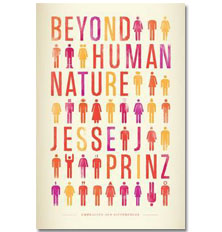
Jesse J. Prinz is the Distinguished Professor of Philosophy at the City University of New York and an Adjunct Professor of Philosophy at the University of North Carolina. His academic specialism is the philosophy of psychology, and he has produced books and articles on emotion, moral psychology, aesthetics and consciousness. His latest book, Beyond Human Nature: How Culture and Experience Shape Our Lives, was published earlier this year. Like much of his previous work, this new book is an attack on “psychological nativism.” Prinz (who is Jewish) claims that his latest book “concerns the cultural impact on human variation” and is part “of a critique of approaches that oversell the role of biology.”[i] The Jewish ethno-political agenda behind this critique soon becomes clear when the author acknowledges his “intellectual heroes who hover silently in the background. I mention here Franz Boas, whose pioneering work in anthropology has been an inspiration to many who try to establish universal human dignity through the study of diversity.”[ii]
In arguing for the primacy of nurture over nature, Prinz devotes a significant part of his book to attempting to explain why measured racial differences in IQ can be ascribed to environmental rather than genetic factors. He believes that “The IQ controversy is an extreme example of a more general tendency to explain human abilities by appeal to biology,” and regards it as “a particularly egregious case because it legitimates biases against many subjugated groups and mistakes social injustice for biological necessity.”[iii] For Prinz “one of the great tragedies of IQ testing is that researchers have used their results to argue fallaciously that certain groups of people differ in intelligence.”[iv] Introducing his case for an environmental explanation for racial differences in IQ, he notes that
everyone agrees that intelligence can be affected by the genes. The fact that humans are smarter than dogs is clearly a consequence of our biology. Everyone also agrees that differences in human intelligence can be genetic. Some people can be congenitally retarded, and extreme forms of genius are likely to be genetically based as well. But what about the vast majority of us who lie somewhere between Einstein and Tweedledumb [note the standard invocation of the Jewish Einstein as the quintessence of human genius]. Genius and retardation are rare conditions, which may result from genetic mutations. Are the differences between people who fall in the normal range distinguished by the genes? Is the run-of-the-mill dullard biologically different from a garden variety whiz-kid? And if so, are those biological differences fixed, or might they be altered by experience? These questions become even more heated when we turn from individual differences to differences between groups.
Do biological differences in brain power come pre-packaged with biological differences in pigmentation? These are touchy topics, and naturists have felt considerable heat for defending positions that are politically incorrect. I don’t think we should let politics arbitrate in this case, however. I think naturists simply get the science wrong. While some differences in intelligence may be linked to biology, most people have pretty comparable biological endowments. If we want to find an explanation for group-wide social inequity, then we would be better off studying the negative effects of poverty, and the positive effects of cultural practices that encourage learning.[v] Read more